


 Apple Podcasts
 Spotify
 Youtube Music
 Spreaker
 Podchaser
 Amazon Music
 From Pilot to Production: Building Enterprise AI That Actually Delivers with Leon Gordon [MVP]
![From Pilot to Production: Building Enterprise AI That Actually Delivers with Leon Gordon [MVP]](https://d3wo5wojvuv7l.cloudfront.net/t_rss_itunes_square_1400/images.spreaker.com/original/f04ab30e9c69ef98ed717f9b70e97215.jpg "From Pilot to Production: Building Enterprise AI That Actually Delivers with Leon Gordon [MVP]")
Building Enterprise AI plays a vital role in driving business value. However, many organizations struggle to transition from pilot projects to full-scale implementations. Common challenges include inadequate infrastructure, data issues, and a lack of change management. You need to establish clear success metrics to measure progress effectively. Research shows that 72% of enterprises are measuring the ROI of Generative AI, highlighting the importance of focusing on measurable outcomes. Additionally, strong governance practices are essential to ensure that your AI initiatives deliver real results.
Key Takeaways
- Enterprise AI drives business value by improving processes and efficiency.
- Identify clear business needs before implementing AI to ensure alignment with goals.
- Strong governance is essential for successful AI projects, ensuring compliance and risk management.
- Use tools like Microsoft Fabric to integrate AI with existing systems effectively.
- Focus on measurable outcomes to track the success of your AI initiatives.
- Overcome common challenges by investing in data quality and fostering collaboration.
- Engage leadership and stakeholders to gain support for AI projects.
- Learn from both successes and failures to refine your AI strategies.
Defining Enterprise AI
What is Enterprise AI?
Enterprise AI refers to a category of software designed specifically for large organizations. It utilizes advanced AI techniques, such as machine learning and natural language processing, to drive digital transformation. This technology addresses high-value use cases at scale, improving business processes and operational efficiency.
Here’s a quick overview of how industry experts define enterprise AI:
| Definition of Enterprise AI | Description |
|---|---|
| Category of Software | Enterprise AI is a category of enterprise software that utilizes advanced AI techniques, including machine learning. |
| Purpose | It drives digital transformation within large organizations. |
| Focus | Addresses specific high-value use cases at scale, improving business processes and operational efficiency. |
Unlike traditional AI solutions, enterprise AI is designed to manage extensive datasets and workloads. It integrates deeply with existing systems like ERP and CRM, ensuring that your AI initiatives align with your organization's goals.
Key Characteristics of Enterprise AI
Enterprise AI possesses several key characteristics that make it suitable for business-critical operations. Understanding these traits can help you leverage AI effectively within your organization.
| Characteristic | Description |
|---|---|
| Scalability | The ability to process large volumes of data and manage increasing workloads without compromising performance. |
| Security | Ensuring data integrity and protection against breaches through advanced encryption and security protocols. |
| Reliability | Providing consistent and accurate outputs, minimizing errors, and ensuring high availability. |
| Interoperability | Seamlessly integrating with existing IT infrastructure and other enterprise applications. |
AI delivers the greatest operational value when it integrates directly into the systems your teams already use each day. This integration prevents AI from becoming an isolated tool, allowing it to enhance productivity across the board.
Data governance is also crucial. It ensures that the information fueling AI is accurate, ethical, and compliant with evolving global standards. Modern enterprises adopt federated governance frameworks, balancing control and agility to maintain data integrity without hindering innovation.
By understanding what enterprise AI is and its key characteristics, you can better position your organization to harness its full potential.
Building Enterprise AI: Current Landscape
Trends in Enterprise AI
The landscape of enterprise AI is rapidly evolving. Organizations are increasingly recognizing the potential of AI to transform their operations. Here are some notable trends shaping the current environment:
- Rise of Generative AI in Enterprises: Companies are leveraging generative AI to create content, automate processes, and enhance customer interactions.
- AI-Powered Decision Intelligence: Businesses are using AI to analyze data and make informed decisions, improving efficiency and effectiveness.
- Hyperautomation Across Business Functions: Organizations are automating complex processes across various departments, leading to significant productivity gains.
- Industry-Specific AI Solutions: Tailored AI applications are emerging to address unique challenges in sectors like healthcare, finance, and manufacturing.
Recent statistics highlight the growing momentum in AI adoption:
| Trend Description | Percentage |
|---|---|
| AI in production (2021) | 42% |
| Organizations with separate AI infrastructure purchasing strategy | 66% |
| Organizations using containerized environments for ML production | 68% |
| Enterprises planning to increase AI spending | 82% |
| Organizations expecting increased data usage for AI models | 79% |
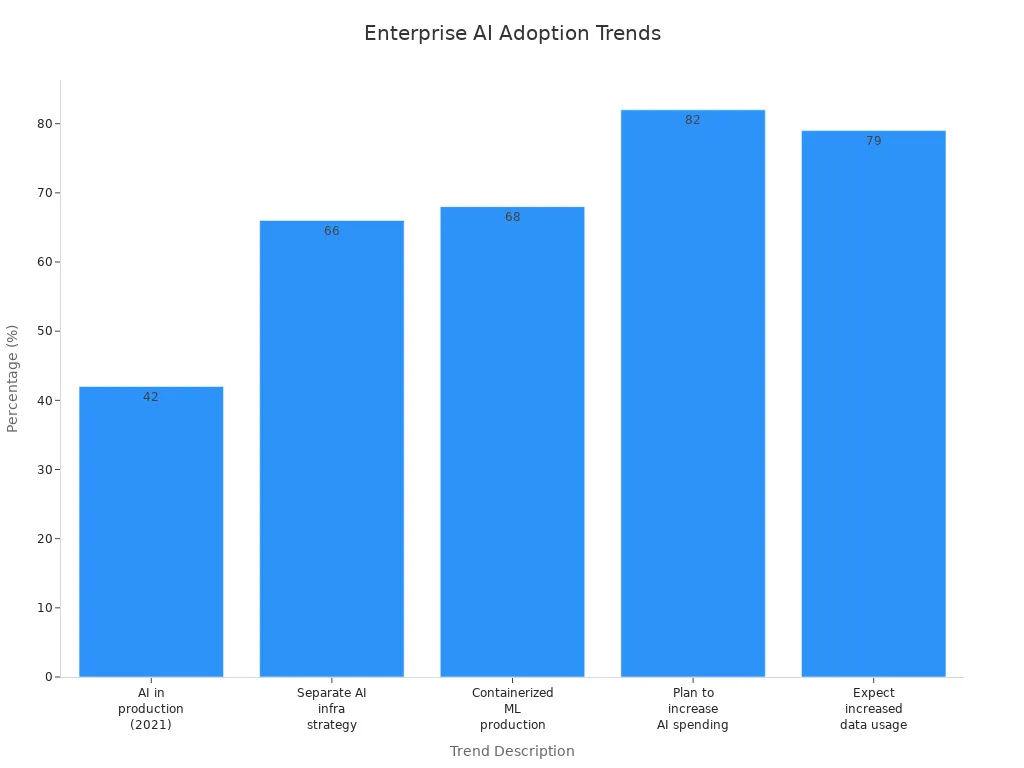
These trends indicate a shift from planning to production stages in AI adoption. The public cloud has become the dominant venue for AI workloads, and container usage for machine learning production is on the rise. The COVID-19 pandemic has further accelerated investments in AI infrastructure, pushing organizations to adapt quickly.
Urgency for AI Adoption
The urgency for AI adoption has intensified over the past five years, especially among Fortune 500 companies. Organizations now recognize that AI is not just a competitive advantage; it is essential for survival in today's market.
Recent data shows significant increases in demand for specific roles related to AI:
| Role Type | Increase in Demand (%) |
|---|---|
| AI Governance and Model Risk | 81 |
| Cost Optimization and Margin Roles | 77 |
As Draup CEO Vijay Swaminathan noted, "Skills are expanding, roles are consolidating and operators of AI are in demand." This statement reflects the growing need for skilled professionals who can navigate the complexities of AI implementation and governance.
Building Enterprise AI Steps
Identifying Business Needs
To build enterprise AI that delivers results, you must first identify your business needs. This step is crucial for ensuring that your AI initiatives align with your organization's goals. Here are some effective strategies to help you pinpoint these needs:
- Lay the foundation: Prepare your organization by educating leadership and defining a clear AI vision that aligns with long-term business goals.
- Identify use cases that matter: Focus on AI initiatives that directly support strategic goals. Look for friction points in your processes and ensure your data is ready for AI applications.
- Evaluate and de-risk: Review potential use cases to balance ambition with feasibility. Ensure they deliver measurable results tied to your business priorities.
You should also consider the significance of buy-in from the board and C-suite. Their support is crucial for project success. AI initiatives should target high-priority business outcomes to avoid developing AI for its own sake.
Different sectors have unique business needs that enterprise AI can address effectively. The following table summarizes some common needs across various industries:
| Sector | Business Needs Addressed |
|---|---|
| Finance | Advanced fraud detection systems and robo-advisors improve efficiency and security. |
| Healthcare | AI enhances diagnostic accuracy, personalizes medicine, and improves treatment outcomes. |
| Manufacturing | AI boosts production efficiency, minimizes downtime with predictive maintenance, and improves sustainability. |
Tools for Building Enterprise AI
Selecting the right tools is essential for building enterprise AI. These tools should integrate seamlessly with your existing systems while providing robust governance and compliance features. Here are some key tools to consider:
Microsoft Fabric Overview
Microsoft Fabric stands out as a unified data platform that simplifies the architecture needed for enterprise AI. It integrates data engineering, analytics, AI, and application development into a single ecosystem. This integration allows you to accelerate AI adoption while ensuring data quality and governance. Key features of Microsoft Fabric include:
- Deep integration with core business systems
- Built-in enterprise AI governance, auditability, and compliance
- Reliable knowledge access with enterprise + agentic RAG
- Scalability without re-engineering
- Faster deployment and lower operational overhead
- Stronger security posture and automated risk management
By leveraging Microsoft Fabric, you can create a structured path toward production-ready AI, ensuring that your investments yield tangible business outcomes.
Other Essential Tools
In addition to Microsoft Fabric, several other tools can enhance your enterprise AI initiatives. Consider the following:
- APIs: Use APIs to connect legacy systems to AI capabilities, ensuring standardized communication.
- Middleware: Implement middleware to facilitate understanding between legacy systems and AI components.
- Data Lakes: Consolidate data into a unified data lake to provide comprehensive datasets for AI analysis.
- Real-Time Processing: Aim for real-time data processing to enhance the accuracy of AI predictions.
These tools will help you integrate AI solutions effectively into your existing IT infrastructure, ensuring that you maximize the benefits of your AI initiatives.
Governance in Enterprise AI

Importance of Governance
Governance plays a crucial role in ensuring successful enterprise AI deployment. It establishes the framework that guides your AI initiatives, ensuring they align with organizational goals and ethical standards. Here are some key reasons why governance is essential:
- Performance Metrics: You need to track the accuracy, efficiency, and reliability of your AI systems. This helps you understand how well your AI initiatives perform.
- Anomaly Detection: Automated systems can spot unusual patterns that may indicate issues. This proactive approach allows you to address problems before they escalate.
- Audit Trails: Maintaining detailed records of AI activities enables you to trace and rectify problems effectively.
| Governance Component | Description |
|---|---|
| AI Principles | High-level statements on fairness, transparency, and accountability. |
| AI Standards | Technical and operational requirements for data handling and model documentation. |
| Procedures | Step-by-step instructions for use-case intake and risk assessment. |
Effective governance ensures compliance with regulations and manages risks associated with AI technologies. It also emphasizes the importance of dynamic guidance as new tools and use cases emerge. Without proper governance, you expose your organization to reputational, regulatory, and legal risks.
Strategies for Effective Governance
Implementing effective governance in enterprise AI projects requires a structured approach. Here are some strategies that have proven successful:
- Align AI Initiatives with Organizational Vision: Ensure your AI projects contribute to long-term goals. This alignment fosters support from leadership and stakeholders.
- Foster Cross-Departmental Engagement: Integrate diverse insights into AI governance. Collaboration across departments enhances the effectiveness of your governance framework.
- Establish Clear Governance Policies: Develop policies and workflows that address the full AI lifecycle. This clarity helps your teams understand their roles and responsibilities.
To further strengthen your governance framework, consider these steps:
- Build a comprehensive ethics curriculum that emphasizes core AI values.
- Launch certification programs to confirm employees' understanding of AI ethics.
- Implement ongoing educational opportunities to keep employees informed about AI governance.
By embedding governance across every stage of the AI lifecycle, you ensure that your AI initiatives remain ethical and compliant. This proactive approach not only mitigates risks but also enhances the overall effectiveness of your AI systems.
Real-World Applications of Enterprise AI

Successful Case Studies
Many organizations have successfully implemented enterprise AI, demonstrating its potential to deliver measurable business outcomes. Here are some notable case studies that highlight the effectiveness of AI in various industries:
| Company | AI Application | Measurable Outcomes |
|---|---|---|
| Walmart | Smarter Supply Chains | Saved $75 million in a year; reduced CO₂ emissions by 72 million pounds. |
| BMW | Quality Control | Achieved a 60% reduction in vehicle defects; cut implementation time for quality checks by two-thirds. |
| JPMorgan Chase | Automating Legal Work | Saved the equivalent of 360,000 staff hours annually; increased speed and accuracy in document processing. |
| CarMax | Scaling Content with Generative AI | Summarized 100,000 reviews into 5,000 highlights; reduced manual work time from 11 years to months. |
| Shell | Predictive Maintenance | Monitored over 10,000 assets; processed 20 billion sensor readings weekly, producing 15 million predictions daily. |
These real-world use cases show how AI can transform operations and drive significant savings. The success of these projects often stems from several key factors:
- Clear Business Objective: A well-defined problem or goal ensures the AI solution delivers real value.
- Quality Data and the Right Tools: High-quality data and appropriate AI tools are critical for success.
- Stakeholder Buy-In and Training: Engaging users and providing training is essential for adoption.
- Iterative Implementation: Starting with pilot projects and refining solutions over time leads to better outcomes.
Lessons from Failures
Despite the successes, many enterprise AI projects fail. Understanding these failures can help you avoid common pitfalls. Here are some frequent reasons for project failures:
- Leadership expectations often misalign with project goals, leading to confusion about success metrics.
- Poor data quality and unbalanced datasets hinder effective AI model performance.
- A shortage of skilled personnel creates challenges in executing AI projects successfully.
- Resistance to change and lack of user adoption can render technology ineffective, regardless of its capabilities.
According to a survey by Gartner, over 80% of AI projects fail, which is twice the failure rate of non-AI IT projects. Only 48% of AI projects make it into production, taking an average of 8 months from prototype to production.
To learn from these failures, consider these lessons:
- Most enterprise AI pilots fail for non-technical reasons: no clear business metric, poor data readiness, weak change management, and scope that is too broad.
- Deploying an AI platform before cleaning your data can lead to significant losses.
- Buying a generic AI assistant instead of building for specific workflows can result in wasted resources.
- Skipping the change management layer is a common pitfall, with 70% of AI projects failing due to lack of employee adoption.
By recognizing these challenges, you can better prepare your organization for successful AI implementation.
Challenges in Building Enterprise AI
Common Obstacles
Building enterprise AI systems comes with several challenges. You may encounter various obstacles that can hinder your progress. Here are some of the most frequently reported issues:
- Complexity of AI Models: Approximately 35% of Chief AI Officers (CAIOs) identify the complexity of building, integrating, and managing AI models as a primary barrier to adoption.
- Cross-Border Data Restrictions: Nearly 60% of AI leaders report that cross-border data restrictions pose significant challenges. These regulations can limit your ability to access and utilize data effectively.
- Integration Complexity: More than half of organizations cite integration complexity as their leading challenge in developing enterprise AI systems. Large organizations often struggle to integrate AI with existing systems due to diverse software applications and their unique requirements.
- Cultural Resistance: Resistance to change within organizations can impede the adoption of AI technologies. Employees may feel threatened by new technologies or unsure about how to adapt.
These obstacles can create significant roadblocks in your journey toward successful AI implementation.
Overcoming Implementation Challenges
To navigate these challenges, you need effective strategies. Here are some approaches that can help you overcome implementation hurdles in enterprise AI projects:
- Develop a Comprehensive AI Strategy: Align your AI initiatives with business objectives. This alignment ensures that your projects support your organization's goals.
- Invest in Data Governance: Ensure clean, accessible data. Poor data quality can lead to unreliable AI outputs, so prioritize data management.
- Leverage Secure Scalable Platforms: Use platforms that can grow with your needs. This flexibility allows you to adapt as your AI initiatives evolve.
- Foster Cross-Functional Collaboration: Encourage collaboration between IT and business teams. This teamwork enhances the effectiveness of your AI governance framework.
- Implement Explainable AI: Build trust and ensure compliance by using explainable AI frameworks. Transparency in AI decision-making can alleviate concerns among stakeholders.
Organizations often face significant challenges in integrating AI due to fragmented data access and security requirements. Data silos create incomplete datasets, leading to poorly trained AI models and unreliable forecasts. To overcome these issues, establish a unified data layer that facilitates seamless data access across various systems. This approach ensures that AI can operate on complete and accurate information.
By addressing these challenges proactively, you can create a more effective environment for your enterprise AI initiatives.
Building enterprise AI requires a structured approach to ensure success. You must align your AI initiatives with your business goals. This alignment helps tackle real needs, such as improving customer experience or reducing costs.
Consider leveraging tools like Microsoft Fabric, which 70% of Fortune 500 companies use. This platform enhances AI deployment through real-time intelligence, automation, and user-friendly features.
Moreover, prioritize governance. Structured governance establishes clarity and accountability, essential for responsible innovation. It helps you manage risks and comply with regulations, ensuring your AI projects deliver measurable business value.
| Component | Description |
|---|---|
| Alignment with Business Goals | Ensure your AI strategy supports your company’s vision and strategic priorities. |
| Use Case Roadmap | Identify and prioritize high-impact AI use cases based on feasibility and ROI. |
| Governance and Risk Management | Establish policies for responsible AI use, covering data privacy and compliance. |
By focusing on these elements, you can navigate the complexities of AI and unlock its potential for the future of work.
FAQ
What is enterprise AI?
Enterprise AI refers to artificial intelligence solutions designed for large organizations. These solutions enhance business processes, improve operational efficiency, and drive digital transformation.
Why is governance important in enterprise AI?
Governance ensures that your AI initiatives align with ethical standards and organizational goals. It helps manage risks, maintain data quality, and ensure compliance with regulations.
How can I identify suitable use cases for AI?
Start by assessing your organization's strategic goals. Look for areas where AI can address pain points, improve efficiency, or enhance customer experiences.
What tools are essential for building enterprise AI?
Key tools include Microsoft Fabric for data integration and governance, APIs for connecting systems, and data lakes for consolidating information. These tools support effective AI implementation.
How do I measure the success of my AI initiatives?
Establish clear success metrics tied to business objectives. Track performance indicators such as accuracy, efficiency, and ROI to evaluate the impact of your AI projects.
What are common challenges in implementing enterprise AI?
Common challenges include data quality issues, integration complexity, cultural resistance, and the need for skilled personnel. Addressing these obstacles is crucial for successful implementation.
How can I overcome resistance to AI adoption?
Foster a culture of collaboration and education. Engage employees by demonstrating the benefits of AI and providing training to help them adapt to new technologies.
What role does data quality play in AI success?
High-quality data is essential for effective AI models. Poor data quality can lead to
Official Microsoft MVP profile: Leon Gordon on Microsoft MVP
🚀 Want to be part of m365.fm?
Then stop just listening… and start showing up.
👉 Connect with me on LinkedIn and let’s make something happen:
- 🎙️ Be a podcast guest and share your story
- 🎧 Host your own episode (yes, seriously)
- 💡 Pitch topics the community actually wants to hear
- 🌍 Build your personal brand in the Microsoft 365 space
This isn’t just a podcast — it’s a platform for people who take action.
🔥 Most people wait. The best ones don’t.
👉 Connect with me on LinkedIn and send me a message:
"I want in"
Let’s build something awesome 👊
1
00:00:00,000 --> 00:00:05,400
Yeah, hello everybody, and welcome back to EM 365 and podcast.
2
00:00:05,400 --> 00:00:13,400
Today's guest is someone who has spent more than 15 years helping organization turn ambitious data strategies into measurable business outcomes.
3
00:00:13,400 --> 00:00:22,600
He is the five time Microsoft MVP founder of Onik State, a creator of the top tap ops governance platform for technology council member,
4
00:00:22,600 --> 00:00:38,600
Oxford site, AI, Aluminum, Alpha, international speaker, and one of the leading voices on Microsoft fabric governance and enterprise AI adoption rather focused on AI demos that never leave the lab.
5
00:00:38,600 --> 00:00:49,600
His work focused on the what happened after the excitement being organizations moved from pilots to production through governance, Microsoft fabric, Microsoft P.O.
6
00:00:49,600 --> 00:01:02,600
is the Monday modeling and measured Roy. He is the creator of the concept, no, as the pilot text highlighting why so many AI initiatives fail before they ever deliver real business value.
7
00:01:02,600 --> 00:01:07,600
Leon, it's a pleasure to have you on the EM 365 podcast. Will I come to the show?
8
00:01:07,600 --> 00:01:16,600
Oh, fantastic, Mercco. Thank you very much for having me. It's a pleasure to be here. And that introduction has just reminded me how, how much help is the I am?
9
00:01:16,600 --> 00:01:26,600
Yeah, I don't hold, I don't think we've got. No, not at all. Thank you for going through that. What a mouthful to try and get through. So thank you.
10
00:01:26,600 --> 00:01:34,600
They are for I don't think it's not so much people much for listening to you for the first time. Who is Leon Gordon?
11
00:01:34,600 --> 00:01:55,600
So I mean, just to give you some context and I guess about me, so I own and operate a Microsoft fabric consultancy called on X data, whereby we have a team of Microsoft MVPs that really support organizations to implement fabric, but also to give that governed environment for them to go and then adopt a value from
12
00:01:55,600 --> 00:02:05,600
the technologies in the artificial intelligence realm on top of that specifically focused on Microsoft technologies, but we're also a data bricks and snowflake partner as well.
13
00:02:05,600 --> 00:02:20,600
I guess the question was more who who is Leon Gordon. So if I give you a bit about my history, it might form a little bit about who I am today. So something that people tend to find quite interesting is that I didn't go to traditional route into
14
00:02:20,600 --> 00:02:40,600
analytics or into artificial intelligence. I actually left school at the GCSE level in United Kingdom to go straight into a football scholarship, which led to me being a footballer until I was around about 18 or 19, which means I didn't go to traditional university route as much of my peers and colleagues.
15
00:02:40,600 --> 00:03:09,600
So what that meant is that I ended up starting from what I would call fairly close to the bottom of the engineering or data analytics stack really doing data entry and then working my way up through Microsoft technologies, starting with T SQL, SAS, so that's analysis services SSIS, which is integration services SSRS reporting services before landing in power be I and then going on to machine learning and artificial implementation.
16
00:03:09,600 --> 00:03:24,600
So very much on the job experience and being self taught throughout my whole career, and then I've gone on to utilize this to build communities of like minded people and to give those people the opportunities that I didn't have as well coming through the industry.
17
00:03:24,600 --> 00:03:32,600
Was there one project that completely changed your change how you think about enterprise data?
18
00:03:32,600 --> 00:03:52,600
Yeah, absolutely. So I had the joy of delivering a Microsoft customer success story. So Microsoft deemed this project that we delivered to be good enough to actually be demonstrated by them as a customer success story and also featured at both build and ignite that year as well.
19
00:03:52,600 --> 00:04:14,600
It was not only a proud moment for me, but we also delivered this as one of the first and largest implementations of fabric in the UAE, so United Arab Emirates and also utilizing space X data as part of that implementation alongside an organization called Elkham and a friend and colleague Jimmy Grew
20
00:04:14,600 --> 00:04:28,600
and they had a managing director who we were able to work alongside with that project. That was very much a real time intelligence project delivered with a very small team of developers and also delivered fully remotely as well.
21
00:04:28,600 --> 00:04:41,600
So with those constraints and variables, it's very much a proud moment for me and Merco as I'm sure you can imagine with that type of development environment with that newer technology as well.
22
00:04:41,600 --> 00:04:45,600
There were lots of experiences and obstacles to overcome as part of that delivery.
23
00:04:45,600 --> 00:05:00,600
Yeah, that's, yeah, the space X all of the interesting. Yeah, you often say something like enterprise AI is where ambitious go to die. What did you mean by that?
24
00:05:00,600 --> 00:05:10,600
So I think especially over the course of the last couple of years with the gen AI kind of I don't know if you can wrap gen AI up in whatever you want to call it the boom, the bubble, the hype.
25
00:05:10,600 --> 00:05:13,600
However, you want to kind of wrap it up.
26
00:05:13,600 --> 00:05:31,600
So lots of organizations have gen AI ambition, but lots of them are also just tick-bock exercises where approve of concept or proof of value never actually leaves the sandbox and just ends up cause costing a lot of money without actually delivering any any value.
27
00:05:31,600 --> 00:05:37,600
while just noting that we've seen a plethora of what I would call traditional artificial intelligence
28
00:05:37,600 --> 00:05:43,280
implementation so the more traditional machine learning implementations that have have gone onto
29
00:05:43,280 --> 00:05:51,280
the liver, high value and a pretty much very war battle tested in today's day and age. What i'm
30
00:05:51,280 --> 00:05:57,200
specifically referring to here is more the gen AI technologies. Now the reason that I've filled
31
00:05:57,200 --> 00:06:03,840
this way about it is it's not just myself, I believe MIT did a study in 2025 that suggested
32
00:06:03,840 --> 00:06:12,080
that only 1% of gen AI implementations actually go onto to hit production. Now there's many reasons
33
00:06:12,080 --> 00:06:17,680
for this. The vast majority of it comes down to actually not leading with value first, understanding
34
00:06:17,680 --> 00:06:24,480
what the return investment is and what the outcome you're trying to deliver is and secondly,
35
00:06:24,480 --> 00:06:31,120
how you're doing that in a governed and fit for a gen TKI environment. So is your data up to
36
00:06:31,120 --> 00:06:36,480
scratch and I'll leave that very, very vague and very broad but that's a good way to at least get
37
00:06:36,480 --> 00:06:47,600
started on what I mean there. I think a lot of companies struggle with this but there's one
38
00:06:47,600 --> 00:06:53,920
part there and they struggle because it's yeah it's cost-intensive but others investing millions.
39
00:06:53,920 --> 00:07:02,480
Why did they struggle if they put so many money in it? Multiple reasons I think we've had some
40
00:07:02,480 --> 00:07:08,000
famous stories. McDonald's is probably one of the largest, at least, social media perspective that
41
00:07:08,000 --> 00:07:16,880
comes to mind whereby they trialed and generative AI on their drive-through, take out kind of checkpoints
42
00:07:16,880 --> 00:07:23,200
and people were able to spoof these agents into being able to order thousands of nuggets for example
43
00:07:23,200 --> 00:07:29,680
and similar scenarios have been utilized on large organizations again their company or their
44
00:07:29,680 --> 00:07:36,000
public facing website chatbots where people have been able to utilize them for for free inference
45
00:07:36,000 --> 00:07:40,240
shall we say and being able to use their chatbots as large language models for all intents and
46
00:07:40,240 --> 00:07:47,440
purposes. Now at least those public facing stories come back to one point which is governance,
47
00:07:47,440 --> 00:07:54,640
quality acceptance testing and ensuring that the tool is for purpose against all edge cases
48
00:07:54,640 --> 00:08:00,720
but typically this comes back to that rush for implementation. The rush to try to deliver that
49
00:08:00,720 --> 00:08:08,960
gen AI tick box for boards etc rather than actually stopping to think why do we need this? Do we have
50
00:08:08,960 --> 00:08:14,240
the infrastructure and platform to be able to support this and what does this look like in three,
51
00:08:14,240 --> 00:08:24,000
six, twelve months time as the technology continues to evolve as well? And how figured your pilot
52
00:08:24,000 --> 00:08:32,400
tax concept in this? Oh absolutely. I mean we believe in doing or at least starting with proof of
53
00:08:32,400 --> 00:08:41,200
values and these are fairly small to medium sized projects which set out to prove the
54
00:08:41,200 --> 00:08:48,240
the kind of the thinking behind is in the title right they're set out to prove value okay so taking
55
00:08:48,240 --> 00:08:55,040
a business use case identifying key strategic areas and business metrics that we can prove value
56
00:08:55,040 --> 00:09:02,880
against, costing that out again looking at all edge cases etc and then proving this out in a small
57
00:09:02,880 --> 00:09:08,160
to medium size before then being able to go ahead and forecast scale for the business
58
00:09:08,160 --> 00:09:13,200
once you go ahead and productionize that. Now the reason that we put together this framework
59
00:09:13,200 --> 00:09:19,840
and methodology is because so many organizations again referring to the MIT stat earlier
60
00:09:19,840 --> 00:09:27,200
so many organizations, 99% of organizations in the last 24 months of so have not being able to
61
00:09:27,200 --> 00:09:32,480
get out of that proof of concept or pilot environment and that's exactly the framework that we've
62
00:09:32,480 --> 00:09:40,800
been able to use to overcome that. Did you see warning things that then AI initiative is failing?
63
00:09:40,800 --> 00:09:49,200
Yeah absolutely so I guess with that it's lack of trust by the business as well is it plays a
64
00:09:49,200 --> 00:09:57,120
big part in it? How can we ensure that what we're being told is accurate there won't be any hallucinations
65
00:09:57,120 --> 00:10:04,000
at all and to be honest we've actually put together an anti hallucination framework to circumnappigate
66
00:10:04,000 --> 00:10:11,600
this as well to actually give organizations that trust in the information that they're being told
67
00:10:11,600 --> 00:10:17,280
by the large language model is being accurate and then making this very verifiable all the way down
68
00:10:17,280 --> 00:10:24,080
to that minute row of data in your lake house or data warehouse environment as well so these are
69
00:10:24,080 --> 00:10:29,280
some of the areas that we've been able to highlight that really stop organizations being able to
70
00:10:29,280 --> 00:10:35,520
productionize that value and there's lots of other areas again and strategically we've been able
71
00:10:35,520 --> 00:10:41,920
to reverse engineer this and be able to lead with a framework that actually enables organizations
72
00:10:41,920 --> 00:10:50,240
to be able to take small steps in a quick period of time to showcase value against needed
73
00:10:50,240 --> 00:10:57,200
business use cases and then be able to have a proven route to production governed and secure
74
00:10:57,200 --> 00:11:06,240
GNI in their environment on their data hallucination free. It's technology usually a problem or
75
00:11:06,240 --> 00:11:13,840
something else and really no combination and so generally some of it's down to culture and technology
76
00:11:13,840 --> 00:11:20,160
lots of organizations to be blunt don't have this capability internally which is why they look to
77
00:11:20,160 --> 00:11:25,920
a third party like ourselves to be able to come in not only just implement this technology but to
78
00:11:25,920 --> 00:11:32,880
also to take their team on this journey so on its data we actually have something called the onix
79
00:11:32,880 --> 00:11:41,040
Academy where by our clients teams are trained on these technologies up skill to be able to then be
80
00:11:41,040 --> 00:11:46,320
a center of excellence internally and to go on and be champions of these technologies and be
81
00:11:46,320 --> 00:11:51,120
able to go and train others internally as well and that's something that we're quite proud of.
82
00:11:51,120 --> 00:11:58,000
Outside of that we've seen organizations rush towards data maturity for anybody that's been
83
00:11:58,000 --> 00:12:06,800
involved in the data space, data quality, data governance etc have all been very tiring conversations
84
00:12:06,800 --> 00:12:13,280
in hard-worn battles with boards and heads of over the past few years. Now it's one of the first
85
00:12:13,280 --> 00:12:19,440
items on any agenda for these types of implementation so that just shows you where data culture is gone
86
00:12:19,440 --> 00:12:26,880
or is led to at least within the last five years or so and you're also really famous for all your
87
00:12:26,880 --> 00:12:33,360
Microsoft fabric topic. Why has Microsoft fabric become such an important platform?
88
00:12:33,360 --> 00:12:41,200
What a platform to begin with, what a concept so could us to Saty and Adela and the whole team
89
00:12:41,200 --> 00:12:46,720
involved in Microsoft fabric as a platform first and foremost and let's be brutally honest it's
90
00:12:46,720 --> 00:12:53,760
not without scrutiny as any new bleeding edge technology and forward-thinking concept that we're
91
00:12:53,760 --> 00:12:59,840
not going to get everything right day day zero but it's an ongoing journey. Now the great point about
92
00:12:59,840 --> 00:13:04,720
Microsoft fabric for organizations, well there's a couple of great points actually so let me expand
93
00:13:04,720 --> 00:13:13,680
on this a little bit. The first great point is it's a single unified solution of what was previously
94
00:13:13,680 --> 00:13:20,480
disparate technology so you're now bringing your pipelines, your notebooks, your data science, your
95
00:13:20,480 --> 00:13:26,560
visualization, your semantic modeling, etc. Now your agentech framework, real-time intelligence
96
00:13:26,560 --> 00:13:33,120
and even now application development with fabric apps and rafin all together into a single
97
00:13:33,120 --> 00:13:39,680
environment with one single line item for your IT team and your infrastructure team on your monthly
98
00:13:39,680 --> 00:13:46,800
bill which is a huge a huge win. There's not only cuts down on complexity in being able to spin up
99
00:13:46,800 --> 00:13:51,920
these environments and time to make all of these different components talk to each other and
100
00:13:51,920 --> 00:13:58,880
but also simplifies billing. Now what that also brings to the forefront typically in a data and
101
00:13:58,880 --> 00:14:04,160
artificial intelligence engineering environment you have people that have varied skill sets
102
00:14:04,160 --> 00:14:11,680
so one way to look at this previously was the t-SQL developer, the Python developer and a data scientist
103
00:14:11,680 --> 00:14:17,920
okay each of those potentially using different languages or different scripts so the t-SQL
104
00:14:17,920 --> 00:14:24,000
developer is using t-SQL, the Python developer is using Python and a data scientist potentially
105
00:14:24,000 --> 00:14:31,520
using r or Python as well then you have the citizen developer who typically is an O-code more low-code
106
00:14:31,520 --> 00:14:40,880
developer. Now what fabric really did fantastically well is introduce the parquet file format and one
107
00:14:40,880 --> 00:14:49,440
lake which is really enabled each of these different personas to be able to come to the same table as
108
00:14:49,440 --> 00:14:56,400
I like to call it and all be able to share the data regardless of what play or cutlery of choice
109
00:14:56,400 --> 00:15:04,400
that they would like to use and that is a fantastic unlock shall we say across various skill sets
110
00:15:04,400 --> 00:15:10,160
within an enterprise organization. Yeah what I've found really interesting is that's the fabric
111
00:15:10,160 --> 00:15:17,200
apps because a lot of people say okay excellent because now we have far more BI and now a lot of
112
00:15:17,200 --> 00:15:22,560
people say power BI of that because we have fabric apps what is this fabric apps and villains
113
00:15:22,560 --> 00:15:29,760
to really kill power BI and X. Who knows is probably the easiest way to look at it but let's look at
114
00:15:29,760 --> 00:15:36,480
what it actually enables as opposed to potentially looking at what the what the future looks like so
115
00:15:37,440 --> 00:15:43,680
the fabric apps and the rafian technologies as support it pretty much brings the application layer
116
00:15:43,680 --> 00:15:49,440
into into fabric so typically when you had your app devs your web devs etc they'd be using as your
117
00:15:49,440 --> 00:15:54,720
technologies. Now they're able to do this given there are a couple of limitations the fact that
118
00:15:54,720 --> 00:15:59,200
it is to improve you we won't go into those but there's plenty of documentation available on what
119
00:15:59,200 --> 00:16:05,440
they are but the goal here is to bring the application layer into fabric and importantly be able
120
00:16:05,440 --> 00:16:11,760
to interact with the rest of the fabric environment so your semantic models for example be able to
121
00:16:11,760 --> 00:16:19,600
be able to process thanks queries etc etc. Now launch members of the data analyst and visualization
122
00:16:19,600 --> 00:16:25,440
community as you mentioned Merco have absolutely looked at this from a power BI perspective how can
123
00:16:25,440 --> 00:16:31,920
we spin up web based apps now and represent data visualizations that enable us to do everything that
124
00:16:31,920 --> 00:16:38,000
we couldn't do previously with the ceiling of power BI and J Park the fellow MVP probably comes
125
00:16:38,000 --> 00:16:44,320
to mind as one of the leaders at the forefront of this AI driven fabric apps implementation
126
00:16:44,320 --> 00:16:51,280
deployment. Now for me personally just to get on to will this remove power BI in the future I will
127
00:16:51,280 --> 00:16:57,920
double down on the fact that who knows potentially potentially not. Now for me one area where I'm
128
00:16:57,920 --> 00:17:03,120
absolutely certain where it won't be removed which is a power BI object or at least it was
129
00:17:03,120 --> 00:17:08,960
natively is the semantic layer the semantic model the tabular engine underneath power BI
130
00:17:08,960 --> 00:17:18,400
that just becomes a more important component and I mentioned this on another panel session very
131
00:17:18,400 --> 00:17:24,480
recently that the semantic model was finally becoming the promo queen shall we say
132
00:17:26,000 --> 00:17:29,920
prom evening and I can only see that getting more integrated as we move forward.
133
00:17:29,920 --> 00:17:40,480
So it's a little bit a mix of of platforms like either power, power apps and tabular edit
134
00:17:40,480 --> 00:17:49,280
runs or how it would. Yeah so I think it's a combination right so if you think down to if you were
135
00:17:49,280 --> 00:17:55,840
a software engineer and you were building applications directly with your technology no JS
136
00:17:56,720 --> 00:18:02,880
react typescript etc Python so on and so forth everything that you've been able to do
137
00:18:02,880 --> 00:18:08,080
previously in those environments you're now able to do directly within fabric so you're absolutely
138
00:18:08,080 --> 00:18:15,040
right this can become a replacement for the likes of power apps for example and it really opens the
139
00:18:15,040 --> 00:18:20,480
lid on the capabilities of what you're able to now do within within fabric it's a huge
140
00:18:20,480 --> 00:18:28,400
walking to a new generation of capabilities not just for data analysts and engineers but also for
141
00:18:28,400 --> 00:18:34,800
software engineers now. Awesome yeah I have to I have to look a little bit more in there.
142
00:18:34,800 --> 00:18:46,080
Did you think or did you see misconceptions organization have what when they look at fabric
143
00:18:46,080 --> 00:18:52,960
or did you something see off? Yeah absolutely so fabric as I've mentioned and pretty much wax
144
00:18:52,960 --> 00:18:58,800
lyrically about a little bit is a fantastic platform it's especially a fantastic platform for
145
00:18:58,800 --> 00:19:07,600
Microsoft native enterprises as well. Now where that we have seen reservations is against let's say
146
00:19:07,600 --> 00:19:13,200
more mature offerings in the market and more cemented offerings in the market the likes of
147
00:19:13,200 --> 00:19:21,920
Databricks and snowflake that have had readily available platforms for a lot longer in regards to time.
148
00:19:21,920 --> 00:19:29,040
Now we have to remember that fabric it's not just the bringing together of components these are
149
00:19:29,040 --> 00:19:35,360
already mature components from an Azure infrastructure perspective they're now being made
150
00:19:35,360 --> 00:19:42,080
available in a single package that can be utilized across the organization so with that comes
151
00:19:42,080 --> 00:19:48,640
some teaving issues and Microsoft have acted really quickly and for those that that where they have been
152
00:19:48,640 --> 00:19:56,160
but this is very much a journey of hardening of a platform that has seen fantastic enhancements
153
00:19:56,160 --> 00:20:01,600
over the course of the last couple of years and as we've seen in recent partner reports etc
154
00:20:01,600 --> 00:20:07,600
has become an industry leader in a very short space of time. Yeah I think a lot of companies have
155
00:20:07,600 --> 00:20:14,160
spent a lot a lot of money for for building their traditional data platforms I don't know
156
00:20:14,160 --> 00:20:21,920
in SQL or something when should companies think about fabric is the right solution for them?
157
00:20:21,920 --> 00:20:32,880
I think whenever you're trialing out a new proof of concept there's probably a good way to look at it
158
00:20:32,880 --> 00:20:40,480
so the the ease of fabric is how easy is to get started with you're able to go ahead
159
00:20:40,480 --> 00:20:46,960
sign in spin up a capacity sizing so let's just say a capacity for those that don't know is the
160
00:20:46,960 --> 00:20:54,720
compute made available for you and this is sized up accordingly in different tiers okay so with
161
00:20:54,720 --> 00:21:02,000
that in mind you can go ahead to to the fabric you can sign in and you can spin up a capacity as low
162
00:21:02,000 --> 00:21:09,920
as an F2 to begin with okay so for a moderately small charge you then have access to all of those
163
00:21:09,920 --> 00:21:15,200
components that I've previously mentioned okay so this means even if you have some small excel
164
00:21:15,200 --> 00:21:21,920
workloads and processes if you have a report that's a legacy report let's say something like crystal
165
00:21:21,920 --> 00:21:30,320
reporting for example or or SAP some legacy SAP objects as well this is a great time to go through
166
00:21:30,320 --> 00:21:36,480
that proof of value okay see where you can have efficiencies typically in the processing of the data
167
00:21:36,480 --> 00:21:43,440
and also being able to make this available from a single point of truth to other areas of the
168
00:21:43,440 --> 00:21:50,080
organization as well so that would be my recommendation if it's something that you're going on a
169
00:21:50,080 --> 00:21:57,840
journey of increasing the size of data in your organization then start small see where fabric
170
00:21:57,840 --> 00:22:03,680
is efficient and and drives value and see where it might not fit your current work processes and then
171
00:22:03,680 --> 00:22:11,120
take an educated step forward based on the outputs of that now if you are already a fully fledged
172
00:22:11,120 --> 00:22:17,520
organization and you're using another cloud provider let's just insert any cloud providers names
173
00:22:17,520 --> 00:22:24,640
there then one of the fantastic areas of fabric is how well they play with other cloud providers now
174
00:22:24,640 --> 00:22:31,280
whether this is the utilization of a technology called mirroring or utilizing shortcuts which enables
175
00:22:31,280 --> 00:22:38,480
you to effectively create a virtual desktop shortcut to another cloud provider and utilize that
176
00:22:38,480 --> 00:22:45,280
data within your fabric environment it's a great opportunity to be able to utilize fabric for
177
00:22:45,280 --> 00:22:50,000
some of those workloads where you wouldn't have previously bought it possible and then bring it into
178
00:22:50,000 --> 00:22:55,600
a native environment where everybody in your organization regardless of their technical ability
179
00:22:55,600 --> 00:23:00,400
can go and start to utilize and drive value with data and artificial intelligence.
180
00:23:00,400 --> 00:23:07,200
When we talk about fabric we most talk about yeah I say the technology
181
00:23:07,200 --> 00:23:12,400
stuff but is it also bring an organizational change?
182
00:23:14,080 --> 00:23:19,680
Yeah I believe so I think that at least in my conversations with lots of enterprise
183
00:23:19,680 --> 00:23:26,400
organizations they're now interested in the ability to do cross-domain charging for example so
184
00:23:26,400 --> 00:23:33,120
historically lots of organizations have had warehouses or lake houses where they haven't been
185
00:23:33,120 --> 00:23:40,400
able to do the traditional finops and split out the charging of the compute etc for various
186
00:23:40,400 --> 00:23:46,880
departments now these capabilities become available within fabric where you can start to have
187
00:23:46,880 --> 00:23:51,440
different domains you can have your marketing domain you could have your finance domain your sales
188
00:23:51,440 --> 00:23:59,360
etc and they can all get charge back which brings a different area or a different concept to
189
00:23:59,360 --> 00:24:03,840
organizations in the fact that sometimes it actually increases what they're able to do because each
190
00:24:03,840 --> 00:24:09,040
of those domains has their own budget set aside for data initiatives and artificial intelligence
191
00:24:09,040 --> 00:24:14,880
initiatives and they can kind of virtually pull this together to bring their environment forward
192
00:24:14,880 --> 00:24:22,800
and Merca we also released a tool called FabOps which does this at scale so it's a governance
193
00:24:22,800 --> 00:24:29,600
and always on kind of command center or lighthouse overview of your whole fabric estate regardless
194
00:24:29,600 --> 00:24:36,080
of how many capacities you have which further enhance the ability to be able to become really
195
00:24:36,080 --> 00:24:41,280
data driven and not have to rely so much on your security and governance teams
196
00:24:41,280 --> 00:24:52,320
yeah I like to talk about governance but one question before a lot of companies say okay
197
00:24:52,320 --> 00:25:01,680
last year's we will become data driven and yeah start was fabric and now the company say we are
198
00:25:02,480 --> 00:25:11,040
we will be AI driven companies what what role does fabric play in in an AI first world
199
00:25:11,040 --> 00:25:16,640
oh you just hit it there on the head and you've taken the words out of my mouth really fabric
200
00:25:16,640 --> 00:25:21,920
in my opinion is becoming an AI first platform Microsoft has done a fantastic job
201
00:25:21,920 --> 00:25:30,160
making data agents available the integration of co-pilot MCP servers increasing the API
202
00:25:30,160 --> 00:25:37,760
and the rest API access across fabric as well the command line tools are amazing as well I would say
203
00:25:37,760 --> 00:25:44,560
Microsoft are doing a great job of preparing fabric to become a leading AI native platform if
204
00:25:44,560 --> 00:25:50,720
it isn't one already just back to your former point as well you're absolutely right lots of
205
00:25:50,720 --> 00:25:57,120
organizations discuss being data driven they discuss being AI driven I still see organizations
206
00:25:57,120 --> 00:26:02,240
I still speak with organizations across the globe in today's day and age they don't have a data
207
00:26:02,240 --> 00:26:09,360
strategy let alone an artificial intelligence strategy as well so there are steps to be taken to
208
00:26:09,360 --> 00:26:15,600
be able to successfully implement these technologies and they're proven paths we just don't see a lot
209
00:26:15,600 --> 00:26:22,640
of organizations either A being aware of those paths or B having the time to actually go and explore
210
00:26:22,640 --> 00:26:28,320
those paths down to down to board pressures etc or they are aware of them but they just can't act
211
00:26:28,320 --> 00:26:35,040
quickly enough as quickly as the technology is in improving this awesome I think
212
00:26:35,040 --> 00:26:42,960
what one topic or my personal problems when I work with companies and we work with fabric is
213
00:26:42,960 --> 00:26:52,320
that the companies often overlink the metadata topic why is it so important topic and
214
00:26:52,800 --> 00:27:00,320
what role do is Microsoft PueView play here and sorry can you just repeat the first bit which topic
215
00:27:00,320 --> 00:27:07,440
in particular yeah I see a lot of companies struggle with their metadata or they don't have metadata
216
00:27:07,440 --> 00:27:18,160
why is this so often overlooked and how can Microsoft PueView help here yeah absolutely so great
217
00:27:18,160 --> 00:27:24,800
question so organizations really don't understand and whether this is from a culture perspective
218
00:27:24,800 --> 00:27:31,280
what metadata means across an organization and how to be able to utilize it okay it's a fairly
219
00:27:31,280 --> 00:27:36,720
new concept especially as organization step into this data and AI world that I kind of call
220
00:27:36,720 --> 00:27:44,000
the era of intelligence okay now with that in mind again you didn't have to become very strategic
221
00:27:44,000 --> 00:27:51,920
in regards to how you not only catalog the metadata but you also ensure that it's regularly updated
222
00:27:51,920 --> 00:27:58,240
you have a steward and it looks after that and then you make this available sometimes just a
223
00:27:58,240 --> 00:28:04,720
just a small audience is within an organization but you ensure that those audiences that need access
224
00:28:04,720 --> 00:28:11,520
to this data to this metadata have access to it now you're absolutely right Microsoft introduced
225
00:28:11,520 --> 00:28:17,360
PueView and specifically for this reason and it's a fantastic tool and to be able to go and take all
226
00:28:17,360 --> 00:28:22,960
of your metadata and master data management quality and governance and wrap it up again into a
227
00:28:22,960 --> 00:28:30,080
single layer which really plays well with other tools in the Microsoft ecosystem like fabric now what
228
00:28:30,080 --> 00:28:36,400
we do tend to find is that some organizations aren't quite ready for the scale are the tool like
229
00:28:36,400 --> 00:28:42,640
like PueView and this is where something I mentioned before something like fab ops steps in as being
230
00:28:42,640 --> 00:28:48,640
that all encompassing data quality and governance tool that helps organizations at that more
231
00:28:48,640 --> 00:28:54,640
small to medium layer be able to still get the benefits of becoming metadata driven tracking data
232
00:28:54,640 --> 00:29:02,240
lineage across your organization so understanding where that data metric or data point in your report
233
00:29:02,240 --> 00:29:07,040
actually tracks back to in your source system and the calculations that are taking part
234
00:29:07,040 --> 00:29:12,880
and also being able to track any changes to that underlying data as well and something that's
235
00:29:12,880 --> 00:29:17,680
become even more prevalent in the last few years as well is how do you actually track who has
236
00:29:17,680 --> 00:29:22,560
access to that data is the access to that data correct and when did that change?
237
00:29:22,560 --> 00:29:28,720
I think another important topic is the the semantic models especially
238
00:29:29,600 --> 00:29:39,440
yeah in data for data projects how the enterprises profit when they will start with a high when
239
00:29:39,440 --> 00:29:46,000
they have good semantic models? Oh it's absolutely as I mentioned earlier it's becoming
240
00:29:46,000 --> 00:29:55,920
probably in my opinion one of the highest priority objects within your data environment to
241
00:29:55,920 --> 00:30:01,760
ensure that you have correct okay now to think about this this is where you hold all of your let's
242
00:30:01,760 --> 00:30:06,640
just talk about traditional kimbal methodology this is where you hold your traditional star schema
243
00:30:06,640 --> 00:30:13,680
so your fact tables your dimension tables and but also most importantly your metrics or your measures
244
00:30:13,680 --> 00:30:19,440
and any context around this so this becomes the feeding ground for your for your
245
00:30:19,440 --> 00:30:26,000
agentech agents to be able to understand your business logic and your data relationships semantic
246
00:30:26,000 --> 00:30:32,640
model the context or descriptions that you provide alongside that data and also be able to
247
00:30:32,640 --> 00:30:39,680
utilize those calculations as well now it's worthwhile noting the Microsoft have also recently
248
00:30:39,680 --> 00:30:48,240
gone into GA with fabric ontologies and fabric IQ as well which also helps support this narrative
249
00:30:48,240 --> 00:30:54,160
as well when sometimes don't always have to rely on your semantic layer as well so now within fabric
250
00:30:54,160 --> 00:30:59,840
you have many roots to actually being able to achieve this intelligence layer for your agents to
251
00:30:59,840 --> 00:31:07,280
work on top of? Yeah well what I also often see is when I work with companies especially in the
252
00:31:07,280 --> 00:31:17,280
in the data field they they really like to have fast the first report in power BI so that's the
253
00:31:17,280 --> 00:31:26,080
goal and if I talk about governance it's often we fix that later but you think that's works?
254
00:31:26,080 --> 00:31:32,960
Never it never works and so at least in the approach that we take with organizations
255
00:31:32,960 --> 00:31:38,560
it's about how you deliver that value quickly and we've had luck I mentioned generally our proof
256
00:31:38,560 --> 00:31:44,720
of value approach is anything as small as four to twelve weeks to actually having governed
257
00:31:44,720 --> 00:31:53,040
the genetic AI reporting directly on a client's data anti hallucination free and correct within
258
00:31:53,040 --> 00:31:58,800
one percent of tolerance as well now how do you do that with the constraints that you've just
259
00:31:58,800 --> 00:32:04,480
mentioned? Okay organizations want to see that end product quickly and like you've mentioned they
260
00:32:04,480 --> 00:32:10,160
don't care too much about the governance aspects or at least not as a phase one deliverable okay
261
00:32:11,040 --> 00:32:19,040
is typically typically how we do this is to bake in governance as part of the whole development
262
00:32:19,040 --> 00:32:26,560
life cycle so how do we get to an end working goal in the quickest possible way? So the organization
263
00:32:26,560 --> 00:32:32,000
can start testing and they can start providing feedback and they have something tangible in front of them
264
00:32:32,000 --> 00:32:37,760
whilst in parallel we are still posing the governance questions and building that a governed
265
00:32:37,760 --> 00:32:45,200
environment alongside that so it's definitely a tight walk or a tight rope should I say to walk
266
00:32:45,200 --> 00:32:50,160
but typically the approach we've used with the on-expring work has enabled us to be able to
267
00:32:50,160 --> 00:32:56,640
deliver both. Yeah what do good governance actually look like from your prospector?
268
00:32:56,640 --> 00:33:01,360
It's a combination of things Mercone to be honest that's probably a whole nother
269
00:33:01,360 --> 00:33:09,040
and podcast session in itself so I'll try to keep it relatively relatively small so we look at this
270
00:33:09,040 --> 00:33:16,400
from a security perspective perspective from a permissions perspective really understanding
271
00:33:16,400 --> 00:33:23,440
where the data comes from any security risks of that data is it PII data for example how much of
272
00:33:23,440 --> 00:33:29,440
it is sensitive is the data shareable across an organization if it's not who should have access
273
00:33:29,440 --> 00:33:35,760
to it who then oversees this process over time when do we have periodic checks to ensure that
274
00:33:35,760 --> 00:33:42,240
this governance is in place what layers do we need to implement this governance in is it just in
275
00:33:42,240 --> 00:33:49,600
the warehouse is it also through object level security, row level security, accesses to workspaces
276
00:33:49,600 --> 00:33:56,000
etc so there's multiple layers to overcome from that perspective so I guess to kind of try to
277
00:33:56,000 --> 00:34:02,400
summarize that you have the data culture layer is the organization geared up to be able to support
278
00:34:02,400 --> 00:34:08,080
governance and do they understand their data who own so you have their ownership and responsibility
279
00:34:08,080 --> 00:34:13,760
layer and then you have the technical implementation layer as well where you look across that whole
280
00:34:13,760 --> 00:34:21,200
architecture and estate and define those governance points and then how you manage and maintain
281
00:34:21,200 --> 00:34:26,480
these standards over time so how you track and how you monitor and ensure this observable
282
00:34:26,480 --> 00:34:32,560
and readily available to the organization as well yeah I think about companies like
283
00:34:32,560 --> 00:34:41,840
they provided governance frameworks and maturity models what did you think about those absolutely
284
00:34:41,840 --> 00:34:47,920
I think that the closer we get to standardization in the in the future is is going to be absolutely
285
00:34:47,920 --> 00:34:54,480
ideal because we typically have like you've just mentioned various different data governance
286
00:34:54,480 --> 00:34:59,680
standards, I'm sure we say and some of these are geographically based as well some of these are
287
00:34:59,680 --> 00:35:05,040
actually industry and domain based and some of these are actually just from organizations themselves
288
00:35:05,040 --> 00:35:10,240
so it would be good in the future to have a standardized framework but I think you hit the
289
00:35:10,240 --> 00:35:16,160
nail on the head when you said the fact that they are using a framework is typically the first point
290
00:35:16,160 --> 00:35:20,960
of getting towards a win as opposed to not having any framework implementation at all
291
00:35:20,960 --> 00:35:30,000
and yeah when we talk about governance especially in fabric you have built fab offs so can you
292
00:35:30,000 --> 00:35:37,520
a little bit explain what problems it's off yeah absolutely so for those the people like myself
293
00:35:37,520 --> 00:35:43,760
and like organizations that we work with that have worked in power BI and now fabric and the joy of
294
00:35:43,760 --> 00:35:48,880
these tools is you're absolutely able to get up and running very quickly a pace and start to
295
00:35:48,880 --> 00:35:56,400
deliver value but it also becomes a bit of a sprawl okay typically when I speak to IT admins or
296
00:35:56,400 --> 00:36:01,920
fabric admins it's very difficult for them to understand what users are doing over in marketing how
297
00:36:01,920 --> 00:36:07,440
they're building their semantic models and reports is that in line with standards set in finance
298
00:36:07,440 --> 00:36:14,240
etc and then as you add multiple capacities to this multiple semantic models reports which then
299
00:36:14,240 --> 00:36:19,440
scale into the hundreds and thousands it becomes this the behalf of that is very difficult to be able
300
00:36:19,440 --> 00:36:27,440
to observe understand and maintain and most importantly to govern and this is absolutely what fab
301
00:36:27,440 --> 00:36:33,760
ops does it's that always on kind of Sentinel in your environment that really is ensuring that
302
00:36:33,760 --> 00:36:38,720
everything adheres the best practice standards it checks to see if there's any outages in your
303
00:36:38,720 --> 00:36:46,160
environment it delivers automated executive quarterly reports monthly managerial reports and daily
304
00:36:46,160 --> 00:36:55,120
snapshots every area that you would like tracked and alerting and performance based guidelines on
305
00:36:55,120 --> 00:37:00,640
is also covered in there and also from a costing perspective as well how much did my lake house cost
306
00:37:00,640 --> 00:37:06,800
me this month how much did marketing's lake house cost them this month so so forth and all in a single
307
00:37:06,800 --> 00:37:15,520
pain of glass in a single platform so it's also fine also I think it's also a topic yeah it's really
308
00:37:15,520 --> 00:37:23,200
interesting because a lot of people are asking about value but but but I think when I think I heard
309
00:37:23,200 --> 00:37:31,920
often from from problems so a lot of companies they built their stacks on Microsoft they say they
310
00:37:31,920 --> 00:37:41,520
cannot use fabric because we cannot different the different cost of different yeah of our clients
311
00:37:41,520 --> 00:37:49,360
that running on the fabric so so can can fab ops also help here yeah absolutely so we actually give
312
00:37:49,360 --> 00:37:54,800
you the option within fab ops to be able to to tag different workloads and different objects
313
00:37:54,800 --> 00:38:00,960
and then attribute them to either a different client or a different department as well and be able
314
00:38:00,960 --> 00:38:08,000
to track the costs against those and so for example at the end of a month you can have the compute
315
00:38:08,000 --> 00:38:12,560
bill for your finance team you can have the compute bill for your marketing team or if you're doing
316
00:38:12,560 --> 00:38:18,640
this by client a client b client c and you can also have those compute bills readily available as well
317
00:38:18,640 --> 00:38:24,800
so you're absolutely correct and fab fab ops also shifts with that pin ops model to it which allows
318
00:38:24,800 --> 00:38:29,680
you to attribute that spend yeah that does does really cool because like off-road companies have
319
00:38:29,680 --> 00:38:38,240
have this this problem and they stayed and not on fabric um what what did you see which governance
320
00:38:38,240 --> 00:38:46,160
matrix more yeah matters most yeah so I guess just to go back to the to the to the previous point one
321
00:38:46,160 --> 00:38:51,440
moment just for listeners out there so um for those of you that are interested in fab ops it is
322
00:38:51,440 --> 00:38:58,320
freely available directly within Microsoft fabric if you go to the workloads tab scroll down until
323
00:38:58,320 --> 00:39:05,680
you see fab ops and you hit um uh install you can free try all fab ops for for seven days and automatically
324
00:39:05,680 --> 00:39:12,000
get a score of your environment as well so I would recommend you all go ahead um and do that
325
00:39:12,000 --> 00:39:18,240
and then morko i hate giving this answer um uh it's it's typically the consulting answer but which
326
00:39:18,240 --> 00:39:24,880
framework to use um it depends and it depends on so many it's the easiest way for me to answer this
327
00:39:24,880 --> 00:39:31,600
question is for you to work with us on x data and to utilize our data governance framework and
328
00:39:31,600 --> 00:39:36,720
allow us to support you in building out one of the works for your organization um but there are so many
329
00:39:37,600 --> 00:39:43,840
different frameworks that fit different um implementations industries and also and geographies as well
330
00:39:43,840 --> 00:39:55,280
um I think another problem I often see it's company states starts with good data quality but yeah
331
00:39:55,280 --> 00:40:02,720
time over time uh yeah it's still getting better uh how do you monitor data quality uh constantly
332
00:40:03,920 --> 00:40:09,360
oh absolutely and again I work with organizations all of the time um that that don't have the
333
00:40:09,360 --> 00:40:15,600
observability in in place especially across their data pipelines their ingestion processes etc
334
00:40:15,600 --> 00:40:20,560
where you're just starting to track so um and you can have different
335
00:40:20,560 --> 00:40:25,680
quality I can't go into details in regards to what quality looks like because it's very much
336
00:40:25,680 --> 00:40:31,760
dependent on that organization it could be um um um the nulls being introduced is a quality
337
00:40:32,560 --> 00:40:39,040
is a quality check it could be a range um from from an integer value um let's say you shouldn't have any
338
00:40:39,040 --> 00:40:45,760
integers within this this uh data set that go above 1000 for example so first and foremost it's about
339
00:40:45,760 --> 00:40:52,400
defining um what quality looks like for that data the tolerance that you're that you're happy to
340
00:40:52,400 --> 00:40:59,920
observe and then how do you not only track that but how do you then display back to the organization
341
00:40:59,920 --> 00:41:07,040
what good looks like and as you've mentioned how do we then handle any anomalies to those rules
342
00:41:07,040 --> 00:41:14,080
so for example um typically in our implementations we will quarantine any data that doesn't fit within
343
00:41:14,080 --> 00:41:21,040
within tolerance it means that we don't stop the load of the data um but we post those anomalies
344
00:41:21,040 --> 00:41:27,120
into a quarantined environment to be checked manually by a human in the loop and then if they need
345
00:41:27,120 --> 00:41:33,920
to be reprocessed then then they can be but again this is a this is a dedicated framework and a pattern
346
00:41:33,920 --> 00:41:40,000
for how to achieve this in an organization the actual rules themselves um really come from working
347
00:41:40,000 --> 00:41:47,520
alongside the organization and the data sets that they're working with. It's interesting um I think um
348
00:41:47,520 --> 00:41:53,840
when when you look a little bit in the future what did you plan with with the fab ops because
349
00:41:53,840 --> 00:42:00,000
there's coming something new features? Yeah absolutely so we're always consistently working with
350
00:42:00,000 --> 00:42:06,560
organizations um that are at the forefront of utilizing fabric at a high level and the pain points
351
00:42:06,560 --> 00:42:12,720
that they currently have with with the platform. Now obviously um we're in the era of intelligence
352
00:42:12,720 --> 00:42:19,920
and an agentic approaches so we we do utilize this within fab ops one of the great ways we actually
353
00:42:19,920 --> 00:42:27,040
do this is be able to um have an agent that's available to you in fab ops which is contextually driven
354
00:42:27,040 --> 00:42:32,560
to your data to be able to ask questions about the Microsoft technologies and how they can support
355
00:42:32,560 --> 00:42:39,280
you as an organization moving forward. So for our example we're good um example of this is direct
356
00:42:39,280 --> 00:42:44,320
lake lots of organizations don't use direct lake they don't understand it um and they they're not
357
00:42:44,320 --> 00:42:49,440
sure what the value of being able to implement this will have for them. Well directly within fab ops
358
00:42:49,440 --> 00:42:57,360
you can ask that um against your data and be shown um how uh to implement it why you would implement it
359
00:42:57,360 --> 00:43:03,920
and also the expected value back um that you can get from for that implementation. Now our roadmap
360
00:43:03,920 --> 00:43:10,400
is quite long um we work we're working on integration um directly with purview as well uh which um
361
00:43:10,400 --> 00:43:15,920
is exciting uh moving forward and we are getting a lot of requests for actually agents being able to
362
00:43:15,920 --> 00:43:22,560
take right actions. Now there's lots of data governance um alongside that to look at um but it's
363
00:43:22,560 --> 00:43:30,800
nothing it's another exciting uh route forward. So our goal with fab ops is for it to be the the default
364
00:43:30,800 --> 00:43:37,440
tool of observability across your whole fabric estate to be able to at a glance be able to understand
365
00:43:37,440 --> 00:43:43,680
how you're performing from a security a governance a performance and a cost perspective and also to be
366
00:43:43,680 --> 00:43:50,720
able to ensure the best practice is being adhered to um across your organization so one way to look
367
00:43:50,720 --> 00:43:56,000
at this is are my marketing team and i've been picking on marketing quite a lot today so i apologize
368
00:43:56,000 --> 00:44:03,440
are my marketing team using that best practice for all of their calculations um are they are they
369
00:44:03,440 --> 00:44:08,960
adhering to our reports standardizations and logo placements etc you can now do all of that
370
00:44:09,600 --> 00:44:16,400
in an automated fashion um across your whole estate. Yeah it's okay to talk about marketing i
371
00:44:16,400 --> 00:44:23,440
came from the marketing part and uh yeah it's the people they they uh do the most cartics
372
00:44:23,440 --> 00:44:34,720
cause they're at the most special visitors or on so on but uh wait what what does
373
00:44:34,720 --> 00:44:42,800
govant um govant production really mean from your perspective. Yeah so i guess in today's day and age
374
00:44:42,800 --> 00:44:49,040
with data being more prevalent um and i guess with large language models and gen ai being where it is
375
00:44:49,040 --> 00:44:54,960
organizations are a lot more open now to threats um than they ever have been before
376
00:44:54,960 --> 00:45:00,560
computer literacy is it is all time high um inference and all time high the availability of data
377
00:45:00,560 --> 00:45:07,360
and computer and all time high so all of this comes together to really put in place a melting pot
378
00:45:07,360 --> 00:45:13,920
which allows organizations like us to support organizations to drive value um but also it means
379
00:45:13,920 --> 00:45:22,160
the organizations become more open to external bad actors but also internal bad actors as well so
380
00:45:22,160 --> 00:45:29,040
starting with that governed first approach um ensuring that you have protection not only externally
381
00:45:29,040 --> 00:45:35,360
but internally with what is quickly becoming your most valuable asset which is your data um is a
382
00:45:35,360 --> 00:45:43,680
key component to get right day one. And uh what one i also found interesting it's uh i think it's
383
00:45:43,680 --> 00:45:51,280
more four or three years or so and uh Microsoft introduced uh the co-pilot AI in in fabric and
384
00:45:51,920 --> 00:45:59,600
yeah it looks so good at uh at uh yeah the demo and and we try it and it's only say okay you have to
385
00:45:59,600 --> 00:46:07,360
done this this this this so i think here it was nearly uh yeah a little bit like google insights
386
00:46:07,360 --> 00:46:13,920
uh a fabric uh so i don't have to open another browser but i'm not really so angry with it
387
00:46:13,920 --> 00:46:22,880
now what what will you say what a doos co-pilot or i play uh what role does it play now in
388
00:46:22,880 --> 00:46:29,120
Microsoft fabric yeah absolutely so i think that co-pilot and just general AI are probably
389
00:46:29,120 --> 00:46:35,440
two separate two separate things um personally so i think that what co-pilot does is it gives you
390
00:46:35,440 --> 00:46:42,400
that introduction um to generate it AI technologies within your fabric environment to make
391
00:46:42,400 --> 00:46:48,800
processes quicker and smoother in a chat interface now the way i think about it is like when we first
392
00:46:48,800 --> 00:46:53,920
got intelligence and the and the use of red gate tools and and in the toolbell right it just made
393
00:46:53,920 --> 00:46:59,360
my process of development a lot quicker uh by being able to tab or use shortcuts and it's very
394
00:46:59,360 --> 00:47:04,480
similar to co-pilot it's a lot quicker by me being able to guide co-pilot and it's very much that
395
00:47:04,480 --> 00:47:11,680
introductory piece right now then there's a journey to go on because utilizing let's call it um
396
00:47:11,680 --> 00:47:17,280
more intelligent AI so a foundry implementation for example whereby you can start to get a bit more
397
00:47:17,280 --> 00:47:24,080
agentic or utilizing vs code um with a large language model of your choice as a frontier model
398
00:47:24,080 --> 00:47:29,840
would potentially open up to you alongside mcp servers and apis etc much more capabilities than
399
00:47:29,840 --> 00:47:35,600
you currently have with co-pilot in the same way the extending intelligence or your red gate
400
00:47:35,600 --> 00:47:42,160
toolkit um to its highest level would again open up more opportunities to you as well so i think
401
00:47:42,160 --> 00:47:48,640
co-pilot is a great starting point um and it's already been able to unlock a lot of more efficient
402
00:47:48,640 --> 00:47:54,400
processes for organizations to at least get started um but realistically where we start to see a
403
00:47:54,400 --> 00:48:01,760
lot of value is with intelligent solutions using foundry um that then orchestrate multiple agents
404
00:48:01,760 --> 00:48:12,720
alongside business processes did you think um fabric can become i don't know uh uh
405
00:48:12,720 --> 00:48:20,480
beburetik or something for for a large language models sorry can it become a i missed up i'm sorry
406
00:48:20,480 --> 00:48:31,360
okay can it be a main source for for large language models um so i guess i believe that foundry
407
00:48:31,360 --> 00:48:37,360
will become or it already is um the main source for large language models the microsoft team do a
408
00:48:37,360 --> 00:48:44,080
great job of being able to make new releases available on on day zero of all of the the frontier
409
00:48:44,080 --> 00:48:51,920
models which is the no small task so great work by them what i believe foundry um will become will
410
00:48:51,920 --> 00:48:57,520
be the data late the data in the context layer for all of those large language and even small
411
00:48:57,520 --> 00:49:02,720
language models as well um to go and feast on uh if i go back to that table and and in a service
412
00:49:02,720 --> 00:49:09,760
analogy um fabric really becomes the table and the plates for the feast to be um and the food in
413
00:49:09,760 --> 00:49:14,400
in this extent for everybody to come and feast on whether that's humans or whether that's agents
414
00:49:14,400 --> 00:49:24,320
yeah interesting i think this will be uh amazing amazing uh future when when all all work together
415
00:49:24,320 --> 00:49:32,320
i think also uh i i i think a i foundry it's it's the best uh uh product from from michael soft
416
00:49:32,320 --> 00:49:37,600
i i don't like the ko pa la studio and all the other things so i think that's the best i like
417
00:49:37,600 --> 00:49:45,600
and yeah i think uh yeah it will become really really interesting um when when we look a little bit
418
00:49:45,600 --> 00:49:55,600
about yeah i say business value leadership why why do executives often lose confidence in in
419
00:49:55,600 --> 00:50:03,600
AI and data programs because of the time to value um we i've cited some uh some stats at the
420
00:50:03,600 --> 00:50:09,200
beginning of of of the podcast and i can there's lots of stacks there's lots of stats available on the
421
00:50:09,200 --> 00:50:15,520
likes of mckinsey etc um AI and data initiatives and they used to be called business intelligence
422
00:50:15,520 --> 00:50:23,200
or bi initiatives um have always been very costly very timely to get to value and particularly
423
00:50:23,200 --> 00:50:29,280
with with AI or gen AI and today's day and age they actually don't get to value 99% of the time so
424
00:50:29,280 --> 00:50:38,640
executives are right to be fearful of lots of capital being wasted for no output and this exactly
425
00:50:38,640 --> 00:50:45,360
why we build the onick's methodology and and framework alongside this um we absolutely ensure
426
00:50:45,600 --> 00:50:53,360
that the data being presented back by the gen AI is accurate it's um hallucination free which is
427
00:50:53,360 --> 00:51:02,160
audited and provable um we assess business um metrics and build the use case against the metrics
428
00:51:02,160 --> 00:51:07,040
that we're actually going to increase or decrease depending on what type of metrics they are
429
00:51:07,040 --> 00:51:11,760
and we prove this out in as little as 12 weeks which we're doing alongside industry leading
430
00:51:11,760 --> 00:51:19,520
organizations um across the globe um today so with this type of approach it's very difficult to get to
431
00:51:19,520 --> 00:51:27,360
that um 99% of of projects not achieving um production we're we're pretty much closer to the
432
00:51:27,360 --> 00:51:34,000
opposite where the vast majority of our of our projects do achieve productionization um and do
433
00:51:34,000 --> 00:51:41,200
go on to um to drive value within an organization as well so that's typically what we've seen
434
00:51:41,200 --> 00:51:44,800
in my experience in how we've been able to circumnavigate it for organization.
435
00:51:44,800 --> 00:51:48,800
So uh how shall company think about AI harness?
436
00:51:48,800 --> 00:51:57,680
And so I think we are very much governed um by what's available on the market
437
00:51:57,680 --> 00:52:04,640
we typically orchestrate at least um our gen AI implementations with Foundry when we actually
438
00:52:04,640 --> 00:52:10,720
utilize gen AI ourselves typically we're dependent on the harnesses of the organization whether
439
00:52:10,720 --> 00:52:17,040
that's codex, uh whether it's Claude code etc um each have their benefits but I think that
440
00:52:17,040 --> 00:52:23,200
that's now becoming the dominant playground um the vast majority of frontier models and now
441
00:52:23,200 --> 00:52:29,600
a similar capability and we're starting to see this um even with some of the um the the smaller
442
00:52:29,600 --> 00:52:34,320
player should we say the likes of um deep-seek the the stilling models and still being able to
443
00:52:34,320 --> 00:52:39,600
compete with the the frontier models again that could be a whole podcast episode in itself um in
444
00:52:39,600 --> 00:52:46,800
the complexities and the nuances of that um but now it becomes more apparent um the capabilities
445
00:52:46,800 --> 00:52:49,920
of the harness and for me and for up to currently leading that race.
446
00:52:49,920 --> 00:52:57,840
Did you think in the future we we need the longer data engineers and data analysts or will
447
00:52:57,840 --> 00:53:06,720
it uh completely uh replace by by AI and when they uh will survive what how will these will change?
448
00:53:07,760 --> 00:53:12,240
Absolutely we will continue to need them so uh give you an example of this Merco
449
00:53:12,240 --> 00:53:19,200
we are implementing for organizations what we call autonomous swarms of data engineers and software
450
00:53:19,200 --> 00:53:25,040
engineers okay the technology is called um onnix kiln and anybody interested please feel free to
451
00:53:25,040 --> 00:53:31,280
reach out to me okay now what this technology does is exactly what you've just mentioned um it enables
452
00:53:31,280 --> 00:53:37,440
you to spin up a team of data engineers it was specializing in notebooks like houses etc
453
00:53:37,440 --> 00:53:43,600
and having a principal developer that sits above them uh improves their work and it all flows through
454
00:53:43,600 --> 00:53:49,760
through devops and all of your um common patterns in in development and then you have a human in the loop
455
00:53:49,760 --> 00:53:55,200
um that finally goes ahead to approve the work and manages those agents and that's exactly the point
456
00:53:55,200 --> 00:54:02,240
that i was getting to okay um what won't happen in my opinion is that these personas and roles will
457
00:54:02,240 --> 00:54:11,200
be replaced by agents they will become um hyper enabled by them okay now for myself um previously being
458
00:54:11,200 --> 00:54:17,440
a developer still being very technical and and having built up onnix data um i was getting quite bored
459
00:54:17,440 --> 00:54:23,040
of development five six years ago um what this is enabled me to do with the new wave of gen AI is
460
00:54:23,040 --> 00:54:29,040
really get excited again about how i develop okay um what we're seeing when i speak to development
461
00:54:29,040 --> 00:54:35,440
teams is it now actually being able to achieve a huge amount more uh value and they're actually working
462
00:54:35,440 --> 00:54:42,400
harder than they ever have been previously even being assisted um by um by these agents and the
463
00:54:42,400 --> 00:54:47,760
reason for that is because they're able to deliver so much more there's always been a huge backlog
464
00:54:47,760 --> 00:54:53,200
organizations are now seeing the art of the possible um art of the possible and so the workload is
465
00:54:53,200 --> 00:54:59,200
increasing now because you have this enabled team of developers that are supporting you and to become
466
00:54:59,200 --> 00:55:04,560
more efficient the workload increases um so we continue to need people in those roles with their
467
00:55:04,560 --> 00:55:12,480
expertise to oversee that development yeah also yeah oh we're running a little bit off time so uh i
468
00:55:12,480 --> 00:55:18,960
have a quick fire out so you i uh ask you a short question and you say what what can you
469
00:55:18,960 --> 00:55:27,920
say in your mind to pass absolutely okay uh power BI or fabric apps currently power BI
470
00:55:27,920 --> 00:55:35,760
coffee uh energy drink or tea uh through uh audits uh definitely coffee
471
00:55:35,760 --> 00:55:40,320
oh it's interesting i think you're a little bit getting new that
472
00:55:40,320 --> 00:55:46,960
um uh uh co-pilot or traditional BI
473
00:55:47,920 --> 00:55:54,320
co-pilot uh how do bellings uh governments and uh innovation
474
00:55:54,320 --> 00:56:01,200
with the correct approach and a framework and methodology that enables both to happen at the same time
475
00:56:01,200 --> 00:56:10,080
uh data lake or raros data lake what's your favorite Microsoft product
476
00:56:12,400 --> 00:56:22,480
good question let's go with fabric okay when uh uh satya nidalya comes on say hey leon garden
477
00:56:22,480 --> 00:56:27,120
i give you all the money and resources you need uh with feature will you develop
478
00:56:27,120 --> 00:56:31,600
a technology that creates world peace
479
00:56:31,600 --> 00:56:41,840
is there one book everyone should read uh yes if it was only one book then
480
00:56:41,840 --> 00:56:51,360
i would suggest um for those leading an organization profit first um how important are a community
481
00:56:51,360 --> 00:56:58,400
oh um massively important i spent a lot of time building communities so um one of the highest
482
00:56:58,400 --> 00:57:03,600
priorities and what's the one school every i tea professional short learn now
483
00:57:06,480 --> 00:57:12,640
how to learn um how to continue to learn new technologies uh that's the key skill for me
484
00:57:12,640 --> 00:57:23,920
what's the best british dish oh british dish oh um let's just go for tea and crampits let's be
485
00:57:23,920 --> 00:57:33,280
traditional um yeah so um thank you for for staying here with me so so my closing question is
486
00:57:33,280 --> 00:57:41,520
what's next for annex data continuing to support clients to deliver value on their journey with
487
00:57:41,520 --> 00:57:48,080
data and AI technology specifically in the Microsoft realm is such an exciting time to be involved
488
00:57:48,080 --> 00:57:53,440
in in the ecosystem there's so much value and to be driven and that's really where we see ourselves
489
00:57:53,440 --> 00:58:00,880
growing yeah then leon thank you so much for joining me today it was uh yeah incredible insightful
490
00:58:00,880 --> 00:58:07,120
conversation about yeah one of the biggest challenge uh facing organizations today not building the
491
00:58:07,120 --> 00:58:13,120
AI demo but delivery AI systems that actually creates yeah business value yeah we explore
492
00:58:13,120 --> 00:58:21,280
Microsoft fabric, QVU governance, semantic models, AI agents, co-pilot, the pilot talks and yeah
493
00:58:21,280 --> 00:58:28,640
why production ready AI is uh about yeah much more about technology yeah so if you're planning a
494
00:58:28,640 --> 00:58:36,560
Microsoft development holding enterprise AI solution also on so all the list not showed with it
495
00:58:36,560 --> 00:58:44,720
uh leon gordon on on linked in his other channel and yeah especially uh showed also look at
496
00:58:44,720 --> 00:58:52,240
at the onyx data website yeah so thank you for being here and uh expand it nearly one hour with me
497
00:58:52,240 --> 00:58:56,720
my pleasure thanks you so much for having me Marco it's been an interesting pleasure
498
00:58:56,720 --> 00:58:58,720
Thank you, bye, bye.
499
00:58:58,720 --> 00:59:00,980
(gentle music)

Founder of m365.fm, m365.show and m365con.net
Mirko Peters is a Microsoft 365 expert, content creator, and founder of m365.fm, a platform dedicated to sharing practical insights on modern workplace technologies. His work focuses on Microsoft 365 governance, security, collaboration, and real-world implementation strategies.
Through his podcast and written content, Mirko provides hands-on guidance for IT professionals, architects, and business leaders navigating the complexities of Microsoft 365. He is known for translating complex topics into clear, actionable advice, often highlighting common mistakes and overlooked risks in real-world environments.
With a strong emphasis on community contribution and knowledge sharing, Mirko is actively building a platform that connects experts, shares experiences, and helps organizations get the most out of their Microsoft 365 investments.

CEO
Enterprise data estates are where AI ambitions go to die.
The board wants Copilot, RAG, and agentic workflows. The estate can't carry any of it, fragmented governance, legacy pipelines, no semantic layer, and a "data strategy" that's really just a migration backlog. That's the gap where AI projects stall, budgets spiral, and leadership loses confidence in the entire programme.
I founded Onyx Data to close that gap.
Over 15 years we've built a practice of Microsoft-certified consultants and the Onyx Impact Framework, a governance-first methodology that defines outcomes before pipelines, builds semantic models before dashboards, and measures ROI like a product, not a project. Across global enterprise engagements it has delivered £93M in revenue growth, including an Elcome International and SpaceX deployment that went from concept to production in six weeks, recognised by Microsoft as a customer success story at Build and Ignite.
Then we built FabOps an AI-powered governance platform for Microsoft Fabric, on Azure Marketplace and Microsoft Co-Sell Ready. It's the control tower for Fabric estates: real-time governance scoring across eight dimensions, cost attribution, performance monitoring, and AI-powered recommendations that keep the estate governed as it scales.
The path is a ladder every step on Azure Marketplace:
• Strategy & Enablement — align your leadership team.
• 4-Week Fabric Accelerator — your first governed production workload, live.
• FabOps — keep it governed, con… Read More




