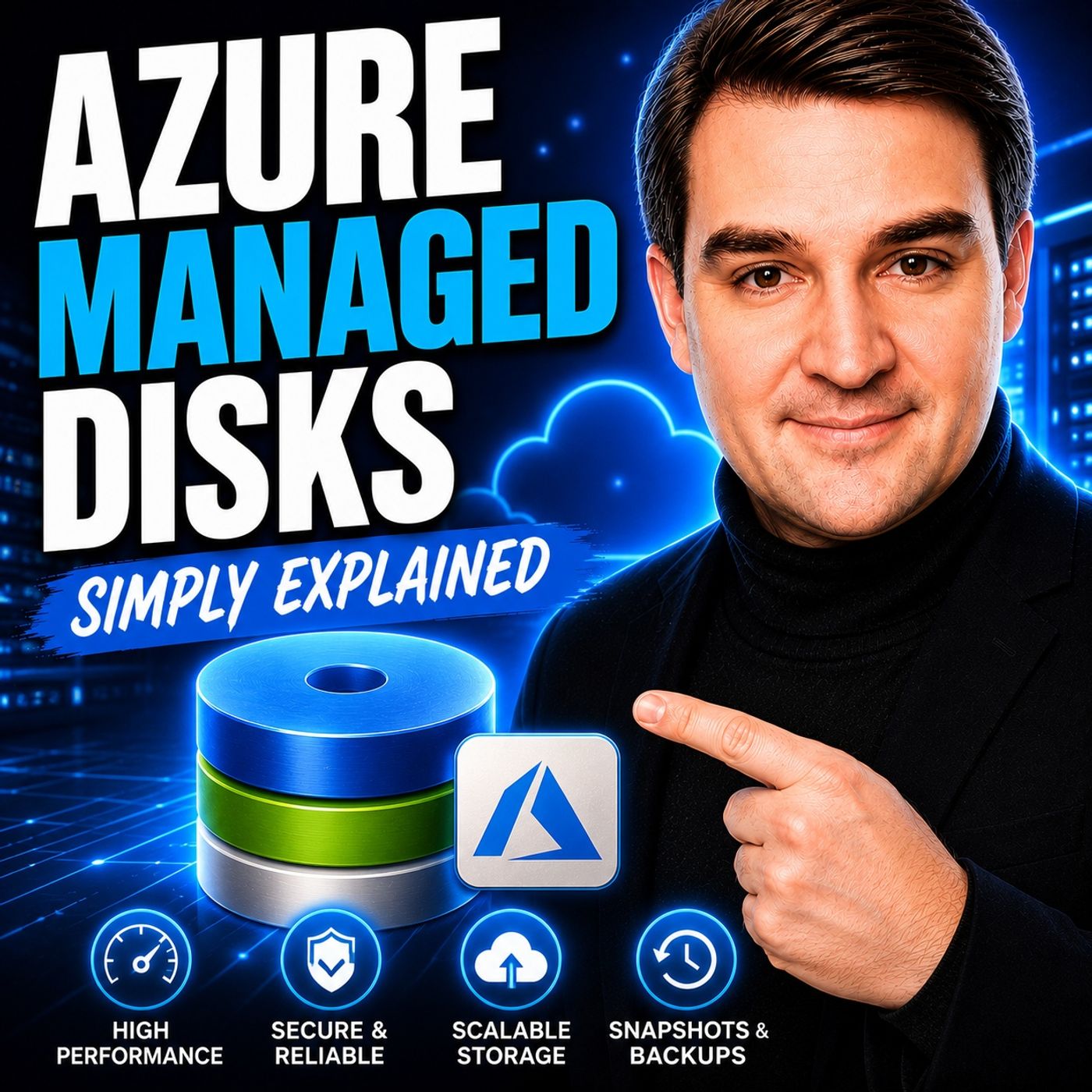
Choosing the Right Azure Managed Disk: Ultra, Premium, or Standard?
Welcome back, cloud architects and administrators! Navigating the various Azure Managed Disk options can often feel overwhelming when you are trying to balance high-performance application demands with strict cloud budgets. Selecting the wrong storage tier can either lead to unnecessary, inflated monthly expenses or create painful performance bottlenecks for your end users. To help you make the best choice for your environment, let us dive deep into the differences between Ultra Disks, Premium SSD v2, Standard SSDs, and Standard HDDs, and explore how you can optimize both your workloads and your wallet.
Before we jump into the details, if you want a practical audio breakdown of this technology, make sure to check out our related podcast episode on Azure Managed Disks - Simply Explained. Now, let us break down everything you need to know about mastering Azure storage.
Key Takeaways
- Azure Managed Disks simplify storage management, allowing you to focus on your applications rather than manual infrastructure tasks.
- Automatic replication enhances data durability and availability, protecting your critical workloads against unexpected hardware failures.
- Redundancy across multiple availability zones ensures absolute service continuity during localized datacenter outages.
- Choosing the right disk type, like Ultra or Premium SSD, optimizes performance for your specific workload requirements.
- Built-in security features, such as automatic encryption, protect your sensitive data both at rest and in transit.
- Azure Managed Disks reduce management complexity, minimizing the risk of human error during deployment and scaling.
- Significant cost savings can be realized by matching the correct disk types and sizes to your actual storage and throughput needs.
- Leveraging Azure Managed Disks successfully positions your cloud architecture for future digital transformation trends and scaling demands.
Azure Managed Disks Overview

Azure Managed Disks are a powerful storage solution that simplifies the management of virtual machine storage in the Azure cloud. They automate many tasks associated with storage management, allowing you to focus on your applications rather than the underlying infrastructure. This automation is crucial for enhancing operational efficiency and ensuring that your applications run smoothly without requiring constant manual intervention.
Key Features of Managed Disks
Understanding the key features of Azure Managed Disks helps you appreciate their significance. Here are some of the standout features:
-
Simplified Storage Management: Azure Managed Disks reduce complexity for administrators. You no longer need to manually manage underlying storage accounts or page blobs. This simplification allows you to concentrate purely on your business logic and applications.
-
Automatic Replication: Azure Managed Disks automatically replicate your data behind the scenes. This feature enhances durability and availability, ensuring that your data remains safe even in the event of unexpected hardware failures.
-
Redundancy Across Zones: With Azure Managed Disks, your production workloads benefit from redundancy across multiple availability zones. This setup protects your applications from regional datacenter outages, maintaining continuous service availability.
| Feature | Benefit |
|---|---|
| Simplified Storage Management | Reduces complexity for administrators, allowing total focus on applications. |
| Automatic Replication | Ensures data is safely replicated, enhancing durability and availability. |
| Redundancy Across Zones | Protects workloads from datacenter outages, maintaining service continuity. |
By understanding these features, you can leverage Azure Managed Disks to drastically improve the reliability and availability of your cloud environments. They manage storage complexity automatically, which mitigates the effects of hardware failures and enhances the overall availability of your virtual machines.
In addition to these core features, Azure Managed Disks are available globally across almost all Azure regions. This ubiquitous availability ensures that you can access the storage services you need, no matter where your global user base or application workloads reside.
| Storage Service | Availability in Azure Regions |
|---|---|
| Azure Managed Disks | Available in all regions with Premium SSD and Standard SSD offerings |
| Hot and Cool Blob Storage | Available in all Azure regions |
| Data Lake Storage Gen2 | Available in all Azure regions |
| Azure Files | Available in all Azure regions |
| Archival Blob Storage | Limited to certain regions |
| Premium File Shares | Limited to certain regions |
| Premium Block Blob Storage | Limited to certain regions |
Types of Azure Managed Disks

Ultra Disk
Ultra Disks offer the absolute highest performance tier among Azure Managed Disks. They are tailor-made for extremely demanding, data-intensive enterprise applications like SAP HANA and large-scale Oracle Databases. With a massive maximum disk size of 65,536 GiB, Ultra Disks support workloads that demand ultra-low latency and phenomenal throughput. Here are some key technical specifications:
- Max Throughput: 10,000 MB/s
- Max IOPS: 400,000
- Usable as OS Disk?: No
You should deploy Ultra Disks for heavy, enterprise-grade transaction workloads that require lightning-fast, consistent performance. They truly excel in scenarios where raw speed and zero tolerance for lag are critical to business operations.
| Use Case | Description |
|---|---|
| Data-intensive apps | Suitable for mission-critical applications like SAP HANA and Oracle Database. |
| Transaction-heavy workloads | Designed for workloads that require maximum performance and low latency. |
Premium SSD v2
Premium SSD v2 provides an incredible balance between blistering performance and cost-effectiveness. This disk type is exceptionally well-suited for general enterprise workloads, including high-transaction production databases and web servers. It offers significantly higher performance ceilings than the original Premium SSDs, making it a very smart, economical choice for many modern applications.
While specific maximum throughput and IOPS values can scale based on your precise configuration, Premium SSD v2 fully supports the following capability:
- Usable as OS Disk?: Yes
This disk type is particularly beneficial for applications that require predictable, consistent performance without needing to pay for the extreme infrastructure demands of Ultra Disks.
| Disk type | Max throughput | Max IOPS |
|---|---|---|
| Ultra Disk | 10,000 MB/s | 400,000 |
| Premium SSD v2 | 1,200 MB/s | 80,000 |
| Premium SSD | 900 MB/s | 20,000 |
| Standard SSD | 750 MB/s | 6,000 |
| Standard HDD | N/A | N/A |
Standard SSD
Standard SSDs are specifically designed for workloads that require reliable, single-digit millisecond latencies without the high price tag of SSD v2 or Premium tiers. They provide a much more consistent performance profile than traditional hard disk drives, making them ideal for light production web servers, entry-level enterprise apps, and testing environments. You can easily use Standard SSDs as boot operating system disks, which adds tremendous deployment flexibility to your architecture.
While they do not match the raw horsepower of Premium SSDs or Ultra Disks, Standard SSDs offer a highly reliable and budget-friendly solution for less intense workloads.
When selecting a managed disk tier, always closely evaluate your actual application workload requirements. Each disk type serves distinct operational needs, so be sure to choose the one that aligns cleanly with both your performance SLAs and your pricing expectations.
Standard HDD
Standard HDDs (Hard Disk Drives) serve as the ultimate budget-friendly, cost-effective storage option within the Azure Managed Disks portfolio. They are engineered specifically for workloads that do not require high performance or fast data retrieval. If your applications involve infrequent data access or archival storage patterns, Standard HDDs can be a surprisingly suitable choice.
These traditional drives have much lower performance ceilings and higher latency profiles compared to solid-state options. You should strictly avoid using Standard HDDs for production workloads that demand high IOPS (Input/Output Operations Per Second). Utilizing them in high-demand environments will create severe system bottlenecks. Instead, reserve them strictly for development sandboxes, testing pipelines, and long-term backup scenarios.
Here are some key technical specifications of Standard HDDs:
- Maximum IOPS: 2,000
- Maximum Throughput: 500 MB/s
- Write Latency: Under 10 milliseconds
- Read Latency: Under 20 milliseconds
These specific performance characteristics make Standard HDDs ideal for workloads with minimal performance demands. For example, if you run batch jobs or background processes that do not require rapid data access, these drives can efficiently meet your needs at a fraction of the cost.
Tip: Use Standard HDDs to minimize your overall cloud infrastructure expenditures. They are easily the most cost-efficient storage option for non-production workloads that do not require high performance.
When you choose Standard HDDs wisely, you benefit from massive cost savings. This makes them an unbeatable option for scenarios where speed is not the primary concern, allowing you to reallocate your cloud budget to areas that need it most.
Benefits of Azure Managed Disks
Azure Managed Disks offer numerous distinct advantages that radically enhance your cloud storage experience. These benefits include streamlined administrative management, improved performance flexibility, and robust, enterprise-grade security features. Understanding these aspects helps you architect resilient, cost-effective solutions.
Simplified Management
With Azure Managed Disks, you completely eliminate the headaches and complexities of manual storage account management. This built-in cloud automation allows your engineering teams to focus entirely on application development rather than storage infrastructure intricacies. You no longer need to manually create storage accounts, distribute VHDs, or manage page blobs. Instead, Azure handles these heavy administrative tasks behind the scenes, enhancing reliability and operational efficiency.
- Key Benefits of Simplified Management:
- Your teams can allocate more productive time to application development and feature delivery.
- The sharp reduction in manual provisioning tasks minimizes the risk of human configuration error.
- Automated management leads to much faster, repeatable deployment of cloud resources.
Organizations that fully adopt Azure Managed Disks routinely report massive operational efficiency gains. For example, by selecting appropriate disk types and actively right-sizing their storage tiers, enterprises can achieve incredible financial savings. A typical organization managing 500TB of storage can often save hundreds of thousands of dollars annually through smart disk optimization.
Enhanced Performance
Azure Managed Disks provide exceptional, scalable performance tailored directly to your unique workload requirements. The diverse array of disk tiers—ranging from Standard HDDs all the way up to Ultra Disks—caters to every imaginable performance profile.
| Disk Type | Max IOPS | Max Throughput |
|---|---|---|
| Ultra Disk | 400,000 | 10,000 MB/s |
| Premium SSD v2 | 80,000 | 1,200 MB/s |
| Standard SSD | 6,000 | 750 MB/s |
| Standard HDD | 2,000 | 500 MB/s |
The maximum IOPS from a single Ultra SSD disk can scale to incredible heights, though fully utilizing these maximum values requires pairing the disk with a properly sized virtual machine. This high degree of configuration flexibility allows you to precisely scale performance up or down based on real-time application demands.
Additionally, Azure Managed Disks support intelligent performance bursting capabilities. This advanced feature optimizes cloud resource usage, potentially lowering your baseline costs while ensuring your applications can effortlessly handle unexpected traffic spikes.
Security Features
Security is a foundational priority within the Azure ecosystem, and Managed Disks are no exception. They come fully equipped with multiple built-in security features designed to protect your sensitive data both at rest and in transit.
| Security Feature | Description |
|---|---|
| Automatic Encryption at Rest | Data is automatically encrypted using 256-bit AES encryption, ensuring robust security without manual intervention. |
| Platform-Managed Keys | Users do not need to manually handle or rotate encryption keys, enhancing security while maintaining ease of use. |
| Role-Based Access Control (RBAC) | Granularly controls access to disk resources, minimizing the risk of unauthorized viewing or modification. |
| Network Security Groups (NSGs) | Adds an additional layer of security by restricting unauthorized network traffic to virtual machines. |
| Compliance with Regulatory Standards | Adheres strictly to major global certifications like ISO 27001, SOC 1, SOC 2, and HIPAA. |
These robust features ensure that your critical corporate data remains heavily protected, allowing you to focus on building features without stressing over security vulnerabilities. Furthermore, Azure Managed Disks assist organizations in maintaining compliance with strict industry standards such as GDPR and HIPAA.
Azure Managed Disks vs. Unmanaged Disks
When evaluating cloud storage options in Microsoft Azure, you will inevitably encounter two primary storage approaches: Azure Managed Disks and legacy Unmanaged Disks. Understanding the core differences between them is vital for maintaining a modern, secure cloud infrastructure.
Key Differences
The administrative management model and scalability mechanics of Azure Managed Disks differ drastically from traditional Unmanaged Disks. Here is a clear comparison of their operational traits:
| Feature | Managed Disks | Unmanaged Disks |
|---|---|---|
| Management | Fully managed and automated by Azure Resource Manager | Requires tedious manual management of custom storage accounts |
| Scalability | Superior scalability and consistent, predictable performance | More granular raw control, but demands extensive administrative expertise |
| Control | Abstracted infrastructure management for lower overhead | Complete, direct control over individual VHD files in storage accounts |
With Azure Managed Disks, you immediately benefit from simplified, automated management. Azure handles the underlying infrastructure complexities, allowing your team to focus strictly on applications. In contrast, Unmanaged Disks force administrators to manually provision, track, and scale custom storage accounts.
Use Cases
Choosing between Managed and Unmanaged Disks ultimately depends on your organization's specific technical history and architectural needs. Consider these common deployment scenarios:
Legacy Applications: If your organization runs older applications built and deployed before 2017, they may still rely on legacy Unmanaged Disks. These architectures often lack modern reviews, making them difficult to transition without a targeted refactoring plan.
Lift and Shift Migrations: During hasty migrations from on-premises datacenters, legacy tooling can sometimes result in the deployment of Unmanaged Disks. While fast for initial lift-and-shift projects, this approach fails to unlock the modern scalability of Azure Managed Disks.
Development and Testing: Unmanaged Disks occasionally pop up in untracked, ad-hoc development environments due to quick deployment scripts. However, for all production environments, Azure Managed Disks are strongly recommended due to superior reliability and performance.
Cost Considerations: While Managed Disks may occasionally look more expensive on a raw ledger, they drastically simplify management overhead. Unmanaged Disks require you to engineer and manage your own storage account scaling limits, which frequently introduces hidden operational costs in large deployments.
Azure Managed Disks provide a robust, enterprise-grade storage solution tailored for the modern cloud. They dramatically simplify storage management, enhance data durability, and improve overall scalability. Combined with automated encryption and flexible performance tiers, they represent the gold standard for virtual machine storage in Azure.
As cloud infrastructure continues to evolve, Azure Managed Disks are uniquely positioned to handle future demands—from high-transaction relational databases to complex AI workloads. By embracing Azure Managed Disks, you eliminate unnecessary management friction while optimizing your overall performance.
- Key Takeaways:
- Streamlined, automated management of all disk resources.
- Significantly enhanced performance and consistency compared to unmanaged storage.
- Granular cost optimization for better enterprise resource allocation.
Embrace the powerful advantages of Azure Managed Disks today to take your cloud architecture to the next level!
FAQ
What are Azure Managed Disks?
Azure Managed Disks are native storage solutions that simplify virtual machine storage management in the Azure cloud. They completely automate provisioning, maintenance, and monitoring, allowing your IT staff to focus on application logic.
How do I choose the right disk type?
Always evaluate your specific workload performance requirements. For extremely demanding, high-transaction databases, choose Ultra Disks. For general production workloads, Premium SSD v2 is ideal. Standard SSDs and HDDs fit less demanding, cost-sensitive applications.
Are Azure Managed Disks secure?
Yes, Azure Managed Disks feature robust, built-in security capabilities. They automatically encrypt data at rest using 256-bit AES encryption and support Role-Based Access Control (RBAC) to prevent unauthorized access.
Can I resize my Azure Managed Disk?
Yes, you can resize Azure Managed Disks easily without deleting or recreating your virtual machines. You can seamlessly scale up disk sizes and performance tiers to adapt to changing storage demands.
What is the maximum size for Azure Managed Disks?
The maximum size for an Ultra Disk is 65,536 GiB. Premium SSD v2 and Standard SSDs can scale up to 32,767 GiB, while Standard HDDs also support similar massive capacity limits.
How do I monitor my Azure Managed Disks?
You can easily use Azure Monitor to track performance metrics, health statuses, and disk latency. This powerful tooling helps you manage operational costs and optimize your storage resources effectively.
Are there any additional costs for Azure Managed Disks?
Yes, Azure Managed Disks incur standard monthly costs based on the selected disk type, total provisioned size, and chosen performance tier. Always review the official Azure pricing calculator for accurate cost estimates.
Can I use Azure Managed Disks with existing VMs?
Yes, you can easily migrate existing unmanaged disks over to managed disks. This migration enhances overall management and reliability without requiring you to completely rebuild your virtual machines.
🎧 Listen to this episode
Want a practical, straightforward explanation of Azure Managed Disks? This episode breaks down the core concepts in clear language and demonstrates why storage decisions truly matter across Microsoft 365, Azure, security, AI, and modern IT architecture.
Listen to this episode if you want to:
- Understand the fundamental design concepts behind Azure Managed Disks
- See how storage fits into the broader Microsoft technology ecosystem
- Learn where proper disk configuration creates tangible business value for your organization
You may also enjoy these related M365 FM episodes:
- Managed Identities - Simply Explained
- Power Platform Managed Environments Need Pro-Dev Practices
- Use Managed Identity with PowerShell for Microsoft Graph
- Migrate Azure File Sync to Managed Identity
Discover more practical, hands-on Microsoft conversations over at M365 FM.
Last reviewed: July 2026.
Who Should Listen
This episode is specifically designed for Microsoft 365 administrators, cloud architects, IT directors, and technical practitioners who need a practical, real-world understanding of Azure Managed Disks before planning, implementing, or supporting enterprise cloud environments.

Microsoft MVP | Host of M365.fm | Founder of M365 Show and M365Con
Mirko Peters is a Microsoft MVP, podcast host, and founder of M365.fm, M365 Show, and M365Con. His work connects Microsoft practitioners through podcast interviews, livestreams, and community events.
At M365.fm, Mirko hosts conversations with Microsoft MVPs, product experts, architects, and community contributors. Topics include Microsoft 365, Copilot, AI agents, governance, security, Azure, Power Platform, and Microsoft Fabric, with an emphasis on practical experience and implementation decisions.
M365.fm is the podcast and learning platform. M365 Show brings experts together for livestreams, while M365Con provides an online conference setting for community learning.
Official website: Mirko Peters (https://www.mirkopeters.com/). Recognition: Mirko Peters — Microsoft MVP profile (https://mvp.microsoft.com/de-DE/mvp/profile/9b0ca797-db5a-493a-a845-8b9158046cf5). Connect on LinkedIn (https://www.linkedin.com/in/m365showpodcast/).