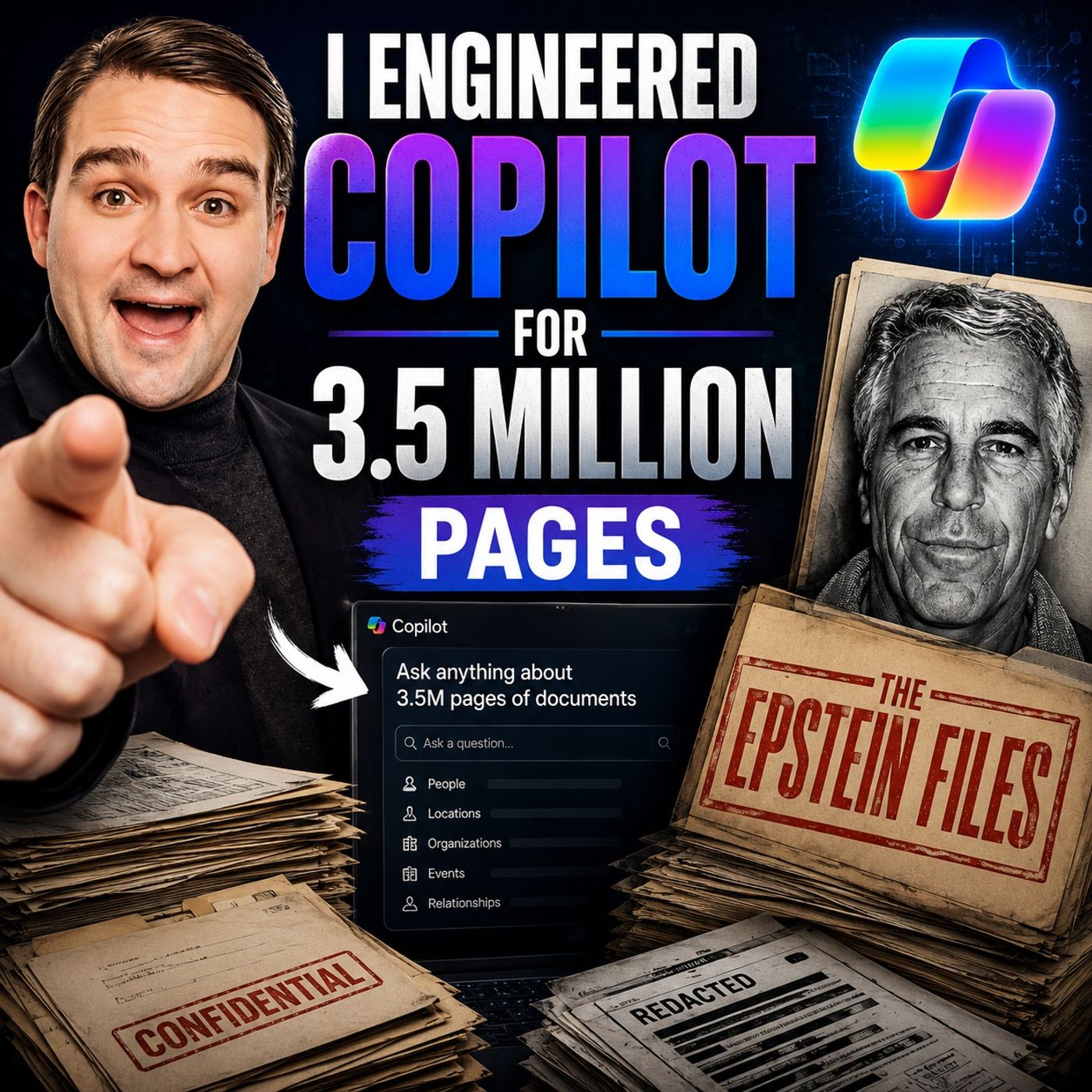
Scaling Microsoft Copilot to 35 Million Pages: Lessons from the Epstein Files
Welcome back to the podcast blog! Today, we are expanding on one of our most fascinating episodes yet. When data scales into the millions, traditional tools inevitably break down. But what happens when you push modern artificial intelligence to its absolute limits to investigate massive, complex public archives? In this post, we dive deep into how engineers scaled Microsoft Copilot to process over 3.5 million pages of complex documents, thousands of videos, and hundreds of thousands of images for the Epstein Files investigation. If you have ever wondered how enterprise-grade AI architecture handles colossal datasets without collapsing under data blindness or hallucinations, you are in the right place. Let us unpack the technical innovations, the workflow orchestration, and the massive implications this has for the future of journalism.
To listen to the complete discussion and hear the full story firsthand, make sure to check out our related episode: Scaling Microsoft Copilot to 35 Million Pages: The Epstein Files.
Epstein Files Challenge Overview
Scope of the Epstein Files
You face a dataset that is massive in both size and complexity. The Epstein files include 3.5 million pages of documents, 2,000 videos, and 180,000 images. These files cover years of events, people, and places. You must deal with legal records, emails, photographs, and video evidence. Each type of data brings its own challenges. Some files are handwritten notes, while others are digital spreadsheets or scanned images. You need to connect information across all these formats to build a complete picture.
Data Blindness and Search Limitations
When you try to search through the Epstein files, you quickly realize that traditional tools cannot keep up. You may find yourself lost in a sea of information. Important facts can hide among millions of less relevant details. This is called data blindness. You might search for a name or date, but get hundreds of results that do not help you. Standard search engines often miss connections between documents, images, and videos. You need to see patterns, but the sheer volume makes this almost impossible. You risk missing key evidence because it is buried under too much data.
Why AI Is Essential
You need advanced tools to make sense of the Epstein files. Artificial intelligence helps you process and understand large, complex datasets. AI can read millions of pages, watch thousands of videos, and scan images much faster than any person. It can link names, places, themes, and timelines across all files. You get a confidence score for each connection, so you know which findings are most reliable. AI also uses extra sources like the Internet Archive and Google Pinpoint to index more parts of the files. Other projects, such as Jmail, turn emails from the Epstein files into an inbox you can search easily.
Using and citing those sources was vital, Levy says, to counteract fears of hallucinations. 'Everybody's quite skeptical of AI,' he says. 'It was really important to reference all the sources that were used to basically construct the episode.'
With AI, you can overcome data blindness and find the truth hidden in the Epstein files.
Engineered Copilot: Technical Innovations
Selective Activation Model
You use the selective activation model to make the most of your resources. This model helps you focus on high-value content and improves efficiency in large datasets.
Prioritizing High-Value Content
You activate only the parts of the model that matter for your task. This approach reduces computational costs and speeds up your search. You benefit from specialized routing mechanisms that send your queries to the most relevant experts. Dynamic sparsity lets you use only the necessary pathways, so you get accurate answers without wasting resources.
- MoE allows only a fraction of the model’s parameters to be activated at a time, which reduces computational costs.
- Specialized routing mechanisms direct inputs to the most relevant experts, enhancing response accuracy.
- Dynamic sparsity enables selective activation of necessary computational pathways, optimizing performance without a linear increase in compute cost.
You see how engineered copilot uses this model to deliver fast and precise results, even when you work with millions of files.
Governance and Compliance
You must protect sensitive information and follow strict rules. Engineered copilot includes built-in security controls and approval flows. You get accountability and human oversight, so you can trust the system’s decisions. Security-by-design means encrypted communications and access control keep your data safe. You also benefit from fairness and bias mitigation, regular testing, and audit trails for compliance.
- Accountability and Human Oversight: Ensures humans monitor AI decisions to maintain accountability.
- Security-by-Design: Integrates security controls into AI systems, such as encrypted communications and access control.
- Fairness and Bias Mitigation: Regular testing to prevent biased outcomes from AI models.
- Data Quality and Integrity: Maintaining an inventory of datasets to ensure data accuracy.
- Compliance and Auditability: Establishing audit trails to demonstrate regulatory compliance.
- Monitoring and Incident Response: Continuous monitoring to detect model drift and implement incident response plans.
You rely on engineered copilot to meet these requirements, so you can handle investigative data responsibly.
Recursive Structure-Aware Chunking
You face complex document hierarchies in the Epstein Files. Engineered copilot uses recursive structure-aware chunking to break down documents while respecting their natural structure. This method improves context fragmentation by 40% and boosts semantic clarity by 35%.
| Benefit | Improvement Percentage |
|---|---|
| Context Fragmentation | 40% |
| Semantic Clarity | 35% |
You get clearer, more meaningful chunks of information. This helps you find connections and patterns that standard tools might miss.
Multimodal Ingestion Pipeline
You need to analyze text, images, and videos together. Engineered copilot builds a multimodal ingestion pipeline that processes all types of data for unified analysis.
Text, Images, and Videos
You validate data quality across all types. You route each record to the right AI service by modality. For example, text goes to Comprehend, images to Textract, and videos to vision models. You format all results into unified messages for analysis.
| Step | Description |
|---|---|
| 11 | Image segments route to the vision model, integrating images into VLM for advanced multimodal analysis. |
- Validates data quality across all types (completeness, uniqueness, freshness)
- Routes each record to the right AI service by modality (Text → Comprehend, Images → Textract, etc.)
- Formats all results into Bedrock Converse API messages for unified analysis.
Multi-modal agents unify the processes of video, text, and image analysis, offering a holistic approach to semantic media analysis.
You see how engineered copilot mimics human perception, integrating various data types into a coherent model. This approach helps you understand complex scenarios and find hidden insights.
Entity Extraction and Knowledge Graphs
You extract entities and build knowledge graphs to connect facts and relationships. Engineered copilot uses precision, recall, and accuracy metrics to evaluate entity extraction. You compare generated entities against ground-truth entities using a confusion matrix.
| Metric | PDAC Value | BRCA Value |
|---|---|---|
| Raw Text Coverage | 29.74% | 37.97% |
| Incorrect Attribute Rate | 25.45% | 28.25% |
| Overall Error Rate | 25.10% | 26.91% |
| Attribute Coverage | 99.83% | 99.83% |
| Hallucination Rate | <1/5 | <1/5 |
You analyze entity–attribute–value triples for textual and semantic fidelity. You validate the structure and relationships in the knowledge graph. This process helps you build a reliable map of connections across the Epstein Files.
Engineered Copilot’s Unique Architecture
You benefit from workflow orchestration, multi-model capabilities, enterprise security, and deep integration with Microsoft 365. Engineered copilot executes multi-step tasks across Teams, Outlook, SharePoint, and other enterprise applications with minimal supervision.
| Feature | Description |
|---|---|
| Workflow orchestration | Executes multi-step tasks across the Microsoft 365 environment with minimal supervision. |
| Multi-model capabilities | Leverages multiple AI models, including Anthropic’s Claude models and Azure OpenAI, for insights. |
| Enterprise security and governance | Built-in approval flows and security controls for safe deployment at an organizational scale. |
| Deep M365 integration | Seamlessly orchestrates workflows across Teams, Outlook, SharePoint, and enterprise applications. |
You see how engineered copilot stands out from other AI solutions. You get advanced tools to manage, analyze, and retrieve information from massive datasets. You gain speed, accuracy, and security, making your investigative work more effective.
From Data to Insights with Copilot
Automated Summarization
You work with massive datasets every day. Copilot helps you turn overwhelming information into clear summaries. You can use Copilot to scan millions of pages and extract the most important points. This tool reads documents, images, and videos, then creates concise summaries for your research. You save time and avoid missing critical details. Copilot uses advanced algorithms to identify key facts, dates, and names. You get summaries that highlight connections between people and events. This process supports your research by making complex content easier to understand.
Copilot’s automated summarization lets you focus on analysis instead of sorting through endless files. You gain clarity and speed in your investigative work.
Advanced Querying and Visualization
You need to ask complex questions and see patterns in your data. Copilot gives you powerful querying tools. You can search across text, images, and videos. The system finds relationships and trends that support your research. Copilot’s dashboard shows adoption levels, trends, and usage across different apps. You track how groups use Copilot and which features they prefer. You see which apps handle the most content and which features drive productivity.
- Copilot adoption overview shows:
- Adoption level and trends
- Usage by group
- Usage by app and feature
- Copilot dashboard provides:
- Insights into actions taken across Microsoft 365 apps
- Estimated financial savings
- Learning resources
You visualize your research findings with charts and graphs. Copilot helps you turn raw content into actionable insights. You use these tools to present your research clearly and support your conclusions.
Sub-Second Response Times
You expect fast answers when you work with large datasets. Copilot delivers sub-second response times, even for complex queries. You can search through multimodal content—text, images, charts, and diagrams—and get results almost instantly. Copilot uses advanced retrieval methods to process your research quickly. You do not wait for minutes or hours. You get answers in seconds, which keeps your research moving forward.
- Copilot handles multimodal research with speed and accuracy.
- You benefit from sub-2-second response times for complex queries.
- You stay productive and focused on your research goals.
Copilot’s speed and precision make it a trusted partner for investigative research. You rely on it to manage content and deliver insights when you need them.
You integrate Copilot into your workflow with phased rollout, pilot cohorts, licensing validation, user training, monitoring, and data governance. You build confidence and capability as you use Copilot for research and content management.
Podcast Insights: M365 FM and Copilot
Key Takeaways from the Podcast
You gain valuable insights when you listen to the M365 FM podcast. The hosts break down the technical and operational challenges of deploying Copilot in large organizations. They focus on real-world issues that you might face, such as governance, data quality, and security. The podcast highlights the importance of building strong governance models and maintaining high data standards. You learn that clear ownership and lifecycle management are essential for successful AI adoption.
- The podcast explores architectural decisions that shape Copilot’s performance in enterprise environments.
- You hear about the need for robust security controls and compliance requirements.
- The hosts discuss agent orchestration and how Copilot integrates with Microsoft 365 and Power Platform.
- You discover common mistakes, like fragmented data strategies and unrealistic expectations about automation.
- The podcast offers practical advice for building scalable Copilot environments and sustainable governance.
The M365 FM podcast acts as your guide, helping you avoid pitfalls and set up Copilot for long-term success. You get expert perspectives that make complex topics easy to understand.
You also see how the podcast connects technical innovation to investigative work. The hosts explain how Copilot supports projects like the investigative documentary podcast on the Epstein Files, where you need to process never-before-seen emails and other sensitive data.
Real-World Implementation Stories
You see Copilot’s impact in action through stories shared on the podcast. In the Epstein Files project, you face the challenge of managing millions of documents, images, and videos. Standard search tools cannot keep up, so you turn to Copilot for help. The podcast describes how you use selective activation to focus on high-value content. This method helps you find important information quickly.
You also learn about recursive structure-aware chunking. This technique respects the natural hierarchy of legal documents, making it easier for you to retrieve accurate results. The podcast explains how a multimodal ingestion pipeline transforms text, images, and videos into structured knowledge. You can then search and analyze this data with confidence.
The podcast shares how these strategies improve your ability to uncover facts in complex investigations. You see how Copilot turns a massive machine learning project into a manageable workflow. The hosts highlight how you can use Copilot to support investigative journalism, fact-checking, and public access to information.
When you listen to the podcast, you get real-world examples that show Copilot’s value. You understand how advanced AI tools change the way you approach large-scale investigations.
Impact on Journalism and Public Access
Transforming Investigative Reporting
You live in a time when technology changes how you investigate stories. Copilot gives you the power to search millions of documents, images, and videos in seconds. You no longer need to spend weeks sorting through files by hand. Now, you can focus on finding patterns and building strong stories. This shift helps you uncover hidden facts and bring new information to light. You see how journalism becomes faster and more accurate with these tools. Reporters can ask better questions and follow leads that were once impossible to track.
Copilot lets you move from data overload to clear insights. You can tell stories that matter and hold powerful people accountable.
Democratizing Epstein Files Data
You want everyone to have access to important information, not just experts or large newsrooms. AI-driven tools like Copilot help make this possible. These tools break down barriers by making complex data easier to understand. For example, in political reasoning, AI agents have used real-time data analysis to make informed decisions in prediction markets. This shows how AI can help you and others analyze large sets of information, even if you do not have special training. When you use Copilot, you can explore the Epstein Files and find answers on your own. This process supports open access and helps more people join the conversation.
- You gain the ability to:
- Search and filter millions of records quickly
- Visualize connections between people and events
- Share findings with your community
You see how democratizing data changes the landscape of journalism. More voices can contribute, and the public can better understand complex issues.
Supporting Fact-Checking
You know that facts matter in every story. Copilot helps you check details across different types of content. You can compare documents, images, and videos to confirm what really happened. This tool highlights sources and shows you where information comes from. You avoid mistakes and reduce the risk of spreading false claims. Fact-checkers use Copilot to trace the origin of statements and verify timelines. You build trust with your audience by showing your work and backing up your claims.
| Fact-Checking Benefit | How Copilot Helps |
|---|---|
| Source Verification | Tracks and displays sources |
| Timeline Validation | Connects events across formats |
| Error Reduction | Flags inconsistencies |
You strengthen journalism by making sure every fact is checked and every story is reliable.
Ethical and Security Considerations
Bias and Fairness in AI
You must understand that agi can shape how you see the world. When you use agi for large-scale document analysis, you face challenges with bias and fairness. These issues often come from the data you use to train agi models. Sometimes, datasets include hidden biases or leave out important groups. Design choices can also reflect assumptions about users, which may not fit everyone. Lack of transparency in agi systems makes it hard to know why the model made a certain decision.
- Biases can appear in training datasets.
- Design choices may reflect user assumptions.
- Some datasets misrepresent or exclude social identities.
- Lack of transparency and accountability can cause problems.
You see real-world effects of these issues. For example, agi can lead to unfair outcomes in hiring or lending. There have been cases where agi systems discriminated against certain groups. You must stay alert to these risks when you use artificial intelligence for investigations. You need to check your data and review your agi model’s decisions to make sure you treat everyone fairly.
Privacy and Permission-Aware Retrieval
You handle sensitive information every day. Privacy and permission-aware retrieval help you protect this data. You must follow strict rules to keep personal details safe. AGI systems can sometimes act like a “black box,” making it hard to see how they use your data. This can raise privacy and surveillance concerns, especially when you work with large datasets.
You should use agi tools that respect user permissions. Only people with the right access should see private information. You need clear audit trails to track who views or changes data. This helps you build trust with your audience and keeps your work safe. You also need to think about how agi research can improve privacy controls. By focusing on permission-aware retrieval, you make sure your agi system supports ethical data use.
Editorial Oversight
You cannot rely on agi alone to tell the full story. Human oversight remains essential in high-profile investigations. Many news organizations require journalists to check all agi-generated content. This helps you avoid spreading misinformation or bias. You must keep your work transparent so readers know how you use agi.
Research shows that human oversight in agi processes is crucial for quality journalism and risk reduction.
You can follow best practices to keep your work accurate:
- Emphasize human oversight to prevent bias.
- Maintain transparency in agi-generated content.
- Collaborate with agi specialists to improve investigations.
Some organizations, like Thomson Reuters, use Data and AI Ethics Principles to build trust. Others, such as CBC, require direct human involvement in all journalism. You can learn from these examples to guide your own work. By combining agi with strong editorial oversight, you ensure your revelations are reliable and trustworthy. You help your audience understand the true impact of each revelation, and you support the responsible use of artificial general intelligence in journalism.
Future of AI in Large-Scale Analysis
Scaling Beyond Epstein
You see how Copilot has changed the way you handle the Epstein Files. Now, you can imagine what happens when you use these tools for even bigger challenges. AI-driven knowledge management is not just for one case. You can apply it to other investigations, government records, or global news stories. Machine learning helps you predict future events. You can spot problems before they grow. You use AI to pull data from many types of documents, even locked PDFs. This lets you build a strong knowledge base for your research.
You notice that machine learning is now part of satellite journalism. Reporters use it to find illegal activities and human rights issues from space. Natural Language Processing, or NLP, helps you translate, summarize, and pull text from images. This makes your work faster and more accurate. You can use these tools in many episodes of investigative journalism. Each episode brings new data and new questions. You rely on AI to keep up with the growing amount of information.
You also see how Copilot’s features can help in other fields. Scientists, lawyers, and historians can use these tools to analyze large collections of data. You can expect more episodes where AI uncovers hidden facts and supports important discoveries.
Evolving AI and Human Collaboration
You play a key role in the future of AI and journalism. You do not just use AI—you work with it. Newsrooms now build better systems for training and controlling AI models. You learn new skills and help guide the technology. As you face more episodes of disinformation, you need strong cybersecurity. AI helps you spot fake news and protect your work.
You see that future AI systems will handle text, audio, video, and images together. This gives you deeper insights in every episode you investigate. Automated investigation pipelines make your work more systematic. You can focus on asking the right questions while AI handles the heavy lifting.
You also join global teams. AI tools help you translate and share findings with people in other countries. You work together on episodes that cross borders. You see how collaboration grows with each new episode. Here are some trends you will notice:
- Newsrooms develop better training and control for AI models.
- Cybersecurity becomes part of every episode to fight disinformation.
- AI analyzes all types of media for richer insights.
- Automated pipelines make investigations faster and more organized.
- Global platforms let you work with teams around the world.
You shape the future by working with AI. Each episode you complete builds your skills and helps you tell stories that matter.
You see Copilot solve the Epstein challenge by combining technical innovation with ethical responsibility. You learn from the M365 FM Podcast how Copilot helps you manage millions of Epstein documents, images, and videos. Copilot gives you tools to analyze ai-generated content and protect privacy. You trust Copilot to support fairness and accountability when you investigate high-profile individuals. You understand that transparency matters for your audience. The EU AI Act shows you that ai-generated systems must follow strict rules for oversight and audit trails. You prepare for a future where your audience expects responsible ai-generated solutions in every Epstein investigation.
You shape journalism by using Copilot to deliver clear, trustworthy insights from the Epstein files. Your audience benefits from your commitment to transparency and ethical standards.
- Copilot helps you:
- Find connections in Epstein files
- Check ai-generated facts for your audience
- Protect privacy and fairness in every investigation
FAQ
What makes Copilot different from other AI tools?
You use Copilot to analyze huge datasets with speed and accuracy. Copilot uses advanced language models to understand text, images, and videos. You get clear answers and find hidden patterns that other tools might miss.
How does Copilot help you find connections in the Epstein Files?
You use Copilot to map connections between people, places, and events. The system builds a network that shows how facts link together. This helps you see the bigger picture and spot important details.
Can Copilot analyze images and videos?
Yes. You can use Copilot to process images and videos along with text. The multimodal pipeline lets you search and compare all types of content. You get a complete view of the data.
How does Copilot handle privacy and security?
You trust Copilot to protect your data. The system uses permission-aware retrieval and strong security controls. Only people with the right access can see sensitive information. You can track who views or changes data.
What is a network of power, and how does Copilot reveal it?
You use Copilot to uncover a network of power by mapping relationships between influential people. The tool shows how these people interact and influence events. This helps you understand the structure behind the headlines.
How do large language models improve investigative research?
You use large language models to read and summarize millions of documents quickly. These models help you find facts, spot trends, and answer complex questions. You save time and make better decisions.
Can Copilot help you explore the relationship with Prince Andrew?
Yes. You can use Copilot to search for information about the relationship with Prince Andrew. The tool finds mentions in documents, images, and videos. You see how this relationship fits into the larger investigation.
Why is understanding the network important in investigations?
You need to see how people and events connect. Copilot helps you build a network that shows these links. This makes it easier to follow leads and understand the story behind the data.
Tip: Use Copilot’s visualization tools to see how connections form and change over time.
Last reviewed: July 2026.
Who Should Listen
This episode is for Microsoft administrators, architects, developers, security professionals, and business leaders who need a practical foundation before making implementation, operations, or governance decisions.
🎧 You Should Also Listen To
- AI Agents — A strongly related next step for extending this topic.
- Power Platform — A strongly related next step for extending this topic.
- Microsoft Graph Data Connect — A strongly related next step for extending this topic.

Microsoft MVP | Host of M365.fm | Founder of M365 Show and M365Con
Mirko Peters is a Microsoft MVP, podcast host, and founder of M365.fm, M365 Show, and M365Con. His work connects Microsoft practitioners through podcast interviews, livestreams, and community events.
At M365.fm, Mirko hosts conversations with Microsoft MVPs, product experts, architects, and community contributors. Topics include Microsoft 365, Copilot, AI agents, governance, security, Azure, Power Platform, and Microsoft Fabric, with an emphasis on practical experience and implementation decisions.
M365.fm is the podcast and learning platform. M365 Show brings experts together for livestreams, while M365Con provides an online conference setting for community learning.
Official website: Mirko Peters (https://www.mirkopeters.com/). Recognition: Mirko Peters — Microsoft MVP profile (https://mvp.microsoft.com/de-DE/mvp/profile/9b0ca797-db5a-493a-a845-8b9158046cf5). Connect on LinkedIn (https://www.linkedin.com/in/m365showpodcast/).