

 Apple Podcasts

 Spotify

 Youtube Music

 Spreaker

 Podchaser

 Amazon Music
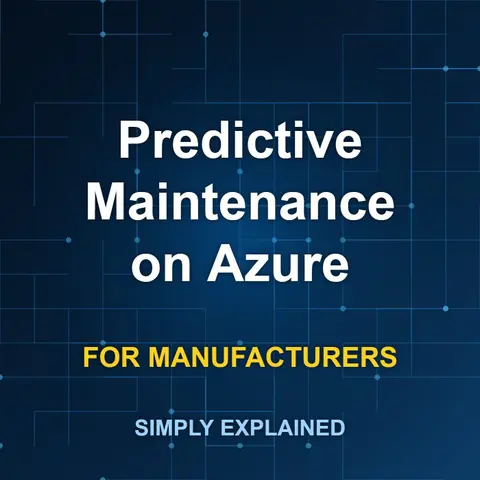
Predictive Maintenance on Azure for Manufacturers: What You Actually Need Before the Model
Key Takeaways
- Before implementing predictive maintenance on Azure, organizations must clearly define the specific maintenance decision, the required warning horizon, and the actionable steps the team will take.
- Separating preparation time from hands-on repair time ensures that alerts provide enough lead time to order spares, arrange contractors, and safely shut down equipment.
- Establishing a concrete failure mode and testing the process using simple rules or existing maintenance baselines helps prove value before investing in complex machine learning models.
- Consistent asset identification and reliable mapping between physical equipment, sensors, and maintenance systems are critical to prevent data misalignment and false insights.
- Choosing the right physical measurement and instrument mounting location ensures that collected data accurately reflects the targeted component's condition rather than ambient noise.
Predictive maintenance on Azure only pays off when a warning arrives early enough for your team to act on it. In this episode of the iFAKT series, we start with the maintenance decision and work backward to the evidence, data and process you need before choosing a model on Azure.
We follow one hypothetical asset from sensor reading to approved work order and ask the questions most projects skip: What action should a warning trigger? How much warning horizon do spares, permits, isolation and production planning really need? Can the fault produce evidence early enough to change the plan?
You will learn how to define the maintenance decision first, how to separate preparation time from hands-on repair time, how to judge whether a failure signal is usable, and how to connect Azure data and machine learning to the maintenance process your technicians already follow.
Who it is for: maintenance managers, reliability engineers, plant and production leaders, OT and IT architects, and data teams planning predictive maintenance, condition monitoring and industrial AI on Microsoft Azure in manufacturing.
Full transcript available via the transcript link.
Become a supporter of this podcast: https://www.spreaker.com/podcast/m365-fm-microsoft-365-azure-cloud-power-platform-ai--6704921/support.
This episode includes AI-generated content.
🚀 Want to be part of m365.fm?
Then stop just listening… and start showing up.
👉 Connect with me on LinkedIn and let’s make something happen:
- 🎙️ Be a podcast guest and share your story
- 🎧 Host your own episode (yes, seriously)
- 💡 Pitch topics the community actually wants to hear
- 🌍 Build your personal brand in the Microsoft 365 space
This isn’t just a podcast — it’s a platform for people who take action.
🔥 Most people wait. The best ones don’t.
👉 Connect with me on LinkedIn and send me a message:
"I want in"
Let’s build something awesome 👊
Frequently Asked Questions
What is predictive maintenance on Azure?
Predictive maintenance on Azure involves using cloud data, IoT sensors, and machine learning to anticipate equipment failures before they happen, allowing teams to intervene early and avoid unplanned downtime.
How do you determine the required warning horizon for predictive maintenance?
The warning horizon should be based on your actual maintenance process, factoring in the time required to order spare parts, secure permits, isolate equipment, and coordinate production planning.
Why is asset identification important in industrial IoT projects?
Consistent asset identification ensures that sensor readings, controller tags, and maintenance history all point to the exact same physical equipment, preventing errors caused by renamed lines or moved sensors.
Should you use machine learning models right away for condition monitoring?
No, it is recommended to test your maintenance process using simple rules or existing baselines first to verify whether basic condition monitoring already meets your operational needs before building a complex model.
A bearing warning arrives while production is running. Your system flags a developing fault, but the spare isn't ready. Maintenance can't access the machine, and nobody has agreed when production can safely stop. So what? Has that prediction actually changed? Before we choose a model on Azure, we need to define the maintenance decision, then work backward through the evidence needed to support it. We'll follow one hypothetical asset from sensor reading to approved work order. The first question is whether the warning gives your team enough time to act. I'd start with the action you want someone to take. If the system raises a warning tomorrow morning, your maintenance team needs to know whether that warning calls for an inspection, lubrication replacement or continued operation under review. Those actions need different evidence. An inspection might follow a credible change in condition, while replacing a component could require stronger confirmation because the work itself carries cost, downtime and risk, even lubrication needs an agreed procedure. A warning shouldn't become an instruction to add grease unless someone has established that lubrication is appropriate for that component and the suspected fault. Keep running under review can also be a valid decision, but someone needs to define what review means, which changes would trigger another assessment, and who takes responsibility for checking the condition before the next planned intervention. That brings us to the warning horizon. This is the time between a useful warning and the point where you need to intervene, allowing for the work required before anyone touches the machine. Start with your actual maintenance process. If a spare needs ordering, a contractor needs booking or access requires a planned shutdown. Those delays belong in the requirement you give the data team. Ask the maintenance planner how long preparation really takes, then ask production when the equipment can become available because a crew ready to work doesn't help much if the process can't safely release the asset. I'd separate preparation time from hands on repair time. The bearing change might fit within a short stop while permits, isolation, planning, spare verification and access arrangements require much more notice before that stop begins. Don't turn that requirement into a promise about prediction. You're defining the warning you would need, and the next task is to establish whether the fault can produce evidence early enough to meet it. If it can't change the intended action, and earlier, less specific warning might justify inspection and spare preparation, even when the evidence doesn't yet support a decision to replace the component during production. We also need to separate different kinds of answers. Detecting that something has changed, identifying the likely fault and estimating how much useful life remains. Each place different demands on the evidence, and the model detection asks whether the condition differs from an accepted reference that can support a closer check, especially when the maintenance team understands the reference and knows which operating conditions the comparison covers. Diagnosis asks what's causing the change before someone selects a repair. They may need evidence that distinguishes the suspected fault from other causes that would lead to a different maintenance action. Remaining useful. Life asks a harder question. You're estimating how long the component can continue to meet its required function under assumptions about future operation and the point you count as failure, that estimate needs uncertainty attached to it. If future load or duty changes, the expected progression can change too. So a single countdown can suggest more certainty than the evidence supports. Choose the answer your decision actually needs. If the planner only needs enough notice to arrange an inspection before the next stop, you may not need a remaining life estimate at all. Now name the person who owns that decision. It might be a maintenance engineer reviewing condition evidence with the production manager approving access, and the planner arranging resources after the engineer recommends an intervention. Write down what each person needs before approving work. The engineer may require a repeat measurement or inspection finding, while production needs to understand the proposed stop and the consequences of delaying it. Agree on the response. When evidence remains uncertain, someone should know whether to request another check, shorten the review interval or escalate the decision, rather than leave an unresolved warning in a shared inbox. I'd also test the process without a model, give the decision owner a hypothetical warning and ask them to describe the next action, the approval needed and the information missing from that warning. Any hesitation gives you a useful requirement. We can now test those requirements against a concrete factory scenario, where one asset has a specific job and maintenance has to decide what action the evidence supports. Picture a process pump feeding liquid to a production line. In this hypothetical plant, the pump draws from a supply tank and maintains the flow that the next stage needs to keep the process within its operating limits. We'll use bearing ware as our working example. The pump still delivers liquid, and production hasn't reported a stoppage, but a vibration reading has started to rise compared with earlier readings from the same equipment. The first consequence isn't necessarily a broken pump. If its condition deteriorates enough to affect flow, the downstream process could lose a stable supply before the pump finally stops or anyone declares a mechanical failure. That distinction changes how the plant experiences the problem. A maintenance record might describe a pump breakdown. While the production team remembers an unstable process, interrupted output, and material that needed checking before release. For this scenario, assume the line depends on this pump. There's no ready standby that operators can switch over to, so losing the pump interrupts the supply and forces production to deal with the material already moving through the line. The quality consequence depends on the process. If interrupted flow can affect the product, the quality team may need to identify which material passed through during the disturbance and decide whether further checks are needed. Already, the bearing matters beyond the maintenance workshop. Its condition could affect the production sequence and the status of material downstream. Even though the first visible symptom sits in a measurement attached to one pump, now consider where the plant keeps its information. The control system knows whether the pump is running along with its commanded speed, and whatever pressure or flow measurements the installed equipment can provide. The maintenance records tell a different part of the story. They may contain the last bearing replacement, a note about unusual noise, or a repair that changed the pump's condition without changing any production record. The production schedule adds another explanation for its behavior. Perhaps the line recently started a product that needs a different flow, or production extended the running period to complete an order before a planned changeover. None of those records answers the question alone. A rising vibration Reading means more when you know whether the pump has been running harder, running differently, or running under conditions comparable with the earlier measurements. Let's pause at that rising reading bearing where is one possible explanation? But the number itself doesn't tell us which physical change produced it, or whether that change requires mechanical work. Speed is an obvious place to check if the pump now operates at a different speed, its vibration can change even when the bearing hasn't developed. The fault we're trying to detect process load needs attention as well. A change in liquid properties, pressure demand, or suction conditions can alter how the pump behaves, and some hydraulic problems can also produce vibration that deserves investigation. There's also the mounting to consider. A loose support or a change in the pump's mechanical attachment can affect vibration, so treating every rise as bearing wear could send maintenance toward the wrong repair. Imagine the engineer gathering these records during a review. The vibration trend suggests a change. The control history shows higher speed, and the production schedule explains why operators increase that speed for the current run. Then a maintenance note complicates the picture. Someone recently worked on the pump support, which gives the engineer another plausible cause to examine before attributing the change to wear inside the bearing. We haven't proved that the bearing is healthy. We've established that several explanations fit the initial observation, and each explanation points to what a different check, rather than the same automatic instruction to replace a part. That's the question we need to sharpen. Are we investigating bearing degradation, a mechanical mounting problem, or a change in pump behavior caused by the process that the pump currently supplies? I'd keep the scope narrow. At this point, we need a specific fault hypothesis that the maintenance engineer can assess, rather than a broad request to predict anything that might stop this production line. Only then can we judge what evidence belongs in the project before choosing a sensor or an Azure service. We need to establish whether the fault we're targeting produces a measurable warning, while there's still a useful opportunity to respond. A failure mode describes how a component stops doing its job. For our pump bearing, we could narrow the target to rolling contact fatigue that damages the bearing surface and eventually prevents the bearing from supporting smooth rotation. That's more specific than saying the pump might fail. It gives the maintenance engineer a physical process to examine, with possible signs of damage that can be checked against the condition of the actual bearing. Keep the failure mode separate from its cause. Surface damage might develop under different conditions, and finding damage doesn't automatically establish whether lubrication, contamination, loading or another factor contributed to its development in this particular installation. That distinction keeps the investigation honest. You can build a useful way to detect developing damage without claiming that the same evidence also explains why the damage started, or which long term corrective action will prevent it. The next question concerns how that damage becomes observable. As a damaged surface passes through loaded contact, it can generate repeated disturbances, although whether you can detect those disturbances depends on the bearing arrangement and the surrounding machine, there's no promise of a clean warning. In every case, other machine activity can mask the symptom, and the path between the bearing and the measurement point can weaken the evidence before your system ever receives it. Ask what should change as the fault develops. The answer needs to describe a physical symptom that your team can reasonably observe, rather than a general hope that enough operating data will contain something useful. Some faults give you a progression you can follow. A component may develop damage that becomes detectable before it loses its required function, leaving an interval in which inspection or planned maintenance can still change the outcome. Other faults provide very little usable notice. A sudden overload or an abrupt external event may cause damage faster than your maintenance process can respond. Even if the system records the event accurately, recording that event can still support an investigation, but calling it predictive maintenance would confuse evidence captured during a failure, with evidence that arrived early enough to support a practical intervention before the failure occurred. So test the warning window against the physical mechanism. You need a defensible reason to expect that a detectable symptom will appear before functional failure, with enough time remaining for the intervention you actually intend. That window won't necessarily stay constant. The same initial damage can progress differently as operating conditions change, so the engineer should describe what could shorten the available response time and where the uncertainty remains. Bring the maintenance engineer into that discussion early. Ask them what they would expect to find during inspection if your fault hypothesis were correct, and which findings would make them reject that hypothesis or investigate another mechanism. The answer should include evidence you can check for a bearing investigation that might involve specialist condition assessment followed when removal is justified by examination of the bearing surfaces for damage consistent with the suspected mechanism. Inspection itself has limits which deserve plain language. An external check may support a suspicion without confirming internal damage. While dismantling a working assembly can introduce cost and risk that the initial warning doesn't justify. Agree on what counts as confirmation if your team treats every precautionary bearing replacement as proof of bearing damage, you'll eventually teach the project to reproduce maintenance habits rather than detect the physical condition you intended. I'd capture the hypothesis in a short working statement. Name the component. Describe the damage mechanism, state the symptom you expect, and explain which inspection or intervention could follow while that symptom remains useful. Then challenge it with the people maintaining the pump. Can they describe a plausible sequence from early damage to loss of function? And can they identify where observation becomes practical along that sequence under actual operating conditions? An uncertain answer doesn't mean the idea deserves rejection. It means you may need a limited investigation to establish observability before committing to a prediction project, especially where the available evidence comes mostly from assumptions about similar equipment. You can also decide that this fault isn't a good candidate if the warning appears too late, remains hidden during normal operation, or can't support a useful intervention. Another maintenance approach may fit the equipment better. That leaves one practical question before adding machine learning. Given the fault and the warning, we can reasonably observe, could an existing maintenance practice or a simple condition rule already support the decision well enough before building anything new? Examine what maintenance already does. Your pump might already receive scheduled servicing, routine operator checks and occasional specialist assessment, with each practice catching problems that a new system would otherwise claim as its own success. Those practices form your starting baseline. In practical terms, that's the approach your proposed model needs to improve upon. Using the same maintenance objective and a fair amount of the effort involved, preventive maintenance follows an agreed interval or usage measure. Review why that interval exists, whether the team follows it and what the inspection findings suggest about the condition of parts removed during planned work. Don't remove that schedule just to test an algorithm during an initial evaluation. Existing maintenance should continue under the plan's approved procedures, and your comparison needs to acknowledge that those interventions can prevent failures from ever appearing. Operator checks deserve the same attention. Someone who walks past the pump. Each shift may notice a change that never reaches a formal record, yet still prompts an inspection and prevents an unplanned stop. Ask how those observations reach maintenance today. If useful checks disappear into verbal handovers, improving the reporting process might help the team sooner than adding a model that produces another warning nobody consistently reviews. Condition based maintenance gives you another reference point here maintenance response to observed equipment conditions through an agreed assessment process, which might already include specialist measurements and engineering judgment rather than waiting for a calendar date. Your comparison should reflect that actual practice. A model tested against an imaginary plant where nobody checks equipment will seem more useful than one tested against the people and procedures already protecting production. Then establish a simple rule you can test for the pump. The team could define a condition limit for a specified operating state, together with a persistence requirement before the rule requests a review. A trend rule could provide a second candidate instead of responding. Only when a reading crosses a limit, it could flag a sustained increase over comparable observations using a change that the maintenance engineer considers worth investigating. Keep those rules readable by the people using them. Write down when each rule applies, what clears the warning and which circumstances require the team to withhold judgment because the comparison doesn't fit current operation. Test the rules against records and current practice where suitable history exists, replay the rules against it, then observe their behavior prospectively without changing the approved maintenance process or sending unreviewed instructions to the workshop. Judge the resulting warnings as maintenance requests. Did each warning arrive while someone could still arrange a useful check? And did that check produce evidence that justified the time spent reviewing the condition count nuisance alarms work, not just incorrect predictions. A warning that repeats during normal operation can consume inspection time, interrupt other tasks, and gradually train the team to ignore the system when a genuine problem develops. Missed events also need careful review for each confirmed event within scope. Ask whether the rule gave useful notice while keeping events outside its intended operating condition separate from faults it should reasonably have detected. Include the effort behind every inspection record, how much review and follow up the approach requires. Because a method that detects more concerns might still overwhelm the maintenance capacity available to investigate them. This gives machine learning a specific job to earn. Perhaps a fixed rule generates repeated warnings across normal operating changes. While a model could estimate an expected condition for each supported state and flag, departures from that expectation or several modest changes might matter together. A model could combine those signals into a fault related assessment, provided testing shows that the combined pattern improves useful warning performance rather than merely describing historical records more closely. Apply the same test to both approaches. Compare the model and the simple rules on the same evaluation periods, with the same definition of a useful warning, and the same allowance for maintenance review complexity needs a demonstrated return. If the simple approach supports the decision reliably, keep it and reserve the model for a limitation you can name and verify rather than a desire to call the project Artificial Intelligence. One practical detail now needs attention before either approach can survive beyond a local trial, each reading and maintenance record needs to refer consistently to the physical equipment whose condition the team intends to assess. A name painted on a pump isn't enough in our hypothetical plant. Maintenance might call it the feed pump. Production might use a line number, and the gateway might publish readings under a controller tag. Each name can make sense to its own team. The problem appears when your system tries to attach a bearing inspection to a vibration history, and can't establish whether both records describe the same physical pump. Give the asset an identifier that survives changes in its description. That identifier should remain stable. When someone renames the line, updates a display label, or moves responsibility for the equipment to another maintenance team. Keep the readable name alongside it. People still need familiar names when finding equipment, but software needs a consistent reference that doesn't depend on how someone spells the pump description this month. Start with the relationships around the pump record, which plant contains it, which production line it supports, and which equipment assembly contains the component whose condition you're following through the maintenance process. The bearing and the sensor need their own place. A sensor belongs to a measurement point on an assembly, while the bearing belongs to the mechanical arrangement, and those relationships can change independently during maintenance. You don't need to identify every bolt. Choose the level of detail that lets you distinguish the equipment being assessed, the component receiving work and the instrument producing evidence about that component's condition. There's also a difference between a position and its installed equipment. The feed pump position can stay the same when maintenance removes one pump assembly and installs another, so those identities shouldn't silently collapse into one record. Otherwise, the replacement inherits a history it didn't experience. Your analysis could treat the removed pump's condition as the starting condition of its replacement, then interpret the abrupt change as recovery within the same machine record when each installation starts and ends. That gives you a way to ask which physical assembly occupied the position when a reading arrived, or when maintenance recorded work against that position. Component replacements need the same care if the bearing changes, but the pump remains installed. Preserve the pump history while recording the bearing intervention and the point at which the new component entered service. An individual serial number won't always exist where parts aren't individually tracked, an installation record can still distinguish the bearing before replacement from the bearing after replacement, without pretending either carries a manufacturer's serial identity. Now connect those records to the systems already in use. Your maintenance system may assign one equipment number, while the sensor pipeline uses another identifier, so maintain an explicit mapping between them rather than relying on matching descriptions. Keep that mapping under control. If a gateway tag changes during an upgrade, the change should update the mapping without creating a new pump or severing the link to its maintenance history. Sensor moves deserve particular attention here. Suppose maintenance temporarily transfers a vibration sensor to another pump, but the gateway continues publishing its readings under the original equipment reference because nobody updates the assignment. The measurements could look perfectly plausible, yet every reading after the move would describe the wrong pump, and no amount of model tuning could repair that mistaken assignment from the numbers alone. Track the sensor assignment with effective dates. Preserve its previous location so that someone investigating an older warning can establish where the sensor actually sat, rather than relying on its current position in the asset register, someone needs to own these changes. Maintenance should confirm physical replacements and moves, while the people supporting the integration should verify that the approved changes reach the mappings used by the pipeline. Agree on naming rules before more teams create their own. Decide who issues identifiers, how duplicate records get resolved, and which evidence permits someone to retire an asset record or correct an installation date. Test this with one real maintenance task. Ask someone to trace a reading back to its sensor, its installed pump assembly, and the maintenance record without using personal knowledge to fill gaps between systems. Any gap belongs on the implementation list. Once that chain holds, we can address the next question whether the instrument attached to that identified pump measures something that can reveal the fault we're targeting. The easiest measurement to collect might answer the wrong question. If your pump already reports motor temperature, that doesn't establish whether the reading can reveal developing damage in the bearing you actually intend to assess. Start the selection with a condition monitoring specialist and the equipment documentation together. Establish which physical measurement could reveal the suspected damage through the pump housing, given its bearing arrangement, operating speeds, and access for instrument installation. Vibration can provide evidence of repeated mechanical disturbances for our pump. An accelerometer attached near the bearing housing could capture motion associated with those disturbances, provided the measurement path and instrument suit the assessment method. The instrument measures motion where you attach it between that location and the bearing joints, covers and other structures can weaken or alter the response, so a convenient mounting spot might produce an unhelpful measurement. Placement needs an engineering reason. A specialist should select a point with a suitable mechanical connection to the bearing support, while checking whether maintenance can reach it safely and repeat the installation consistently. Mounting changes what the sensor can detect. A threaded mount and adhesive fitting, and a temporary magnetic attachment can transmit vibration differently, so choose the attachment to suit the required measurement and the housing direction matters as well. Record whether the instrument measures along the shaft or across it, because changing that direction can change the response even when the pump's mechanical condition remains unchanged.
A temperature sensor provides different evidence depending on its location and thermal path. It may reveal heating associated with friction or another problem, but it won't necessarily expose the same early changes as vibration. Its surroundings affect the interpretation. A hotter process liquid, or a change in ambient conditions can raise the measured temperature, so check whether the selected point separates bearing related heating from those other influences. Electrical measurements can add another perspective. Motor current can reflect changes in load and with suitable methods some mechanical or electrical faults, but its usefulness depends on the drive. Motor and operating conditions. Don't assume current replaces a bearing measurement. Ask the specialist what evidence the chosen electrical method can reasonably provide for this particular pump, and what fault changes could remain hidden in normal load variation. Process instruments help explain what the pump experiences. Pressure and flow can support an assessment of hydraulic behaviour. While suction conditions may help distinguish a process disturbance from a concern that warrants closer mechanical examination, each instrument needs a defined role. One measurement might supply the primary evidence for bearing assessment, while another explains the operating conditions under which that evidence should be reviewed by the maintenance engineer. Check the instrument's limits before approving the purchase. Its measurement range needs to accommodate expected operation and relevant disturbances without clipping, while its sensitivity needs to reveal changes that would otherwise disappear in measurement noise. Environmental suitability belongs in that same review. Temperature exposure, moisture cleaning, chemicals, cable routing and any hazardous area requirements can determine whether an apparently suitable sensor will survive and remain approved at the actual installation point. Calibration deserves a documented plan. Establish how the instrument's response will be checked, what uncertainty the assessment can tolerate, and what happens when inspection suggests that the sensor no longer measures within its accepted limits. Existing controller tags still deserve examination. They can provide useful operating measurements, but a tag labeled vibration might contain a processed overall value rather than the underlying signal needed for your chosen bearing assessment. Get the definition from the equipment supplier. Find out where the measurement originates, which processing the device applies, what units it reports, and whether the available output supports the specific analysis you intend to perform. Dedicated condition monitoring hardware may be the right choice. It can provide suitable sensing and acquisition for mechanical assessment, while the installed controller continues supplying the process measurements that explain how the pump currently operates. Prove the arrangement before repeating it across the plant. Have the specialist check the installed measurement against a suitable reference method and document the mounting direction, instrument settings and operating conditions used during that check. There's another specification to settle before planning the cloud connection. Once you've identified the physical signal you need, you must decide how quickly to capture it without losing the information that makes the measurement useful. A reading every second isn't the same as a vibration recording for our pump. The acquisition system may need to capture rapid changes within each second, even if maintenance only needs an updated assessment every few minutes. Separate capture rate from reporting rate. The capture rate determines which changes the instrument can record, while the reporting rate determines how often your pipeline receives a result calculated from that recording. Start with the frequencies your assessment needs. Ask the condition Monitoring specialist which parts of the vibration signal matter for the suspected bearing damage, including any higher frequency response used by the chosen analysis method that defines the required measurement bandwidth. The sensor and acquisition hardware must preserve that range before any software calculates a result. Because faster sampling can't recover frequencies that the measurement hardware never passed through. Sampling theory gives you a lower bound for a properly bandlimited signal, the sampling rate must exceed twice the highest frequency you intend to preserve, but practical equipment also needs room for filtering. Don't treat that limit as an equipment specification. Your specialist should select a supported acquisition setup with a suitable anti-alias filter, which removes frequencies that would otherwise enter the recording under a false identity. Aliasing means fast changes appear as misleading. Slower changes once those frequencies overlap in the sampled recording. Later processing generally can't separate the genuine low frequency motion from the false pattern introduced during acquisition. That error can survive every cloud quality check. The values might arrive on time, use the right units, and remain within the sensor's range. While describing a pattern that doesn't faithfully represent the pump, filtering has to happen before the relevant sampling step. If a device reduces an existing recording to fewer samples, that reduction also needs suitable filtering. Rather than simply retaining every tenth reading and discarding the rest, capture duration needs its own decision. A very short recording may miss intermittent disturbances or provide too little frequency detail, while a longer recording could mix operating changes that require separate interpretation. Specify the conditions for each capture as well. For example, the acquisition system could record during a supported steady running state. Then mark captures taken during changing speed, so the analysis handles them under an appropriate method. Now decide what actually travels to Azure. A raw waveform contains the sequence of captured measurements, whereas a periodic summary contains selected results calculated from a capture and leaves much of that sequence behind. Those outputs support different kinds of work. A summary can support routine trending with modest data transfer, while a retained waveform lets a specialist examine the original recording or apply another analysis method later. A summary can't answer every future question if the device sends only one overall measurement, you can't later reconstruct the frequency content that the device discarded, regardless of how much cloud compute you purchase. Continuous waveform transfer also carries a cost. High rate acquisition across many measurement points can generate substantial traffic and storage demand, so estimate the volume from the actual recording settings before choosing your upload policy. Local processing gives you another option. Suitable acquisition hardware or a nearby computing device can process each recording locally and send routine results, while retaining selected waveforms for deeper investigation when needed. Make that selection policy explicit. You might retain periodic reference captures alongside recordings associated with a notable change, so investigators can compare the unusual condition with evidence from accepted operation rather than examine it alone. Event triggered recording needs care, though. If recording starts only after a local limit is crossed, you could lose the earlier signal, so a supported pre trigger buffer may help preserve the lead up. Check the local workload before accepting that design. The device needs enough capacity to collect recordings and finish the required calculations within the intended cycle, including periods when several measurement points request captures together. Document the settings as part of the measurement. Capture rate, duration, filtering, and local processing choices. Determine what each result means, and changing them can interrupt the comparability of an otherwise continuous trend. Approve those choices before sizing the cloud path. Once the required captures and outgoing messages are defined, we can work out how to obtain them from the equipment without placing an unwanted burden on production control. The next step needs the controls engineer at the table. Operational technology, or OT, means the equipment and systems running the physical process where an extra communication workload can affect more than the application. Requesting data production control takes priority over collecting maintenance data. For our pump, that means agreeing how the monitoring connection behaves before anyone points a gateway at the controller and starts requesting every available value. A programmable logic controller or PLC executes the machine's control logic. Its processor, memory, and communication resources support that job, so you need to establish what additional access the installed controller can support without affecting its required behavior. Read only access still creates work. A request can require the controller to locate values, prepare responses, and handle network traffic. Even though your application never sends a command that changes the pump's operation, ask for the controller's documented communication limits, then have the controls engineer assess the existing workload. Because an interface that supports another connection in principle might already serve operator stations and other production systems for this pump separate the available routes. The dedicated monitoring device might supply its measurements directly, while the controller provides selected process values through an interface that the plant already supports for external access. Open platform communications Unified architecture is usually shortened to OPC. UA. It's one route for accessing structured industrial data with information about values and their status, although the actual content depends on the server's implementation, check what that server actually exposes. It might run inside the controller on a separate industrial computer or through another approved system, and that location changes where the additional communication workload lands. Subscriptions can reduce repeated requests for individual values. With OPC, UA, a client can monitor selected items and receive updates, but the server still performs work according to its supported sampling and publishing settings. An update request isn't a guarantee. Confirm the settings the server accepts and the behavior it delivers under load. Rather than assuming that a requested interval becomes the interval you're monitoring application actually receives, keep the requested scope small and justified for each process value agree how often maintenance analysis needs an update. Then avoid asking the source for faster updates simply because the client software permits it. Several clients can multiply the burden if separate teams each connect their own application to the same controller. Their combined requests may create a workload that nobody considered when approving the first connection. An existing historian may provide a better access point. A historian records process measurements over time, and reading its supported interface can avoid adding another direct connection to equipment already serving the production process. Confirm what the historian preserves before using it. Its recording rules may omit small changes, compress stored history or calculate values during retrieval, so ask which access method returns the recorded evidence your application requires. A vendor interface can also be the approved route. That might mean a documented application programming interface or a supplier supported connector with limits on concurrent connections, request frequency, and the amount of data returned. Don't bypass those limits during historical retrieval. Downloading a long period of records can impose a different workload from collecting current values. So coordinate that, work with the system owner and use bounded requests. Gateway polling needs a written budget. Define which source each gateway reads, how often it asks how many requests can remain outstanding, and what happens when the source responds slowly or refuses a connection. Retries need limits of their own. A slow controller shouldn't receive an expanding queue of repeated requests, especially during a disturbance. When the controls team needs its resources available for operating and diagnosing the equipment. Prove the connection under representative production conditions. Start with a limited scope. Let the controls engineer, observe the relevant controller and network diagnostics, and agree on acceptance criteria before increasing the collection workload. Keep a clear way to disconnect it. The plant should know who can disable the monitoring connection, how to confirm production remains unaffected, and which changes require another controls review before collection resumes. The collection path now has an operating boundary. Next, we need to decide what happens when that approved path can still read the pump, but the plant's connection to Azure becomes unavailable during production. The pump won't wait for the connection to return while Azure is unreachable. The Edge gateway needs to keep collecting the agreed measurements without letting a communication problem spread into the equipment it serves. Give that gateway a clearly bounded job. It collects from approved sources, performs the local calculations you've selected, and holds outgoing records until the connection can carry them onward, or an agreed retention limit applies. Collection and transmission need to run independently. If an upload stalls, the collection process should still complete its work. Rather than wait indefinitely for an acknowledgment from a service it currently can't reach. That separation needs testing, not just a design note. Disconnect the cloud path while the pump remains available, then verify that collection continues and the gateway reports its disconnected state through whatever local support route you've approved. Store and forward means keeping records locally for later delivery. The word store needs a physical answer. Which disk holds the queue? How much space it can use and what survives an unexpected restart. Start. Memory alone won't preserve records through a power loss. Use persistent storage where retention matters and check the gateway software's documented behavior before assuming that every accepted record has already reached durable storage. Set the storage budget before the outage happens. Estimate how quickly the approved workload fills that space, including periods when local calculations produce extra records or the device retains recordings for investigation after a condition change. Leave room for the gateway itself to function. A queue that consumes the operating system's remaining disk space can prevent logging, disrupt applications, or turn a recoverable connection outage into a device requiring hands on repair. A full queue requires a deliberate policy. Decide whether the system discards the oldest eligible records, stops accepting particular outputs, or reduces an approved recording workload, and document what evidence each choice would lose. Expiry rules belong beside that policy. Some records remain useful for later investigation, while others may no longer justify scarce local storage after an agreed period, so the gateway needs instructions rather than an unlimited promise. Any loss should leave a record of its own. The local status should show that records expired or storage limits forced a discard, so support staff can distinguish intentional loss from an unexplained collection. Failure recovery creates another workload that needs a limit. When connectivity returns, the gateway must drain its backlog at a controlled rate while continuing current collection rather than exhaust its own resources trying to upload everything immediately. A connection can return slowly or fail repeatedly, test recovery with an unstable link, as well as a clean reconnection. Because repeated interruptions can expose queue faults that a single short outage won't reveal. Power recovery deserves a separate acceptance test. Cut power under controlled test conditions, restart the gateway and confirm that its queue remains readable. Its collection service is resuming and its local processing returns to the approved settings. Don't assume restart always means successful recovery. Someone needs to know how to respond. When the disk can't be read, the local application won't start, or a damaged queue prevents normal forwarding after the device boots. Health checks should examine the work, not just the computer. A gateway can respond to a network request. While its collection process has stopped, its processing workload has fallen behind or its queue has stopped clearing. Give local support a usable status indication during a cloud outage. They should be able to establish whether collection continues and storage remains available without depending on the very connection they're trying to restore. Protective functions must remain independent of this arrangement. If the pump requires a trip or another protective response, that function belongs in the approved local protection design and must remain effective when the gateway or Azure fails. A prediction doesn't replace that protection. Keeping maintenance analysis separate from protective control lets the plant lose the monitoring service without silently losing a function needed to keep equipment within its approved operating limits. The gateway now has a defined outage behaviour, but its recovered queue introduces another question when an old reading finally reaches Azure, How will the receiving system know when the pump actually produced it? That reading needs two separate times attached to it. Event time describes when the measurement occurred, while arrival time describes when the receiving service in Azure accepted the record, which could happen much later after an outage. Use event time to reconstruct the pump's behavior. Arrival time helps you understand delivery delays, but it shouldn't determine where a delayed reading belongs in the history of what the equipment actually experienced. Consider a vibration capture taken before an interruption in connectivity. If that capture reaches Azure after a newer reading delivered through a recovered connection, arrival order alone could make the older condition appear to follow the newer one. The apparent sequence would be wrong. Preserve the original measurement time through collection and forwarding, then let investigators distinguish changes in the pump from changes in how quickly the communication path delivered its records. First, establish what each source means by its timestamp. A monitoring device might timestamp the beginning of a waveform, capture the end of that capture, or the moment it finishes calculating a result from the captured samples. Those times aren't interchangeable for a result calculated across a recording, retain the capture interval or a documented timestamp convention so someone can establish which period of pump operation that result actually describes. Check the clock behind the timestamp as well. Two devices can both report precise looking times, while their clocks disagree enough to place related measurements in the wrong order during an investigation of changing pump conditions. Clock drift means that disagreement can grow between corrections, temperature, hardware behavior, and lost access to a time source can affect the clock, so define an acceptable timing error based on the comparisons your assessment requires. The required accuracy depends on the job. Comparing slow temperature changes may tolerate an error that would make a close comparison between a speed change and a vibration capture unreliable for the engineer reviewing them. Have the controls team approved the time synchronization arrangement? Devices should use a supported time source through the plant's permitted network paths, with a way to detect when synchronization stops or timing error exceeds the accepted limit. Standardized stored times on coordinated Universal Time, usually called UTC, that gives records from different locations a common reference without depending on local clock changes. While applications can still present local time when someone reviews an event, daylight saving changes expose why this matters when a local hour repeats, two different measurements can carry the same clock reading, so a local timestamp without its offset may leave their actual order unresolved. Some sources won't provide a trustworthy measurement timestamp. In that case, record when the gateway acquired the value and identify that time as an acquisition estimate, rather than presenting it as a precise time supplied by the instrument. Keep the uncertainty visible. Appalled value might already be old when the gateway reads it, and variable communication delay can widen the gap between the physical measurement and your best available timestamp. Sequence numbers can preserve another part of the evidence. When a source provides a counter for successive records, retain it so you can identify their intended order even where the clock information remains uncertain or changes unexpectedly. A counter doesn't supply elapsed time document whether it resets after a restart or wraps at its limit, because a smaller number might indicate a new device session rather than an earlier measurement from the same session. Clock corrections can also move timestamps, backward record known synchronization problems and corrections where the equipment supports that evidence. So an investigator doesn't mistake a clock adjustment for a reversal in the pump's physical behavior. Delayed delivery must preserve that distinction. If yesterday's queued readings arrived this morning, they belong to yesterday's measurement history, with today's arrival times retained to explain why the receiving system only learned about them. Now, an old timestamp doesn't mean the reading justifies immediate action. Anyone reviewing delayed evidence needs to know its age and whether newer observations exist, especially when the pump has continued operating since that recording ended. Timing now has a meaning the receiving system can use. The next task is to carry that meaning consistently with the measurement. So each message says what was observed and how confidently its time can be understood. I'd put that agreement into a data contract. It's a written definition of what each message means, which fields must accompany a reading, and what the receiving application should do when a message breaks those rules. The contract belongs to both sides of the connection. Whoever maintains the gateway and whoever maintains the receiving application need the same definition, because neither side should have to guess what the other intended to send. Start with the measurements, meaning not its field names. A field called vibration needs a definition that explains whether it represents acceleration, velocity, or another quantity, and whether the value describes an overall measurement or a particular calculation. The unit must travel with that meaning. If one device reports acceleration relative to gravity and another reports meters per second squared, a receiving application needs an explicit conversion rule. Before treating their numbers as comparable, give each measurement type a control definition. That definition can sit in a shared catalog rather than every message provided. The message carries an unambiguous reference and the receiver can resolve the correct version. Keep the equipment reference distinct from the message identifier. The equipment reference tells the application what the observation concerns, while a message identifier distinguishes this particular observation from other records about the same measurement point. Required fields should have clear acceptance rules for our pump. The receiver should be able to establish the asset reference measurement definition unit, event time and quality status without inferring missing meaning from the numeric value. Quality status needs an agreed vocabulary. A device reporting a valid measurement, an instrument reporting an internal fault, and a gateway unable to obtain a reading should produce distinguishable records with meanings. The receiving application understands zero deserves special care. Here, a valid zero reports an observed quantity, while a missing reading reports an absence of evidence. So replacing missing values with zero would turn a collection problem into an apparent physical condition, invalid and unavailable. Also describe different situations. An invalid reading might contain a value that failed a device check, whereas an unavailable reading means the expected observation couldn't be obtained under the agreed collection procedure. Decide how each situation appears in a message. You might permit an absent numeric value with a reason code while rejecting a message that claims a valid measurement but contains no number to support that claim. Don't let software defaults decide this silently. Some applications substitute an empty string or a numeric default when conversion fails, so the contract should require an explicit outcome when a source value can't be interpreted. Changes need rules before gateway software starts evolving. Add a schema version which identifies the structure of the message and document which changes older receiving applications can accept without changing their interpretation of existing fields. Adding an optional field can be compatible. Renaming a required field, changing its type, or redefining its meaning usually requires coordinated changes because an older receiver may reject the message or, worse, accept it incorrectly, meaning changes deserve the same attention as structural changes. If a gateway update changes how an overall vibration value is calculated, preserving the old field name doesn't make the new result interchangeable with the previous one.
Plan the transition between versions explicitly during an upgrade. Old and new gateways may operate together, so the receiving application needs a tested policy for supported versions and a clear response to unsupported messages. Contract tests make that agreement executable. Feed representative messages into the receiving application and check that valid examples retain their intended meaning, while broken examples trigger the response defined by the contract rather than an improvised fallback test. More than neatly formatted examples include an unknown measurement reference, a number outside the permitted representation, and a quality status that conflicts with the presence or absence of a reported value. In that message, an unknown version needs a test to verify that it produces a visible rejection or another agreed response, rather than slipping through. Because the application recognizes a few familiar field names and ignores everything else. Keep those examples with the gateways release checks. A software update should demonstrate that it still produces accepted messages before deployment, especially when a supplier changes a connector or modifies the format of its output. We now have an agreement about acceptable information. The next boundary concerns authority. Which systems may submit that information? Who may read it and who may change the definitions that give it meaning. Permission to send a measurement shouldn't grant permission to control equipment for our pump. The security design needs to separate those authorities so that a compromised monitoring service doesn't automatically provide a route into production control. Begin with the network boundaries between OT and Information Technology or IT. Have the plants, network and security owners define which connections may cross those boundaries, where those connections terminate and which systems can initiate them. Keep those permitted paths specific. An approved gateway might establish an outbound connection through controlled network equipment, while inbound access from cloud applications remains blocked unless a separate reviewed requirement justifies allowing it. Outbound doesn't automatically mean safe restrict destinations and protocols, inspect connections where appropriate, and confirm that a firewall rule written for one gateway hasn't accidentally granted the whole production network Broad internet access. An industrial demilitarized zone can provide an intermediate network boundary where the plant's design calls for one services. There can mediate exchanges between production and enterprise networks without giving enterprise applications direct access to controllers. The exact arrangement depends on the site's requirements. Security engineers and controls engineers need to agree on it together, including how support staff diagnose a failed connection without temporarily removing the restrictions that protect the plant. Each connecting device needs a verifiable identity for the gateway serving our pump. Use credentials assigned to that gateway rather than a shared credential copied across installations so access can be revoked without disconnecting unrelated equipment certificates. Need an operating process, not just an installation step. Record who issues them where private credentials remain protected when certificates expire, and how replacement credentials reach a gateway that isn't continuously connected to the corporate network. Test renewal before expiry creates an outage. The process should confirm that the gateway accepts its replacement certificate and reconnects successfully, with enough notice for support staff to correct a failed renewal before collection loses its delivery path. Grant only the permissions. Each identity needs a gateway. Submitting readings shouldn't also receive authority to change cloud access policies, and an analyst reviewing pump history shouldn't automatically gain permission to alter the incoming records. Separate administrative access from routine service access when someone changes permissions or device settings. Retain an audit record that identifies the person responsible. Rather than attributing every change to a shared administrator account within Azure. Managed identities can reduce stored application credentials where both the service and its target support the required authentication method. An application can use its managed identity instead of carrying a password in its configuration. Permissions still need deliberate assignment. A managed identity authenticates the application, but you must grant appropriate access at the target service and avoid broad permissions simply because they're easier during initial setup. The gateway itself needs a maintenance plan keep an inventory of its operating system and installed software, review supplier security notices, and assign someone responsibility for assessing updates rather than assuming the appliance looks after itself. Schedule patches around approved operating constraints. Test updates against the Gateway's drivers and collection software. Preserve a supported recovery route and arrange a maintenance window when a restart or failed update could require local attention. Remote support needs the same discipline. Use the plant's approved access route. Require strong authentication. Limit access to authorized people in equipment, and end temporary access when the support task finishes, rather than leaving it available indefinitely. Agree on what remote staff may change. A supplier investigating a sensor issue shouldn't receive unrestricted access to other production systems just because the gateway shares a network connection with equipment outside that supplier's responsibility. Plan for a stolen credential before one disappears. The response should identify how to revoke the affected identity, block its connections and investigate recent activity without assuming that every measurement carrying that identity still deserves trust. Recovery may require more than issuing a replacement certificate. If an attacker could have changed the gateway, restore it from an approved configuration or rebuild it, then verify its software and access settings before reconnecting it. Put names against those recovery tasks. The plant needs to know who can isolate the device, who can restore cloud permissions, and who approves its return when production support and security staff reach different conclusions. Those responsibilities now shape the ingestion choice. We can assess Azure services against the connectivity and identity duties they need to perform, rather than choose one first and discover its operating requirements later. Which service should receive the pump's outgoing messages? I'd answer that by identifying whether Azure needs to manage a population of connecting devices, or accept an event stream from an upstream application that already handles those devices. Azure IoT hub fits the device connectivity responsibility. It supports device identities and device to cloud messaging with supported mechanisms for exchanging information in the other direction. When the application and security design require that capability, that doesn't make it a complete maintenance platform, your team still builds the application around it, including the relationship between incoming measurements and the pump whose condition those measurements are intended to describe. Decide what counts as a device in your design. If the gateway connects to IoT hub, the pumps individual sensors don't automatically become independently managed cloud devices merely because their readings pass through that gateway. This distinction affects support and provisioning. Ask whether you need to onboard and manage each instrument separately, or whether the gateway represents the managed connection, while carrying measurements from several identified assets behind it. Azure Event Hubs addresses a different responsibility. It's designed for high throughput event ingestion, which can suit a plant, application or industrial platform that already collects measurements and needs to publish those events into Azure. Consider an approved plant data service supplying several applications. If that service already handles its equipment connections, event hubs can accept its outgoing stream without requiring you to treat every underlying sensor as an IoT hub device. Neither choice automatically replaces the other. A broader architecture can include both responsibilities, but I'd introduce both services only when they're separate duties justify the extra configuration support work and failure paths. Protocol compatibility needs its own check message. Queuing telemetry transport, usually called Mqtt, is a messaging protocol that many industrial devices and gateways use to exchange messages through a broker or compatible service endpoint. Supporting Mqtt doesn't settle the architecture. You still need to establish which protocol, version and messaging patterns the endpoint supports. Because an existing gateways broker configuration might not transfer directly to a different service. IoT hub supports Mqtt with service specific requirements. Check those requirements against the gateways implementation, rather than assuming that support for Mqtt means compatibility with every topic, structure, or broker behavior your supplier currently uses. Keep routing responsibilities explicit as well. IoT Hub message routing can direct messages to supported destinations using defined rules, while an event hubs design needs a clear account of which consumers read which event streams for event hubs. Partitioning affects how consumers read the stream. Ordering applies within a partition, so any requirement to preserve order for a particular source needs a deliberate partitioning choice, rather than an assumption about the whole service. Capacity. Planning starts with the outgoing workload you've already defined. Estimate message sizes and sending rates then include the recovery traffic that appears when several gateways reconnect and begin forwarding queued measurements at the same time. A quiet day test won't expose that peak review. The selected service tiers, quotas and throughput limits, including message size limits and applicable charging rules. Because those constraints differ between services and can change the practical design, define how the sender responds to throttling. It should recognize temporary rejection and follow an agreed retry policy, rather than treat a busy ingestion endpoint as evidence that the original measurement should disappear, an acknowledgment also needs a precise interpretation. Acceptance by the ingestion service doesn't prove that every downstream application has completed its work, so distinguish successful submission from successful processing. When defining the support teams checks, document the delivery behavior you actually depend on. A reconnect or retry can result in repeated delivery, and different consumers can progress at different rates, so avoid promising one perfectly ordered arrival for every original observation, give the ingestion service a named owner. That person or team needs responsibility for capacity changes, routing configuration, rejected message investigation, and coordination with whoever supports the gateway. When a delivery problem spans both sides, I'd make the selection with a short operating test, connect the intended sender, exercise the expected workload and reconnection behavior, and confirm that the support team can identify whether rejection starts at the sender or the Azure endpoint. We can now define the next responsibility. Once messages enter Azure, the processing path must handle late arrivals and repeated deliveries without changing what those observations mean or producing repeated effects from the same evidence. Processing starts with a practical choice about when a calculation becomes complete for the pump. Suppose you want an average of the incoming vibration summaries over a defined interval, rather than a separate result for every message. That interval is a time window. Azure Stream Analytics or another suitable stream processor can group observations into windows and calculate results using configured timing rules to decide which observations belong together. Choose the window to suit the assessment. Separate fixed windows divide the history into successive intervals while overlapping windows. Let a calculation update more often than the length of history. It considers neither arrangement automatically produces a better maintenance signal. An overlapping calculation shares observations between successive results, so several elevated results might reflect much of the same underlying evidence, rather than several independent changes. The difficult choice concerns when to publish each result. If the processor closes a window before delayed observations arrive, its calculation could describe only part of the evidence collected during that period of pump operation. Waiting longer can improve completeness, but delays the result set an allowed lateness policy around the decisions needs. Then check how your selected processor applies that policy. When observations arrive outside its accepted timing limits. Read those settings carefully before deployment depending on the processing engine and configuration, an observation outside the timing policy might be dropped, have its processing timestamp adjusted, or require another path for later correction. Keep any adjusted processing time separate from the original evidence. If your chosen configuration adjusts timestamps for window assignment, preserve the source timestamp so an investigator can still establish when the observation actually occurred at the pump. I test the boundary cases with deliberately delayed messages, send observations just inside and just outside the accepted interval, then inspect which result includes them and whether the system records any exclusion or adjustment. Decide whether a published result can change one design publishes provisional calculations and later corrections, while another publishes only after its waiting period, accepting that still later evidence won't enter that operational result. Corrections require support from the receiving application. If a calculation changes after publication, the receiver needs to recognize it as a replacement for that window's result rather than add it as another independent observation. Repeated delivery introduces a separate calculation risk. If one observation appears twice inside an average, its value receives extra weight, which can shift the result even though the pump produced no additional measurement. Use observation identifiers to recognize those repetitions. Define how long duplicate detection state remains available because a record replayed after that period could otherwise enter the calculation again as though it were new evidence. Similar values aren't reliable. Proof of duplication two genuine observations can contain identical numbers, so use the agreed source identifiers rather than discard records merely because their measurements happen to match within a short interval. The output right needs protection as well. Idempotent writing means that processing the same intended operation repeatedly leaves the same final effect, rather than creating another output record every time an attempt runs for a window result. Use a deterministic output identifier. Combining the measurement reference window, boundaries and calculation version can let the destination recognize the intended result, provided its right mechanism actually enforces that identity. Check that enforcement under concurrent retrieves a check followed by a separate insert. Can still create duplicates when two workers act together. So use a supported conditional right uniqueness constraint or equivalent destination capability. Azure functions can handle bounded event driven work around this processing path. A function might validate an output or call a supported interface, provided its workload fits the execution model and its failure behavior remains explicit. Keep persistent window coordination in a suitable processing engine, reconstructing that coordination inside loosely connected function executions add state and recovery duties that someone must implement test and support throughout. Changes in workload and deployment. Retries need to distinguish temporary trouble from unusable input. A temporarily unavailable destination may justify another attempt, while a malformed record needs isolation and investigation rather than repeated execution that blocks progress indefinitely, give failed processing a visible destination and an owner retain enough diagnostic information to identify the affected observation. The attempted calculation and the reason processing stopped without treating a logged exception as a completed recovery. We also need a way to rebuild a disputed calculation that brings us to retaining source evidence alongside usable results, so an engineer can investigate an unexpected output without depending on whatever the running processor still remembers. Storage has to serve investigation as well as routine analysis. The engineer reviewing our pump needs a quick way to retrieve its recent trend. While the person checking a disputed calculation needs access to the evidence behind that trend. Those are different access patterns. I preserve incoming source records separately from the prepared time series, so routine queries don't depend on opening and interpreting the original messages every time someone asks about pump condition. Azure Data Lake Storage can hold that retained source evidence. Keep the received payload alongside enough receipt information to establish where it entered the platform, using a write path that doesn't silently replace earlier records. Be precise about what raw means here. If the gateway sends a calculated vibration summary, retaining that message preserves the received summary, but it doesn't preserve a waveform that never left the acquisition device. Selected waveform recordings can live alongside those messages as separate objects. Link each recording to its measurement reference and capture details, rather than burying that connection in a file name that only the original developer understands. Organize the stored objects for predictable retrieval. Grouping by collection, date and source can help bound the search, but avoid creating so many tiny files that listing and opening them becomes the main workload. Retention needs an explicit purpose. Decide how long the evidence supports fault investigation. Calculation changes and audit needs. Then apply lifecycle rules that reflect those requirements rather than retaining everything indefinitely by default. Cheaper storage tiers come with access trade offs before moving older evidence check retrieval, delay and retrieval charges against the way your engineers actually investigate events, especially where a maintenance review needs historical recordings promptly. Replay should operate as a controlled job. Read the chosen source period into a separate processing run record, which calculation version runs and keep rebuilt outputs distinguishable from results produced during normal operation. Keep replay away from live work order triggers. A historical calculation should let you investigate or compare results without accidentally presenting last month's pump condition as a new maintenance request that somebody needs to review today, the prepared time series needs a different storage decision. Azure Data Explorer supports analytical queries over time stamped records, which can suit investigations that filter an asset's history, aggregate measurements and compare intervals across equipment. Microsoft Fabric Event House is another option for suitable workloads within fabric. It provides a home for event oriented analytical data through its Kusto databases, so an organization already operating fabric may evaluate it alongside its existing data services. Neither choice removes the need for workload testing. Try the actual maintenance questions against representative data volumes, including queries across multiple assets, rather than judge the platform solely by how quickly one pumps latest readings appear, write those questions down before choosing capacity. Retrieving a recent trend. Searching a long history for a pattern and repeatedly scanning retained waveforms. Place different demands on storage, compute, and the applications issuing those requests. Your existing platform commitments matter, too. If the organization already supports one of these services, that experience can reduce operating friction provided the service meets the query, retention and access requirements of this maintenance application. Keep the processing stages connected through recorded references. A cleaned measurement should retain its source observation identifier and transformation version, while a derived result should identify the input period and calculation that produced it. A reference to every input isn't always practical for a large calculation. A reproducible query definition and a fixed source data version can provide traceability, but only if later changes won't silently alter the evidence that query retrieves. Corrections need to remain explainable when a unit conversion or parsing rule changes retain enough version information to distinguish earlier outputs from rebuilt ones, so an engineer can understand why two investigations return different values. Access permissions should follow the work people perform. Someone who needs prepared pump trends may not need permission to rewrite retained source objects, and the replay process should use its own approved access rather than an analyst's personal credentials. Test retrieval before calling the storage design complete, pick a derived result. Follow its references back to the retained source, and verify that another engineer can reproduce the calculation without asking its author what the records mean that proves the evidence is recoverable, not that it's trustworthy. We still need to establish whether the stored measurements deserve maintenance decisions, because preserving an incorrect reading faithfully doesn't make its account of the pump correct. Data quality needs a place in the maintenance routine. Someone should review whether the pump's measurements remain fit for assessment, with checks that reveal problems before an engineer mistakes them. For a change in equipment condition, start with readings that stop changing. A vibration value repeated exactly across many observations could indicate a frozen instrument output. Although the check needs to account for the devices reporting precision and expected variation. Fresh messages can still carry stale measurements. Check whether the source continues updating its observations, rather than accepting regular message delivery. As proof that the instrument keeps producing new evidence about the pump. Gaps need a rule tied to expected collection. If a measurement should arrive during operation, its absence deserves investigation. While silence during an approved collection pause shouldn't generate the same response from the quality checks, measure the gap where it affects the assessment. A short interruption inside a recording could invalidate a calculation even when the total daily availability looks acceptable, so record continuity matters alongside the count of received observations. Clipping needs a different check when a signal reaches the instrument's measurement limit, repeated values at that boundary can indicate that the recording no longer preserves the full size or shape of the motion. The resulting summary might still look plausible. Have the acquisition hardware report overload where supported, and use recording checks that identify saturation, rather than relying solely on whether the final calculated number falls within an expected range. Watch for abrupt changes in measurement scale if a device setting changes its output unit without the receiving configuration changing with it, the trend can jump even though the pump's physical condition hasn't changed. Check configuration changes against observed discontinuities, a sudden step affecting several measurements after a gateway update deserves a different investigation from a gradual change confined to one instrument that hasn't received any configuration work. Physical limits can catch some errors immediately. A reading outside the instrument's rated range or a value the measurement method cannot produce should fail a defined check rather than enter maintenance analysis without qualification. Plausible values require more careful judgment. An unusual vibration reading could be genuine evidence of a mechanical problem, so don't reject it merely because it differs from the range observed during accepted operation. Separate measurement integrity from equipment condition quality checks. Assess whether the observation can support interpretation, while condition assessment considers what a trustworthy observation suggests about the pump and either process can request further investigation. An uncertain reading needs a controlled destination. Quarantine it from calculations that require accepted inputs while preserving the record and the reason for exclusion, so the responsible person can investigate without losing the original evidence. Quality flags should explain the limitation, distinguish suspected clipping from a collection gap or a failed device check, because each problem calls for a different repair and may affect different uses of the reading. Avoid one universal pass or fail decision. A recording unsuitable for detailed frequency assessment might still support a limited check, but that use needs an approved rule rather than an analyst deciding informally that the data looks close enough. Assign each failure type to a name support role. Instrument problems might go to the condition monitoring technician while missing collections. Go to the gateway support team with a clear escalation route when neither team can establish the cause.
Repair needs verification before the issue closes. After someone replaces a sensor or corrects a collection setting, confirm that fresh observations pass the relevant checks and document the period during which earlier evidence remains questionable. Report quality where maintenance actually uses the information. A fleet wide percentage can conceal a pump with unusable readings, particularly when thousands of healthy measurement points dominate a score that management sees as an acceptable overall result. Break those checks down by asset and operating state. A measurement point might work reliably while the pump stands idle but clipped during normal production, leaving its best looking availability figures attached to the least useful observations. Use the results to direct repair work. The review should identify which assessments lack dependable evidence and who will restore them, rather than produce another score that improves without changing what maintenance can safely conclude. Passing these checks still leaves a question unanswered. Once we've established that a reading faithfully represents the measurement, we need to understand the operating conditions surrounding it before deciding whether the pump's behavior deserves concern. A valid reading still needs a fair comparison for our pump. That means establishing which operating conditions belong together, before asking whether today's measured behavior departs from what the maintenance engineer would expect under those conditions. I define the comparison conditions with production and maintenance. Together, they should identify the states in which bearing assessment makes sense and explain which process changes require a different reference, rather than a warning against the same limit, production systems can supply part of that context. A manufacturing execution system, or mezz, tracks production execution and may provide the active operation, product and equipment state depending on what the plant has implemented and connected. Check what those states actually mean. A line marked as running might still include periods when this particular pump waits, circulates liquid, or supplies the process, so a line level status may be too broad for the assessment. Business systems contribute another part of the picture enterprise Resource planning, or ERP, holds business records such as materials and orders, and may hold maintenance related transactions, although responsibilities vary with the applications installed at your plant. Those records don't replace direct operating evidence. An order scheduled for a particular product doesn't establish that the pump supplied that product throughout the scheduled interval, especially when production changes sequence or records completion later. Use the closest reliable source for each condition. The execution record might identify the material actually processed, while equipment measurements establish the pump's operating point and an approved maintenance transaction establishes that someone recently completed work. Then associate those conditions with each assessment interval. If the pump changes state halfway through a vibration capture, marking the entire capture as steady production would hide a change that could affect its interpretation. Startup deserves an explicit treatment during acceleration and process stabilization, the pump can pass through behavior that differs from established operation, so the engineer should define when steady state assessment becomes applicable after a start. Excluding startup from one assessment is a deliberate boundary. Preserve the startup label so reviewers can distinguish an interval outside that method's scope from an interval that the method assessed and found acceptable under its operating assumptions. Product context can explain conditions beyond a recipe name, where different liquids place different demands on the pump. Identify the properties or process settings that matter rather than assume every product code requires an entirely separate condition reference. Recent maintenance also changes how you interpret observations. After work on the pump, engineers may need an agreed period of observation before accepting a new reference because an immediate change could reflect the intervention or an unresolved problem. Attach context according to when it applied, a product assignment entered later should describe its actual production interval, and a corrected equipment state record should remain distinguishable from the information available when the original assessment took place. Missing context should limit the assessment visibly if the method requires a known operating state and that state can't be established, report that limitation rather than silently compare the reading against whichever reference happens to be available. This is where explicit relationships can help. A digital twin can represent equipment and its relevant connections, While a knowledge graph represents entities and relationships that let applications retrieve context across records about production and equipment for the pump, those relationships should answer practical questions. Which process does it supply? Which production operation uses that process, and which equipment record connects the operating measurements to the maintenance history relevant to this assessment? Start with the simplest representation that answers those questions. A well-managed set of tables may be enough, while a graph becomes more useful when applications repeatedly need to follow several changing relationships across different systems. Azure Digital Twins can represent modeled entities and relationships. Your organization still defines those models, integrates the source systems, and keeps the relationships current. The service doesn't discover the plant's operational, meaning simply because telemetry reaches Azure Fabric can bring relevant records into an analytical workflow. The engineering work remains deciding which records apply to each observation, resolving conflicting contexts and documenting the conditions under which the resulting comparison supports a maintenance judgment. We can now describe the conditions surrounding an unusual reading. The next question is whether inspection and maintenance findings support the suspected fault, because operational context explains behaviour without by itself confirming damage inside the bearing. The work order is where that investigation often leaves its record. A computerized maintenance management system, or CMS, holds work orders and maintenance history, but its records usually support organizing and documenting work rather than proving a particular fault mechanism. Read the entries as accounts of work, not automatic diagnoses for our hypothetical pump. A technician might record unusual noise. Another person might request a bearing replacement, and the completed order might simply state that the pump returned to service. Those statements establish different things. Noise describes a reported symptom replacement, describes an action and return to service, describes an operational outcome. While none of those statements alone confirms damage to the removed bearing. Keep the stages of the investigation separate. Preserve what someone initially reported, what inspection revealed, which parts the team replaced and which caused. The engineer eventually confirmed, including cases where that cause remains unresolved. Take a report that reads pump noisy bearing changed without further findings. You know that someone heard noise and maintenance replaced a bearing, but you can't establish whether the bearing contained damage consistent with your target fault. A detailed finding changes what you can conclude if an approved inspection identifies damage on the removed bearing surface. Retain that finding with its assessment method and reviewer, rather than relying only on the replacement transaction confirmation needs a stated level of confidence. The person recording the findings should distinguish direct examination from a suspected diagnosis, especially when the assembly returns to a supplier and the plant never receives a teardown report. You can improve this without writing a maintenance novel. Give the technician a short set of relevant fields with room for observations that don't fit the available choices, and an explicit option for an undetermined cause. Required fields can create false certainty if they're poorly designed. When closing a work order demands a fault code that nobody can justify, the technician may select the closest option merely to complete the administrative process. Dates need similar care. The date and operator reports noise, the date and engineer inspects the pump and the date maintenance finishes the repair describes separate events that may sit days apart. A closure date isn't a failure date. Someone may complete the paperwork after the pump returns to operation, so using that timestamp as the moment of failure would shift the event to suit office activity rather than equipment behavior. Record the timing evidence at its actual resolution. If the operator only remembers that the noise began during the previous shift, preserve that interval and its uncertainty. Instead of assigning an exact minute, nobody observed the onset of damage may remain unknown. An inspection can establish that damage exists when the bearing is examined while leaving open when it began, and how long it affected the pump before anyone noticed. Then there's the bearing you replace before it fails. Once maintenance removes it, the plant no longer observes how long that component would have continued operating under the conditions it would otherwise have experienced. That unfinished history has a technical name. Censoring it means observation ends before the event of interest occurs. And it matters because no failure observed doesn't establish that the component would have remained healthy indefinitely. Record why the observation ended a planned overhaul. A condition warning and removal of the pump from production. Each interrupt the history differently, so preserve the intervention reason alongside whatever inspection evidence becomes available. Condition driven interventions also influence which failures you get to observe. If experienced technicians consistently remove bearings showing certain symptoms, the remaining failure records won't represent every developing fault that the plant actually encountered during operation. Review those histories with the maintenance engineer. Resolve ambiguous entries where evidence permits. Preserve unresolved cases as uncertain and avoid rewriting old records into confident fault labels simply because the analytical project needs cleaner answers. This gives each history an honest interpretation. We can distinguish confirmed damage from suspected faults and incomplete observations, then use those distinctions when turning the pump's readings and maintenance findings into inputs for the model. We can now define the measurements the model will actually use. Feature engineering means turning recorded observations into inputs that describe aspects of the pump's condition, using calculations chosen because they could reveal the physical change we're investigating. A feature should answer a specific engineering question for bearing assessment. That question might concern the overall vibration level, the concentration of motion within a frequency range, or a temperature change that persists under comparable load. Start with a calculation the engineer can interpret. Root mean square, usually shortened to RMS, expresses the overall level of a signal by squaring the sample's averaging those squares and taking the square root. That calculation keeps opposing movements from cancelling each other. A vibration signal can swing above and below zero while the housing moves strongly, so simply averaging its sine samples could suggest very little movement. RMS retains information about the signal's overall magnitude, but two recordings can produce similar RMS values while distributing their vibration differently across frequencies, which means this feature alone may miss a change relevant to the bearing frequency. Band energy asks a more focused question. It measures how much of the recorded signal sits within a selected frequency range, allowing the analysis to follow activity that an overall measurement could partly conceal. Choose that range with the specialist, not by habit. The useful band depends on the assessment method and machine response, and its calculation needs a documented definition so another engineer can reproduce the same result. Bearing related analysis can require more than a frequency total depending on the mechanism and recording. A specialist might examine the repeated modulation of higher frequency vibration through envelope analysis, which extracts changes in the amplitude of that vibration. Use that method only where the measurement supports it. Its settings need an engineering justification, because a plausible looking output doesn't establish that the selected processing isolates evidence associated with the bearing damage you're trying to assess. Temperature gives us a different kind of feature. Rather than supply only the latest reading, we could calculate how quickly it changes across a defined period, provided that period contains enough accepted observations to support a trend. Keep the calculations units explicit. A temperature level and a temperature rise per unit of time describe different properties, and confusing them would change what the model learns about the pump's behavior. Load adjustment can make a feature more informative. One approach estimates an expected measurement for supported operating conditions, then calculates the difference between that expectation and the observation taken while the pump occupies those conditions. That difference is often called a residual. It expresses departure from an operating reference, but its usefulness depends on whether the reference adequately represents the conditions in which you intend to assess the equipment. I'd avoid automatic division by load near zero load. A ratio can become unstable, and there may be no physical reason to expect the measured quantity to scale proportionately with load across the pumps operating range. Every feature also needs a window definition. State how much recording or elapsed history it uses, whether observations receive equal weight and how the calculation handles a change in operating state. Within that period, window length changes what survives the calculation. A longer average can smooth brief disturbances, but also dilute a developing change, while a short interval can respond strongly to variation that doesn't warrant maintenance attention. Missing observations need a rule for each feature. Specify the minimum accepted coverage and whether any interpolation is permitted, rather than allowing a calculation to produce a confident result from whichever few readings happen to remain. Interpolation isn't neutral for vibration analysis. Filling gaps can introduce patterns or suppress disturbances, so a waveform feature may require an intact capture even when a slow temperature trend permits limited interpolation under an approved method, keep each feature traceable to its evidence. Record the source interval, accepted observation count, calculation settings, and version so the engineer can investigate a change result without guessing which implementation produced it. Then check when that evidence became available. A feature can preserve the physics perfectly, yet still use information from after the moment of prediction. So our next check concerns what the model could genuinely know at that moment. Set a prediction time for every example in the data set for our pump. That's the moment when the system would assess the available evidence and produce an answer that maintenance could actually receive during operation. Everything starts from that boundary. The observation window reaches backward from the prediction time, while the future event window defines the period in which you're asking whether a specified event will occur. Give that future event a precise definition, asking whether an inspection will confirm bearing damage during the next planning interval differs from asking whether the pump will lose its required function during that interval. Those questions require different labels. Each label tells the learning process which outcome followed an example, so your data set must reflect the question maintenance intends to ask, rather than whichever event date is easiest to retrieve. Reconstruct what the system could know at prediction time. A measurement taken earlier but delivered later wasn't available for that original assessment, even though a historical query might now return it alongside all the other readings, availability time deserves its own check when building each example, exclude records that reach the decision path after its prediction boundary, unless your intended application explicitly waits for them before issuing the assessment. Otherwise, the data set contains information leakage that means evidence unavailable at the intended decision time enters the inputs, allowing the model to perform well in testing by answering an easier question than then production will present. Repair notes are an obvious route for leakage. A diagnosis entered after dismantling the pump can help establish the outcome, but it can't become an input to a prediction supposedly issued before anyone inspected the bearing. Calculated inputs can leak information more quietly. A smoothing operation that uses readings on both sides of a timestamp includes future observations, so check that each calculation uses only evidence available before its prediction boundary. Data set preparation needs the same discipline estimate, replacement values for missing inputs and any scaling parameters from the training portion alone. Then apply those fixed choices to the separate periods used for evaluation. Don't randomly shuffle neighboring pump records into separate sets. Adjacent examples often share operating history and overlapping observation windows, which can let testing reward recognition of nearly identical circumstances already present in the training data. Separate the history according to the intended deployment. If you'll train on past operation and assess later operation on those pumps, reserve a later period that the development process hasn't used to choose inputs or settings. Check the boundaries between those periods carefully. Training labels that look forward into the test period can cross the separation, so leave enough separation or remove boundary examples until the observation and outcome rules hold. Deployment on unfamiliar pumps needs another test. Hold out complete assets when you need evidence that the approach transfers beyond equipment represented in training, rather than assume later period performance proves that broader capability. Keep the final test untouched during development. Repeatedly inspecting its results and changing the approach turns that history into another development set, leaving you without an independent check of the choices you've settled on. Rare faults create a separate trap if accepted operation dominates the data set, a method that predicts no fault every time can appear highly accurate, while failing to identify the events that justified the project count. Distinct events as well as data set rows. Hundreds of prediction examples leading up to one damaged bearing still represent one observed fault progression, not hundreds of independent demonstrations that the approach recognizes bearing damage. Keep those related examples together during evaluation. Otherwise, one part of a false progression can enter training while another enters testing, giving an inflated impression of performance on an event the approach has effectively encountered already. Histories without observed failure also need explicit treatment. Use them only for outcome windows whose follow up is known rather than label the final records healthy when their future extends beyond the available evidence or an intervention, some examples must remain unresolved document exclusions, incomplete follow up, and uncertain outcomes so reviewers can distinguish a genuinely event free window from a window where the plant simply stopped, providing enough information to establish what followed. Only now does model selection become a defensible next step. We have a question tied to a prediction time inputs restricted to available evidence, and a test designed around the equipment and future operation the system must face. I choose the model by the answer it must produce for this pump. A request to rank equipment for inspection leads to a different choice from a request to estimate whether confirmed bearing damage will appear within a defined future interval. Start with the least complex candidate that fits. If an agreed rule already answers the question. Use it as a contender. Rather than treating machine learning as the required destination for every measurement entering Azure. Anomaly detection fits when your immediate question concerns unexpected behavior. You can train an approach to describe accepted operation, then score how far a new combination of measurements departs from the patterns represented in that reference. The score needs a careful interpretation. A high anomaly score establishes that the observed combination looks unusual to that method, not that the bearing contains damage, or that replacement is the appropriate response for our pump. Consider an unfamiliar but permitted operating condition. An anomaly detector could assign it a high score because the training history contains few comparable examples. Even though an engineer finds no evidence requiring bearing work that can still support an inspection priority decision, you need to test whether unusual observations concentrate useful findings often enough to justify review, while keeping the requested action consistent with what the score actually establishes. Supervised classification suits a more specific question. With sufficiently credible outcome labels. It can learn to distinguish examples associated with your defined future event from examples whose known follow up doesn't contain that event. Compare straightforward classifiers before trying more elaborate approaches. A logistic regression can provide a relatively simple starting point, while a tree based method can capture interactions between inputs without requiring you to specify every interaction beforehand. Neither method guarantees an understandable physical explanation. Review whether its behavior remains plausible across supported operating conditions, and investigate predictions that appear driven by administrative fields or equipment identifiers rather than credible condition evidence. Probability estimates need their own validation if the application presents a result as a likelihood check. Calibration whether predictions assigned similar probabilities correspond to similar observed event frequencies across enough independent evidence to support that assessment. A score alone doesn't decide when to request inspection. Select the warning threshold using the consequences of missed events and unnecessary reviews, then evaluate that choice on evidence that didn't determine the threshold in the first place. Remaining life estimation requires a stronger justification. Consider it when the decision genuinely depends on estimated time to an agreed endpoint, and the available histories can support analysis of progression under the operating conditions you expect. Be prepared to return an interval rather than a countdown. Methods that account for incomplete observation, including survival analysis, may suit some datasets, but their assumptions still need checking against how maintenance interventions and changing duty affect the histories. Azure Machine Learning can support this development work. Depending on the chosen setup, it can run training jobs, track experiments, and register model versions, giving the team a controlled record of which candidate produced which evaluation. The service doesn't select your engineering objective. Your team defines the training code, evaluation, logic and acceptance criteria, including the maintenance specific tests that a generic model metric won't express on its own. Judge candidates at the level of maintenance events for each distinct confirmed event. Establish whether the candidate produced a qualifying warning within the useful interval, rather than count every elevated score as another successful prediction. Warning lead time leads a distribution, not just an average. A candidate might provide generous notice for several events, yet miss the practical response window on others, so inspect those differences before accepting a reassuring overall figure. Apply exactly the same assessment to the rule based baseline. Compare event coverage, useful lead time, and unnecessary review requests under the same warning policy. So the comparison measures a change in method rather than a change in scoring rules. A larger model should earn its extra burden if its apparent advantage disappears. When you group warnings by event or restrict evaluation to actionable timing, the simpler candidate remains the better supported choice for this maintenance question. Document what the selected candidate can legitimately answer. With that boundary established, we can decide where its calculations should run so the resulting assessment reaches the maintenance decision when it's needed. Running the model on new inputs is called inference. Its location should follow the response time maintenance needs, the computing resources available, and the support arrangements your plant can sustain when something stops working during production.
For a pump scheduled batch scoring could be sufficient if the engineer reviews condition before arranging work for an upcoming stop. Calculating an assessment at agreed intervals may serve that decision without keeping a prediction endpoint continuously available. Define the latest acceptable completion time for each run. A calculation that finishes eventually doesn't meet the requirement. If the engineer has already completed the review and committed the available maintenance capacity elsewhere for that planning period. Streaming inference fits a different response requirement. It evaluates incoming inputs as they become ready, which can suit a shorter assessment cycle when waiting for the next scheduled run would consume too much of the useful response window. Faster execution doesn't automatically provide a fresher assessment if the required input covers an extended observation period. Calling the model repeatedly between input updates simply produces more executions against essentially the same evidence about the pump edge. Inference places the calculation near the equipment that can support assessments during cloud disconnection or reduced transfer requirements, provided the local device can run the complete calculation and expose its result to an approved local application. I'd check the whole workload before choosing that location. A gateway already collecting recordings and processing signals needs enough remaining capacity for inference, including memory storage and the operating requirements of the model's runtime software test execution on the actual target hardware. A model that runs comfortably on a development computer might exceed the gateway's memory, or take too long when collection and signal processing demand resources at the same time. Cloud inference shifts those computing demands away from the gateway. Azure Machine Learning supports managed batch and online endpoints for suitable deployments. While your application still needs to assemble inputs, invoke the deployment, and handle its responses correctly. Connectivity becomes part of that execution dependency if the cloud calculation can't complete while the connection is unavailable, define where the assessment pauses or an independently approved local method continues under clearly stated limitations during that interruption. Avoid creating two competing authorities by accident. If both local and cloud deployments can issue assessments, specify which result the receiving application uses and how it recognizes different model versions or unavailable calculations. Placement also determines which inputs must cross the network. Sending prepared inputs can reduce transfer demand, but it commits the local system to producing those inputs correctly under the same definitions used during model development and testing. Training and deployed calculations need to match a difference in window boundaries. Unit conversion or treatment of incomplete observations can change the model's inputs even when both implementations appear to calculate the same named feature, use shared calculation code where the platform's permitted, where separate implementations are necessary, run both against fixed reference recordings and compare their outputs within documented tolerances before allowing the deployed version to support a maintenance assessment package more than the model file. Record its required input definitions, calculation versions, software dependencies, and supported execution environment so the deployment can be reproduced without reconstructing assumptions from a developer's working machine. Release changes through a controlled sequence. Run the candidate deployment without influencing maintenance decisions first, then enable it for a limited approved scope once its execution and input compatibility meet the agreed acceptance criteria. Keep the previous approved release ready for rollback reverting needs to restore compatible calculations and dependencies, as well as the model, otherwise, the older model could receive inputs that its original evaluation never covered. Failed inputs need an explicit deployment response if required measurements are missing or outside the supported conditions. Return an unavailable assessment with a reason. Rather than force a numerical prediction through an input combination the model can't support, a previous result must retain its original age. The application shouldn't refresh its apparent assessment time merely because it displays the last successful prediction. Again, after a new inference attempt fails or cannot obtain acceptable inputs. We now have an execution design with defined failure behavior. The next task is to verify that the deployed service keeps doing that work, because a successful release doesn't establish that tomorrow's assessment will reach its intended decision. Who notices when the prediction service stops being dependable? Assign that responsibility before routine use begins with checks that distinguish a working Azure resource from a maintenance assessment that still arrives with usable evidence behind it. Monitor progress through the complete processing path for our pump. Compare the latest expected collection interval with the latest completed assessment. Then identify which stage accounts for any delay before the maintenance review. Depends on that result. Set freshness limits around the review schedule. A delay deserves attention when it threatens that schedule, so the monitoring policy should distinguish a brief, recoverable interruption from a backlog that will prevent an assessment from being ready. Backlog size alone won't tell you that. Track the age of the oldest unprocessed record, and whether processing is catching up because a shrinking queue can still contain evidence too old for the intended decision, gateway monitoring should identify developing support problems before collection stops. Watch resource use, unexpected service restarts, and recurring connection failures together, using thresholds that give the support team enough notice to investigate during an approved access window. Processing jobs need evidence of successful completion. Check that each expected run produces its intended output. Rather than accept a schedule as record, that it launched the task as proof that the assessment became available. Failures also need a response clock, assign an owner and an escalation time to each operational alert, so a recurring job error doesn't remain acknowledged but unresolved while the next maintenance review approaches. Azure monitor can support much of this operational telemetry depending on the resources involved and their configuration. It can collect metrics and logs and evaluate alert rules that notify the team responsible for the affected service. Industrial meaning requires checks your team defines Azure Resource Telemetry won't establish whether this pump's assessment covers its latest production run, so publish application level measures that connect processing progress to the asset and expected review interval. The model needs another kind of monitoring. Compare current input patterns with the conditions represented during evaluation. Separating supported changes in production duty from changes that suggest the measurement system itself has started behaving differently. Consider a gradual shift in the pump's operating range. If production now spends more time at higher speed, the input distribution may change even while the instruments continue measuring correctly and the pump remains mechanically sound. That shift calls for an applicability review. Establish whether the model still has adequate evidence for those operating conditions, rather than automatically retrain it on recent records and assume the new reference represents acceptable equipment condition. A sensor shift demands a different investigation if one measurement moves, while related process evidence remains consistent. Inspect the instrument and its configuration before concluding that the model needs to learn a new form of normal behavior. Drift is a prompt to investigate, not a diagnosis. Keep the comparison results with relevant equipment and configuration changes, so the reviewer can determine whether production, instrumentation or model applicability explains the departure from its reference. Actual prediction performance takes longer to establish. Inspection findings and completed maintenance records may arrive well after an assessment, so maintain a review process that revisits earlier predictions when credible outcome evidence finally becomes available. Don't close the evaluation before that evidence matures. Distinguished assessments still awaiting follow up from those with reviewed findings. Otherwise, a recent period can appear successful simply because nobody has yet confirmed what happened afterward. Review individual disagreements as well as the aggregate performance. When inspection contradicts an assessment, examine the inputs deployed version and timing together before attributing the discrepancy to the model rather than an incomplete or incorrectly associated finding. Keep operational failures separate from prediction errors. A missed assessment caused by a failed job needs a service repair, while a timely assessment that misses confirmed damage needs an engineering review of the method and its evidence. Run these reviews on an agreed cadence. Support staff should resolve delivery and execution problems, while maintenance and the model owner review whether the available assessments still support the intended judgment under current operating conditions. The next boundary concerns the warnings destination. Once those checks establish that an assessment remains timely and supportable, we need a controlled route from that evidence into a maintenance task. Someone has authority to approve a warning, needs its own record before it becomes approved. Work for our pump. Create a maintenance review request that carries the assessment and gives the reviewer somewhere to document a decision, rather than sending a message that disappears into an inbox. Make that record useful without requiring a separate investigation to understand it. Include the equipment reference, it's familiar plant name and the affected measurement point, so the reviewer can identify the pump and locate the evidence without interpreting gateway labels. Describe the concern in terms the evidence supports. If the assessment identifies behaviour consistent with possible bearing damage, state that suspicion and request an appropriate inspection rather than presenting bearing replacement as an instruction already justified by the model, attach the evidence needed for that initial review. Provide the relevant trend interval, operating conditions and assessment time, together with a clear account of any limitations that could change how the engineer interprets the concern. Uncertainty should change the wording of the request, distinguish a departure from expected behaviour from evidence supporting a particular fault, and avoid presenting an uncalibrated score as a percentage chance that the bearing will fail. The next challenge is deciding when to open that request. A single qualifying assessment might justify review in some applications, while others need repeated qualifying evidence across an agreed period before they create work for maintenance. Set that persistence rule with the engineer. Specify how long the concern must remain present, how interrupted assessments affect the rule, and which conditions permit it to clear after the evidence returns to an accepted range. Opening a request shouldn't mean opening another with every calculation. Give the concern a case identifier and append subsequent evidence to that case while it remains active. So the engineer reviews one developing issue rather than a growing collection of alerts. Duplicate suppression needs a boundary of its own. Suppress repeated notifications about the same active concern, but define when a materially changed assessment requires renewed attention instead of leaving it hidden inside an acknowledged case. Acknowledgement only confirms that someone has received the request. Record review and disposition separately, so clicking an acknowledgment doesn't accidentally tell the application that maintenance has assessed the condition or completed the recommended inspection. Human review comes before approved work order creation. In this arrangement, the reviewer checks the proposed inspection, adds any relevant judgment, and either approves the request for transfer into the maintenance system or records why another response is appropriate. Keep that approval attached to the resulting work order. The integration should carry the case reference and approved inspection scope into the maintenance system, then return the work order identifier so both records remain connected throughout the investigation. An uncertain integration response needs reconciliation, not blind resubmission. If the maintenance system accepts a request, but its reply never reaches the sending application, check for an existing order under that case reference before trying to create another record. Acceptance and rejection as separate outcomes. An accepted warning means the reviewer considers follow up justified, while a dismissed warning needs a reason that explains the judgment without forcing the reviewer to invent a confirmed mechanical diagnosis, dismissal can mean several different things. The evidence might concern an already investigated condition. The proposed inspection might duplicate existing work, or the reviewer might find that the concern doesn't warrant action given the available findings. Inspection results belong in the same chain of records. Capture what the technician actually checked, what they observed, and whether the result supports the suspected bearing problem while allowing an inconclusive finding when the inspection can't resolve it. Keep completed repairs separate from that inspection finding. If work follows, record what the team completed and link the completion evidence to the originating case. Rather than treating an approved order as proof that anyone repaired the pump. Feedback capture should fit the technician's normal workflow. Use a small set of clear choices with room for a useful note, and return those findings to the assessment record without requiring someone to maintain a separate spreadsheet. We now have a warning that can produce accountable maintenance work its case records, who reviewed it, what inspection established, and what repair followed. The remaining question is when that approved work can fit into production. An approved repair still needs a feasible place in the schedule for our hypothetical pump. The planner now has to find a stop that satisfies the maintenance requirements without creating a production problem the plant can't reasonably manage. Start by checking when the replacement part will actually be usable. A stock record showing a bearing available doesn't establish that someone has verified its specification, located it, and reserved it for this particular job rather than another planned repair. Crew availability has to match the work as well. The planner needs the right mechanical skills during the proposed stop, plus any electrical or specialist support required by the approved procedure, not simply an available name on the shift roster. Access can determine the earliest feasible start if the process needs draining, cooling, cleaning, or isolation before technicians can approach the pump, the schedule must include that preparation rather than show only the time needed to change the bearing permits. Introduce dependencies that the schedule needs to respect. The people authorized to release the equipment and approve the work must be available, and the proposed maintenance window must accommodate the checks required before production hands it over. Return to service also occupies time after mechanical work finishes, the plant may need to restore the process, perform the specified checks and establish acceptable operation before the line can resume producing material for its next order. I'd scheduled a complete interruption, not just the repair task. Otherwise, production can appear to lose time against a plan that never allowed for the activities everyone already knew would surround the actual bearing replacement. Now consider a stop during the next product changeover. It might look convenient because production already expects an interruption, but the pump could be needed for cleaning or transfer work during that same interval, making it unavailable for maintenance. The planner needs those dependencies made explicit. Sharing a calendar slot doesn't establish that two activities can happen together, especially when they compete for the same equipment isolation boundary or people responsible for preparing the process. Production demand narrows the choices further. A proposed stop might delay an order consumer buffer needed downstream, or shift work onto another resource that already has commitments, so assess its consequences beyond this pump's own operating schedule. ERP records provide part of that planning evidence. They can supply order commitments and material information, while the actual scheduling duties depend on the installed applications, their configuration and how the plant divides responsibility between planning systems. Don't assume the business system computes every feasible alternative. Establish which application maintains the detailed resource schedule and which records merely describe planned dates. Because a recorded date doesn't establish that all required resources are available together. Advanced planning and scheduling or apps can help evaluate alternatives. These systems can construct or compare schedules under modeled constraints, provided the configuration represents the equipment, labor, materials, and timing restrictions that matter for this particular maintenance decision. The word modeled carries a practical limitation here. If the scheduler doesn't know that a particular technician must approve the isolation, it can propose a schedule that satisfies every constraint it contains, while remaining impossible for the plant to execute. Compare specific options. Rather than ask for an abstract optimum, the planner could assess the next permitted interruption against a later planned stop, with the maintenance engineer defining which timing options remain acceptable under the current condition assessment. Keep that engineering boundary outside a casual scheduling trade off a scheduling tool can compare production consequences within permitted choices, but it shouldn't independently declare that extending pump operation beyond an approved limit is justified by meeting a delivery date. Simulation can examine uncertainties around those feasible choices where process interactions or variable task durations matter. It can explore how a longer interruption might affect downstream supply rather than present one assumed repair duration as a guaranteed outcome. Microsoft Services can carry information between these planning applications. The manufacturing systems and specialist tools still supply their respective scheduling functions. While your organization owns the constraint definitions and confirms that each proposed alternative reflects how the plant actually works. The chosen window should represent an executable agreement. Maintenance accepts the work arrangements, production accepts the interruption, and the planner confirms that resources and dependencies remain available when the job approaches. Rather than relying on an earlier schedule remaining unchanged, that coordination consumes effort alongside the technical service. We can now examine whether the decisions it enables justify the continuing cost of operating the full arrangement, not merely running its model. The operating budget needs an owner before the project becomes routine. Ask who will pay for keeping the pump assessment available after the initial project funding ends, including the work that never appears on an Azure invoice. Separate installation spending from recurring obligations. Sensor installation includes the physical fitting and commissioning work, while continued operation brings instrument checks, replacement parts, gateway support and engineering time when equipment or production conditions change. Integration also creates a continuing expense. When a source application changes its interface or a supplier updates its software. Someone must assess the effect, make any necessary changes, and verify that the maintenance application still behaves as intended. Put those responsibilities into the cost estimate. Work performed by your existing controls or data team still consumes paid time, even when nobody raises a separate invoice against the predictive maintenance project for that support. Maintenance review belongs in the same calculation estimate the effort needed to assess warnings and complete follow up using recorded activity, rather than assuming that engineers and technicians can absorb every additional request within their existing workload. Keep investigation time visible even when no repair follows. An inspection that finds no evidence requiring intervention can still be appropriate, but the labour and access it consumes belong in the operating cost of that warning policy. For Azure spending, follow the workload rather than the product names. Attribute consumption to ingestion, processing, retained evidence, and analytical use where practical, so you can explain which activity drives a change in the monthly bill. Waveform retention deserves particular attention in that review. Calculate its cost from actual capture sizes. Capture frequency and retention periods, including additional copies or processing outputs that your selected workflow creates. Beyond the original retained recording, query behaviour can change the economics after deployment. A recurring analysis that scans the full equipment history may consume much more compute than a bounded investigation, depending on the platform and how its capacity is purchased. Give analytical workloads, spending boundaries, and accountable owners review scheduled queries and repeated exports, especially when several teams begin using the same retained measurements for purposes that weren't included in the original maintenance applications operating estimate then put operational results beside those costs. Track actionable lead time as the note is remaining when maintenance could actually begin preparing a justified response, rather than measuring only the interval between a model score and a recorded event review its consistency not merely its best examples a service that occasionally provides early notice but usually reaches the engineer after preparation must begin, may offer less practical help than its most impressive individual, warning suggests. False alarms need a maintenance definition. Separate warnings that produce no supporting finding from inconclusive inspections and cases where the suspected condition exists but doesn't yet justify repair because those outcomes imply different changes to the method count. Completed inspections alongside warnings issued. That comparison reveals whether the service produces work the organization can investigate, and whether the review burden consumes capacity without generating enough evidence to support useful maintenance decisions. Production effects need evidence from the plant? Record the interruption associated with completed work and any observed consequences for output. Then examine those records with production rather than infer a benefit directly from the number of warnings. Be cautious when someone labels every intervention and avoid a breakdown. Finding bearing damage supports the diagnosis, but it doesn't establish exactly when functional failure would have occurred or how much production that hypothetical failure would have interrupted. That unobserved alternative makes financial attribution difficult. You can document a confirmed defect and a planned repair accurately while presenting any estimate of avoided downtime separately, with its assumptions and uncertainty stated, rather than hidden inside a savings total. Use a range where the evidence warrants one. Compare plausible outcomes with the maintenance and production owners, and avoid treating every hour of stopped equipment as an hour of lost sales when buffers or later recovery affect the business result, these records should influence the next funding decision. The question becomes whether demonstrated maintenance outcomes justify the recurring cost, and which unresolved expenses or weak results must change before the organization commits to a broader operating obligation. Expansion should require another decision, not follow automatically from the pilot before adding equipment. Agree. What evidence would justify taking on another asset and which unresolved problems would prevent that approval? Even if the demonstration impressed everyone involved? I'd define a narrow first deployment choose one asset class and one observable fault. Then give a name decision owner authority to accept the service for maintenance use within that scope. That scope becomes your first acceptance boundary. A successful assessment on this pump doesn't establish readiness for every rotating machine in the plant, so the deployment record should state exactly which applications its evidence supports. Use readiness gates that can actually stop a release. Each gate needs an acceptance test. A person who can approve it, and a documented response when the evidence falls short of the requirement. The first gate concerns the installed measurement require evidence from representative operating conditions, including the demanding conditions within scope, rather than accept a commissioning capture taken while the equipment runs under unusually convenient circumstances.
Timing deserves an independent approval. Demonstrate that observations retain usable timing through the delivery path, and that any remaining uncertainty stays within what the intended assessment can tolerate under its approved operating conditions. Context needs to pass its own test, take examples spanning supported state changes and verify that the assessment selects the correct reference or withholds judgment without an engineer quietly correcting the records before each demonstration. Then examine the outcome evidence. The maintenance reviewer should approve which findings qualify as confirmation and which remain unresolved, so release decisions don't depend on the development team's most favorable interpretation of ambiguous records. Include a response gate. Before issuing live requests, ask the decision owner to demonstrate that a qualifying assessment reaches the responsible person and results in a recorded disposition within the time allowed for that decision. Passing those gates permits observation, not immediate reliance begin with shadow operation, where the deployed service produces assessments under actual operating conditions, but those assessments don't direct maintenance or replace any existing approved procedure. Set the exit conditions before shadow operation starts. Review whether the service behaves consistently across the intended scope and leave it in shadow operation if the necessary operating conditions or credible outcome evidence haven't occurred. A quiet period doesn't prove the system detects faults. It can establish dependable execution and acceptable behavior during observed operation. While the evidence needed to support claims about fault detection may still remain incomplete. Moving to controlled maintenance use with explicit limits. Restrict the initial users and supported equipment, keep the decision owner involved and specify what would suspend use if the service begins producing unsupported or unmanageable requests. Expansion should follow those reviewed results. Add equipment only after checking whether it shares the assumptions already tested and require additional qualification wherever its installation or duty changes the basis of the assessment. Standardize the deployment contract not every physical installation carry forward the required message definitions, acceptance tests and support responsibilities, while leaving explicit configuration choices for equipment whose sensing arrangement or operating conditions differ from the original deployment. Those differences need a controlled review. A plant team should be able to explain which settings changed and why, with evidence that the resulting installation still meets the approved requirements rather than merely resembles the original. This is how you build architecture that actually scales. Repeated deployment becomes a repeatable qualification process where each site supplies its own acceptance evidence instead of inheriting approval from a machine operating somewhere else. Keep the decision to stop available throughout that process. A failed gate can justify repairing the foundation, narrowing the supported use or declining expansion without turning every technical limitation into a demand for a more complex model. When I call the model the last ten percent, that's a framing device. It isn't a measured effort split, and some applications will require substantial modeling work after the data and operating arrangements become dependable enough to support it. The phrase describes the order of commitment. Model performance becomes a deployment argument only after the surrounding system can deliver usable evidence, and the maintenance organization can turn that evidence into an approved response. Make the final release question concrete. Ask whether a qualifying warning produced under the proposed deployment conditions can reach the named owner, with enough remaining time to change the planned work safely. A correct warning can still arrive after the maintenance window closes. Once that happens, the team can't recover the lost opportunity by improving the wording of the alert because the safe stop they needed has already passed. Where's the weakest link in your deployment today, I'd like to compare approaches to getting from a sensor reading to an approved work order.