

 Apple Podcasts

 Spotify

 Youtube Music

 Spreaker

 Podchaser

 Amazon Music
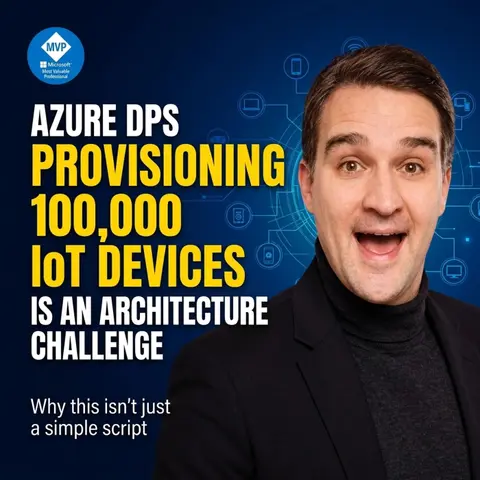
Azure DPS: Why Provisioning 100,000 IoT Devices Is an Architecture Problem

Key Takeaways
- Provisioning IoT devices at scale requires moving away from manual connection strings and embracing an automated architectural approach.
- Separating manufacturing identity from operational identity keeps device images portable across multiple customer environments and deployment waves.
- Azure Device Provisioning Service (DPS) acts as a secure reception desk that evaluates cryptographic proof and routes devices to their assigned IoT Hubs.
- Enrollment groups allow administrators to apply consistent security policies and provisioning rules to entire device families instead of managing records individually.
- Bootstrap software must implement robust, safe retry logic to handle imperfect first-boot conditions such as missing networks, proxy configurations, and DNS delays.
Provisioning ten devices on a shop floor is simple, as a technician can easily punch in a connection string and confirm telemetry. However, trying that same manual approach with one hundred thousand devices spread across global factories and customer networks causes every shortcut to turn into an architectural failure. Moving beyond basic setups requires a robust understanding of device identity, trust boundaries, hub routing, and long-term fleet management.
MANUFACTURING VERSUS OPERATIONAL IDENTITYA newly manufactured industrial gateway leaves the factory with a tested software image and local driver configurations, but it should never carry a hard-coded connection string for a future plant. Baking a permanent connection string into an image creates massive security risks if the secret ever escapes. Instead, separate your manufacturing identity (which proves what physical unit was built) from your operational identity (which dictates how and where the device connects to the cloud). This separation ensures your device images remain portable across different customer environments and deployment waves.
THE ROLE OF AZURE DEVICE PROVISIONING SERVICE (DPS)Azure Device Provisioning Service acts as the secure reception desk for your cloud estate, standing between unconfigured hardware and the specific IoT Hub that will handle its daily traffic. Rather than hard-coding endpoints, devices contact a global provisioning endpoint on first boot, present their cryptographic proof, and receive their assigned hub details based on predefined rules. This decouples the bootstrap software from the final destination, allowing you to manage large-scale rollouts without manual spreadsheet tracking.
MANAGING TRUST THROUGH ATTESTATION AND ENROLLMENTTo ensure only approved hardware enters your environment, devices must prove their identity using robust cryptographic attestation methods:
- TPM (Trusted Platform Module): Ties identity directly to a hardware chip, preventing cloned disk images from inheriting access.
- X.509 Certificates: Uses digital certificates and private keys, making it ideal for multi-tier supply chains and long-lived fleets.
- Symmetric Keys: Relies on shared secrets, which can simplify lab setups but require rigorous protection against extraction.
HANDLING FIRST BOOT REALITIES AND HUB ALLOCATIONFirst boot conditions in industrial plants are rarely pristine, meaning bootstrap software must gracefully handle missing networks, proxy configurations, DNS delays, and clock drifts through safe retry logic. Once admission is granted, DPS allocates the device to an IoT Hub using strategies like lowest latency, static configuration, or evenly weighted distribution. Proper capacity planning ensures that your assigned hubs can comfortably handle not just the device count, but the true operational telemetry volume and command traffic.
Become a supporter of this podcast: https://www.spreaker.com/podcast/m365-fm-a-microsoft-mvp-podcast-by-mirko-peters--6704921/support.
🚀 Want to be part of m365.fm?
Then stop just listening… and start showing up.
👉 Connect with me on LinkedIn and let’s make something happen:
- 🎙️ Be a podcast guest and share your story
- 🎧 Host your own episode (yes, seriously)
- 💡 Pitch topics the community actually wants to hear
- 🌍 Build your personal brand in the Microsoft 365 space
This isn’t just a podcast — it’s a platform for people who take action.
🔥 Most people wait. The best ones don’t.
👉 Connect with me on LinkedIn and send me a message:
"I want in"
Let’s build something awesome 👊
Frequently Asked Questions
What is Azure Device Provisioning Service (DPS)?
Azure DPS is a helper service for IoT Hub that enables zero-touch, secure provisioning of devices to the right IoT hub without requiring manual intervention or hard-coded connection strings.
Why shouldn't you bake connection strings into device images?
Baking a connection string into an image creates severe security risks if the secret escapes, and it removes flexibility by locking the device into a single destination before deployment.
What is the difference between individual enrollments and enrollment groups?
Individual enrollments target a single specific device and its unique settings, whereas enrollment groups define provisioning rules and trust methods for an entire family of shared devices.
How do devices prove their identity to Azure DPS?
Devices use cryptographic attestation methods such as Trusted Platform Module (TPM) chips, X.509 certificates, or symmetric keys to securely prove their identity during the registration process.
0:00 So provisioning 10 devices is easy. A technician punches in a connection string, checks that telemetry arrives, and moves onto the next cabinet. Try that with 100,000 devices spread across factories, customer sites, and field networks, and every shortcut turns into a real problem involving identity, trust, hub routing, recovery, and audit records. Stick with me, because we're tracing the architecture from the factory image to the IoT hub, a device finally joins. A weak onboarding path doesn't stay in the lab. It follows every device into the field, turning into security tickets, support calls, or devices nobody can safely replace. Start with the first problem every device has to solve. A device arrives with no cloud identity, picture a new industrial gateway leaving a factory floor in a sealed box.
0:41 The operating system is installed, the software image is tested, and the hardware already knows how to read PLC tags or sensor values, but it should not carry a hard-coded IoT hub connection string for some future plant. That connection string would answer too many questions too early. Which hub should it use? Which customer or site owns it? What happens if the device ships to another country moves from a test line to production or arrives at a plant whose network team hasn't opened the required outbound path yet? Before the gateway can send telemetry, receive a command, or report digital twin-state, it needs a trusted way to enter the cloud environment it belongs to. That path must work without a field technician opening a text file, copying secrets from a portal, and hoping they pasted the right value into the right device.
1:25 At 10 devices people can absorb that mess. They keep a spreadsheet, label the boxes, and call the engineer who knows which hub each one needs. At fleet scale, that engineer becomes part of the runtime architecture, which is a polite way of saying the design has already failed. Now the first separation to understand is between manufacturing identity and operational identity. Manufacturing identity answers which physical unit this is. It might relate to a hardware serial number, a board record, a protected chip identity, or a certificate injected during production. Operational identity answers a different question. Which cloud device can connect here, under which rules, and to which IoT hub? Those identities may link together, but they don't need to be identical. Foresign them to match without thinking through the life cycle often creates trouble later.
2:07 Here's where it gets practical. Say a hardware maker produces 1,000 identical edge gateways with the same image on every unit, some ship to plant A, some go to plant B, and another batch goes through a system integrator to customer sites that use a separate cloud boundary. The gateway software should not need a custom image for each destination, because if it does, you've turned deployment planning into image management where every small routing change needs a rebuild, retest, and new field process. Think of the device image like a blank employee badge. It proves the badge belongs to a real person, but doesn't print the building room and permissions onto the plastic before that person knows where they'll work. The device needs a bootstrap path instead, starting with a small set of stable facts. The provisioning service endpoint, the device's registration identity, and secure material it can use to prove that identity.
2:52 It does not start with a permanent IoT, hub address, and a broadly copied secret. That distinction changes how you handle a rollout. The factory builds and tests a repeatable device image. The deployment process decides where the device belongs and the cloud accepts it only after it proves it belongs to an approved enrollment rule. You also avoid a nasty failure mode, one connection string copied into every image. If that secret escapes through a disc clone, a support archive, or a laptop used during commissioning, the problem doesn't belong to one gateway anymore. It belongs to every gateway sharing it. For you, the practical move is simple. Don't bake a single IoT hub connection string into the standard image. Keep the image portable, keep its trust material controlled, and let the deployment architecture determine the operational connection only when the device first enters service.
3:38 That doesn't mean a device arrives with no identity at all. It arrives with the right kind for the stage it's in, enough to prove its original membership, but not enough to bypass your deployment rules. So provisioning isn't a setup screen. It's a controlled identity exchange between a device that needs a destination and a cloud service that decides whether it deserves one. What Azure DPS actually does, Azure Device Provisioning Service, DPS for short, sits between a device trying to join your cloud estate and the IoT hub that handles its daily traffic. Its job is to take a device through enrollment, verify its proof of identity, and then assign it to an IoT hub based on rules you defined ahead of time. DPS is not the system that receives every sensor reading from then on. It does not run your commands, store your telemetry, or replace the device to in capabilities inside IoT hub.
4:23 DPS handles just the admission event and once that is done, the device moves to its assigned hub for normal operations. Think of it like the reception desk at a large industrial site. A visitor does not walk in knowing which building which office or which access route they should take. They arrive at reception, show approved credentials, and reception checks the rules before directing them to the right building. The reception desk does not do the visitors job all day. It checks who they are and points them in the right direction. DPS works the same way. The device starts by contacting a global provisioning endpoint rather than a specific IoT hub endpoint. That matters because the device image can stay the same even when the final destination differs per site, per customer boundary, per rollout wave, or per device class. Along with the request, the device sends its registration identity and cryptographic proof.
5:06 DPS compares that proof against an enrollment record. If the device passes the check, DPS applies the enrollment rules and returns the details the device needs to connect to its assigned IoT hub. Those details tell the device where it belongs. From that point on, the device connects to that IoT hub and uses it for telemetry, Cloud2Device messages, direct methods, and device twin traffic. The provisioning conversation ends until the device needs to register again under the rules you allow. That boundary sounds minor, but it helps keep the architecture clean. If a device fails to register, you investigate its enrollment, its proof of identity, and the assignment rules. If a registered device fails to send telemetry, you look at its IoT hub connection, network path, permissions, and application flow. Without that separation, support teams end up treating every connection failure as one big Azure problem.
5:50 It never is. A device might fail at admission or it might pass admission and fail later during normal communication. Those are different parts with different owners and different evidence. DPS supports two broad ways to define who can come through the door. You can create an individual enrollment for one specific device. That record ties one registration identity and one attestation method to provisioning settings that apply only to that device. This fits cases where the unit needs an exception. Maybe it belongs to a special test station. Maybe it requires a fixed destination. Or maybe the asset process demands a record you manage one unit at a time. But individual records do not scale well as your default operating model, creating and maintaining them for every gateway can turn the provisioning service into another admin queue, just with more cryptography attached.
6:32 The other model uses enrollment groups. An enrollment group lets you define a rule for a family of devices that share a trust method and a provisioning policy. Instead of creating the same rule thousands of times, you set it once and let each eligible device register against it. Picture a device maker, shipping a standard gateway model to several plants. The hardware and software may match while the cloud assignment rules differ based on deployment class. Group enrollment gives you a way to apply those rules without changing the gateway image or hand-building every device record. The device still proves its own identity during registration. The group does not mean every device becomes anonymous. It means DPS can recognize that a device belongs to an approved family then apply the policy for that family. That distinction matters because people often hear zero touch and assume the cloud simply trusts whatever connects first.
7:17 No, zero touch removes manual setup from the field. It does not remove the trust check. If anything, it puts more pressure on the trust model because there may be no technician there to catch a bad enrollment. DPS also gives you a clean place to separate assignment rules from the application code running on the device. Your bootstrap software knows how to ask for provisioning. It does not need a hard coded list of hubs or a pile of customer-specific branches that grow every time the rollout expands. The cloud side enrollment rules decide which devices qualify and where they should land. The IoT hub then takes over the long-running relationship. That is the handoff. Once you see DPS as an enrollment and assignment layer, the rest of the design starts to make sense. The next question is, what the device actually does on first boot? From its first request to the point where it opens a live connection to its assigned hub.
8:01 Zero touch provisioning, step by step. Zero touch provisioning begins long before the device reaches a plant network. The device image contains bootstrap code, the public DPS endpoint, and the attestation material needed to prove that this particular unit or this approved device family can ask for a cloud assignment. That bootstrap code should stay small and predictable. Its job is not to know every plant, every hub, or every business rule that may exist next year. It needs to collect its registration information, access protected identity material, contact DPS, and handle the answer safely. Picture a gateway starting for the first time inside a new control cabinet. It has power, it has a network path if the site is ready, and it knows the DPS endpoint. What it does not know is the host name of the IoT hub, it will use for normal work.
8:44 That missing host name is deliberate. If the final hub lived inside the image, then the image would carry a deployment choice that might change after manufacturing, during shipping, or after a site cutover. DPS lets the gateway ask the cloud where it belongs when it actually enters service. The device sends a registration request to DPS. That request includes a registration ID and proof tied to the attestation method chosen for the device. The proof differs by trust model, but the intent stays the same. The device needs to demonstrate that it controls identity material accepted by an enrollment rule. DPS receives the request and looks for a matching individual enrollment or an enrollment group that accepts the device. It does not accept a plain serial number typed into a request. The service checks cryptographic proof against the rules you created before rollout.
9:27 That check changes the failure behavior in a useful way. If a device arrives with the wrong identity material, it does not quietly join the wrong cloud estate and send data somewhere unexpected. Registration stops and the failure points back to enrollment or attestation rather than becoming an invisible-roating error later. Once DPS accepts the device, it applies the allocation policy linked to that enrollment. The policy selects one IoT hub from the set you allow for that device class and then DPS returns the result to the device. In practical terms, the reply gives the device its assigned IoT hub hostname and the identity details it needs for the next connection. Depending on the enrollment path and settings, DPS creates or links the device identity in that hub as part of the provisioning flow.
10:07 The device did not need to carry that destination into the field. Think of the request as a temporary routing conversation. The gateway asks, "I can prove who I am." Which operational endpoint should I use? DPS checks the rulebook, chooses an approved hub and sends back a specific address instead of letting the device guess. The gateway then opens its normal connection to the assigned IoT hub. From there, its application can send telemetry, receive cloud-side actions and exchange twin-state using the identity attached to that hub assignment. There are two points people often blur together. Registring with DPS proves the device can receive an assignment. Connecting to IoT hub begins the device's ongoing operational session. A clean first step does not guarantee a clean second step.
10:48 DNS, firewall rules, time settings, or the local network can still block the hub connection. The device software needs to treat first boot as an unreliable event. A technician may power the cabinet before the switch port is live. The local DNS server may not resolve the endpoint yet. A planned firewall change may sit in an approval queue while the gateway waits in a rack. None of those conditions should force a human to re-image the device. The bootstrap process needs retries, reasonable delay between attempts, clear diagnostics, and a way to avoid hammering DPS or the network when a whole batch powers up at once. A retry also needs to be safe. If the gateway loses its network after DPS assigns a hub, but before it completes the next connection, it should not invent a new identity or treat the partial attempt as a broken install.
11:30 It should retry the registration path according to the rules and continue towards the approved operational state. This is where small implementation choices show up in field support. A device that logs its registration ID, the stage it reached, and a non-secret failure code gives a support engineer something to work with. A device that reports only "cloud connection" failed creates a long day for everyone. You also need to plan for temporary DPS unavailability, local internet loss, and reboots during start-up. Provisioning does not need to happen instantly for every device, but it needs to recover without manual credential work when normal infrastructure problems clear. Zero touch does not mean nothing happens. It means the device follows a repeatable path without someone sitting in front of a portal, copying credentials into a setup tool, and hoping the label on the box matches the row in a spreadsheet.
12:14 The flow sounds straightforward. Start, prove, assign, connect. But every step depends on what the device identity actually means, who controls it, and whether that identity survives the trip from manufacturing through service and replacement. The identity model behind the device. Here's the thing about registration. It only works if the names actually mean something stable. Most teams start with a serial number because it's already printed on the enclosure, and sometimes that works fine. But a serial number alone rarely gives you a full identity design. Think about what happens before a device sends its first useful signal. The boardmaker records hardware data first, then the device maker builds and tests the unit. Next, a warehouse tracks a shipment, a plant installs it beside a machine, your cloud needs an identity it can recognize all the way through that chain.
12:57 That's a lot of handoffs for one number to survive intact. So let's separate four identities that I see teams collapse into one field. The manufacturing identity belongs to the physical product leaving a production process. It might point to a board serial number an enclosure serial number, a supply a lot, or protected identity material inside the hardware. Manufacturing teams need this identity for traceability, test results, and warranty work. The enrollment identity belongs to the provisioning design. It tells DPS which enrollment record or group can evaluate this device when it requests admission. This connects the unit to the rules you created for its device class. Then you have the registration ID. This is the value the device presents when it registers with DPS. It needs to follow DPS naming rules and it needs to stay stable enough that your operations team can find the same device after it leaves the factory, sits in a warehouse for six months and later appears on a plant network.
13:47 Finally, the IoT Hub Device Identity Begins after assignment. This is the identity used for the ongoing cloud connection, device twin-state messages, and device side operations. It may match the registration ID, it may not. And the choice should come from a rule not from whatever field happened to be easiest during a proof of concept. Now, picture a typical industrial gateway. The enclosure has a serial number. The TPM or certificate has another identifier. The order system has a shipment line number. The MES may refer to the installed gateway through an asset tag tied to a work center. DPS needs a registration ID, while IoT Hub needs a device ID. Those values can connect clearly without being the same string. And in fact, forcing every system to use one string often creates false certainty. A serial number can change if a unit gets replaced.
14:29 An asset record can stay with the production cell even when the gateway changes. A cloud device identity may need to remain tied to the hardware or it may need to move with the logical asset. Your service process decides that. So write down what each identity identifies. Not what it looks like, what it means. If the registration ID identifies physical hardware, keep it with that hardware for its full life. If it identifies a logical device role, like the gateway assigned to packaging line 4, you need a clear replacement rule because the physical hardware will eventually change. This becomes very practical when someone asks a simple support question, which device is this? A technician reads an enclosure label. An OT engineer knows the asset tag, an IT engineer searches an IoT Hub device ID. If the mappings live only in one person's spreadsheet, the answer depends on who's on holiday.
15:13 Nobody plans for that. Your data model needs explicit links between those records. The cloud device ID should link to the physical unit where that helps. The physical unit should link to the asset or work center where it runs. ERP, MES, and asset systems can keep their own records, but they need a shared way to resolve the device behind a message. Registration IDs deserve more care than they usually receive. Pick a format that your device software can generate or read reliably, that meets the service rules, and that avoids accidental duplicates across suppliers and product lines. Don't build the format around a plant name if the same unit may ship elsewhere. Don't put sensitive customer data into it either because identifiers tend to travel farther than you expect. A stable, non-secret registration ID often works best when it derives from a controlled manufacturing record or protected device identity, with a clear prefix or rule that prevents collisions.
16:01 The exact pattern depends on your process. What matters is that every team can apply it the same way without inventing exceptions at the loading dock. There's another trap here. People sometimes assume the IoT Hub device ID must equal the hardware serial number because it looks neat and a portal. And it may be neat, until a supplier changes serial formats, a failed unit gets swapped, or the asset team needs one logical record to survive a hardware replacement. You can choose matching IDs when the lifecycle supports it. Just don't let the portal naming choice dictate the architecture. Device IDs affect how you search telemetry, manage twins, connect the dots between IT and OT, and explain a device's history during an incident. That's a lot riding on a naming decision. For you, this means identity design belongs before procurement, factory imaging, and shipment.
16:43 Define the manufacturing record, the registration ID rule, the enrollment link, the IoT Hub device ID rule, and the asset mapping while you can still change the process cheaply. Once thousands of labels, certificates, and images leave the factory, a naming decision turns into operational debt with metal around it, and that debt is hard to service. With those identities defined, the next decision is how each device proves it owns the identity it presents. Attestation is the security decision. A registration ID tells DPS which identity a device claims. Attestation answers the harder question. Can the device prove that claim using material and approved enrollment trusts? That proof must be cryptographic. A serial number in a spreadsheet can help you find a unit, link it to a shipment, or check a warranty claim. But anyone who can read a label can copy that number into another device.
17:26 It doesn't prove possession. It doesn't create trust. Think of a registration ID as a name on a visitor list. Attestation is the proof that the person standing at the gate controls the approved credential for that name. You need both, but they do different jobs. DPS supports three main attestation paths. A trusted platform module, usually called a TPM. X509 certificates and symmetric keys. Each path gives the device a way to prove itself during registration. But they create very different responsibilities for your factory, your cloud team, and your field service process. People often start by asking which method is best. That's the wrong first question. The better question is which method matches the hardware we can buy, the supplier process we can control, the threats we need to handle, and the support process we can live with after deployment.
18:09 A TPM keeps protected identity material inside a hardware security component. The device uses that component to create proof during registration without treating the proof material like a text secret that an installer copies around. X509 uses certificates and public key cryptography. The device holds a certificate and private key, while DPS trusts the issuing chain or a device specific certificate. This works well when you need a formal certificate process across device makers, suppliers, and long-lived fleets. Symmetric keys use a shared secret. The device and DPS each rely on related secret material to validate the request. This can reduce friction in controlled cases, but secret handling becomes the central risk. Because a copied secret doesn't carry the same hardware bound meaning as a TPM proof or a private key protected in a well-managed certificate setup.
18:54 None of these options fixes a weak deployment process by itself. You can put excellent cryptography around a device, then lose control because nobody knows which unit went into which cabinet. You can also maintain clean acid records and still create an exposure if secrets pass through too many factory tools. The attestation choice has to fit the whole chain. Take a managed industrial gateway that ships from one approved hardware maker, uses a repeatable image and enters plants under a controlled rollout. A TPM may fit naturally, because the hardware already supplies a protected root of identity and the production process can capture the required device information before shipment. Now take a device family built through several suppliers with certificates injected at different stages and a service model that expects certificate renewal over a long life cycle.
19:37 X509 may fit that chain better, because the trust structure can follow the issuing authority rather than requiring an individual administrative record for every unit. Then there are prototypes tightly controlled internal devices or small bootstrapping cases where symmetric keys can be reasonable. But that doesn't mean they become the default for every industrial device that leaves the lab. A simple secret becomes much less simple when it must survive contract manufacturing, shipping, field replacement, support access and an incident response process. Your threat model also changes the choice. Ask what happens if someone copies a device disk, extracts data from a retired unit, compromises a factory workstation or steals a gateway from an uncontrolled location. Ask which event you can detect, which device you can block, and what scope of exposure you create if identity material escapes.
20:21 Support matters just as much. A security design that only one cloud engineer understands will fail during a Saturday replacement call. The technician needs a controlled process that identifies the replacement hardware, links it to the right operational record, and proves its identity without handing out broad cloud credentials. This is why one universal answer usually creates trouble. A low cost sensor, a high value edge gateway, and a machine controller embedded by an OEM may need different trust methods, because their hardware, ownership model and service path differ. Standardize where the operating model truly matches, not because a single slide looks cleaner. Enrollment and attestation also need to stay separate in your thinking. Enrollment creates the rule, it says, which devices qualify, what settings apply, and which IoT hubs they may join.
21:07 Attestation is the device presenting proof at boot that it belongs under that rule. That separation gives you control without putting business logic into every device image. You can define policy in the cloud, then require each physical unit to earn admission through the trust material it controls. The device doesn't receive access because somebody typed its serial number correctly six months ago. For you, the first design decision isn't the DPS portal setting. It's the trust boundary. What identity material will the device protect, who injects or records it, who can change the trust rule, and what happens when that device fails in the field? Let's start with TPM next, because it fits many managed hardware deployments where you want trust tied closely to the physical unit. TPM attestation for hardware bound trust.
21:47 A TPM ties a device's identity directly to the physical chip. The module stores protected material and does its crypto work inside a sealed boundary. So when a device registers itself, it can prove who it is without ever sending a shared secret that software could copy export or paste into a commissioning tool. That changes the risk picture completely. If someone clones the operating system disk from one gateway to another, the clone doesn't automatically carry the TPM back to identity with it. The cryptographic proof depends on the hardware module inside the original unit, not on the disk image. Think of the TPM as a locked component on the board. It can answer a challenge, but it won't hand you the material it uses to answer it. Your bootstrap software asks the TPM to create proof and DPS checks whether that proof links back to a hardware identity at trust.
22:28 On a practical level, every TPM has an endorsement key, EK. That key comes from the module itself and acts as a hardware rooted identity for the chip. During manufacturing or intake, you capture the information DPS needs to recognize that TPM back to device. Then you create the right enrollment path before the gateway ever reaches the field. When the gateway boots, it sends its registration request to DPS and uses the TPM to respond to the service challenge. The device proves control of the TPM without sending a reusable secret across the network. DPS validates the proof against the enrollment information then proceeds with the normal assignment process. Now that doesn't mean you need to hand-build an individual record for every TPM device in every case. Individual enrollment gives you direct device-specific control.
23:09 You register the unit's TPM details, attaches provisioning settings and can manage that one unit as an exception when the process calls for it. That works for equipment with a special role or a tightly controlled asset record. It also creates a clear path when one gateway needs a different destination or different provisioning rule from the rest of its hardware family. A group approach can reduce repeated administration, but TPM-based group setup needs careful planning. You still need reliable device-specific TPM information and a way for the service to trust the physical units entering that group. A group rule doesn't turn hardware identity into a generic password shared by every device in the batch. This is where people get confused by the word group. The policy may apply to a fleet, but the proof still comes from each physical TPM.
23:51 You're scaling a rule, not lowering the bar for who can use it. The picture are managed industrial gateway built from a repeatable bill of materials. The board ships with a TPM. The factory loads the same approved operating image, runs its production tests, reads the TPM data required for enrollment and links that data to the unit's manufacturing record before the gateway goes into a shipping carton. The factory process matters more than the portal screen. If somebody captures TPM information from the wrong board, skips a batch or links the record to the wrong enclosure label, TPS may reject a legitimate gateway later. The TPM did its job, the traceability process around it failed. And that failure can be hard to spot before rollout because the device still looks normal. It powers on the operating system starts. The PLC driver can detects.
24:31 Then the gateway reaches DPS and can't prove that it belongs to the record your cloud team expects. You need a controlled handoff from the hardware built to the enrollment process. That means capturing TPM data at a known point, validating that it belongs to the physical unit on the line, and recording enough information to find the device again when it appears in a warehouse, a support ticket, or a plant cabinet. Replacement is another place where TPM designs force clear thinking. A replacement gateway brings its own TPM identity. You can't treat it as a drop-in copy of the failed unit from a cloud trust point of view, even if the disc image, gateway model, and physical job are identical. The service process needs to recognize the new hardware, enroll its TPM identity through the approved path and link it to the operational record that the failed unit previously supported.
25:15 Otherwise, teams start looking for shortcuts, reusing stale credentials or moving storage media between devices, and those shortcuts defeat the reason you chose hardware bound trust. Inventory accuracy still matters. A TPM can show that a specific device controls protected hardware identity, but it can't tell you whether that unit shipped to the correct customer sits in the right cabinet or replaced the asset your maintenance team thinks it replaced. So TPM attestation gives you a strong device bound proof at registration. It doesn't repair weak asset records, loose shipping data, or a field process where nobody records which box went into which machine. For you, that means treat TPM data capture as part of manufacturing quality, not a technical detail that someone exports after the shipment leaves.
25:56 If the physical identity and the enrollment record don't stay connected from the start, the first boot becomes where the paperwork finally argues with the hardware. Certificates solve a different part of the trust problem, especially when the device fleet needs a trust chain that can move through suppliers, production stages, and long service lives. X509 attestation for certificate-based fleets. X509 attestation takes a different route from TPM-based proof. A device holds a certificate and it's matching private key, then uses that private key to prove control of the certificate during registration without sending the private key to DPS. The certificate is a signed identity document. It contains public information about the device identity and an issuing authority signs it so DPS can decide whether to trust it. Public key cryptography lets the service validate the proof using the public side of that relationship while the private key stays with the device.
26:43 That makes certificates a good fit when trust needs to cross-company boundaries. A board supplier may prepare hardware, a device maker may install the software. A system integrator may deploy the unit, your cloud team still needs one clear answer to a basic question. Who issued the credential that lets this hardware enter our environment? You can handle that at the individual device level. DPS can trust a certificate tied to one unit, which gives you a direct record for that device and a direct control point if the device needs special treatment. That approach fits devices with their own service rules, unusual deployment parts or strict asset controls. It also means your administration process must create and maintain a record for every individual certificate. At low volume, that's fine. At fleet volume, it becomes another production, data flow you need to automate and audit.
27:25 Certificate authority backed enrollment groups change the model. Instead of uploading or managing a device certificate one by one, you register a root certificate or an intermediate certificate authority with DPS. Devices that present certificates issued under that trusted chain can qualify for the group, provided the rest of the enrollment rules match. Think of the issuing certificate authority as the approved stamp on a batch of control documents. DPS doesn't need to recognize every document before it arrives. It needs to recognize the authority that issued it, then verify that the device can prove it controls the private key linked to the certificate it presents. The trust chain must be set up carefully. A root certificate sits at the top. An intermediate certificate authority can issue device certificates beneath it.
28:06 In a well-run manufacturing process, you avoid treating the root as something that belongs on an ordinary production workstation because compromise at that level affects every device chain below it. DPS needs proof that you control the certificate authority you register. That proof of possession step prevents someone from adding a public certificate they found elsewhere and claiming its trust chain. The service gives you a validation step and you complete it using the private key for the certificate authority. Once DPS trusts the issuing certificate, the factory path becomes much more repeatable. A supplier or manufacturing line injects a device certificate and private key into each unit, ideally in protected storage. The same process records the certificate identity against the manufacturing record, test result, and shipment data for that physical unit.
28:49 Your cloud operator doesn't need to receive each private key. They should not receive it. The operator registers the issuing root or intermediate certificate in DPS and defines the enrollment group rules. The device keeps the private half. DPS sees the certificate chain and the cryptographic proof during registration. That split matters. The device maker owns the act of installing device identity material. The cloud operator owns which issuing authorities, the environment accepts. Neither side needs to pretend it can safely manage the other sensitive material through email attachments and shared folders, which is how very serious security designs often meet a zip file. Certificate names need a deliberate rule as well. The subject in a device certificate may carry a common name or other identity fields while the DPS registration ID tells the service which device is registering.
29:33 Those values can follow the same pattern when the lifecycle supports it, but they don't become interchangeable just because they both identify a device. Set the rule before factory production begins. Decide what the certificate subject identifies, what the registration ID identifies and how both values link back to the physical unit and its asset record. If a device certificate says one thing while the enrollment database expects another, the problem isn't cryptography. The problem is that two teams designed identity separately. The certificate also needs a planned life. It expires. That expiry date isn't a footnote in a security document. It affects whether a device can prove its identity during future registration, whether a replacement workflow works cleanly and whether your service team can keep a unit in operation without improvising credentials.
30:15 Revocation needs the same level of planning. If a device is compromised, lost or built with exposed key material, you need a way to stop trusting the relevant certificate or issuing path without guessing which system still accepted. A certificate-based fleet gives you clear controls, but only if ownership of those controls is defined. Replacement adds one more constraint. A replacement gateway receives a new private key and a new certificate. It may take over the physical job of the old unit, but it doesn't inherit the old certificate by moving a disk or copying a configuration folder. The new hardware must enter through its own trusted proof. That is why X509 isn't merely a provisioning option you tick in DPS. It connects your device factory, certificate authority, cloud enrollment rules, and field service process into one chain. The certificate lifecycle becomes part of your production and service process.
31:00 Certificate lifecycle beyond day one. The moment your first device leaves the factory, the certificate fleet starts aging. Every device certificate carries an expiry date and that date belongs inside a service process you own, not buried in a document nobody reads until a gateway fails to reconnect. If a device stays online with an existing session, expiry might not bother it right away. But during a reboot, network outage, reprovisioning event, or replacement call, that expired credential becomes painfully obvious. The device has to prove itself again and its allowed date is passed. Plan renewal before that date arrives by giving the device a safe way to receive, install, and start using a replacement certificate while its current credential still works.
31:41 And the process must preserve the identity rules you set for the fleet, not create a new naming scheme every time a certificate changes. That means separating the long lived identity of the physical unit from the certificate instance that currently proves it so the gateway can keep the same registration rule and asset mapping while the certificate serial number and expiry date change underneath. You also need a plan for when renewal doesn't work. A device might be offline for months, its clock could be wrong, or a certificate update would fail halfway. The software needs a defined path for these cases because send someone on site with a new certificate isn't a process until you define who approves it, what they install, and how they prove they worked on the right unit. Revocation handles a different event than expiry, which is expected.
32:23 Revocation responds to lost hardware, suspected key exposure, a compromised supplier system, or a device that should no longer enter your cloud environment. When you revoke trust, you need to understand the scope. Removing trust in one device certificate is very different from removing trust in an intermediate CA that issued credentials to an entire batch. That second action might be necessary in a serious incident, but it can also block healthy devices that depend on the same chain. That's why certificate trust management needs an incident path before the incident occurs. Security needs authority to stop a bad credential. Operations needs to know which devices lose access and field service needs an approved recovery path. If those decisions start only after a suspected compromise, the technical control becomes a business outage with no map.
33:07 Supplier changes create a quieter version of the same problem. Maybe a device maker changes its CA. Maybe you move certificate issuance into a different controlled environment, or maybe an acquired product line arrives with its own trust chain and assumptions about naming and renewal. Don't replace one trusted route with another in a single cutover and hope every device appears on schedule. Instead, trust both chains during a controlled migration period issue new credentials under the new chain, track which units moved, then retire the old chain only after the remaining devices have a clear treatment path. A staged migration gives you evidence. You can see which devices renewed under the new authority which stayed offline and which need a targeted service action. Without that staging, the first misdevice may surface months later during an outage when its old certificate chain no longer has a valid path.
33:54 Field replacement exposes all the assumptions in the design. A technician arrives because a gateway or board has failed and they may need to restore a production cell quickly, but they shouldn't solve the problem by copying the old device certificate and private key onto the replacement hardware. The replacement unit needs its own approved credential and its own proof of identity and your process then links that new device identity to the logical asset, machine position, or service record that the failed unit supported. The old credential should lose trust when the old unit leaves service, subject to your organization's retention and incident rules. Warranty work needs the same discipline. When a supplier swaps a board, determine whether the protected identity moved with the board, remained with the enclosure or changed completely. Those aren't paperwork details.
34:35 They decide whether the replacement can register and whether your record still point to the unit running beside the machine. For you, certificate design reaches past cloud enrollment into supplier contracts, warranty returns, field repair, incident response, and the practical question of what a technician can do without carrying broad cloud access on a laptop. Symmetric keys look simpler, so let's examine the trade-off plainly. Some symmetric keys and their limits. Symmetric key attestation uses a shared secret. The device proves it knows secret material that DPS can validate and then DPS decides whether that device belongs to an approved enrollment rule. It's a familiar model for many software teams. The device starts with a secret and uses it to create an authentication token, and the service can validate that token because it holds the related secret material.
35:17 No certificate chain is involved, and there's no TPM challenge path to manage. That simplicity can be useful, but it also moves the risk into one very specific place, how you create, store, transfer, and protect that secret from the first factory step through the full device life. With an individual enrollment, each device receives its own Symmetric keys in DPS. The device holds its matching credential and the individual enrollment defines its registration ID and provisioning rules. This gives you direct control over one device. If a unit needs a unique setup, or you need to stop it from registering, you can act on its individual record. But the work grows with the fleet because every device needs its own secret handling path record and way to receive protected material without exposing it during manufacturing or service.
36:01 At small scale, teams often accept that overhead, a lab build may inject a secret during image creation, store it in a protected local store, and use it only in a controlled test environment. But the danger begins when that same shortcut quietly becomes the standard process for production hardware. A disk image is easy to copy, and a secret inside that image is easy to copy too. Group enrollment takes a different approach. You create a group enrollment in DPS with group-level symmetric key material, and each device then uses a registration ID and derives its own device-specific key from that group material. The device-specific result matters because devices in the same group don't all authenticate with one identical-derived key. Their registration IDs feed into the derivation process, so each unit can produce a credential associated with its own identity while the enrollment group supplies the shared root material.
36:49 That gives you a repeatable pattern for a large device family. A factory can apply the same enrollment design across a batch while each device still registers under its own registration ID, and you avoid creating a separate cloud enrollment rule by hand for every unit. But the shared root material still carries group-level risk. If somebody extracts it from a factory tool, exposes it in a build pipeline or copies it from a poorly protected device that exposure can reach far beyond one unit. An attacker who holds that material may derive credentials for registration IDs within the group depending on the rest of your controls. This is the trade-off people miss when symmetric keys look easy and apportal. The registration ID creates separation between devices, but it doesn't magically erase the importance of the group secret.
37:32 Protecting that root material becomes one of the main security jobs in the entire provisioning path. Think about a contract manufacturer preparing a batch of gateways if the process requires technicians, test tools, or deployment scripts to read a group secret in plain form. Every one of those points becomes part of your security boundary. You need to know who can access it, where it lands, where the logs capture it, and how you rotate it if exposure is suspected. That can be manageable in a tightly controlled bootstrapping case. Maybe you're validating an internal prototype or the devices run in a low-risk environment under direct operational control. And you need a practical way to establish the first connection while the hardware design is still evolving. Symmetric keys can also fit devices where cost and hardware limits rule out a TPM or a fuller certificate process.
38:16 But even then, less expensive hardware doesn't remove the need for a serious secret handling process. It just means more of the trust burden sits in your manufacturing workflow and device software. For a fleet of long-lived industrial devices, ask hard questions before choosing this root. Can the secret be extracted if somebody gains physical access? Does your OS protect the secret well enough? Can a supplier inject it without retaining a copy? If group material leaks, can you identify the affected devices and rotate the trust path without shutting down a whole rollout? Those questions don't mean symmetric keys are automatically wrong. They mean the design has a narrower margin for careless handling. A certificate private key can also be mishandled. And TPM-based projects can still fail through poor records, but group symmetric material creates a shared point of exposure that you need to treat with full seriousness.
39:00 I tend to see Symmetric keys work best when the deployment boundary is controlled, the fleet risk is understood, and the secret path can be kept short. They become a poor fit when devices pass through many hands, remain in service for years, or sit in places where physical extraction and uncontrolled copying are realistic concerns. Choose the method based on the device and the operating process, not on which setup screen takes fewer minutes to complete. Those saved minutes disappear quickly when a secret turns up in the wrong image archive. Attestation proves the device can enter the door. Enrollment decides what that trusted device receives once it gets there. Individual enrollments, per device control. Individual enrollment is the most direct way to control a device in TPS. You create one record for one physical device attached its attestation method, set its registration identity, pick its IoT hub assignment settings, and apply provisioning rules that belong only to that unit.
39:48 Nothing gets inferred from a wider device family. The record tells DPS exactly what that device may do when it asks for admission, and gives your operations team a single place to inspect or change that decision without affecting the rest of the fleet. That level of control fits certain industrial cases well, take a high value machine gateway sitting beside expensive equipment, the asset record, service process, and cloud boundary all need individual treatment, or a regulated device that requires a traceable approval path for each unit, who enrolled it, which trust material it used, and where it was allowed to connect. You might also have exceptions that don't fit the standard rollout path, a device supporting a special test cell, sitting in a lab with a separate IoT hub, or needing different initial setup because it's data path owner or support model differs from the surrounding gateways.
40:34 Here's the real advantage. Individual enrollment lets you express those differences cleanly. No special branches in the device software, no distorting a wider policy just to handle one unusual unit. A production test station near the end of an assembly line runs the same general gateway hardware as other stations, but it sends test results into a separate IoT hub because the data needs a different retention path and a different set of operational users. That station may also need its own device identity rule. Perhaps the device ID must tie directly to the station's controlled asset record, while ordinary plant gateways, user standard manufacturing pattern. The individual enrollment sets that exception directly instead of asking a general enrollment policy to guess what sort of device it's dealing with, the benefit really shows up during an incident.
41:15 One device gets lost, behaves unexpectedly or leaves service. You block or change that one enrollment record. You aren't changing trust for a whole hardware family just because one unit needs attention. Replacement is more direct too. When a new physical unit takes over a defined role, you create the approved record for the replacement and retire the old one through a controlled process. The records show the difference between hardware that left service and hardware that now holds approved cloud access. That control has a cost. Someone needs to create, review, update, and retire each record and those steps need reliable input from manufacturing, deployment, or asset systems. At a few devices, that's completely reasonable. At thousands of devices, it becomes a queue of administrative work with plenty of chances for a typo, a wrong ID, or a record that never got closed.
41:59 The real problem isn't that individual enrollment lacks scale inside the service. It's the human process around it. If every device needs a person to decide its settings one by one, then every rollout batch depends on manual records staying correct under time pressure. You can automate parts of that work, but the design still needs to justify the per device exception. Don't choose individual enrollment simply because it feels safer to see every device listed separately in a portal. A long list of records isn't controlled if nobody can explain which records differ, why they differ, or who owns the next change. Use individual enrollment where the unit itself carries a meaningful exception, a specific machine, a control test station, or a device under a special compliance process. For ordinary repeated hardware, per device records often turn a repeatable fleet rule into unnecessary admin work.
42:45 The question to ask is simple. If 10,000 devices follow the same trust and assignment pattern, what new decision does a separate record actually make for each one? If the answer is none, you're maintaining 10,000 copies of the same policy. That's where enrollment groups come in. They handle those repeated patterns without repeated admin work. Enrollment groups, fleet rules at scale. Enrollment groups are where DPS, starts behaving like fleet architecture rather than a collection of device records. You define one shared policy for devices that follow the same operational pattern, then DPS applies that policy each time in eligible device registers. The group can represent a gateway model, a supplier batch, a deployment class, or a defined type of plant.
43:26 What joins those devices isn't that they report to the same manager or sit under the same business unit. They share the same trust path and need the same cloud onboarding treatment. That distinction keeps the group useful over time, and org chart changes after a reog. A device family, a certificate issuer, or a regional deployment boundary tends to have a much clearer technical meaning. With X and 509, the group commonly trusts a certificate authority chain. Each device arrives with its own certificate and private key, while the group accepts certificates issued by the approved authority. DPS can apply one common policy without treating every device as the same identity. Symmetric key groups work differently. The group holds root key material and the device derives its own credential from that material and its registration ID.
44:07 The policy scales across the fleet, but the shared root material still needs tight control because it sits at the start of every derived device credential in that group. Both models solve a repeated problem. The device fleet needs common rules, while each physical unit still needs to prove its own right to use them. The group gives you a policy boundary and it shouldn't become a bucket where you throw every device just because their housings look alike. An enrollment group can define the IoT hubs available to its devices and the policy DPS uses to choose among them. It can also apply initial device twin settings and tags during the provisioning event, so the device lands in the cloud with more than an address. It arrives with an approved starting context. Picture one standard edge gateway image leaving the same factory line.
44:50 Half the units ship to plants in one region, the other half to a different region, whether support team IoT hub boundary and roll out rules differ. Nobody needs to build a second image just because the cloud rules changed. The two sets of devices register against separate enrollment groups, each trusting the relevant device identities, pointing to its approved IoT hubs and applying the starting settings for that deployment class, same hardware, same bootstrap software, a different cloud policy that saves you from a familiar industrial pattern. Someone asks for a tiny change in a side roll out, then the change gets pushed into the gateway image because the cloud model has no other place to express it. A few exceptions later, the image no longer belongs to a device model. It belongs to a pile of past projects. Group boundaries should follow real operational differences.
45:32 Use a separate group when devices need different trust authorities, different hub boundaries, different assignment rules, different initial configuration, or different support ownership that changes how provisioning should behave. Don't split groups merely because one belongs to operations and another to engineering. If both sets of gateways share the same trust, rooting and start-up policy, the separation creates extra records without changing a technical decision. You end up with two copies of the same rule and they drift. They always do. On the flip side, don't force two fleets into one group just to keep the DPS portal tidy. If one fleet must stay inside a country-specific cloud boundary, while another can use a shared regional hub pool that difference belongs in the group design. The enrollment group is where you express that boundary before a device enters service.
46:14 Supplier batches can also justify a group when the supplier process changes the trust path. Maybe one batch receives certificates from an approved intermediate authority, while a later hardware revision uses another controlled issuer. The group lets you keep the trust policy clear while you manage both paths intentionally. But be careful not to treat a batch label as an eternal architecture rule. A batch is useful if it maps to a real difference in certificate issuance, hardware identity, or rollout control. If it only describes the day a pallet left the warehouse, it probably doesn't need its own provisioning policy. Think of enrollment groups as the release lanes for device onboarding. A release lane defines which units may enter, where they can go, and what starting rules follow them. It doesn't describe every detail of the physical asset, and it doesn't replace the records your ERP, MES, or asset system already owns.
46:59 For you, the design work happens before you create groups in DPS. List the device classes you expect to operate then identify which differences actually changed trust, assignment, or first boot configuration. Those differences define the groups, everything else belongs somewhere else. A good group model gives your rollout team control paths instead of one giant fleet rule with exceptions taped all over it. When a new gateway registers, DPS applies a policy that already matches the deployment, rather than relying on a technician to decide what the device should become while standing in front of a cabinet, and provisioning can set more than connection details. Initial device state, tags, and desired properties. Once a device passes enrollment, DPS can do more than just pointed to what an IoT hub.
47:43 The enrollment also applies an initial device twin state, including tags and desired properties, so the gateway boots up with a controlled starting configuration instead of an empty record waiting for someone to set it up later. That might sound like a small detail, but it really isn't. First boot settings often decide whether the gateway starts behaving like a generic box or like the approved device for a specific deployment. Desired properties live on the device-facing side of the twin. Your cloud side writes the desired state, the device software reads that state, applies the settings it understands, and then reports back what it actually applied. That last part matters. A desired value is an instruction, not proof that the device accepted it. Here's a practical scenario. Say a gateway goes into a packaging area.
48:23 The initial desired properties might tell it which side code to use in its payloads, which sampling plan applies to its connected sensors, or whether it should follow a stable software channel rather than a pilot channel. Those settings reach the device through the normal twin model after provisioning. Now, the device needs explicit code for each setting. If it receives a sampling interval, it must validate the value, update the local data collection behavior, and report its applied state. If the property means nothing to the software image, it just sits there as a line of JSON with no effect, which is a very efficient way to create a future support problem. Keep these properties focused on settings the device can actually act on. Sidecode, approved endpoint behavior, collection rules, feature flags, and software release channels fit well when the gateway needs them for its own operation.
49:06 And the device should handle missing, malformed, or unsupported values in a controlled way. Tags work differently. They belong on the cloud facing side of the device twin. The device doesn't receive them as instructions, and it shouldn't depend on them for local behavior. Their job is to help the cloud organize devices for reporting, rooting, queries, and daily operations. A tag might identify the deployment class, the plant region, the equipment family, the support tier, or a rollout wave. Your cloud processes query those tags when they need to select a set of devices, send data toward a given flow, or build an operations view that separates one device class from another. Think of desired properties as the settings card inside the cabinet, while tags are the labels on the outside that help your operations team sort and find cabinets later.
49:48 One guides device behavior. The other helps cloud side systems understand how to treat the device. That separation prevents a common design error. Teams put site context into tags, then expect the device to read that tag and change its behavior. Or they put cloud only rooting information into desired properties, then create needless device updates every time a reporting rule changes. Decide who needs the data before deciding where it belongs. Initial state also needs restraints, don't put secrets into desired properties or tags. Device twin data can move through operational tools, diagnostic views, and application paths that aren't designed to protect credentials. A secret place in a twin tends to become visible to far more people and systems than you planned. The twin also isn't your full asset master. It can carry a useful operating view of the device, but it shouldn't become the only place that knows the work center, warranty status, maintenance history, shipping record, owner, and every other fact that belongs in business systems.
50:39 Your ERP still owns the records it owns, your MES still owns production context, your asset management or CMS still owns maintenance and service history. DPS and the device twin receive the small slice of context needed to provision and operate the device, while explicit mappings connect that cloud identity back to the systems where the wider record lives. That keeps the data model honest. A device may carry a site code for local behavior and a deployment tag for cloud operations, while the authoritative location, asset relationship, and service record remain in systems built to manage those facts over time. It also makes change easier to reason about. If a site reorganizes equipment records in the asset system, you don't want to discover that dozens of device twins had become an untracked second copy of the same data.
51:20 CloudState should support operations, not quietly replace systems that already own the business record. So use DPS initial state to give a device a clear starting position, put device instructions in desired properties, put cloud site grouping data in tags, keep secrets out and keep the full physical asset story in the systems that own it. Initial state only works when the device knows how to act on it. Bootstrap software and first boot behavior. The enrollment rule can place initial state on the device twin, but the device image still has to do the work. A gateway doesn't become site aware, just because a desired property exists in the cloud. Its bootstrap software needs to connect, read the state it receives, validate it, and apply only the settings that belong on that hardware. Keep the bootstrap layer small but treated seriously.
52:02 It needs DPS client logic access to the chosen attestation material, a retry policy, time handling, and clear local diagnostics because this code runs at the one moment when the device has the least context and the site has the most unknowns. On first boot, the gateway should read the identity material available on that unit. Depending on the trust model that may mean using a TPM interface, loading a protected certificate and private key, or accessing the secret path you designed for a controlled symmetric key case. It then contacts the DPS endpoint and waits for an approved assignment. The normal application doesn't have to guess an IoT hub name from a config file a site label or a rule copied into an image six months ago. The bootstrap path asks the provisioning service and uses the result it receives.
52:43 Once DPS returns an assignment, the device can persist the IoT hub host name and related non-secret connection state where that suits the design. Persisting that result can reduce needless provisioning traffic after ordinary restarts, but the local record should never become an unchecked source of truth that survives every lifecycle event no matter what changed in the cloud. You need clear rules for when the device uses its stored assignment and when it registers again. A factory reset, a deliberate reprovisioning action, damaged local storage, or a planned move may require a fresh path. An ordinary reboot after a brief power loss usually shouldn't turn into a full identity event just because the power flickered. The device also needs to behave sensibly before it has a network.
53:24 That sounds obvious until a field engineer watches a new gateway fill its logs with failed requests every few seconds while the network team still configures a switch port. No network is a normal first boot condition. DNS failure is normal too, especially when local resolvers, outbound rules, or split DNS settings haven't reached the final plan setup. The bootstrap service should distinguish these failures where it can, record enough detail for support, and wait with increasing delay rather than retrying at full speed forever. Proxy rules complicate the path as well. Some plant networks send outbound traffic through an approved proxy, while others permit direct outbound connections under controlled firewall policy. If the device may encounter a proxy that support needs to exist in the image and in the site design before the unit arrives, a proxy field typed into a laptop during commissioning isn't zero touch.
54:11 Its manual recovery wearing a nicer shirt, system time creates another quiet failure. Certificate-based connections depend on time that makes sense. A gateway with a clock far in the past or future may reject a valid certificate or fail to establish a secure connection even though the enrollment and network rules look correct from the cloud side. So the bootstrap process needs a time strategy appropriate to the device and network. That may include reaching an approved time source once connectivity exists, preserving time across short power losses where hardware permits it, and logging clock-related failures in a way that tells support what actually happened. Repeated startup needs the same discipline. Provisioning logic should be idempotent, which means a retry leads to what the same intended operational state instead of creating a different story each time it runs.
54:53 Picture a gateway that reaches DPS, receives its assignment, then loses power before it completes its first normal IoT hub connection. When power returns, it should not create a duplicate local identity, switch itself to a different configuration branch, or behaviors though a technician must begin from scratch. It should resume the approved path. If it must register again, it uses the same hardware identity and accepts the outcome under the enrollment policy. If it has a valid stored assignment and the policy allows it, it reconnects to that assigned hub and continues. Consider a new cabinet installation on a Monday morning. The gateway powers up when the panel receives power, but the firewall rule for its outbound path remains in a change queue until later that day. The unit should wait, retry with back off, and expose a clear status locally or through approved diagnostics once the network path becomes available.
55:39 Nobody should need to pull the gateway from the cabinet, rebuild its image, or paste a cloud credential into a service tool because the firewall approval took longer than the wiring work. That kind of work around turns a temporary network delay into a permanent weakness in the process, build the first boot path as if it will run in incomplete conditions, because it will. It needs protected identity access, controlled retries, sensible time behavior, network diagnostics, and a stable response when power or connectivity drops halfway through. After the device passes that validation path, DPS still has one decision left, which IoT hub should receive it. IoT hub allocation policies. Once DPS accepts a device, it picks an IoT hub from the hubs linked to that enrollment. That choices the allocation policy.
56:21 It looks like a small setting, but it decides where the device lands in your operating model. The device doesn't pick a hub based on a host name baked into its image. Instead, DPS evaluates the enrollment policy, checks the linked hub list, and returns the hub selected for that registration. That gives you one bootstrap path while keeping the assignment rule in the cloud, where you can manage it as part of the wider architecture. Think of it like dispatching trucks to depots. You don't send each truck to the nearest pin on a map and hope the depot has space, accepts that load, and belongs to the right legal or service boundary. You use a dispatch rule that considers where the truck belongs and what the depot is meant to handle. DPS gives you several ways to express that rule. Lowest latency, evenly weighted distribution, static configuration, or a custom allocation function.
57:03 Each one answers a different question, so picking one should start with the business and operating boundary, not with which label sounds most automatic. Lowest latency places a device with the IoT hub that responds with the lowest network delay during provisioning. This can fit a fleet where the linked hubs cover different regions, and the device network path gives a useful signal about which hub can respond most quickly. Now here's where the limits show up. Network delay at registration is not a full model of where the plant sits, which legal region owns its data, or where the support team expects that device to land. Plant networks use proxies, private routing, shared internet exits, and security controls that can make a simple latency test tell a very incomplete story. Geography helps you plan, but it doesn't prove the live network path.
57:46 Even the weighted distribution takes another approach. Link several IoT hubs, then assign weights that express how you want new registrations to spread across them. A hub with a higher weight receives a larger share of devices over time, which can help you divide a broad fleet according to plant capacity. The word "planned" matters. A weight doesn't measure current telemetry volume, command traffic, device health, or a site outage. It expresses a distribution intent at the point of assignment, so you still need to plan what each hub can handle after the device is beginning sending real shop floor data. Static configuration sends devices to the hub you specify with no selection across a pool. The enrollment points to a defined destination, and every device under that enrollment follows that route unless you change the rule. That may sound less sophisticated than an automatic policy, but in many industrial environments it is exactly the right choice because the device belongs to a known plant, customer, country boundary, or operating team before it ever powers on.
58:38 A deterministic rule can be far easier to explain during an audit or support call than a selection based on a measurement no one recorded at deployment time. Custom allocation lets you call your own function to decide the hub assignment. It exists for cases where the built-in rules don't match the way your organization decides device placement. You might need a controlled rule based on approved deployment data, a product restriction, or a rollout gate that sits outside the standard enrollment fields. Use that option with restraint. Every extra decision point becomes part of the first boot path, and that path already faces real plant network conditions, device resets, and support pressure. If a custom function becomes a miniature asset system, a contract engine, and a regional routing service all at once, you've placed a fragile dependency between the device and its first cloud connection.
59:23 The policy should answer one focused question, which linked IoT hub should this approved device use? It shouldn't become a dumping ground for every bit of context the business wants to attach to a device. Your choice changes more than initial routing. It affects capacity planning because device populations land on specific hubs. Data residency because an assignment can place operational data under a given regional boundary, and support because teams need to know where to look when a gateway reports a problem or when a device twin needs inspection. Picture a support engineer receiving an alert from a line-side gateway. If the assignment model follows known operational boundaries, they can trace the device from its identity to the expected hub without first reverse engineering a hidden routing decision.
1:00:05 That saves time when the production team is waiting for an answer, not a lecture about cloud topology. So don't treat allocation as a default checkbox you select after enrollment works. Define what hub ownership means for each device class, what boundary the assignment must respect, and whether automatic distribution adds real value or just hides a decision you should make explicitly. Static assignment helps when business boundaries matter more than balancing. Static and Geography Aware assignment. Static assignment works when you already know where a device belongs before it reaches the site. A gateway ships for a named plant, a named customer, or a defined network zone, and the enrollment rule sends it to the IoT hub that owns that boundary. That is often the cleanest industrial design because the device team doesn't need to infer location from its network path, and the installer doesn't need to select a destination from a setup screen while standing beside a machine.
1:00:55 Think about a supplier that ships identical gateways into separate customer environments. The hardware image can stay the same, but each customer may need a separate cloud boundary because of contract terms, support ownership, network controls, or internal data rules. Static assignment turns that boundary into a rule before the device connects. You can then trace the device path clearly. The enrollment group tells you which kind of device registered. The static hub rule tells you where it should land, and the asset mapping tells you which physical job it supports. Those records don't need to depend on a technician remembering a choice from installation day. A fixed plant boundary works the same way, say a group of gateways only belongs in one factory, where one operations team owns the IoT hub, and its downstream data flow.
1:01:35 Point that enrollment group at the assigned hub, if the unit appears somewhere else, that should trigger investigation, not automatic routing based on whatever internet exit it happens to use. This matters when network paths get messy, which they often do. A plant in one country may send outbound traffic through a shared corporate gateway in another place. A remote site may use a proxy, a service laptop may temporarily provide the network path. The IP route tells you where the request emerged, not always where the equipment lives. Lowest latency allocation can still fit some fleets. It works best when devices can enter a pool of approved hubs, and network response time gives a useful first signal about the closest operational destination. For example, a broad deployment of similar low-risk devices may use regional hub pools where the physical location is not fixed in advance, and the network path normally follows local routing.
1:02:21 In that case, lowest latency can reduce the need to pre-sort every unit before first boot, but treated as guidance, not geography, DPS measures response time during registration. It doesn't confirm the legal data boundary, the customer contract, the plant address, the support team, or whether the device sits behind a network design that sends traffic through a distant exit point. A low-latency result can be technically correct and still send the device to the wrong place for your operating model. That isn't a failure in the service. It means you asked a network measurement to answer a business and governance question. So plan your linked hub lists by deployment class. A deployment class might represent a country boundary, a customer tier, a managed service zone, or a defined family of plants with the same operating rules. Each class gets the hubs that it may genuinely use.
1:03:04 Don't link every hub in the estate to one giant enrollment group and expect the allocation policy to sort out the rest. That turns a clear assignment design into a wide pool full of places the device should never reach. A clever rule can't repair a boundary you never defined, picture two device families leaving the same factory. One family goes only two sites in one country. The other supports a business unit that runs plants across several approved regions. They can use the same bootstrap image and even the same hardware model while separate enrollment groups give each family the correct hub list and assignment rule. The country bound group might use static assignment because the destination must remain fixed. The business unit group might use lowest latency across a limited set of hubs because those sites can operate under a shared regional model.
1:03:45 The difference comes from ownership and deployment facts, not from a preference for one portal setting. You also need to account for changes. If a device moves between plants, don't assume its original latency result should decide this new cloud home. Handle the move through an approved lifecycle process that updates the enrollment path and the asset mapping because moving equipment can change more than its physical address. Static rules give you clarity where a boundary must stay fixed. Lowest latency gives you a controlled option where network proximity can guide the first placement. Both work when the hub list already reflects the places that device class is allowed to enter. Balancing policies solve fleet spread but they need capacity awareness. Low distribution and hub capacity planning. Evenly weighted allocation gives you a clean way to spread new device registrations across a set of linked IoT hubs based on a planned ratio.
1:04:32 You assign a weight to each hub and DPS uses those values when it picks a destination for devices in that enrollment. Think of weights like lanes at a receiving dock. If one lane should handle twice as much incoming work as another, you plan for that before the trucks arrive. The weights tell DPS how to divide the incoming fleet. They don't inspect every lane in real time and decide which one looks least busy that second. That distinction matters because a device count is only one piece of an IoT workload. Two hubs can each host a similar number of devices while one receives much more traffic because its gateways collect fast sensor data, send frequent health reports, or support a larger share of active production lines. A hub with fewer devices can carry more operational work that catches teams out when they plan only around registration numbers then discover that the devices don't behave like identical units once they enter production.
1:05:18 Weight's express intent. They might reflect a plan split between hubs a staged expansion of capacity or a decision to keep more room on one hub for a coming rollout. They don't measure current message throughput. They don't know whether an application downstream has slowed down. They don't sense a side-wide outage, a burst of commands, or a maintenance event that brings a large device population online together. DPS makes an assignment decision during provisioning. Your daily telemetry design has to carry the result long after that decision finishes. So capacity planning needs a wider view than how many devices can we divide between these hubs. You need to understand how many devices will connect, how often they send messages, how large those messages are, and whether traffic arrives at a steady pace or in sharp bursts tied to production shifts, power restoration, or scheduled data uploads.
1:06:04 Command traffic matters too. A device that only publishes periodic telemetry places a different load on the system than a gateway that receives configuration changes, software management actions, frequent twin updates, or cloud-to-device commands while it manages a live process. Then look ahead to roll-out waves. A hub plan that handles the first plant may look balanced on paper, but a second wave could bring a different device class with more tags, more connected assets, or a much faster data cadence. The device count might still fit the original ratio. The workload may not. Here's the real challenge. The cloud team can see hub assignment and service limits, but the OT team knows which devices sit on high-speed equipment, which ones report only a few signals, and which line changes could cause many gateways to wake up or reconnect at the same time.
1:06:47 Neither view works alone. If you plan only from the cloud side, every device can look like a generic connection. If you plan only from the shop floor side, it is easy to miss the shared cloud path where all those connections land. Keep two questions separate, even though they affect each other. Provisioning capacity asks whether a roll-out batch can register safely and receive assignments when devices first boot or retry. Daily telemetry capacity asks whether the assigned hubs and the rest of the data path can handle normal operation, unusual bursts, and future use without turning one local event into a broad service problem. Those questions need different tests. A successful first boot test proves that the device can enrol and connect, but it doesn't prove that thousands of devices sending production data on the same schedule will behave well once dashboards, storage, alerts, and downstream applications consume that data.
1:07:35 Consider a fleet split evenly across two hubs. One-half supports simple environmental monitoring in warehouses. The other half sits beside production equipment and sends more frequent readings, status changes, and operational events. DPS can distribute the number of devices exactly as planned, while one hub still carries a much heavier load. The policy didn't fail. The architecture assumed equal device count meant equal device work. For you, use weights to express a deliberate fleet split, then validate that split against actual device behavior. Build a model that includes message patterns, command needs, roll-out timing, and the difference between idle devices and devices attached to active production. A balanced fleet list can still produce an uneven IoT workload.
1:08:16 Some organizations need assignment rules that draw from their own source data. Bootstrap software and first boot behavior. The enrolment rule can place initial state on the device twin, but the device image still has to do the work. A gateway doesn't become site-aware just because a desired property exists in the cloud. Its bootstrap software needs to connect, read the state it receives, validate it, and apply only the settings that belong on that hardware. Keep the bootstrap layer small but treated seriously. It needs DPS client logic access to the chosen attestation material, a retry policy, time handling, and clear local diagnostics because this code runs at the one moment when the device has the least context and the site has the most unknowns. On first boot, the gateway should read the identity material available on that unit.
1:08:59 Depending on the trust model that may mean using a TPM interface, loading a protected certificate and private key, or accessing the secret path you designed for a controlled symmetric key case. It then contacts the DPS endpoint and waits for an approved assignment. The normal application doesn't have to guess an IoT hub name from a config file a site label or a rule copied into an image six months ago. The bootstrap path asks the provisioning service and uses the result it receives. Once DPS returns an assignment, the device can persist the IoT hub host name and related non-secret connection state where that suits the design. Persisting that result can reduce needless provisioning traffic after ordinary restarts, but the local record should never become an unchecked source of truth that survives every lifecycle event, no matter what changed in the cloud.
1:09:42 You need clear rules for when the device uses its stored assignment and when it registers again. A factory reset, a deliberate reprovisioning action, damaged local storage, or a planned move may require a fresh path. An ordinary reboot after a brief power loss usually shouldn't turn into a full identity event just because the power flickered. The device also needs to behave sensibly before it has a network. That sounds obvious until a field engineer watches a new gateway fill its logs with failed requests every few seconds while the network team still configures a switch port. No network is a normal first boot condition. DNS failure is normal too, especially when local resolvers, outbound rules or split DNS settings haven't reached the final plan setup. The bootstrap service should distinguish these failures where it can, record enough detail for support, and wait with increasing delay rather than retrying at full speed forever.
1:10:30 Proxy rules complicate the path as well. Some plant networks send outbound traffic through an approved proxy, while others permit direct outbound connections under controlled firewall policy. If the device may encounter a proxy that support needs to exist in the image and in the site design before the unit arrives. A proxy field typed into a laptop during commissioning isn't zero touch. Its manual recovery wearing a nicer shirt, system time creates another quiet failure. Certificate based connections depend on time that makes sense. A gateway with a clock far in the past or future may reject a valid certificate or fail to establish a secure connection even though the enrollment and network rules look correct from the cloud side. So the bootstrap process needs a time strategy appropriate to the device and network.
1:11:12 That may include reaching an approved time source once connectivity exists, preserving time across short power losses where hardware permits it, and logging clock related failures in a way that tells support what actually happened. Repeated startup needs the same discipline. Provisioning logic should be idempotent, which means a retry leads toward the same intended operational state instead of creating a different story each time it runs. Picture a gateway that reaches DPS receives its assignment then loses power before it completes its first normal IoT hub connection. When power returns it should not create a duplicate local identity, switch itself to a different configuration branch or behaviors though a technician must begin from scratch. It should resume the approved path. If it must register again it uses the same hardware identity and accepts the outcome under the enrollment policy.
1:11:55 If it has a valid stored assignment and the policy allows it, it reconnects to that assigned hub and continues. Consider a new cabinet installation on a Monday morning. The gateway powers up when the panel receives power, but the firewall rule for its outbound path remains in a change queue until later that day. The unit should wait, retry with back off, and expose a clear status locally or through approved diagnostics once the network path becomes available. Nobody should need to pull the gateway from the cabinet, rebuild its image, or paste a cloud credential into a service tool because the firewall approval took longer than the wiring work. That kind of work around turns a temporary network delay into a permanent weakness in the process, build the first boot path as if it will run in incomplete conditions because it will.
1:12:37 It needs protected identity access, controlled retries, sensible time behavior, network diagnostics, and a stable response when power or connectivity drops halfway through. After the device passes that validation path, DPS still has one decision left, which IoT hub should receive it. IoT hub allocation policies. Once DPS accepts the device, it picks an IoT hub from the hubs linked to that enrollment. That choices the allocation policy. It looks like a small setting, but it decides where the device lands in your operating model. The device doesn't pick a hub based on a host name baked into its image. Instead, DPS evaluates the enrollment policy, checks the linked hub list, and returns the hub selected for that registration. That gives you one bootstrap path while keeping the assignment rule in the cloud where you can manage it as part of the wider architecture.
1:13:20 Think of it like dispatching trucks to depots. You don't send each truck to the nearest pin on a map and hope the depot has space, accepts that load, and belongs to the right legal or service boundary. You use a dispatch rule that considers where the truck belongs and what the depot is meant to handle. DPS gives you several ways to express that rule. Lowest latency, evenly weighted distribution, static configuration, or a custom allocation function. Each one answers a different question, so picking one should start with the business and operating boundary, not with which label sounds most automatic. Lowest latency places a device with the IoT hub that responds with the lowest network delay during provisioning. This can fit a fleet where the linked hubs cover different regions and the device network path gives a useful signal about which hub can respond most quickly.
1:14:03 Now here's where the limits show up. Network delay at registration is not a full model of where the plant sits, which legal region owns its data or where the support team expects that device to land. Plant networks use proxies, private routing, shared internet exits and security controls that can make a simple latency test tell a very incomplete story. Geography helps you plan, but it doesn't prove the live network path even the weighted distribution takes another approach. Link several IoT hubs, then assign weights that express how you want new registrations to spread across them. A hub with a higher weight receives a larger share of devices over time, which can help you divide a broad fleet according to plant capacity. The word "planned" matters. A weight doesn't measure current telemetry volume, command traffic, device health or a site outage.
1:14:46 It expresses a distribution intent at the point of assignment, so you still need to plan what each hub can handle after the devices begin sending real shop floor data. Static configuration sends devices to the hub you specify with no selection across a pool. The enrollment points to a defined destination and every device under that enrollment follows that route unless you change the rule. That may sound less sophisticated than an automatic policy, but in many industrial environments it is exactly the right choice because the device belongs to a known plant, customer, country boundary, or operating team before it ever powers on. A deterministic rule can be far easier to explain during an audit or support call than a selection based on a measurement no one recorded at deployment time. Custom allocation lets you call your own function to decide the hub assignment.
1:15:28 It exists for cases where the built-in rules don't match the way your organization decides device placement. You might need a controlled rule based on approved deployment data, a product restriction, or a rollout gate that sits outside the standard enrollment fields. Use that option with restraint. Every extra decision point becomes part of the first boot path and that path already faces real plant network conditions, device resets, and support pressure. If a custom function becomes a miniature asset system, a contract engine, and a regional routing service all at once, you've placed a fragile dependency between the device and its first cloud connection. The policy should also one focused question, which linked IoT hub should this approve device use? It shouldn't become a dumping ground for every bit of context the business wants to attach to a device.
1:16:12 Your choice changes more than initial routing. It affects capacity planning because device populations land on specific hubs, data residency, because an assignment can place operational data under a given regional boundary and support because teams need to know where to look when a gateway reports a problem or when a device twin needs inspection. Picture a support engineer receiving an alert from a line-side gateway. If the assignment model follows known operational boundaries, they can trace the device from its identity to the expected hub without first reverse engineering a hidden routing decision. That saves time when the production team is waiting for an answer not a lecture about cloud topology, so don't treat allocation as a default checkbox you select after enrollment works.
1:16:54 Define what hub ownership means for each device class, what boundary the assignment must respect, and whether automatic distribution adds real value or just hides a decision you should make explicitly. Static assignment helps when business boundaries matter more than balancing. Static and Geography Aware Assignment Static assignment works when you already know where a device belongs before it reaches the site. A gateway ships for a named plant, a named customer, or a defined network zone and the enrollment rule sends it to the IoT hub that owns that boundary. That is often the cleanest industrial design because the device team doesn't need to infer location from its network path and the installer doesn't need to select a destination from a setup screen while standing beside a machine.
1:17:34 Think about a supplier that ships identical gateways into separate customer environments. The hardware image can stay the same, but each customer may need a separate cloud boundary because of contract terms, support ownership, network controls, or internal data rules. Static assignment turns that boundary into a rule before the device connects. You can then trace the device path clearly. The enrollment group tells you which kind of device registered. The static hub rule tells you where it should land and the asset mapping tells you which physical job it supports. Those records don't need to depend on a technician remembering a choice from installation day. A fixed plant boundary works the same way, say a group of gateways only belongs in one factory where one operations team owns the IoT hub and its downstream data flow. Point that enrollment group at the assigned hub.
1:18:16 If the unit appears somewhere else, that should trigger investigation, not automatic routing based on whatever internet exit it happens to use. This matters when network paths get messy, which they often do. A plant in one country may send outbound traffic through a shared corporate gateway in another place. A remote site may use a proxy. A service laptop may temporarily provide the network path. The IP route tells you where the request emerged, not always where the equipment lives. Lowest latency allocation can still fit some fleets. It works best when devices can enter a pool of approved hubs and network response time gives a useful first signal about the closest operational destination. For example, a broad deployment of similar low-risk devices may use regional hub pools where the physical location is not fixed in advance, and the network path normally follows local routing.
1:19:01 In that case, lowest latency can reduce the need to pre-sort every unit before first boot, but treated as guidance, not geography. DPS measures response time during registration. It doesn't confirm the legal data boundary, the customer contract, the plant address, the support team, or whether the device sits behind a network design that sends traffic through a distant exit point. A low-latency result can be technically correct and still send the device to the wrong place for your operating model. That isn't a failure in the service. It means you asked a network measurement to answer a business and governance question. So plan your linked hub lists by deployment class. A deployment class might represent a country boundary, a customer tier, a managed service zone, or a defined family of plants with the same operating rules. Each class gets the hubs that it may genuinely use.
1:19:43 Don't link every hub in the estate to one giant enrollment group and expect the allocation policy to sort out the rest. That turns a clear assignment design into a wide pool full of places the device should never reach. A clever rule can't repair a boundary you never defined, picture two device families leaving the same factory. One family goes only to sites in one country. The other supports a business unit that runs plants across several approved regions. They can use the same bootstrap image and even the same hardware model while separate enrollment groups give each family the correct hub list and assignment rule. The country bound group might use static assignment because the destination must remain fixed. The business unit group might use lowest latency across a limited set of hubs because those sites can operate under a shared regional model.
1:20:24 The difference comes from ownership and deployment facts, not from a preference for one portal setting. You also need to account for changes. If a device moves between plants, don't assume its original latency result should decide its new cloud home. Handle the move through an approved lifecycle process that updates the enrollment path and the asset mapping because moving equipment can change more than its physical address. Static rules give you clarity where a boundary must stay fixed. Lowest latency gives you a controlled option where network proximity can guide the first placement. Both work when the hub list already reflects the places that device classes allow to enter. Balancing policies solve fleet spread but they need capacity awareness. Low distribution and hub capacity planning. Evenly weighted allocation gives you a clean way to spread new device registrations across a set of linked IoT hubs based on a planned ratio.
1:21:11 You assign a weight to each hub and DPS uses those values when it picks a destination for devices in that enrollment. Think of weights like lanes at a receiving dock. If one lane should handle twice as much incoming work as another, you plan for that before the trucks arrive. The weights tell DPS how to divide the incoming fleet. They don't inspect every lane in real time and decide which one looks least busy that second. That distinction matters because a device count is only one piece of an IoT workload. Two hubs can each host a similar number of devices while one receives much more traffic because its gateways collect fast sensor data, send frequent health reports, or support a larger share of active production lines. A hub with fewer devices can carry more operational work that catches teams out when they plan only around registration numbers, then discover that the devices don't behave like identical units once they enter production.
1:21:57 Wates express intent. They might reflect a plan split between hubs a staged expansion of capacity or a decision to keep more room on one hub for a coming rollout. They don't measure current message throughput. They don't know whether an application downstream has slowed down. They don't sense a side-wide outage, a burst of commands, or a maintenance event that brings a large device population online together. DPS makes an assignment decision during provisioning. Your daily telemetry design has to carry the result long after that decision finishes. So capacity planning needs a wider view than how many devices can we divide between these hubs. You need to understand how many devices will connect, how often they send messages, how large those messages are, and whether traffic arrives at a steady pace or in sharp bursts tied to production shifts, power restoration, or scheduled data uploads.
1:22:43 Command traffic matters too. A device that only publishes periodic telemetry places a different load on the system than a gateway that receives configuration changes, software management actions, frequent twin updates, or cloud-to-device commands while it manages a live process. Then look ahead to rollout waves, a hub plan that handles the first plant may look balanced on paper, but a second wave could bring a different device class with more tags, more connected assets, or a much faster data cadence. The device count might still fit the original ratio, the workload may not. Here's the real challenge. The cloud team can see hub assignment and service limits, but the OT team knows which devices sit on high-speed equipment, which ones report only a few signals, and which line changes could cause many gateways to wake up or reconnect at the same time.
1:23:26 Neither view works alone. If you plan only from the cloud side, every device can look like a generic connection. If you plan only from the shop floor side, it is easy to miss the shared cloud path where all those connections land. Keep two questions separate, even though they affect each other. Provisioning capacity asks whether a rollout batch can register safely and receive assignments when devices first boot or retry. Daily telemetry capacity asks whether the assigned hubs and the rest of the data path can handle normal operation, unusual bursts, and future use without turning one local event into a broad service problem. Those questions need different tests. A successful first boot test proves that the device can enrol and connect, but it doesn't prove that thousands of devices sending production data on the same schedule will behave well, one stashboards, storage alerts, and downstream applications consume that data.
1:24:14 Consider a fleet split evenly across two hubs. One half supports simple environmental monitoring in warehouses. The other half sits beside production equipment and sends more frequent readings, status changes and operational events. DPS can distribute the number of devices exactly as planned, while one hub still carries a much heavier load. The policy didn't fail, the architecture assumed equal device count meant equal device work. For you, use weights to express a deliberate fleet split, then validate that split against actual device behavior. Build a model that includes message patterns, command needs, rollout timing, and the difference between idle devices and devices attached to active production. A balanced fleet list can still produce an uneven IoT workload.
1:24:55 some organizations need assignment rules that draw from their own source data.