Apple Podcasts
 Spotify
 Youtube Music
 Spreaker
 Podchaser
 Amazon Music
 AI-Powered SharePoint Intranets: Beyond Static Design
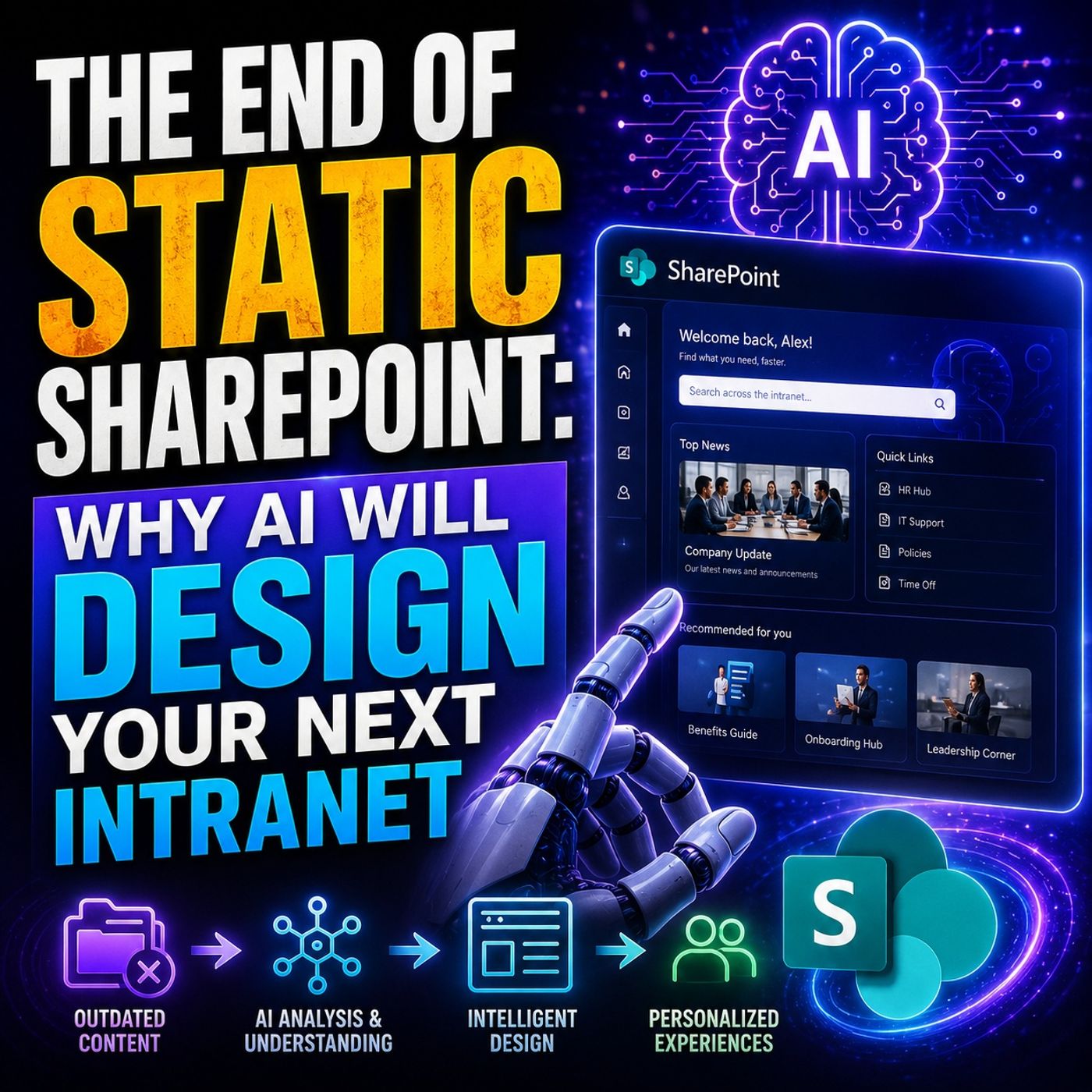
The traditional SharePoint intranet is reaching the end of its lifecycle. For years, organizations have relied on manually designed sites, static navigation structures, and carefully curated content pages that quickly become outdated. In this episode of the M365 FM Podcast, we explore how artificial intelligence is transforming intranet design from a static publishing model into a dynamic, adaptive experience.
The discussion examines why traditional intranets struggle to keep pace with modern workplaces. Employees expect personalized experiences, relevant information, and instant access to knowledge, yet many intranets still rely on manual content management and one-size-fits-all information architectures. As AI capabilities mature, this approach becomes increasingly difficult to justify.
A central theme of the episode is that AI will not simply enhance intranets—it will fundamentally redesign how they are built and maintained. Instead of administrators manually creating navigation, page layouts, content structures, and audience targeting rules, AI systems will increasingly generate, organize, personalize, and optimize these experiences automatically based on user behavior, context, and organizational knowledge.
The conversation explores how Microsoft 365, SharePoint, Copilot, Microsoft Graph, and emerging AI services are enabling a future where intranets become intelligent knowledge experiences rather than static websites. Topics include personalization, knowledge discovery, content recommendations, AI-driven information architecture, automated governance, and the evolving role of intranet owners in an AI-first workplace.
Quick answer: AI-powered SharePoint intranet design is covered in this M365 FM episode with a practical focus on how it works, where it fits, and the architecture, security, governance, or operational choices that matter in real Microsoft environments.
In today's fast-paced digital workplace, organizations face significant challenges with static SharePoint intranets. Many struggle with content sprawl and information architecture degradation, which leads to outdated content that diminishes user trust. Compliance and audit readiness gaps, inconsistent governance across business units, and the complexities of migrating legacy content only add to the difficulties. As the demand for more dynamic and intelligent solutions grows, you must recognize the end of static SharePoint. Embracing AI-driven intranet design will help you create a more efficient and user-friendly experience.
Key Takeaways
- Static SharePoint intranets limit user engagement and fail to meet modern needs.
- Dynamic intranets enhance communication and collaboration through personalized content.
- AI automates content management, saving time and improving efficiency.
- Personalized dashboards help employees find relevant information quickly.
- AI-driven insights tailor content to user preferences, boosting engagement.
- Organizations must assess their content structure for effective AI integration.
- IT roles will evolve to focus on managing AI tools and ensuring content quality.
- Embracing AI in intranets fosters a culture of collaboration and innovation.
The End of Static SharePoint
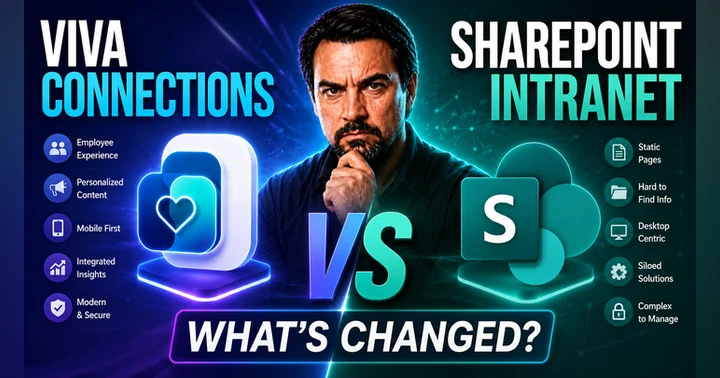
The shift from static to dynamic SharePoint intranets marks a significant change in how organizations operate. Static intranets often serve as rigid information repositories. They limit user engagement and fail to meet the needs of modern employees. In contrast, dynamic intranets offer interactive and extensible platforms that enhance communication and collaboration.
Here are some key differences between static and dynamic SharePoint intranets:
| Feature | Static Intranet | Dynamic Intranet |
|---|---|---|
| Nature | Rigid and traditional | Interactive and extensible |
| User Engagement | Limited, primarily an information repository | Enhanced through personalized content and targeted communications |
| Communication | Primarily through email | Through SharePoint sites and community portals |
| Content | Static information | Dynamic, community-generated content |
| Newsfeed | Corporate news dominates | Personalized news targeted to specific audiences |
Dynamic intranets transform the way you access and share information. They integrate various tools into a single platform, streamlining workflows and reducing the complexity of using multiple systems. This integration leads to increased employee engagement and productivity. Modern intranets connect all elements of the workplace, including communication, collaboration, and project management tools. This cohesive digital environment reduces fragmentation and enhances overall user experience, which is crucial for improving productivity and employee satisfaction.
You can expect to see a variety of content types on a dynamic SharePoint intranet. These may include:
- Company news and announcements
- Internal communications
- Employee directories
- HR resources and workflows
- Knowledge bases
- Company policies
- Collaboration tools
As you embrace the end of static SharePoint, consider the implications for your organization. A dynamic intranet fosters a culture of collaboration and innovation. It empowers employees to find the information they need quickly and efficiently. By prioritizing user experience, you can build a more engaged workforce that drives productivity and success.
AI in Intranet Design
AI revolutionizes intranet design by introducing automation and intelligent content creation. This transformation enhances user experience and streamlines workflows, making your SharePoint intranet more effective.
Automation Benefits
Streamlining Content Management
AI significantly reduces the time and effort required for content management. With AI tools, you can automate repetitive tasks, allowing your team to focus on more strategic activities. For instance, AI assistants can handle approvals and metadata tagging, which cuts down on manual workload. The table below highlights some key benefits of AI in content management:
| Benefit | Description |
|---|---|
| Faster Intranet Development | AI reduces page creation time from hours to minutes. |
| Improved Design Consistency | AI tools follow branding guidelines, ensuring consistent design across pages. |
| Accessibility for Non-Technical Teams | AI enables HR, communications, and operations teams to build pages without technical expertise. |
| Better Employee Experience | Modern intranet pages improve navigation, usability, and engagement. |
Enhancing Workflow Efficiency
AI enhances workflow efficiency by automating business processes. This automation allows for smoother operations and faster decision-making. For example, AI can automatically categorize documents and route approvals, which streamlines your workflows. As a result, you can expect quicker turnaround times and improved productivity across your organization.
Intelligent Content Creation
AI also plays a crucial role in intelligent content creation. It helps you generate relevant and engaging content tailored to your audience's needs.
AI-Driven Insights
AI-driven insights allow you to understand user behavior and preferences better. By analyzing data, AI can provide recommendations for content that resonates with your audience. This capability ensures that your intranet remains relevant and engaging.
Dynamic Recommendations
With AI, you can offer dynamic recommendations based on user interactions. For instance, if an employee frequently accesses specific resources, AI can suggest related content. This personalized approach enhances user satisfaction and encourages deeper engagement with your intranet.
User Experience Improvements
AI significantly improves user experience on SharePoint intranets. By focusing on personalization and enhanced search capabilities, you can create a more engaging environment for your employees.
Personalized Dashboards
AI enables the creation of personalized dashboards that cater to individual user needs. These dashboards can display relevant news, updates, and resources, making it easier for employees to find the information they need quickly. This tailored experience reduces information overload and enhances productivity.
Enhanced Search Capabilities
AI search tools improve the accuracy and relevance of search results. By understanding natural language queries, AI can provide users with the most pertinent information. This capability not only saves time but also enhances the overall user experience on your intranet.
SharePoint Intranet Case Studies
Company A: Communication Transformation
Company A, a leading healthcare provider, transformed its communication strategy by implementing AI in its SharePoint intranet. The organization utilized AI-enhanced communication tools to streamline information sharing among employees. This shift allowed for real-time updates and improved collaboration across departments. As a result, employees experienced a more connected workplace, leading to higher engagement levels.
Key Benefits:
- Enhanced communication flow
- Improved employee engagement
- Faster access to critical information
Company B: Productivity Boost
In the finance sector, Company B leveraged AI for intelligent document management within its SharePoint intranet. By automating routine tasks, the organization significantly reduced the time employees spent searching for documents. This automation led to a 65% reduction in compliance officers’ time spent locating regulations. Additionally, the company reported annual savings of $2.3 million due to decreased content management overhead.
| Cost Reduction Details | Impact |
|---|---|
| 65% reduction in compliance time | Faster regulatory compliance |
| $2.3M annual savings | Lower operational costs |
| Zero outdated policy citations | Improved accuracy in documentation |
Company C: Collaboration Enhancement
Company C, an educational institution, focused on enhancing collaboration through its SharePoint intranet. By integrating AI-powered insights, the organization improved content management and streamlined workflows. Employees benefited from AI-driven recommendations that helped them quickly access relevant documents, news, and resources based on their roles and activities. This approach fostered a culture of collaboration and innovation.
Reported Improvements:
- Enhanced content management
- Streamlined workflows
- Better employee experiences
These case studies illustrate how organizations across various sectors successfully implemented AI in their SharePoint intranets. By modernizing their intranet environments, they achieved significant improvements in communication, productivity, and collaboration.
Future of SharePoint with AI
As you look ahead, the future of SharePoint with AI promises to reshape how organizations manage their intranets. Several trends will emerge, driving this transformation and enhancing user experiences.
Trends to Watch
| Trend | Description |
|---|---|
| Reliable Content | The need for a trusted source of information will grow. Organizations will seek a single place for reliable data amidst various applications and repositories. |
| AI Agents | The rise of AI agents will automate tasks and improve content management. This optimization will enhance user experience on SharePoint intranets. |
| Natural Language Search | Employee expectations for intranet search will evolve. Influenced by consumer behavior and AI technologies, users will increasingly rely on natural language queries and AI-generated summaries. |
| Hyper-Personalization | There will be an increased demand for personalized experiences within intranets. This demand will stem from consumer expectations for tailored content and interactions, necessitating improved personalization features in SharePoint. |
| Omnichannel Publishing | The integration of various digital channels will become essential. This integration will deliver consistent and engaging content across platforms, enhancing user engagement and accessibility. |
Preparing for AI Integration
To successfully integrate AI into your SharePoint intranet, you must take several steps. Organizations are currently evaluating their Microsoft 365 environments to identify foundational issues that may affect AI integration. Here are some key preparations:
- Assess the existing content structure, which often includes unstructured, duplicated, or outdated files.
- Enhance knowledge architecture and content quality to ensure effective AI deployment.
- Review governance structures and permissions to align with actual work processes.
- Establish clear ownership and maintenance of taxonomy to support AI functionalities.
- Implement formal training and communication campaigns to prepare users for AI tools like Copilot.
Evolving IT Roles
The integration of AI tools in SharePoint intranets is transforming IT departments' responsibilities. As Microsoft 365 Copilot and AI agents become integral to workflows, IT professionals must adapt to new roles that focus on activating and reusing knowledge within SharePoint. This shift emphasizes the importance of quality, structure, and context in SharePoint content. Here are some new skills that IT professionals will need:
- Discover Knowledge Faster: AI enhances the ability to find relevant information quickly.
- Publish Engaging Content: AI assists in creating content that is engaging and informative.
- Build AI-Assisted Solutions: IT professionals need to understand how to build and manage AI-assisted sites and libraries.
| Skill/Feature | Description |
|---|---|
| Custom Skills | Allow organizations to embed their own rules, workflows, and knowledge directly into SharePoint AI. |
| Proposal Development Workflow | A five-phase AI workflow that automates the proposal lifecycle, enhancing efficiency and focus. |
| Content Finding & Mapping | AI searches existing content to surface relevant proposals and data mapped to requirements. |
| Synthesis & Direction | AI synthesizes matched content into a coherent response strategy before drafting begins. |
| Review & Quality Control | Built-in checks ensure compliance with policies and standards, enhancing quality assurance. |
As you prepare for the intranet of the future, remember that AI-powered SharePoint intranets will support remote and hybrid work environments. They will enable real-time collaboration across locations, allowing employees to access information anytime, from anywhere. Intelligent automation will reduce repetitive tasks, enhancing productivity and ensuring compliance with governance standards.
The transition to AI-driven SharePoint intranets marks a pivotal moment for organizations. You can expect several key takeaways from this shift:
- Practical workings of AI capabilities in SharePoint
- Enhanced employee experience through AI's ability to think, respond, and produce
- Strategic importance for businesses using Microsoft 365
- Necessary organizational preparations for effective AI integration
- Future implications for the evolution of intranets
AI presents exciting opportunities for intranet design and management. For instance, AI tools will boost productivity by automating repetitive tasks and minimizing errors. Additionally, AI-powered voice commands will facilitate hands-free navigation and meeting scheduling. As intranet teams recognize AI's transformative potential, they pave the way for a more efficient future.
Embracing these advancements will help you create a dynamic, user-centric intranet that fosters collaboration and drives success.
FAQ
What is a dynamic SharePoint intranet?
A dynamic SharePoint intranet is an interactive platform that enhances communication and collaboration. It adapts to user needs, providing personalized content and streamlined workflows.
How does AI improve intranet design?
AI enhances intranet design by automating content management, generating insights, and personalizing user experiences. This leads to improved engagement and productivity.
What are the benefits of using AI in SharePoint?
Using AI in SharePoint offers faster content creation, better search capabilities, and personalized dashboards. These features enhance user satisfaction and streamline workflows.
How can I prepare for AI integration in SharePoint?
To prepare for AI integration, assess your current content structure, improve governance, and provide training for users. This ensures a smooth transition to AI-driven tools.
What role does IT play in AI-powered SharePoint?
IT professionals will focus on activating knowledge, managing AI tools, and ensuring content quality. They will need new skills to support AI functionalities effectively.
Can AI help with compliance in SharePoint?
Yes, AI can automate compliance processes, ensuring that documents meet regulatory standards. This reduces the risk of errors and enhances overall governance.
How does AI personalize user experiences?
AI personalizes user experiences by analyzing behavior and preferences. It recommends relevant content, making it easier for employees to find what they need.
What trends should I watch for in SharePoint AI?
Watch for trends like hyper-personalization, natural language search, and the rise of AI agents. These developments will shape the future of SharePoint intranets.
🎧 Listen to this episode
Want a practical explanation of AI-Powered SharePoint Intranets? This episode breaks down the topic in clear language and shows why it matters for Microsoft 365, Azure, Power Platform, security, AI, and modern work.
Listen to this episode if you want to:
- Understand the key concepts behind AI-Powered SharePoint Intranets
- See how it fits into the wider Microsoft technology ecosystem
- Learn where it can create practical value for your organization
You may also enjoy these related M365 FM episodes:
- Automate Microsoft 365 Governance Beyond Static Checklists
- Multi-Agent AI with Microsoft Copilot and SharePoint – Reshmee Auckloo [MVP]
- Microsoft Graph Automation Architecture: Beyond Scripts
- Graph-Powered AI Agents: An Enterprise Architecture Guide
- Microsoft AI Agent Runtimes: Beyond Enterprise Chatbots
Discover more practical Microsoft conversations on M365 FM.
Last reviewed: July 2026.
Who Should Listen
This episode is for Microsoft administrators, architects, developers, security professionals, and business leaders who need a practical foundation before making implementation, operations, or governance decisions.
🎧 You Should Also Listen To
- Microsoft Teams — A strongly related next step for extending this topic.
- SharePoint Premium — A strongly related next step for extending this topic.
- OneDrive Sync — A strongly related next step for extending this topic.
🚀 Want to be part of m365.fm?
Then stop just listening… and start showing up.
👉 Connect with me on LinkedIn and let’s make something happen:
- 🎙️ Be a podcast guest and share your story
- 🎧 Host your own episode (yes, seriously)
- 💡 Pitch topics the community actually wants to hear
- 🌍 Build your personal brand in the Microsoft 365 space
This isn’t just a podcast — it’s a platform for people who take action.
🔥 Most people wait. The best ones don’t.
👉 Connect with me on LinkedIn and send me a message:
"I want in"
Let’s build something awesome 👊
1
00:00:00,000 --> 00:00:02,200
Your internet wasn't designed for how people work today.
2
00:00:02,200 --> 00:00:06,080
It was designed for structure, pages, navigation, hierarchies,
3
00:00:06,080 --> 00:00:08,680
and the assumption that people know what they're looking for,
4
00:00:08,680 --> 00:00:10,320
that assumption is broken.
5
00:00:10,320 --> 00:00:12,680
Because today, work doesn't start with navigation.
6
00:00:12,680 --> 00:00:14,440
It starts with context.
7
00:00:14,440 --> 00:00:17,080
Most SharePoint sites are built on a single-floor idea,
8
00:00:17,080 --> 00:00:18,920
the idea that people will browse,
9
00:00:18,920 --> 00:00:20,560
that they'll click through menus,
10
00:00:20,560 --> 00:00:22,560
that they'll follow the path you designed for them.
11
00:00:22,560 --> 00:00:24,000
This was defensible in 2010.
12
00:00:24,000 --> 00:00:25,320
Organizations were smaller.
13
00:00:25,320 --> 00:00:26,520
Information was simpler.
14
00:00:26,520 --> 00:00:28,920
People sat in the same building and learned the internet
15
00:00:28,920 --> 00:00:30,800
by walking past it, but that world is gone.
16
00:00:30,800 --> 00:00:32,240
Now your users are remote.
17
00:00:32,240 --> 00:00:34,200
They're in Teams, they're on mobile,
18
00:00:34,200 --> 00:00:36,960
they're switching between five applications before breakfast.
19
00:00:36,960 --> 00:00:39,400
They don't start their day by opening the internet home page
20
00:00:39,400 --> 00:00:40,240
and exploring.
21
00:00:40,240 --> 00:00:42,680
They start with a problem, a question, a deadline.
22
00:00:42,680 --> 00:00:44,480
They need an answer in the next 90 seconds
23
00:00:44,480 --> 00:00:47,360
and they have no patience for your carefully designed hierarchy.
24
00:00:47,360 --> 00:00:50,520
This is the structural floor behind most failed internet projects.
25
00:00:50,520 --> 00:00:54,000
Not bad design, not poor governance, not a lack of training.
26
00:00:54,000 --> 00:00:55,320
The floor is the model itself.
27
00:00:55,320 --> 00:00:57,680
You build a library when people need it a GPS.
28
00:00:57,680 --> 00:00:59,840
You organize content for people who have time to look
29
00:00:59,840 --> 00:01:01,640
in a world where nobody has time to look.
30
00:01:01,640 --> 00:01:03,800
And until you see this assumption for what it is,
31
00:01:03,800 --> 00:01:05,520
every SharePoint project you launch
32
00:01:05,520 --> 00:01:07,400
will carry it inside like a virus.
33
00:01:07,400 --> 00:01:09,360
The navigation assumption is buried so deep
34
00:01:09,360 --> 00:01:11,720
that most organizations don't even know they hold it.
35
00:01:11,720 --> 00:01:14,040
They hire consultants to redesign the navigation.
36
00:01:14,040 --> 00:01:16,280
They run workshops on information architecture.
37
00:01:16,280 --> 00:01:18,080
They debate whether the HR page should live
38
00:01:18,080 --> 00:01:19,840
under people or under services.
39
00:01:19,840 --> 00:01:22,280
And all of it assumes that if the structure is right,
40
00:01:22,280 --> 00:01:23,720
people will find what they need.
41
00:01:23,720 --> 00:01:25,280
But the structure was never the problem.
42
00:01:25,280 --> 00:01:28,440
The problem is that work no longer moves through structures.
43
00:01:28,440 --> 00:01:32,160
It moves through context, a meeting mention, a team's chat,
44
00:01:32,160 --> 00:01:34,840
a search query, a copilot prompt.
45
00:01:34,840 --> 00:01:37,280
Your internet is still designed for the old path
46
00:01:37,280 --> 00:01:39,640
while your users have already left it behind.
47
00:01:39,640 --> 00:01:41,440
Think about how you actually find information
48
00:01:41,440 --> 00:01:42,360
when you're under pressure.
49
00:01:42,360 --> 00:01:45,600
You don't open a portal, you search, you ask a colleague,
50
00:01:45,600 --> 00:01:46,880
you check your chat history.
51
00:01:46,880 --> 00:01:48,480
If you're lucky, you ask copilot.
52
00:01:48,480 --> 00:01:50,840
The idea that someone will calmly browse through five levels
53
00:01:50,840 --> 00:01:52,760
of navigation to find a policy document
54
00:01:52,760 --> 00:01:55,160
is a fantasy that only survives in conference rooms.
55
00:01:55,160 --> 00:01:56,320
Not in real work.
56
00:01:56,320 --> 00:01:58,120
Yet most SharePoint environments are still
57
00:01:58,120 --> 00:02:00,040
built like digital filing cabinets.
58
00:02:00,040 --> 00:02:01,600
Every site collection is a drawer.
59
00:02:01,600 --> 00:02:02,840
Every subset is a folder.
60
00:02:02,840 --> 00:02:04,080
Every page is a label.
61
00:02:04,080 --> 00:02:06,280
And the whole thing depends on users knowing which draw
62
00:02:06,280 --> 00:02:08,040
to open before they start.
63
00:02:08,040 --> 00:02:10,600
This navigation first design also creates a training burden
64
00:02:10,600 --> 00:02:12,200
that most enterprises underestimate.
65
00:02:12,200 --> 00:02:15,040
Every new employee needs to learn the internet structure.
66
00:02:15,040 --> 00:02:18,120
Every reorganization breaks the structure they've learned.
67
00:02:18,120 --> 00:02:20,920
Every new site collection adds another draw to remember.
68
00:02:20,920 --> 00:02:22,320
After a few years, the mental map
69
00:02:22,320 --> 00:02:25,120
required to navigate the environment become so complex
70
00:02:25,120 --> 00:02:27,880
that only long tenured employees can use it effectively.
71
00:02:27,880 --> 00:02:29,800
New hires are lost, contractors are lost.
72
00:02:29,800 --> 00:02:32,400
Employees who transferred from another division are lost.
73
00:02:32,400 --> 00:02:34,440
The internet becomes a tool for insiders
74
00:02:34,440 --> 00:02:36,240
instead of a resource for everyone.
75
00:02:36,240 --> 00:02:38,000
And the organization mistakes inside a knowledge
76
00:02:38,000 --> 00:02:39,120
for good design.
77
00:02:39,120 --> 00:02:41,520
Context is the starting point of modern work.
78
00:02:41,520 --> 00:02:44,440
It means the user doesn't need to know where something lives.
79
00:02:44,440 --> 00:02:45,800
They need to know what they're trying to do
80
00:02:45,800 --> 00:02:47,560
and the system should meet them there.
81
00:02:47,560 --> 00:02:49,360
But SharePoint was never built for context.
82
00:02:49,360 --> 00:02:50,560
It was built for location.
83
00:02:50,560 --> 00:02:52,920
And that difference explains why so many internet projects
84
00:02:52,920 --> 00:02:55,640
look successful on paper while failing in practice.
85
00:02:55,640 --> 00:02:58,920
The shift from location to context is not a feature request.
86
00:02:58,920 --> 00:03:01,880
It's a fundamental rethinking of what an internet is.
87
00:03:01,880 --> 00:03:03,840
A location-based system asks the user
88
00:03:03,840 --> 00:03:05,840
to understand the organization's structure.
89
00:03:05,840 --> 00:03:08,280
A context-based system asks the organization
90
00:03:08,280 --> 00:03:10,160
to understand the user's situation.
91
00:03:10,160 --> 00:03:12,040
One puts burden on the employee,
92
00:03:12,040 --> 00:03:14,200
the other puts intelligence in the platform.
93
00:03:14,200 --> 00:03:16,000
And until SharePoint environments are designed
94
00:03:16,000 --> 00:03:17,440
around context instead of location,
95
00:03:17,440 --> 00:03:19,440
every new site collection, every new subset,
96
00:03:19,440 --> 00:03:21,920
and every new navigation menu will make the problem worse
97
00:03:21,920 --> 00:03:22,920
instead of better.
98
00:03:22,920 --> 00:03:24,480
Location-based design made sense
99
00:03:24,480 --> 00:03:26,160
when documents had one home.
100
00:03:26,160 --> 00:03:28,200
When the org chart determined the site structure,
101
00:03:28,200 --> 00:03:29,920
when the person who needed the travel policy
102
00:03:29,920 --> 00:03:32,360
worked in the same department that wrote it.
103
00:03:32,360 --> 00:03:35,160
But modern work cuts across departments, time zones,
104
00:03:35,160 --> 00:03:36,240
and applications.
105
00:03:36,240 --> 00:03:38,720
A sales rep in Berlin needs the same onboarding information
106
00:03:38,720 --> 00:03:40,240
as a support engineer in Sydney.
107
00:03:40,240 --> 00:03:42,440
They don't care which department owns the page.
108
00:03:42,440 --> 00:03:44,680
They care whether the page answers their question.
109
00:03:44,680 --> 00:03:47,040
And right now, most SharePoint environments
110
00:03:47,040 --> 00:03:49,240
forced them to care about the department first
111
00:03:49,240 --> 00:03:50,520
and the answer second.
112
00:03:50,520 --> 00:03:51,360
That's backwards.
113
00:03:51,360 --> 00:03:54,000
And it's why so many pages sit in beautiful site collections
114
00:03:54,000 --> 00:03:55,080
that nobody ever visits.
115
00:03:55,080 --> 00:03:57,680
The navigation assumption also creates a hidden cost
116
00:03:57,680 --> 00:03:59,520
that doesn't show up in project budgets.
117
00:03:59,520 --> 00:04:02,480
Every time a user can't find something, they don't report it.
118
00:04:02,480 --> 00:04:05,280
They give up, they ask a colleague, they create a duplicate.
119
00:04:05,280 --> 00:04:07,040
They store the document in their own one drive
120
00:04:07,040 --> 00:04:08,880
because they can't remember which team side holds
121
00:04:08,880 --> 00:04:10,000
the official version.
122
00:04:10,000 --> 00:04:13,320
These workarounds multiply across thousands of employees
123
00:04:13,320 --> 00:04:16,520
until your SharePoint environment becomes a digital junkyard.
124
00:04:16,520 --> 00:04:19,240
Clean structures on the surface, chaos underneath.
125
00:04:19,240 --> 00:04:21,680
And nobody can see it because the metrics you're tracking
126
00:04:21,680 --> 00:04:23,080
don't measure frustration.
127
00:04:23,080 --> 00:04:26,200
This duplication also creates compliance and legal risks.
128
00:04:26,200 --> 00:04:28,120
When an employee saves a policy document
129
00:04:28,120 --> 00:04:29,720
to their personal one drive,
130
00:04:29,720 --> 00:04:31,000
that copy is no longer governed
131
00:04:31,000 --> 00:04:33,600
by the retention policies applied to the original.
132
00:04:33,600 --> 00:04:36,080
When they shared with a colleague via email attachment,
133
00:04:36,080 --> 00:04:37,880
the organization loses visibility
134
00:04:37,880 --> 00:04:39,520
into who has access to what.
135
00:04:39,520 --> 00:04:41,320
When multiple departments each maintain
136
00:04:41,320 --> 00:04:43,120
their own version of the same procedure,
137
00:04:43,120 --> 00:04:45,240
there is no single source of truth.
138
00:04:45,240 --> 00:04:46,920
Auditors ask for the official policy
139
00:04:46,920 --> 00:04:48,680
and receive three different versions.
140
00:04:48,680 --> 00:04:50,160
Legal asks for the current procedure
141
00:04:50,160 --> 00:04:52,080
and finds five conflicting copies.
142
00:04:52,080 --> 00:04:55,160
The navigation assumption doesn't just make users inefficient.
143
00:04:55,160 --> 00:04:57,040
It actively undermines governance in ways
144
00:04:57,040 --> 00:05:00,200
that most enterprises never trace back to the root cause.
145
00:05:00,200 --> 00:05:01,880
Publish and forget architecture.
146
00:05:01,880 --> 00:05:03,560
But the real problem isn't the design.
147
00:05:03,560 --> 00:05:05,600
It's what happens after you hit publish.
148
00:05:05,600 --> 00:05:08,200
Most SharePoint projects follow the same lifecycle.
149
00:05:08,200 --> 00:05:10,440
Months of planning, workshops on governance,
150
00:05:10,440 --> 00:05:12,840
discussions about templates, content reviews,
151
00:05:12,840 --> 00:05:14,600
training sessions for site owners,
152
00:05:14,600 --> 00:05:15,640
then the page goes live,
153
00:05:15,640 --> 00:05:19,040
the project is declared a success and nothing happens.
154
00:05:19,040 --> 00:05:21,600
The page remains unchanged for six months.
155
00:05:21,600 --> 00:05:23,320
Then a year, then two years.
156
00:05:23,320 --> 00:05:25,680
Meanwhile, the policy at references has been updated.
157
00:05:25,680 --> 00:05:27,640
The team it describes has been restructured,
158
00:05:27,640 --> 00:05:29,600
the contact person has left the company.
159
00:05:29,600 --> 00:05:31,640
But the page still sits there collecting views,
160
00:05:31,640 --> 00:05:34,240
misleading users and slowly eroding trust.
161
00:05:34,240 --> 00:05:36,240
This is the publishing forget architecture.
162
00:05:36,240 --> 00:05:39,000
And it's the default operating model for most enterprises.
163
00:05:39,000 --> 00:05:41,000
SharePoint is treated like a construction project,
164
00:05:41,000 --> 00:05:41,840
not like a product.
165
00:05:41,840 --> 00:05:43,440
You build it, you launch it and you move on
166
00:05:43,440 --> 00:05:44,440
to the next project.
167
00:05:44,440 --> 00:05:45,520
There is no feedback loop.
168
00:05:45,520 --> 00:05:46,360
There is no telemetry.
169
00:05:46,360 --> 00:05:47,520
There is no iteration.
170
00:05:47,520 --> 00:05:49,600
The team that built the site has disbanded.
171
00:05:49,600 --> 00:05:50,800
The site owner has a new job.
172
00:05:50,800 --> 00:05:53,800
The content author hasn't logged in since the training session.
173
00:05:53,800 --> 00:05:57,640
And the page drifts further from reality with every passing week.
174
00:05:57,640 --> 00:05:59,280
The problem isn't that people are lazy.
175
00:05:59,280 --> 00:06:00,360
The problem is the model.
176
00:06:00,360 --> 00:06:02,360
When you treat an internet like a building,
177
00:06:02,360 --> 00:06:04,680
you assume it stays useful once it's built.
178
00:06:04,680 --> 00:06:06,120
But an internet is not a building.
179
00:06:06,120 --> 00:06:06,760
It's a garden.
180
00:06:06,760 --> 00:06:07,960
It needs constant attention,
181
00:06:07,960 --> 00:06:10,080
or it becomes overgrown with outdated content,
182
00:06:10,080 --> 00:06:12,320
broken links and confusing navigation.
183
00:06:12,320 --> 00:06:15,080
And yet most enterprises invest 10 times more effort
184
00:06:15,080 --> 00:06:17,800
in building new sites than in maintaining existing ones.
185
00:06:17,800 --> 00:06:19,720
They measure success by launch date,
186
00:06:19,720 --> 00:06:22,560
not by whether anyone actually uses what was launched.
187
00:06:22,560 --> 00:06:24,720
This imbalance shows up in budgets too.
188
00:06:24,720 --> 00:06:26,440
A typical SharePoint redesign project
189
00:06:26,440 --> 00:06:29,640
might cost $200,000 in consulting, design and development.
190
00:06:29,640 --> 00:06:31,760
The annual maintenance budget for the resulting environment
191
00:06:31,760 --> 00:06:33,680
is often $10,000.
192
00:06:33,680 --> 00:06:34,760
If it exists at all,
193
00:06:34,760 --> 00:06:36,880
that is a 20 to 1 ratio of build to maintain.
194
00:06:36,880 --> 00:06:39,440
No product team in any successful technology company
195
00:06:39,440 --> 00:06:41,160
operates with those proportions.
196
00:06:41,160 --> 00:06:42,320
They invest continuously.
197
00:06:42,320 --> 00:06:43,360
They measure continuously.
198
00:06:43,360 --> 00:06:44,400
They improve continuously
199
00:06:44,400 --> 00:06:47,000
because they understand that software is not a deliverable.
200
00:06:47,000 --> 00:06:49,080
It's an ongoing relationship with the user.
201
00:06:49,080 --> 00:06:51,120
Your internet deserves the same relationship.
202
00:06:51,120 --> 00:06:53,520
The maintenance gap also shows up in staffing models.
203
00:06:53,520 --> 00:06:56,720
Many organizations appoint site owners as volunteers.
204
00:06:56,720 --> 00:06:58,760
They are business users with full-time jobs
205
00:06:58,760 --> 00:07:00,440
who happen to own a SharePoint site
206
00:07:00,440 --> 00:07:02,760
because they were in the meeting when it was created.
207
00:07:02,760 --> 00:07:04,400
They receive no training refreshes.
208
00:07:04,400 --> 00:07:06,800
They have no time allocated for content reviews.
209
00:07:06,800 --> 00:07:08,920
And they often don't even know they still own the site
210
00:07:08,920 --> 00:07:10,080
until someone complains.
211
00:07:10,080 --> 00:07:11,760
This volunteer model is not governance.
212
00:07:11,760 --> 00:07:13,360
It's neglect with a name tag.
213
00:07:13,360 --> 00:07:15,240
A product requires dedicated ownership.
214
00:07:15,240 --> 00:07:17,760
Someone whose job includes keeping the product healthy,
215
00:07:17,760 --> 00:07:18,880
not as an afterthought.
216
00:07:18,880 --> 00:07:22,200
As a primary responsibility, consider what this means at scale.
217
00:07:22,200 --> 00:07:25,040
A typical organization has thousands of SharePoint pages.
218
00:07:25,040 --> 00:07:26,400
Some have tens of thousands.
219
00:07:26,400 --> 00:07:28,920
If each page is only reviewed once per year,
220
00:07:28,920 --> 00:07:30,760
you need a full-time army of content owners
221
00:07:30,760 --> 00:07:32,320
just to keep things current.
222
00:07:32,320 --> 00:07:34,880
And since most site owners are volunteers with day jobs,
223
00:07:34,880 --> 00:07:36,400
the review never happens.
224
00:07:36,400 --> 00:07:38,920
Content becomes outdated, pages become cluttered,
225
00:07:38,920 --> 00:07:42,200
navigation becomes confusing, employees can't find information.
226
00:07:42,200 --> 00:07:45,120
And the organization has no visibility into any of it.
227
00:07:45,120 --> 00:07:48,240
The publishing forget model also creates a dangerous illusion.
228
00:07:48,240 --> 00:07:50,360
When leadership asks about internet success,
229
00:07:50,360 --> 00:07:51,960
the team shows page views.
230
00:07:51,960 --> 00:07:55,240
Look, 15,000 people visited the HR portal last month.
231
00:07:55,240 --> 00:07:57,840
But page views don't mean the content was useful.
232
00:07:57,840 --> 00:08:00,000
They don't mean users found what they needed.
233
00:08:00,000 --> 00:08:01,880
They only mean that somebody opened the page,
234
00:08:01,880 --> 00:08:03,920
probably because they had no other choice.
235
00:08:03,920 --> 00:08:05,720
The project looks successful on the metrics
236
00:08:05,720 --> 00:08:07,520
while quietly failing the users.
237
00:08:07,520 --> 00:08:09,200
And because nobody measures the failure,
238
00:08:09,200 --> 00:08:10,560
it continues indefinitely.
239
00:08:10,560 --> 00:08:12,200
What makes this particularly damaging
240
00:08:12,200 --> 00:08:15,160
is that the next project starts from the same broken assumption.
241
00:08:15,160 --> 00:08:16,800
The team sees the old site is struggling,
242
00:08:16,800 --> 00:08:19,480
so they build a new one with better templates,
243
00:08:19,480 --> 00:08:22,520
with updated branding, with a redesigned navigation.
244
00:08:22,520 --> 00:08:24,080
And they launch it with the same ceremony,
245
00:08:24,080 --> 00:08:26,120
the same training and the same absence
246
00:08:26,120 --> 00:08:28,320
of any plan for ongoing measurement.
247
00:08:28,320 --> 00:08:29,680
The cycle repeats.
248
00:08:29,680 --> 00:08:33,680
Every few years, a new internet is born, celebrated, and abandoned.
249
00:08:33,680 --> 00:08:35,120
And the employees learn to ignore it
250
00:08:35,120 --> 00:08:37,280
because they know it won't be maintained.
251
00:08:37,280 --> 00:08:39,080
This isn't a technology problem.
252
00:08:39,080 --> 00:08:40,120
SharePoint has the tools.
253
00:08:40,120 --> 00:08:41,800
The problem is the mental model.
254
00:08:41,800 --> 00:08:44,720
Organizations think in projects, not in products.
255
00:08:44,720 --> 00:08:46,520
They fund launches, not operations.
256
00:08:46,520 --> 00:08:49,240
They celebrate go-live dates, not ongoing outcomes.
257
00:08:49,240 --> 00:08:51,760
And until that model changes, no amount of AI
258
00:08:51,760 --> 00:08:54,160
or new features will fix what's really broken.
259
00:08:54,160 --> 00:08:56,280
The shift from project thinking to product thinking
260
00:08:56,280 --> 00:08:58,240
is the hardest organizational change
261
00:08:58,240 --> 00:08:59,520
in this entire conversation.
262
00:08:59,520 --> 00:09:02,520
It means your internet team doesn't disband after launch.
263
00:09:02,520 --> 00:09:05,080
It means you have a budget for continuous improvement,
264
00:09:05,080 --> 00:09:06,440
not just initial build.
265
00:09:06,440 --> 00:09:08,840
It means success is measured by whether users
266
00:09:08,840 --> 00:09:11,880
accomplish their goals not by whether a page went live on schedule.
267
00:09:11,880 --> 00:09:15,040
And it means you need telemetry, real telemetry, not page views,
268
00:09:15,040 --> 00:09:17,240
not vanity metrics, behavioral signals
269
00:09:17,240 --> 00:09:18,800
that tell you whether the page is working
270
00:09:18,800 --> 00:09:21,920
or whether it's just sitting there accumulating digital dust.
271
00:09:21,920 --> 00:09:23,760
What the metrics actually hide.
272
00:09:23,760 --> 00:09:25,400
And the worst part, you probably think
273
00:09:25,400 --> 00:09:27,200
you know how your page is up for forming.
274
00:09:27,200 --> 00:09:29,000
You don't.
275
00:09:29,000 --> 00:09:31,240
Most organizations track the wrong things.
276
00:09:31,240 --> 00:09:33,720
They measure activity instead of outcomes.
277
00:09:33,720 --> 00:09:36,000
Page views tell you that somebody opened a page.
278
00:09:36,000 --> 00:09:38,840
They do not tell you whether the content was useful.
279
00:09:38,840 --> 00:09:41,360
They do not tell you whether users found what they needed.
280
00:09:41,360 --> 00:09:43,560
They do not tell you whether users scrolled, clicked,
281
00:09:43,560 --> 00:09:44,800
or became frustrated.
282
00:09:44,800 --> 00:09:46,800
The gap between visited and satisfied
283
00:09:46,800 --> 00:09:48,400
is where intranets die.
284
00:09:48,400 --> 00:09:51,000
And it's a gap that traditional SharePoint analytics never show you.
285
00:09:51,000 --> 00:09:51,800
Let's be specific.
286
00:09:51,800 --> 00:09:53,840
A page receives 20,000 views in a month.
287
00:09:53,840 --> 00:09:55,400
By all standards, that's a success.
288
00:09:55,400 --> 00:09:57,000
The team reports it to leadership.
289
00:09:57,000 --> 00:09:58,400
The site owner gets praised.
290
00:09:58,400 --> 00:10:00,800
But what if the average scroll depth is 18%?
291
00:10:00,800 --> 00:10:02,560
What if users leave after 10 seconds?
292
00:10:02,560 --> 00:10:04,600
What if rage clicks cluster around a table
293
00:10:04,600 --> 00:10:06,960
that looks interactive but isn't?
294
00:10:06,960 --> 00:10:08,760
Suddenly the page looks very different.
295
00:10:08,760 --> 00:10:10,760
20,000 people arrived, looked around,
296
00:10:10,760 --> 00:10:12,840
realized the page wasn't helping them and left.
297
00:10:12,840 --> 00:10:13,920
That's not success.
298
00:10:13,920 --> 00:10:15,880
That's a billboard on a highway that everyone drives
299
00:10:15,880 --> 00:10:17,280
past without reading.
300
00:10:17,280 --> 00:10:19,440
Traditional metrics also hide search failures.
301
00:10:19,440 --> 00:10:22,040
SharePoint analytics will show you which pages are popular.
302
00:10:22,040 --> 00:10:23,800
It won't show you which searches failed.
303
00:10:23,800 --> 00:10:26,160
It won't show you that 300 employees searched
304
00:10:26,160 --> 00:10:27,840
for vacation requests last month
305
00:10:27,840 --> 00:10:29,000
and never found the right page.
306
00:10:29,000 --> 00:10:31,920
Those 300 people didn't show up in your page view report
307
00:10:31,920 --> 00:10:34,200
because they never reached the destination.
308
00:10:34,200 --> 00:10:35,960
They tried, failed and gave up.
309
00:10:35,960 --> 00:10:37,520
To your analytics, they don't exist.
310
00:10:37,520 --> 00:10:40,160
But to your business, they're 300 frustrated employees
311
00:10:40,160 --> 00:10:42,080
who learned that the internet doesn't work.
312
00:10:42,080 --> 00:10:43,960
This is why vanity metrics are dangerous.
313
00:10:43,960 --> 00:10:45,840
They don't just fail to measure quality.
314
00:10:45,840 --> 00:10:47,560
They actively obscure failure.
315
00:10:47,560 --> 00:10:49,760
A page with high traffic and low satisfaction
316
00:10:49,760 --> 00:10:51,200
looks like a star performer.
317
00:10:51,200 --> 00:10:55,240
A page with low traffic but high task completion looks like a failure.
318
00:10:55,240 --> 00:10:57,080
If you optimize for the wrong signal,
319
00:10:57,080 --> 00:10:58,960
you optimize toward more frustration.
320
00:10:58,960 --> 00:11:00,240
You feature the popular page.
321
00:11:00,240 --> 00:11:01,240
You clone its layout.
322
00:11:01,240 --> 00:11:02,800
You recommend it as a template.
323
00:11:02,800 --> 00:11:04,800
And all the while, the page that actually helps users
324
00:11:04,800 --> 00:11:07,120
sits unnoticed because it doesn't generate enough traffic
325
00:11:07,120 --> 00:11:08,520
to register on your dashboard.
326
00:11:08,520 --> 00:11:10,640
The real signal you need is behavioral.
327
00:11:10,640 --> 00:11:12,720
Not whether someone visited, but what they did.
328
00:11:12,720 --> 00:11:13,520
Did they scroll?
329
00:11:13,520 --> 00:11:14,920
Did they click the right elements?
330
00:11:14,920 --> 00:11:17,080
Did they find the answer and leave satisfied?
331
00:11:17,080 --> 00:11:18,560
Or did they bounce in confusion?
332
00:11:18,560 --> 00:11:20,680
These questions require different kind of analytics.
333
00:11:20,680 --> 00:11:22,880
Not the kind that comes built into SharePoint.
334
00:11:22,880 --> 00:11:25,760
The kind that watches how users actually interact with the page.
335
00:11:25,760 --> 00:11:27,920
Scroll-depth, click-maps, session recordings,
336
00:11:27,920 --> 00:11:30,600
rage clicks, these are the metrics that expose the truth.
337
00:11:30,600 --> 00:11:32,680
And until you have them, you're managing your internet
338
00:11:32,680 --> 00:11:33,880
with the lights off.
339
00:11:33,880 --> 00:11:35,240
There's another layer to this problem.
340
00:11:35,240 --> 00:11:38,000
Even when organizations do track some behavior,
341
00:11:38,000 --> 00:11:39,600
they track it at the wrong level.
342
00:11:39,600 --> 00:11:42,280
They look at site level trends instead of page level friction.
343
00:11:42,280 --> 00:11:45,080
They report monthly averages instead of specific pain points.
344
00:11:45,080 --> 00:11:47,000
They see that overall internet traffic is up
345
00:11:47,000 --> 00:11:48,920
and conclude that things are improving.
346
00:11:48,920 --> 00:11:51,440
But traffic can go up for all the wrong reasons.
347
00:11:51,440 --> 00:11:53,760
More users searching because they can't find things.
348
00:11:53,760 --> 00:11:55,520
More repeat visits because the first visit
349
00:11:55,520 --> 00:11:56,840
didn't solve the problem.
350
00:11:56,840 --> 00:11:58,320
More page loads because a broken link
351
00:11:58,320 --> 00:11:59,720
sends people in circles.
352
00:11:59,720 --> 00:12:03,040
Aggregate metrics smooth over these individual failures
353
00:12:03,040 --> 00:12:04,640
until they become invisible.
354
00:12:04,640 --> 00:12:06,400
And invisible problems don't get fixed.
355
00:12:06,400 --> 00:12:08,440
The reporting cadence is also part of the problem.
356
00:12:08,440 --> 00:12:10,160
Monthly or quarterly analytics reviews
357
00:12:10,160 --> 00:12:13,120
are too slow for digital experiences that change daily.
358
00:12:13,120 --> 00:12:14,280
A page breaks on Monday.
359
00:12:14,280 --> 00:12:15,640
Users struggle all week.
360
00:12:15,640 --> 00:12:18,040
The monthly report captures the aggregated data
361
00:12:18,040 --> 00:12:20,000
and shows slightly elevated traffic.
362
00:12:20,000 --> 00:12:22,800
Nobody notices the problem until the next quarterly review
363
00:12:22,800 --> 00:12:25,200
by which time thousands of users have been affected.
364
00:12:25,200 --> 00:12:26,640
In a product-driven environment,
365
00:12:26,640 --> 00:12:28,160
you would see the issue within hours
366
00:12:28,160 --> 00:12:29,480
and fix it within days.
367
00:12:29,480 --> 00:12:32,120
In a project-driven environment, you might not see it for months.
368
00:12:32,120 --> 00:12:34,400
The reporting rhythm is matched to project milestones,
369
00:12:34,400 --> 00:12:35,440
not user needs.
370
00:12:35,440 --> 00:12:38,600
And that mismatch alone explains why so many internet feel abandoned
371
00:12:38,600 --> 00:12:40,200
even when they're technically active.
372
00:12:40,200 --> 00:12:42,240
This is where the next generation of analytics
373
00:12:42,240 --> 00:12:46,280
becomes important, not bigger dashboards, not prettier reports.
374
00:12:46,280 --> 00:12:48,400
Signals that connect specific user struggles
375
00:12:48,400 --> 00:12:49,960
to specific page elements.
376
00:12:49,960 --> 00:12:52,200
A search query that returns no results.
377
00:12:52,200 --> 00:12:53,880
A click on what looks like a button, but isn't.
378
00:12:53,880 --> 00:12:55,280
A scroll that stops at the same point
379
00:12:55,280 --> 00:12:56,840
on every session recording.
380
00:12:56,840 --> 00:12:58,200
These are the diagnostic signals
381
00:12:58,200 --> 00:13:00,320
that tell you exactly where the page is broken.
382
00:13:00,320 --> 00:13:01,520
And they are completely absent
383
00:13:01,520 --> 00:13:03,680
from the metrics most teams currently trust.
384
00:13:03,680 --> 00:13:06,200
The cost of missing these signals is hard to quantify,
385
00:13:06,200 --> 00:13:07,720
but easy to illustrate.
386
00:13:07,720 --> 00:13:10,320
If a high traffic page fails 500 users per week,
387
00:13:10,320 --> 00:13:12,400
and each failure costs 10 minutes of wasted time,
388
00:13:12,400 --> 00:13:13,920
that's 5,000 minutes per week,
389
00:13:13,920 --> 00:13:16,080
over a year, that's 4,000 hours,
390
00:13:16,080 --> 00:13:17,680
at a loaded cost of $50 per hour,
391
00:13:17,680 --> 00:13:19,800
that's $200,000 in loss productivity
392
00:13:19,800 --> 00:13:21,240
from a single broken page.
393
00:13:21,240 --> 00:13:23,200
And most companies have dozens of pages
394
00:13:23,200 --> 00:13:24,720
with similar failure rates.
395
00:13:24,720 --> 00:13:26,920
The total cost of poor internet usability
396
00:13:26,920 --> 00:13:30,240
often exceeds the entire annual budget for the internet team.
397
00:13:30,240 --> 00:13:31,880
But because the cost is distributed
398
00:13:31,880 --> 00:13:33,440
across thousands of employees
399
00:13:33,440 --> 00:13:35,240
and never appears on a single line item,
400
00:13:35,240 --> 00:13:36,960
it remains invisible to leadership.
401
00:13:36,960 --> 00:13:38,560
Until you have behavioral analytics,
402
00:13:38,560 --> 00:13:41,320
you're managing by hope instead of evidence.
403
00:13:41,320 --> 00:13:42,800
The department side syndrome,
404
00:13:42,800 --> 00:13:44,360
this isn't a theoretical problem.
405
00:13:44,360 --> 00:13:46,760
Walk into any department side and you'll see the symptoms.
406
00:13:46,760 --> 00:13:48,320
Take a typical HR portal.
407
00:13:48,320 --> 00:13:50,480
The benefits page was created 18 months ago.
408
00:13:50,480 --> 00:13:52,200
The content was reviewed once at launch.
409
00:13:52,200 --> 00:13:54,160
It receives 15,000 views per month.
410
00:13:54,160 --> 00:13:55,360
By every traditional metric,
411
00:13:55,360 --> 00:13:57,640
it's one of the most successful pages in the tenant.
412
00:13:57,640 --> 00:13:58,560
But look closer.
413
00:13:58,560 --> 00:14:01,680
Clarity shows that the average scroll depth is 18%.
414
00:14:01,680 --> 00:14:04,360
Users spend an average of 10 seconds on the page.
415
00:14:04,360 --> 00:14:07,040
Rage clicks cluster around the benefits comparison table
416
00:14:07,040 --> 00:14:08,920
because it looks like it should be interactive,
417
00:14:08,920 --> 00:14:10,560
but it's just a static image.
418
00:14:10,560 --> 00:14:13,880
340 employees search for vacation requests every month
419
00:14:13,880 --> 00:14:16,280
and the search results send them to IT, not HR.
420
00:14:16,280 --> 00:14:18,960
The page is a traffic success and emission failure.
421
00:14:18,960 --> 00:14:20,520
This is the department side syndrome.
422
00:14:20,520 --> 00:14:22,240
Each department builds its own site,
423
00:14:22,240 --> 00:14:23,560
designs its own navigation,
424
00:14:23,560 --> 00:14:25,240
and publishes its own content.
425
00:14:25,240 --> 00:14:27,400
From the department's perspective, everything looks fine.
426
00:14:27,400 --> 00:14:28,400
The page went live.
427
00:14:28,400 --> 00:14:31,240
The content is accurate or at least it was when it was published.
428
00:14:31,240 --> 00:14:33,600
The site owner checks the view count and feels good.
429
00:14:33,600 --> 00:14:36,200
But from the user's perspective, the experience is broken.
430
00:14:36,200 --> 00:14:37,920
They don't care about the department boundary.
431
00:14:37,920 --> 00:14:40,560
They don't know that the PTO policy lives in HR
432
00:14:40,560 --> 00:14:42,480
while the laptop request lives in IT.
433
00:14:42,480 --> 00:14:43,760
They just need an answer.
434
00:14:43,760 --> 00:14:45,640
And your navigation structure forces them
435
00:14:45,640 --> 00:14:48,560
to understand your org chart before they can solve their problem.
436
00:14:48,560 --> 00:14:51,040
The department side syndrome gets worse over time.
437
00:14:51,040 --> 00:14:53,920
As departments add more pages, the navigation grows.
438
00:14:53,920 --> 00:14:56,320
Sub-sites multiply, link rot accumulates,
439
00:14:56,320 --> 00:14:59,000
content owners change roles and stop updating their pages,
440
00:14:59,000 --> 00:15:01,160
new employees inherit sites they didn't build
441
00:15:01,160 --> 00:15:02,320
and don't understand.
442
00:15:02,320 --> 00:15:04,000
And because there's no centralized measurement
443
00:15:04,000 --> 00:15:07,080
of user experience, each department operates in isolation,
444
00:15:07,080 --> 00:15:08,760
unaware that their users are bouncing
445
00:15:08,760 --> 00:15:12,080
between three different sites trying to complete a single task.
446
00:15:12,080 --> 00:15:14,600
The internet becomes a collection of disconnected islands
447
00:15:14,600 --> 00:15:17,000
each with its own structure, its own terminology,
448
00:15:17,000 --> 00:15:18,600
and its own abandoned corners.
449
00:15:18,600 --> 00:15:21,480
What's particularly insidious is that this syndrome hides
450
00:15:21,480 --> 00:15:23,160
inside success metrics.
451
00:15:23,160 --> 00:15:24,920
Every department can point to their view counts.
452
00:15:24,920 --> 00:15:27,600
Every site owner can show that their pages are visited.
453
00:15:27,600 --> 00:15:30,080
But none of them can show that users actually accomplished
454
00:15:30,080 --> 00:15:31,000
what they came to do.
455
00:15:31,000 --> 00:15:32,440
The internet looks healthy from above
456
00:15:32,440 --> 00:15:35,360
while quietly failing at the level where real work happens.
457
00:15:35,360 --> 00:15:37,680
And because the failure is distributed across thousands
458
00:15:37,680 --> 00:15:39,760
of pages, nobody sees the pattern.
459
00:15:39,760 --> 00:15:42,120
Each broken page is an isolated incident.
460
00:15:42,120 --> 00:15:44,320
But together, they form a systemic collapse
461
00:15:44,320 --> 00:15:46,840
of findability, usability, and trust.
462
00:15:46,840 --> 00:15:49,000
I wonder what clarity would show on your homepage?
463
00:15:49,000 --> 00:15:51,160
Consider what this means for a new employee.
464
00:15:51,160 --> 00:15:53,360
On their first day, they need to set up their laptop,
465
00:15:53,360 --> 00:15:55,080
find the benefits enrollment form,
466
00:15:55,080 --> 00:15:56,840
and locate the expense policy.
467
00:15:56,840 --> 00:15:58,920
In a healthy system, they search for each topic
468
00:15:58,920 --> 00:16:00,800
and land on the right page immediately.
469
00:16:00,800 --> 00:16:02,400
In most SharePoint environments,
470
00:16:02,400 --> 00:16:04,320
they search, find three competing versions
471
00:16:04,320 --> 00:16:06,040
of the same document, click the wrong one,
472
00:16:06,040 --> 00:16:08,600
realize it's outdated, backtrack, try another link,
473
00:16:08,600 --> 00:16:10,880
and eventually ask a colleague instead.
474
00:16:10,880 --> 00:16:12,520
The colleague sends them a one drive link
475
00:16:12,520 --> 00:16:14,040
to the actual current version,
476
00:16:14,040 --> 00:16:15,320
the new employee bookmarks it.
477
00:16:15,320 --> 00:16:17,720
Six months later, that link is also outdated.
478
00:16:17,720 --> 00:16:19,840
But they'll keep using it because the official internet
479
00:16:19,840 --> 00:16:21,000
already failed them once.
480
00:16:21,000 --> 00:16:22,600
This is how shadow libraries form,
481
00:16:22,600 --> 00:16:24,240
not because users are careless,
482
00:16:24,240 --> 00:16:25,880
because the official system didn't work.
483
00:16:25,880 --> 00:16:28,240
The department side syndrome isn't caused by bad intentions.
484
00:16:28,240 --> 00:16:29,920
It's caused by a structural model
485
00:16:29,920 --> 00:16:32,080
that assumes departments own information
486
00:16:32,080 --> 00:16:33,680
and users will browse by department.
487
00:16:33,680 --> 00:16:36,360
That model made sense in the era of physical filing cabinets.
488
00:16:36,360 --> 00:16:38,440
It makes no sense in an era of search, chat,
489
00:16:38,440 --> 00:16:40,320
and AI assisted discovery.
490
00:16:40,320 --> 00:16:42,120
Yet it's still the default architecture
491
00:16:42,120 --> 00:16:43,800
for most SharePoint environments.
492
00:16:43,800 --> 00:16:45,600
And it will stay that way until someone measures
493
00:16:45,600 --> 00:16:48,440
the user experience across departmental boundaries
494
00:16:48,440 --> 00:16:50,200
and proves that the model is failing.
495
00:16:50,200 --> 00:16:51,760
What makes the syndrome so persistent
496
00:16:51,760 --> 00:16:54,480
is that it aligns with organizational power structures.
497
00:16:54,480 --> 00:16:57,080
Departments own budgets, departments own headcount,
498
00:16:57,080 --> 00:16:58,800
departments own priorities.
499
00:16:58,800 --> 00:16:59,880
So when a new site is needed,
500
00:16:59,880 --> 00:17:02,480
the department builds it, maintains it, and measures it.
501
00:17:02,480 --> 00:17:04,640
There is no central owner for the user journey
502
00:17:04,640 --> 00:17:05,720
that crosses departments.
503
00:17:05,720 --> 00:17:07,520
Nobody is measured on whether a new employee
504
00:17:07,520 --> 00:17:09,760
can smoothly navigate from HR to IT
505
00:17:09,760 --> 00:17:11,480
to finance in their first week.
506
00:17:11,480 --> 00:17:14,120
Each department optimizes for its own metrics.
507
00:17:14,120 --> 00:17:16,960
And the cross departmental experience falls through the cracks.
508
00:17:16,960 --> 00:17:18,280
This is not a SharePoint problem.
509
00:17:18,280 --> 00:17:20,080
It's an organizational design problem.
510
00:17:20,080 --> 00:17:21,640
And SharePoint merely reflects it.
511
00:17:21,640 --> 00:17:24,240
Microsoft graph, the structural blueprint.
512
00:17:24,240 --> 00:17:26,360
To fix this, you need a new kind of visibility,
513
00:17:26,360 --> 00:17:28,920
not just what people visited, what they did.
514
00:17:28,920 --> 00:17:30,680
But before you can understand behavior,
515
00:17:30,680 --> 00:17:32,280
you need to understand structure.
516
00:17:32,280 --> 00:17:34,800
Because AI can't optimize what it can't read.
517
00:17:34,800 --> 00:17:37,200
And most AI systems looking at your SharePoint environment
518
00:17:37,200 --> 00:17:38,520
today would see a mess.
519
00:17:38,520 --> 00:17:40,040
Not because the content is bad,
520
00:17:40,040 --> 00:17:41,960
because the structure isn't machine readable,
521
00:17:41,960 --> 00:17:43,320
pages without clear headings,
522
00:17:43,320 --> 00:17:45,400
navigation that changes from site to site,
523
00:17:45,400 --> 00:17:48,120
metadata that's inconsistent or missing entirely,
524
00:17:48,120 --> 00:17:49,240
web parts that look similar
525
00:17:49,240 --> 00:17:51,640
but contain completely different types of information.
526
00:17:51,640 --> 00:17:54,480
To an AI, this is like trying to read a library
527
00:17:54,480 --> 00:17:56,520
where every book has a different color cover,
528
00:17:56,520 --> 00:17:59,040
no spine labels and the shelves were arranged by mood
529
00:17:59,040 --> 00:18:00,240
instead of topic.
530
00:18:00,240 --> 00:18:02,320
This is where Microsoft graph becomes essential,
531
00:18:02,320 --> 00:18:04,920
not as a nice to have integration as the foundation.
532
00:18:04,920 --> 00:18:07,480
Graph is the structural blueprint of your digital workplace.
533
00:18:07,480 --> 00:18:08,920
It knows what pages exist.
534
00:18:08,920 --> 00:18:10,960
It knows which web parts are on those pages.
535
00:18:10,960 --> 00:18:13,560
It knows how sites connect, what metadata is attached
536
00:18:13,560 --> 00:18:15,520
and which permissions govern who can see what.
537
00:18:15,520 --> 00:18:18,200
It maps the relationships between users, groups, files,
538
00:18:18,200 --> 00:18:19,440
meetings and content.
539
00:18:19,440 --> 00:18:21,120
Without this blueprint, AI is blind.
540
00:18:21,120 --> 00:18:24,240
It can read text, but it can't understand architecture.
541
00:18:24,240 --> 00:18:27,240
It can answer questions, but it can't diagnose structural problems.
542
00:18:27,240 --> 00:18:30,280
It can generate content, but it can't generate the right structure
543
00:18:30,280 --> 00:18:32,080
for that content to live in.
544
00:18:32,080 --> 00:18:35,160
Graph plays three critical roles in an AI-driven internet.
545
00:18:35,160 --> 00:18:37,280
First, it provides permission-aware retrieval.
546
00:18:37,280 --> 00:18:39,200
This matters more than most people realize.
547
00:18:39,200 --> 00:18:42,200
An AI that suggests content without respecting access controls
548
00:18:42,200 --> 00:18:43,240
isn't helpful.
549
00:18:43,240 --> 00:18:44,360
It's a liability.
550
00:18:44,360 --> 00:18:46,040
Graph ensures that any recommendation,
551
00:18:46,040 --> 00:18:49,880
any summary, any generated page only uses content the user is allowed to see.
552
00:18:49,880 --> 00:18:50,720
This isn't a feature.
553
00:18:50,720 --> 00:18:52,800
It's a prerequisite for enterprise adoption.
554
00:18:52,800 --> 00:18:56,280
You can't deploy AI at scale in an organization with confidential data
555
00:18:56,280 --> 00:18:58,160
unless the AI understands boundaries.
556
00:18:58,160 --> 00:19:00,440
Graph provides those boundaries automatically
557
00:19:00,440 --> 00:19:03,760
because it inherits the same permissions that govern human access.
558
00:19:03,760 --> 00:19:05,960
Second, Graph provides behavioral signals,
559
00:19:05,960 --> 00:19:09,000
not just who accessed what, but how work actually flows.
560
00:19:09,000 --> 00:19:11,320
Which documents are frequently accessed together?
561
00:19:11,320 --> 00:19:13,720
Which teams collaborate across which sites?
562
00:19:13,720 --> 00:19:16,000
Which topics co-occur in user interactions?
563
00:19:16,000 --> 00:19:18,520
These patterns reveal how information is actually used,
564
00:19:18,520 --> 00:19:20,400
not how it was designed to be used.
565
00:19:20,400 --> 00:19:23,600
The org chart says the finance team and the sales team are separate.
566
00:19:23,600 --> 00:19:27,000
Graph might show that they access the same pricing documents every week.
567
00:19:27,000 --> 00:19:29,760
That signal tells you something your navigation structure doesn't.
568
00:19:29,760 --> 00:19:31,600
That tells you where the real connections are.
569
00:19:31,600 --> 00:19:34,480
And an AI that can see those connections can design experiences
570
00:19:34,480 --> 00:19:37,960
that match actual work patterns instead of theoretical org structures.
571
00:19:37,960 --> 00:19:40,680
Third, Graph Data Connect allows organizations
572
00:19:40,680 --> 00:19:44,080
to export the structural and behavioral data at scale into Azure.
573
00:19:44,080 --> 00:19:47,480
This is where advanced analytics and custom AI applications come in.
574
00:19:47,480 --> 00:19:51,320
You can build knowledge-based construction tools, expert finding systems,
575
00:19:51,320 --> 00:19:55,360
content recommendation engines that go far beyond what's built into SharePoint.
576
00:19:55,360 --> 00:19:57,760
For architects, this is the extensibility layer.
577
00:19:57,760 --> 00:20:00,280
It means you're not limited to Microsoft's AI features.
578
00:20:00,280 --> 00:20:03,800
You can build your own models that understand your specific environment,
579
00:20:03,800 --> 00:20:06,560
your specific terminology, and your specific work patterns.
580
00:20:06,560 --> 00:20:09,600
But all of them depend on Graph as the source of truth.
581
00:20:09,600 --> 00:20:11,640
The practical implication is clear.
582
00:20:11,640 --> 00:20:15,920
If your SharePoint environment has poor information architecture, Graph will expose it.
583
00:20:15,920 --> 00:20:19,200
Not as a human readable report that sits in an inbox.
584
00:20:19,200 --> 00:20:22,440
As a machine readable reality that shapes every AI interaction,
585
00:20:22,440 --> 00:20:25,400
if your metadata is inconsistent, AI can't filter effectively.
586
00:20:25,400 --> 00:20:28,800
If your navigation is fragmented, AI can't suggest related content.
587
00:20:28,800 --> 00:20:32,080
If your permissions are messy, AI can't safely retrieve information.
588
00:20:32,080 --> 00:20:33,440
Graph doesn't fix these problems.
589
00:20:33,440 --> 00:20:35,600
It makes them visible to systems that can.
590
00:20:35,600 --> 00:20:39,040
And that visibility is the first step toward automated optimization.
591
00:20:39,040 --> 00:20:42,120
For the technically-minded, Graph exposes the structural data
592
00:20:42,120 --> 00:20:45,040
through specific endpoints that matter for AI integration.
593
00:20:45,040 --> 00:20:48,600
The site's endpoint reveals site collections, hubs, and their relationships.
594
00:20:48,600 --> 00:20:51,200
The page's endpoint exposes modern page content,
595
00:20:51,200 --> 00:20:54,000
including web, part types, and their configurations.
596
00:20:54,000 --> 00:20:58,960
The lists and list item endpoints provide access to metadata, content types, and custom fields.
597
00:20:58,960 --> 00:21:02,240
The drive and drive item endpoints handle document libraries and files.
598
00:21:02,240 --> 00:21:05,680
The search endpoint queries across all these surfaces simultaneously.
599
00:21:05,680 --> 00:21:10,680
And perhaps most critically for AI, the beta endpoints for page diagnostics and web part usage
600
00:21:10,680 --> 00:21:14,400
are beginning to expose performance and engagement data at the component level.
601
00:21:14,400 --> 00:21:18,000
This means an AI system cannot only read what a page contains,
602
00:21:18,000 --> 00:21:21,880
but understand how each element on that page performs relative to others.
603
00:21:21,880 --> 00:21:23,800
Graph data connect pushes this even further
604
00:21:23,800 --> 00:21:27,280
by allowing bulk export of interaction data into Azure Data Lake.
605
00:21:27,280 --> 00:21:29,880
Organizations can then run custom machine learning models
606
00:21:29,880 --> 00:21:32,000
over their entire SharePoint corpus.
607
00:21:32,000 --> 00:21:35,120
They can identify which page layouts predict higher engagement.
608
00:21:35,120 --> 00:21:39,280
They can cluster documents by semantic similarity rather than folder location.
609
00:21:39,280 --> 00:21:42,120
They can build recommendation engines that suggest related content
610
00:21:42,120 --> 00:21:44,800
based on actual co-access patterns, not manual tagging.
611
00:21:44,800 --> 00:21:47,560
This is the difference between a search engine that matches keywords
612
00:21:47,560 --> 00:21:49,760
and an AI that understands relationships.
613
00:21:49,760 --> 00:21:51,640
And those relationships live in graph.
614
00:21:51,640 --> 00:21:54,280
Building an AI native internet increasingly means designing
615
00:21:54,280 --> 00:21:57,240
not just sites and pages, but the graph surfaces underneath them.
616
00:21:57,240 --> 00:22:00,800
The content, the metadata, the permissions, the connections.
617
00:22:00,800 --> 00:22:04,320
These are the inputs that determine whether your AI experiences are accurate,
618
00:22:04,320 --> 00:22:05,840
relevant and secure.
619
00:22:05,840 --> 00:22:09,200
A beautiful page with bad graph data is like a car with no engine.
620
00:22:09,200 --> 00:22:11,080
It looks fine, it doesn't go anywhere useful.
621
00:22:11,080 --> 00:22:14,960
Many organizations spend months on visual design while ignoring graph readiness.
622
00:22:14,960 --> 00:22:18,840
They debate color schemes and branding while their metadata is a free text field
623
00:22:18,840 --> 00:22:21,480
that contains 14 different spellings of the same department.
624
00:22:21,480 --> 00:22:24,280
They redesign the homepage while permissions are inherited
625
00:22:24,280 --> 00:22:26,440
through chains that nobody can trace.
626
00:22:26,440 --> 00:22:28,040
This is backwards.
627
00:22:28,040 --> 00:22:31,880
In an AI-driven environment, the invisible structure matters more than the visible design
628
00:22:31,880 --> 00:22:33,600
because the AI sees the structure.
629
00:22:33,600 --> 00:22:34,880
The user sees the design.
630
00:22:34,880 --> 00:22:39,520
And if the structure is broken, the design is just a pretty wrapper around a flawed system.
631
00:22:39,520 --> 00:22:42,680
The organizations that get ahead will be the ones that treat graph
632
00:22:42,680 --> 00:22:44,320
as a first-class design surface.
633
00:22:44,320 --> 00:22:47,520
They'll standardize metadata schemas before they launch new sites.
634
00:22:47,520 --> 00:22:50,000
They'll clean up permissions before they deploy Copilot.
635
00:22:50,000 --> 00:22:53,320
They'll connect related sites through hub relationships so graph can see the patterns.
636
00:22:53,320 --> 00:22:55,800
This is unglamerous work and it doesn't show up in demos.
637
00:22:55,800 --> 00:22:59,560
But it's the work that makes every AI feature you deploy actually function.
638
00:22:59,560 --> 00:23:01,240
Without it, you're building on sand.
639
00:23:01,240 --> 00:23:04,320
There's a practical checklist that graph ready organizations follow.
640
00:23:04,320 --> 00:23:08,640
Every key document uses a defined content type, not the generic document type.
641
00:23:08,640 --> 00:23:11,840
Every site belongs to a hub with a clear relationship to other hubs.
642
00:23:11,840 --> 00:23:15,120
Every page has a descriptive title and a meaningful description field.
643
00:23:15,120 --> 00:23:18,920
Every list has indexed columns for the fields most commonly filtered or searched.
644
00:23:18,920 --> 00:23:23,320
Permissions are managed through groups, not through individual user assignments at the item level.
645
00:23:23,320 --> 00:23:24,720
These are not advanced practices.
646
00:23:24,720 --> 00:23:27,560
They're basic hygiene, but most environments lack them.
647
00:23:27,560 --> 00:23:31,440
And the absence of this hygiene is what makes AI integration so frustrating.
648
00:23:31,440 --> 00:23:34,440
The AI tries to read the structure, finds inconsistency,
649
00:23:34,440 --> 00:23:39,320
and either fails silently or produces recommendations that don't match reality.
650
00:23:39,320 --> 00:23:42,320
SharePoint Analytics - popularity is not quality.
651
00:23:42,320 --> 00:23:44,880
But structure alone doesn't tell you if the page works.
652
00:23:44,880 --> 00:23:46,640
For that, you need usage signals.
653
00:23:46,640 --> 00:23:49,880
And this is where most companies discover a problem they didn't know they had.
654
00:23:49,880 --> 00:23:53,480
SharePoint Analytics provides the first layer of these signals.
655
00:23:53,480 --> 00:23:59,160
Page Views - unique visitors, returning visitors, usage trends, these numbers tell you what's popular.
656
00:23:59,160 --> 00:24:00,680
They don't tell you what's effective.
657
00:24:00,680 --> 00:24:05,680
And confusing those two things is one of the most expensive mistakes an internet team can make.
658
00:24:05,680 --> 00:24:12,760
A page with 500 views and 80% task completion is more valuable than a page with 50,000 views and 5% completion.
659
00:24:12,760 --> 00:24:15,000
But your analytics dashboard won't tell you that.
660
00:24:15,000 --> 00:24:20,960
It will sort by views, it will highlight the popular page, it will recommend you feature it, clone it and make it a template.
661
00:24:20,960 --> 00:24:27,560
And all the while, the page that actually helps users is invisible because it never generated enough traffic to register as important.
662
00:24:27,560 --> 00:24:33,080
This is how you optimize toward frustration by following the signal that says loud instead of the signal that says useful.
663
00:24:33,080 --> 00:24:36,840
The danger of popularity metrics is that they reward the wrong behavior.
664
00:24:36,840 --> 00:24:42,200
A confusing page generates more views because users have to visit it multiple times to find what they need.
665
00:24:42,200 --> 00:24:47,560
A broken search experience drives more page views because users click through every result hoping one will help.
666
00:24:47,560 --> 00:24:52,080
A poorly organized site gets more traffic because users open 10 pages looking for the right one.
667
00:24:52,080 --> 00:24:55,880
In each case, high traffic is a symptom of failure, not success.
668
00:24:55,880 --> 00:24:58,280
But the dashboard shows green. The report looks good.
669
00:24:58,280 --> 00:25:03,760
The meeting ends with everyone feeling confident about a site that's quietly wasting thousands of hours of employee time.
670
00:25:03,760 --> 00:25:07,360
SharePoint analytics does provide useful signals when you know how to read them.
671
00:25:07,360 --> 00:25:14,560
Returning visitors can indicate content that people actually rely on, especially if the return rate is high and the time on page is reasonable.
672
00:25:14,560 --> 00:25:18,840
Usage trends can show you which content is growing in importance and which is fading.
673
00:25:18,840 --> 00:25:21,920
Popularity spikes can alert you to new needs or urgent topics.
674
00:25:21,920 --> 00:25:27,600
The data isn't useless. It's just incomplete. It's one color in a palette that requires several others to paint an accurate picture.
675
00:25:27,600 --> 00:25:30,680
What you need is a way to combine popularity with purpose.
676
00:25:30,680 --> 00:25:33,680
Not just how many people visited, but whether they found what they came for.
677
00:25:33,680 --> 00:25:36,880
Not just which pages are trending, but which pages are solving problems.
678
00:25:36,880 --> 00:25:40,560
This requires connecting SharePoint analytics with other signal sources.
679
00:25:40,560 --> 00:25:43,560
Search data to see what people were looking for before they arrived.
680
00:25:43,560 --> 00:25:46,360
Clarity data to see what they did after they got there.
681
00:25:46,360 --> 00:25:49,160
Graph data to understand the structure they navigated through.
682
00:25:49,160 --> 00:25:54,680
Only when you combine these sources can you distinguish a popular failure from an effective page that serves a smaller audience.
683
00:25:54,680 --> 00:25:59,160
The other blind spot in traditional analytics is that they aggregate away the individual experience.
684
00:25:59,160 --> 00:26:03,960
A page with 20,000 monthly views and an average time of 30 seconds looks healthy.
685
00:26:03,960 --> 00:26:07,560
But that average hides the fact that half the visitors left in five seconds,
686
00:26:07,560 --> 00:26:10,560
while the other half spent two minutes reading carefully.
687
00:26:10,560 --> 00:26:14,760
It hides the fact that mobile users have a completely different experience than desktop users.
688
00:26:14,760 --> 00:26:18,560
It hides the fact that the page performs well for senior staff who know exactly where to look,
689
00:26:18,560 --> 00:26:22,160
but fails completely for new employees who have no context.
690
00:26:22,160 --> 00:26:24,760
Averages are comfortable, they make reports look clean,
691
00:26:24,760 --> 00:26:28,760
but they make problems invisible by smoothing them into curves that nobody questions.
692
00:26:28,760 --> 00:26:32,760
There's also a question of what SharePoint analytics specifically can and cannot tell you.
693
00:26:32,760 --> 00:26:35,960
It tracks page views, unique visitors and time spent.
694
00:26:35,960 --> 00:26:38,760
It can show you trends over time and compare periods,
695
00:26:38,760 --> 00:26:41,960
but it does not track scroll depth. It does not track click coordinates.
696
00:26:41,960 --> 00:26:45,960
It does not distinguish between a user who read the entire page and a user who opened it,
697
00:26:45,960 --> 00:26:48,160
got confused and left immediately.
698
00:26:48,160 --> 00:26:50,560
Both show up as a page view with a short duration.
699
00:26:50,560 --> 00:26:52,760
The analytics surface is useful for macro trends.
700
00:26:52,760 --> 00:26:56,960
It's useless for micro diagnosis and internet quality lives at the micro level.
701
00:26:56,960 --> 00:27:00,360
A single broken link in a critical path can frustrate thousands of users.
702
00:27:00,360 --> 00:27:03,960
But the macro report will show green because the overall site traffic is unchanged.
703
00:27:03,960 --> 00:27:06,960
If you're using SharePoint analytics as your primary measurement tool,
704
00:27:06,960 --> 00:27:09,360
you're flying with one instrument in a cockpit that needs five.
705
00:27:09,360 --> 00:27:12,160
You can see altitude, but you can't see fuel, you can see speed,
706
00:27:12,160 --> 00:27:14,360
but you can't see weather. You can land the plane,
707
00:27:14,360 --> 00:27:16,760
but you have no idea whether you're landing at the right airport.
708
00:27:16,760 --> 00:27:17,760
The metrics aren't wrong.
709
00:27:17,760 --> 00:27:20,960
They're just insufficient for the complexity of what you're trying to measure.
710
00:27:20,960 --> 00:27:22,360
And the sooner you admit that,
711
00:27:22,360 --> 00:27:26,360
the sooner you can start building the telemetry system that actually tells you what's happening.
712
00:27:26,360 --> 00:27:30,360
The practical implication is that you need to stop reporting analytics in isolation.
713
00:27:30,360 --> 00:27:33,360
The next time someone presents page view numbers in a meeting,
714
00:27:33,360 --> 00:27:35,160
ask the questions that actually matter.
715
00:27:35,160 --> 00:27:37,960
What percentage of those visitors completed their task?
716
00:27:37,960 --> 00:27:40,160
How many returned to search within the same session?
717
00:27:40,160 --> 00:27:41,760
Which devices did they use?
718
00:27:41,760 --> 00:27:43,560
How did mobile performance compare to desktop?
719
00:27:43,560 --> 00:27:45,560
What was the scroll depths on the most important section?
720
00:27:45,560 --> 00:27:48,360
If the presenter can't answer these questions, the numbers are noise.
721
00:27:48,360 --> 00:27:52,360
And decisions based on noise are worse than decisions based on no data at all
722
00:27:52,360 --> 00:27:54,560
because noise creates false confidence.
723
00:27:54,560 --> 00:27:57,360
Microsoft search intent is the signal.
724
00:27:57,360 --> 00:28:01,560
If analytics tell you what happened, search data tells you what people actually wanted.
725
00:28:01,560 --> 00:28:06,160
Search is the most underutilized source of insight in most sharepoint environments.
726
00:28:06,160 --> 00:28:08,760
And that's strange because it's also the most honest.
727
00:28:08,760 --> 00:28:12,360
When a user types a query into the search box, they're not browsing.
728
00:28:12,360 --> 00:28:13,360
They're stating intent.
729
00:28:13,360 --> 00:28:15,960
They're telling you exactly what they need in their own words
730
00:28:15,960 --> 00:28:18,360
without any filtering or corporate vocabulary.
731
00:28:18,360 --> 00:28:22,760
Vacation request, laptop setup, expense policy, new hire checklist.
732
00:28:22,760 --> 00:28:24,760
These are not navigation paths.
733
00:28:24,760 --> 00:28:25,760
They are problems.
734
00:28:25,760 --> 00:28:28,960
And every one of them is a signal about where your internet is failing.
735
00:28:28,960 --> 00:28:31,760
Fail searches are the most valuable data you have.
736
00:28:31,760 --> 00:28:36,160
When 300 employees search for vacation request and none of them reach the right page,
737
00:28:36,160 --> 00:28:37,560
that's not a search problem.
738
00:28:37,560 --> 00:28:38,760
It's a findability problem.
739
00:28:38,760 --> 00:28:39,760
It's a terminology problem.
740
00:28:39,760 --> 00:28:40,960
It's a structural problem.
741
00:28:40,960 --> 00:28:44,360
Maybe the page exists but uses the phrase time off instead of vacation.
742
00:28:44,360 --> 00:28:49,160
Maybe the page lives in HR, but the search ranking pushes the IT equipment request page higher
743
00:28:49,160 --> 00:28:51,360
because it happens to contain the word request more often.
744
00:28:51,360 --> 00:28:55,160
Maybe the page was published 18 months ago and the search index hasn't been tuned
745
00:28:55,160 --> 00:28:57,160
to prioritize current policy documents.
746
00:28:57,160 --> 00:29:01,360
Whatever the cause, the search log captures a user need that your current structure isn't meeting.
747
00:29:01,360 --> 00:29:03,760
And it does so in a way that page views never could.
748
00:29:03,760 --> 00:29:05,960
Search data also reveals content gaps.
749
00:29:05,960 --> 00:29:09,760
When you see the same query appearing week after week and no existing page addresses it,
750
00:29:09,760 --> 00:29:12,160
you have clear evidence of demand without supply.
751
00:29:12,160 --> 00:29:14,360
This is more actionable than any user survey.
752
00:29:14,360 --> 00:29:16,960
Surveys ask people to remember what they couldn't find.
753
00:29:16,960 --> 00:29:18,760
Search logs show you in real time.
754
00:29:18,760 --> 00:29:22,360
If 50 people per week are searching for remote work reimbursement policy
755
00:29:22,360 --> 00:29:26,560
and finding nothing, you don't need a committee to decide whether that content is needed.
756
00:29:26,560 --> 00:29:29,760
The data has already decided you just need someone to create the page.
757
00:29:29,760 --> 00:29:32,960
And more importantly, you need a system that can flag these gaps automatically
758
00:29:32,960 --> 00:29:35,160
instead of waiting for a human to read search logs.
759
00:29:35,160 --> 00:29:37,960
The intersection of search and AI is particularly powerful.
760
00:29:37,960 --> 00:29:40,560
Microsoft Search, integrated with Microsoft Graph,
761
00:29:40,560 --> 00:29:46,160
provides a unified search experience across SharePoint, OneDrive, Exchange, and other services.
762
00:29:46,160 --> 00:29:51,360
It supports semantic search where queries are matched by meaning rather than exact keywords.
763
00:29:51,360 --> 00:29:54,360
This means a user searching for how do I get time off?
764
00:29:54,360 --> 00:29:58,360
Can find the PTO policy even if the page never uses the word time off.
765
00:29:58,360 --> 00:30:01,560
The search engine understands the intent and maps it to the relevant content.
766
00:30:01,560 --> 00:30:06,160
This is a critical capability for AI-driven intranets because users don't know your terminology.
767
00:30:06,160 --> 00:30:08,960
They know their problem and the system needs to bridge that gap.
768
00:30:08,960 --> 00:30:11,560
But search optimization doesn't happen automatically.
769
00:30:11,560 --> 00:30:14,760
It requires structured metadata, clear page titles,
770
00:30:14,760 --> 00:30:18,960
and managed properties that tell the search index what each piece of content is about.
771
00:30:18,960 --> 00:30:23,360
If your pages have vague titles like policy update or important information,
772
00:30:23,360 --> 00:30:26,160
the search engine can't distinguish them from one another.
773
00:30:26,160 --> 00:30:28,160
If your metadata is empty or inconsistent,
774
00:30:28,160 --> 00:30:31,160
the search engine has no signals to rank results accurately.
775
00:30:31,160 --> 00:30:34,760
The best search experience in the world can't compensate for poor content structure.
776
00:30:34,760 --> 00:30:39,160
This is why search data and graph data are deeply connected, search reveals the intent.
777
00:30:39,160 --> 00:30:41,960
Graph provides the structure that makes intent discoverable.
778
00:30:41,960 --> 00:30:42,760
You need both.
779
00:30:42,760 --> 00:30:46,960
Organizations that take search seriously treat search logs as product feedback.
780
00:30:46,960 --> 00:30:48,760
Their review failed queries weekly,
781
00:30:48,760 --> 00:30:50,560
they map common searches to content gaps.
782
00:30:50,560 --> 00:30:53,760
They tune result sources and query rules to surface the right content.
783
00:30:53,760 --> 00:30:56,360
They use promoted results for high frequency queries,
784
00:30:56,360 --> 00:30:58,360
so users find answers immediately.
785
00:30:58,360 --> 00:31:00,160
This is not SEO for the public web.
786
00:31:00,160 --> 00:31:01,760
It's internal findability engineering,
787
00:31:01,760 --> 00:31:05,360
and it's one of the highest leverage activities an internet team can perform
788
00:31:05,360 --> 00:31:09,760
because it directly reduces the time employees spend looking for information.
789
00:31:09,760 --> 00:31:13,760
In a large organization that time savings translates to hundreds of thousands of dollars per year,
790
00:31:13,760 --> 00:31:16,360
but you only capture it if you're measuring search behavior.
791
00:31:16,360 --> 00:31:17,760
Most organizations aren't.
792
00:31:17,760 --> 00:31:20,960
They're tracking page views while ignoring the signal that matters most.
793
00:31:20,960 --> 00:31:25,760
Microsoft search also supports semantic capabilities that most administrators never configure.
794
00:31:25,760 --> 00:31:29,360
Query rules allow you to promote specific results for specific terms.
795
00:31:29,360 --> 00:31:33,360
Result sources let you scope searches to specific content types or sites.
796
00:31:33,360 --> 00:31:36,360
Search verticals create tabs for different content categories.
797
00:31:36,360 --> 00:31:40,760
Custom refiners allow users to filter by metadata that actually matters.
798
00:31:40,760 --> 00:31:42,560
These features have existed for years,
799
00:31:42,560 --> 00:31:46,560
but they're rarely used because search administration is considered a back-end IT task,
800
00:31:46,560 --> 00:31:48,160
not a product management task.
801
00:31:48,160 --> 00:31:52,360
The result is a default search experience that performs poorly and users who learn to ignore it.
802
00:31:52,360 --> 00:31:55,360
When users stop trusting search, they stop using it.
803
00:31:55,360 --> 00:31:58,560
And when they stop using it, the search logs stop capturing their intent.
804
00:31:58,560 --> 00:32:00,560
The failure becomes self-reinforcing.
805
00:32:00,560 --> 00:32:04,160
The only way to break the cycle is to invest in search as a first-class user experience,
806
00:32:04,160 --> 00:32:06,160
not as a forgotten infrastructure component.
807
00:32:06,160 --> 00:32:09,360
There's another dimension to search that most environments miss.
808
00:32:09,360 --> 00:32:11,760
Search doesn't just reveal what users can't find.
809
00:32:11,760 --> 00:32:15,960
It reveals how they think about the organization, the vocabulary they use, the problems they face.
810
00:32:15,960 --> 00:32:17,560
The connections they expect to exist.
811
00:32:17,560 --> 00:32:20,160
If sales reps consistently search for product roadmap,
812
00:32:20,160 --> 00:32:23,360
that tells you something about the gap between sales and product teams.
813
00:32:23,360 --> 00:32:25,760
If engineers search for customer feedback,
814
00:32:25,760 --> 00:32:27,960
that tells you something about information silos.
815
00:32:27,960 --> 00:32:29,760
These patterns are strategic intelligence.
816
00:32:29,760 --> 00:32:31,760
They show you where the organization is fragmented,
817
00:32:31,760 --> 00:32:33,760
where communication is breaking down,
818
00:32:33,760 --> 00:32:36,760
and where new content or new connections could create value.
819
00:32:36,760 --> 00:32:38,760
A search log is not a technical artifact.
820
00:32:38,760 --> 00:32:41,160
It's a window into how work actually happens,
821
00:32:41,160 --> 00:32:43,360
and most companies have never looked through it.
822
00:32:43,360 --> 00:32:46,760
For an AI-driven internet, search data becomes training data.
823
00:32:46,760 --> 00:32:49,760
The AI learns which queries lead to successful outcomes
824
00:32:49,760 --> 00:32:51,360
and which ones lead to frustration.
825
00:32:51,360 --> 00:32:53,560
It learns which content answers which intents.
826
00:32:53,560 --> 00:32:55,560
It learns the vocabulary of the organization
827
00:32:55,560 --> 00:32:58,160
and maps it to the structured language of the content.
828
00:32:58,160 --> 00:33:00,360
Over time, this creates a feedback loop
829
00:33:00,360 --> 00:33:02,360
where search improves automatically
830
00:33:02,360 --> 00:33:04,360
as the AI learns from user behavior.
831
00:33:04,360 --> 00:33:06,760
But that loop only works if you're collecting the data.
832
00:33:06,760 --> 00:33:09,760
If search logs are ignored, the AI has nothing to learn from.
833
00:33:09,760 --> 00:33:12,560
And you're left with a system that has potential but no memory.
834
00:33:12,560 --> 00:33:15,360
Most organizations don't even export their search logs.
835
00:33:15,360 --> 00:33:17,960
The data exists in the Microsoft 365 admin center
836
00:33:17,960 --> 00:33:20,560
for a limited retention period, then it ages out.
837
00:33:20,560 --> 00:33:22,360
Nobody reviews it, nobody analyzes it,
838
00:33:22,360 --> 00:33:24,360
nobody connects it to content planning.
839
00:33:24,360 --> 00:33:25,360
This is like running a retail store
840
00:33:25,360 --> 00:33:28,160
and never reviewing what customers asked for but couldn't find.
841
00:33:28,160 --> 00:33:29,160
The data is there.
842
00:33:29,160 --> 00:33:31,560
The insight is free, and it's being thrown away.
843
00:33:31,560 --> 00:33:34,360
If you're serious about building an AI-driven internet,
844
00:33:34,360 --> 00:33:36,560
the first technical step is often the simplest.
845
00:33:36,560 --> 00:33:39,360
Start collecting and reviewing your search logs weekly.
846
00:33:39,360 --> 00:33:40,760
The patterns will surprise you.
847
00:33:40,760 --> 00:33:41,960
Microsoft clarity.
848
00:33:41,960 --> 00:33:43,360
Behavior exposes truth.
849
00:33:43,360 --> 00:33:45,360
But the most honest signal of all
850
00:33:45,360 --> 00:33:46,360
isn't what people type.
851
00:33:46,360 --> 00:33:47,560
It's what they do with their mouse.
852
00:33:47,560 --> 00:33:50,760
Microsoft clarity is a free behavioral analytics tool
853
00:33:50,760 --> 00:33:53,160
that brings web-level telemetry to SharePoint.
854
00:33:53,160 --> 00:33:56,360
Session recordings, heat maps, scroll depth, click maps,
855
00:33:56,360 --> 00:33:57,560
rage clicks, dead clicks.
856
00:33:57,560 --> 00:33:59,960
It shows you not whether someone visited your page
857
00:33:59,960 --> 00:34:01,560
but whether they struggled with it.
858
00:34:01,560 --> 00:34:03,360
And the difference between those two measurements
859
00:34:03,360 --> 00:34:05,160
is where the real quality lives.
860
00:34:05,160 --> 00:34:07,160
Clarity integrates with SharePoint online
861
00:34:07,160 --> 00:34:09,560
through a SharePoint framework application customizer.
862
00:34:09,560 --> 00:34:10,960
You create a clarity project.
863
00:34:10,960 --> 00:34:13,480
Get your project ID, deploy the SPF
864
00:34:13,480 --> 00:34:15,360
solution to your tenant app catalog
865
00:34:15,360 --> 00:34:17,360
and enable it as a tenant-wide extension.
866
00:34:17,360 --> 00:34:19,760
Once configured, it runs on every modern SharePoint page
867
00:34:19,760 --> 00:34:21,760
without requiring any per-page edits.
868
00:34:21,760 --> 00:34:24,160
The script loads client-side, captures behavior,
869
00:34:24,160 --> 00:34:26,760
and sends telemetry back to clarity's cloud service.
870
00:34:26,760 --> 00:34:28,160
It's lightweight, it's free.
871
00:34:28,160 --> 00:34:30,160
And it takes less than an hour to deploy
872
00:34:30,160 --> 00:34:31,760
across an entire tenant.
873
00:34:31,760 --> 00:34:34,560
What you get is visibility that SharePoint has never had before.
874
00:34:34,560 --> 00:34:36,760
Scroll depth shows you how far down the page
875
00:34:36,760 --> 00:34:37,960
users actually read.
876
00:34:37,960 --> 00:34:39,360
On many internet pages,
877
00:34:39,360 --> 00:34:41,760
the average scroll depth is under 20%.
878
00:34:41,760 --> 00:34:43,960
That means 80% of your carefully crafted content
879
00:34:43,960 --> 00:34:44,760
is never seen.
880
00:34:44,760 --> 00:34:46,960
Click maps show you where users expect to click.
881
00:34:46,960 --> 00:34:48,560
If a static image looks like a button,
882
00:34:48,560 --> 00:34:50,560
you'll see click heat maps concentrated on it.
883
00:34:50,560 --> 00:34:51,760
That's not user error.
884
00:34:51,760 --> 00:34:52,960
That's design failure.
885
00:34:52,960 --> 00:34:54,560
The user is telling you with their mouse
886
00:34:54,560 --> 00:34:56,160
that they expected something to happen.
887
00:34:56,160 --> 00:34:58,560
And when nothing happens, they leave frustrated.
888
00:34:58,560 --> 00:35:00,760
Rage clicks are one of the most diagnostic signals
889
00:35:00,760 --> 00:35:01,760
clarity provides.
890
00:35:01,760 --> 00:35:03,760
A rage click is when a user clicks
891
00:35:03,760 --> 00:35:06,560
the same element multiple times in rapid succession.
892
00:35:06,560 --> 00:35:08,360
It means they think something is broken.
893
00:35:08,360 --> 00:35:09,760
Or they think the page is loading.
894
00:35:09,760 --> 00:35:11,160
Or they think they are clicking a link
895
00:35:11,160 --> 00:35:12,760
that isn't actually a link.
896
00:35:12,760 --> 00:35:15,360
Every rage click is a user screaming at your design.
897
00:35:15,360 --> 00:35:17,560
And traditional analytics don't capture it.
898
00:35:17,560 --> 00:35:18,760
Page views won't show rage.
899
00:35:18,760 --> 00:35:20,560
Time on page might increase because the user
900
00:35:20,560 --> 00:35:21,760
is clicking repeatedly,
901
00:35:21,760 --> 00:35:23,960
making the page look more engaging than it is.
902
00:35:23,960 --> 00:35:26,160
Only behavior analytics reveals the frustration.
903
00:35:26,160 --> 00:35:28,160
Session recordings take this even further.
904
00:35:28,160 --> 00:35:29,560
You can watch anonymized replays
905
00:35:29,560 --> 00:35:31,960
of how individual users navigate your pages.
906
00:35:31,960 --> 00:35:33,160
Not to spy on employees,
907
00:35:33,160 --> 00:35:34,560
but to understand journeys.
908
00:35:34,560 --> 00:35:35,360
Where do they start?
909
00:35:35,360 --> 00:35:36,360
Where do they hesitate?
910
00:35:36,360 --> 00:35:37,160
Where do they backtrack?
911
00:35:37,160 --> 00:35:38,160
Where do they give up?
912
00:35:38,160 --> 00:35:40,360
A recording of a user trying to complete a task
913
00:35:40,360 --> 00:35:42,560
on your internet is worth more than any focus group.
914
00:35:42,560 --> 00:35:44,760
Because it's real behavior, not reported behavior.
915
00:35:44,760 --> 00:35:46,760
People don't remember their frustrations accurately.
916
00:35:46,760 --> 00:35:48,560
But clarity records every one of them.
917
00:35:48,560 --> 00:35:50,360
The combination of clarity with SharePoint
918
00:35:50,360 --> 00:35:52,560
creates a new standard for internet quality.
919
00:35:52,560 --> 00:35:53,760
Not does the page exist,
920
00:35:53,760 --> 00:35:55,560
but can users interact with it successfully?
921
00:35:55,560 --> 00:35:56,960
Not was the content published,
922
00:35:56,960 --> 00:35:58,160
but did anyone read it?
923
00:35:58,160 --> 00:35:59,360
Not did the launch go well,
924
00:35:59,360 --> 00:36:01,160
but does the page work six months later?
925
00:36:01,160 --> 00:36:02,360
These are product questions,
926
00:36:02,360 --> 00:36:03,560
not project questions.
927
00:36:03,560 --> 00:36:05,960
And they require product telemetry to answer.
928
00:36:05,960 --> 00:36:07,760
What makes clarity particularly powerful
929
00:36:07,760 --> 00:36:09,560
is that it's free and officially supported.
930
00:36:09,560 --> 00:36:10,960
There's no licensing barrier.
931
00:36:10,960 --> 00:36:12,360
There's no complex procurement.
932
00:36:12,360 --> 00:36:14,560
A SharePoint administrator can deploy it ten and wide
933
00:36:14,560 --> 00:36:15,560
in a single afternoon.
934
00:36:15,560 --> 00:36:17,760
The technical barrier is SPFX deployment,
935
00:36:17,760 --> 00:36:21,360
which most M365 teams already know how to do.
936
00:36:21,360 --> 00:36:23,760
And the data it produces is immediately actionable.
937
00:36:23,760 --> 00:36:25,760
You don't need a data scientist to interpret a heatmap.
938
00:36:25,760 --> 00:36:27,360
You need eyes and a willingness to see
939
00:36:27,360 --> 00:36:29,960
that your beautiful page isn't working the way you assumed.
940
00:36:29,960 --> 00:36:30,960
There's a common objection
941
00:36:30,960 --> 00:36:33,560
to behavioral analytics on internet's privacy
942
00:36:33,560 --> 00:36:34,560
and its valid.
943
00:36:34,560 --> 00:36:36,960
Recording user behavior inside a corporate environment
944
00:36:36,960 --> 00:36:39,960
requires clear policies, appropriate anonymization
945
00:36:39,960 --> 00:36:41,560
and compliance review.
946
00:36:41,560 --> 00:36:43,960
But clarity is designed with privacy controls.
947
00:36:43,960 --> 00:36:45,560
You can mask sensitive elements
948
00:36:45,560 --> 00:36:46,760
so they're never recorded.
949
00:36:46,760 --> 00:36:48,760
You can exclude certain pages or user groups.
950
00:36:48,760 --> 00:36:50,160
You can deploy it selectively,
951
00:36:50,160 --> 00:36:51,560
rather than ten and wide.
952
00:36:51,560 --> 00:36:54,360
If your organization requires a more cautious approach.
953
00:36:54,360 --> 00:36:56,160
The point isn't to spy on employees.
954
00:36:56,160 --> 00:36:58,160
It's to understand whether the digital workplace
955
00:36:58,160 --> 00:36:59,760
you've built actually serves them.
956
00:36:59,760 --> 00:37:01,360
And that's a legitimate business need
957
00:37:01,360 --> 00:37:03,160
that most privacy frameworks accommodate
958
00:37:03,160 --> 00:37:04,760
when implemented responsibly.
959
00:37:04,760 --> 00:37:06,560
The real question isn't whether you can afford
960
00:37:06,560 --> 00:37:07,560
to deploy clarity.
961
00:37:07,560 --> 00:37:09,360
It's whether you can afford not to.
962
00:37:09,360 --> 00:37:10,760
Every page on your internet
963
00:37:10,760 --> 00:37:12,760
that users struggle with costs, real money
964
00:37:12,760 --> 00:37:13,960
and lost productivity,
965
00:37:13,960 --> 00:37:16,360
repeated support tickets and duplicated work.
966
00:37:16,360 --> 00:37:19,360
If clarity helps you fix even five high traffic pages,
967
00:37:19,360 --> 00:37:21,360
the time savings across your organization
968
00:37:21,360 --> 00:37:23,960
will pay for the deployment a thousand times over.
969
00:37:23,960 --> 00:37:24,960
The tool is free.
970
00:37:24,960 --> 00:37:25,960
The data is immediate.
971
00:37:25,960 --> 00:37:28,760
The only cost is the courage to look at what it shows you.
972
00:37:28,760 --> 00:37:31,160
And for most enterprises, that's the hardest part.
973
00:37:31,160 --> 00:37:32,560
There's a specific technical pattern
974
00:37:32,560 --> 00:37:35,160
for clarity deployment that many organizations miss.
975
00:37:35,160 --> 00:37:37,960
The Microsoft Learn Guidance recommends enabling clarity
976
00:37:37,960 --> 00:37:41,760
as a tenant-wide extension through an SPFX application customizer.
977
00:37:41,760 --> 00:37:44,760
This means the tracking code loads on every modern SharePoint page
978
00:37:44,760 --> 00:37:46,960
without requiring per-site configuration.
979
00:37:46,960 --> 00:37:49,760
You create a clarity project, capture the project ID,
980
00:37:49,760 --> 00:37:51,560
package the SPFX solution,
981
00:37:51,560 --> 00:37:53,760
upload it to the tenant app catalog
982
00:37:53,760 --> 00:37:55,360
and enable the tenant-wide extension
983
00:37:55,360 --> 00:37:57,960
with the ID as a component property.
984
00:37:57,960 --> 00:38:00,560
Once active, the solution captures user interactions
985
00:38:00,560 --> 00:38:02,560
asynchronously and sends them to clarity.
986
00:38:02,560 --> 00:38:04,160
It takes about an hour to deploy
987
00:38:04,160 --> 00:38:07,560
and covers your entire modern SharePoint footprint immediately.
988
00:38:07,560 --> 00:38:10,360
The alternative, deploying site-by-site through custom actions
989
00:38:10,360 --> 00:38:12,960
creates fragmented coverage and administrative overhead.
990
00:38:12,960 --> 00:38:15,760
For most enterprises, tenant-wide is the right pattern
991
00:38:15,760 --> 00:38:17,760
unless you have specific privacy requirements
992
00:38:17,760 --> 00:38:19,760
that mandate selective deployment.
993
00:38:19,760 --> 00:38:21,960
One common deployment mistake is failing to validate
994
00:38:21,960 --> 00:38:23,560
that data is actually flowing.
995
00:38:23,560 --> 00:38:26,160
GitHub issues show that misconfigured custom actions,
996
00:38:26,160 --> 00:38:27,560
incorrect project IDs,
997
00:38:27,560 --> 00:38:30,760
or missing app catalog approvals can lead to silent failures.
998
00:38:30,760 --> 00:38:31,960
The page loads.
999
00:38:31,960 --> 00:38:33,360
The user's browse.
1000
00:38:33,360 --> 00:38:35,160
But nothing reaches clarity.
1001
00:38:35,160 --> 00:38:36,160
The fix is simple.
1002
00:38:36,160 --> 00:38:38,360
After deployment, open a SharePoint page,
1003
00:38:38,360 --> 00:38:40,160
open browser developer tools
1004
00:38:40,160 --> 00:38:43,160
and look for network requests to clarity's collection endpoints.
1005
00:38:43,160 --> 00:38:45,160
If you see them, data is flowing.
1006
00:38:45,160 --> 00:38:47,560
If you don't, your configuration is incomplete.
1007
00:38:47,560 --> 00:38:49,160
This five-minute validation step
1008
00:38:49,160 --> 00:38:51,760
prevents weeks of wondering why the dashboard is empty.
1009
00:38:51,760 --> 00:38:53,560
The range-click diagnostic.
1010
00:38:53,560 --> 00:38:55,560
Let me show you what this looks like in practice
1011
00:38:55,560 --> 00:38:58,160
and I want you to imagine your own highest traffic page
1012
00:38:58,160 --> 00:38:59,360
while I walk through this
1013
00:38:59,360 --> 00:39:01,160
because the pattern I'm about to describe
1014
00:39:01,160 --> 00:39:02,760
is probably happening on your site right now.
1015
00:39:02,760 --> 00:39:04,560
Imagine an HR onboarding site.
1016
00:39:04,560 --> 00:39:06,360
It's one of the most visited sites in your tenant,
1017
00:39:06,360 --> 00:39:07,760
20,000 views per month.
1018
00:39:07,760 --> 00:39:09,360
The site owner is proud of it.
1019
00:39:09,360 --> 00:39:10,360
Leadership sees the numbers
1020
00:39:10,360 --> 00:39:11,960
and considers it a success story.
1021
00:39:11,960 --> 00:39:12,960
But look closer.
1022
00:39:12,960 --> 00:39:14,360
Open Microsoft clarity.
1023
00:39:14,360 --> 00:39:16,160
Filter to the onboarding home page.
1024
00:39:16,160 --> 00:39:17,760
The scroll depth is 18%.
1025
00:39:17,760 --> 00:39:20,560
That means 82% of your new hires never see the content
1026
00:39:20,560 --> 00:39:21,560
below the first screen.
1027
00:39:21,560 --> 00:39:23,160
They arrive, look at what's visible
1028
00:39:23,160 --> 00:39:24,960
and decide it's not what they need.
1029
00:39:24,960 --> 00:39:27,360
In less time than it takes to read a single paragraph,
1030
00:39:27,360 --> 00:39:28,360
they've already given up
1031
00:39:28,360 --> 00:39:31,160
on your most important employee experience page.
1032
00:39:31,160 --> 00:39:32,360
Now look at the click map.
1033
00:39:32,360 --> 00:39:33,760
The heat map shows dense activity
1034
00:39:33,760 --> 00:39:36,360
around a section titled new hire checklist.
1035
00:39:36,360 --> 00:39:37,360
It looks like a button.
1036
00:39:37,360 --> 00:39:38,160
It has an icon.
1037
00:39:38,160 --> 00:39:39,360
It sits in a highlighted box,
1038
00:39:39,360 --> 00:39:40,160
but it's not clickable.
1039
00:39:40,160 --> 00:39:43,360
It's a static image that the designer created to look interactive.
1040
00:39:43,360 --> 00:39:45,360
300 new employees clicked it last month.
1041
00:39:45,360 --> 00:39:47,560
Some clicked it five or six times in a row.
1042
00:39:47,560 --> 00:39:48,760
Those are rage clicks.
1043
00:39:48,760 --> 00:39:50,560
They're not engaging with your content.
1044
00:39:50,560 --> 00:39:52,160
They're screaming at your design
1045
00:39:52,160 --> 00:39:54,960
and your page view report shows 300 engaged users
1046
00:39:54,960 --> 00:39:56,760
switched to the search logs query.
1047
00:39:56,760 --> 00:39:57,960
First day laptop.
1048
00:39:57,960 --> 00:40:00,160
340 searches last month.
1049
00:40:00,160 --> 00:40:02,960
The top result sends users to the IT equipment page
1050
00:40:02,960 --> 00:40:04,760
which describes the laptop ordering process
1051
00:40:04,760 --> 00:40:05,760
for existing employees,
1052
00:40:05,760 --> 00:40:07,960
not the first day set up for new hires.
1053
00:40:07,960 --> 00:40:11,360
Query benefits enrollment 210 searches.
1054
00:40:11,360 --> 00:40:12,760
The top result is a news post
1055
00:40:12,760 --> 00:40:14,760
from last year's open enrollment period.
1056
00:40:14,760 --> 00:40:16,560
The actual current benefits page is buried
1057
00:40:16,560 --> 00:40:17,560
on page two of the results
1058
00:40:17,560 --> 00:40:19,360
because its title is benefits update
1059
00:40:19,360 --> 00:40:21,160
and the search engine can't distinguish it
1060
00:40:21,160 --> 00:40:23,960
from 50 other pages with update in the title.
1061
00:40:23,960 --> 00:40:25,760
Now open SharePoint analytics.
1062
00:40:25,760 --> 00:40:27,360
The onboarding site is number three
1063
00:40:27,360 --> 00:40:28,560
in tenant wide traffic.
1064
00:40:28,560 --> 00:40:31,160
The site owner shows this in every quarterly review.
1065
00:40:31,160 --> 00:40:32,760
But what the analytics don't show
1066
00:40:32,760 --> 00:40:34,960
is that most of this traffic is repeat visits.
1067
00:40:34,960 --> 00:40:36,960
New hires who came back three or four times
1068
00:40:36,960 --> 00:40:39,160
because they couldn't find what they needed the first time.
1069
00:40:39,160 --> 00:40:41,760
The average session duration looks healthy at two minutes
1070
00:40:41,760 --> 00:40:44,360
but clarity reveals that those two minutes are spent
1071
00:40:44,360 --> 00:40:46,760
bouncing between three pages, backtracking
1072
00:40:46,760 --> 00:40:49,760
and eventually leaving without completing a single task.
1073
00:40:49,760 --> 00:40:50,960
This is what assumptions look like
1074
00:40:50,960 --> 00:40:52,960
when you finally turn on the lights.
1075
00:40:52,960 --> 00:40:55,760
This page is a traffic success and a mission failure.
1076
00:40:55,760 --> 00:40:57,960
By every metric the organization currently tracks
1077
00:40:57,960 --> 00:41:00,560
it's a star performer by every metric that actually matters.
1078
00:41:00,560 --> 00:41:02,960
It's broken and it's been broken for 18 months.
1079
00:41:02,960 --> 00:41:05,160
Nobody knew because nobody was looking at the right signals.
1080
00:41:05,160 --> 00:41:08,360
The site owner checks views leadership sees green uses
1081
00:41:08,360 --> 00:41:09,960
suffering silence because they don't know
1082
00:41:09,960 --> 00:41:11,160
there's a better version somewhere else.
1083
00:41:11,160 --> 00:41:13,560
They just know the internet doesn't work and they stop trying.
1084
00:41:13,560 --> 00:41:15,760
Let's go one level deeper look at the session recordings.
1085
00:41:15,760 --> 00:41:18,160
Watch a new hire arrive on the onboarding page.
1086
00:41:18,160 --> 00:41:20,760
They scroll slightly pause at the benefit section
1087
00:41:20,760 --> 00:41:21,960
then scroll back up.
1088
00:41:21,960 --> 00:41:24,360
They click the new hire checklist image three times.
1089
00:41:24,360 --> 00:41:27,360
They wait nothing happens they open the site navigation
1090
00:41:27,360 --> 00:41:30,360
and click a link labeled forms that page loads
1091
00:41:30,360 --> 00:41:33,360
with 14 different PDF links in alphabetical order none of them
1092
00:41:33,360 --> 00:41:35,760
mentioned onboarding they use the browser's back button.
1093
00:41:35,760 --> 00:41:37,760
They try the search box inside SharePoint.
1094
00:41:37,760 --> 00:41:40,360
They type laptop setup the results show a hardware policy
1095
00:41:40,360 --> 00:41:44,960
from 2022 a team's troubleshooting guide and a page about monitor ergonomics.
1096
00:41:44,960 --> 00:41:47,460
The actual first day IT guide is not in the results
1097
00:41:47,460 --> 00:41:49,760
because the page title is device provisioning workflow
1098
00:41:49,760 --> 00:41:51,560
and the description field is empty.
1099
00:41:51,560 --> 00:41:54,160
The user gives up they message their manager in teams.
1100
00:41:54,160 --> 00:41:56,360
The manager sends a direct link to a one drive folder
1101
00:41:56,360 --> 00:41:58,360
that contains the actual documents.
1102
00:41:58,360 --> 00:42:00,360
The new hire bookmarks the one drive folder.
1103
00:42:00,360 --> 00:42:02,360
They never visit the onboarding site again.
1104
00:42:02,360 --> 00:42:04,960
In your analytics this session shows as a two-minute visit
1105
00:42:04,960 --> 00:42:06,160
with three page views.
1106
00:42:06,160 --> 00:42:09,760
In reality it was a complete failure of the system you invested months building.
1107
00:42:09,760 --> 00:42:12,160
Now look at the same journey through the search data lens.
1108
00:42:12,160 --> 00:42:15,760
340 people searched for first day laptop last month.
1109
00:42:15,760 --> 00:42:18,160
280 of them clicked a result.
1110
00:42:18,160 --> 00:42:20,760
190 landed on the wrong page.
1111
00:42:20,760 --> 00:42:23,160
40 returned to search within the same session.
1112
00:42:23,160 --> 00:42:25,360
Only 12 eventually found the correct page.
1113
00:42:25,360 --> 00:42:31,160
That means 328 people out of 340 did not successfully complete their task using search.
1114
00:42:31,160 --> 00:42:33,360
Your search success rate is under 4%.
1115
00:42:33,360 --> 00:42:36,760
But your search analytics dashboard probably shows healthy query volume
1116
00:42:36,760 --> 00:42:38,760
and doesn't calculate task completion at all.
1117
00:42:38,760 --> 00:42:41,360
The benefits enrollment story is equally revealing.
1118
00:42:41,360 --> 00:42:43,360
210 searches per month.
1119
00:42:43,360 --> 00:42:46,360
The top result is last year's open enrollment news post
1120
00:42:46,360 --> 00:42:48,560
because it received many views during that period
1121
00:42:48,560 --> 00:42:50,560
and search ranking still considers it relevant.
1122
00:42:50,560 --> 00:42:55,160
The actual current benefits page is ranked low because it was published 18 months ago
1123
00:42:55,160 --> 00:42:57,160
and hasn't been viewed heavily since launch.
1124
00:42:57,160 --> 00:43:00,360
Search ranking rewards popularity not accuracy.
1125
00:43:00,360 --> 00:43:04,360
So your most important current information sits below outdated content
1126
00:43:04,360 --> 00:43:07,160
that users click, realises wrong and abandon.
1127
00:43:07,160 --> 00:43:09,360
Each click on the wrong result increases its ranking.
1128
00:43:09,360 --> 00:43:10,960
The failure reinforces itself.
1129
00:43:10,960 --> 00:43:15,160
What makes this scenario so common is that each department sees its own numbers in isolation.
1130
00:43:15,160 --> 00:43:17,960
HRC's 20,000 views and celebrates.
1131
00:43:17,960 --> 00:43:22,160
It sees their equipment page getting traffic and assumes users are finding what they need.
1132
00:43:22,160 --> 00:43:24,160
Search administrators see overall query volume
1133
00:43:24,160 --> 00:43:26,360
and don't know that half the top queries are failing.
1134
00:43:26,360 --> 00:43:29,760
The experience is fragmented across teams, tools and reports.
1135
00:43:29,760 --> 00:43:32,560
Nobody has the complete picture and without the complete picture
1136
00:43:32,560 --> 00:43:34,160
nobody can fix the complete problem.
1137
00:43:34,160 --> 00:43:36,960
The diagnostic power comes from combining these signals.
1138
00:43:36,960 --> 00:43:39,760
Clarity shows you where users struggle on the page.
1139
00:43:39,760 --> 00:43:42,760
Search logs show you what they were trying to find before they arrived
1140
00:43:42,760 --> 00:43:45,560
analytics show you which pages are affected at scale.
1141
00:43:45,560 --> 00:43:48,960
Graph shows you how the page is connected and whether the structure supports the journey.
1142
00:43:48,960 --> 00:43:50,360
One signal gives you a symptom.
1143
00:43:50,360 --> 00:43:52,360
Four signals give you a diagnosis.
1144
00:43:52,360 --> 00:43:55,760
And the diagnosis is almost never what the page view report suggests.
1145
00:43:55,760 --> 00:43:58,360
Consider the new higher checklist, RageClicks.
1146
00:43:58,360 --> 00:44:00,560
Clarity alone tells you the element is misleading.
1147
00:44:00,560 --> 00:44:02,360
But SearchData adds another layer.
1148
00:44:02,360 --> 00:44:05,960
Many of those RageClicks came from users who searched for onboarding checklist
1149
00:44:05,960 --> 00:44:09,360
and landed on the homepage because no dedicated checklist page exists.
1150
00:44:09,360 --> 00:44:12,560
The search failed, so they tried to click what looked like a checklist.
1151
00:44:12,560 --> 00:44:15,160
The design failure and the content gap are connected.
1152
00:44:15,160 --> 00:44:19,360
Fixing the button without creating the actual checklist page won't solve the problem.
1153
00:44:19,360 --> 00:44:22,760
And neither fix would show up in your analytics dashboard as a problem to begin with.
1154
00:44:22,760 --> 00:44:24,360
Look at the mobile experience too.
1155
00:44:24,360 --> 00:44:27,960
Clarity shows that 60% of onboarding traffic comes from mobile devices.
1156
00:44:27,960 --> 00:44:30,760
On mobile, the scroll depth drops to 12%.
1157
00:44:30,760 --> 00:44:33,360
The navigation menu requires three tabs to expand.
1158
00:44:33,360 --> 00:44:36,360
The PDF forms linked from the page don't render properly on phones.
1159
00:44:36,360 --> 00:44:40,960
The benefits comparison table that causes RageClicks on desktop is completely unreadable on mobile.
1160
00:44:40,960 --> 00:44:46,560
So your highest-need users, new hires who are setting up their phones and checking benefits while commuting or at home
1161
00:44:46,560 --> 00:44:48,360
are getting the worst experience.
1162
00:44:48,360 --> 00:44:51,160
But your analytics aggregate desktop and mobile together,
1163
00:44:51,160 --> 00:44:53,560
so the mobile failure is invisible inside the average.
1164
00:44:53,560 --> 00:44:55,560
The geographic data adds yet another dimension.
1165
00:44:55,560 --> 00:45:00,360
Clarity shows that users in your Asia-Pacific offices have an average session time of four minutes.
1166
00:45:00,360 --> 00:45:01,560
Double the global average.
1167
00:45:01,560 --> 00:45:03,960
At first, this looks like higher engagement.
1168
00:45:03,960 --> 00:45:07,960
But the recordings reveal that these users are struggling with English language content
1169
00:45:07,960 --> 00:45:09,960
and translating pages in their browsers.
1170
00:45:09,960 --> 00:45:12,560
The longer session is not engagement, it's friction.
1171
00:45:12,560 --> 00:45:14,760
They need localized content that doesn't exist.
1172
00:45:14,760 --> 00:45:17,560
Your global analytics show A-Pac as an engaged region.
1173
00:45:17,560 --> 00:45:20,960
The behavioral truth is that they're working twice as hard to get half the value.
1174
00:45:20,960 --> 00:45:25,960
This is why telemetry needs to be comprehensive, not clarity alone, not search alone,
1175
00:45:25,960 --> 00:45:30,560
not analytics alone, a nervous system that connects structure, intent, behavior, and outcomes
1176
00:45:30,560 --> 00:45:33,160
without it your treating symptoms as successes.
1177
00:45:33,160 --> 00:45:35,560
You're optimizing for traffic instead of tasks.
1178
00:45:35,560 --> 00:45:39,360
You're celebrating pages that users tolerate instead of pages that users complete.
1179
00:45:39,360 --> 00:45:41,760
The onboarding example is not unusual, it's typical.
1180
00:45:41,760 --> 00:45:45,960
Pick any high traffic page in your environment and apply the same four signal diagnostic.
1181
00:45:45,960 --> 00:45:47,560
Graph shows you how it's connected.
1182
00:45:47,560 --> 00:45:49,560
Analytics show you how much traffic it gets.
1183
00:45:49,560 --> 00:45:52,160
Search shows you what users wanted before they arrived.
1184
00:45:52,160 --> 00:45:54,960
Clarity shows you what actually happened when they got there.
1185
00:45:54,960 --> 00:45:57,160
In most environments, the result is uncomfortable.
1186
00:45:57,160 --> 00:46:00,160
But it's the only way to move from assumptions to evidence.
1187
00:46:00,160 --> 00:46:01,560
The optimization loop.
1188
00:46:01,560 --> 00:46:03,760
Now imagine you didn't need to find this manually.
1189
00:46:03,760 --> 00:46:05,760
Imagine something was watching these patterns for you.
1190
00:46:05,760 --> 00:46:08,160
That's the shift from analytics to intelligence.
1191
00:46:08,160 --> 00:46:10,160
Not bigger dashboards, not more reports.
1192
00:46:10,160 --> 00:46:15,160
A system that reads the signals finds the correlations and tells you what's broken before your users complain.
1193
00:46:15,160 --> 00:46:19,960
This is the optimization loop and it's built on four inputs that most enterprises already have
1194
00:46:19,960 --> 00:46:21,460
but almost nobody connects.
1195
00:46:21,460 --> 00:46:23,060
Graph provides the structural blueprint.
1196
00:46:23,060 --> 00:46:27,160
It knows what pages exist, how they're connected, what components they contain,
1197
00:46:27,160 --> 00:46:28,760
and how permissions flow.
1198
00:46:28,760 --> 00:46:30,960
Analytics provide the popularity layer.
1199
00:46:30,960 --> 00:46:35,160
They show which pages attract traffic, which are ignored, and where usage trends are shifting.
1200
00:46:35,160 --> 00:46:39,160
Search provides the intent layer. It reveals what users want, what they can't find,
1201
00:46:39,160 --> 00:46:41,160
and where the terminology gaps live.
1202
00:46:41,160 --> 00:46:42,960
Clarity provides the behavioral layer.
1203
00:46:42,960 --> 00:46:46,960
It exposes the gap between what you built and what users actually experience.
1204
00:46:46,960 --> 00:46:50,960
When these four signals are connected, the system can begin to answer strategic questions.
1205
00:46:50,960 --> 00:46:53,760
Not simple factual questions, structural questions.
1206
00:46:53,760 --> 00:46:56,760
Why is this page performing poorly when it receives high traffic?
1207
00:46:56,760 --> 00:46:59,160
What makes our best performing pages successful?
1208
00:46:59,160 --> 00:47:01,760
Which web parts correlate with deeper engagement?
1209
00:47:01,760 --> 00:47:05,360
Which navigation structures reduce search activity instead of increasing it?
1210
00:47:05,360 --> 00:47:07,160
Which pages generate rage clicks?
1211
00:47:07,160 --> 00:47:08,760
And what do those pages have in common?
1212
00:47:08,760 --> 00:47:12,260
These are the questions that transform content management into experience management.
1213
00:47:12,260 --> 00:47:15,960
The co-pilot becomes something new in this model, not a chatbot that answers questions,
1214
00:47:15,960 --> 00:47:18,060
not a content assistant that writes faster.
1215
00:47:18,060 --> 00:47:21,560
A digital UX analyst, a governance advisor, a SharePoint architect,
1216
00:47:21,560 --> 00:47:24,560
all working simultaneously across every page in your environment.
1217
00:47:24,560 --> 00:47:29,760
It can identify that your top 20 most visited pages all share a common structural floor.
1218
00:47:29,760 --> 00:47:33,760
It can notice that pages with FAQ web parts have 40% lower bounce rates
1219
00:47:33,760 --> 00:47:36,160
and recommend adding them to similar pages.
1220
00:47:36,160 --> 00:47:41,160
It can detect that users who arrive via search spend less time on pages with heavy navigation menus
1221
00:47:41,160 --> 00:47:43,960
and recommend simplifying those menus for search traffic.
1222
00:47:43,960 --> 00:47:45,760
This moves us beyond manual auditing.
1223
00:47:45,760 --> 00:47:49,760
Today, if you want to know whether your internet is working, you hire a consultant.
1224
00:47:49,760 --> 00:47:53,560
They sample some pages, they run some user interviews, they deliver a report.
1225
00:47:53,560 --> 00:47:56,760
Six months later, the report is outdated and the problems have shifted.
1226
00:47:56,760 --> 00:47:59,760
The optimization loop replaces this with continuous observation.
1227
00:47:59,760 --> 00:48:01,160
Every click feeds the model.
1228
00:48:01,160 --> 00:48:04,160
Every search query updates the understanding of intent.
1229
00:48:04,160 --> 00:48:06,160
Every page edit changes the structural map.
1230
00:48:06,160 --> 00:48:08,160
The system learns as your environment changes.
1231
00:48:08,160 --> 00:48:09,560
It doesn't give you a snapshot.
1232
00:48:09,560 --> 00:48:11,160
It gives you a live diagnosis.
1233
00:48:11,160 --> 00:48:12,560
The model is simple in concept.
1234
00:48:12,560 --> 00:48:15,760
Signals feed reasoning, reasoning produces orchestration.
1235
00:48:15,760 --> 00:48:19,160
Graph and analytics and search and clarity provide the signals.
1236
00:48:19,160 --> 00:48:20,760
AI processes the patterns.
1237
00:48:20,760 --> 00:48:22,160
The output is not a report.
1238
00:48:22,160 --> 00:48:23,160
It's action.
1239
00:48:23,160 --> 00:48:24,360
Restructure this page.
1240
00:48:24,360 --> 00:48:25,360
Add this web part.
1241
00:48:25,360 --> 00:48:26,960
Remove this navigation element.
1242
00:48:26,960 --> 00:48:28,160
Create this missing content.
1243
00:48:28,160 --> 00:48:29,760
Update this outdated policy.
1244
00:48:29,760 --> 00:48:34,160
Each recommendation is grounded in behavioral evidence across thousands of interactions,
1245
00:48:34,160 --> 00:48:37,160
not in one consultant's opinion or one stakeholder's preference.
1246
00:48:37,160 --> 00:48:39,760
What makes this loop powerful is the speed of iteration.
1247
00:48:39,760 --> 00:48:43,960
In a traditional internet redesign, you might collect user feedback through annual surveys.
1248
00:48:43,960 --> 00:48:45,360
Analyze it over weeks.
1249
00:48:45,360 --> 00:48:46,960
Present findings to a committee.
1250
00:48:46,960 --> 00:48:48,360
Debate priorities for months.
1251
00:48:48,360 --> 00:48:50,960
And finally implement changes in the next fiscal year.
1252
00:48:50,960 --> 00:48:55,160
By then, the work patterns have shifted and the recommendations are already outdated.
1253
00:48:55,160 --> 00:48:58,360
The optimization loop collapses this cycle from years to days.
1254
00:48:58,360 --> 00:48:59,960
The system detects a pattern on Monday.
1255
00:48:59,960 --> 00:49:01,960
It generates a recommendation by Tuesday.
1256
00:49:01,960 --> 00:49:03,360
A human reviews it on Wednesday.
1257
00:49:03,360 --> 00:49:04,760
The change is live by Thursday.
1258
00:49:04,760 --> 00:49:07,160
And clarity starts measuring the impact on Friday.
1259
00:49:07,160 --> 00:49:11,360
The feedback loop is closed before a traditional project would have completed its kickoff meeting.
1260
00:49:11,360 --> 00:49:14,160
The loop also scales in ways that human analysis cannot.
1261
00:49:14,160 --> 00:49:16,760
A UX consultant can review 10 pages in a week.
1262
00:49:16,760 --> 00:49:19,760
The optimization loop reviews 10,000 pages continuously.
1263
00:49:19,760 --> 00:49:22,560
It can detect that your top 50 most visited pages
1264
00:49:22,560 --> 00:49:25,560
or share a common flaw that your bottom 50 pages don't.
1265
00:49:25,560 --> 00:49:28,160
It can notice that pages created by one business unit
1266
00:49:28,160 --> 00:49:31,160
have consistently lower engagement than pages created by another
1267
00:49:31,160 --> 00:49:34,560
and recommend investigating the difference in templates or training.
1268
00:49:34,560 --> 00:49:37,360
It can identify seasonal patterns that humans would never see
1269
00:49:37,360 --> 00:49:39,160
because they span across years.
1270
00:49:39,160 --> 00:49:41,760
Your benefits page gets three times the traffic in January.
1271
00:49:41,760 --> 00:49:43,960
Your expense policy spikes at month end.
1272
00:49:43,960 --> 00:49:47,360
Your IT support page surges after every Windows update.
1273
00:49:47,360 --> 00:49:50,960
The loop learns these rhythms and can preemptively recommend content refreshes
1274
00:49:50,960 --> 00:49:53,160
before the predictable demand arrives.
1275
00:49:53,160 --> 00:49:56,160
There's also a network effect that emerges once the loop is running.
1276
00:49:56,160 --> 00:49:58,560
The AI doesn't just learn about individual pages.
1277
00:49:58,560 --> 00:50:00,560
It learns about your entire digital workplace.
1278
00:50:00,560 --> 00:50:02,960
It discovers that users who visit the onboarding page
1279
00:50:02,960 --> 00:50:06,360
are twice as likely to search for benefits information within the same week.
1280
00:50:06,360 --> 00:50:09,560
So it recommends adding a benefits quick link to the onboarding page.
1281
00:50:09,560 --> 00:50:12,360
It notices that users who read the remote work policy
1282
00:50:12,360 --> 00:50:14,760
almost always visit the equipment request page next.
1283
00:50:14,760 --> 00:50:18,560
So it suggests combining those journeys into a single guided experience.
1284
00:50:18,560 --> 00:50:21,960
These cross-page insights are invisible when each page is managed in isolation.
1285
00:50:21,960 --> 00:50:25,960
But they're obvious when an AI can see the entire graph of user journeys at once.
1286
00:50:25,960 --> 00:50:27,960
Of course, the loop requires integration.
1287
00:50:27,960 --> 00:50:30,360
The signals must flow into a common analysis layer.
1288
00:50:30,360 --> 00:50:34,760
Today, this often means exporting clarity data, search logs and graph metadata
1289
00:50:34,760 --> 00:50:37,360
into Azure Synapse or a similar analytics platform.
1290
00:50:37,360 --> 00:50:40,160
Power BI sits on top visualizing the patterns.
1291
00:50:40,160 --> 00:50:43,160
Power Automate triggers actions when thresholds are crossed.
1292
00:50:43,160 --> 00:50:47,760
A co-pilot agent or custom Azure OpenAI model processes the natural language reasoning.
1293
00:50:47,760 --> 00:50:50,960
This architecture is not trivial to build, but it's not science fiction either.
1294
00:50:50,960 --> 00:50:53,360
The components exist, the connectors exist.
1295
00:50:53,360 --> 00:50:55,560
What's missing in most companies is not the technology.
1296
00:50:55,560 --> 00:50:57,360
It's the will to connect the dots.
1297
00:50:57,360 --> 00:51:00,760
There's also a maturity progression that most enterprises will follow.
1298
00:51:00,760 --> 00:51:06,560
Stage one is data collection, deploy clarity, export search logs, audit graph metadata.
1299
00:51:06,560 --> 00:51:08,560
Stage two is visualization.
1300
00:51:08,560 --> 00:51:12,160
Build dashboards that show the four signals side by side for key pages.
1301
00:51:12,160 --> 00:51:13,360
Stage three is alerting.
1302
00:51:13,360 --> 00:51:17,560
Create automated notifications when a page is scroll depth drops below a threshold.
1303
00:51:17,560 --> 00:51:20,760
Or when a search query fails more than 50 times in a week.
1304
00:51:20,760 --> 00:51:22,760
Stage four is automated recommendation.
1305
00:51:22,760 --> 00:51:25,760
The AI not only detects the pattern, but suggests the fix.
1306
00:51:25,760 --> 00:51:27,760
Stage five is automated optimization.
1307
00:51:27,760 --> 00:51:30,760
The AI proposes, the human approves and the system implements.
1308
00:51:30,760 --> 00:51:33,160
Most enterprises today are at stage zero.
1309
00:51:33,160 --> 00:51:34,560
They haven't collected the data.
1310
00:51:34,560 --> 00:51:37,760
Moving to stage one is the critical step that unlocks everything else.
1311
00:51:37,760 --> 00:51:40,960
But can AI actually build the pages or just analyze them?
1312
00:51:40,960 --> 00:51:41,760
We'll get there.
1313
00:51:41,760 --> 00:51:43,960
Knowledge agent, AI as UX analyst.
1314
00:51:43,960 --> 00:51:45,960
This is where knowledge agent enters the picture.
1315
00:51:45,960 --> 00:51:47,760
And it's probably not what you expect.
1316
00:51:47,760 --> 00:51:51,760
Knowledge agent is a co-pilot-powered assistant embedded directly in SharePoint.
1317
00:51:51,760 --> 00:51:54,960
It appears as a floating button across SharePoint experiences.
1318
00:51:54,960 --> 00:51:59,760
Its context aware, which means it behaves differently depending on whether you're in a document library,
1319
00:51:59,760 --> 00:52:01,760
on a page, or in the admin center.
1320
00:52:01,760 --> 00:52:02,760
And it's not a chatbot.
1321
00:52:02,760 --> 00:52:04,960
It's not a content assistant that helps you write faster.
1322
00:52:04,960 --> 00:52:08,760
It's a digital UX analyst and governance advisor that works 24 hours a day.
1323
00:52:08,760 --> 00:52:13,760
In document libraries, knowledge agent examines file content and proposes metadata fields.
1324
00:52:13,760 --> 00:52:17,560
It generates values. It organizes documents into more meaningful structures.
1325
00:52:17,560 --> 00:52:20,360
It auto-fills columns based on what it reads inside the files.
1326
00:52:20,360 --> 00:52:24,560
This matters because metadata is usually the weakest link in any SharePoint environment.
1327
00:52:24,560 --> 00:52:26,560
Humans are inconsistent at tagging.
1328
00:52:26,560 --> 00:52:29,960
Poorly designed metadata schemas make search and filters ineffective.
1329
00:52:29,960 --> 00:52:34,160
By deriving tags from content, knowledge agent creates a richer information architecture
1330
00:52:34,160 --> 00:52:37,160
without requiring users to become metadata experts.
1331
00:52:37,160 --> 00:52:41,160
On pages and sites, the agent identifies issues that humans would miss at scale.
1332
00:52:41,160 --> 00:52:45,960
Outdated content, broken links, content gaps where search queries are failing,
1333
00:52:45,960 --> 00:52:49,160
pages that receive traffic but haven't been updated in months.
1334
00:52:49,160 --> 00:52:51,560
It flags these issues and recommends cleanup actions.
1335
00:52:51,560 --> 00:52:54,160
It can generate FAQ sections from existing documents,
1336
00:52:54,160 --> 00:52:56,760
turning static pages into dynamic knowledge components.
1337
00:52:56,760 --> 00:53:00,960
It can propose improvements based on patterns it observes across the environment,
1338
00:53:00,960 --> 00:53:03,160
not based on a template, based on evidence.
1339
00:53:03,160 --> 00:53:07,960
What makes this particularly powerful is that knowledge agent combines the signals we've been discussing.
1340
00:53:07,960 --> 00:53:12,360
It doesn't just read the page text, it reads the graph structure, it considers search patterns.
1341
00:53:12,360 --> 00:53:16,560
It uses the same semantic understanding that powers co-pilot across Microsoft 365.
1342
00:53:16,560 --> 00:53:19,760
So when it recommends a change, it's not applying a generic best practice.
1343
00:53:19,760 --> 00:53:23,560
It's applying a pattern that it observed working in your specific environment.
1344
00:53:23,560 --> 00:53:26,760
Your users, your content, your navigation patterns.
1345
00:53:26,760 --> 00:53:29,160
The agent also plays a role in content creation.
1346
00:53:29,160 --> 00:53:31,760
It can generate FAQ webpots from existing documents.
1347
00:53:31,760 --> 00:53:34,160
It can draft text for pages or news posts.
1348
00:53:34,160 --> 00:53:37,160
It can refine content based on prompts or design suggestions.
1349
00:53:37,160 --> 00:53:40,360
This doesn't mean you publish AI generated content without review.
1350
00:53:40,360 --> 00:53:43,760
Accuracy, tone and compliance still require human oversight.
1351
00:53:43,760 --> 00:53:47,560
But it means the content creation bottleneck that causes so many pages to go stale
1352
00:53:47,560 --> 00:53:49,160
can be addressed systematically.
1353
00:53:49,160 --> 00:53:52,360
Instead of waiting for a site owner to find time to update the page,
1354
00:53:52,360 --> 00:53:55,160
the agent flags the problem and proposes a draft.
1355
00:53:55,160 --> 00:53:56,960
The site owner reviews and publishes.
1356
00:53:56,960 --> 00:53:59,960
The gap between problem and fix collapses from months to hours.
1357
00:53:59,960 --> 00:54:03,760
For administrators, the content governance agent in the SharePoint admin center
1358
00:54:03,760 --> 00:54:06,560
provides a natural language interface to governance tasks.
1359
00:54:06,560 --> 00:54:09,760
You can ask about site permissions, lifecycle policies and storage usage.
1360
00:54:09,760 --> 00:54:13,160
The agent aggregates data that would otherwise require manual compilation
1361
00:54:13,160 --> 00:54:14,360
across multiple reports.
1362
00:54:14,360 --> 00:54:16,960
It identifies sites with no activity for 12 months.
1363
00:54:16,960 --> 00:54:19,760
It flags permission chains that have become inconsistent.
1364
00:54:19,760 --> 00:54:22,760
It surfaces storage growth that exceeds normal patterns.
1365
00:54:22,760 --> 00:54:25,360
This is governance at the speed of conversation,
1366
00:54:25,360 --> 00:54:27,360
not at the speed of spreadsheet exports.
1367
00:54:27,360 --> 00:54:30,760
The significance of these agents is not that they replace human judgment.
1368
00:54:30,760 --> 00:54:32,760
It's that they make human judgment scalable.
1369
00:54:32,760 --> 00:54:35,760
A single internet manager cannot review 10,000 pages.
1370
00:54:35,760 --> 00:54:37,760
But an agent can scan them continuously,
1371
00:54:37,760 --> 00:54:39,560
prioritize issues by impact,
1372
00:54:39,560 --> 00:54:42,960
and present the human with a filtered list of the 20 problems that matter most.
1373
00:54:42,960 --> 00:54:45,560
The human makes the decision, the human approves the change,
1374
00:54:45,560 --> 00:54:48,360
but the human no longer needs to find the needle in the haystack.
1375
00:54:48,360 --> 00:54:49,960
The agent brings the needle to them.
1376
00:54:49,960 --> 00:54:53,360
Knowledge agent also operates differently depending on where you encounter it.
1377
00:54:53,360 --> 00:54:56,560
In a document library, it behaves like an automated librarian.
1378
00:54:56,560 --> 00:55:00,760
It examines files, suggests metadata columns based on the content it detects,
1379
00:55:00,760 --> 00:55:03,160
and generates values to fill those columns.
1380
00:55:03,160 --> 00:55:06,760
A library full of contracts might get suggested columns for contract type,
1381
00:55:06,760 --> 00:55:08,560
expiration date, and counterparty.
1382
00:55:08,560 --> 00:55:12,560
The agent reads the documents, extracts the information, and populates the fields.
1383
00:55:12,560 --> 00:55:16,160
This is the kind of tedious metadata work that humans are notoriously bad at,
1384
00:55:16,160 --> 00:55:20,960
and it's exactly the kind of structured data that makes search and copilot more effective.
1385
00:55:20,960 --> 00:55:22,560
On a modern SharePoint page,
1386
00:55:22,560 --> 00:55:25,560
Knowledge agent behaves like an embedded editor and UX reviewer.
1387
00:55:25,560 --> 00:55:28,160
It can summarize the page content for quick scanning.
1388
00:55:28,160 --> 00:55:31,760
It can identify broken links by crawling the URLs embedded in the page.
1389
00:55:31,760 --> 00:55:36,760
It can detect outdated content by comparing publication dates against organizational freshness policies.
1390
00:55:36,760 --> 00:55:42,160
And it can suggest improvements based on patterns it observes across higher performing pages in the same site collection.
1391
00:55:42,160 --> 00:55:43,960
The agent doesn't just tell you what's wrong.
1392
00:55:43,960 --> 00:55:45,360
It proposes what to do about it,
1393
00:55:45,360 --> 00:55:47,560
and because it's grounded in graph and search data,
1394
00:55:47,560 --> 00:55:50,160
its recommendations are specific to your environment,
1395
00:55:50,160 --> 00:55:52,960
not generic best practices from a blog post.
1396
00:55:52,960 --> 00:55:56,760
Knowledge agent also generates FAQ web parts from existing documents,
1397
00:55:56,760 --> 00:55:58,560
which is a subtle but important shift.
1398
00:55:58,560 --> 00:56:02,160
Traditionally, FAQs are written by humans who guess what users will ask.
1399
00:56:02,160 --> 00:56:03,960
The agent reads the actual documents,
1400
00:56:03,960 --> 00:56:06,360
identifies the questions that the content answers,
1401
00:56:06,360 --> 00:56:08,560
and formats them as a FAQ section.
1402
00:56:08,560 --> 00:56:12,360
This means the FAQ is grounded in actual content rather than assumptions.
1403
00:56:12,360 --> 00:56:15,960
When the underlying document changes, the agent can flag the FAQ for review.
1404
00:56:15,960 --> 00:56:18,160
This closes another gap in the content lifecycle,
1405
00:56:18,160 --> 00:56:20,960
where supporting content like FAQs drifts out of sync
1406
00:56:20,960 --> 00:56:22,960
with the primary documents they reference.
1407
00:56:22,960 --> 00:56:25,960
It's a small feature with outsize impact on content quality
1408
00:56:25,960 --> 00:56:27,560
from analysis to generation.
1409
00:56:27,560 --> 00:56:29,360
But analysis is only half the story.
1410
00:56:29,360 --> 00:56:31,760
The real shift happens when AI starts creating.
1411
00:56:31,760 --> 00:56:35,560
Microsoft has already begun rolling out AI-generated SharePoint pages.
1412
00:56:35,560 --> 00:56:37,760
The experience starts with a natural language prompt,
1413
00:56:37,760 --> 00:56:39,760
create an onboarding site for new employees.
1414
00:56:39,760 --> 00:56:43,160
The system analyzes successful onboarding pages across your environment.
1415
00:56:43,160 --> 00:56:46,760
It studies usage analytics to see which pages new hires actually use.
1416
00:56:46,760 --> 00:56:49,760
It examines search behavior to understand what they look for.
1417
00:56:49,760 --> 00:56:54,560
It reviews engagement patterns to identify which layouts and web parts keep users reading,
1418
00:56:54,560 --> 00:56:56,360
and it generates a complete proposal.
1419
00:56:56,360 --> 00:56:58,560
Page structure, navigation, web parts,
1420
00:56:58,560 --> 00:57:01,160
suggested content calls to action, search optimization,
1421
00:57:01,160 --> 00:57:03,960
you don't start from a blank page, you start from a proven experience.
1422
00:57:03,960 --> 00:57:05,960
The AI doesn't just copy a template.
1423
00:57:05,960 --> 00:57:06,960
It learns from evidence.
1424
00:57:06,960 --> 00:57:09,560
If your organization's best performing onboarding pages
1425
00:57:09,560 --> 00:57:12,960
all start with a quick link section and end with a contact form,
1426
00:57:12,960 --> 00:57:14,960
the generated page will reflect that pattern.
1427
00:57:14,960 --> 00:57:18,360
If analytics show that users rarely scroll past the third section,
1428
00:57:18,360 --> 00:57:21,960
the AI proposes a shorter page with the most critical information at the top.
1429
00:57:21,960 --> 00:57:26,160
If search logs reveal that new hires consistently look for laptop setup instructions,
1430
00:57:26,160 --> 00:57:28,760
the AI includes a dedicated section for that topic,
1431
00:57:28,760 --> 00:57:30,960
even if the human architect didn't think to add it.
1432
00:57:30,960 --> 00:57:33,960
This is designed driven by behavior, not by assumptions.
1433
00:57:33,960 --> 00:57:38,960
Sections with AI allow you to add entire sections to existing pages from natural language prompts.
1434
00:57:38,960 --> 00:57:40,960
You describe the goal and the audience.
1435
00:57:40,960 --> 00:57:43,760
You can ground the section in specific documents for accuracy.
1436
00:57:43,760 --> 00:57:48,160
The AI generates headings, paragraphs, bulleted lists, tables, and calls to action.
1437
00:57:48,160 --> 00:57:51,760
You refine via chat, shorten the introduction, make the tone more formal,
1438
00:57:51,760 --> 00:57:55,960
add a FAQ section, use a two column layout, each prompt produces one canvas update.
1439
00:57:55,960 --> 00:57:58,960
You iterate until it matches your needs, then add it to the page.
1440
00:57:58,960 --> 00:58:00,960
The blank page problem disappears.
1441
00:58:00,960 --> 00:58:05,960
The starting point is always a structured draft grounded in your organization's actual content.
1442
00:58:05,960 --> 00:58:09,160
Site creation with AI extends this to the architectural level.
1443
00:58:09,160 --> 00:58:13,760
You describe the site you want, a project hub for the HR system modernization program,
1444
00:58:13,760 --> 00:58:16,960
including tasks, documents, and stakeholder updates.
1445
00:58:16,960 --> 00:58:19,960
The AI proposes a site plan, recommended pages in their names,
1446
00:58:19,960 --> 00:58:22,760
suggested lists and libraries, navigation elements.
1447
00:58:22,760 --> 00:58:26,760
You refine the plan via chat, add a risks page, remove the milestones list,
1448
00:58:26,760 --> 00:58:28,760
rename the stakeholder page to project team.
1449
00:58:28,760 --> 00:58:32,760
When you're satisfied, you confirm the site name and sensitivity label and the system builds it.
1450
00:58:32,760 --> 00:58:37,760
What used to require workshops, wire frames, and multiple review cycles now happens in a conversation.
1451
00:58:37,760 --> 00:58:40,760
This changes the economics of SharePoint development dramatically.
1452
00:58:40,760 --> 00:58:44,760
A department site that might have taken six weeks of meetings, design reviews, and content drafting
1453
00:58:44,760 --> 00:58:46,760
can now be prototyped in an afternoon.
1454
00:58:46,760 --> 00:58:51,760
Not finalized, not published without review, but prototyped with structure grounded in evidence.
1455
00:58:51,760 --> 00:58:54,760
The human team still edits, approves, and polishes.
1456
00:58:54,760 --> 00:58:56,760
But they no longer start from nothing.
1457
00:58:56,760 --> 00:58:59,760
They start from a model that has learned what works in their environment.
1458
00:58:59,760 --> 00:59:01,760
The comparison to templates is important.
1459
00:59:01,760 --> 00:59:05,760
Templates represent one consultant's best practices at one point in time.
1460
00:59:05,760 --> 00:59:10,760
An AI model represents the collective behavior of thousands of employees continuously updated.
1461
00:59:10,760 --> 00:59:12,760
A template says this is how we think users behave.
1462
00:59:12,760 --> 00:59:15,760
An AI model says this is how users actually behave.
1463
00:59:15,760 --> 00:59:17,760
That distinction changes everything.
1464
00:59:17,760 --> 00:59:19,760
It changes who designs the experience.
1465
00:59:19,760 --> 00:59:22,760
And it changes what skills the internet team leads.
1466
00:59:22,760 --> 00:59:27,760
Less page building, more evidence review, less template enforcement, more pattern recognition.
1467
00:59:27,760 --> 00:59:30,760
The generation capabilities also extend to content adaptation.
1468
00:59:30,760 --> 00:59:33,760
The same page can be rendered differently for different audiences.
1469
00:59:33,760 --> 00:59:37,760
The executive version leads with key metrics and decision points.
1470
00:59:37,760 --> 00:59:40,760
The operational version includes step-by-step procedures.
1471
00:59:40,760 --> 00:59:43,760
The mobile version strips away heavy media and prioritizes quick links.
1472
00:59:43,760 --> 00:59:47,760
The AI doesn't just generate one page, it generates the right page for the right context.
1473
00:59:47,760 --> 00:59:53,760
This is personalization at scale driven by behavioral data rather than by manual audience segmentation.
1474
00:59:53,760 --> 00:59:54,760
A template can have variations.
1475
00:59:54,760 --> 01:00:02,760
An AI model can have continuous gradients adjusting tone, depth, and structure based on what it knows about the user, the device, and the task.
1476
01:00:02,760 --> 01:00:04,760
There are limits and it's important to name them.
1477
01:00:04,760 --> 01:00:06,760
AI-generated pages are not guaranteed to be accurate.
1478
01:00:06,760 --> 01:00:09,760
They can hallucinate facts. They can misinterpret source documents.
1479
01:00:09,760 --> 01:00:14,760
They can produce content that sounds authoritative but contains outdated information.
1480
01:00:14,760 --> 01:00:18,760
This is why human review is not optional. It's mandatory. The AI accelerates the draft.
1481
01:00:18,760 --> 01:00:21,760
The human validates the truth. The AI proposes the structure.
1482
01:00:21,760 --> 01:00:23,760
The human confirms it meets compliance requirements.
1483
01:00:23,760 --> 01:00:27,760
The AI suggests the call to action. The human ensures it aligns with current business priorities.
1484
01:00:27,760 --> 01:00:31,760
This is a partnership not a replacement. The speed comes from automation.
1485
01:00:31,760 --> 01:00:34,760
The quality comes from human judgment. Both are essential.
1486
01:00:34,760 --> 01:00:36,760
Another important limit is scope.
1487
01:00:36,760 --> 01:00:41,760
AI-generation works best for structured information-heavy pages where patterns are clear.
1488
01:00:41,760 --> 01:00:50,760
On boarding guides, policy summaries, project hubs, FAQ collections, it works less well for highly creative or sensitive communications.
1489
01:00:50,760 --> 01:00:56,760
A CEO announcement about organizational change requires human tone and judgment that AI cannot replicate.
1490
01:00:56,760 --> 01:01:01,760
A legal interpretation of a new regulation requires expertise that AI can assist but not replace.
1491
01:01:01,760 --> 01:01:03,760
The smart approach is to match the tool to the task.
1492
01:01:03,760 --> 01:01:07,760
Let AI handle the repetitive pattern-driven content where it excels.
1493
01:01:07,760 --> 01:01:11,760
Reserve human authors for the communications where voice, nuance and authority matter most.
1494
01:01:11,760 --> 01:01:15,760
This division of labour makes both the AI and the humans more effective.
1495
01:01:15,760 --> 01:01:18,760
Self-optimizing intranets, the feedback loop.
1496
01:01:18,760 --> 01:01:21,760
And once the page is live, the loop doesn't end. It begins.
1497
01:01:21,760 --> 01:01:25,760
This is where the concept of a self-optimizing intranet becomes real.
1498
01:01:25,760 --> 01:01:27,760
Not as a product feature, as an operating model.
1499
01:01:27,760 --> 01:01:31,760
Publish the page, users interact with it, clarity captures their behavior,
1500
01:01:31,760 --> 01:01:36,760
analytics measure engagement, search records their intent, the AI evaluates the outcomes.
1501
01:01:36,760 --> 01:01:39,760
It proposes improvements. The page evolves continuously.
1502
01:01:39,760 --> 01:01:42,760
Not in annual redesigns, not in quarterly content reviews.
1503
01:01:42,760 --> 01:01:44,760
In days, sometimes in hours.
1504
01:01:44,760 --> 01:01:46,760
The internet becomes a living system.
1505
01:01:46,760 --> 01:01:48,760
One that learns. One that improves.
1506
01:01:48,760 --> 01:01:52,760
One that responds to users without requiring a project plan for every change.
1507
01:01:52,760 --> 01:01:54,760
A page that isn't working gets flagged automatically.
1508
01:01:54,760 --> 01:01:58,760
The AI suggests a new structure based on patterns from higher performing pages.
1509
01:01:58,760 --> 01:02:01,760
The site owner reviews and approves. The updated page goes live.
1510
01:02:01,760 --> 01:02:03,760
Clarity starts measuring the new version immediately.
1511
01:02:03,760 --> 01:02:05,760
The loop continues.
1512
01:02:05,760 --> 01:02:08,760
This is the experience platform. Not a content management system.
1513
01:02:08,760 --> 01:02:13,760
Not a portal. A system that gets better every day without requiring another six month redesign project.
1514
01:02:13,760 --> 01:02:16,760
The static internet is replaced by an adaptive experience.
1515
01:02:16,760 --> 01:02:19,760
The digital workplace becomes a product with a heartbeat.
1516
01:02:19,760 --> 01:02:21,760
Not a building with a completion date.
1517
01:02:21,760 --> 01:02:24,760
What makes this possible is the integration of the components we've covered.
1518
01:02:24,760 --> 01:02:27,760
Graph provides the structural awareness, search provides the intent data.
1519
01:02:27,760 --> 01:02:29,760
Analytics provide the usage context.
1520
01:02:29,760 --> 01:02:31,760
Clarity provides the behavioral truth.
1521
01:02:31,760 --> 01:02:34,760
Knowledge agent provides the analysis and generation.
1522
01:02:34,760 --> 01:02:37,760
And the human team provides the judgment, the governance and the approval.
1523
01:02:37,760 --> 01:02:39,760
The AI doesn't replace the internet team.
1524
01:02:39,760 --> 01:02:42,760
It makes them effective at a scale that was previously impossible.
1525
01:02:42,760 --> 01:02:44,760
Consider what this means for governance.
1526
01:02:44,760 --> 01:02:45,760
Today governance is largely reactive.
1527
01:02:45,760 --> 01:02:47,760
A user complains that a page is outdated.
1528
01:02:47,760 --> 01:02:50,760
A search administrator notices that queries are failing.
1529
01:02:50,760 --> 01:02:54,760
A content owner remembers to review their pages once a year, if they remember at all.
1530
01:02:54,760 --> 01:02:57,760
In a self-optimizing model, governance becomes proactive.
1531
01:02:57,760 --> 01:03:00,760
The agent flags outdated content before users encounter it.
1532
01:03:00,760 --> 01:03:02,760
It identifies broken links before they accumulate.
1533
01:03:02,760 --> 01:03:06,760
It detects content gaps from search failures and proposes new pages.
1534
01:03:06,760 --> 01:03:08,760
The governance team shifts from firefighters to architects.
1535
01:03:08,760 --> 01:03:11,760
They set the rules. The agents enforce them at scale.
1536
01:03:11,760 --> 01:03:14,760
The shift also changes how organizations should think about investment.
1537
01:03:14,760 --> 01:03:17,760
Today most SharePoint budgets go to builds and migrations.
1538
01:03:17,760 --> 01:03:20,760
Design projects, template rollouts, platform upgrades.
1539
01:03:20,760 --> 01:03:25,760
In a self-optimizing model, the budget shifts to telemetry, integration and governance automation.
1540
01:03:25,760 --> 01:03:30,760
Clarity deployment, graph data quality, search schema tuning, agent configuration.
1541
01:03:30,760 --> 01:03:34,760
These are not flashy investments. They don't produce demos that impress leadership.
1542
01:03:34,760 --> 01:03:37,760
But they produce the infrastructure that makes every AI feature actually work.
1543
01:03:37,760 --> 01:03:40,760
There's also a cultural shift that comes with self-optimization.
1544
01:03:40,760 --> 01:03:43,760
Today many internet teams are defensive. They protect their designs.
1545
01:03:43,760 --> 01:03:46,760
They resist changes that weren't in the original plan.
1546
01:03:46,760 --> 01:03:50,760
They measure success by adherence to standards rather than by user outcomes.
1547
01:03:50,760 --> 01:03:53,760
A self-optimizing model requires the opposite mindset.
1548
01:03:53,760 --> 01:03:56,760
It requires a willingness to let evidence override opinion.
1549
01:03:56,760 --> 01:03:59,760
To let user behavior challenge establish design patterns.
1550
01:03:59,760 --> 01:04:03,760
To let AI recommendations test assumptions that have gone unquestioned for years.
1551
01:04:03,760 --> 01:04:05,760
This is harder than any technical implementation.
1552
01:04:05,760 --> 01:04:07,760
It requires organizational humility.
1553
01:04:07,760 --> 01:04:11,760
The willingness to admit that the current design might be wrong and the data might know better.
1554
01:04:11,760 --> 01:04:14,760
The feedback loop also creates compounding returns.
1555
01:04:14,760 --> 01:04:16,760
The first month of telemetry reveals obvious problems.
1556
01:04:16,760 --> 01:04:20,760
The rage clicks, the failed searches, the broken links, these are quick wins.
1557
01:04:20,760 --> 01:04:23,760
But as the loop continues, it starts to reveal deeper patterns.
1558
01:04:23,760 --> 01:04:28,760
It notices that users who complete the expense form in under three minutes almost always started from search.
1559
01:04:28,760 --> 01:04:31,760
While users who take longer started from navigation.
1560
01:04:31,760 --> 01:04:37,760
It discovers that pages updated within the last 30 days have 40% higher task completion than older pages.
1561
01:04:37,760 --> 01:04:42,760
It identifies that the terminology in your engineering site doesn't match the terminology in your sales site,
1562
01:04:42,760 --> 01:04:44,760
causing search failures at the boundary between them.
1563
01:04:44,760 --> 01:04:46,760
These are not obvious problems.
1564
01:04:46,760 --> 01:04:49,760
There are subtle patterns that only emerge from continuous observation at scale.
1565
01:04:49,760 --> 01:04:54,760
This is why the organizations that get ahead will not be the ones with the biggest AI budgets.
1566
01:04:54,760 --> 01:04:56,760
They'll be the ones with the cleanest graph data.
1567
01:04:56,760 --> 01:04:59,760
The most complete search logs, the most comprehensive clarity coverage.
1568
01:04:59,760 --> 01:05:03,760
The most consistent metadata, because AI is not magic, it's pattern recognition.
1569
01:05:03,760 --> 01:05:06,760
And pattern recognition only works when the patterns are visible.
1570
01:05:06,760 --> 01:05:11,760
The companies that invested in information architecture, metadata discipline and telemetry before AI arrived,
1571
01:05:11,760 --> 01:05:14,760
are the ones whose AI experiences will actually function.
1572
01:05:14,760 --> 01:05:18,760
Everyone else will be trying to build a smart system on top of a messy foundation.
1573
01:05:18,760 --> 01:05:19,760
And that doesn't work.
1574
01:05:19,760 --> 01:05:21,760
The foundation matters more than the features.
1575
01:05:21,760 --> 01:05:27,760
A mediocre AI on a clean foundation will outperform a state of the art AI on a messy foundation every time.
1576
01:05:27,760 --> 01:05:29,760
The algorithm can only see what the data reveals.
1577
01:05:29,760 --> 01:05:33,760
If the data is incomplete, inconsistent or inaccurate, the recommendations will be too.
1578
01:05:33,760 --> 01:05:36,760
This is the hardest lesson for organizations rushing to adopt AI.
1579
01:05:36,760 --> 01:05:38,760
They want the outcomes without the preparation.
1580
01:05:38,760 --> 01:05:40,760
They want the intelligence without the infrastructure.
1581
01:05:40,760 --> 01:05:42,760
But AI is not a substitute for good architecture.
1582
01:05:42,760 --> 01:05:45,760
It is an amplifier of it. Good architecture becomes great.
1583
01:05:45,760 --> 01:05:47,760
Bad architecture becomes visible.
1584
01:05:47,760 --> 01:05:50,760
And there's no hiding from visibility once the lights are on.
1585
01:05:50,760 --> 01:05:52,760
Why templates are not enough?
1586
01:05:52,760 --> 01:05:56,760
But before you get excited, there's a hard truth about templates and standardization.
1587
01:05:56,760 --> 01:05:58,760
Organizations have relied on templates for years.
1588
01:05:58,760 --> 01:06:00,760
Templates provide consistency.
1589
01:06:00,760 --> 01:06:04,760
They enforce branding, they reduce design decisions, and for a static internet, they're a reasonable approach.
1590
01:06:04,760 --> 01:06:06,760
But templates do not learn.
1591
01:06:06,760 --> 01:06:10,760
A template represents one consultant's best practices at one point in time.
1592
01:06:10,760 --> 01:06:15,760
It encodes assumptions about what users need, how they navigate, and what information belongs together.
1593
01:06:15,760 --> 01:06:18,760
Those assumptions might have been accurate when the template was created.
1594
01:06:18,760 --> 01:06:23,760
They become less accurate every month that users interact with the site in ways the template never anticipated.
1595
01:06:23,760 --> 01:06:27,760
An AI model represents the collective behavior of thousands of employees.
1596
01:06:27,760 --> 01:06:29,760
Continuously updated.
1597
01:06:29,760 --> 01:06:31,760
It observes which pages succeed and which fail.
1598
01:06:31,760 --> 01:06:36,760
It notices that users consistently ignore the welcome banner that every template includes.
1599
01:06:36,760 --> 01:06:40,760
It detects that the three column layout performs worse than the two column layout for mobile users.
1600
01:06:40,760 --> 01:06:45,760
It identifies that pages with video introductions have lower scroll depth than pages with text summaries.
1601
01:06:45,760 --> 01:06:47,760
A template cannot make these adjustments.
1602
01:06:47,760 --> 01:06:48,760
An AI model can.
1603
01:06:48,760 --> 01:06:51,760
And that difference changes the economics of internet management.
1604
01:06:51,760 --> 01:06:52,760
The distinction is fundamental.
1605
01:06:52,760 --> 01:06:54,760
A template says this is how we think users behave.
1606
01:06:54,760 --> 01:06:57,760
An AI model says this is how users actually behave.
1607
01:06:57,760 --> 01:06:58,760
One is based on opinion.
1608
01:06:58,760 --> 01:06:59,760
The other is based on evidence.
1609
01:06:59,760 --> 01:07:00,760
One is frozen at creation.
1610
01:07:00,760 --> 01:07:02,760
The other evolves with every interaction.
1611
01:07:02,760 --> 01:07:08,760
And in a world where work patterns change faster than project timelines, only the evolving model can keep up.
1612
01:07:08,760 --> 01:07:14,760
A template that was perfect for hybrid work in 2023 might be completely misaligned with how teams collaborate in 2026.
1613
01:07:14,760 --> 01:07:17,760
An AI model would detect that shift in months.
1614
01:07:17,760 --> 01:07:19,760
A template would detect it never.
1615
01:07:19,760 --> 01:07:21,760
This changes the role of the internet team.
1616
01:07:21,760 --> 01:07:27,760
Today many internet teams spend most of their time building pages, enforcing templates and policing brand compliance.
1617
01:07:27,760 --> 01:07:30,760
In an AI driven environment, that work is automated.
1618
01:07:30,760 --> 01:07:32,760
The team becomes experienced curators, not page builders.
1619
01:07:32,760 --> 01:07:33,760
They set the goals.
1620
01:07:33,760 --> 01:07:34,760
They define the guardrails.
1621
01:07:34,760 --> 01:07:38,760
They review AI generated recommendations and decide which to implement.
1622
01:07:38,760 --> 01:07:42,760
They focus on strategy, user research and governance instead of production work.
1623
01:07:42,760 --> 01:07:43,760
This is a better use of skilled people.
1624
01:07:43,760 --> 01:07:45,760
But it requires a different skill set.
1625
01:07:45,760 --> 01:07:52,760
Less share point designer, more data literacy, less template management, more pattern interpretation.
1626
01:07:52,760 --> 01:07:55,760
The template mindset also creates a false sense of security.
1627
01:07:55,760 --> 01:07:59,760
Leadership sees consistent branding across every site and assumes the internet is well managed.
1628
01:07:59,760 --> 01:08:01,760
But consistency is not quality.
1629
01:08:01,760 --> 01:08:03,760
A consistently broken experience is still broken.
1630
01:08:03,760 --> 01:08:06,760
A consistently confusing navigation structure is still confusing.
1631
01:08:06,760 --> 01:08:08,760
Templates make bad design scale efficiently.
1632
01:08:08,760 --> 01:08:14,760
They ensure that every department gets the same floor assumptions instead of allowing each department to develop its own.
1633
01:08:14,760 --> 01:08:17,760
The result is a uniform failure mode instead of a distributed one.
1634
01:08:17,760 --> 01:08:22,760
And uniform failures are harder to detect because there is no variation to compare against.
1635
01:08:22,760 --> 01:08:24,760
What organizations need is not more templates.
1636
01:08:24,760 --> 01:08:27,760
It's more telemetry, not more standardization, more evidence.
1637
01:08:27,760 --> 01:08:29,760
The goal should not be to make every page look the same.
1638
01:08:29,760 --> 01:08:31,760
The goal should be to make every page work.
1639
01:08:31,760 --> 01:08:35,760
And working means different things for different audiences, different tasks and different contexts.
1640
01:08:35,760 --> 01:08:39,760
An AI system can learn these variations and adapt.
1641
01:08:39,760 --> 01:08:41,760
A template can only enforce averages.
1642
01:08:41,760 --> 01:08:43,760
An average design produces average outcomes.
1643
01:08:43,760 --> 01:08:47,760
In a competitive environment for employee attention and productivity, average is not enough.
1644
01:08:47,760 --> 01:08:50,760
The template mindset also produces a false efficiency.
1645
01:08:50,760 --> 01:08:53,760
Leadership loves templates because they reduce design decisions.
1646
01:08:53,760 --> 01:08:56,760
They speed up page creation. They ensure consistency.
1647
01:08:56,760 --> 01:08:59,760
But they speed up the creation of bad pages just as efficiently as good ones.
1648
01:08:59,760 --> 01:09:04,760
A template for a project site might include a risk register, a milestones list, and a stakeholder directory.
1649
01:09:04,760 --> 01:09:09,760
But if your users never clicked the risk register, the template is producing waste at scale.
1650
01:09:09,760 --> 01:09:14,760
An AI model would notice that the risk register has near zero engagement across 90% of project sites
1651
01:09:14,760 --> 01:09:17,760
and recommend removing it from the default template.
1652
01:09:17,760 --> 01:09:22,760
A template committee would debate whether risk management is important and decide to keep it because it should be used.
1653
01:09:22,760 --> 01:09:28,760
The AI follows the evidence, the committee follows the assumption, and assumptions are what got us into this problem in the first place.
1654
01:09:28,760 --> 01:09:33,760
Governance in the age of AI design, which brings us to the part nobody wants to talk about governance.
1655
01:09:33,760 --> 01:09:37,760
The vision of AI generated self-optimizing internet raises hard questions.
1656
01:09:37,760 --> 01:09:39,760
Should AI optimise purely for engagement?
1657
01:09:39,760 --> 01:09:43,760
Will every page eventually look the same as the AI converges on what works?
1658
01:09:43,760 --> 01:09:45,760
Who approves AI generated content?
1659
01:09:45,760 --> 01:09:48,760
How do you maintain compliance when pages are changing automatically?
1660
01:09:48,760 --> 01:09:51,760
How do you prevent incorrect recommendations from propagating across your environment?
1661
01:09:51,760 --> 01:09:56,760
These questions are not objections to the vision. They are prerequisites for implementing it responsibly.
1662
01:09:56,760 --> 01:09:58,760
The goal is not to replace human expertise.
1663
01:09:58,760 --> 01:10:00,760
The goal is to augment it.
1664
01:10:00,760 --> 01:10:06,760
AI becomes a partner, not a replacement. And like any partnership, it requires clear boundaries.
1665
01:10:06,760 --> 01:10:09,760
Approval workflows for AI generated pages are essential.
1666
01:10:09,760 --> 01:10:14,760
The AI can propose, the human must approve. Sensitivity labels must be applied before publication, not after.
1667
01:10:14,760 --> 01:10:21,760
Microsoft Perview integration ensures that AI generated content inherits the same compliance rules as human created content.
1668
01:10:21,760 --> 01:10:24,760
Retention policies must govern AI outputs just as they govern human outputs.
1669
01:10:24,760 --> 01:10:30,760
And co-pilot audit logging must be enabled to trace every AI recommendation back to its source data and reasoning.
1670
01:10:30,760 --> 01:10:34,760
Microsoft's content governance agent in the SharePoint Admin Center is a step in this direction.
1671
01:10:34,760 --> 01:10:39,760
It allows administrators to ask natural language questions about site permissions, lifecycle policies and storage usage.
1672
01:10:39,760 --> 01:10:45,760
The agent aggregates data from across the tenant and presents insights that would otherwise require manual report compilation.
1673
01:10:45,760 --> 01:10:49,760
It identifies inactive sites, inconsistent permissions and policy violations.
1674
01:10:49,760 --> 01:10:53,760
This is governance at scale, not by replacing the governance team but by giving them tools and tools.
1675
01:10:53,760 --> 01:10:56,760
The governance model must evolve from control to orchestration.
1676
01:10:56,760 --> 01:11:01,760
In a static internet, governance means enforcing rules. Every site must use the approved template.
1677
01:11:01,760 --> 01:11:05,760
Every page must have the standard footer. Every image must comply with brand guidelines.
1678
01:11:05,760 --> 01:11:10,760
In an AI-driven internet, governance means setting parameters and monitoring outcomes.
1679
01:11:10,760 --> 01:11:15,760
The AI can experiment within boundaries. It can test different layouts on low-risk pages.
1680
01:11:15,760 --> 01:11:19,760
It can measure which variations perform better and recommend broader rollout.
1681
01:11:19,760 --> 01:11:25,760
The governance team becomes a laboratory manager, not a traffic cop. They design the experiments, they review the results.
1682
01:11:25,760 --> 01:11:28,760
They decide which patterns become standards and which remain exceptions.
1683
01:11:28,760 --> 01:11:31,760
There's also a practical consideration around licensing and cost.
1684
01:11:31,760 --> 01:11:35,760
Knowledge agent requires Microsoft 365 copilot licenses.
1685
01:11:35,760 --> 01:11:37,760
AI-generated pages and sections require copilot.
1686
01:11:37,760 --> 01:11:42,760
Content governance agent requires SharePoint Advanced Management. These are not free capabilities.
1687
01:11:42,760 --> 01:11:47,760
Organizations need to budget for them. But the cost of licensing should be the same.
1688
01:11:47,760 --> 01:11:53,760
A single content author spending 40 hours per month on manual page updates costs more than their copilot license.
1689
01:11:53,760 --> 01:11:58,760
A governance failure that exposes sensitive data costs infinitely more than per view integration.
1690
01:11:58,760 --> 01:12:05,760
The investment in AI features is small compared to the cost of manual work, content drift, and compliance risk that these features eliminate.
1691
01:12:05,760 --> 01:12:11,760
The licensing model also rewards scale. A copilot license is a per user cost, but the benefits are organization wide.
1692
01:12:11,760 --> 01:12:18,760
When one user generates a page with AI, that page serves thousands of future visitors. When one administrator uses content governance agent, the policies they enforce protect the entire tenant.
1693
01:12:18,760 --> 01:12:23,760
The return on investment is not linear. It's multiplied across every employee who interacts with the improved content.
1694
01:12:23,760 --> 01:12:29,760
This is why early adopters often see the fastest payback. The first AI-generated page saves one author a few hours.
1695
01:12:29,760 --> 01:12:33,760
But the thousands page saves the organization months of cumulative user time.
1696
01:12:33,760 --> 01:12:35,760
The economic market is not the same.
1697
01:12:35,760 --> 01:12:41,760
The next day saves one author a few hours. But the thousands page saves the organization months of cumulative user time.
1698
01:12:41,760 --> 01:12:45,760
The economics improve as the system grows. There's also a risk of over-optimization.
1699
01:12:45,760 --> 01:12:56,760
If the AI optimizes purely for engagement metrics, it might produce clickbait style internet content, flashy headlines, shallow summaries, interactive elements that increase time on page without increasing comprehension.
1700
01:12:56,760 --> 01:13:01,760
This is why the governance framework must include outcome metrics, not just behavioral metrics.
1701
01:13:01,760 --> 01:13:08,760
The user complete their task. Did they find the right policy? Did they submit the correct form? These are harder to measure than scroll depth or click rate.
1702
01:13:08,760 --> 01:13:17,760
But they're the only metrics that matter. And they require the governance team to define what success looks like for each page type, then feed those definitions back into the AI's optimization criteria.
1703
01:13:17,760 --> 01:13:23,760
Privacy and compliance also need attention. Behavioral analytics like clarity capture detailed user interactions.
1704
01:13:23,760 --> 01:13:30,760
Search logs contain sensitive queries. Graph data reveals organizational relationships. All of this is valuable for optimization.
1705
01:13:30,760 --> 01:13:36,760
Must be handled according to your organization's privacy framework, regulatory requirements, and employee consent policies.
1706
01:13:36,760 --> 01:13:45,760
Mask sensitive elements and clarity recordings. Anonymized search logs before using them for AI training. Restrict graph data connect exports to approved analytics environments.
1707
01:13:45,760 --> 01:13:52,760
The telemetry that powers the self-optimizing internet must be collected responsibly. Otherwise the optimization becomes surveillance.
1708
01:13:52,760 --> 01:13:59,760
And that breaks trust faster than any broken page ever could. The organizations that succeed will be the ones that treat governance as an enabler, not a blocker.
1709
01:13:59,760 --> 01:14:06,760
They'll invest in automated policy enforcement through power automate sensitivity labels and retention policies. They'll establish clear ownership for AI generated content.
1710
01:14:06,760 --> 01:14:15,760
They'll create review cycles for agent recommendations. And they'll build feedback loops so users can report when AI generated pages are inaccurate misleading or off-brand.
1711
01:14:15,760 --> 01:14:22,760
Governance in an AI era is not about saying no. It's about saying yes within boundaries that protect the organization and its employees.
1712
01:14:22,760 --> 01:14:25,760
The forefaces ahead. So what does the timeline actually look like?
1713
01:14:25,760 --> 01:14:31,760
Over the next three to five years, I believe most companies will move through four distinct phases. Phase one is happening now.
1714
01:14:31,760 --> 01:14:38,760
AI analyzes your sharepoint environment, knowledge agents scans your content, clarity captures your user behavior, graph exposes your structural patterns.
1715
01:14:38,760 --> 01:14:46,760
The analysis is continuous, automated, and comprehensive in a way that manual audits never could be. This phase is about visibility. Most enterprises have never had it.
1716
01:14:46,760 --> 01:14:52,760
Once they do, everything else becomes possible. Phase two follows naturally. AI recommends improvements continuously.
1717
01:14:52,760 --> 01:14:59,760
Not in annual reports, not in quarterly reviews, in real time. The agent flags outdated content. The date passes your freshness threshold.
1718
01:14:59,760 --> 01:15:06,760
It detects broken links before users complain. It identifies content gaps from failed search queries and proposes new pages.
1719
01:15:06,760 --> 01:15:12,760
It recommends layout changes based on clarity heat maps. The internet team shifts from finding problems to reviewing solutions.
1720
01:15:12,760 --> 01:15:19,760
The cycle time collapses from months to days. And the quality of the environment improves continuously instead of episodically.
1721
01:15:19,760 --> 01:15:27,760
Phase three is where the real transformation happens. AI generates pages and site structures from evidence. Not from templates, not from consultant opinions.
1722
01:15:27,760 --> 01:15:33,760
From the accumulated behavioral data of your own employees. On-boarding sites that reflect what new hires actually search for.
1723
01:15:33,760 --> 01:15:40,760
Project hubs that include the web parts your most successful projects use. Policy pages structured around the questions your users actually ask.
1724
01:15:40,760 --> 01:15:47,760
Each generated page is grounded in the patterns of what already works in your environment. And each one is reviewed by a human before publication.
1725
01:15:47,760 --> 01:15:55,760
The generation is automated. The judgment is human. Phase four is the destination. AI continuously optimizes experiences based on live user behavior.
1726
01:15:55,760 --> 01:16:03,760
The pages never finished. It is always adapting. The layout shifts based on device and context. The content reorders based on what similar users found helpful.
1727
01:16:03,760 --> 01:16:15,760
The navigation simplifies based on search patterns. The internet becomes an intelligent experience platform. Not a content management system, not a portal, a platform that learns from every click, every search, and every interaction.
1728
01:16:15,760 --> 01:16:21,760
And gets better without requiring another redesign project. At that point, we may stop talking about intranets altogether.
1729
01:16:21,760 --> 01:16:27,760
The word carries too much baggage, too many associations with static pages, departmental silos, and abandoned projects.
1730
01:16:27,760 --> 01:16:34,760
Instead, we'll talk about intelligent experience platforms, systems that understand context, systems that adapt to users, systems that improve themselves.
1731
01:16:34,760 --> 01:16:41,760
The technology has been moving in this direction for years. The phase model simply describes how organizations will catch up to what's already possible.
1732
01:16:41,760 --> 01:16:51,760
The timeline varies by organization. Companies that already have clean information architecture, consistent metadata, and deployed telemetry might move through all four phases in 18 months.
1733
01:16:51,760 --> 01:16:59,760
Companies that are still managing SharePoint, like a file share, might take three years just to complete phase one. The gap between leaders and laggards will widen quickly.
1734
01:16:59,760 --> 01:17:07,760
Because the organizations with good data will see compounding returns from AI, while the organizations with messy data will see compounding frustration.
1735
01:17:07,760 --> 01:17:14,760
The AI doesn't care about your intentions, it cares about your inputs, clean data produces clean recommendations, messy data produces messy recommendations.
1736
01:17:14,760 --> 01:17:25,760
There is no AI shortcut around information architecture. The phase model also helps with internal communication. When leadership asks for an AI roadmap, you can show them exactly where you are and what comes next.
1737
01:17:25,760 --> 01:17:31,760
Phase one requires telemetry deployment and data cleanup. Phase two requires integration and dashboard development.
1738
01:17:31,760 --> 01:17:38,760
Phase three requires co-pilot licensing and pilot projects. Phase four requires governance automation and continuous deployment pipelines.
1739
01:17:38,760 --> 01:17:49,760
Each phase has specific deliverables, specific costs, and specific prerequisites. This transforms the conversation from vague AI aspiration into a concrete program with measurable milestones.
1740
01:17:49,760 --> 01:17:54,760
Leadership understands programs, they fund programs. They don't fund vague aspirations.
1741
01:17:54,760 --> 01:18:10,760
For most companies, the realistic starting point is Phase one with a limited scope. Pick one high value site, onboarding HR policies, IT support, deploy clarity, export search logs for that area, audit the graph metadata, build a simple dashboard that shows the four signals side by side, run it for 90 days.
1742
01:18:10,760 --> 01:18:14,760
The patterns you discover will justify expanding to the next site.
1743
01:18:14,760 --> 01:18:23,760
And the next, small scope, fast learning incremental expansion. This is how you build an AI-driven internet without betting the farm on a transformation project that takes two years to show results.
1744
01:18:23,760 --> 01:18:33,760
The real question. But here's the question that actually matters. It's not whether AI can build SharePoint pages. It can. The demos exist, the products are shipping, the capabilities improve every quarter. The question is deeper.
1745
01:18:33,760 --> 01:18:41,760
If an AI system learns from millions of user interactions and consistently produces better outcomes than manual design, why would you keep designing those experiences by hand?
1746
01:18:41,760 --> 01:18:46,760
If the algorithm understands your user is better than your committee does, why does the committee still decide?
1747
01:18:46,760 --> 01:18:56,760
This is uncomfortable. It challenges professional identity, it challenges the value of design expertise, it challenges the entire project based model that has governed SharePoint work for two decades.
1748
01:18:56,760 --> 01:19:07,760
But the challenge is not theoretical, it's empirical. The organizations that deploy telemetry connect their signal sources and let AI learn from evidence will produce better internet experiences than the organizations that don't.
1749
01:19:07,760 --> 01:19:14,760
Not because the AI is smarter than the humans, because the AI has better data. It sees patterns that no human can see across 10,000 pages.
1750
01:19:14,760 --> 01:19:28,760
It tests variations that no human has time to test. It learns continuously while humans learn episodically. The professionals who thrive in this transition will not be the ones who resist it. They'll be the ones who lean into it. They'll learn to read telemetry the way they once learn to read wireframes.
1751
01:19:28,760 --> 01:19:37,760
They'll interpret AI recommendations the way they once interpreted user interviews. They'll set governance guardrails instead of enforcing design standards. Their value won't decrease. It will shift.
1752
01:19:37,760 --> 01:19:50,760
From building pages to orchestrating systems, from enforcing templates to interpreting evidence, from managing launches to optimizing outcomes. This transition also creates new career paths. The telemetry architect who designs the signal collection and integration pipeline.
1753
01:19:50,760 --> 01:20:01,760
The AI curator who reviews agent recommendations and decides which to implement. The experienced data analyst who translates behavioral patterns into design decisions. These roles don't exist in most enterprises today.
1754
01:20:01,760 --> 01:20:15,760
But they will. And the people who develop these skills now will be the ones who define the field in five years. Just as the first SharePoint Architects defined a career path in the 2010s, the first experienced platform architects will define the next generation of digital workplace roles.
1755
01:20:15,760 --> 01:20:24,760
The future of SharePoint isn't more governance meetings about page layouts. It's not another round of template standardization. It's not a bigger training program for content authors.
1756
01:20:24,760 --> 01:20:34,760
It's a system that replaces assumptions with evidence, a system that treats the internet as a product to be continuously improved, not a project to be completed and abandoned. And it may arrive sooner than you think.
1757
01:20:34,760 --> 01:20:38,760
If this changed how you think about SharePoint, follow me, Mirko Peters, on LinkedIn.
1758
01:20:38,760 --> 01:20:48,760
I post regularly about Microsoft 365 Architecture, AI strategy, and the future of the digital workplace. And if you want more of this, leave a review. It helps more people find the podcast.
1759
01:20:48,760 --> 01:20:58,760
Share this with your team, especially if you're dealing with static internet problems right now. The organizations that understand this shift early will have a significant advantage. The ones that wait will be optimizing a dead model.
1760
01:20:58,760 --> 01:21:10,760
Subscribe to the M365FM podcast. Next episode will look at how to build your first telemetry pipeline for SharePoint step by step. What to instrument first, what to ignore, and how to turn behavioral data into actual design decisions.
1761
01:21:10,760 --> 01:21:21,760
We'll walk through clarity deployment, search log export, and graph data connection in practical terms you can use immediately. You won't want to miss it if you're already thinking about which page to diagnose first, you're on the right track.
1762
01:21:21,760 --> 01:21:28,760
Start small, start now the data is already there, you just need to look at it. And once you do, you'll never see SharePoint the same way again.