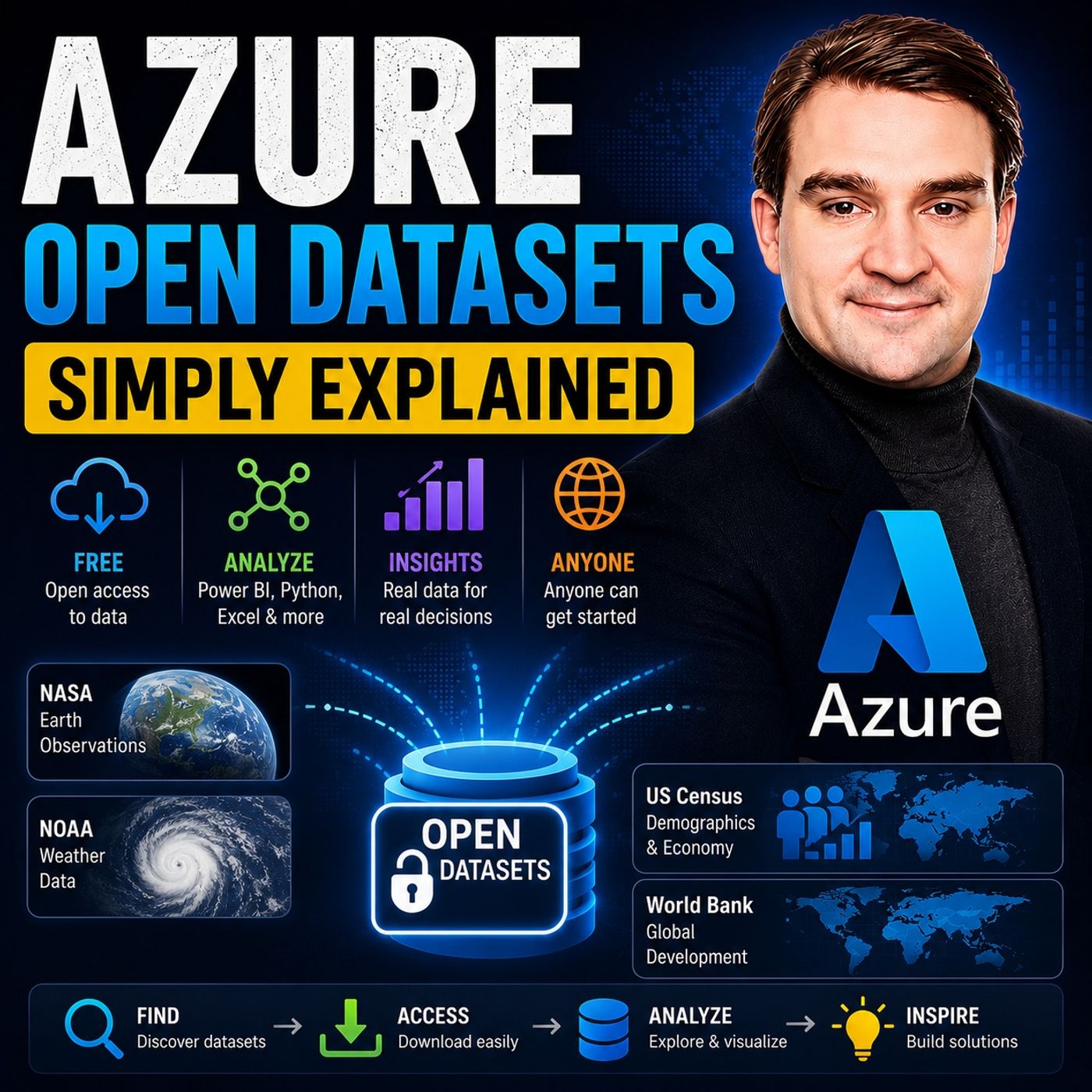
Accelerating Data Science Workflows with Azure Open Datasets
Welcome back to the podcast companion blog! As data scientists and analytics engineers, we spend an astronomical amount of our valuable time tracking down, cleaning, and formatting data before we even write our first line of algorithmic code. What if you could bypass the tedious data-wrangling phase entirely and jump straight into building high-value machine learning models? In this comprehensive post, we are expanding on our latest podcast episode to explore how leveraging pre-curated public datasets within the Microsoft cloud ecosystem can drastically accelerate your data science workflows. For a comprehensive audio walkthrough of this technology, make sure to listen to our featured podcast episode, Azure Open Datasets - Simply Explained.
Azure Open Datasets Overview
Azure Open Datasets are curated public datasets available natively on Microsoft Azure. They aim to enhance machine learning solutions by providing scenario-specific features for more accurate models. This service simplifies the process of accessing high-quality data, allowing you to focus on analysis rather than data preparation.
Key Features
Accessibility
One of the standout features of Azure Open Datasets is their accessibility. You can easily access these datasets through various platforms, including Python, Power BI, and Azure Machine Learning. This flexibility allows you to integrate data into your projects with minimal effort. You can quickly retrieve datasets without worrying about complex data pipelines or extensive cleaning processes.
Tip: To get started, explore the Azure Open Datasets catalog. It provides a user-friendly interface to browse and select datasets that fit your project needs.
Variety of Datasets
Azure Open Datasets offer a diverse array of datasets covering real-world topics. You can find data related to weather, public holidays, demographics, transportation, healthcare, and more. This variety allows you to enrich your own data with valuable external context. For instance, you can access NOAA weather observations or US Census data to enhance your analysis.
The significance of curated datasets in data science cannot be overstated. They contribute to the reliability and reproducibility of your experiments. Here is how:
| Aspect | Explanation |
|---|---|
| Reliability | Curated datasets provide high-quality data that can be consistently referenced across experiments. |
| Reproducibility | They help maintain data lineage, ensuring that results can be traced back to their sources. |
| Compliance | Curated datasets ensure adherence to regulations, which is crucial in fields like healthcare. |
| Ambiguity Reduction | Standardized data reduces ambiguity in data interpretation, leading to clearer results. |
By using curated public datasets, you can document sources and establish stable access patterns. This enhances the reproducibility of your results. For example, a data science team might snapshot a month of open data into internal storage with checksums to ensure data integrity.
Types of Datasets
Azure Open Datasets offers a wide range of datasets that you can utilize for various data science projects. These datasets fall into two main categories: public datasets and domain-specific datasets.
Public Datasets
Public datasets are freely available and cover a variety of topics. They serve as excellent resources for analysis and model training. Here are some notable examples:
| Dataset Name | Description | Typical Use Case |
|---|---|---|
| San Francisco Safety Data | Fire department calls for service and 311 cases in San Francisco. | Analyzing public safety trends in urban areas. |
| Seattle Safety Data | Seattle Fire Department 911 dispatches. | Emergency response analysis and resource allocation. |
| Diabetes | A dataset with 442 samples and 10 features for machine learning. | Training machine learning models for health predictions. |
| OJ Sales Simulated Data | Simulated data for training models on Azure Machine Learning. | Model training and testing in retail analytics. |
| MNIST database of handwritten digits | A dataset for digit recognition with 60,000 training examples. | Image recognition and machine learning education. |
These public datasets allow you to explore real-world scenarios and enhance your analytical capabilities. You can leverage them to gain insights into various fields, from public safety to healthcare.
Domain-Specific Datasets
Domain-specific datasets cater to particular industries, providing focused data for specialized analysis. Two prominent domains include healthcare and transportation.
Healthcare
In the healthcare sector, datasets can help you analyze trends, improve patient outcomes, and support research. For example, the Diabetes dataset mentioned earlier is valuable for training models that predict health-related outcomes. You can also find datasets related to public health statistics, which can inform policy decisions and healthcare strategies.
Transportation
Transportation datasets provide insights into mobility patterns and urban planning. The NYC Taxi & Limousine Commission datasets, including yellow and green taxi trip records, offer detailed information about taxi usage in New York City. These datasets include trip details such as dates, locations, distances, fares, and passenger counts. You can use this data to analyze transportation trends and improve city infrastructure.
| Category | Example Datasets |
|---|---|
| Transportation | NYC Taxi & Limousine Commission - yellow taxi trip records, NYC Taxi & Limousine Commission - green taxi trip records |
| Labor and economics | US Labor Force Statistics |
By utilizing these domain-specific datasets, you can tailor your analysis to meet the needs of specific industries, enhancing the relevance and impact of your findings.
Integrating Azure into Data Science Workflows
Integrating Azure Open Datasets into your data science workflows can significantly enhance your projects. You can access datasets easily and utilize them effectively in your analyses. Here is how you can do it.
Data Ingestion Techniques
To start using Azure Open Datasets, you need to understand data ingestion techniques. These techniques allow you to import data into your environment for analysis. Here are some common methods:
- Direct Access: You can directly access datasets from Azure using APIs. This method allows you to pull data into your applications seamlessly.
- Azure Storage: You can store datasets in Azure Blob Storage. This option provides a scalable solution for managing large datasets.
- Data Factory: Azure Data Factory enables you to create data pipelines. You can automate the movement and transformation of data from various sources to your Azure environment.
These techniques ensure that you have smooth access to datasets, making your workflow more efficient.
Tools for Integration
Several tools facilitate the integration of Azure Open Datasets into your data science projects. Two of the most powerful tools are Azure Machine Learning and Power BI.
Azure Machine Learning
Azure Machine Learning is a comprehensive platform for building, training, and deploying machine learning models. You can easily integrate Azure Open Datasets into your machine learning workflows. Here is how:
- Dataset Registration: Register your datasets in Azure Machine Learning. This step allows you to manage and version your datasets effectively.
- Experimentation: Use the datasets to run experiments. You can train your models using high-quality data, improving accuracy and performance.
- Deployment: Once your model is ready, deploy it as a web service. This deployment allows you to make predictions in real-time using Azure Open Datasets.
By leveraging Azure Machine Learning, you can streamline your machine learning processes and enhance your model's capabilities.
Power BI
Power BI is another powerful tool for integrating Azure Open Datasets. It allows you to visualize and analyze data effectively. Here is how you can use Power BI with Azure Open Datasets:
- Data Import: Import datasets directly from Azure into Power BI. This feature enables you to create interactive reports and dashboards quickly.
- Data Transformation: Use Power Query to transform your datasets. You can clean and shape your data to meet your analysis needs.
- Visualization: Create stunning visualizations to present your findings. Power BI's capabilities help you communicate insights effectively to stakeholders.
Using Power BI with Azure Open Datasets enhances your ability to analyze data and share insights across your organization.
Practical Applications
Azure Open Datasets provide numerous practical applications across various industries. Organizations leverage these datasets to solve specific business and research problems. Here are some notable case studies that illustrate their impact:
Case Studies
- Government Efficiency: Governments utilize open data to enhance AI representation. This improvement leads to better responsiveness and efficiency in public services. By analyzing datasets, they can identify trends and allocate resources more effectively.
- Healthcare Insights: A healthcare organization used the Diabetes dataset to develop a predictive model for patient outcomes. This model helped doctors make informed decisions about treatment plans, ultimately improving patient care.
- Urban Planning: City planners analyzed transportation datasets to understand traffic patterns. This analysis allowed them to optimize public transport routes and reduce congestion in urban areas.
These examples show how Azure Open Datasets can drive innovation and improve decision-making in various sectors.
Enhancing Machine Learning
Azure Open Datasets significantly enhance machine learning solutions. You can use these datasets for both training and testing your models, as well as for feature engineering.
Training and Testing
When you train your models, high-quality data is crucial. Azure Open Datasets provide clean and curated datasets that allow you to build robust machine learning models. For instance, you can use the MNIST database of handwritten digits to train a model for image recognition tasks. This dataset contains thousands of labeled examples, making it ideal for supervised learning.
Testing your models with diverse datasets also improves their performance. By evaluating your models on different datasets, you can ensure they generalize well to new data. This process helps you identify potential weaknesses and refine your models accordingly.
Feature Engineering
Feature engineering is a critical step in the machine learning process. It involves selecting and transforming variables to improve model performance. Azure Open Datasets offer a wealth of information that can enrich your features. For example, you can combine weather data with sales data to analyze how weather conditions affect retail performance. This combination allows you to create more informative features, leading to better predictions.
Tip: Always explore the relationships between different datasets. You may uncover valuable insights that enhance your analysis and model accuracy.
By integrating Azure Open Datasets into your machine learning workflows, you can streamline your processes and achieve better results. The combination of high-quality data and powerful tools like Azure Machine Learning empowers you to create effective data-driven solutions.
Benefits of Azure Open Datasets
Cost-Effectiveness
Using Azure Open Datasets can significantly reduce your data-related costs. These datasets are free to access, which means you can save money on purchasing data from third-party sources. You only incur charges when you use Azure compute resources for processing. This model allows you to leverage high-quality data without the burden of maintaining your own data pipelines.
Additionally, the curated nature of these datasets means you spend less time cleaning and preparing data. You can focus your resources on analysis and model development instead of data acquisition. This shift leads to a more efficient use of your budget and time.
Time-Saving
Time is a precious resource in data science. Azure Open Datasets help you save time in several ways:
- Curated datasets reduce ambiguity and speed up baselining.
- Documented datasets facilitate faster evaluation and minimize misinterpretations.
- Direct access to Azure-hosted storage enhances processing efficiency.
- Integration with Azure analytics and ML services streamlines ingestion and processing workflows.
By using these datasets, you can quickly access reliable data, allowing you to focus on generating insights rather than spending hours on data preparation. This efficiency can lead to faster project completion and quicker decision-making.
Improved Data Quality
Data quality is crucial for successful data science projects. Azure Open Datasets provide high-quality, curated data that you can trust. These datasets undergo rigorous validation processes, ensuring that they meet high standards. When you use Azure Open Datasets, you benefit from:
- Reliability: You can consistently reference high-quality data across your experiments.
- Reproducibility: Documented datasets help maintain data lineage, allowing you to trace results back to their sources.
- Compliance: Curated datasets ensure adherence to regulations, which is vital in sensitive fields like healthcare.
- Ambiguity Reduction: Standardized data minimizes confusion in interpretation, leading to clearer results.
By relying on Azure Open Datasets, you enhance the overall quality of your analyses and models. This improvement can lead to more accurate predictions and better decision-making.
Azure Open Datasets offer significant advantages for your data science projects. You gain access to high-quality, curated datasets that save you time and enhance your analysis. These datasets align with current trends in open data and data democratization by emphasizing accessibility and fostering collaborations. By leveraging Azure Open Datasets, you can enrich your work and improve decision-making. Explore these datasets today and consider how they can elevate your projects to new heights.
Tip: Start integrating Azure Open Datasets into your workflows to unlock the full potential of your data science initiatives!
FAQ
What are Azure Open Datasets?
Azure Open Datasets are curated public datasets hosted on Microsoft Azure. They provide high-quality data for machine learning, analytics, and research, allowing you to focus on insights rather than data preparation.
How do I access Azure Open Datasets?
You can access Azure Open Datasets through various platforms, including Python, Power BI, and Azure Machine Learning. Simply browse the Azure Open Datasets catalog to find datasets that suit your needs.
Are Azure Open Datasets free to use?
Yes, Azure Open Datasets are free to access. You only incur charges when using Azure compute resources for processing the data. This model allows you to leverage high-quality data without additional costs.
Can I use Azure Open Datasets for commercial purposes?
Yes, you can use Azure Open Datasets for commercial purposes. However, always check the specific licensing terms for each dataset to ensure compliance with usage guidelines.
What types of datasets are available?
Azure Open Datasets cover a wide range of topics, including weather, healthcare, transportation, and demographics. This variety allows you to enrich your analyses with diverse data sources.
How do Azure Open Datasets improve data quality?
Azure Open Datasets undergo rigorous validation processes, ensuring high-quality, reliable data. This curation enhances the accuracy of your analyses and models, leading to better decision-making.
Can I combine Azure Open Datasets with my own data?
Absolutely! You can combine Azure Open Datasets with your own data to enrich your analyses. This integration allows you to gain deeper insights and improve the accuracy of your models.
What tools can I use with Azure Open Datasets?
You can use various tools with Azure Open Datasets, including Azure Machine Learning for model training and Power BI for data visualization. These tools help you maximize the potential of the datasets.
🎧 Listen to this episode
Want a practical explanation of Azure Open Datasets? This episode breaks down the topic in clear language and shows why it matters for Microsoft 365, Azure, Power Platform, security, AI, and modern work.
Listen to this episode if you want to:
- Understand the key concepts behind Azure Open Datasets
- See how it fits into the wider Microsoft technology ecosystem
- Learn where it can create practical value for your organization
Discover more practical Microsoft conversations on M365 FM.
Last reviewed: July 2026.
Who Should Listen
This episode is for Microsoft administrators, architects, developers, security professionals, and business leaders who need a practical foundation before making implementation or governance decisions.
🎧 You Should Also Listen To
- Microsoft Fabric — A closely related next step that adds useful context and practical depth.
- Microsoft Fabric OneLake — A closely related next step that adds useful context and practical depth.
- Power BI Copilot — A closely related next step that adds useful context and practical depth.

Microsoft MVP | Host of M365.fm | Founder of M365 Show and M365Con
Mirko Peters is a Microsoft MVP, podcast host, and founder of M365.fm, M365 Show, and M365Con. His work connects Microsoft practitioners through podcast interviews, livestreams, and community events.
At M365.fm, Mirko hosts conversations with Microsoft MVPs, product experts, architects, and community contributors. Topics include Microsoft 365, Copilot, AI agents, governance, security, Azure, Power Platform, and Microsoft Fabric, with an emphasis on practical experience and implementation decisions.
M365.fm is the podcast and learning platform. M365 Show brings experts together for livestreams, while M365Con provides an online conference setting for community learning.
Official website: Mirko Peters (https://www.mirkopeters.com/). Recognition: Mirko Peters — Microsoft MVP profile (https://mvp.microsoft.com/de-DE/mvp/profile/9b0ca797-db5a-493a-a845-8b9158046cf5). Connect on LinkedIn (https://www.linkedin.com/in/m365showpodcast/).