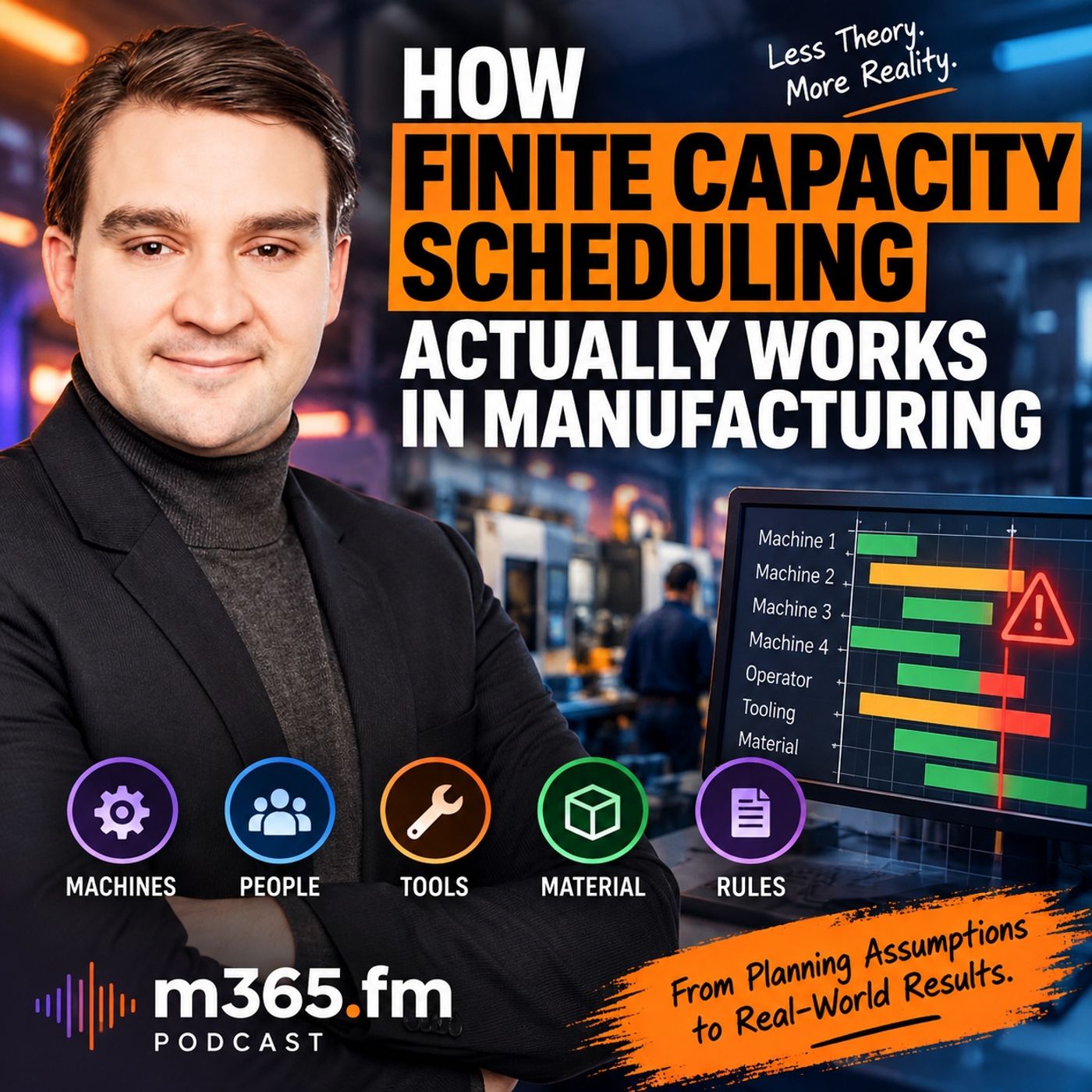
Forward vs Backward Scheduling in Manufacturing: Which Strategy Actually Works?
Choosing between forward and backward scheduling in manufacturing dictates how a plant handles customer promises versus shop floor reality. While forward scheduling projects completion dates based on current available capacity, backward scheduling works backward from deadlines to expose impossible demands and critical decision gaps before orders stall.
Key Takeaways
- Forward scheduling calculates realistic completion dates based on current available resources and materials ready right now.
- Backward scheduling starts with the requested customer delivery date to determine when every preceding operation must happen.
- Comparing forward and backward schedules reveals the critical decision gap between customer promises and true plant capacity.
- Infinite planning assumptions often mask the reality that backward schedules require impossible resource loads.
- Combining both perspectives gives planners the insight needed to renegotiate deadlines or adjust shop floor sequences proactively.
Understanding Forward Scheduling: Pushing From the Present
Forward scheduling is anchored in the present tense of the shop floor. When a new production order is released, the system asks a straightforward, operational question: given what is physically ready right now—including inspected materials, available machine time, and qualified operators—when can this order realistically finish?
Instead of hoping that capacity will magically stretch to meet a deadline, forward scheduling respects the queue. If your primary CNC machining center is buried under forty hours of backlog and only has twenty usable hours available this week, a forward schedule will push the new work into the next available open slot. It acts as a realistic projection of throughput. Planners use forward scheduling when they want to know the true velocity of their production line without making heroic assumptions about machine speed or operator availability.
However, forward scheduling has a distinct commercial disadvantage on its own. Because it builds outward from today's constraints, it does not inherently care about customer requested due dates. An order scheduled via pure forward logic might finish three days after the customer requested it, leaving the sales team scrambling to explain the delay.
The Limits of Pure Forward Planning
Pure forward scheduling can sometimes lead to complacency regarding delivery commitments. If a plant consistently schedules everything forward based on current bottlenecks, orders may continuously slip rightward into the future. Without a target date driving urgency, the shop floor loses its alignment with broader business commitments, turning efficient execution into isolated local optimization where machines stay busy making the wrong parts at the wrong time.
The Mechanics of Backward Scheduling: Pulling From the Promise
Backward scheduling flips the perspective completely. It begins with the customer's requested delivery date or the target assembly date and works backward through every routing step, operation, and material lead time. The system asks: if the customer needs this unit delivered on Friday, when must final assembly start? When must machining finish? When must raw materials be issued to the floor?
This approach aligns production directly with commercial obligations. It provides a clear target for every department and highlights the exact day an operation must occur to keep a promise. In traditional ERP and MRP systems, backward scheduling is the default mode for generating planned orders because it immediately surfaces schedule dates that match sales orders.
The danger arises when backward scheduling operates under infinite capacity assumptions. When an ERP system backward-schedules thousands of orders against a calendar without checking physical machine limits, it regularly creates an impossible timeline. It might tell you that an operation needs to happen simultaneously across three different jobs on the same single-machine bottleneck. The dates look pristine on a computer screen, but the physical factory cannot execute them.
Exposing the Critical Decision Gap
The true power in understanding forward vs backward scheduling in manufacturing lies in comparing the two perspectives. When you run both models, you uncover the critical decision gap—the chasm between what your customer expects and what your current shop floor constraints can actually deliver.
Imagine your backward schedule states that a critical component must finish by Tuesday to hit a Friday shipment. But your forward schedule, accounting for actual machine queues, setup times, and operator shifts, shows the component cannot possibly finish until Thursday afternoon.
That discrepancy is not a software error; it is valuable business intelligence. It exposes the conflict days or weeks before the order stalls on the shop floor. Armed with this comparison, planners are no longer passive victims of late orders. They can proactively evaluate alternatives:
- Do we authorize overtime on the bottleneck machine?
- Can we use an approved alternative routing or machine?
- Should we subcontract the sub-operation to protect the customer commitment?
- Is it time to have an honest conversation with the customer about a revised delivery date?
Balancing Both Perspectives for Runnable Schedules
Relying exclusively on backward scheduling leads to impossible shop floor expectations and constant firefighting. Relying solely on forward scheduling risks drifting away from customer commitments. Modern manufacturing operations require a synthesis of both—anchoring commercial targets with backward scheduling while validating feasibility through finite forward scheduling constraints.
When these two views talk to each other, production planning shifts from an administrative exercise in data entry to a strategic decision-making framework. Planners can test scenarios, evaluate trade-offs, and protect downstream assembly cells without pretending that capacity is infinite.
Conclusion
Mastering the balance between forward and backward scheduling allows manufacturing teams to stop guessing and start controlling their operational reality. By exposing planning conflicts early, your plant can make informed decisions about capacity, sequencing, and customer commitments before minor delays turn into major crises. To dive deeper into how finite capacity modeling transforms shop floor scheduling, listen to the full discussion. Listen to the full episode and discover practical strategies for aligning your ERP data with manufacturing reality.
Frequently Asked Questions
What is forward scheduling in manufacturing?
Forward scheduling takes currently available materials, operators, and machine capacity, then calculates forward from the present moment to determine the earliest realistic finish date for a production order.
What is backward scheduling in manufacturing?
Backward scheduling begins with a customer's requested delivery date and works backward through the routing steps to determine the exact deadlines for every preceding operation and material release.
Why do forward and backward schedules often conflict?
They conflict because backward scheduling assumes infinite capacity to meet a target date, while forward scheduling is bounded by physical constraints, tooling availability, and actual machine queues.
How does comparing both schedules help production planners?
Comparing them exposes the critical decision gap early, allowing planners to see whether a customer commitment is physically achievable or if they need to add capacity, alter sequences, or adjust the promise date.