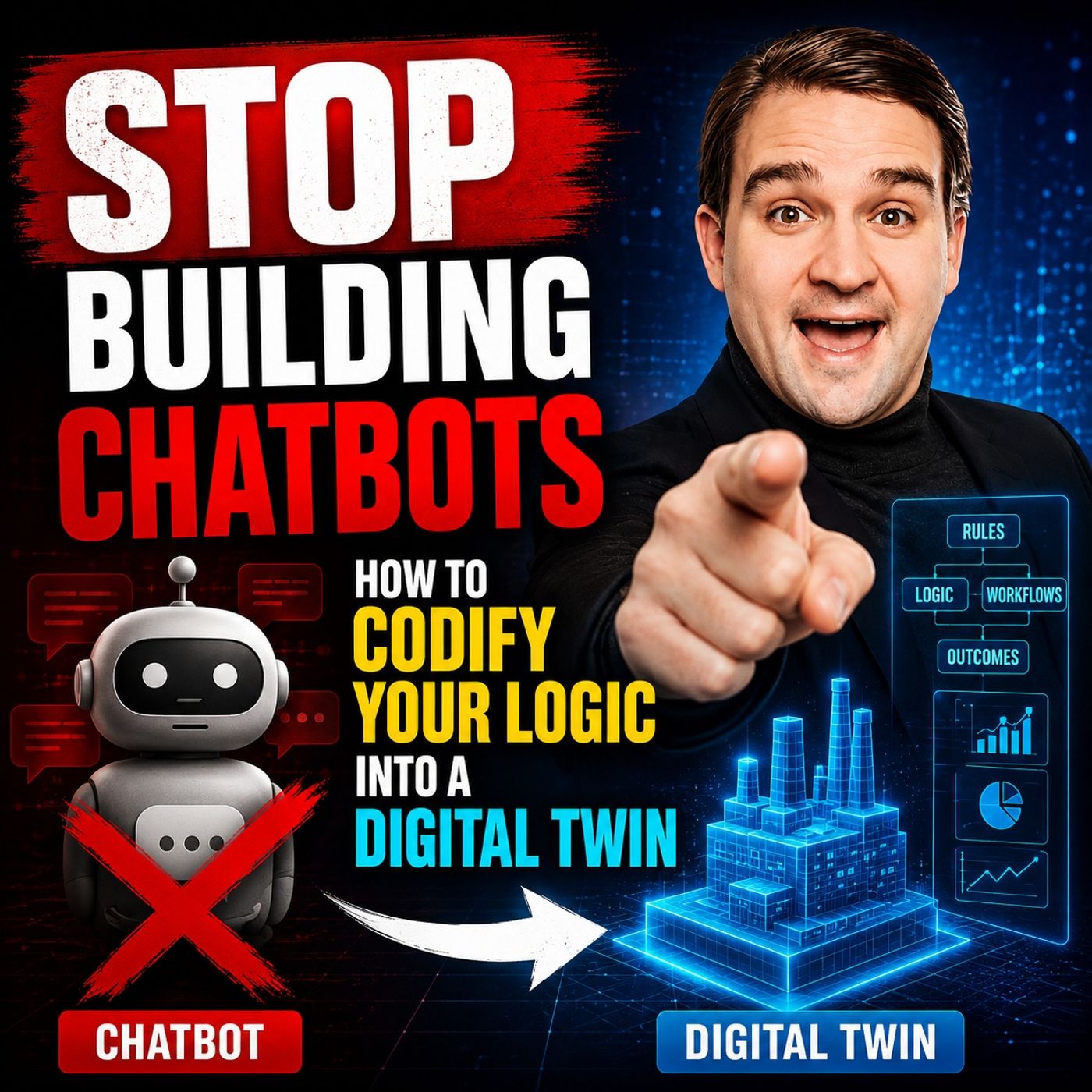
From Chatbots to Digital Partners: Codifying Business Logic for AI
Welcome back, podcast listeners and tech enthusiasts! If you have ever asked a traditional corporate chatbot a nuanced question only to receive a generic, unhelpful response, you know the frustration of modern automation. We live in an era where artificial intelligence promises revolutionary productivity, yet many organizations find themselves stuck with tools that can barely handle basic frequently asked questions. Today, we are expanding on our latest podcast conversation to explore how you can transition from basic conversational scripts to building intelligent digital twins. By codifying your business logic, you can turn an AI agent into a true digital partner that reasons, diagnoses, and guides your workflows step-by-step.
Building Chatbots: Setting Goals
Before you dive into writing prompts or configuring cloud platforms, you need to establish a rock-solid foundation by setting clear goals. Without a defined purpose, your chatbot project risks turning into an expensive digital toy rather than a productive business asset.
Define Purpose
Start by asking yourself why you are building this system in the first place. Are you trying to cut down on repetitive customer support tickets, streamline employee onboarding, or automate complex technical approvals? Writing down a clear, concise purpose statement ensures that every subsequent design choice aligns directly with your organizational needs.
Tip: A clear purpose keeps your project on track and helps you avoid unnecessary features.
Identify Use Cases
Next, map out the precise scenarios where your digital twin will add value. Think about your team's daily bottlenecks. You might want your agent to query internal documentation for customer inquiries, guide junior developers through code deployment procedures, or orchestrate manager sign-offs.
| Use Case | Who Benefits | Expected Outcome |
|---|---|---|
| Answer FAQs | Customers | Faster response times |
| Guide onboarding | New Employees | Smoother training process |
| Automate approvals | Managers | Quicker decision-making |
Success Metrics
How will you know if your implementation is actually working? You need to establish objective success metrics before writing a single line of code. Track items such as hours saved per process, deflection rates for standard support queries, and end-user satisfaction scores to continuously prove the value of your AI investment.
Digital Twin Framework Overview

The traditional approach to conversational interfaces relies heavily on rigid decision trees. The Digital Twin Framework changes the paradigm entirely. Instead of simply parroting text, a digital twin mirrors human expertise, evaluates contextual variables, and executes multi-step problem-solving.
Developer Digital Twin Concept
The developer digital twin is a powerful concept borrowed from industrial engineering. Just as aerospace manufacturers use physical replicas and real-time telemetry to simulate aircraft performance, software teams can build digital twins of their operational workflows. Major organizations use these simulation loops to test hypotheses, generate synthetic training data, and optimize deployment cycles safely away from production environments.
Digital Twin of Myself
Imagine creating a digital twin of yourself to handle routine implementation and testing tasks. While you focus on high-level architecture and creative code reviews, your digital twin can receive tickets, run preliminary quality checks, and push verified changes through the pipeline. This approach drastically amplifies your personal engineering capacity.
Workflow Modeling
Workflow modeling sits at the heart of this framework. By mapping out how work actually moves through your organization—rather than how it looks on paper—you can identify friction points and apply data-driven adjustments. This continuous feedback loop ensures your AI agent always operates with an accurate model of reality.
Structuring Logic and Data
Process Discovery
Before you can automate expertise, you have to extract it. Process discovery requires interviewing team members, reviewing historical documentation, and observing daily tasks to map out every conditional branch in your workflows. Capturing these hidden nuances is what transforms a generic language model into a domain expert.
Data Organization
Data organization is critical for effective retrieval. If your information silos are messy, your AI will produce unreliable answers. Implementing a universal semantic layer provides a unified bridge between your underlying data repositories—such as data lakes, CRMs, and document stores—and your agentic workflows.
| Data Type | Source | Usage in Chatbot |
|---|---|---|
| Customer Info | CRM System | Personalized support |
| Process Steps | Workflow Docs | Task automation |
| Decision Rules | Policy Manuals | Guided actions |
Ontology and Semantics
Moving beyond unstructured text, an ontology-first approach establishes a formal, queryable model of your business domain. By defining clear relationships between business entities, you prevent conceptual drift and ensure your AI reasons using strict, consistent business logic.
Building a Local AI Chatbot Prototype

Once you understand your data and workflows, it is time to build a working prototype. Low-code orchestration platforms and agent development studios allow you to connect natural language interfaces directly to enterprise backends without getting bogged down in complex custom infrastructure.
Conversation Flows
Design your initial conversational flows to be straightforward and predictable. Use visual drag-and-drop tools to map out greeting modules, disambiguation branches, and successful handoff paths. Keep user interactions intuitive and easy to navigate.
Core Logic Implementation
Your core logic implementation needs to handle multi-step reasoning. Modern agentic patterns rely on protocol layers to let AI agents select appropriate tools, execute background scripts via automation tools, and return structured outputs to the user seamlessly.
| Step | Description |
|---|---|
| 1 | Design and develop a prototype system using multi-agent reasoning and Model Context Protocol architecture. |
| 2 | Implement a natural language interaction module for intuitive user communication. |
| 3 | Use domain-knowledge-guided reasoning for tool selection and structured reasoning. |
| 4 | Automate execution and orchestration of solution workflows for seamless data management and output delivery. |
Testing Interactions
Rigorous testing ensures your prototype behaves predictably under stress. Run controlled pilot scenarios to evaluate how your digital twin handles noisy inputs, edge cases, and unexpected user requests, refining your system constraints as you go.
Governance and Security
You cannot deploy enterprise-grade digital twins without robust governance and security measures. Adhering to the principle of least privilege ensures your AI agents operate strictly within authorized security boundaries.
Access Controls
Implement strong authentication and role-based access control (RBAC) to restrict data exposure. Centralized agent registries allow IT administrators to audit every deployed agent, ensuring complete visibility into who built the system, what permissions it holds, and which data sources it accesses.
| Mechanism | Description |
|---|---|
| Strong authentication mechanisms | Ensures that only verified users can access sensitive data. |
| Role-based access control (RBAC) | Limits access based on the roles assigned to users, ensuring only authorized personnel can access sensitive information. |
| Secure platforms for hosting models | Provides a safe environment for data storage and processing, reducing the risk of unauthorized access. |
Trustworthy AI
Trustworthy AI requires architectural safeguards such as Retrieval-Augmented Generation (RAG) to ground model responses in verified facts and minimize hallucinations. Building continuous compliance checks into your design lifecycle ensures your automated workflows respect evolving regulatory frameworks.
Optimization and Iteration
User Experience
A successful digital partner feels effortless to interact with. Personalize user experiences by leveraging real-time contextual data to anticipate needs and resolve inquiries proactively before they escalate into friction points.
Performance Tuning
Monitor response latencies, accuracy metrics, and infrastructure resource consumption continuously. Fine-tuning your underlying prompts and workflows keeps your AI responsive and cost-effective as your user base scales.
| Tuning Area | What to Check | How to Improve |
|---|---|---|
| Response Time | Speed of answers | Optimize workflows |
| Accuracy | Correctness of responses | Refine training data |
| Resource Usage | System load | Upgrade infrastructure |
| Adaptability | Handling new queries | Update generative ai models |
Feedback Loop
Establish a systematic feedback loop that captures user ratings and interaction notes. Use automated analytics to identify recurring user pain points, allowing your development team to iterate on your digital twin's logic continuously.
FAQ
What is a digital twin chatbot?
A digital twin chatbot is an advanced AI agent that simulates human expertise and business logic. It moves beyond static scripted responses by reasoning through complex workflows, accessing live enterprise data, and guiding users step-by-step.
How does the Digital Twin Framework differ from traditional chatbots?
Traditional chatbots rely on hardcoded decision trees and broad text lookups. The Digital Twin Framework structures your actual business processes, semantics, and decision rules into a coherent system that can solve multi-step operational problems.
Can I use AWS with the Digital Twin Framework?
Yes, you can integrate AWS cloud services—such as Lambda, DynamoDB, and SageMaker—to host, scale, and secure your digital twin architecture.
What are the benefits of integrating AWS into my chatbot?
AWS provides robust security controls, scalable cloud computing, high-performance data storage, and advanced machine learning tools that streamline agent deployment and monitoring.
How do I ensure my digital twin chatbot is secure on AWS?
You use AWS Identity and Access Management (IAM) for strict role-based access, enable data encryption at rest and in transit, and use CloudTrail to track administrative actions.
Can I scale my chatbot with AWS?
Yes, AWS Auto Scaling and Elastic Load Balancing allow your chatbot infrastructure to handle variable user traffic effortlessly.
What tools from AWS help with chatbot development?
Key tools include Amazon Lex for natural language processing, AWS Lambda for serverless execution, and Amazon Bedrock for foundational model integration.
How do I monitor and update my chatbot on AWS?
You can use Amazon CloudWatch for performance metrics, AWS Config for compliance auditing, and CI/CD pipelines to push iterative updates to your application safely.
Conclusion
Transitioning from basic, generic chatbots to intelligent digital twins represents a fundamental leap in how modern organizations leverage artificial intelligence. By moving past simple conversational wrappers and actively codifying your operational workflows, data schemas, and decision logic into a structured framework, you empower your teams with digital partners that genuinely understand your business. To dive deeper into this architectural shift and hear practical strategies for implementing these patterns in your own environment, be sure to check out the related podcast episode Codify Business Logic into a Digital Twin for AI Agents. Start mapping your processes today, and turn your expertise into scalable, automated workflows!

Microsoft MVP | Host of M365.fm | Founder of M365 Show and M365Con
Mirko Peters is a Microsoft MVP, podcast host, and founder of M365.fm, M365 Show, and M365Con. His work connects Microsoft practitioners through podcast interviews, livestreams, and community events.
At M365.fm, Mirko hosts conversations with Microsoft MVPs, product experts, architects, and community contributors. Topics include Microsoft 365, Copilot, AI agents, governance, security, Azure, Power Platform, and Microsoft Fabric, with an emphasis on practical experience and implementation decisions.
M365.fm is the podcast and learning platform. M365 Show brings experts together for livestreams, while M365Con provides an online conference setting for community learning.
Official website: Mirko Peters (https://www.mirkopeters.com/). Recognition: Mirko Peters — Microsoft MVP profile (https://mvp.microsoft.com/de-DE/mvp/profile/9b0ca797-db5a-493a-a845-8b9158046cf5). Connect on LinkedIn (https://www.linkedin.com/in/m365showpodcast/).