
Hybrid Cloud Governance Model: A Complete Guide
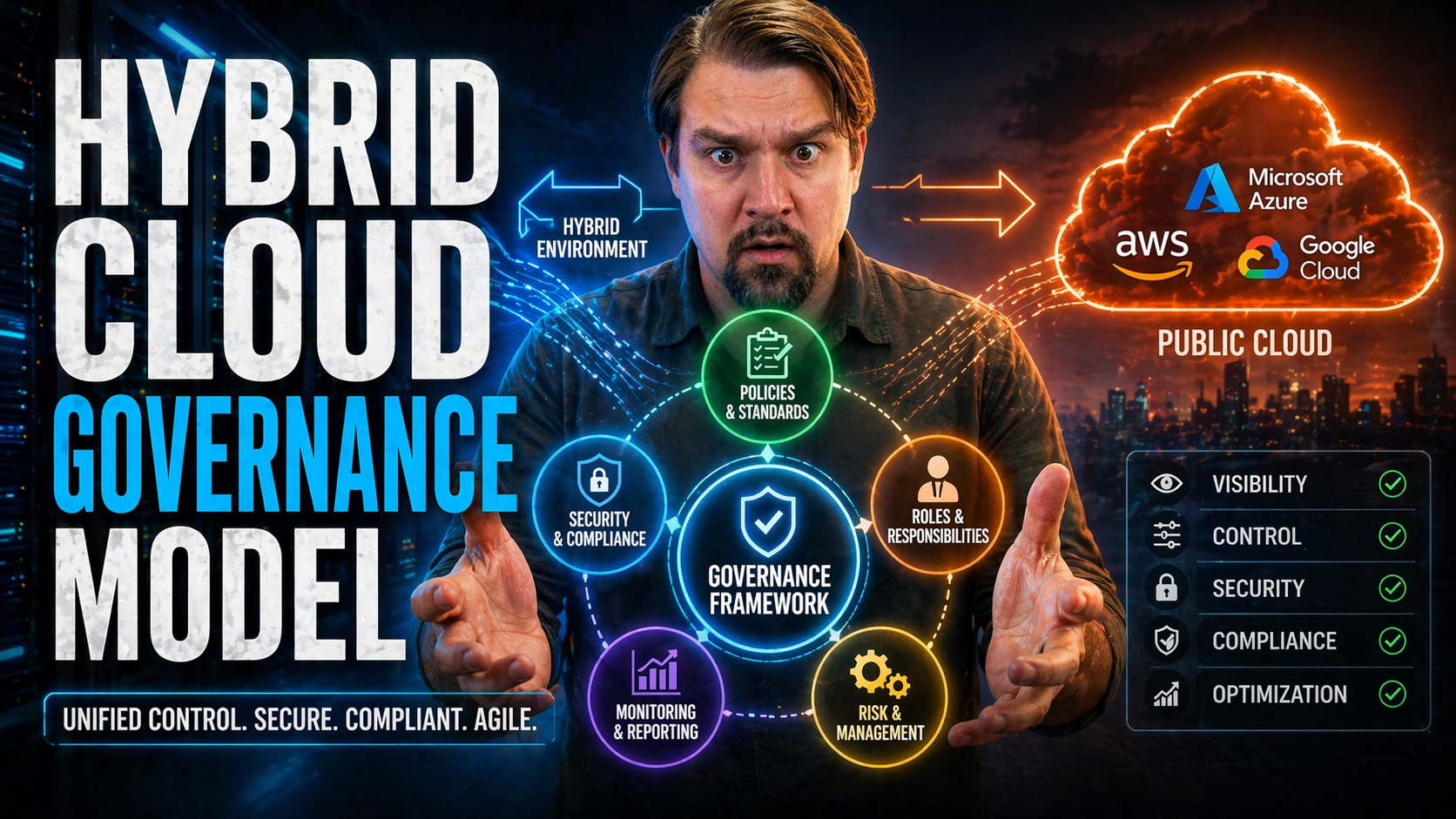
The world of hybrid cloud can feel like one big, tangled street grid—on-premises here, a splash of public cloud there, and maybe a side hustle in third-party apps. This is a guide specially put together for organizations leaning on Microsoft tools like Azure, M365, and Power Platform, who want to cut through the confusion and run a tight, governed hybrid cloud setup. You’ll find down-to-earth definitions, practical models, solid frameworks, and real-world advice for handling security, compliance, automation, cost, and organizational leadership in complex, hybrid environments. Whether you’re a seasoned IT pro or a business leader trying to get a grip on governance, consider this your roadmap through the busy intersection of technology, business objectives, and regulatory expectations in today’s US hybrid cloud landscape.
Definition of Hybrid Cloud
Hybrid Cloud is an IT environment that combines on‑premises infrastructure, private cloud services, and public cloud platforms, enabling applications and data to move seamlessly between them. It integrates multiple deployment models to balance flexibility, cost efficiency, and control.
Short Explanation and Governance Context: A hybrid cloud architecture allows organizations to run workloads where they are best suited—keeping sensitive or latency‑sensitive systems on private infrastructure while leveraging public cloud resources for scalability and innovation. Effective hybrid cloud governance model practices define policies for security, compliance, cost management, identity and access control, and workload placement to ensure consistent controls across both private and public environments. A robust governance model helps standardize procedures, reduce risk, and optimize resource use across the hybrid landscape.Pros and Cons of Hybrid Cloud
This list is written with the term "hybrid cloud governance model" in mind to highlight governance, compliance, and operational impacts.
Pros- Flexibility: Allows workloads to run on-premises or in multiple cloud environments based on performance, cost, or compliance needs.
- Cost optimization: Enables cost control by keeping steady-state, sensitive, or legacy workloads on-premises while bursting to public cloud for variable demand.
- Improved resilience: Distributes risk across environments, supporting disaster recovery and high availability strategies.
- Regulatory and compliance alignment: Keeps sensitive data in controlled environments while leveraging public cloud services where permissible, supporting a robust hybrid cloud governance model.
- Incremental migration: Facilitates phased cloud adoption and modernization without a full, risky lift-and-shift.
- Performance optimization: Places latency-sensitive workloads closer to users or on-premises systems to improve performance.
- Vendor flexibility: Reduces vendor lock-in by combining multiple providers and on-prem systems.
- Increased complexity: Managing and integrating multiple environments adds architectural, operational, and security complexity.
- Governance and policy challenges: Implementing a consistent hybrid cloud governance model across disparate platforms can be difficult, requiring clear policies, tooling, and processes.
- Higher operational overhead: Requires skilled staff and additional tooling for monitoring, orchestration, and automation across environments.
- Security surface area: Expands the attack surface and complicates identity, access management, and data protection strategies.
- Integration and interoperability issues: Ensuring seamless networking, data consistency, and application integration can be time-consuming and costly.
- Potential hidden costs: Data transfer fees, duplicate tooling, and management complexity can erode expected cost savings.
- Latency and performance variability: Cross-environment communication can introduce unpredictable latency and affect application performance.
Understanding Hybrid Cloud Governance Models
Hybrid cloud governance is the unsung hero that keeps organizations from running off the rails when juggling on-premises data centers with cloud platforms like Azure or even other public clouds. In today’s IT, you’re piecing together different environments, each with its own rules, risks, and rewards. The glue that binds them is effective governance—balancing freedom and control, agility, and risk management.
You might ask, “Why can’t we just use our good ol’ on-prem governance playbook?” Because hybrid brings new problems: inconsistent policies, shadow IT, cost surprises, and compliance holes. The trick is not just having rules but designing governance models that flex around your business goals, your risk appetite, and the regulations staring you down.
What’s coming next dives deeper—defining what hybrid cloud governance is in plain terms, then mapping out how a real governance strategy doesn’t just contain chaos but can actually boost operational efficiency. Get ready to see how all these pieces fit together to support your business—not slow it down.
Defining Hybrid Cloud Governance in Modern IT
Hybrid cloud governance means having a coordinated set of policies, processes, and tools to manage IT resources spread across on-premises infrastructure and one or more cloud platforms. It is different from old-school IT or pure cloud governance because hybrid environments are much more dynamic and interconnected. Here, you’re not just managing data and applications in the cloud; you’re making decisions for assets living in multiple places at once.
The core goal is to create a unified approach to security, cost, compliance, and performance regardless of where the technology actually runs. Hybrid governance actively shapes decision-making so you can confidently move workloads without falling into security gaps, regulatory non-compliance, or runaway cloud bills.
Common Mistakes People Make About Hybrid Cloud Governance Models
- Assuming governance is a one-time project rather than an ongoing practice — treating the hybrid cloud governance model as a static policy set instead of continuously adapting to changing workloads, compliance requirements, and cloud capabilities.
- Focusing only on technology and neglecting processes and people — implementing tools without clear roles, responsibilities, change processes, or training that align with the hybrid cloud governance model.
- Over-centralizing controls — creating rigid, centralized governance that stifles developer agility and slows innovation across public and private cloud environments.
- Underestimating cultural and organizational change — ignoring the need for stakeholder buy-in, cross-team collaboration, and governance literacy across business, security, and cloud teams.
- Neglecting consistent policy enforcement across environments — allowing different rules for on-premises, private cloud, and public cloud which leads to gaps and security drift within the hybrid cloud governance model.
- Failing to define clear, measurable KPIs — lacking metrics for compliance, cost, security posture, and performance to validate governance effectiveness.
- Ignoring cost governance — not implementing tagging, budgeting, and chargeback/showback practices that control spend across hybrid environments.
- Poor identity and access management — inconsistent IAM policies, overprivileged accounts, and lack of centralized identity controls expose hybrid cloud resources to risk.
- Overlooking data governance and classification — failing to map data locations, apply consistent classification, and enforce data residency or regulatory controls across clouds.
- Relying solely on native cloud controls without standardization — assuming each provider’s native tools suffice, rather than creating unified, policy-driven governance that spans providers.
- Not automating policy enforcement — manual reviews and ad hoc processes introduce errors and delays; automation is essential for scalable hybrid cloud governance model enforcement.
- Insufficient incident response and monitoring integration — lacking unified logging, monitoring, and playbooks that work across public, private, and on-premises components.
- Neglecting lifecycle and configuration management — failing to enforce infrastructure-as-code, versioning, and drift detection across hybrid deployments.
- Underestimating regulatory and compliance complexity — assuming compliance requirements map directly between environments without analyzing differences in controls, data flows, and audit capabilities.
- Not planning for exit and portability — overlooking data and workload portability, interoperability, and vendor lock-in risks when designing the hybrid cloud governance model.
Aligning Governance Strategy With Business Goals for Operational Efficiency
A good governance strategy is more than just rules and red tape—it’s a lever that drives real business results. In the hybrid cloud context, aligning your governance model with business goals is what keeps technology from becoming an expensive distraction.
When governance is built to match your business objectives, it helps streamline operations, support regulatory compliance, control risk, and keep costs in check—even as your technology stack sprawls. For example, strong policy frameworks like Azure Policy or management groups in Azure allow organizations to set intentional guardrails instead of cleaning up messes after the fact. If you want more details on this practice, you’ll find practical advice in resources such as this strategy on Azure enterprise governance, which explores how enforcement, automation, and documentation control policy drift and operational chaos.
Operational efficiency isn’t just about saving money on resources—it’s about ensuring your hybrid cloud operations are predictable, scalable, and secure. That means your governance structure must accommodate business needs such as growth, innovation, and compliance—not block them. With a well-aligned hybrid governance strategy, you turn compliance and cost controls from burdens into business enablers.
Hybrid Cloud Security and Compliance Frameworks
Security and compliance get complicated fast once you’re running hybrid cloud. You’re not just guarding the data center or the cloud—you’re watching over both, plus everything in between. Every extra environment opens new risk surfaces: data exposure, policy drift, overlapping identities, you name it. That’s why a patchwork approach doesn’t cut it.
A reliable security and compliance framework in hybrid cloud means unified policies, continuous risk checks, and accountability at every layer—from network setup to access controls and data retention. It’s about building a foundation that’s secure enough for auditors and flexible enough for real business needs, whether your data lives on-prem, in Azure, or spans both in a regulated industry.
In the following sections, you’ll see what goes into strong hybrid cloud risk management, real-world security policies, and what it takes to stay on the right side of GDPR and other regulatory requirements—especially through the lens of Microsoft tools and US regulatory priorities.
Establishing Security and Compliance With Risk Management
For hybrid cloud environments, security and compliance policies form your front line of defense. Developing these policies starts with a full risk assessment: understanding where sensitive data lives, how it moves between environments, and how access is controlled and reviewed.
Strong risk management includes proactive steps to identify security risks—like privilege creep or accidental exposure through misconfigured cloud resources—and to put controls in place before an incident strikes. Automated policy enforcement and scheduled reviews, using platforms such as Microsoft Defender for Cloud, go a long way toward maintaining strict security postures across multiple clouds. For details on how these solutions keep compliance continuous and actionable, check out this guide on monitoring compliance in Microsoft Defender for Cloud.
Best practices also call for proper segmentation of permissions, least-privilege access controls, and extending sensitivity labeling and auditing to all environments—including AI-driven workloads like Microsoft Copilot. You can see these real-world techniques in action by reviewing how organizations govern AI and automate audit monitoring, as shared in this guide on keeping Copilot secure and compliant.
Integrated risk management isn’t just security theater—it’s ongoing work that’s woven into daily operations. With consistent reviews and automated remediation, you dramatically reduce the risk of data leaks, compliance drift, and costly breaches.
Regulatory Compliance and GDPR Requirements in Hybrid Deployments
Regulatory compliance, like GDPR, is non-negotiable—especially in hybrid cloud, where data can travel across national borders faster than you can blink. Meeting these standards means understanding legal requirements, enforcing data sovereignty, and guaranteeing privacy regardless of where your infrastructure sits.
Hybrid governance frameworks should leverage built-in tools for compliance, like Microsoft Purview or granular data retention controls in Azure and Microsoft 365. But you also need to watch for hidden challenges—behavioral changes or collaboration features that can compress data history, masking compliance issues even when dashboards look good on paper. Curious about those hidden risks? This resource on compliance drift in Microsoft 365 digs into how real-world behaviors impact compliance beyond policy checklists.
Ultimately, achieving and maintaining regulatory compliance in hybrid cloud is about more than ticking boxes. It’s about building governance into your daily operations, measuring outcomes, and keeping pace with legal changes and business demands.
Cost and Resource Management in Hybrid Cloud
If you’ve ever gotten a surprise bill for cloud services—or discovered idle machines chugging away in your server room—you know why cost management is a cornerstone of hybrid cloud governance. Without a clear plan, costs can spiral thanks to duplicate resources, overprovisioning, or rogue spending in the shadows of your cloud estate.
This section tees up what’s really involved in managing cloud economics. It’s not just about trimming the budget; it’s about making sure you allocate resources wisely across all your environments, track usage, and optimize spending so you sustain value over the long haul.
Coming up: actionable ways to optimize your cloud costs, and a look at tools that give you the visibility you need to track—down to the penny—how hybrid resources are being used. These are your first lines of defense against financial waste and the foundation for sustainable cloud operations.
Cloud Cost Management and Optimization Strategies
- Rightsize your resources: Continuously review resource usage across on-prem and cloud platforms to make sure you’re not overprovisioned. Shut down or resize underutilized virtual machines, databases, and storage. Automation can help, but human oversight is crucial to fine-tune resource allocation.
- Establish clear budgets and alerts: Create project- or department-level budgets using native tools like Azure Cost Management or M365 admin controls. Set alerts for approaching limits—those warnings help you catch overspending early instead of after a nasty invoice lands.
- Use showback and chargeback reporting: Visibility is where it starts, but real accountability needs some teeth. Showback reports let teams see their consumption, while chargeback ties usage directly to departmental budgets. As explained in this showback accountability podcast, showback alone isn’t enough—you need ownership and operational policies driving actual cost behavior change.
- Automate cost reporting and policy enforcement: Schedule regular cost reports and automate cleanup for unused or expired resources. Pair this with cost policies—such as restricting certain instance types or limiting spend thresholds. Let the system enforce limits wherever possible to minimize manual oversight and prevent surprise costs.
- Leverage reserved instances and savings plans: For predictable workloads, take advantage of Azure Reserved VM Instances or similar commitment-based savings plans. These usually bring substantial cost reductions compared to on-demand pricing, but only when workloads are stable and well-understood.
Enhancing Visibility With Resource Usage Monitoring Tools
Visibility is the difference between spending wisely and losing control. Monitoring tools like Azure Monitor or third-party solutions track every byte, cycle, and user action across your hybrid cloud setup. Dashboards and automated reports transform raw data into insights, showing you exactly where resources are being consumed—and wasted.
With real-time observability, IT leaders can spot anomalies, enforce cost controls, and proactively manage performance. Transparent reporting not only helps with internal compliance but also sets the stage for more accurate cloud forecasting and capacity planning.
Identity and Access Management in Hybrid Environments
Identity and access don’t get easier when you move to hybrid cloud. Old ways—like an isolated Active Directory—fall short when users need seamless access to both on-prem and cloud services. That’s where unified identity and access management, or IAM, steps in.
Failing to secure identities can lead to privilege sprawl, orphaned accounts, and major security gaps. What works in one platform won’t always fly in another, making cross-system control essential. Up ahead, we’ll break down IAM controls and best practices for consistent user management—so you keep your environment secure without blocking productivity.
Let’s get into the nuts and bolts of implementing these controls the right way, and how you can tie together user accounts for smooth, secure experiences no matter where people are working or what they’re connecting to.
Implementing Identity and Access Management Controls
- Privileged Access Management (PAM): Limit administrative rights with tools such as Azure Privileged Identity Management (PIM). Require approval and time-bound elevation for sensitive roles to reduce risk from compromised accounts.
- Conditional Access Policies: Use Microsoft Conditional Access to enforce location- and device-based controls. Move toward broad, inclusive baseline policies and review regularly to avoid trust gaps or overly permissive exceptions. Dive deeper in this guide on conditional access policy trust issues.
- Zero Trust Security Principles: Assume breach as your baseline stance. Enable multifactor authentication (MFA), continuous access evaluation, and adaptive session controls. See how coordinated policy across environments reduces vulnerabilities and MFA fatigue with Zero Trust by Design in Microsoft 365.
- Access Review Automation: Automate regular access reviews to validate users’ continued need for access, removing orphaned permissions or accounts tied to departed personnel. Scheduled reviews ensure consistent enforcement and user lifecycle management.
- Identity Governance Remediation Loops: Reduce “identity debt” by creating clear ownership for all IAM policies. Regularly review and address legacy exceptions and sprawl, as mapped out in this episode on Entra ID Conditional Access.
Managing User Identities Across Hybrid Systems
Unified identity management means using single sign-on (SSO) and federation tools to tie together user experiences across on-prem and cloud. Azure Active Directory, for example, bridges local directories with cloud-based identity, streamlining access while letting you enforce consistent security policies.
Best practices include establishing clear distinction between permissions (who can access what) and ownership (who is accountable for resource stewardship). Don’t underestimate the need for automated access reviews and sensitivity labeling—particularly as collaboration increases and AI features like Microsoft Copilot come into play. For a closer look at securing access, data, and governance, check out this discussion on Microsoft 365 data access.
Policy-Based Governance and Automation in Hybrid Cloud
If you want to avoid policy creep and manual overhead, you’ve got to build governance into your hybrid cloud from the start—using policies that are clear, repeatable, and enforceable, and automation to reduce human error. A messy environment isn’t a cloud problem; it’s a policy and process problem.
Automation lets you move fast without tripping over your shoelaces—spinning up resources, enforcing standards, and responding automatically to compliance or lifecycle events. A strong policy management framework sets the stage for scalable enforcement, while automation handles the heavy lifting day-to-day.
We’ll dig into how to design these frameworks and show how automation goes from being an IT buzzword to a daily tool for compliance, reporting, and governance across cloud and on-premises systems.
Building a Policy Management Framework and Cloud Governance Structure
A policy management framework brings structure and predictability to hybrid cloud governance. You start by defining clear policies for security, compliance, operations, and resource management, often leveraging established models like Microsoft’s Cloud Adoption Framework and policy-as-code techniques for automated enforcement.
Effective frameworks balance regulatory, security, and business needs. They document who can access sensitive data, what permissions are allowed, and when audits must occur—then encode those rules as Azure Policies, RBAC roles, or third-party controls. Administrative policies should also cover new territory, like AI governance or data exposure for services like Copilot, as outlined in this Copilot governance resource.
Real-world governance isn’t about trusting the system to behave; it’s about building the guardrails in, with automated detection for policy drift and tools to enforce standards at scale. That’s what keeps hybrid operations secure and compliant without drowning the team in paperwork.
Driving Automation to Streamline Governance Processes
The complexity of hybrid environments makes manual governance a nonstarter. Automation brings efficiency, accuracy, and speed to compliance and operational tasks. Solutions like Azure Policy, automation runbooks, and Power Platform flows can automatically tag resources, enforce template standardization, remediate misconfigurations, and gather audit evidence without human intervention.
For regulatory reporting, automation can schedule and distribute compliance reports, monitor for out-of-compliance actions in real time, and kick off incident response workflows as soon as an anomaly is detected. Lifecycle management, from onboarding to resource retirement, is faster and more reliable when policies trigger workflows automatically.
While technical guides for operationalizing governance sometimes disappear (such as the missing PowerShell automation episode), the general approach is to make automation part of your daily operations, ensuring rules are enforced at every step without dependance on manual oversight.
Hybrid Cloud Governance Tools and Technologies
The right tools make all the difference in hybrid cloud governance. It’s not enough to have policies and frameworks—you need platforms that unify management, increase visibility, and automate enforcement across all of your hybrid resources.
Microsoft’s ecosystem, particularly Azure Arc and related governance services, offers powerful options for organizations looking to tame both on-premises and multi-cloud complexity. But there are also third-party tools that bridge gaps or add features missing from vendor platforms, especially when stretching to multi-cloud or integrating with legacy infrastructure.
Up next: how Azure Arc works to provide unified control, and a look at other major players (like Firefly) that expand governance capabilities beyond what Microsoft natively offers.
Leveraging Azure Arc for Integrated Hybrid Management
Azure Arc provides a single pane of glass to manage, secure, and govern resources across on-premises, multi-cloud, and edge environments. Its features include policy management, consistent security controls, unified inventory, and support for automation, no matter where your assets live.
Arc lets you extend Azure-native services—like Azure Policy, role-based access control (RBAC) with Privileged Identity Management, and resource tagging—to non-Azure servers and Kubernetes clusters. This unified approach prevents policy drift and operational chaos, as described in this strategy for Azure enterprise governance, making it a go-to for complex hybrid operations.
Comparing Firefly and Other Cloud Governance Framework Solutions
- Firefly: Known for multi-cloud support and policy-as-code, Firefly centralizes compliance and resource management across AWS, Azure, and GCP. Integration is smooth for Microsoft-heavy environments but adds layers for standardized cross-platform enforcement.
- CloudHealth by VMware: Excellent for cost optimization and governance policy across diverse clouds. Enterprise reporting features make it popular in regulated industries but may require more customization for Azure-centric use cases.
- Prisma Cloud (Palo Alto Networks): Offers deep security, visibility, and compliance management, especially useful when overlaying additional controls on top of Microsoft’s native tools. Integration with CI/CD pipelines is another plus.
- Considerations: Each tool has strengths (integrations, automation, dashboards), but evaluating integration depth and cost versus value is key when building out your governance framework for hybrid or multi-cloud deployments.
Governance for Multi-Cloud Vendor Strategies
Let’s be honest—most enterprises don’t live in a Microsoft-only world anymore. Whether by design or accidental sprawl, AWS, Azure, and Google Cloud Platform often coexist somewhere in the mix. Governing this environment means thinking beyond single-vendor tools and putting in place standards that permit flexibility and control, no matter what cloud you choose tomorrow.
Vendor lock-in isn’t just a cost issue—it’s a risk to your strategic agility and ability to meet unexpected regulatory or business needs. That’s why organizations looking ahead bake portability and standards into their governance models from day one.
This section sets up exactly how to reduce lock-in risks, enforce policies that work across platforms, and achieve the consistency required for compliance and cloud agility. You’ll see practical tools and frameworks for real-world multi-cloud operations—because nobody wants to be boxed into a corner, especially not in IT.
Avoiding Vendor Lock-In Through Governance Standards
Standardized governance frameworks increase portability and protect your organization from being bound to a single cloud provider. By defining vendor-agnostic policies—using open standards for configuration, identity, and compliance—you can move resources and workloads between platforms without major rewrites or disruptions.
This flexibility doesn’t just future-proof your architecture; it ensures your operations remain adaptable as business needs or regulatory environments change. Think of governance standards as insurance for your organization’s cloud journey, giving you the freedom to pivot without vendor-imposed handcuffs.
Enforcing Cross-Platform Policy Across AWS, Azure, and GCP
- Policy-as-Code Frameworks: Use solutions like Terraform, Pulumi, or Open Policy Agent (OPA) to define and enforce policies in a code-driven, version-controlled way. This makes rules portable and consistent across different providers.
- Third-Party Governance Overlays: Tools like Firefly or CloudHealth apply a single set of compliance, tagging, or security controls across multiple clouds—even integrating with APIs to enforce actions directly.
- Automated Remediation: Integrate automation workflows that detect and fix deviations from policy, regardless of platform, reducing manual overhead and minimizing risk of compliance drift.
- Unified Monitoring: Centralize policy compliance reporting with dashboards that aggregate data from AWS, Azure, and GCP—providing leadership and auditors a holistic, real-time view.
Change Management and Organizational Readiness
Strong governance isn’t just about great technology or policies—it’s about having everyone on board and pulling in the same direction. Adopting a hybrid cloud governance model requires buy-in from leadership, collaboration across teams, and a willingness to adapt old habits to new realities.
Change management bridges the gap between theory and daily execution. It’s your toolkit for overcoming resistance, supporting cultural shifts, and helping people understand their roles in a governed, secure cloud environment. Training, communication, and cross-functional team structures are foundational to any long-term success.
This section introduces the real-world side of cloud transformation: championing governance adoption and building the right teams beyond IT. After all, successful hybrid governance depends on humans making good choices—backed by technology and clear, enforceable rules.
Driving Cultural Transformation for Cloud Governance Adoption
It takes more than policy documents to build a governance-first culture. Leaders need to advocate—not just mandate—governance, setting the tone across business units. Fostering transparency, trust, and ongoing communication makes cloud governance everyone’s business, not just an IT project.
Training and day-to-day reminders help teams internalize cloud policies and recognize governance as an enabler, not an obstacle. If you want to peek behind the curtain at common pitfalls when governance gets treated like automatic magic, this podcast episode on Microsoft 365 governance illusions illustrates why organizations need intentional design, accountability, and persistent buy-in to succeed.
Designing a Hybrid Governance Team Structure Beyond IT
Effective hybrid governance is a team sport, not a solo act. Using a RACI (Responsible-Accountable-Consulted-Informed) model, successful organizations assign governance roles that extend across IT, compliance, business owners, and risk management. This ensures decisions aren’t made in isolation and that accountability lives outside just the tech department.
Establishing cross-functional teams with clear responsibilities boosts operational efficiency and makes sure that governance aligns with business priorities. Balanced involvement from both technical and business stakeholders leads to practical, scalable governance rather than a parade of disconnected policies.
Measuring and Auditing Hybrid Cloud Governance Effectiveness
How do you know your hybrid cloud governance is actually working? Measurement and continuous auditing close the loop, turning your governance from a set-it-and-forget-it proposal into a living, breathing discipline. Tracking the right metrics shows whether policies are effective, where gaps exist, and how well your organization adapts to new threats or compliance demands.
Auditing isn’t just for external regulators—it’s a tool for internal improvement. Modern governance requires regular review, risk assessment, and ongoing monitoring with actionable data, especially as hybrid environments and regulations evolve. Microsoft’s arsenal (Purview, Defender for Cloud, Power BI) plays a strong role in these processes for shops running heavy on Azure and M365.
This section walks you through which metrics and KPIs matter, and how to audit continuously—so you’re never left scrambling when leadership or auditors want proof your controls actually work.
Key Metrics and KPIs for Hybrid Cloud Governance Success
- Policy Compliance Rate: Percentage of resources or actions that adhere to enforced governance policies at all times.
- Incident Response Time: The average time to detect, report, and remediate policy violations or security incidents.
- Audit Findings: Number and severity of non-compliances uncovered during internal or external audits—tracked over time for improvement.
- User Activity Insights: Detailed analytics on user behavior, as provided by tools like Microsoft Purview Audit, to spot trends and pinpoint risk.
Continuous Auditing and Compliance Monitoring Best Practices
The heart of continuous governance is regular, automated auditing and compliance checks. Schedule periodic reviews of policies, access rights, and resource configurations using native Microsoft tools like Purview Audit and Defender for Cloud for tenant-wide oversight. These tools provide forensic-level user activity logging and compliance drift prevention, supporting proactive risk management and regulatory audits. Get more hands-on techniques in this Purview Audit guide or discover compliance automation and reporting best practices with Microsoft Defender for Cloud.
By integrating audit trails, reporting, and automated remediation into your governance routines, you ensure your hybrid environment stays secure, compliant, and ready to respond—no matter how the rules or risks change over time.
Hybrid Cloud Governance Model Checklist
hybrid cloud management strategy and robust hybrid cloud governance
What is a hybrid cloud governance model?
A hybrid cloud governance model is an operating model and set of policies that align cloud strategy, security data, compliance and cost controls across hybrid infrastructure and cloud and on-premises environments to ensure consistent governance, data integrity and predictable cloud spend.
Why is governance important when managing hybrid cloud?
Governance becomes critical across hybrid cloud environments because it enforces governance requirements, reduces security risks, prevents cost overruns and ensures that cloud data and workloads comply with enterprise policies whether they run in on-premises and cloud environments or across different cloud and multiple public cloud providers.
How does hybrid cloud governance relate to cloud management platforms?
Cloud management platforms and hybrid cloud management tools provide the automation, visibility and posture management needed to implement a hybrid cloud management solution; they enable tagging, policy enforcement, access controls and financial reporting so governance can be applied consistently across the entire hybrid estate.
What are best practices for effective hybrid cloud governance?
Best practices for effective governance include defining a clear hybrid cloud management strategy, using hybrid cloud management tools, standardizing policies across hybrid and multi-cloud environments, implementing continuous posture management, monitoring cloud spend to avoid cost overruns, and leveraging managed services and management solutions where appropriate.
How do you align cloud strategy with governance requirements?
Align cloud strategy and governance by mapping business objectives to governance policies, classifying cloud data according to sensitivity, selecting the right cloud model for workloads, enforcing identity and access management, and using management tools to measure compliance and cost across cloud offerings and on-premises systems.
What role does data governance play in a hybrid cloud model?
Cloud data governance ensures data integrity, privacy and lifecycle management across hybrid infrastructure. It specifies where data can reside, how it is protected, how backups are handled and how data flows are audited across multiple public cloud providers and on-premises systems to meet regulatory and internal governance requirements.
Can hybrid cloud governance prevent cost overruns?
Yes. By applying policies for resource provisioning, using cloud management platforms to monitor usage, implementing budgeting and alerts, and optimizing workloads across hybrid and multi-cloud providers, governance helps control cloud spend and prevents cost overruns and security-related financial impacts.
What tools and management solutions support managing hybrid cloud?
Management tools include cloud management platforms, hybrid cloud management tools, cost management and FinOps solutions, security posture management, configuration management databases, and orchestration platforms. These solutions help operationalize a hybrid cloud management strategy across entire hybrid environments.
How do you handle security risks in a hybrid cloud governance model?
Address security risks by adopting a zero-trust stance, enforcing consistent identity and access controls, encrypting data in transit and at rest, deploying continuous posture management, integrating SIEM and threat detection across cloud and on-premises environments, and embedding security into the governance lifecycle.
What is the difference between hybrid and multi-cloud from a governance perspective?
Hybrid cloud combines on-premises and cloud resources into a single architecture, so governance must bridge cloud and on-premises environments; multi-cloud involves multiple public cloud providers, increasing complexity for consistent governance. Both require unified policies, interoperability and management tools to enforce governance across different cloud offerings.
How does the National Institute of Standards and Technology (NIST) influence hybrid cloud governance?
The institute of standards and technology, including NIST frameworks, provides guidance on risk management, cybersecurity and cloud computing reference architectures. Organizations use these standards to shape governance requirements, compliance controls and best practices for effective hybrid cloud management.
What are common challenges when trying to implement a hybrid cloud governance model?
Challenges include lack of visibility across cloud and on-premises, inconsistent policies, fragmented tooling, cultural resistance, unclear operating model, difficulty classifying cloud data, and managing hybrid cloud management often across multiple teams and providers; overcoming these requires management solutions, automation and executive sponsorship.
When should an organization use managed services as part of their governance model?
Managed services are useful when internal teams lack specialized skills, when the organization needs accelerated implementation of hybrid cloud management solutions, or when continuous monitoring and compliance are required; outsourcing routine governance tasks can improve consistency and reduce time-to-value.
How do you measure the effectiveness of hybrid cloud governance?
Measure effectiveness with KPIs such as policy compliance rate, mean time to detect/respond to misconfigurations, percentage of workloads in approved cloud models, cost savings versus forecast, data integrity incident counts, and audit readiness across hybrid and multi-cloud environments.
What is a practical first step to implement a hybrid cloud governance model?
Start by creating a hybrid cloud management strategy that inventories assets, classifies cloud data, defines governance requirements, selects management tools and platforms, and pilots policies on a subset of workloads to refine the operating model before scaling across the entire hybrid footprint.

Microsoft MVP | Host of M365.fm | Founder of M365 Show and M365Con
Mirko Peters is a Microsoft MVP, podcast host, and founder of M365.fm, M365 Show, and M365Con. His work connects Microsoft practitioners through podcast interviews, livestreams, and community events.
At M365.fm, Mirko hosts conversations with Microsoft MVPs, product experts, architects, and community contributors. Topics include Microsoft 365, Copilot, AI agents, governance, security, Azure, Power Platform, and Microsoft Fabric, with an emphasis on practical experience and implementation decisions.
M365.fm is the podcast and learning platform. M365 Show brings experts together for livestreams, while M365Con provides an online conference setting for community learning.
Official website: Mirko Peters (https://www.mirkopeters.com/). Recognition: Mirko Peters — Microsoft MVP profile (https://mvp.microsoft.com/de-DE/mvp/profile/9b0ca797-db5a-493a-a845-8b9158046cf5). Connect on LinkedIn (https://www.linkedin.com/in/m365showpodcast/).




