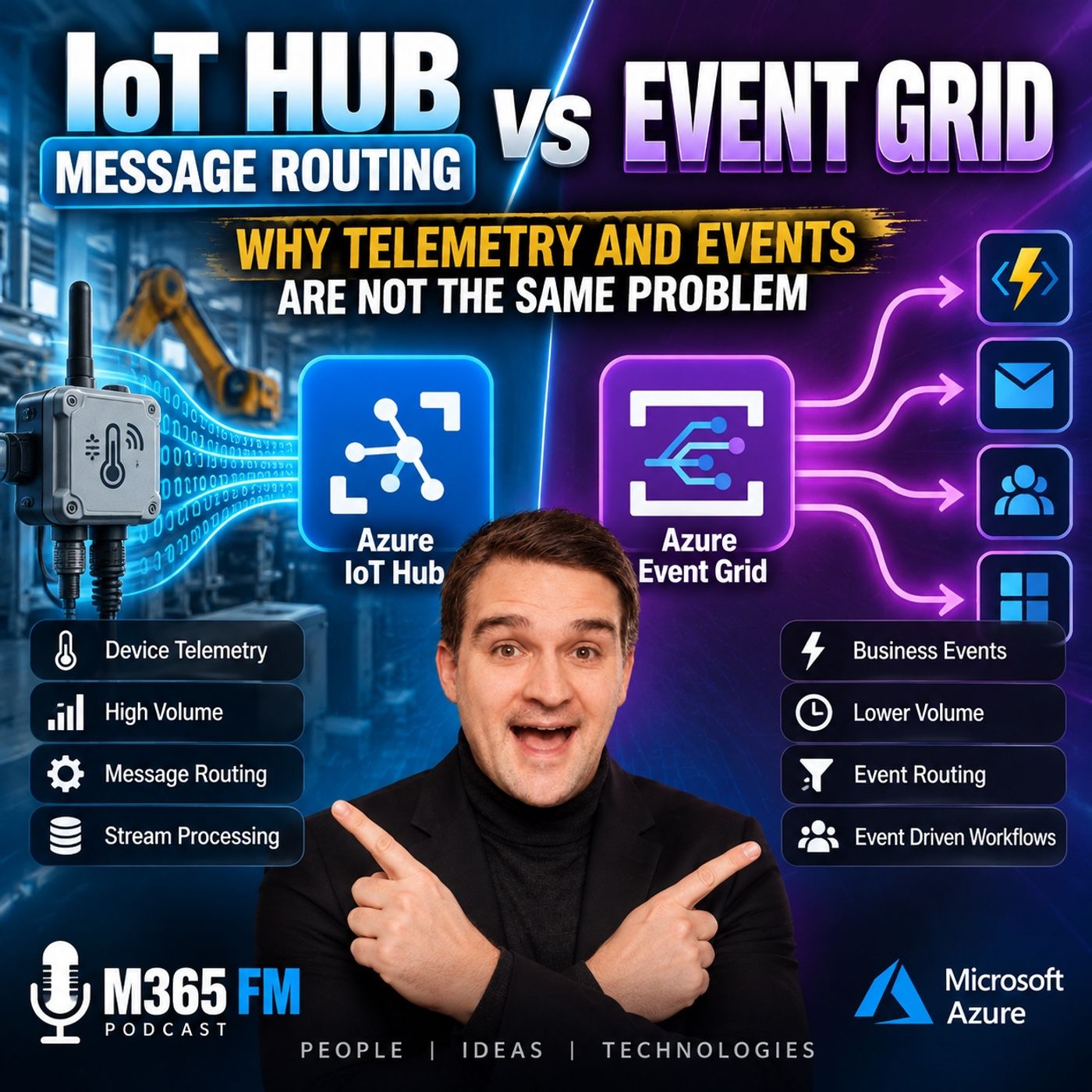
Why Treating High-Volume Industrial Telemetry as Event Grid Messages Breaks Cloud Architectures
When designing cloud solutions for manufacturing environments, engineering teams often fall into the trap of treating every incoming sensor measurement as a discrete event. While services like Azure Event Grid make it tempting to route every temperature reading, vibration spike, and power fluctuation into immediate serverless functions, this architectural shortcut introduces severe scalability, ordering, and data integrity problems as production scales.
Key Takeaways
- Treating continuous machine sensor readings as discrete events causes severe system bloat and alert fatigue.
- Azure Event Grid does not guarantee message ordering, making it catastrophic for time-series industrial telemetry.
- High-frequency data streams need specialized retention and sequential processing rather than immediate, lightweight serverless triggers.
- Proper industrial architectures cleanly separate continuous data planes (IoT Hub/Event Hubs) from reactive control planes (Event Grid).
The Illusion of 'Everything Is an Event' in IoT Proofs of Concept
During a proof of concept, sending every single device-to-cloud message straight into an event-driven workflow feels remarkably efficient. A press machine sends a temperature reading, a lightweight Azure Function wakes up, evaluates the payload, and logs it. Everything works smoothly when you are testing with a single gateway on a clean network.
However, reality sets in the moment production scale arrives. When multiple manufacturing lines begin streaming temperature, vibration data, cycle counts, and energy consumption every few seconds, every single reading triggers another downstream handler. Maintenance creates its own subscription, quality management adds another, and energy analytics builds a third.
Before long, your simple cloud architecture has devolved into dozens of small, tightly coupled handlers trying to perform filtering, state management, and retry handling independently. Routine operating data has turned into a flood of noise, and your cloud bill begins scaling alongside the unnecessary message executions.
Why Event Grid Fails for High-Volume Telemetry Streams
The core issue stems from confusing the data plane with the control plane. Azure Event Grid is an exceptional tool for reactive workflows—it excels at telling you when something changed and someone needs to react, such as a device registering, a gateway disconnecting, or an administrative security boundary being crossed.
Event Grid is intentionally designed to be lightweight, fast, and loosely coupled. However, it does not guarantee message ordering. In manufacturing telemetry, sequence is everything. An isolated temperature reading of 82 degrees means very little on its own; its true value is unlocked only when analyzed in sequence with the readings that preceded it.
If you route high-frequency telemetry through a system that lacks guaranteed ordering, a vibration reading from after a machine shutdown might arrive at your consumer before the final running-state message. Downstream analytics will process these out of sequence, misclassifying normal operational shutdowns as sudden faults, corrupting downtime statistics, and poisoning Overall Equipment Effectiveness (OEE) calculations.
Protecting Operator Attention and Avoiding Alert Fatigue
Architectural anti-patterns do not just cause technical debt—they actively damage human workflows on the factory floor. When every routine sensor measurement can potentially fire an event-driven alert, plant engineers and operators are rapidly trained to view system notifications as background noise.
Good industrial architecture respects human attention. A continuous telemetry stream should quietly populate time-series stores, data lakes, and analytics platforms like Microsoft Fabric without pinging operators for every normal cycle. Meanwhile, distinct operational thresholds should explicitly emit a separate, highly contextualized response signal only when conditions genuinely require human intervention or automated remediation.
Building the Correct Separation of Concerns
To build resilient industrial cloud architectures, you must enforce a strict separation between data pipelines and event notification paths. Use Azure IoT Hub and Event Hubs to manage the high-volume data plane—providing the retention, replayability, and sequential integrity required by data engineers, quality assurance, and predictive maintenance models.
Reserve Event Grid specifically for discrete lifecycle events and reactive notifications. When a device disconnects or a critical threshold is breached, use Event Grid to alert the correct support systems while allowing the underlying telemetry stream to continue its uninterrupted journey into your operational data stores.
Conclusion
Choosing the right tool for your Microsoft cloud architecture prevents expensive compute overhead, preserves critical manufacturing context, and ensures your operational data tells a truthful story. To dive deeper into how Azure IoT Hub Message Routing and Event Grid solve entirely different problems in modern industrial ecosystems, Listen to the full episode and subscribe to the M365 FM Podcast for daily insights across the Microsoft cloud.
Frequently Asked Questions
Can Azure Event Grid handle high-volume IoT telemetry?
Technically yes, but architecturally no. Event Grid is designed for low-frequency notification events, not high-frequency continuous data streams. Using it for millions of sensor readings will overwhelm downstream handlers and lack the necessary stream-processing capabilities.
Why is message ordering critical for industrial sensor data?
Industrial telemetry like temperature and vibration relies heavily on chronological sequences to tell an accurate operational story. If messages arrive out of order, systems can misinterpret normal shutdowns as equipment faults or corrupt Overall Equipment Effectiveness (OEE) calculations.
What is the primary difference between IoT Hub Message Routing and Event Grid?
IoT Hub Message Routing is built for the data plane to preserve, sequence, and distribute operational time-series data. Event Grid is built for the response path, notifying systems and users when a specific lifecycle change or operational threshold requires immediate attention.
How do duplicate messages affect industrial architectures?
In reliable industrial messaging, duplicate delivery is common to prevent data loss. Robust stream processors and handlers must implement idempotency to recognize and safely discard duplicate readings without skewing production metrics.