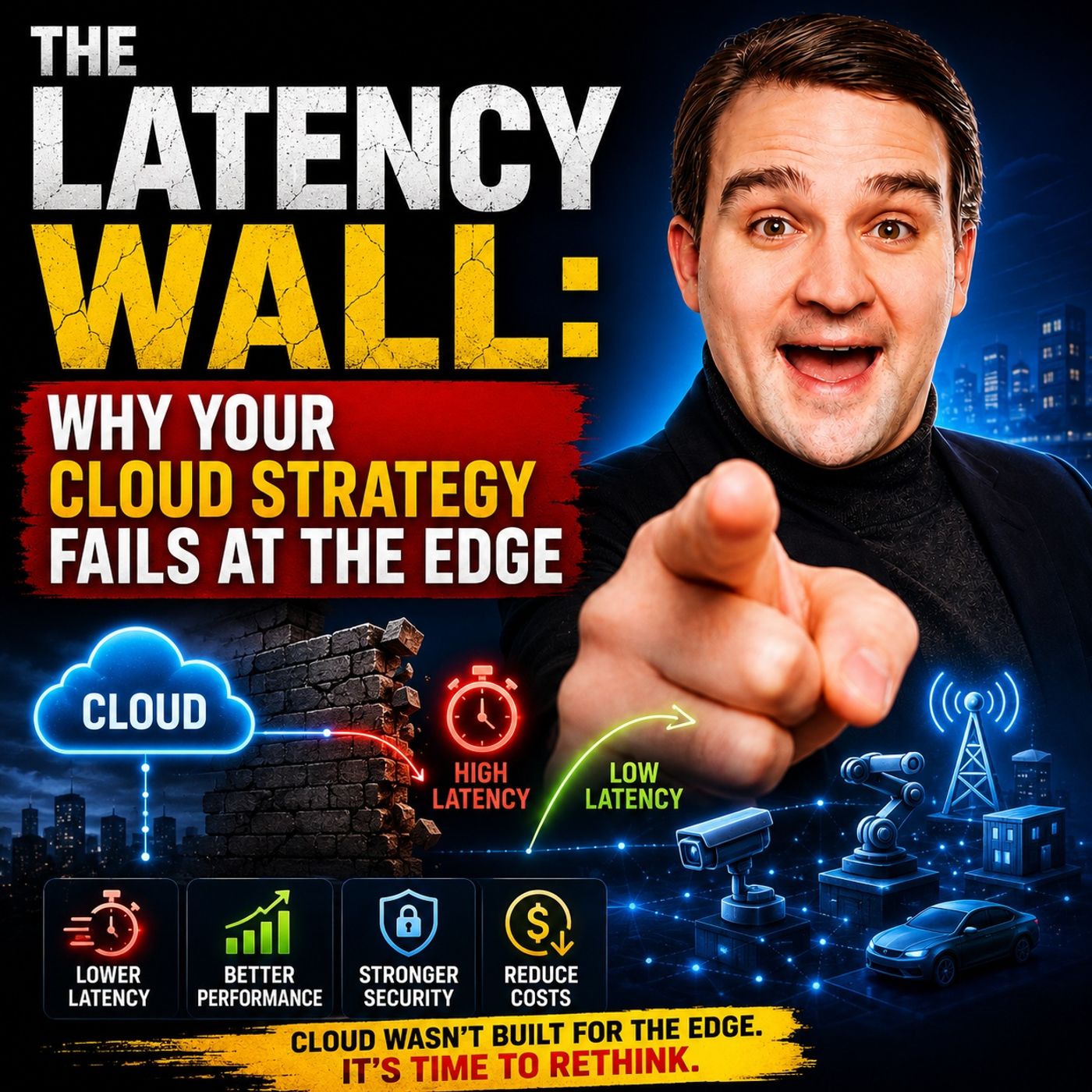
Overcoming the Latency Wall: Why Your Cloud Strategy Needs the Edge
As organizations push deeper into artificial intelligence, industrial automation, and real-time operational telemetry, a silent barrier often threatens to derail their digital initiatives: the latency wall. While centralized cloud environments offer incredible scalability, long-term storage power, and robust data analytics, they fundamentally struggle when applications demand instantaneous feedback loops. If your architecture relies entirely on a distant data center, every round-trip packet introduces milliseconds of delay—delays that can translate to broken automated processes, failed quality checks, or critical safety vulnerabilities.
In this post, we will unpack why the traditional centralized cloud model hits a brick wall at the edge, how modern industries are addressing these constraints through local data processing, and what a comprehensive hybrid strategy looks like in practice. For a deep dive into how these architectural, security, and governance choices play out specifically inside Microsoft environments, make sure to listen to our companion podcast episode on Cloud Latency and Edge Computing Strategy.
Understanding the Latency Wall and Its Impact on Real-Time Operations
The latency wall represents the physical and architectural limit of how fast data can travel between its point of origin and a centralized cloud repository. Network distance, physical routing hops, bandwidth congestion, and packet loss all compound to create predictable performance floors. In standard enterprise software, a delay of 100 milliseconds is completely imperceptible to a human user. However, for an autonomous guided vehicle, a robotic arm on a factory floor, or a high-speed vision inspection system, 100 milliseconds is an eternity.
When you map out the requirements of edge-heavy environments, the limitations of sending raw sensor or video feeds to a public cloud data center become glaringly obvious. Network latency introduces jitter, asynchronous data sync issues, and monitoring overhead. To preserve system integrity, architects must shift their mindset from a cloud-only mentality to a localized processing paradigm where decisions happen milliseconds away from the hardware itself.
Technical and Business Impacts of Centralized Cloud Limitations
Failing to account for the latency wall carries heavy technical and financial consequences. Application performance suffers immediately when real-time loops fail. For instance, data-intensive AI workloads running computer vision models require immediate inference results. If those video frames must traverse public internet routes to reach a cloud cluster, the resulting lag can render the output completely obsolete by the time it returns.
Furthermore, data synchronization across distributed environments introduces massive architectural complexity. Edge nodes often operate in remote, disconnected, or low-bandwidth locations where continuous high-speed connectivity cannot be guaranteed. Trying to manage telemetry, patching, security policies, and asynchronous updates without a coherent edge strategy leads to widespread fragmentation, security gaps, and vulnerability to unauthorized physical access.
From a financial perspective, funneling petabytes of raw, unfiltered operational data back to the cloud racks up staggering bandwidth costs. Instead of streaming raw telemetry 24/7, organizations achieve massive cost efficiencies by filtering, aggregating, and processing data locally—sending only compressed insights or critical alerts up to the cloud.
Real-World Cases: Industrial Automation, Autonomous Vehicles, Healthcare, and Retail
The rubber truly meets the road when examining how physical industries handle the latency wall:
- Industrial Automation: On high-speed factory floors where unplanned downtime costs thousands of dollars every minute, cloud-based AI checking for product defects introduces unacceptable round-trip latency. By deploying quantized vision models on local edge devices, total inspection latency drops to mere milliseconds, allowing defective parts to be intercepted instantly.
- Autonomous Vehicles: Self-driving cars and automated mobile robots must navigate dynamic physical spaces within milliseconds. Sensor data acquisition, steering telemetry, and collision-avoidance logic require zero tolerance for network dropouts, making local edge compute nodes mandatory for safety.
- Healthcare Telemetry: Remote patient monitoring systems and diagnostic telemetry networks demand ultra-low latency alongside strict compliance with regulations like HIPAA and GDPR. Local edge servers process sensitive patient metrics on-premise, reducing latency by up to 80% while safeguarding data privacy.
- Retail and Smart Spaces: High-traffic retail stores utilize edge analytics for automated checkouts, real-time inventory tracking, and dynamic shelf monitoring, ensuring that customer experiences remain seamless even if external cloud connectivity fluctuates.
Overcoming the Latency Wall with Edge Computing and Hybrid Strategies
Overcoming the latency wall does not mean abandoning the cloud; rather, it requires a carefully balanced hybrid cloud-to-edge strategy. By running latency-sensitive operational workloads, real-time AI inference, and process control loops directly at the edge, organizations preserve the responsiveness needed for physical operations. Meanwhile, the centralized cloud remains the ultimate home for deep historical analytics, global reporting, and long-term model training.
Platforms like Azure Stack Edge bridge this exact gap, bringing enterprise cloud capabilities directly on-premises or into remote field environments. When integrated with private 5G networks and Multi-access Edge Computing (MEC), businesses unlock dedicated, ultra-low-latency architectures capable of powering the most demanding modern applications.
Building a Future-Proof Cloud-to-Edge Strategy
Designing a resilient, future-proof edge strategy requires a methodical, step-by-step approach:
- Assess Latency Needs: Audit your operational workloads to identify which systems demand sub-20-millisecond responses versus those that can tolerate cloud-bound queues.
- Deploy Edge-Ready Infrastructure: Invest in ruggedized compute nodes, robust local storage with high redundancy, and high-speed network connectivity (such as private 5G or Wi-Fi 6).
- Optimize AI Models: Compress and quantize machine learning models so they can execute efficiently on resource-constrained edge hardware.
- Enforce Unified Governance: Maintain consistent security policies, identity management, and monitoring frameworks across your entire distributed cloud-to-edge continuum.
Frequently Asked Questions About Cloud Latency and Edge Computing Strategy
What is the latency wall in cloud computing?
The latency wall occurs when the physical distance and network hops between your operational data source and a centralized cloud data center introduce unacceptable delays, rendering real-time applications ineffective.
Why does edge computing reduce latency?
Edge computing processes data directly at or near the source of generation (such as an on-site factory server or retail terminal), drastically shortening the physical distance data must travel.
How does Azure Stack Edge help with real-time processing?
Azure Stack Edge brings Azure compute, storage, and AI capabilities directly to your local environment, allowing you to run workloads and analyze data locally before sending consolidated insights to the cloud.
Which industries benefit most from edge computing?
Manufacturing, healthcare, transportation, autonomous driving, logistics, and retail benefit the most due to their strict requirements for instantaneous, real-time decision-making.
Can I use edge computing with my current cloud strategy?
Yes. A hybrid approach allows you to run time-sensitive workloads at the edge while leveraging the public cloud for broad scalability, archiving, and advanced analytics.
What is the role of private 5G in edge computing?
Private 5G provides a dedicated, highly secure wireless network infrastructure that guarantees ultra-low latency and reliable connectivity for mission-critical edge devices.
How do I know if my application needs edge computing?
If your application requires sub-50-millisecond responses, operates in remote environments with unstable connectivity, or handles sensitive local data that cannot tolerate transit delays, it is a prime candidate for edge computing.
Does edge computing improve security?
Edge computing can significantly enhance security by keeping sensitive telemetry and personal data on-premise, minimizing exposure during long-distance network transmission.
🎧 Listen to this episode
Want a practical explanation of Cloud Latency and Edge Computing Strategy? This episode breaks down the topic in clear language and shows why it matters for Microsoft 365, Azure, Power Platform, security, AI, and modern work.
Listen to this episode if you want to:
- Understand the key concepts behind Cloud Latency and Edge Computing Strategy
- See how it fits into the wider Microsoft technology ecosystem
- Learn where it can create practical value for your organization
You may also enjoy these related M365 FM episodes:
- Microservice Dependency Poisoning and Cascading Cloud Latency
- Microsoft Cloud Solution Provider (CSP) - Simply Explained
- Microsoft Defender for Cloud Apps - Simply Explained
- How to Build a Winning Microsoft Partner Strategy
- AI Governance from Microsoft Copilot to Quantum Computing
Discover more practical Microsoft conversations on M365 FM.
Last reviewed: July 2026.
Who Should Listen
This episode is for Microsoft administrators, architects, developers, security professionals, and business leaders who need a practical foundation before making implementation, operations, or governance decisions.
🎧 You Should Also Listen To
- AI Agents — A strongly related next step for extending this topic.
- Power Platform — A strongly related next step for extending this topic.
- Microsoft Graph Data Connect — A strongly related next step for extending this topic.

Microsoft MVP | Host of M365.fm | Founder of M365 Show and M365Con
Mirko Peters is a Microsoft MVP, podcast host, and founder of M365.fm, M365 Show, and M365Con. His work connects Microsoft practitioners through podcast interviews, livestreams, and community events.
At M365.fm, Mirko hosts conversations with Microsoft MVPs, product experts, architects, and community contributors. Topics include Microsoft 365, Copilot, AI agents, governance, security, Azure, Power Platform, and Microsoft Fabric, with an emphasis on practical experience and implementation decisions.
M365.fm is the podcast and learning platform. M365 Show brings experts together for livestreams, while M365Con provides an online conference setting for community learning.
Official website: Mirko Peters (https://www.mirkopeters.com/). Recognition: Mirko Peters — Microsoft MVP profile (https://mvp.microsoft.com/de-DE/mvp/profile/9b0ca797-db5a-493a-a845-8b9158046cf5). Connect on LinkedIn (https://www.linkedin.com/in/m365showpodcast/).