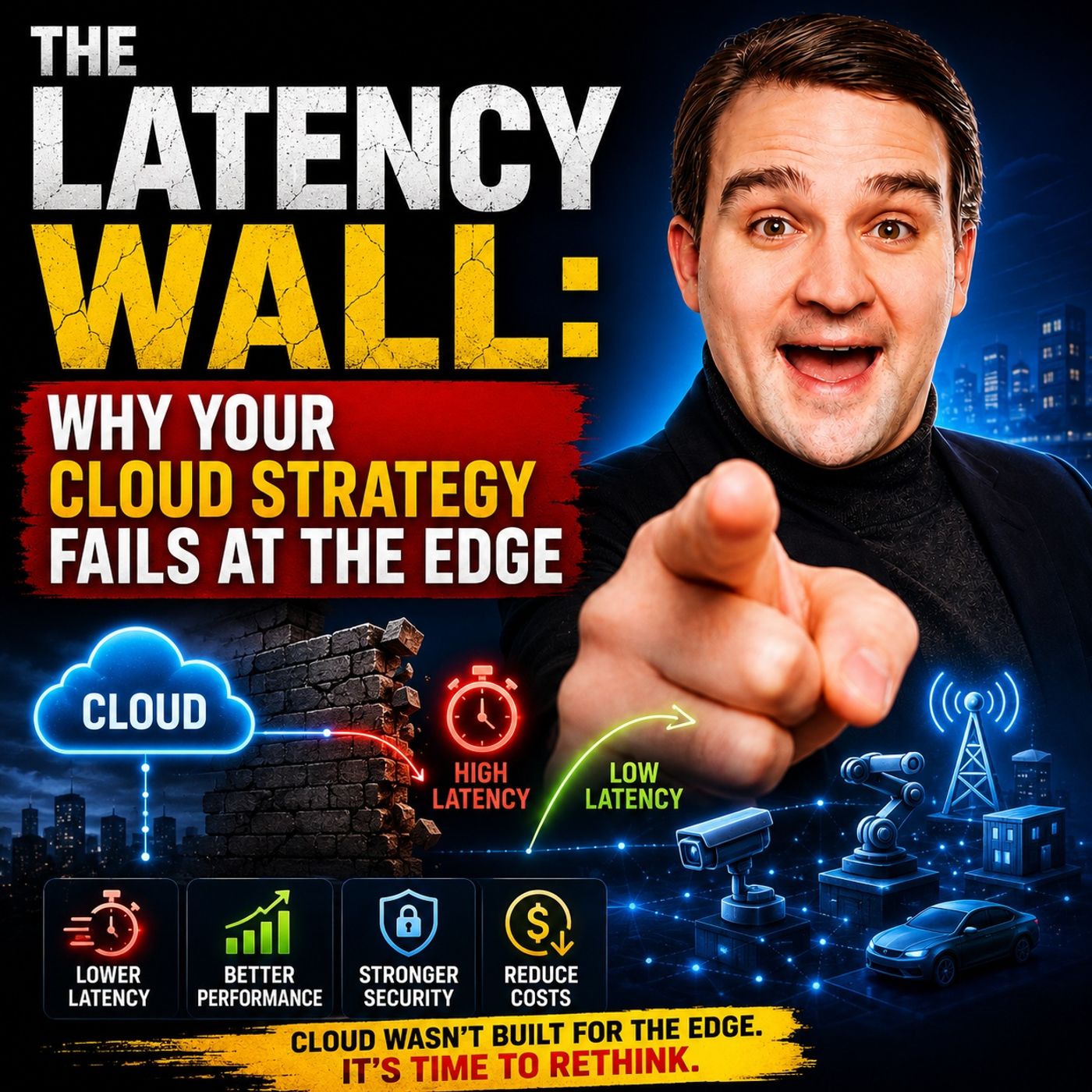
Overcoming the Latency Wall: Why Your Cloud Strategy Needs the Edge
Welcome back to the podcast companion blog. Today, we are expanding on a topic that is becoming a critical breaking point for modern IT architectures: the latency wall. When organizations first move to the cloud, the promise is limitless scale, boundless storage, and global accessibility. However, as business requirements evolve toward real-time automation, artificial intelligence, and split-second operational decisions, that centralized cloud model begins to crack under the weight of distance and network travel times. If you have ever wondered why your lightning-fast cloud applications suddenly stutter when deployed on a factory floor or inside a remote medical facility, you are running headfirst into the latency wall.
To dive deeper into this subject with practical architectures and real-world Microsoft ecosystem insights, make sure to listen to the companion episode Cloud Latency and Edge Computing Strategy.
Key Takeaways
- Understand the latency wall: Delays in data processing can hinder real-time operations and impact your competitive edge.
- Embrace edge computing: Process data closer to its source to reduce latency and improve response times for critical applications.
- Adopt a hybrid strategy: Combine cloud and edge computing to optimize performance for both real-time tasks and long-term analytics.
- Monitor latency closely: Use real-time measurement systems to track delays and ensure your edge applications remain reliable.
- Prioritize local processing: Run AI models and data processing at the edge to enhance efficiency and minimize bandwidth usage.
- Plan for infrastructure needs: Build a robust edge-ready infrastructure with reliable connectivity and powerful compute nodes.
- Address security risks: Maintain consistent security measures across your edge and cloud environments to protect sensitive data.
- Continuously optimize your strategy: Regularly assess and adapt your edge computing solutions to meet evolving demands and maintain performance.
Why the Latency Wall Stops Cloud at the Edge
Centralized Cloud Model Limits
You may think the cloud can handle all your data needs, but the centralized model creates real limits at the edge. When you send data from remote sites to a distant data center, you face delays that can break real-time operations. The table below shows the main challenges you will encounter:
| Limitation Type | Description |
|---|---|
| Latency Challenges | Data must travel long distances for processing. This causes delays that can be critical for real-time tasks. |
| Scalability Constraints | Costs rise quickly as you add more devices. You may see bottlenecks in data processing. |
| Technical Challenges | Hybrid setups struggle with data sync, efficient exchange, and conflict resolution when many sites change data. |
You need to process data where it is created. If you rely only on the cloud, you risk missing the speed and scale that edge computing demands.
Latency Wall in Real-Time Operations
The latency wall blocks your cloud strategy when you need instant results. In many cases, cloud computing latency can exceed 20 milliseconds. Sometimes, it can even reach over 1,000 milliseconds if the network is poor. For real-time operations, these delays are not acceptable.
- In industrial automation, robots and process controls need responses in less than 20 milliseconds.
- Autonomous vehicles must make decisions within milliseconds to avoid accidents.
- High-speed manufacturing cannot afford a one-second delay, as it can lead to over 30 defective items.
- Automated ports and drone monitoring require split-second actions to prevent collisions.
As Dongwook Kim from 3GPP MCC explains: "Telecommunications is not an exception and, despite the continued efforts to enhance performance, there always is limit to where latency can be reduced (i.e. the theoretical minimum is the total length of distance divided by the speed of light)."
You cannot move your data fast enough to the cloud and back for these critical tasks. The latency wall makes it clear that you need edge computing for real-time and AI-driven applications.
Edge Needs Immediate Response
You must act fast at the edge. Many applications cannot wait for a round trip to the cloud. The table below shows how strict the latency requirements are for different edge use cases:
| Application Type | Required Latency |
|---|---|
| Robotics | < 10 ms |
| User-interactive tasks | < 50 ms |
| Virtual Reality | < 20 ms |
| Autonomous Vehicle Navigation | Within milliseconds |
| Industrial Automation | Within milliseconds |
- Autonomous robots need near real-time responses to stay safe.
- Industrial automation systems must process data within milliseconds to avoid risks.
- Computer vision alerts and automated quality checks depend on immediate data processing.
Waiting on a round trip to the cloud is not feasible when the application must respond immediately (think computer vision alerts, automated quality checks, or on-site operational systems).
In healthcare, the need for speed is even greater. Surgical telerobotics require latency below 10 milliseconds to keep patients safe. In industrial settings, edge AI applications need total latency of 12 milliseconds for effective inspection. You achieve this by running AI workloads on devices close to the action. This approach reduces compute distance and keeps your operations safe.
You cannot ignore the latency wall if you want your migration to the edge to succeed. You must design your strategy to process data locally, support AI, and meet the strict demands of modern industries.
Understanding the Latency Wall
What Is the Latency Wall?
You face the latency wall when your applications cannot get data fast enough for real-time action. This wall appears when the distance between your data source and the cloud creates delays that break your operations. The latency wall blocks your ability to make instant decisions at the edge. You see this most in industries that need split-second responses, like manufacturing, robotics, and autonomous vehicles.
The difference between cloud and edge becomes clear when you look at response times. Cloud computing often delivers latency between 20 and 100 milliseconds. Edge computing can cut this down to just 1 to 10 milliseconds. That difference can decide whether a robot arm stops in time or a vehicle avoids a collision.
How Latency Impacts Edge Computing
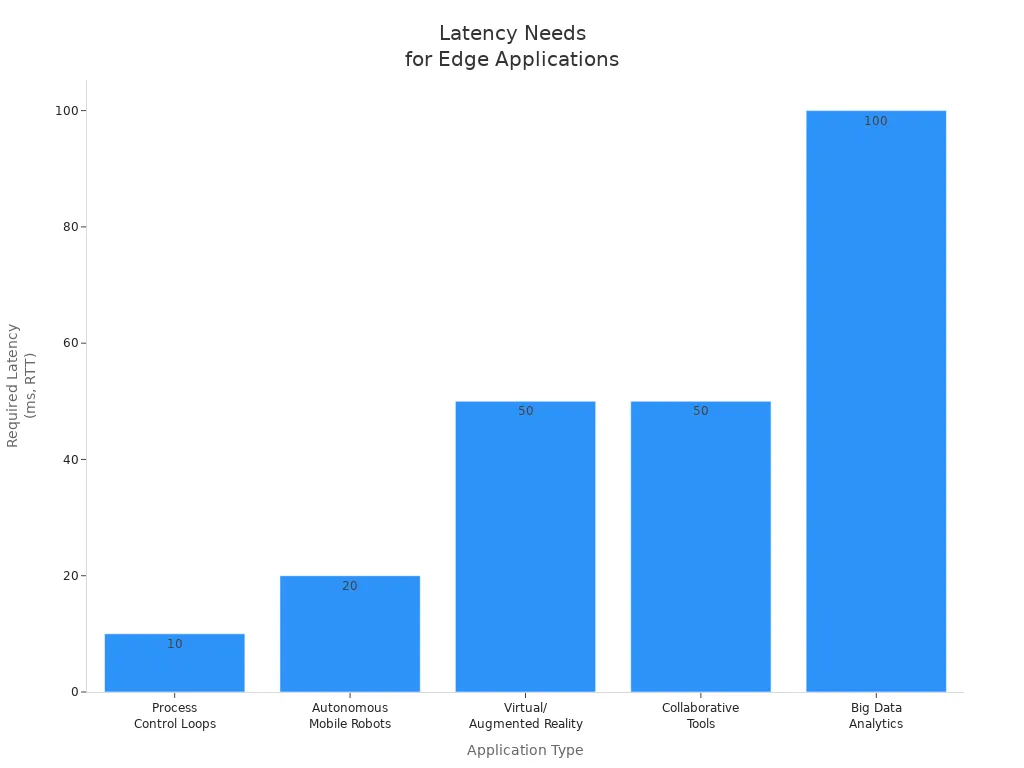
You need to understand how latency affects your systems. The table below shows how different applications respond to latency and where edge works best:
| Application Type | Required Latency (RTT) | Edge Suitability | Cloud Suitability |
|---|---|---|---|
| Process Control Loops | ≤ 10 ms | Mandatory; designed for real-time | Unsuitable; cannot ensure sub-10 ms |
| Autonomous Mobile Robots (AMR/AGV) | < 20 ms | Highly recommended; low response times | Limited; high risk |
| Virtual/Augmented Reality (VR/AR) | < 20 ms to 50 ms | Preferred; avoids backhaul delays | May exceed 50 ms, reducing quality |
| Collaborative Tools | < 50 ms | Suitable; local processing | Acceptable if data centers are nearby |
| Big Data Analytics | > 100 ms | Possible but not essential | Ideal; supports scalability |
Network Distance and Hops
Every time data travels across a network, it passes through routers and switches. Each "hop" adds delay. The farther your data must go, the more hops it takes, and the higher the latency. Edge computing reduces these hops by processing data close to where it is created. You get faster results and more reliable performance.
Bandwidth and Packet Loss
Bandwidth limits how much data you can send at once. If your network gets crowded, packets of data can get lost or delayed. This increases latency and can cause your applications to fail. Edge computing helps by handling most data locally, so only important information travels to the cloud. You save bandwidth and keep your systems running smoothly.
5G increases the speed the data travels at, and edge computing reduces the distance it travels before it is processed. In short, edge enhances the performance of 5G.
Measuring Latency at the Edge
You can measure latency at the edge using several methods. Real-time latency measurement systems use monitoring agents to track delays as they happen. Latency prediction algorithms look at past data to forecast future performance. Distributed monitoring architectures give you a full view of latency across all your edge nodes. Network path optimization helps you find the fastest route for your data.
| Method Type | Description |
|---|---|
| Real-time latency measurement systems | Systems that continuously measure and monitor latency in edge environments using monitoring agents. |
| Latency prediction algorithms | Algorithms that analyze historical data to forecast latency behavior and optimize performance. |
| Distributed monitoring architecture | Frameworks for monitoring latency across multiple nodes, providing visibility into end-to-end latency. |
| Network path optimization | Techniques for optimizing routing decisions to minimize latency in edge scenarios. |
You need to track latency closely to keep your edge applications reliable. If you do not measure and optimize, the latency wall will limit your success.
Technical and Business Impacts
Application Performance Issues
Real-Time Failures
You see the latency wall when your cloud strategy fails to deliver real-time insights at the edge. Latency disrupts your workload, especially when you run data-intensive ai workloads that demand instant responses. Edge computing reduces the time it takes for data to travel, which is crucial for applications like IoT devices, autonomous vehicles, and industrial automation. When you process video feeds from security cameras locally, you generate critical alerts instantly. This improvement boosts performance and keeps your operations safe.
You face migration failures when your workload cannot meet real-time requirements. The complexity of edge environments increases the risk of delayed responses. You must design your workload to handle real-time insights, or you risk missing key moments.
Data Sync Problems
Data synchronization creates complexity in edge deployments. You often deal with asynchronous communication between edge and cloud, which complicates real-time monitoring and alerting. Monitoring systems introduce computational overhead, forcing you to compromise on granularity and frequency. Network connectivity issues disrupt monitoring data transmission, creating gaps in latency metrics. Standardization gaps lead to inconsistent latency measurement across heterogeneous infrastructures. Centralized monitoring approaches struggle with managing large-scale edge deployments, causing performance bottlenecks and delayed alerts.
- Monitoring Overhead
- Network Connectivity Issues
- Standardization Gaps
- Scalability Challenges
- Asynchronous Communication
You must address these challenges to avoid migration failures and ensure your workload delivers consistent insights.
Security and Compliance Risks
You increase security and compliance risks when you do not manage latency in your cloud-to-edge strategy. Distributed architectures create complexity and expose your workload to new threats. Edge nodes may lack physical protection, increasing exposure to theft and unauthorized access. Inconsistent patching and policy enforcement create vulnerabilities that attackers exploit. You must maintain consistent security measures across distributed environments to protect your data and workload.
| Evidence | Description |
|---|---|
| SOC Reports for Cloud Security and Privacy | Highlights the importance of consistent security measures across distributed environments and the challenges posed by increased exposure and operational inconsistency. |
| The Impact Of 5G On Cloud Security Risks And Opportunities | Edge nodes may lack physical protection, increasing exposure to theft and unauthorized access, which can lead to security breaches. |
| The Impact Of 5G On Cloud Security Risks And Opportunities | Distributed architectures often suffer from inconsistent patching and policy enforcement, creating vulnerabilities that attackers exploit. |
You must address these risks to avoid migration failures and protect your workload from complexity.
Cost and Resource Strain
You face cost and resource strain when latency increases in edge computing environments. The complexity of managing data-intensive ai workloads grows as you scale your edge infrastructure. You see migration failures when your workload cannot meet performance targets. Upfront costs for testing latency performance can reach £10,200, with annual fees of £4,800. Subscription plans start at £85 per 1,000 m² per month, covering installation, maintenance, and management software. These plans reduce operational workload and complexity.
Edge architectures reduce latency by a factor of 2 to 10 compared to centralized models. This reduction is crucial for cost-effective performance in latency-sensitive applications. You gain real-time insights and predictive analytics while minimizing resource strain. You must optimize your workload and analytics to avoid migration failures and manage complexity.
Tip: You can achieve better performance and lower costs by processing data locally at the edge and sending only essential insights to the cloud.
Latency Wall: Real-World Cases
Industrial Automation
You see the impact of the latency wall most clearly in industrial automation. Factories depend on real-time control to keep production lines moving and to catch defects instantly. If you rely on the cloud for these tasks, you face delays that can cost thousands of dollars every minute. When you send data from a conveyor belt to the cloud for ai analysis, the round-trip latency can reach 800 milliseconds. During this delay, a defective part moves past the ejection station, making the insight useless.
The experiment with Cloud-based real-time control has concluded, and the results are definitive. For the distinct, unforgiving physics of the factory floor, the cloud is an absentee manager—too far away, too slow to react, and too unreliable to trust with the heartbeat of production. Latency is the enemy. In a world where unplanned downtime burns $22,000 every minute, the 800ms lag of the cloud is an operational tax that manufacturers can no longer afford to pay. Cloud AI introduces 800ms round-trip latency through image encoding, upload, network routing, queueing, inference, and return. On a conveyor belt moving at 2 m/s, the defective part travels 1.6 meters during this delay — overshooting the 1-meter ejection station by 60cm. The defect is correctly detected but the physics of the line render the insight worthless. How does edge AI achieve 12ms industrial inspection latency? By deploying quantized vision models on NVIDIA Jetson devices mounted directly on the conveyor, Veriprajna reduces compute distance from 500+ miles to under 1 meter and switches from public internet to PCIe/MIPI-CSI interfaces.
You solve this problem by using edge platforms like Azure Stack Edge. You process data and run ai models right next to the machines. This approach reduces latency and keeps your production line efficient.
Autonomous Vehicles
You face unique challenges when you operate autonomous vehicles. These vehicles must make decisions in milliseconds to stay safe. If you depend on the cloud for ai inference, you risk delays that can cause accidents. Edge computing helps you run ai models locally and synchronize sensor data for real-time action.
| Evidence Description | Explanation |
|---|---|
| Edge computing for DNN model inference | Utilizes model partitioning and right-sizing to reduce latency in autonomous vehicles. |
| Synchronization of sensor data | Collects data from sensors like steering angle and LiDAR simultaneously to mitigate latency caused by different operating frequencies. |
| Multi-task environment detection | Combines vehicle and lane detection models to enhance efficiency and reduce latency in processing. |
| Latency Source | Impact on Operations |
|---|---|
| Edge hardware limitations | Increases computational delays, affecting real-time processing. |
| Sensor data acquisition delays | Adds latency due to time required for data capture and transmission. |
| Synchronization challenges | Creates temporal inconsistencies, complicating coordination in robotic operations. |
You improve safety and efficiency by processing data at the edge. Azure Stack Edge supports these critical workloads, allowing you to filter and analyze data without relying on distant cloud servers.
Healthcare Telemetry
You see latency challenges in healthcare telemetry when you depend on the cloud for real-time analytics. Medical centers need instant access to patient data for diagnostics and monitoring. If you send data to the cloud, you risk delays and privacy concerns. Edge platforms like Azure Stack Edge help you process data locally and maintain compliance.
- A regional medical center faced significant latency issues due to centralized cloud processing, which delayed real-time analytics and raised privacy concerns.
- Edge servers enabled local data processing, resulting in an 80% reduction in data latency for diagnostic systems.
- The system ensured compliance with regulations like HIPAA and GDPR while maintaining continuous operation in remote clinics with limited connectivity.
You protect patient privacy and improve outcomes by using edge solutions. You keep data close to the source and support real-time decision-making.
Retail and Smart Spaces
You see the latency wall in retail and smart spaces every day. When you run a store or manage a smart building, speed matters. Customers expect fast checkouts, instant loyalty rewards, and real-time inventory updates. If your systems rely on distant cloud servers, you risk delays that frustrate shoppers and slow down your operations.
Latency affects the speed of transactions and customer interactions. You notice this when payment terminals take too long to process, or when digital signage lags behind real-time promotions. Slow systems can lead to lost sales and unhappy customers. You need to respond quickly to customer needs and manage inventory effectively.
Edge computing changes the game for retail and smart spaces. You process data locally, which reduces latency and enables real-time insights. This local processing lets you deliver fast, personalized experiences. You can track inventory as it moves, update prices instantly, and trigger alerts when shelves run low.
Tip: You improve operational efficiency by keeping sensitive information at the source. Edge computing enhances data privacy and reliability.
You benefit from edge solutions like Azure Stack Edge. This platform brings cloud capabilities closer to your store or smart space. You run AI models on-site, analyze customer behavior, and optimize store layouts without waiting for data to travel to the cloud and back. You save bandwidth by sending only essential insights to the cloud, which reduces costs and congestion.
Consider these advantages of edge computing in retail and smart spaces:
- You get low-latency processing for time-sensitive applications.
- You optimize bandwidth by handling data locally.
- You enhance reliability and improve data privacy.
You can use Azure Stack Edge to support self-checkout kiosks, smart shelves, and real-time video analytics. These tools help you detect theft, monitor foot traffic, and personalize offers. You keep your operations running smoothly, even during network disruptions.
Retailers who adopt edge computing gain a competitive advantage. You deliver seamless experiences, manage inventory with precision, and protect customer data. Smart spaces become more responsive, secure, and efficient. You overcome the latency wall by processing data where it matters most—right at the edge.
Overcoming the Latency Wall with Edge Computing
Hybrid Cloud-to-Edge Strategy
You need a hybrid cloud-to-edge strategy to overcome the latency wall. This approach lets you use the strengths of both the cloud and edge computing. You run latency-sensitive tasks at the edge, while you use the cloud for deep analytics and long-term storage. You gain flexibility and control by choosing where each workload runs best.
Key components of a hybrid cloud-to-edge strategy include:
- Workload optimization: You process real-time data at the edge and send large-scale analytics to the cloud.
- Vendor management and cost control: You select the right mix of edge and cloud vendors to match your needs and budget.
- Eliminating waste: You filter and pre-process data at the source, which reduces unnecessary data transmission.
- Holistic management: You use a unified management framework for both edge and cloud environments.
- Enhanced customer and employee experience: You deliver real-time AI insights at the edge for faster responses.
Azure Stack Edge supports this strategy by bringing cloud capabilities closer to your data. You can process AI workloads locally and keep your operations running smoothly, even when network connections are unstable.
Local Processing and AI at the Edge
You unlock real-time decision-making when you process data and run AI at the edge. Edge computing brings data processing closer to where it is generated. This reduces the time it takes for data to travel, which is critical for applications that need instant responses. You see this in autonomous vehicles, industrial automation, and robotics.
Edge AI enhances power efficiency by processing data locally. You use optimized inference models that run on devices with limited resources. This lets you deploy lightweight AI applications for tasks like object recognition, path planning, and anomaly detection. You minimize the amount of data sent over the network, which is important in environments with bandwidth limits.
You also gain autonomy. Devices can keep working even if the network connection drops. Drones use edge AI for real-time navigation and obstacle avoidance. Environmental sensors detect problems and trigger actions right away. Smart cameras analyze video feeds locally, which enables quick responses to security threats. Wearable health devices monitor vital signs and alert you to health issues immediately. Manufacturing systems identify defects on the spot using local image processing.
Azure Stack Edge delivers lower latency for AI inference and local decision-making.
You can trust your edge devices to keep your operations safe and efficient. You do not have to wait for cloud processing to make critical decisions.
Data Filtering and Bandwidth Savings
You improve efficiency and reduce costs by filtering data and saving bandwidth at the edge. Edge computing processes data locally and sends only important information to the cloud. This approach minimizes data transmission, which reduces latency and prevents network congestion.
You cut bandwidth usage by sending only relevant data, such as alerts or summaries. You avoid unnecessary uploads, which lowers your data transmission costs. This is essential as the number of connected devices grows. You keep your network running smoothly, even during peak times.
- You process data locally for ultra-low latency in applications like cloud gaming and real-time industrial control.
- You reduce bandwidth consumption on core networks by aggregating and filtering data at the source.
- You lower data plan costs by minimizing the volume of data sent to the cloud.
Azure Stack Edge helps you achieve these benefits. You can handle AI workloads at the edge, filter out noise, and send only what matters to the cloud. This strategy keeps your systems responsive and cost-effective.
Private 5G and MEC Integration
You can break through the latency wall by combining private 5G networks with Multi-access Edge Computing (MEC). This integration brings data processing even closer to where your devices operate. You no longer need to send every piece of data to a distant cloud. Instead, you process information right at the edge, often within the same building or campus.
Private 5G gives you a dedicated wireless network. You control who connects and how data flows. This control means you can guarantee high speeds and low delays. MEC lets you run applications and AI models near your devices. You get instant responses for tasks that cannot wait.
Here is how private 5G and MEC integration supports your critical applications:
- You process data locally, which reduces the distance data must travel. This leads to much lower latency.
- You enable near real-time responses for applications like autonomous vehicles and industrial automation.
- You improve responsiveness for remote healthcare, smart factories, and connected logistics.
When you use private 5G with MEC, you unlock new possibilities for your business. You can run advanced AI, monitor equipment, and control machines with split-second accuracy.
Azure Stack Edge works well with private 5G and MEC. You can deploy it on-site to handle AI workloads, video analytics, and sensor data. You keep your operations running, even if your connection to the public cloud drops. This setup is vital for industries where every millisecond counts.
The table below shows how private 5G and MEC integration benefits different industries:
| Industry | Benefit of 5G + MEC Integration | Example Use Case |
|---|---|---|
| Manufacturing | Ultra-low latency for machine control | Real-time defect detection |
| Healthcare | Fast, secure data for patient monitoring | Remote surgery assistance |
| Transportation | Reliable, instant communication | Autonomous vehicle navigation |
| Retail | Quick response for customer interactions | Smart checkout and inventory |
You can see that private 5G and MEC give you the speed and reliability you need. You support critical operations and keep your business ahead of the competition.
Building a Future-Proof Cloud-to-Edge Strategy
Assessing Latency Needs
You start your migration by understanding how latency affects your operations. Real-time applications demand strict latency requirements. Robot-assisted remote surgery needs very low latency to keep patients safe. Self-driving cars rely on minimal latency for quick decisions. You must plan your migration by identifying which tasks require instant responses. You can deploy micro edge data centers in places like office buildings or bus shelters to meet these needs. This planning step helps you avoid delays and ensures your migration supports critical workloads.
- Real-time applications need low latency for safety and efficiency.
- Micro edge data centers support fast processing in many locations.
- You must plan your migration to match the latency needs of each application.
Edge-Ready Infrastructure
You build your migration on strong infrastructure. Edge computing depends on reliable and scalable systems. You need powerful compute nodes for local processing. Storage solutions must handle real-time data with redundancy. High-speed connections like 5G and Wi-Fi 6 reduce delays. Edge orchestration and management software help you control your cloud environments. Security frameworks protect your data with encryption and anomaly detection. Monitoring tools track the health and performance of your edge nodes. AI and machine learning capabilities deliver real-time insights and automation.
- Compute nodes process data locally and support scalability.
- Storage solutions keep your data safe and ready for real-time access.
- Network connectivity ensures low latency and fast migration.
- Edge orchestration and management software unify your cloud environments.
- Security frameworks protect your infrastructure and data.
- Monitoring tools provide real-time insights into node performance.
- AI and machine learning enable automation and quick decision-making.
You must plan your migration to include these elements. This infrastructure supports your edge computing goals and keeps your migration on track.
Continuous Optimization
You keep your migration successful by focusing on optimization. You select use cases where latency is critical, such as autonomous vehicles or patient monitoring. You optimize AI models for hardware constraints, using techniques like model compression. You monitor and retrain edge models to maintain performance. This planning ensures your migration adapts to changing needs and keeps your cloud architecture efficient.
- Select use cases that need real-time responses.
- Optimize models for edge hardware and scalability.
- Monitor and retrain models for ongoing optimization.
Tip: Continuous planning and optimization help you avoid migration failures and keep your cloud environments responsive.
You must plan for ongoing adaptation. Azure Stack Edge gives you the tools to monitor, optimize, and scale your infrastructure. You gain real-time insights and keep your migration future-proof.
You face the latency wall when you rely on the cloud for real-time operations at the edge. Ignoring latency spikes and constant data transfer can cause delays, higher costs, and poor user experiences. Edge computing processes data closer to its source, which reduces latency and improves real-time performance. The hybrid cloud-to-edge strategy lets you optimize workloads for each use case. You should assess your architecture and separate time-sensitive tasks from long-term analysis. This approach helps you build a future-proof, latency-aware edge solution.
-
Risks of neglecting latency wall:
- Delays of 50–200 ms impact retail and AR/VR.
- Increased operational costs and power consumption.
- Real-time applications suffer from network dependence.
-
Value of edge and hybrid cloud-to-edge:
- Edge reduces latency.
- Enhances real-time processing.
- Hybrid strategy optimizes performance.
Take proactive steps to overcome latency challenges and ensure your edge and cloud environments stay responsive.
FAQ
What is the latency wall in cloud computing?
You hit the latency wall when data takes too long to travel between your devices and the cloud. This delay can break real-time applications and slow down your business.
Why does edge computing reduce latency?
Edge computing processes data close to where you create it. You get faster results because data does not need to travel far. This helps you run real-time applications smoothly.
How does Azure Stack Edge help with real-time processing?
Azure Stack Edge lets you process and analyze data locally. You can run AI models at the edge and send only important results to the cloud. This reduces delays and saves bandwidth.
Which industries benefit most from edge computing?
You see the biggest benefits in industries like manufacturing, healthcare, transportation, and retail. These fields need instant decisions and cannot wait for cloud round trips.
Can I use edge computing with my current cloud strategy?
Yes, you can combine edge computing with your cloud setup. You run time-sensitive tasks at the edge and use the cloud for storage and deep analytics. This hybrid approach gives you flexibility.
What is the role of private 5G in edge computing?
Private 5G gives you a fast, secure network for your devices. You use it with edge computing to get ultra-low latency and reliable connections for critical tasks.
How do I know if my application needs edge computing?
If your application needs instant responses or cannot afford delays, you need edge computing. Examples include robotics, autonomous vehicles, and real-time monitoring.
Does edge computing improve security?
Edge computing can improve security. You keep sensitive data close to its source and reduce the risk of exposure during transmission. You also control who accesses your data at the edge.
🎧 Listen to this episode
Want a practical explanation of Cloud Latency and Edge Computing Strategy? This episode breaks down the topic in clear language and shows why it matters for Microsoft 365, Azure, Power Platform, security, AI, and modern work.
Listen to this episode if you want to:
- Understand the key concepts behind Cloud Latency and Edge Computing Strategy
- See how it fits into the wider Microsoft technology ecosystem
- Learn where it can create practical value for your organization
You may also enjoy these related M365 FM episodes:
- Microservice Dependency Poisoning and Cascading Cloud Latency
- Microsoft Cloud Solution Provider (CSP) - Simply Explained
- Microsoft Defender for Cloud Apps - Simply Explained
- How to Build a Winning Microsoft Partner Strategy
- AI Governance from Microsoft Copilot to Quantum Computing
Discover more practical Microsoft conversations on M365 FM.
Last reviewed: July 2026.
Who Should Listen
This episode is for Microsoft administrators, architects, developers, security professionals, and business leaders who need a practical foundation before making implementation, operations, or governance decisions.
🎧 You Should Also Listen To
- AI Agents — A strongly related next step for extending this topic.
- Power Platform — A strongly related next step for extending this topic.
- Microsoft Graph Data Connect — A strongly related next step for extending this topic.

Microsoft MVP | Host of M365.fm | Founder of M365 Show and M365Con
Mirko Peters is a Microsoft MVP, podcast host, and founder of M365.fm, M365 Show, and M365Con. His work connects Microsoft practitioners through podcast interviews, livestreams, and community events.
At M365.fm, Mirko hosts conversations with Microsoft MVPs, product experts, architects, and community contributors. Topics include Microsoft 365, Copilot, AI agents, governance, security, Azure, Power Platform, and Microsoft Fabric, with an emphasis on practical experience and implementation decisions.
M365.fm is the podcast and learning platform. M365 Show brings experts together for livestreams, while M365Con provides an online conference setting for community learning.
Official website: Mirko Peters (https://www.mirkopeters.com/). Recognition: Mirko Peters — Microsoft MVP profile (https://mvp.microsoft.com/de-DE/mvp/profile/9b0ca797-db5a-493a-a845-8b9158046cf5). Connect on LinkedIn (https://www.linkedin.com/in/m365showpodcast/).