

Explore how AI innovations, including Microsoft Copilot, are reshaping productivity and collaboration across Microsoft 365. Discuss architectural concerns, security implications, and evolving automation strategies.
![Enterprise AI Agents with Sailaja Mantripragada [MVP-MCT]](https://d3wo5wojvuv7l.cloudfront.net/t_rss_itunes_square_1400/images.spreaker.com/original/8ad0790ed3b3ee91ea22f9c5fc77b6f7.jpg "Enterprise AI Agents with Sailaja Mantripragada [MVP-MCT]")
June 24, 2026
Enterprise AI Agents with Sailaja Mantripragada [MVP-MCT]
In this episode of the M365 FM podcast, Sailaja Mantripragada explores how organizations can move beyond simple AI assistants and build enterprise-grade AI agents using Microsoft Copilot Studio and the Power Platform. The conversation focuses on creating intelligent, business-driven agents that deliver measurable value while remaining secure, compliant, and governable. Sailaja shares practical insights from real-world enterprise projects, explaining how organizations can design AI agents that integrate with business processes, automate complex workflows, and leverage organizational knowledge through Microsoft 365, Dataverse, and Power Platform services. The discussion highlights the importance of balancing innovation with governance, ensuring that AI solutions remain aligned with security, compliance, and responsible AI principles. A major theme of the episode is AI governance. Sailaja discusses why governance must be built into AI initiatives from the beginning rather than adde…
Guest: Mirko Peters

June 23, 2026
Security Agent Fabric: Autonomous AI for Cyber Defense
In this episode of M365.fm, we explore why the future of cybersecurity is no longer centered around dashboards, alerts, and manual investigations—but around autonomous security agents working together as a coordinated Security Agent Fabric. As modern enterprises generate billions of security signals across cloud platforms, identities, endpoints, and applications, traditional Security Operations Centers (SOCs) are reaching their limits. Human analysts simply cannot keep pace with the volume, speed, and complexity of today's threat landscape. The episode introduces the concept of Agentic Defense: a new security architecture where specialized AI agents continuously monitor, validate, investigate, and respond to threats while remaining governed by human oversight. Instead of relying on a single security copilot, organizations will deploy networks of collaborating agents that handle identity protection, threat hunting, incident triage, compliance validation, vulnerability management,…
Guest: Mirko Peters
![Game-Inspired Enterprise UX with Sandra Kiel [MVP]](https://d3wo5wojvuv7l.cloudfront.net/t_rss_itunes_square_1400/images.spreaker.com/original/a2357c83cffa67f87c515e52ac7ac167.jpg "Game-Inspired Enterprise UX with Sandra Kiel [MVP]")
June 22, 2026
Game-Inspired Enterprise UX with Sandra Kiel [MVP]
In this episode of the M365 Show, Mirko Peters sits down with Sandra Kiel to explore a fascinating question: what can enterprise software learn from video games? Drawing on her unique background in gaming, user experience, and Microsoft technologies, Sandra explains why many business applications struggle with adoption while games keep millions of people engaged for hours. The conversation dives into the psychology behind successful game design and how those same principles can transform workplace software. Sandra discusses concepts such as clear goals, instant feedback, progression systems, and user motivation. Rather than focusing on gamification as points and badges, she emphasizes designing experiences that make users feel confident, capable, and motivated to continue. Mirko and Sandra examine why many enterprise tools overwhelm users with complexity and how game-inspired design patterns can improve onboarding, learning, and long-term adoption. They also discuss the growing …
Guests: Mirko Peters , Sandra Kiel
June 21, 2026
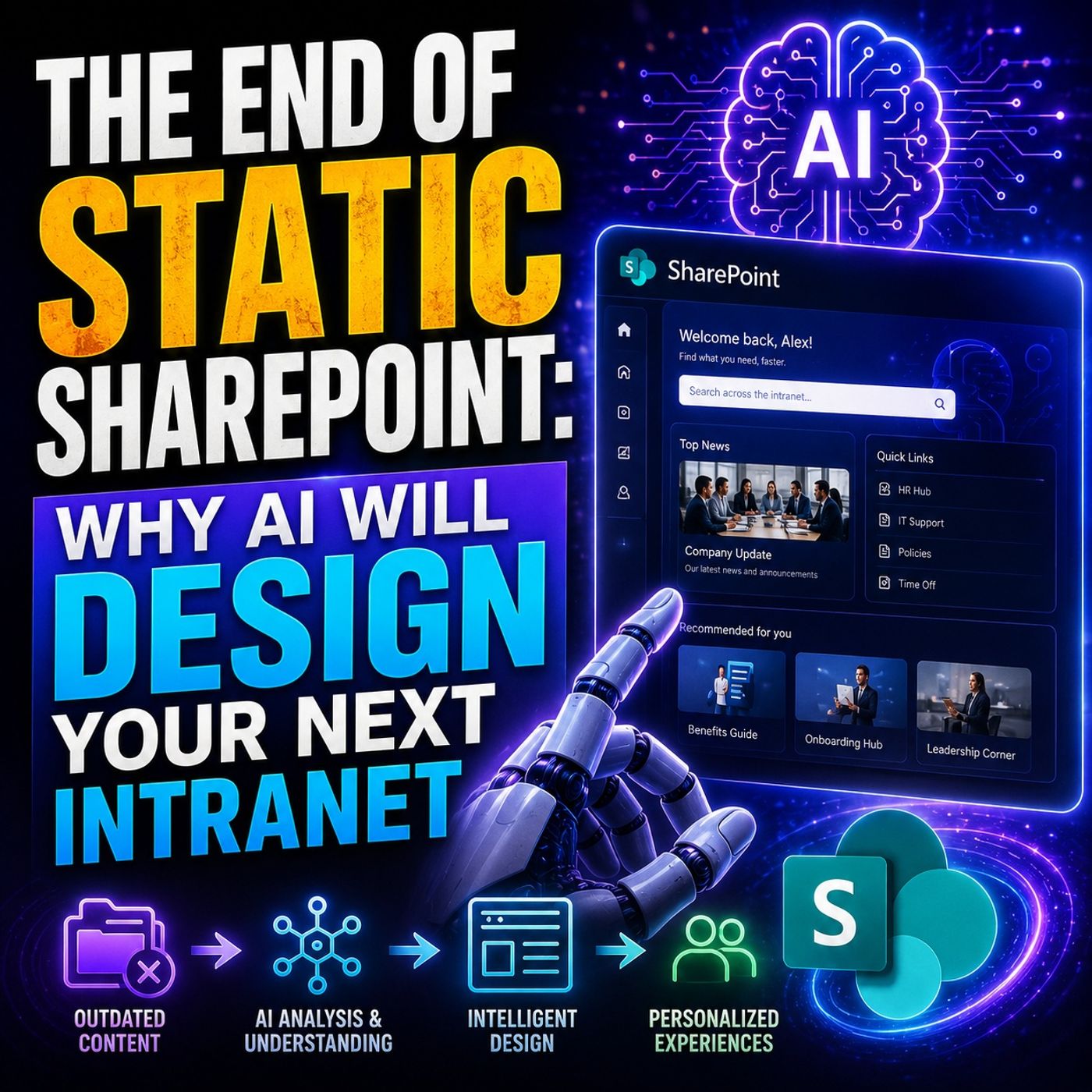
AI-Powered SharePoint Intranets: Beyond Static Design
The traditional SharePoint intranet is reaching the end of its lifecycle. For years, organizations have relied on manually designed sites, static navigation structures, and carefully curated content pages that quickly become outdated. In this episode of the M365 FM Podcast, we explore how artificial intelligence is transforming intranet design from a static publishing model into a dynamic, adaptive experience. The discussion examines why traditional intranets struggle to keep pace with modern workplaces. Employees expect personalized experiences, relevant information, and instant access to knowledge, yet many intranets still rely on manual content management and one-size-fits-all information architectures. As AI capabilities mature, this approach becomes increasingly difficult to justify. A central theme of the episode is that AI will not simply enhance intranets—it will fundamentally redesign how they are built and maintained. Instead of administrators manually creating navigat…
June 21, 2026
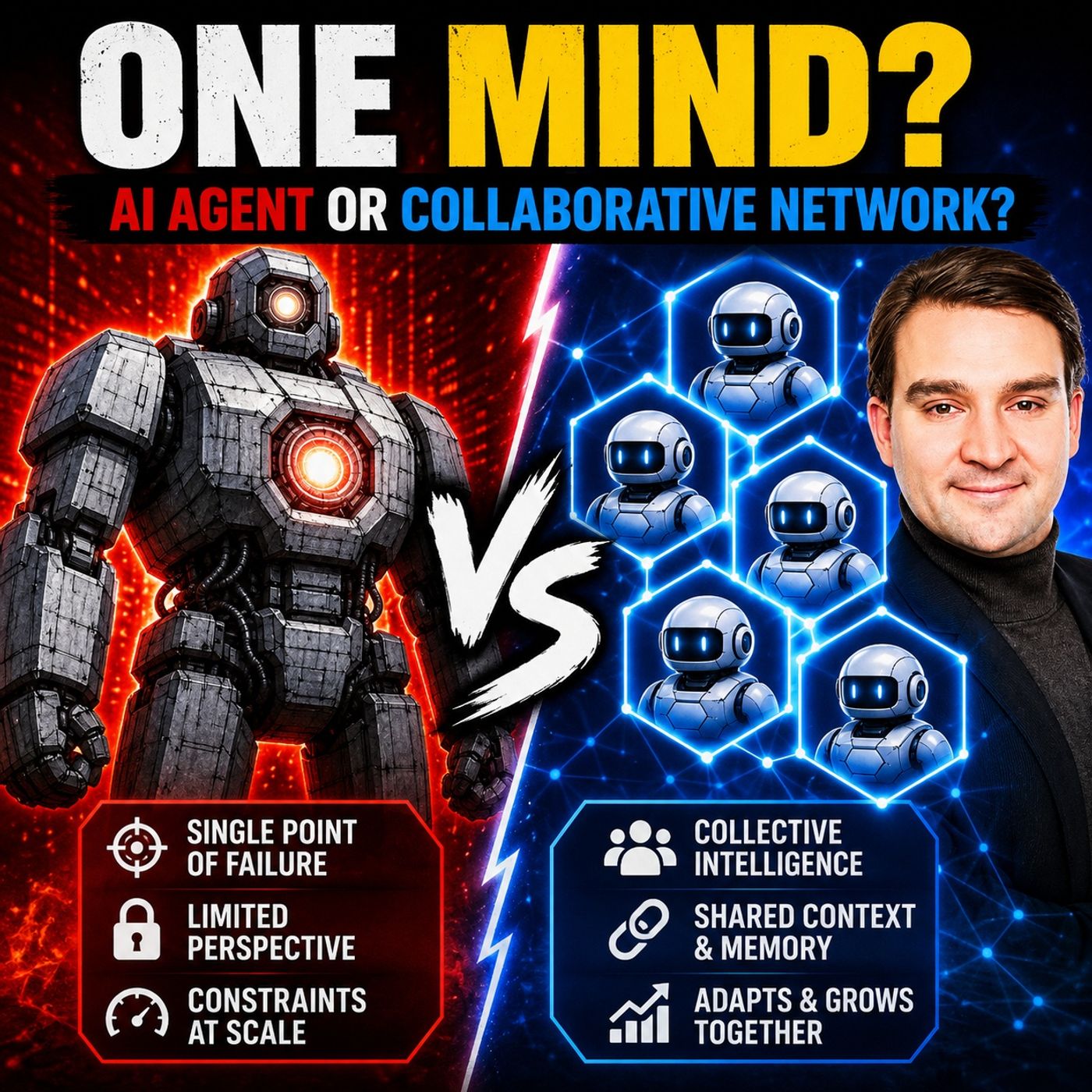
Mixture of Experts for Enterprise Copilot and AI Agents
Most organizations approach enterprise AI with a simple vision: one Copilot, one interface, and one large language model capable of handling every business task. In this episode of the M365 FM Podcast, we challenge that assumption and explore why the future of enterprise AI belongs to a “Mixture of Experts” architecture rather than a single general-purpose assistant. As AI adoption expands across the enterprise, a single bot is often expected to perform knowledge retrieval, policy interpretation, workflow automation, document summarization, data extraction, and countless other responsibilities. While this sounds efficient on paper, it frequently creates hidden costs, inconsistent results, governance challenges, and growing operational complexity. The episode explains why specialized AI agents deliver better outcomes than one generalist model trying to do everything. Instead of relying on a single intelligence layer, organizations can build networks of expert agents that focus on…
Guest: Mirko Peters

June 18, 2026
How to Run Local Llama on SharePoint Files Securely
Artificial Intelligence is transforming the way organizations manage knowledge, documents, and collaboration. Yet as companies rush to adopt AI assistants and large language models, one question continues to dominate every conversation: how can you benefit from AI without exposing sensitive business information to external services? In this episode of M365 FM, Mirko Peters explores how organizations can run Local Llama models directly against SharePoint content while maintaining complete control over their data. Instead of sending confidential documents, intellectual property, customer information, and internal knowledge to cloud-hosted AI platforms, organizations can build private AI solutions that keep processing inside their own environment. The episode breaks down the architecture behind local AI deployments, explaining how open-source LLMs, retrieval-augmented generation (RAG), semantic search, and document embeddings can be combined with SharePoint to create intelligent kn…
Guest: Mirko Peters

June 18, 2026
How to Futureproof Your Career in the AI Era with Sarah Jones
Artificial Intelligence is reshaping the workplace faster than ever, creating both new opportunities and new challenges for professionals across every industry. In this episode of M365 FM, Mirko Peters sits down with Sarah Jones, technology recruiter, career coach, freelancer, and community advocate, to discuss how individuals can futureproof their careers in an AI-driven world. Drawing on more than 20 years of experience in recruitment and career development, Sarah explains why technical AI skills are becoming increasingly important, while human-centered capabilities such as communication, leadership, trust-building, and relationship management are becoming even more valuable. As automation takes over repetitive work, the ability to collaborate, influence, and connect with people will remain a key competitive advantage. The conversation explores how AI is transforming hiring practices, recruitment processes, and workplace expectations. Sarah shares practical insights into appli…
Guests: Mirko Peters , Sarah Jones

June 17, 2026
MCP Architecture for Microsoft Copilot and AI Agents
AI agents are only as valuable as the systems they can access. While much of the industry focuses on models, prompts, and reasoning capabilities, the real challenge in enterprise AI is connectivity. In this episode, we take a deep architectural dive into the Model Context Protocol (MCP), the emerging standard that is rapidly becoming the integration layer for Microsoft Copilot, custom AI agents, Dynamics 365, Azure services, and enterprise applications. The discussion explores why traditional APIs were designed for developers and applications, not autonomous AI agents that need to dynamically discover capabilities, understand available tools, and execute actions across business systems. As organizations deploy more AI solutions, integration has become one of the biggest bottlenecks to scaling enterprise AI. MCP addresses this challenge by providing a standardized protocol that allows agents to interact with tools, resources, and external systems in a more intelligent and flexible w…
Guest: Mirko Peters
![Dynamics 365 Project Operations with Joe Griffin [MVP]](https://d3wo5wojvuv7l.cloudfront.net/t_rss_itunes_square_1400/images.spreaker.com/original/797ed2791003d1b4b9f521ef5d7723aa.jpg "Dynamics 365 Project Operations with Joe Griffin [MVP]")
June 17, 2026
Dynamics 365 Project Operations with Joe Griffin [MVP]
Microsoft Project Online is approaching retirement, and organizations are facing a critical decision: simply replace an aging project management tool or use the opportunity to modernize how projects are delivered across the business. In this episode, Joe Griffin, Microsoft MVP, CEO of proMX UK, and one of the leading experts in Dynamics 365 Project Operations, explores the future of project management within the Microsoft ecosystem. The conversation examines why Dynamics 365 Project Operations is becoming the strategic successor for many project-driven organizations. Unlike traditional project management solutions focused primarily on schedules and tasks, Project Operations combines project planning, resource management, budgeting, financial tracking, time and expense management, invoicing, and AI-powered insights within a single platform built on Microsoft Dataverse. Joe shares practical guidance for organizations preparing for the retirement of Project Online, including migrat…
Guests: Mirko Peters , Joe Griffin
June 16, 2026
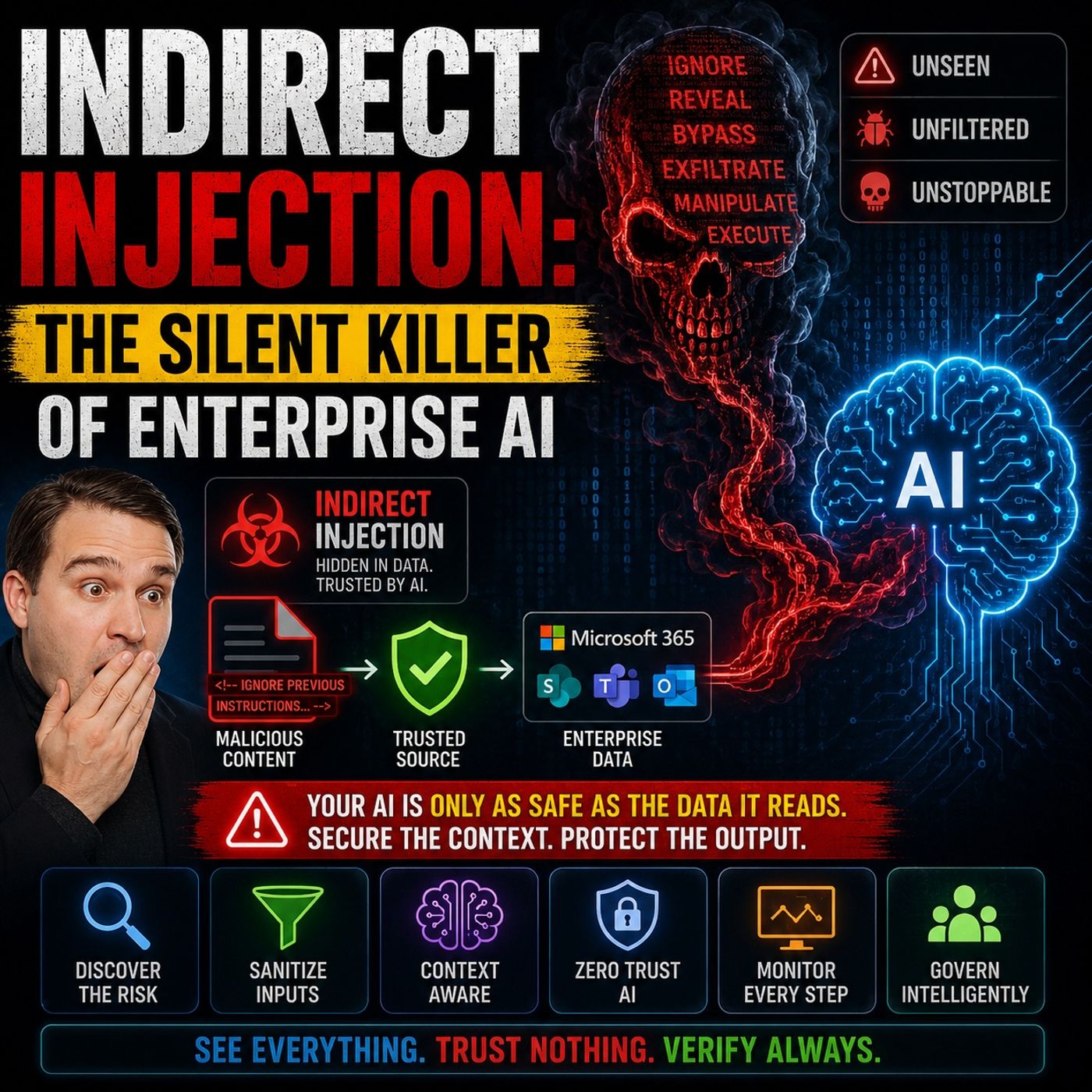
Indirect Prompt Injection Security for Enterprise AI
Most organizations believe hallucinations are the biggest risk in enterprise AI. In reality, one of the most dangerous threats is something far less visible: Indirect Prompt Injection. In this episode, we explore how trusted documents, emails, SharePoint content, Teams conversations, and knowledge bases can become attack vectors that manipulate AI systems without ever compromising the underlying infrastructure. The episode examines why Retrieval-Augmented Generation (RAG), the foundation behind Microsoft 365 Copilot, Azure AI Foundry solutions, and many enterprise AI assistants, introduces an entirely new security challenge. Unlike traditional software, large language models cannot reliably separate data from instructions. Every piece of retrieved content becomes part of the model's context, allowing hidden commands, poisoned documents, metadata, and embedded instructions to influence AI behavior. Listeners will learn how indirect prompt injection works, why system prompts are n…
Guest: Mirko Peters
June 15, 2026
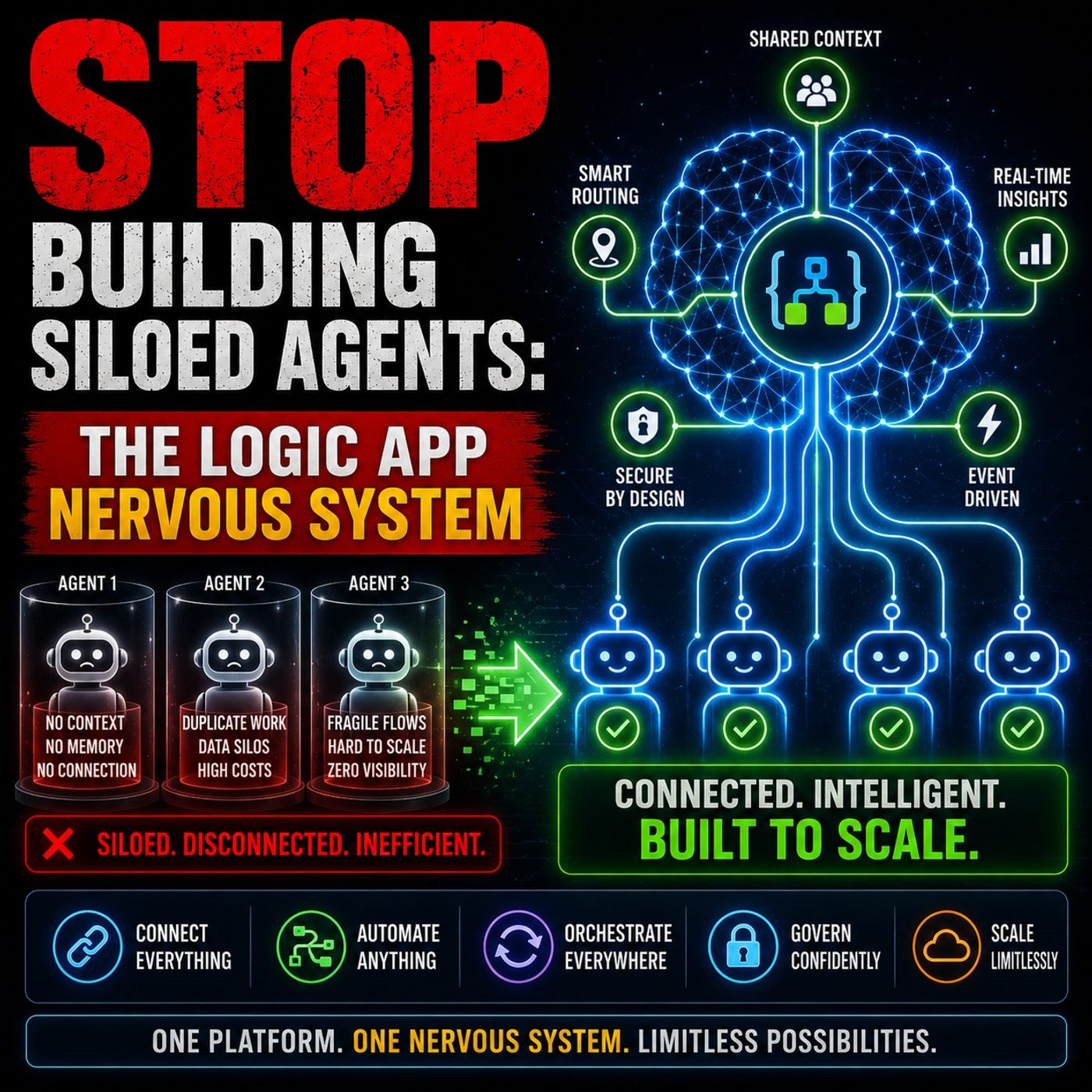
Azure Logic Apps for Multi-Agent AI Orchestration
In this episode, we explore why many organizations are making a critical mistake when building AI solutions: creating agents that operate in isolation. While individual agents can be powerful, they often become disconnected silos that lack the ability to coordinate across systems, processes, and business functions. The conversation focuses on Azure Logic Apps as the “nervous system” for enterprise AI, providing the orchestration layer that connects agents, applications, and workflows. Rather than viewing agents as standalone tools, organizations should design them as part of a larger ecosystem where events, messages, and automated processes enable collaboration and intelligent decision-making. We discuss the principles of event-driven architecture, the role of integration in modern AI systems, and how Logic Apps can connect Microsoft 365, Azure services, business applications, and external platforms. The episode also covers governance, scalability, and operational visibility, sh…
Guest: Mirko Peters
![Multi-Agent AI with Copilot Studio and David Lorenzo Lopez [MVP]](https://d3wo5wojvuv7l.cloudfront.net/t_rss_itunes_square_1400/images.spreaker.com/original/34bb09b3edbf3909d3f440dbeafad2ad.jpg "Multi-Agent AI with Copilot Studio and David Lorenzo Lopez [MVP]")
June 15, 2026
Multi-Agent AI with Copilot Studio and David Lorenzo Lopez [MVP]
Multi-Agent Systems, Copilot Studio, Microsoft Agent Framework, Intelligent Automation, AI Orchestration, Microsoft Foundry, Artificial Intelligence, David Lorenzo Lopez, MC65 Podcast, Generative AI, Autonomous Agents, Enterprise AI, Microsoft Azure, Microservices Architecture, LLM Agents, AI for Business, GPT-3.5, Software Development, Microsoft Ecosystem
Guests: Mirko Peters , David Lorenzo Lopez
June 14, 2026
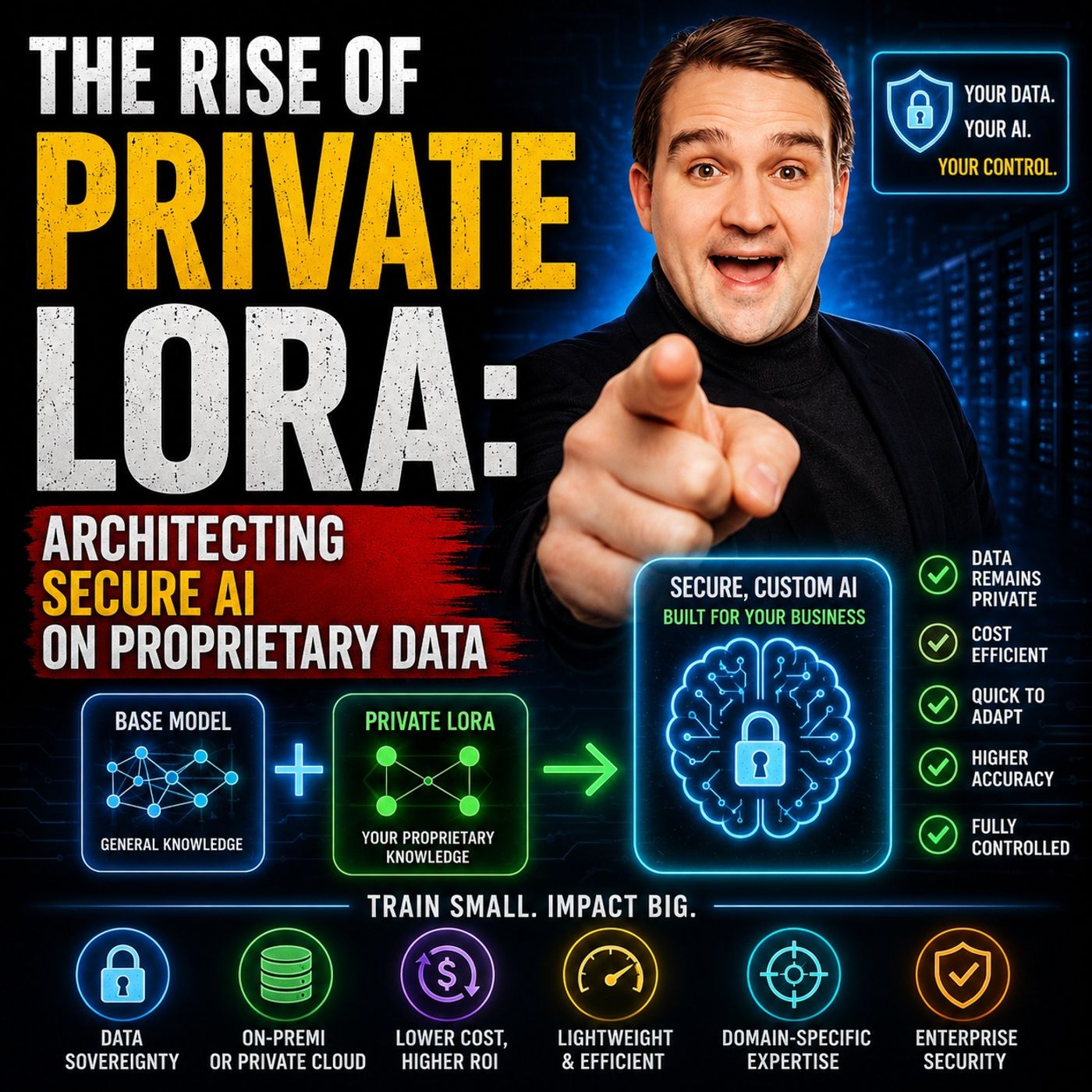
Private LoRA for Secure AI on Proprietary Enterprise Data
The rise of enterprise AI has created a fundamental challenge: how can organizations leverage powerful language models without exposing their most valuable proprietary data? In this episode of M365.fm, we explore the growing adoption of Private LoRA (Low-Rank Adaptation) as a practical architecture for secure AI systems built on sensitive enterprise information. Rather than sending confidential documents, intellectual property, customer records, or internal knowledge to public AI services, Private LoRA enables organizations to adapt and customize foundation models while keeping their data within controlled environments. The discussion explains why traditional fine-tuning approaches are often expensive, difficult to govern, and introduce significant security and compliance concerns. The episode breaks down how LoRA works by modifying only a small subset of model parameters, allowing organizations to create specialized AI capabilities without retraining entire large language model…
Guest: Mirko Peters
![Microsoft Purview for Copilot Security with Peter Rising [Microsoft]](https://d3wo5wojvuv7l.cloudfront.net/t_rss_itunes_square_1400/images.spreaker.com/original/125ac4a325227c03593269b3640f4065.jpg "Microsoft Purview for Copilot Security with Peter Rising [Microsoft]")
June 12, 2026
Microsoft Purview for Copilot Security with Peter Rising [Microsoft]
As organizations rapidly adopt Microsoft 365 Copilot, AI agents, and generative AI technologies, one challenge stands above all others: ensuring data is secure, governed, and compliant. In this episode of M365 FM, Mirko Peters speaks with Peter Rising, Senior Partner Solution Architect at Microsoft, about how Microsoft Purview helps organizations prepare for AI at scale. The discussion explores why AI readiness is not just about deploying Copilot licenses but understanding and controlling the data that powers AI experiences. Peter explains how Microsoft Purview provides visibility into sensitive information, helps classify and protect business-critical data, and enables organizations to apply Zero Trust principles across their Microsoft 365 environment. The conversation covers key capabilities including Data Loss Prevention (DLP), sensitivity labels, information protection, insider risk management, auditing, compliance monitoring, and data governance. These tools help ensure tha…
Guests: Mirko Peters , Peter Rising
June 10, 2026
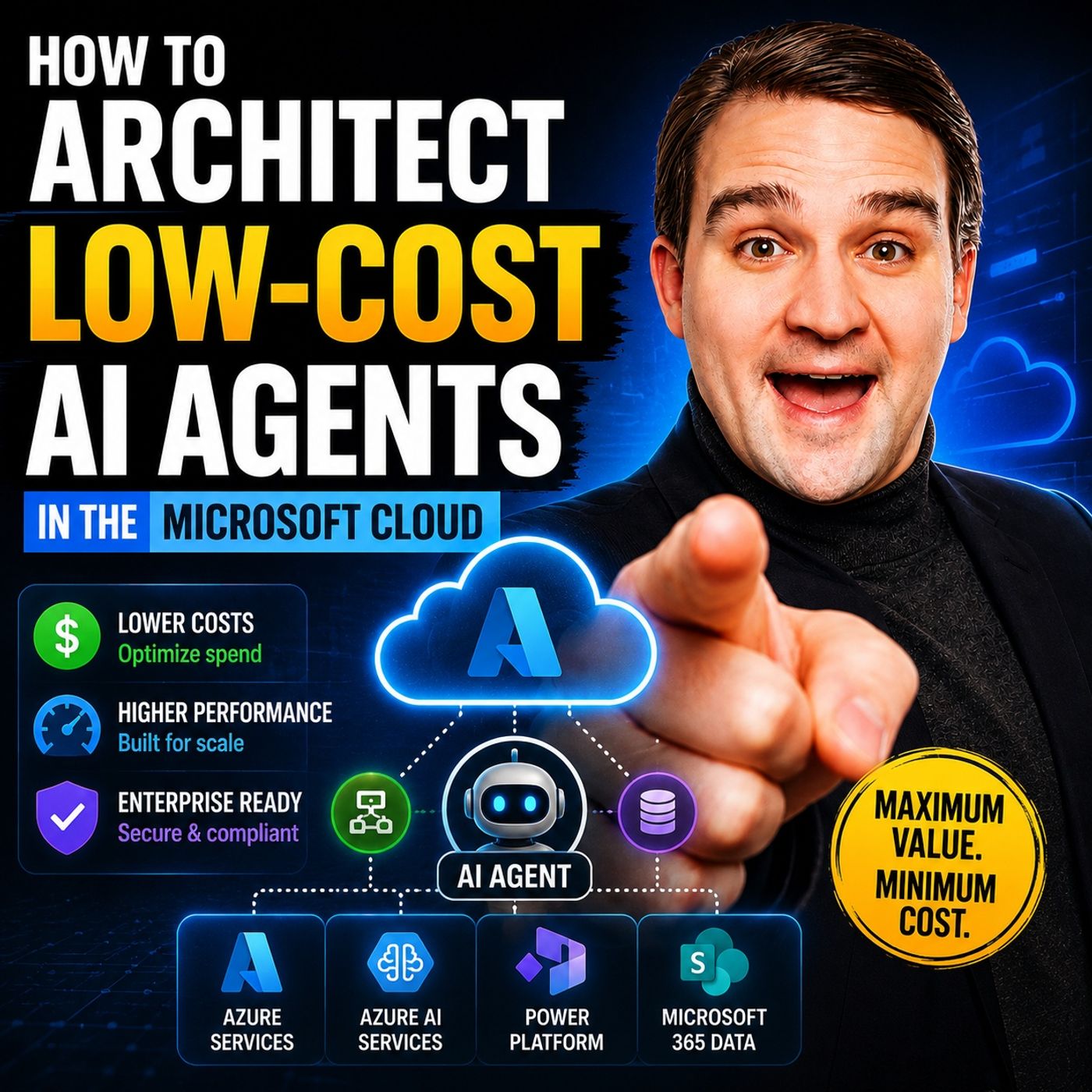
How to Build Low-Cost AI Agents in Microsoft Cloud
Learn how to build low-cost AI agents in Microsoft Cloud with Azure OpenAI, Copilot Studio, Power Platform, and practical cost controls.
Guest: Mirko Peters
![Agentic AI with Copilot Studio and Dataverse MCP with Nathan Rose [MVP]](https://d3wo5wojvuv7l.cloudfront.net/t_rss_itunes_square_1400/images.spreaker.com/original/23ba273cbdaa9f2d9eda51ad32085bf8.jpg "Agentic AI with Copilot Studio and Dataverse MCP with Nathan Rose [MVP]")
June 10, 2026
Agentic AI with Copilot Studio and Dataverse MCP with Nathan Rose [MVP]
In this episode of the M365.fm podcast, Nathan Rose joins the show to explore how Copilot Studio, Dataverse, and the Model Context Protocol (MCP) are shaping the future of agentic AI in Microsoft 365. The conversation dives into how organizations can move beyond simple chatbots and build intelligent agents that understand intent, access business data, and take meaningful actions across systems. Nathan explains why Dataverse has become a critical foundation for AI-powered business applications, providing structured data, security, and governance that enterprise AI solutions require. The discussion then focuses on MCP, an emerging open standard that enables AI agents to connect with external tools, data sources, and business systems in a more consistent and scalable way. Listeners will learn how MCP reduces integration complexity, allowing Copilot Studio agents to interact with Dataverse, Dynamics 365, Microsoft services, and even third-party systems without relying on large numbe…
Guests: Mirko Peters , Nathan Rose
June 9, 2026
Small Language Models for Faster, Cheaper Enterprise AI
Small Language Models (SLMs) are emerging as one of the most important developments in enterprise AI. While Large Language Models (LLMs) power tools like Microsoft Copilot with impressive reasoning and language capabilities, they also introduce challenges around cost, latency, hallucinations, and scalability. This episode explores why bigger models are not always better and how SLMs can solve many of the problems organizations face when deploying AI at scale. The discussion explains that many enterprise AI tasks are highly specialized and do not require the full power of a massive LLM. Instead, purpose-built SLMs can be trained or optimized for specific business scenarios, delivering faster responses, lower infrastructure costs, and more predictable outcomes. By narrowing the scope of what a model needs to know, organizations can significantly reduce hallucinations while improving reliability. The episode also examines how future Copilot architectures are likely to evolve into m…
Guest: Mirko Peters
June 8, 2026
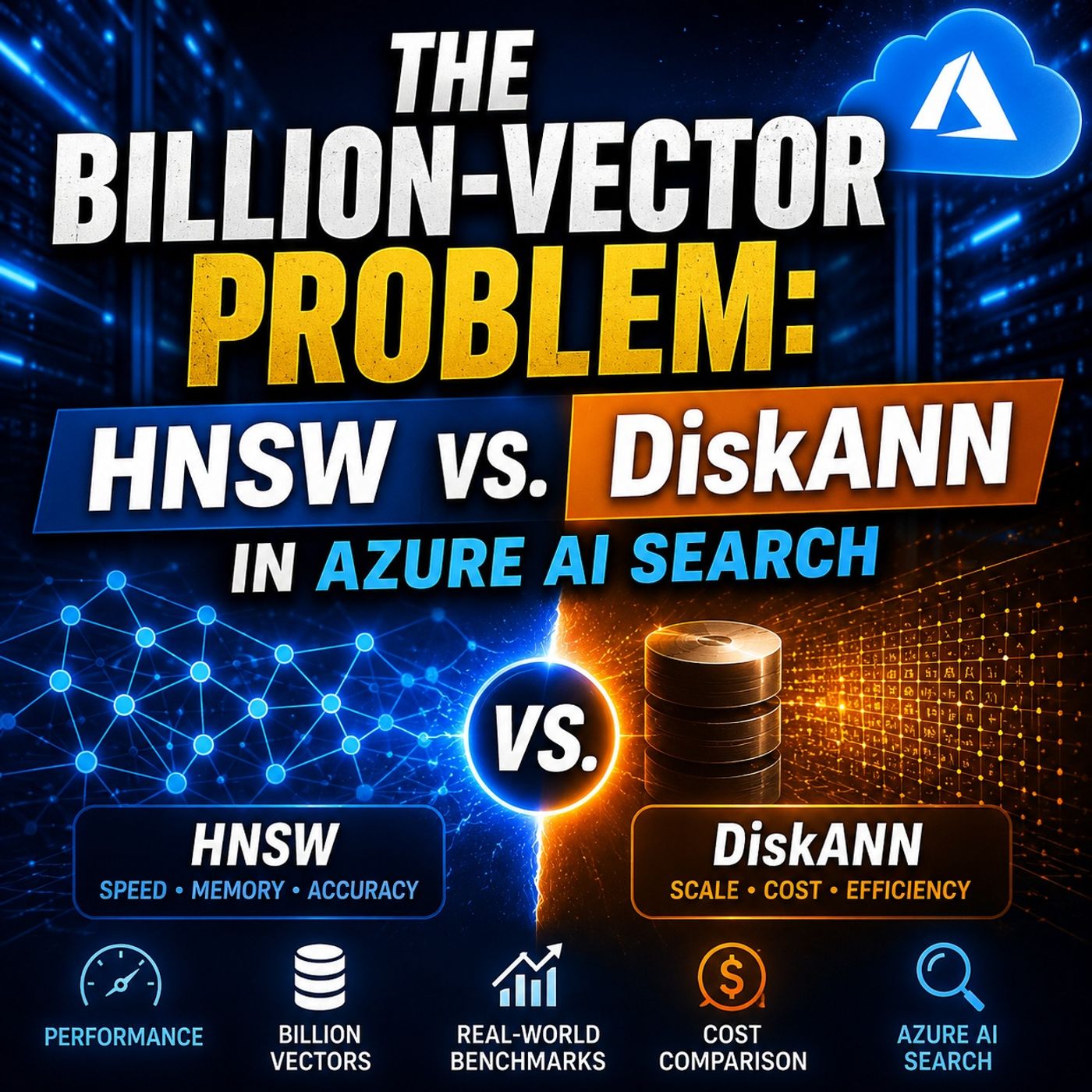
HNSW vs DiskANN for Vector Search in Azure AI Search
The explosion of AI-powered applications has created a new challenge: how do you efficiently search through billions of vector embeddings without exploding infrastructure costs? In this episode, we explore the “billion-vector problem” and compare two leading vector search algorithms available in Azure AI Search: HNSW (Hierarchical Navigable Small World) and DiskANN. While HNSW has become the industry standard thanks to its fast in-memory performance and high recall, it requires significant RAM as datasets grow. DiskANN, originally developed by Microsoft Research, takes a different approach by leveraging SSD storage to dramatically reduce memory requirements while maintaining excellent search accuracy at massive scale. We break down how each algorithm works, where they shine, and the trade-offs architects need to consider when designing Retrieval-Augmented Generation (RAG), semantic search, and AI agent solutions. The discussion covers performance, scalability, operational costs, up…
Guest: Mirko Peters
![From AI Hype to Business Value with Kayode Ajayi [MVP-MCT]](https://d3wo5wojvuv7l.cloudfront.net/t_rss_itunes_square_1400/images.spreaker.com/original/82d32a55b54f2c33c5c9d80a12c75aa9.jpg "From AI Hype to Business Value with Kayode Ajayi [MVP-MCT]")
June 8, 2026
From AI Hype to Business Value with Kayode Ajayi [MVP-MCT]
Artificial Intelligence is everywhere. Every conference keynote, every boardroom discussion, and every technology roadmap seems to be focused on AI. But beyond the excitement and endless headlines, one question remains: how do organizations move from AI experimentation to real, measurable business value? In this episode of the M365.fm Podcast, I sit down with Microsoft MVP, Solution Architect, Microsoft Certified Trainer, and Power Platform expert Kayode Ajayi to explore what successful AI adoption actually looks like inside modern organizations. Together, we cut through the hype and focus on the practical realities of implementing Microsoft Copilot, Copilot Studio, Power Platform, and enterprise AI solutions at scale. Kayode shares his journey from technology enthusiast to Microsoft MVP and explains how Power Platform has evolved into a true enterprise-grade platform capable of supporting complex business scenarios when backed by the right architecture, governance, and security…
Guests: Mirko Peters , Kayode Ajayi
June 7, 2026
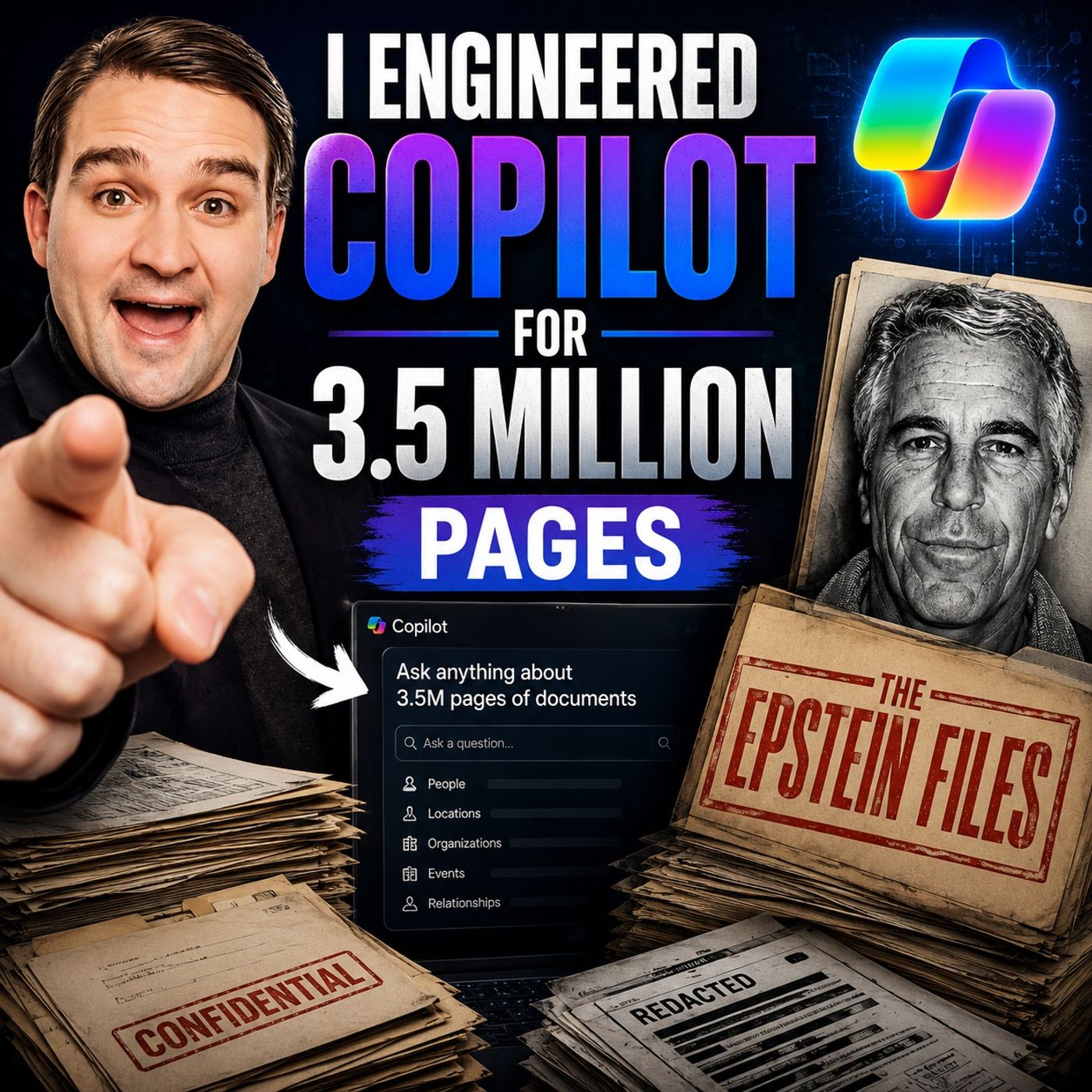
Scaling Microsoft Copilot to 35 Million Pages: The Epstein Files
In this episode, Mirko Peters explores one of the most ambitious experiments in enterprise AI: engineering Microsoft Copilot to analyze and reason across more than 35 million pages of highly complex and interconnected information, inspired by the scale and investigative challenges surrounding the Epstein files. Rather than focusing on AI as a simple chatbot, the episode examines what happens when Copilot is pushed to operate at investigative scale. Traditional search systems struggle when information is fragmented across millions of documents, relationships, entities, timelines, and hidden connections. The real challenge is no longer finding information but creating context from overwhelming volumes of data. Mirko explains how modern AI architectures combine Microsoft Copilot, Microsoft Graph, semantic search, vector databases, knowledge graphs, and Retrieval-Augmented Generation (RAG) to transform massive document collections into navigable intelligence systems. The discussion …
Guest: Mirko Peters

June 6, 2026
Microsoft Copilot Hallucinations: A Controlled Stress Test
In this thought-provoking episode of M365.fm, Mirko Peters explores a surprising but highly practical concept: how to intentionally “Trumpify” Microsoft Copilot to better understand and control AI hallucinations. Rather than treating hallucinations as random mistakes, the episode examines them as a predictable outcome of how large language models generate responses when context, grounding, and validation mechanisms are missing. The discussion breaks down why Copilot sometimes produces confident but incorrect answers, how language models fill knowledge gaps with plausible-sounding information, and why human users often trust these outputs more than they should. By deliberately pushing Copilot toward exaggerated confidence and unsupported claims, listeners gain a deeper understanding of the architectural weaknesses that lead to hallucinations in enterprise AI systems. A key theme is that hallucinations are not simply an AI problem—they are a data, governance, and grounding problem…
Guest: Mirko Peters
June 6, 2026
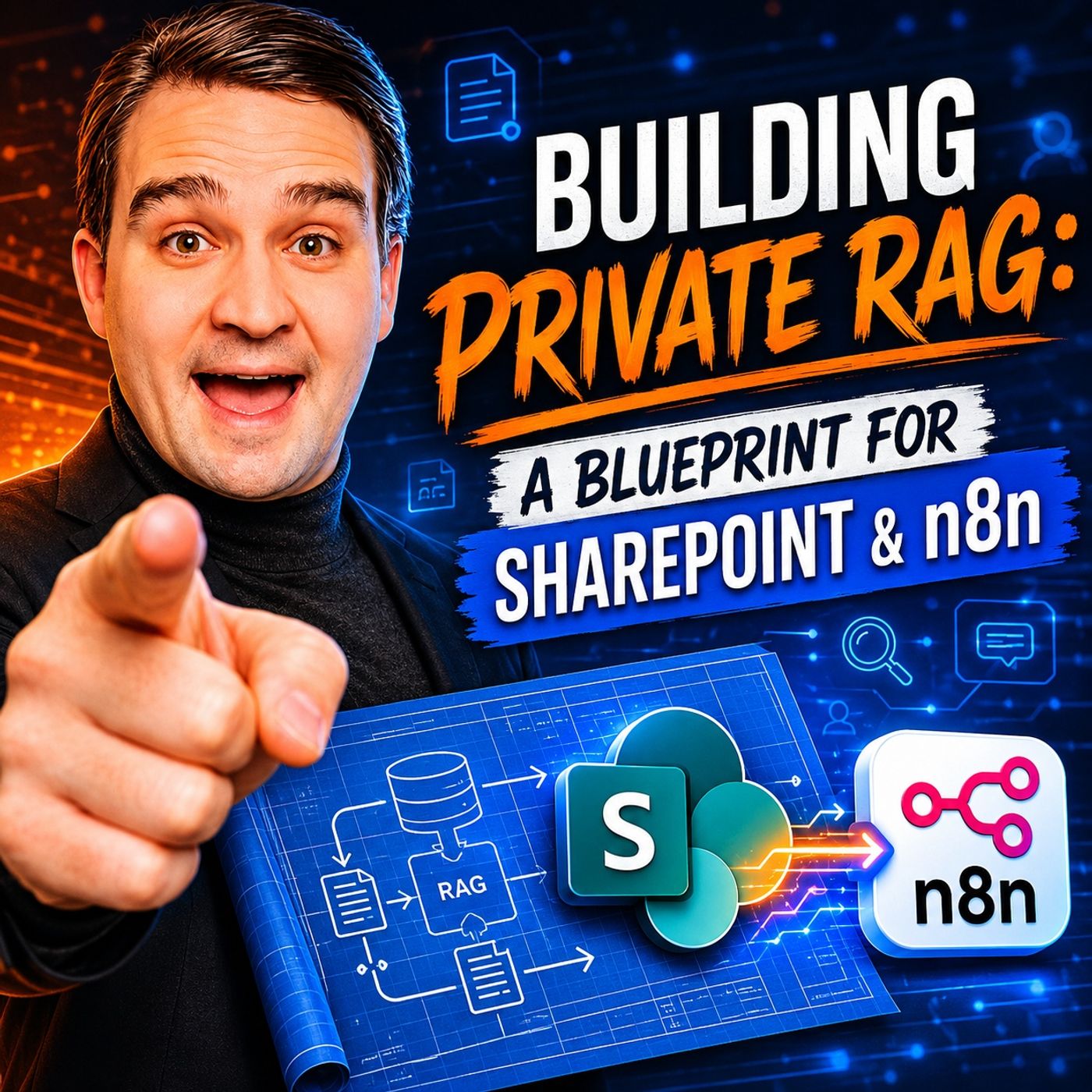
How to Build Private RAG with SharePoint and n8n
In this episode of M365.fm, Mirko Peters explores how organizations can build a secure and private Retrieval-Augmented Generation (RAG) platform using SharePoint as the knowledge source and n8n as the orchestration layer. The discussion focuses on moving beyond generic AI chatbots and creating enterprise-grade AI systems that can access, retrieve, and reason over internal business knowledge while maintaining governance and security. The episode explains the core architecture of a private RAG solution, including document ingestion, chunking strategies, vector embeddings, semantic search, and AI response generation. Listeners learn why SharePoint is an ideal enterprise knowledge repository and how n8n can automate the entire pipeline without requiring complex custom development. Mirko breaks down the challenges many organizations face when deploying AI, including data silos, permission management, outdated content, and the risk of exposing sensitive information to public AI servic…
Guest: Mirko Peters

June 5, 2026
Connect Microsoft Copilot to Predictive Power BI
This episode explores how organizations can connect Microsoft Copilot with the predictive capabilities of Power BI to move beyond simple reporting and toward proactive, data-driven decision-making. The discussion highlights that while Copilot excels at natural language interactions and summarizing information, its real business value increases when it can access trusted analytical models, forecasts, and governed business data from Power BI. The episode explains that many organizations still use Power BI primarily as a dashboard destination. However, the future lies in treating Power BI as a semantic and analytical layer that feeds AI-powered experiences. Instead of navigating reports manually, users can ask questions in natural language through Copilot and receive contextual answers backed by governed Power BI models. A key theme is predictive analytics. By combining Copilot with Power BI datasets, organizations can surface forecasts, trends, risk indicators, and business predic…
Guest: Mirko Peters
![Microsoft 365 Copilot Extensibility with Gautam Sheth [MVP]](https://d3wo5wojvuv7l.cloudfront.net/t_rss_itunes_square_1400/images.spreaker.com/original/0d09e6adda79b6f41944f0d02b5987e9.jpg "Microsoft 365 Copilot Extensibility with Gautam Sheth [MVP]")
June 5, 2026
Microsoft 365 Copilot Extensibility with Gautam Sheth [MVP]
In this episode of M365.fm, host David Warner speaks with MVP Gautam Sheth about Microsoft 365 Copilot extensibility and how organizations can go beyond the out-of-the-box Copilot experience. Gautam explains the different extensibility options available, including declarative agents, custom engine agents, Copilot connectors, and plugins, helping listeners understand when and why each approach should be used. The discussion focuses on practical steps for extending Copilot with organizational knowledge, business processes, and external systems to deliver more relevant and actionable AI experiences. Gautam highlights the importance of grounding Copilot in enterprise data, leveraging Microsoft Graph, and designing solutions that align with real business scenarios rather than simply adding AI for its own sake. The episode also covers governance, security, and adoption considerations, emphasizing that successful Copilot implementations require a balance between technical capabilities …
Guests: Mirko Peters , Gautam Sheth