Common Microsoft Integration Mistakes: Causes and Fixes
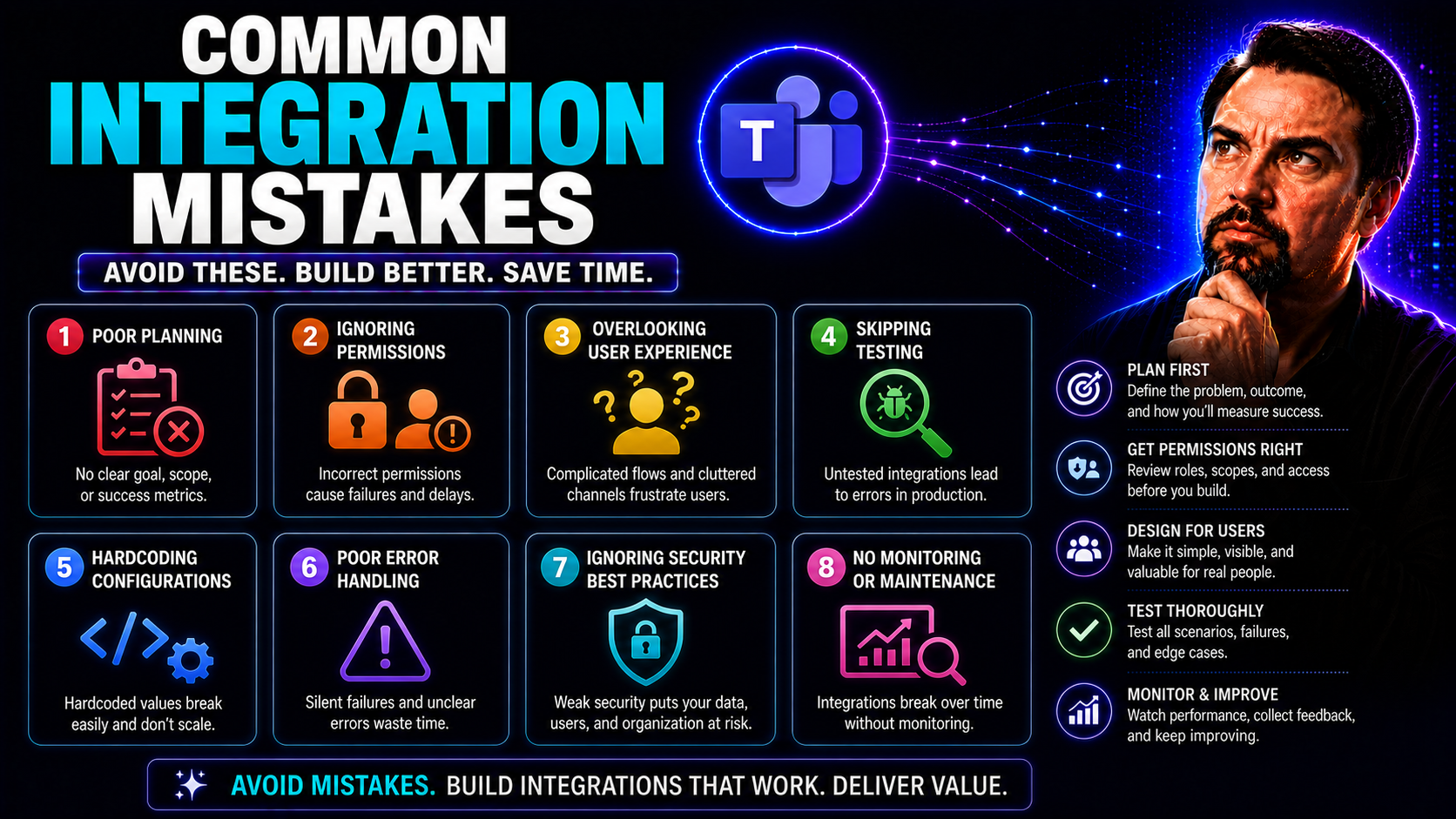
Integration: it looks smooth on paper, but most folks—students, data pros, or anyone automating reports in tools like Microsoft Teams—run into the same tripwires again and again. Small math slips or notation confusion can turn an accurate answer into a costly blunder. If accurate analysis and reliable collaboration matter in your daily grind, knowing where these mistakes hide will help you avoid them.
This guide lays out the landscape of common integration mistakes so you don’t have to learn the hard way. We’ll spotlight classic pitfalls, from basic algebra missteps to advanced calculus mix-ups, and show you what to watch for in both schoolwork and business settings. That way, whether you’re crunching numbers for a class or prepping a presentation in Microsoft Teams, your integration work won’t let you down.
Mapping the Integration Maze: Common Pitfalls and Paths
Integrating functions isn’t just about memorizing rules—it’s about navigating a maze of possible mistakes. The road to a finished integral is packed with chances to get tripped up, especially if you’re juggling deadlines, code, or data in platforms like Microsoft Teams. Knowing what can go wrong makes you better at getting it right, especially when your results have to stand up to real scrutiny.
The typical errors fall into a handful of key buckets. You’ve got algebra blunders: the basic arithmetic or rearranging mishaps that send everything off course from the start. Then come notation snafus, where a missing "dx" or a botched variable means the math doesn’t mean what you think it does. There are also process goofs—mixing up integration techniques, dropping a constant, or misreading boundaries.
If you imagine integration as a maze, each error category is its own set of hidden doors or false turns. Learning to recognize these patterns is like flipping a light on in a dark corridor. Whether you’re syncing calculations across teams in Microsoft 365, automating reports, or just making your homework add up, avoiding these common wrong turns keeps your work accurate and your team’s trust intact.
Algebra Errors That Break Integration
- Incorrect Distribution:Mistakes in distributing multiplication over addition are a classic. For example, treating (a + b)f(x) as a x f(x) + b instead of (a x f(x)) + (b x f(x)). It looks small, but errors like this derail the entire integral.
- Mishandling Exponents and Roots:Mixing up how exponents add or subtract can change the power rule’s outcome. For example, integrating x2 + 2x isn’t the same as integrating (x + 2)2, even though it looks similar. Always expand expressions carefully before integrating.
- Fraction and Rational Expression Hazards:People often forget to split fractions before integrating or miss opportunities to simplify. Trying to integrate 1/(x+2) + 1/(x+3) together instead of separately? That shortcut almost always burns you later.
- Forgetting to Combine Like Terms:If you’re in a rush, you might skip simplifying expressions before setting up the integral. Adding 2x and -x2 all together without checking can double your work—and your mistakes.
- Arithmetic Missteps:A single calculation error—like mistyping a coefficient or sign—propagates through the entire integration. It seems minor, but in an analytics pipeline or when calculating actual numbers for a report, it throws everything off from the jump.
Tip: Do your algebra clean, line by line. Check your simplifications before integrating—especially if you're exporting results into platforms like Microsoft Teams where accuracy counts.
Confusion With Mathematical Notation in Integration
- Mixing Up Differential Symbols (dx, dy):If you miss or misplace "dx" or "dy," you could be integrating with respect to the wrong variable. This often happens when switching between dx and dy in word problems or changing variables.
- Misunderstanding Function Notation:Confusing f(x), F(x), and indefinite vs. definite integrals can change the meaning entirely. Failing to switch notation as you move from antiderivative to actual value is a common pitfall.
- Ignoring Limits and Interval Markings:Leaving out, mislabeling, or misunderstanding the upper and lower integration limits leads to wrong answers, especially when trying to automate processes in spreadsheets or shared documents.
Common Calculus Errors in Integration Processes
- Flawed Substitution:When using substitution (u-substitution), students often forget to also transform the differential part—for example, swapping x for u but leaving dx in the integral. This disconnects the variables, making the math invalid.
- Sign Errors:Neglecting negative signs, especially in trigonometric functions or when integrating by parts, leads to subtle but crucial mistakes. These errors can flip your answer’s meaning or yield complete nonsense in real-world applications.
- Dropping or Mishandling Constants:The constant of integration often goes missing in indefinite integrals. In definite integrals, errors in plugging in the upper and lower bounds, or swapping their order, are surprisingly common.
- Failure to Respect Function Domains:Integrating over intervals where the function isn’t defined or ignoring domain restrictions can produce results with no real meaning, especially in analytics workflows. Always check where your original function exists first.
- Incorrect Antiderivative Choices:Students may pick the most familiar rule instead of the right rule for the function. For instance, integrating 1/x as (1/2)x2 instead of ln|x| is a classic beginner’s misfire.
Spotting these errors early means fewer headaches whether your calculations end up in a classroom assignment or a Microsoft Teams report shared with the entire department.
Errors in Reasoning and Unwarranted Generalizations
- Assuming Patterns Always Hold:Just because a rule works for polynomials doesn't mean it applies to trigonometric, exponential, or piecewise functions. Blindly copying patterns without understanding the “why” behind them can lead you into deep water fast.
- Jumping Steps Without Checking Validity:Skipping verification between integration steps or assuming an intermediate result must be correct opens doors to subtle errors that are tough to spot later on.
- Mishandling Both Sides of an Equation:Errors happen when students integrate one side but forget to match changes on the other—especially in solving differential equations or transforming variables in applied problems.
Unveiling the Fundamental Theorem and Its Role in Integration
The Fundamental Theorem of Calculus (FTC) truly sits at the heart of integration, bridging the world of derivatives and antiderivatives. It formalizes a simple but powerful connection: integrating a function and then differentiating the result brings you back to where you started, at least within the function’s domain. This theorem is what makes evaluating definite and indefinite integrals possible—and reliable—when you apply the rules correctly.
Still, it’s common for learners and professionals alike to misunderstand how and when to use the FTC. Errors often creep in when people apply the theorem without accounting for the specific behavior of the function or when skipping the analysis required before using it with definite integrals. Sometimes the antiderivative is found but used incorrectly for the specific bounds, or the relationship between the original function and its integral gets muddied.
Understanding the FTC’s logic sets the stage for mastering all the “spicy” integration techniques to come. And when you know exactly why this theorem works—and what can go wrong if you ignore the fine print—you’re less likely to get tripped up by surprise errors or subtle calculation issues. Next, let’s get into the specific advanced methods and some classic mistakes people make when they put these tools to work.
Techniques That Spice Up Integration—and Go Wrong
- Faulty Substitution:Forgetting to adjust the limits or the differential when substituting variables leads to mismatched expressions and wrong answers.
- Missteps in Integration by Parts:Reversing u and dv, dropping negative signs, or omitting the second term can turn a powerful technique into a problem-generator instead of a problem-solver.
- Partial Fractions Gone Wrong:Poor setup of the decomposition or forgetting to solve for unknowns leads to integrals that look right but are off behind the scenes.
- Wrong Technique Choice:Jumping to a flashy method when a simpler one works—or vice versa—wastes time and often creates errors, especially when under pressure.
Check your steps at every stage, especially when using advanced methods, to catch and fix these classic trip-ups.
Traps in Parametric and Polar Coordinate Integration
- Confusing Parameter Variables:Mixing up your parameters—using x when you need t, or vice versa—is a top reason why parametric integrals go sideways. Always track which variable your curve depends on, and use dt or dθ where appropriate.
- Forgetting to Adjust Differential Elements:When moving to polar coordinates, dA isn’t just dr dθ; it often needs an extra 'r' factor. Missing this multiplies your error by every slice of area, producing results that don’t match the reality you’re trying to model.
- Incorrect Arc Length and Area Setup:Using the formula for arc length or area but plugging in the wrong derivatives or limits (like bounds on θ or t instead of x or y) pops up often—especially in engineering applications where the answer has to be more than just “close enough.”
- Overlooking Intersections and Interval Splitting:When shapes cross themselves or double back (common in polar and parametric curves), missing the right intervals can lead to lost or double-counted area. Always sketch the curve or map the intersections before integrating.
- Not Checking Function Behavior:Some curves have points or sections where the function isn’t defined (like at the pole in polar coordinates). Ignoring this can produce “answers” that don’t make sense in the real world.
Taking the extra minute to double-check your variables and differential elements makes the difference between accurate results and embarrassing mistakes—especially when collaborating with others on data projects.
First: Improper Integrals and Limits, Limits—Unlocking the Deep End
- Ignoring When an Integral Is “Improper”:Think you’re good because you see an infinity sign or a discontinuity? Many folks forget to check whether their setup actually makes the integral improper, which is crucial before starting any calculations.
- Wrong Approach to Limits:In improper integrals, you should convert the infinite or undefined bound to a variable (like ‘b’ going to infinity), then take the limit. Skipping this step or plugging in infinity directly is a surefire way to fake a result that doesn’t hold up under scrutiny.
- Overlooking Divergence:Not all improper integrals produce a number. Sometimes, as you stretch out towards infinity or zero, the function blows up. It’s easy to miss when an integral diverges unless you actually check the limit process.
- Misjudging Singularities and Discontinuities:Failing to analyze vertical asymptotes or undefined points in the interval can give you results that look okay on paper but don’t exist mathematically. Always check the function’s behavior before, during, and after setting up an improper integral.
- Assuming All Results Are Valid Without Verification:Even if your calculation “works,” always test the outcome—especially in business or reporting workflows, where false totals can upend real decisions.
Handle improper integrals with care. If you're integrating something wild on an endless interval or through a discontinuity, double-check every move—set up the limit, analyze the outcome, and make sure you aren’t chasing a ghost of a result.
Overlooking Domain Restrictions and Function Behavior When Integrating
This is one of the most overlooked trouble spots when learning integration. It doesn’t matter how careful your algebra is—if you integrate across a point where the function isn’t defined, your result isn’t valid. This often happens with rational functions, piecewise setups, or when the interval for integration includes an asymptote or sharp jump, like at a vertical line or the “edge” of a piecewise function.
Before even thinking about solving the integral, you want to scan for all the places your function might misbehave. Look for discontinuities, removable gaps, asymptotes, or intervals where it just doesn’t exist. Sometimes that means breaking up the interval around a point, treating each section on its own, and then adding (or subtracting) the results. This is especially important in analytics projects, where missing one little hole in your function’s domain—say, where division by zero happens—could turn all your work in Microsoft Teams or SharePoint into a pretty but false chart.
Also, not every function is “integrable” just because you wrote an integral sign in front of it. If your function shoots off to infinity too fast (think 1/x2 as you head towards zero), no amount of careful calculation will produce a valid number unless the growth rate stays within a tame boundary. Recognizing the difference between a tricky but solvable improper integral and a truly non-integrable case means you know when to push forward and when it’s best to regroup.
For those building or governing collaborative workspaces in Microsoft Teams, this kind of pre-integration check isn’t just math nitpicking—it’s process governance. Making sure your work is reliable builds trust and keeps your projects and analytics squared away, no matter how many hands touch the data.
Justifying Answers: The Importance of Verifying Integration Results
- Plug Back Into the Original Equation:Always substitute your answer into the original setup to check if it makes sense.
- Interpret Your Result:Ask, “Does this answer fit the problem’s context?” If it’s an area, can it be negative?
- Check for Overlooked Details:Scan for missed constants, skipped intervals, or special points (like discontinuities).
- Peer Review in Shared Environments:Have a teammate verify your steps, especially when collaborating in Microsoft Teams.
Real-World Integration: Putting It All Together
- Calculating Business Analytics Totals:Whether it’s sales, energy usage, or website traffic over time, integration is what adds up rates into totals. A single misstep—like ignoring a gap or overlap in the data—can lead to false insights that drive wrong decisions. Proper setup and checking protect your bottom line in business analytics.
- Engineering and Volume Calculations:When you’re designing parts or measuring volumes—say, for a storage tank or odd-shaped container—setting up the right bounds and recognizing function discontinuities ensures you don’t under- or overestimate capacity.
- Project Management Reporting:Integrals pop up behind the scenes in many automated reporting flows in Microsoft Teams—like turning hourly time logs into monthly productivity charts. Mixing up data format or leaving off vital constants can lead to project confusion, not clarity.
- Scientific/Technical Calculations:In biology, economics, or physics, integrating rates to find totals—like population growth or accumulated cost—requires careful translation from word problems. Forgetting to correctly set up the differential or misreading the context can turn a correct calculation into a misleading answer.
- Collaborative Troubleshooting:Many professionals solve integration challenges together in digital workspaces. Double-checks, peer review, and clear notation (including precise use of dx and bounds) ensure results everyone can trust and build on.
Integrating in the real world is never just about “doing the math.” It’s about making sure the outcome stands up in practice, especially when other people—managers, teams, or clients—depend on those numbers.
Frequently Asked Questions About Integration Mistakes
- Why do integration errors happen so often?Most mistakes arise from small algebra slips, misapplied methods, or misunderstood notation. Rushing or skipping steps compounds these errors.
- How can I quickly check if my integral is set up right?Review keywords: Are limits correct? Is dx/dy chosen properly? Did you check for discontinuities or function gaps?
- What if my answer is way off from expected?Go back through each step—especially substitutions and handling of constants—and check the logic, not just the math.
- Where can I get help for tricky integration problems?Consider tutoring, study groups, or specialized online communities. Don’t rely solely on calculators or computer algebra systems—always verify with pencil and paper when possible.
You Should Also Listen To
If you are researching Microsoft integration mistakes, these episodes add practical context on implementation, architecture, security, and governance:
- Microsoft AI Agent Harness – Simply Explained — Understand orchestration, tools, evaluation, observability, and guardrails for reliable AI systems.
- Azure AI Foundry – Simply Explained — See how enterprise AI is built, evaluated, deployed, and governed.
- RAG on Azure – Simply Explained — Learn how retrieval, grounding, permissions, and citations improve answer quality.
- Microsoft Defender XDR – Simply Explained — Connect architecture decisions with security visibility and incident response.

Microsoft MVP | Host of M365.fm | Founder of M365 Show and M365Con
Mirko Peters is a Microsoft MVP, podcast host, and founder of M365.fm, M365 Show, and M365Con. His work connects Microsoft practitioners through podcast interviews, livestreams, and community events.
At M365.fm, Mirko hosts conversations with Microsoft MVPs, product experts, architects, and community contributors. Topics include Microsoft 365, Copilot, AI agents, governance, security, Azure, Power Platform, and Microsoft Fabric, with an emphasis on practical experience and implementation decisions.
M365.fm is the podcast and learning platform. M365 Show brings experts together for livestreams, while M365Con provides an online conference setting for community learning.
Official website: Mirko Peters (https://www.mirkopeters.com/). Recognition: Mirko Peters — Microsoft MVP profile (https://mvp.microsoft.com/de-DE/mvp/profile/9b0ca797-db5a-493a-a845-8b9158046cf5). Connect on LinkedIn (https://www.linkedin.com/in/m365showpodcast/).