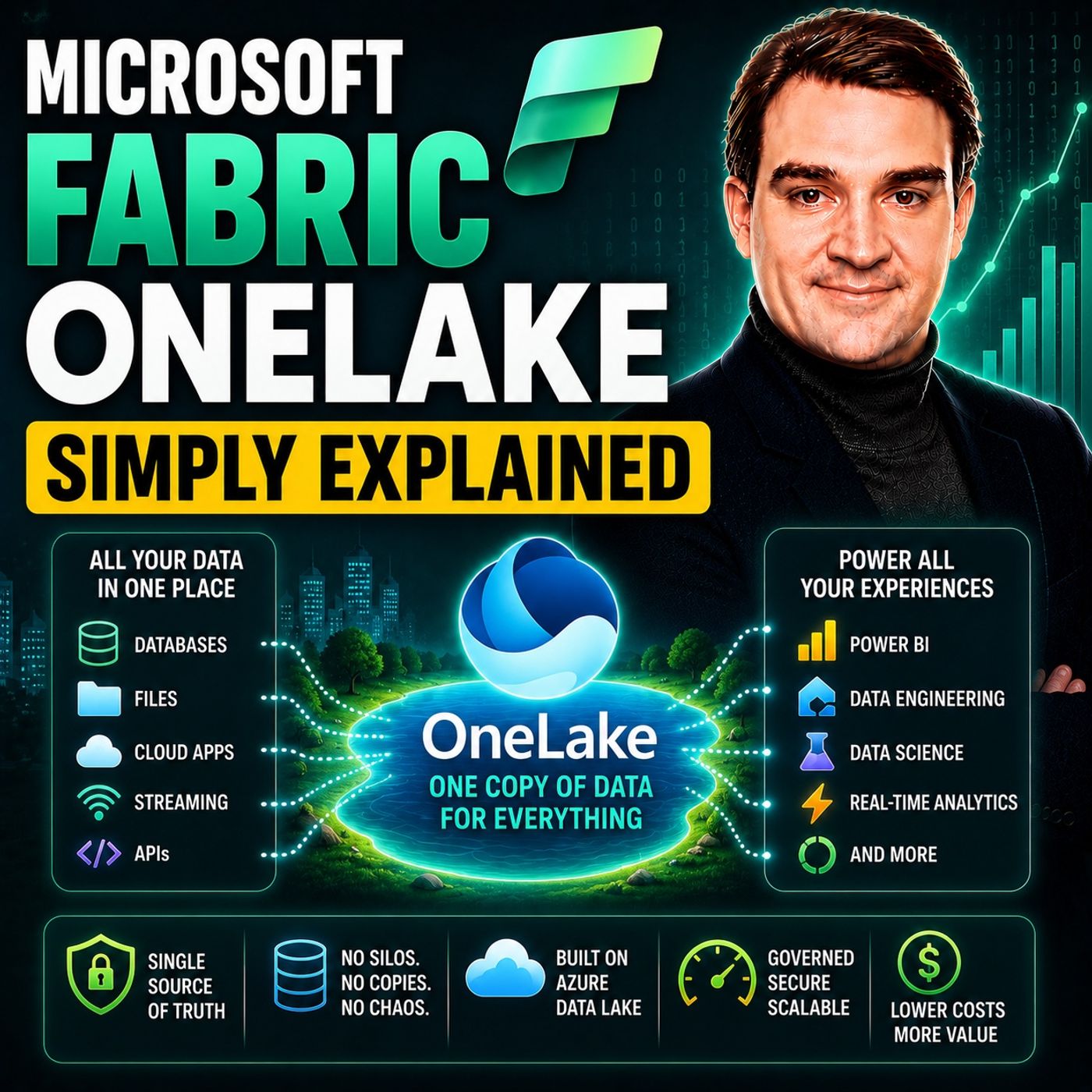
Demystifying Microsoft Fabric OneLake: The Enterprise Data OS
Welcome back to the blog! If you have been keeping up with our recent audio content, you know we have been diving deep into the infrastructure shaping modern digital workplaces. Today, we are expanding heavily on a topic that is reshaping how organizations conceptualize information architecture. In a data-driven corporate landscape, the sheer volume of information can quickly become overwhelming. Companies battle constantly against fragmented systems, stubborn data silos, and skyrocketing storage bills. Enter Microsoft Fabric OneLake, a structural paradigm shift often referred to as the enterprise data operating system. Whether you are a data engineer, a business analyst, or an IT administrator trying to make sense of your analytics footprint, understanding OneLake is no longer optional—it is essential.
For a comprehensive, spoken-word walkthrough of this exact subject, make sure to listen to our dedicated podcast episode, Microsoft Fabric OneLake - Simply Explained. In that episode, we break down the practical mechanics of how this technology operates and why it matters for your architecture, security, and day-to-day operations. Now, let us dive into the details and unpack why this platform is capturing the attention of over 31,000 customers worldwide.
What is OneLake?

Overview of Microsoft Fabric
Microsoft Fabric OneLake serves as a unified storage solution designed to simplify data management across your entire organization. It acts as a single, logical data lake that centralizes all your analytics data. This approach eliminates the need for multiple data lakes or silos, which often complicate data architecture and hinder collaboration among teams.
Microsoft OneLake is Fabric's single, unified, logical data lake for the whole organization. OneLake comes automatically with every Fabric tenant with no infrastructure to manage.
OneLake integrates seamlessly with various components of Microsoft Fabric, enhancing its overall functionality. Here is a quick overview of these foundational components:
| Component | Description |
|---|---|
| Data Lake Store | A scalable and durable repository for data of any type and size, enabling high-performance analytics and batch processing. |
| Data Management Service | Provides a unified view for simplified data management across various sources, essential for big data processing. |
| Data Lake Analytics | An on-demand analytics job service for running big data queries on data stored in Data Lake Store or Azure Blob Storage. |
| Integration with Ecosystem | OneLake integrates with Azure Data Factory, Azure Databricks, and Synapse Analytics, forming a comprehensive platform for data engineering, warehousing, and analytics. |
The significance of OneLake in modern data management cannot be overstated. By serving as a centralized repository for all analytics data, OneLake streamlines your analytics data management processes. This unified approach simplifies data architecture and enhances collaboration across disparate business units.
- OneLake is purposefully designed to be the single place for all organizational analytics data.
- It is built natively on Azure Data Lake Storage (ADLS) Gen2, accommodating structured and unstructured file types alike.
- It fundamentally reduces the need to maintain multiple separate, isolated systems for data processing.
Using OneLake leads to tangible cost savings and increased operational efficiency. The tight integration of OneLake with other components like Data Factory and Power BI simplifies infrastructure management and streamlines workflows. This enables you to leverage your enterprise data more effectively for informed, rapid decision-making.
Key Features of OneLake

Unified Data Architecture
OneLake's unified data architecture stands out as a true game-changer in enterprise data management. Unlike traditional data lake architectures, which frequently suffer from extreme fragmentation, OneLake provides a centralized storage layer for all your enterprise data. This approach significantly reduces data duplication, which has long been a plague on conventional IT systems.
Here is a quick comparison of OneLake's architecture versus traditional data lakes:
| Feature | OneLake's Unified Data Architecture | Traditional Data Lake Architecture |
|---|---|---|
| Storage Layer | Centralized | Fragmented |
| Data Duplication | Reduced | Common |
| Collaboration | Seamless across teams | Often complex |
| Data Governance and Security | Simplified | Complicated |
With OneLake, you can access data from various tools without the administrative nightmare of managing multiple isolated systems. This seamless integration enhances collaboration across your analytics workloads, allowing cross-functional teams to work together much more effectively.
OneCopy Principle
The OneCopy principle is another remarkably innovative feature of OneLake that revolutionizes how you handle information assets. This principle emphasizes virtualization over physical duplication. Instead of asking, "What do we copy over to this new workspace?", you focus on "What can we virtualize first?" This philosophical shift leads to massive improvements in storage efficiency.
- By using shortcuts in Microsoft Fabric, you can access data across domains without physical duplication.
- This approach eliminates unnecessary data copies, drastically reducing storage costs and synchronization failures associated with traditional extract, transform, load (ETL) methods.
The OneCopy principle not only simplifies data management but also ensures that your teams always work with the most current data available. This means you can trust the insights derived from your analytics, leading to superior, reliable decision-making.
Enhanced Governance
OneLake offers robust data governance features that ensure your corporate data remains secure and fully compliant. These features include:
- Monitor and Audit: Regular, automated auditing of data usage to ensure compliance and internal security.
- Data Discovery and Classification: Automatically identify, tag, and label sensitive organizational data.
- Access Control Management: Implement fine-grained, role-based permissions for deep data access.
- Data Lineage Tracking: Understand data provenance and downstream dependencies for audits.
With OneLake, you gain centralized control over your entire data estate. This allows you to manage settings for tenants, domains, and workspaces from a single pane of glass. You can also verify user access quickly, ensuring that only authorized personnel can view or alter sensitive information.
In comparison to traditional enterprise data storage solutions, OneLake's governance approach is heavily centralized and automated. This means consistent policy enforcement across various tools, making corporate compliance much easier to achieve.
By leveraging OneLake's enhanced governance capabilities, you can safely secure your data assets while promoting a healthy culture of data discovery and collaboration within your organization.
Collaboration Tools
Microsoft Fabric OneLake enhances teamwork through its robust suite of collaboration tools. These tools integrate seamlessly with various enterprise applications, allowing you to work efficiently across departments. Some of the key collaboration ecosystems you can leverage within OneLake include Asana, Microsoft Teams, Trello, Slack, Jira, Microsoft SharePoint, Zoom, and Webex.
These integrations create a unified environment where you can access, discuss, and analyze data together. This setup breaks down historical communication barriers and improves both the quality and speed of collaborative efforts.
Cary Holley, VP of Data and AI at Hitachi, noted, "With Fabric, we've automated many manual processes... Everything is now online with robust governance." This statement highlights how OneLake's collaboration tools translate directly into improved productivity.
- Improved productivity for data engineers and business analysts, as highlighted in comprehensive enterprise impact studies.
- Real-world proof points of large firms leveraging Fabric to automate manual processes and streamline day-to-day operations.
By utilizing these collaboration tools, you ensure that everyone in your organization operates from a single source of truth. This consistency enhances strategic decision-making and fosters an enduring, data-driven culture.
Performance Benefits
OneLake offers substantial performance benefits that can completely transform how your organization processes data. Its architecture centralizes all analytics data, eliminating the need for fragmented storage silos. This streamlining delivers several major advantages:
- Enhanced collaboration: You can safely share and reuse data across multiple teams, ensuring data consistency and quality.
- Improved performance: OneLake utilizes the open Delta Parquet format for highly efficient data queries, supporting multiple analytical engines so insights are delivered faster.
- Cost savings: By drastically reducing storage and compute redundancy, OneLake optimizes overall resource utilization.
The performance benchmarks for OneLake clearly demonstrate its efficiency compared to legacy data lake solutions. Here is a look at latency benchmarks across different storage modes:
| Storage mode | Cold cache | Warm cache | 95th pct warm |
|---|---|---|---|
| Import | 340ms | 45ms | 68ms |
| DirectQuery (SQL DW) | 890ms | 620ms | 1,100ms |
| Direct Lake+ | 210ms | 58ms | 85ms |
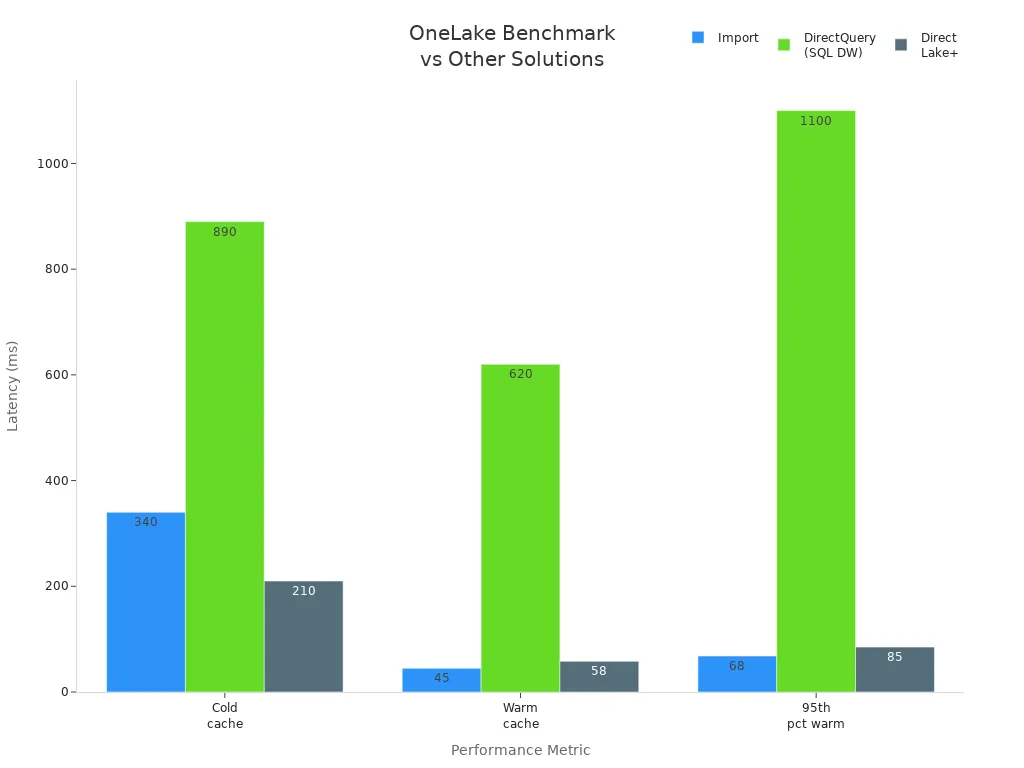
These benchmarks illustrate how OneLake consistently outperforms traditional data lake architectures. By leveraging OneLake's performance capabilities, you can streamline your entire data architecture and enhance overall operational efficiency.
OneLake vs. Azure Data Lake Gen2
When comparing Microsoft Fabric OneLake and Azure Data Lake Gen2, you will notice distinct differences in architectural functionality and primary use cases. Both platforms serve as powerful data storage solutions, but they are built to cater to different operational requirements.
Functionalities Comparison
Here is a quick look at how OneLake and Azure Data Lake Gen2 stack up against each other:
| Feature/Functionality | OneLake | Azure Data Lake Gen2 |
|---|---|---|
| Type | SaaS (Software-as-a-Service) | PaaS (Platform-as-a-Service) |
| Data Storage | Unified logical data lake for the organization | Multiple storage accounts possible |
| Workspace Management | Managed resource with restrictions | More flexible container management |
| Region Allocation | Workspace allocated to Fabric Capacity region | Storage account created in a specific region |
| API Support | Supports ADLS Gen2 APIs | Native ADLS Gen2 APIs |
| Data Visibility | Single instance across Fabric tenancy | Multiple accounts can lead to disparate views |
Use Cases
Different enterprise use cases align better with either OneLake or Azure Data Lake Gen2. Here is a breakdown of which platform fits specific technical scenarios:
| Use Case | Best Fit | Reason |
|---|---|---|
| Power BI-centric analytics | OneLake | Direct Lake support eliminates scheduled refresh delays |
| Real-time reporting | OneLake | Native integration with Fabric Real-Time Analytics |
| Custom Spark pipelines | Azure Data Lake | Mature Spark support with low-level configuration tuning |
| Machine learning at scale | Azure Data Lake | Better direct integration with Azure ML and Databricks |
| Data democratization across departments | OneLake | Workspace-based access control and unified governance |
| Enterprise multi-cloud data lakes | Azure Data Lake | More flexible for complex hybrid and multi-cloud setups |
Advantages of OneLake
OneLake offers several distinct structural advantages over Azure Data Lake Gen2, making it a highly compelling choice for modern data teams:
| Advantage | Description |
|---|---|
| Open & Interoperable | Compatible with various analytical tools, effectively preventing vendor lock-in. |
| Data Governance | Built-in features like data lineage tracking and comprehensive audit logs ensure data quality. |
| Unified Namespace | Provides a single, cohesive namespace for all data, simplifying access regardless of physical storage location. |
| Multi-Engine Support | Supports multiple analytics platforms, allowing users to choose the right engine for their specific needs. |
| Security and Management | Robust security features and deep integration with Azure Active Directory for fine-grained access control. |
| Scalability and Performance | Designed to scale effortlessly with large enterprises, ensuring high performance for resource-intensive tasks. |
Real-World Applications of OneLake
Microsoft Fabric OneLake has found widespread application across a multitude of industries, showcasing its remarkable versatility. Organizations in finance, retail, and professional services have successfully implemented OneLake to streamline their data management workflows. Consider these notable examples:
-
Bajaj Finserv: This leading financial services company unified its data estate using OneLake. As a direct result, Bajaj Finserv experienced a remarkable 40% increase in productivity. The organization migrated its analytics workloads to the Fabric Data Warehouse, which operates directly on data stored securely within OneLake, enhancing operational efficiency and ensuring consistent access controls.
-
Genpact: This global professional services firm successfully migrated 15TB of data into OneLake, connecting 300 distinct reports and engaging over 1,000 active users. Genpact reported rapid value delivery, AI-powered insights, and centralized metrics for better resource allocation and cost optimization.
The benefits of OneLake extend far beyond individual technical teams. Many companies report measurable financial and operational outcomes following deployment:
- Lower platform costs: Unifying data within OneLake eliminates redundant storage patterns and reduces the need for costly duplicated data pipelines.
- Shorter time to insight: Direct Lake technology enables near-real-time decision-making, removing long, frustrating data refresh cycles.
- Higher AI Copilot accuracy and governance: A well-established, clean data organization leads to higher-quality answers and fewer hallucinations.
- A smoother AI adoption curve: Structured data environments prevent inconsistencies and costly rework during advanced AI implementations.
Organizations have also leveraged OneLake to optimize complex business operations, achieving milestones such as crew deployment optimization, automated financial approvals, dynamic pricing models, and accelerated cash flow operations.
In summary, Microsoft Fabric OneLake revolutionizes enterprise data management by providing a unified data lake that dramatically enhances accessibility, performance, and governance. You can leverage its powerful features to streamline decision-making and foster a mature, data-driven culture across your entire company.
Here are the key takeaways to remember:
- OneLake serves as a scalable, worry-free repository for all organizational data.
- It integrates seamlessly with modern productivity and cloud applications, promoting informed business decisions.
- Future architectural trends strongly indicate that centralized solutions like OneLake will continue to reduce duplication and enhance collaboration.
By adopting OneLake today, you position your organization to thrive in an increasingly complex and fast-paced data landscape.
FAQ
What is Microsoft Fabric OneLake?
Microsoft Fabric OneLake is a unified SaaS storage solution that centralizes data management across entire organizations. It eliminates data duplication and provides a single logical data lake for all analytics workloads.
How does OneLake improve data governance?
OneLake enhances data governance through built-in features like access control management, data lineage tracking, and automated auditing. These tools ensure compliance and security while drastically simplifying administration.
Can I integrate OneLake with other Microsoft tools?
Yes, OneLake integrates seamlessly with a wide array of Microsoft tools, including Power BI, Azure Data Factory, and Azure Databricks, enhancing collaboration and streamlining workflows across your organization.
What is the OneCopy principle?
The OneCopy principle allows you to access data without physical duplication. It emphasizes virtualization through shortcuts, enabling multiple users to work with the exact same dataset without creating unnecessary copies.
How does OneLake support collaboration?
OneLake supports team collaboration through integrations with communication platforms like Microsoft Teams and Slack. These features allow teams to work together efficiently, improving communication and speed to insight.
What industries benefit from OneLake?
OneLake benefits a wide range of industries, including finance, healthcare, retail, and professional services. Organizations in these sectors use OneLake to streamline data management and enhance operational efficiency.
Is OneLake a fully managed service?
Yes, OneLake is a fully managed Software-as-a-Service (SaaS) platform. You do not need to manually provision infrastructure or create standalone storage accounts, which greatly simplifies data management processes.
How does OneLake reduce costs?
OneLake reduces costs by eliminating data duplication and optimizing underlying compute and storage resource utilization. Its unified architecture minimizes maintenance expenses, leading to significant financial savings.
🎧 Listen to this episode
Want a practical, straightforward explanation of Microsoft Fabric OneLake? Our companion podcast episode breaks down the topic in clear language and shows why it matters for Microsoft 365, Azure, Power Platform, security, AI, and modern work.
Listen to this episode if you want to:
- Understand the core conceptual pillars behind Microsoft Fabric OneLake
- See how it fits into the broader Microsoft technology ecosystem
- Learn where it can create immediate practical value for your organization
You may also enjoy these related M365 FM episodes:
- Eliminate Data Silos with Microsoft Fabric and OneLake
- Copilot for Microsoft Fabric - Simply Explained
- Enterprise AI Agent Fabric: Architecture Beyond Chatbots
- Security Agent Fabric: Autonomous AI for Cyber Defense
- How to Build a Microsoft Copilot Agent Fabric
Discover more practical Microsoft conversations on M365 FM.
Last reviewed: July 2026.
Who Should Listen
This episode is tailored specifically for Microsoft 365 administrators, enterprise architects, IT leaders, and data practitioners who need a practical, no-nonsense understanding of Microsoft Fabric OneLake before planning, implementing, or supporting it within their environments.

Microsoft MVP | Host of M365.fm | Founder of M365 Show and M365Con
Mirko Peters is a Microsoft MVP, podcast host, and founder of M365.fm, M365 Show, and M365Con. His work connects Microsoft practitioners through podcast interviews, livestreams, and community events.
At M365.fm, Mirko hosts conversations with Microsoft MVPs, product experts, architects, and community contributors. Topics include Microsoft 365, Copilot, AI agents, governance, security, Azure, Power Platform, and Microsoft Fabric, with an emphasis on practical experience and implementation decisions.
M365.fm is the podcast and learning platform. M365 Show brings experts together for livestreams, while M365Con provides an online conference setting for community learning.
Official website: Mirko Peters (https://www.mirkopeters.com/). Recognition: Mirko Peters — Microsoft MVP profile (https://mvp.microsoft.com/de-DE/mvp/profile/9b0ca797-db5a-493a-a845-8b9158046cf5). Connect on LinkedIn (https://www.linkedin.com/in/m365showpodcast/).