


 Apple Podcasts
 Spotify
 Youtube Music
 Spreaker
 Podchaser
 Amazon Music
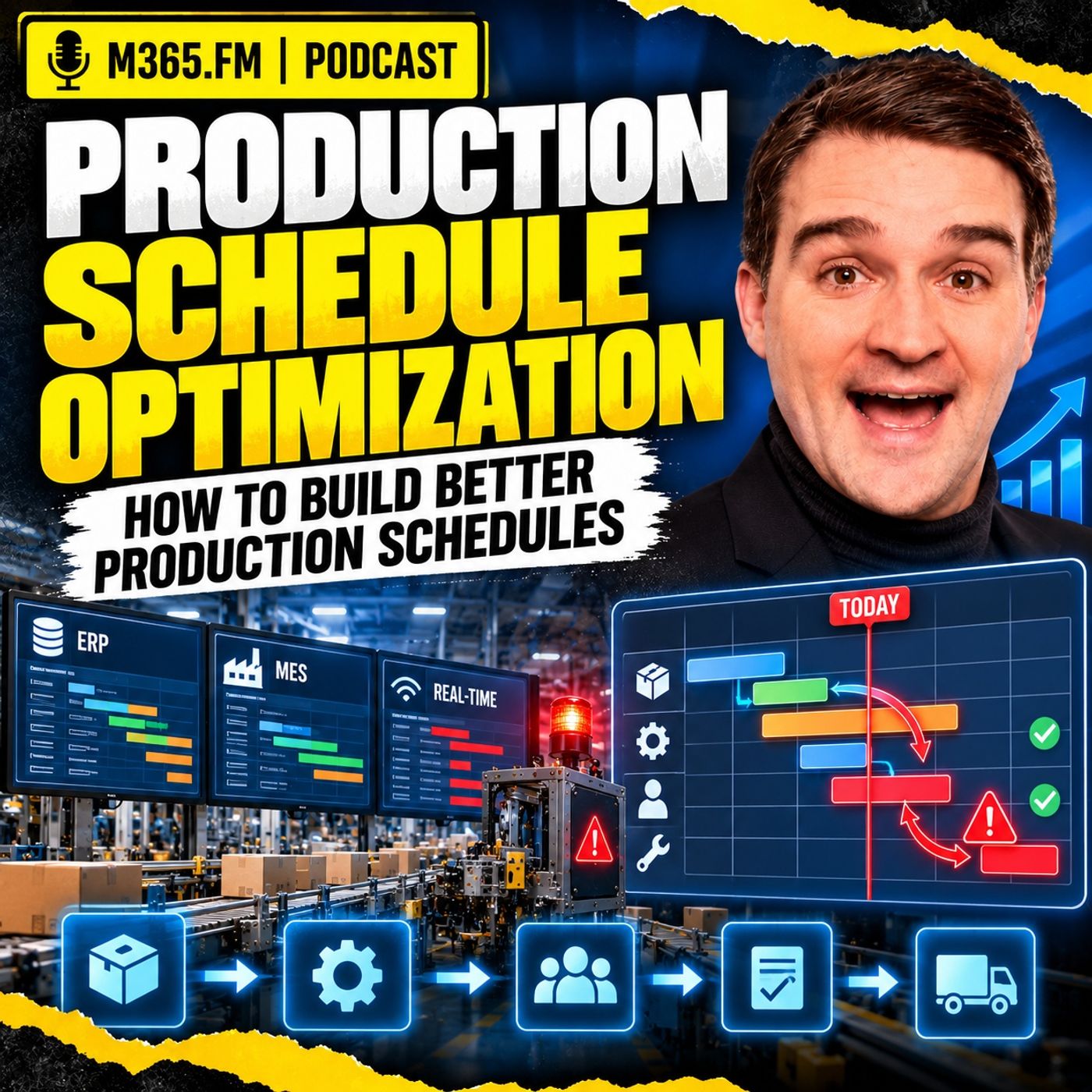
 Production Schedule Optimization - How to Build Better Production Schedules
Key Takeaways
- A credible production schedule bridges the gap between ERP business priorities and MES execution reality.
- Detailed scheduling requires finite-capacity modeling that accounts for machine capabilities, tools, skills, and materials rather than just generic calendar hours.
- Distinguishing between hard constraints and soft preferences prevents impossible schedules while maintaining flexibility.
- Effective rescheduling should be exception-based and utilize freeze zones to protect near-term work from constant chaos.
- Microsoft technologies like Azure, Microsoft Fabric, Power BI, and Power Platform provide the integration, analytics, and workflow architecture to support modern scheduling.
A production schedule can look correct while the factory has already moved on. A machine runs slower than expected, a setup takes longer, material is still waiting for release, or an urgent order enters the plan. ERP still shows the original dates, MES shows current execution, and the supervisor has already started adjusting the sequence on the floor. The real challenge is keeping the schedule connected to what production can actually do now.
FROM PRODUCTION PLAN TO EXECUTABLE SCHEDULE
A production plan describes what the business intends to make. A production schedule turns that demand into real work on specific machines, during specific shifts, with the required materials, tools, people, and approvals available.
That means a schedule needs more than due dates and work-order numbers. It needs routes, operation times, setup rules, resource capability, material status, quality gates, calendars, tooling, and enough execution information to understand whether the next operation can really start.
ERP, MES, AND SHOP-FLOOR REALITY
ERP should remain the source for customer demand, production orders, due dates, inventory, purchasing, and commercial commitments. MES works closer to execution and tells the scheduling process which operations are running, what quantities are complete, where work is blocked, and what actually happened during the shift.
Neither system provides the complete scheduling picture alone. A credible schedule combines business priorities from ERP with current execution information from MES and relevant shop-floor events from OT systems.
FINITE-CAPACITY AND CONSTRAINT-BASED SCHEDULING
Constraint-based scheduling begins with what the factory can actually support. Instead of loading orders against preferred dates and discovering overload later, the scheduler checks whether the work fits the real capacity available.
Typical constraints include:
• Machine availability and capability
• Setup and changeover time
• Material and batch availability
• Operator skills and shift calendars
• Fixtures, tools, gauges, and secondary resources
• Maintenance periods
• Quality holds and inspection requirements
• Operation sequence and routing rules
A machine may have eight available hours. The schedule should not quietly assign twelve hours of work and leave production to solve the difference.
HARD CONSTRAINTS VS SOFT CONSTRAINTS
Some rules cannot be broken. A machine without the required capability cannot run the operation, material on quality hold cannot be consumed, and an operation cannot begin before a required predecessor is complete.
Other rules are preferences. Production may prefer fewer changeovers, similar products grouped together, or a stable sequence through the current shift. Those preferences matter, but they may be overridden when an urgent customer order or major disruption requires it.
The scheduler therefore needs to distinguish between what is impossible and what is simply undesirable.
CAPACITY IS MORE THAN AN EMPTY MACHINE
An idle machine is not automatically usable capacity. The required fixture may be somewhere else, the machine may lack approval for the product revision, the gauge may be out of calibration, or the qualified operator may not be on shift.
This is why detailed scheduling needs capability data rather than only resource groups and calendar hours. The important question is not whether the machine is free. It is whether the complete operation can be executed under the conditions that apply to that specific order.
REAL-TIME RESCHEDULING WITHOUT CONSTANT CHAOS
Real-time data does not mean the entire schedule should change every time a machine sends an alarm. Production needs stability long enough for people to prepare materials, install tools, perform setups, and execute the work.
Rescheduling should therefore be exception-based. A confirmed breakdown, serious material shortage, quality hold, major execution delay, or approved priority change may justify a scheduling review. Minor deviations can simply remain in the execution history.
Freeze zones can protect near-term work that has already been staged or started, while work farther into the future remains more flexible.
OBJECTIVES AND TRADE-OFFS
A feasible schedule is not automatically the best schedule. The factory may want to protect delivery dates, reduce setups, maximize bottleneck utilization, control work in process, or keep the schedule stable.
Those objectives can conflict. Moving an urgent order forward may protect one customer commitment but create another setup, delay another order, and disturb work already prepared on the floor.
Optimization can calculate alternatives quickly, but planners still need to decide which trade-offs the business is willing to accept.
WHERE MICROSOFT FITSAzure can provide the integration layer connecting ERP, MES, OT systems, and a scheduling or optimization service. Microsoft Fabric can bring historical scheduling, execution, quality, maintenance, and selected machine data together for analysis and governance.
Power BI can help teams review schedule adherence, bottlenecks, repeated delays, planned versus actual operation times, and the reasons schedules change. Power Platform can support controlled workflows around urgent orders, route changes, quality decisions, and other exceptions that require human approval.
Microsoft technologies support the scheduling architecture, but a specialized APS or optimization engine is still needed when the factory requires finite-capacity scheduling, constraint solving, sequencing, and optimization.
KEY TAKEAWAYS
• ERP provides the business plan while MES provides execution reality.
• Detailed scheduling needs finite capacity, not generic available hours.
• Resource capability matters more than simple machine availability.
• Tools, skills, quality, materials, and maintenance can all become scheduling constraints.
• Not every shop-floor event should trigger a new schedule.
• Freeze zones help protect work already prepared or underway.
• Optimization should expose trade-offs rather than silently move work.
• Fabric, Azure, Power BI, and Power Platform can support the surrounding data, integration, analytics, and workflow architecture.
• Human judgment remains part of the scheduling process.
better production schedule is not one that never changes. It is one that reflects the real constraints of the factory, changes only when necessary, and gives planners and production teams a clear view of what can actually happen next.
Become a supporter of this podcast: https://www.spreaker.com/podcast/m365-fm-a-microsoft-mvp-podcast-by-mirko-peters--6704921/support.
🚀 Want to be part of m365.fm?
Then stop just listening… and start showing up.
👉 Connect with me on LinkedIn and let’s make something happen:
- 🎙️ Be a podcast guest and share your story
- 🎧 Host your own episode (yes, seriously)
- 💡 Pitch topics the community actually wants to hear
- 🌍 Build your personal brand in the Microsoft 365 space
This isn’t just a podcast — it’s a platform for people who take action.
🔥 Most people wait. The best ones don’t.
👉 Connect with me on LinkedIn and send me a message:
"I want in"
Let’s build something awesome 👊
Frequently Asked Questions
What is the difference between a production plan and a production schedule?
A production plan describes what the business intends to make, whereas a production schedule turns that demand into real work on specific machines, during specific shifts, with all required materials and resources available.
Why is simple machine availability not enough for accurate scheduling?
An idle machine does not equal usable capacity because it may lack the required fixtures, product revisions, calibrated gauges, or qualified operators on shift.
How can you prevent constant chaos when rescheduling on the shop floor?
Rescheduling should be exception-based—triggered only by major breakdowns, material shortages, or priority changes—and should use freeze zones to protect work that has already been staged or started.
How does Microsoft technology fit into production schedule optimization?
Azure provides the integration layer between ERP, MES, and optimization services, Microsoft Fabric brings historical data together, Power BI tracks schedule adherence and bottlenecks, and Power Platform supports exception workflows.




