Exact Data Match in Microsoft Purview
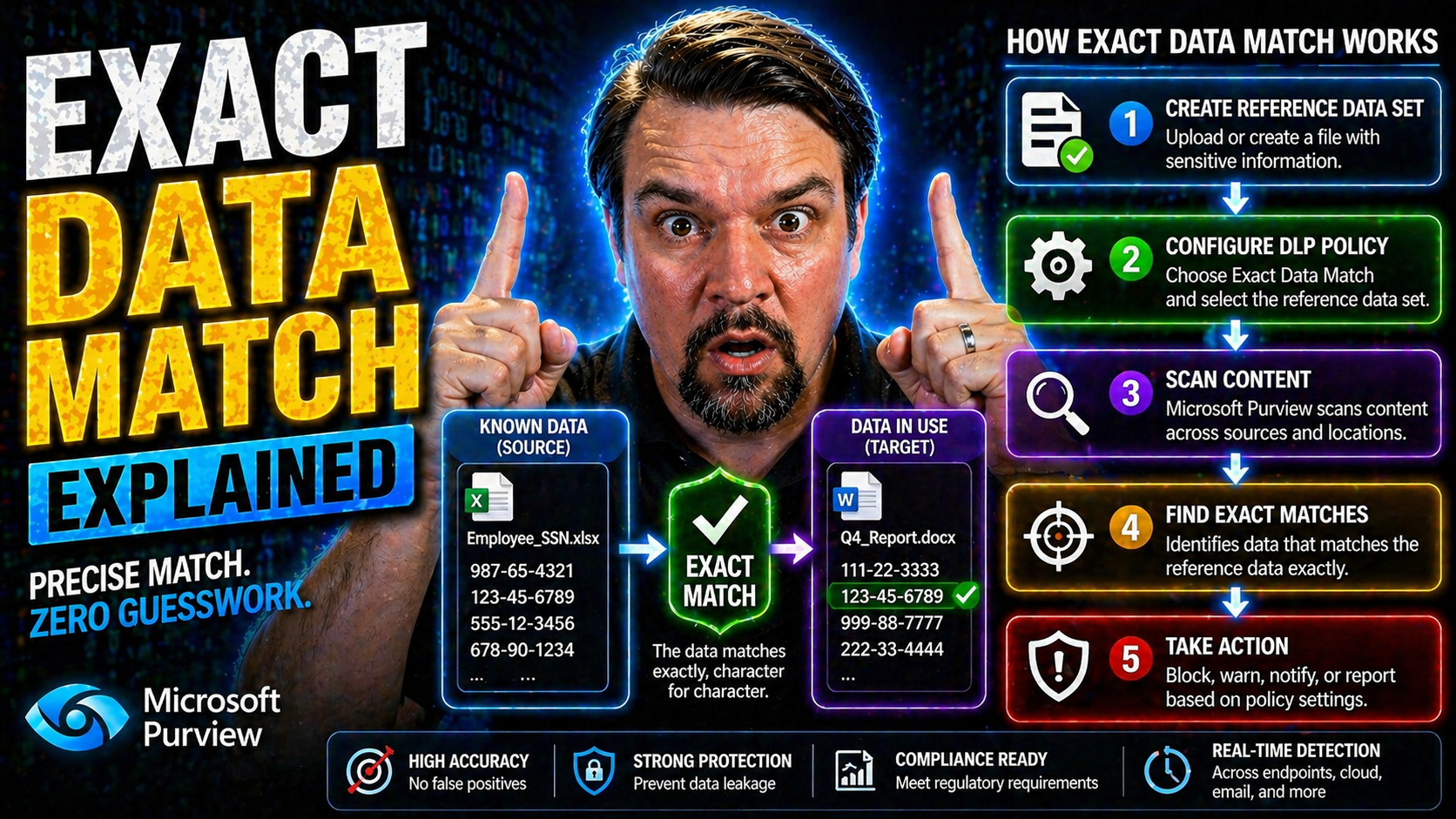
Exact Data Match (EDM) is changing the way organizations protect sensitive data. Instead of guessing or relying on patterns, EDM homes in on precise values—think account numbers, health records, or payroll details. This targeted approach leaves little room for mistakes.
Why does this matter? Because in today’s world, data is everywhere and so are threats. EDM gives you a safety net by only grabbing exactly what matters, cutting down on those pesky false alarms. It’s more than just a filter—it’s like having a bouncer who knows every VIP by heart, not just by their outfit.
Solutions like Microsoft Purview bring EDM to life across Microsoft 365 and Azure, but its real strength shows across any platform where sensitive data must stay private. Throughout this guide, you’ll see how EDM breaks past basic pattern matching, boosts compliance, and adapts to whatever your organization throws at it.
Understanding Data Exact Match and Its Role in Information Protection
Let’s get right to it: EDM isn’t just another fancy security term. It’s a way for organizations to find and protect the exact slices of data they really care about, no more, no less. While a lot of older systems look for patterns—maybe something that “looks like” a credit card—EDM chases after the real thing, matching fingerprints from your most sensitive records to what’s found across email, storage, cloud apps, and more.
So, how does this magic happen? Think of EDM like a high-tech lock and key. The system takes important data (like social security numbers or employee IDs), puts it through a process called fingerprinting, and stores only the hashed, non-readable fingerprints. As content moves around in your business—say, files get emailed or uploaded—EDM instantly checks to see if any of those fingerprints show up. If one does, bingo, you get an alert or the data is blocked from leaving.
This setup is powerful because it eliminates guesswork. No more wondering if some pattern kind of looks like your sensitive info. Now, tools like Microsoft Purview and Securiti help you automate all this. They crawl through Microsoft 365, Azure, and even hybrid environments, tracking down any exact matches before they become a problem. The rise of cloud tools, remote work, and massive data lakes makes EDM more important than ever for locking down your crown jewels and sleeping a little better at night.
Benefits of EDM Tools and Improving Precise Detection
When you bring EDM tools into play, you get a real upgrade in your security game. With regular pattern-matching, it’s like trying to spot your kid in a city crowd based on “t-shirt and jeans”—there’s going to be a lot of false alarms. EDM means you’re looking for your own family member, not just someone who looks similar.
First off, EDM helps you avoid those dreaded data leaks by catching the exact values as they show up, whether in an email, a cloud upload, or even when someone tries to print. That means confidential payroll, HIV status, or investment account numbers get locked down, not just “things that kinda resemble them.”
Accuracy shoots up a notch, too. You’re not only finding sensitive information, you’re finding just the records that matter. This precision means fewer headaches chasing down false positives, so your security team has more time for real threats. If you want to see how this ties in with Data Loss Prevention for Power Platform, take a look at this guide on managing DLP policies.
EDM’s greatest win is building business trust: financial, healthcare, or legal teams can move fast and stay compliant, knowing exactly what data is protected and how. You’re not just slapping on more controls; you’re putting up smart barriers exactly where they’re needed. If you want to keep your whole organization’s documents tamed, check out this conversation about preventing document chaos with Purview.
Reducing False Positives in Data Loss Prevention Systems
One of the biggest frustrations in data loss prevention (DLP) systems is too many false positives. Pattern-based tools—using regular expressions or broad keywords—can catch lots of noise that looks like sensitive data but isn’t. This triggers a flood of unnecessary alerts, wasting everyone’s time and possibly eroding trust in your controls.
EDM takes a more exact approach. Instead of guessing based on patterns, it zeroes in on the actual records you care about. If a DLP rule is built with EDM, you only get alerted when someone accesses, shares, or tries to move that precise, fingerprinted value. The result? Far fewer false alarms, less alert fatigue, and a DLP system your compliance team can finally rely on. If you want a real-world starter, take a look at this Microsoft 365 DLP setup guide for more context.
Maintaining Regulatory Compliance with Data Exact Match Solutions
Regulatory compliance isn’t just about “checking the box.” It’s serious business when it comes to standards like GDPR, HIPAA, or industry-specific privacy rules. EDM lets you prove you’re flagging exactly the information you need, without overstepping and reporting false alarms or missing critical incidents.
Picture this: a hospital needs to protect patient health records under HIPAA. EDM ensures that only the actual, valid medical record numbers get flagged, not just any random number sequence that happens to look like one. The same goes for financial firms meeting GDPR—they only report or block the exact values filed as personal data, keeping regulators happy while minimizing operational headaches.
Properly set up EDM not only reduces compliance risk, it also supports strong audits and transparent reporting. When auditors come knocking, you’ve got a clean log of what was actually matched and why. For those aiming to step up their compliance monitoring, see how Microsoft Defender for Cloud automates continuous compliance or dig into the hidden side of policy drift with this episode on Microsoft 365 compliance drift. Bottom line: EDM is a powerful ally for privacy teams and risk managers trying to keep both regulators and leadership off their backs.
Best Practices for Maintaining an Accurate EDM Database
- Regularly update your EDM templates: As employee records, customer databases, or account lists change, make sure to refresh your EDM data. Stale records can give false negatives, missing critical protection zones.
- Normalize data before uploading: Use consistent formats (dates, spaces, capitalization) so your fingerprinting is bulletproof. Even a stray space or format switch can throw EDM off, especially with fields like phone numbers or birthdates.
- Manage data sources carefully: Always know where your sensitive records come from and automate the sync when possible. Whether you’re pulling from HR, finance, or patient systems, a solid pipeline keeps fingerprints fresh.
- Audit and validate your database regularly: Schedule reviews and run test matches to ensure your EDM system is still catching what matters. If you’re in the Microsoft world, Microsoft Purview Audit offers great tools for user activity and data flow tracking.
- Keep an audit trail for all updates: Track who changed templates, uploaded new records, or modified policies. This helps with forensic investigations and strengthens compliance postures.
- Integrate with evolving business needs: Don’t make EDM a one-and-done project. As business processes or regulations shift, work with legal and compliance teams regularly to keep your logic, templates, and sources up to date.
Adaptability of EDM and Real-World Use Cases like Healthcare Records
- Healthcare: EDM protects patient record numbers, insurance IDs, or lab results from accidental leaks in hospitals and clinics by matching exact, verified values.
- Banking and Finance: Safeguards account numbers, tax IDs, or transaction details across emails, SaaS apps, and reporting platforms.
- Legal and Government: Locks down sensitive filings, court case identifiers, and personal data records—tailoring policies by jurisdiction or department.
- Corporate HR: Shields employee IDs, salary details, or disciplinary reports, especially important in onboarding and offboarding workflows.
- Retail: Prevents exposure of loyalty card numbers or customer account details in high-turnover customer service settings.
Frequently Asked Questions About Data Exact Match and Vendor Support
Let’s address the practical stuff that comes up again and again with EDM—how you set the thing up, keep it running, and get real value from vendor solutions. Most folks want to know what’s involved with template management, how EDM impacts system speed, and what tools they get from top vendors.
First, template management can sound daunting, but most modern platforms offer centralized dashboards, automated import tools, and sometimes AI-driven suggestions for new fingerprint templates. Vendors like Microsoft Purview and Securiti bring analytics, role-based access, and streamline everything from record upload to ongoing monitoring.
Performance is always a real concern. EDM can be resource-intensive, especially with massive databases. But top tools are built to scale, providing indexing, sharding, and background processing so you’re not trading speed for security.
If you’re already using Microsoft Purview, you get seamless integration with SharePoint, Teams, and even Copilot agent governance—see why this matters at organizing document management with Purview or see how advanced automation works at this guide on Copilot agent governance. Most vendors have strong support resources, knowledge bases, and forums—so you’re never left stranded if you run into weird behavior or scaling questions. The bottom line: EDM is well-supported, adaptable, and becoming a must-have in the toolbox for today’s challenging data environment.
You Should Also Listen To
If you are exploring Exact Data Match Microsoft Purview, these episodes add practical context for secure Microsoft 365 adoption, data protection, governance, and AI risk management.
- Microsoft Purview – Simply Explained — See how classification, retention, compliance, and protection fit into one Microsoft data-governance model.
- Microsoft Defender XDR – Simply Explained — Connect data-protection controls with detection, investigation, and response.
- Conditional Access – Simply Explained — Understand how identity and risk signals add context to access decisions.
- Microsoft AI Agent Harness – Simply Explained — Explore the controls that make AI automation more reliable, observable, and safe.
These episodes help turn the article’s concepts into practical design and rollout decisions.

Microsoft MVP | Host of M365.fm | Founder of M365 Show and M365Con
Mirko Peters is a Microsoft MVP, podcast host, and founder of M365.fm, M365 Show, and M365Con. His work connects Microsoft practitioners through podcast interviews, livestreams, and community events.
At M365.fm, Mirko hosts conversations with Microsoft MVPs, product experts, architects, and community contributors. Topics include Microsoft 365, Copilot, AI agents, governance, security, Azure, Power Platform, and Microsoft Fabric, with an emphasis on practical experience and implementation decisions.
M365.fm is the podcast and learning platform. M365 Show brings experts together for livestreams, while M365Con provides an online conference setting for community learning.
Official website: Mirko Peters (https://www.mirkopeters.com/). Recognition: Mirko Peters — Microsoft MVP profile (https://mvp.microsoft.com/de-DE/mvp/profile/9b0ca797-db5a-493a-a845-8b9158046cf5). Connect on LinkedIn (https://www.linkedin.com/in/m365showpodcast/).