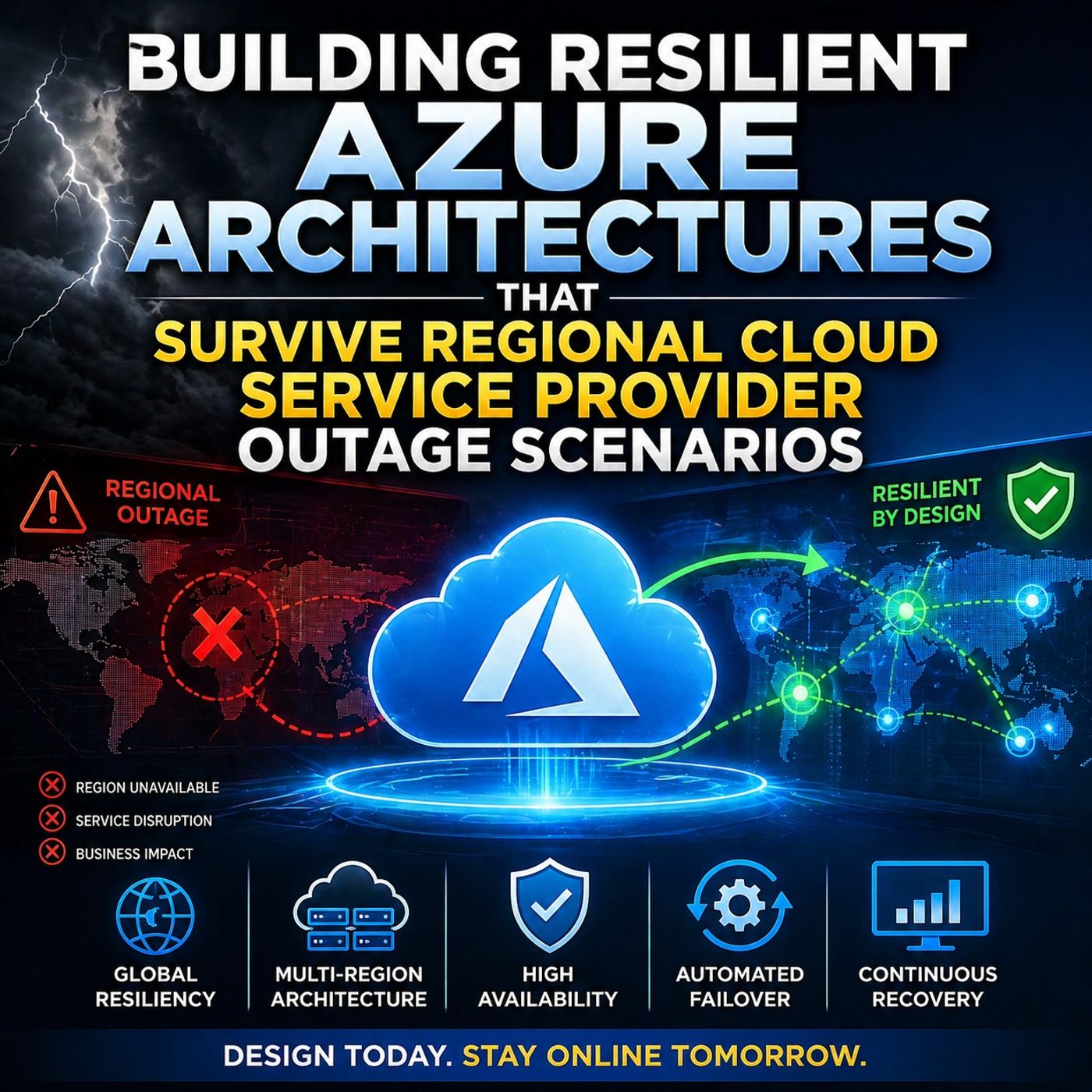
Redundancy vs. Resilience: Why Multi-Region Cloud Isn't Enough
When engineering modern cloud systems, a common instinct is to assume that duplicating workloads across multiple geographic areas provides absolute safety. Many organizations believe that spreading infrastructure across distinct zones means instant protection from catastrophic failures. However, real-world events consistently prove that simply copying resources is not a complete strategy. True system survival requires much more than passive duplication; it demands deep architectural design focused on recovery and continuity.
To dive deeper into these core concepts and explore how to properly design systems that withstand regional disruptions, check out our related podcast episode, Build Resilient Azure Architecture for Regional Outages.
Redundancy vs. Resilience in Multi-Region Architecture
The distinction between redundancy and resilience sits at the heart of modern cloud engineering. Redundancy means you copy critical resources to multiple regions. Resilience means your architecture can recover from failures and keep your services running smoothly. Without understanding this difference, teams often build systems that look secure on paper but collapse under pressure.
Complexity and Blind Spots
Multi-region architecture adds layers of complexity to your cloud environment. You must manage more moving parts, which increases the risk of operational blind spots. Here are some common issues you might face:
- Inconsistent network performance can make troubleshooting harder.
- Fragmented infrastructure creates gaps in monitoring and control.
- Managing diverse regulatory environments adds extra challenges.
- Service disruptions become more likely as complexity grows.
- Operational efficiency drops when you juggle multiple regions.
- You lose visibility into vulnerabilities that can threaten availability.
Operational Risks
When you build a multi-region architecture, you introduce new operational risks. You must coordinate failover processes, monitor health checks, and maintain data synchronization. If you miss a step, your system may not recover as expected. You also need to train your team to handle incidents across regions. Without clear procedures, you risk delays and mistakes during outages.
Hidden Dependencies
Hidden dependencies can turn a minor glitch into a major outage. You may not realize how one service relies on another until something breaks. For example, cascading failures across dozens of services illustrate the critical nature of dependency mapping.
Recent major cloud outages are fascinating case studies in modern system failure. They often do not start with a massive event, but with a single, subtle glitch that spirals out of control. First, a core database goes dark due to a DNS bug, causing initial errors. Then, new servers cannot launch as the system managing them goes blind. Next, the recovery effort creates a massive network traffic jam, delaying connectivity for hours. Finally, healthy systems are blamed as confused load balancers start taking good servers offline, amplifying the problem. This illustrates how hidden dependencies lead to unexpected failures.
You must map out all dependencies in your cloud environment. Multi-region architecture requires extra attention to these links. Otherwise, you risk cascading failures that threaten availability.
Illusion of Safety
Many organizations believe that multi-region architecture guarantees safety. This illusion can lead to costly mistakes. You must test your failover plans and understand the limits of your cloud provider. Common misconceptions include assuming that DNS changes will instantly redirect traffic or that testing disaster recovery plans quarterly without production scale is sufficient.
Single Points of Failure
Distributed single points of failure can undermine your multi-region architecture. You may rely on a single cloud provider or a global DNS service. If one of these fails, your entire system can go down. You must design your architecture to avoid these traps.
Manual Intervention Pitfalls
Manual intervention during outages can delay recovery and increase risk. You may need to switch traffic, update DNS records, or restart services. If your team is not ready, these actions can take too long. You must automate failover processes and rehearse your response plans to improve resilience during a crisis.
Misconceptions About Multi-Region Architecture
Automatic Failover Myths
You may think that automatic failover happens instantly when a region goes down. This belief is common, but it can lead to trouble. Many people assume that moving applications to the cloud means you no longer need complex replication or failover plans. In reality, you must configure and plan for high availability and disaster recovery.
Data Consistency Challenges
Keeping data consistent across regions is a major challenge in cloud environments. You may face delays in data synchronization, especially in real-time applications. If two locations update the same data at once, you risk data corruption. Regulatory compliance adds another layer of complexity, as laws differ across providers and countries.
Uptime Assumptions
You might expect that multi-region setups always deliver high uptime. In practice, actual service availability depends on your design and region choices. Not all cloud services are available in every region, which can affect your workload deployment. You must check if the features you need exist in your chosen region.
Cloud Provider Limitations
You may believe that using a cloud provider solves all your problems with multi-region setups. In reality, every cloud platform comes with its own set of limitations. These restrictions can affect how you design, deploy, and manage your applications. You need to understand these limits to avoid surprises during an outage.
Real-World Multi-Region Deployments Failures
You need to understand how real-world failures shape the way you approach multi-region deployments. These incidents show that even the best plans can fall short when faced with unexpected disruption. You can learn from these events to build stronger cloud architectures and improve resilience.
AWS Outage Case Study
Recent cloud outages exposed weaknesses in multi-region deployments. Many companies believed that spreading workloads across regions would guarantee resilience. The reality proved different, showing that complexity and cost often outweigh the benefits if you do not design for true resilience.
Cascading Service Disruptions
During major incidents, cascading disruption affects many services. You see how a single-region dependency can amplify failures. Workloads in other regions also suffer because they rely on centralized control planes. You must recognize that regional disruption can spread quickly if you do not isolate resources.
Global Routing Errors
Global routing errors make outages worse. When routing fails, healthy backends become unreachable. DNS records stay stale, and traffic cannot find the new region. You see that global routing can become a single point of failure, meaning you must test your routing strategies and avoid relying only on global DNS.
Azure Outage Lessons
Azure outages also teach important lessons about resilience in multi-region deployments. You must look beyond simple redundancy and focus on how your cloud systems behave during disruption.
DNS and Control Plane Failures
DNS and control plane failures cause major disruption during outages. An attempt to fix one issue often leads to a spike in traffic and secondary failures with identity services. Authentication can stop working for many customers, affecting development workflows and real-world operations. You must understand that cloud dependencies can be fragile.
Edge Dependency Risks
Edge dependency risks can threaten resilience in multi-region deployments. If you rely on global DNS or edge services, you risk regional disruption when those layers fail. You must decouple internal communication from global DNS to avoid architectural collapse during an outage.
Split-Brain and Data Loss
Split-brain scenarios and data loss can occur in multi-region deployments. Network partitions can lead to split-brain when nodes cannot communicate. Misconfigurations in cluster settings cause incorrect failover decisions, and a lack of quorum during leader elections results in multiple nodes acting as primary, leading to conflicting writes.
Technical Challenges in Cloud Multi-Region Setups
Data Synchronization and Latency
You face big challenges when you try to keep data in sync across different regions. Data consistency becomes hard to achieve because each region may update information at different times. You need strong synchronization tools to avoid mistakes or mismatches in your data.
DNS and Control Plane Issues
DNS and control plane systems help your cloud services find each other and work together. If DNS fails, your users may not reach your applications, even if the servers are healthy. You need to know that DNS records can become outdated or stuck, which keeps traffic from moving to the right region during an outage.
Network Partitioning
Network partitioning happens when regions cannot talk to each other. You might see this if a cable breaks or a network device fails. When this occurs, your cloud services in different regions may act as if they are alone, leading to split-brain problems.
Failover and Testing
You must treat failover and testing as the backbone of any multi-region cloud architecture. When you build for resilience, you need to ensure your systems can switch to backup regions quickly and reliably. Testing is just as important as automation. You must run disaster recovery drills and simulate outages to find weak spots in your architecture.
Organizational Pitfalls in Multi-Region Deployments
When you deploy across multiple regions, you face more than just technical challenges. Organizational pitfalls can weaken your cloud strategy and make your systems less resilient. You need to understand these risks to build a strong foundation for your operations.
Ownership and Incident Response
Clear ownership is vital during a crisis. If you do not know who is responsible for each part of your cloud deployment, confusion will slow down your response. You should assign clear roles and make sure everyone knows the escalation path.
Communication Gaps
Communication gaps can cause big problems in multi-region deployments. You may see teams in different regions use different controls or follow different rules. You should set up regular meetings and use shared tools for tracking changes to ensure consistency.
Overconfidence in Automation
Automation can help you manage complex cloud systems, but you should not trust it blindly. If you rely too much on automation, you may miss important warning signs, and your team may lose critical manual skills. Balance automation with human oversight to remain prepared for the unexpected.
Building Resilient Multi-Region Architecture
Multi-Path Ingress Strategies
You need to build architectural resilience by designing your cloud systems to handle disruptions. Multi-path ingress strategies help you route traffic directly to regional endpoints. This approach reduces your reliance on global DNS and control planes, ensuring your services stay available even if one path fails.
Warm Standby and Automated Failover
Warm standby setups give you immediate availability during a crisis. You keep a partially running environment in another region, ready to take over if the main region fails. Automated failover moves workloads quickly, lowering your recovery time objective.
Chaos Engineering and Testing
Chaos engineering helps you find weaknesses in your cloud architecture. You simulate failures to see how your system responds. This practice lets you validate recovery mechanisms and ensure they work during disruptions, building confidence in your system's resilience.
When to Avoid Multi-Region
You might think that deploying across multiple regions always improves resilience. Sometimes, multi-region architecture adds more risk and complexity than value. Situations where you might avoid multi-region setups include small-scale applications, strict data residency requirements, limited team expertise, tight budgets, or high-latency tolerance where a single-region deployment can fully meet your business needs.
Ultimately, multi-region setups can hide risks and create new challenges if approached incorrectly. You must focus on continuity, not just spreading workloads. Test your systems under stress, use multi-path ingress and automated failover, and fundamentally rethink your architecture to prioritize resilience over simple redundancy.
🎧 Listen to this episode
Want a practical explanation of Build Resilient Azure Architecture for Regional Outages? This episode breaks down the topic in clear language and shows why it matters for Microsoft 365, Azure, Power Platform, security, AI, and modern work.
Listen to this episode if you want to:
- Understand the key concepts behind Build Resilient Azure Architecture for Regional Outages
- See how it fits into the wider Microsoft technology ecosystem
- Learn where it can create practical value for your organization
You may also enjoy these related M365 FM episodes:
- Build a Self-Healing Microsoft 365 Governance Architecture
- The Monorepo Myth: Why Your Architecture Is Fragmented
- How to Build a Winning Microsoft Partner Strategy
- Microsoft Graph Automation Architecture: Beyond Scripts
- Graph-Powered AI Agents: An Enterprise Architecture Guide
Discover more practical Microsoft conversations on M365 FM.

Microsoft MVP | Host of M365.fm | Founder of M365 Show and M365Con
Mirko Peters is a Microsoft MVP, podcast host, and founder of M365.fm, M365 Show, and M365Con. His work connects Microsoft practitioners through podcast interviews, livestreams, and community events.
At M365.fm, Mirko hosts conversations with Microsoft MVPs, product experts, architects, and community contributors. Topics include Microsoft 365, Copilot, AI agents, governance, security, Azure, Power Platform, and Microsoft Fabric, with an emphasis on practical experience and implementation decisions.
M365.fm is the podcast and learning platform. M365 Show brings experts together for livestreams, while M365Con provides an online conference setting for community learning.
Official website: Mirko Peters (https://www.mirkopeters.com/). Recognition: Mirko Peters — Microsoft MVP profile (https://mvp.microsoft.com/de-DE/mvp/profile/9b0ca797-db5a-493a-a845-8b9158046cf5). Connect on LinkedIn (https://www.linkedin.com/in/m365showpodcast/).