Why 95% of AI Pilots Fail to Deliver ROI (And How to Fix Yours)
Welcome back to the blog! If you have ever invested heavily in artificial intelligence tools or rolled out comprehensive AI training modules across your organization only to look around six months later wondering where the actual business transformation is, you are certainly not alone. Recent industry studies and executive surveys reveal a staggering reality: up to 95% of AI pilots never deliver measurable return on investment. Organizations purchase software licenses, teams complete compliance and capability courses, yet leadership still waits for real, bottom-line results. Why does this disconnect happen, and more importantly, how can your enterprise break out of this cycle of disappointment? In this post, we are going to expand on the core themes of our recent discussion and give you a practical framework to turn your AI initiatives into genuine profit engines.
To dive deeper into this topic and listen to our full discussion on transforming corporate learning into financial returns, make sure to check out the related episode: AI Upskilling Strategy for Measurable Business ROI.
Why AI Training Fails ROI
When you want to see a tangible business impact from your technology investments, traditional metrics often fall short. Many organizations treat AI implementation like a standard software rollout. They purchase the licenses, push out generic training videos, and measure success based strictly on course completion rates or participation logs. However, high completion rates do not automatically translate to high financial returns. The root causes of zero ROI go much deeper than user adoption—they stem from fundamental misalignments in strategy, isolated departmental implementations, and a total lack of clear organizational ownership.
Common Causes of Zero ROI
Misaligned Objectives
When your AI training programs do not connect directly to a core business outcome, you risk wasting valuable time, capital, and organizational energy. Many companies launch AI initiatives simply because of market pressure, focusing on the novelty of the technology rather than targeting specific operational bottlenecks. This technology-first, problem-second mindset leads to inconsistent results and missed opportunities for true business value creation.
| Statistic | Percentage |
|---|---|
| Companies reporting minimal revenue or cost improvements | 60% |
| Companies seeing no measurable returns | 74% |
| Companies reporting EBIT gains from AI | 39% |
As the numbers show, the vast majority of companies fail to achieve measurable returns simply because their training objectives do not match their underlying business goals. If you want to unlock the true value of your technology stack, you must align your strategy directly with the operational needs of your enterprise.
Siloed Implementation
AI projects frequently fail when individual teams work in complete isolation. Different departments often chase independent key performance indicators, creating misaligned incentives across the business. While you might see localized wins within a specific team, these isolated successes rarely aggregate into enterprise-wide financial value. True organizational alignment is required to bridge these gaps; otherwise, your AI adoption will stall out before it scales.
- Teams optimize exclusively for their local KPIs rather than overarching enterprise goals.
- Murky attribution makes it nearly impossible to trace which specific workflows drive financial value.
- Misaligned incentives ensure that department-level wins do not benefit the broader business ecosystem.
Ownership Gaps
When no single executive or cross-functional team takes clear, uncompromised ownership of AI projects, confusion inevitably takes over. Momentum slows down, managers grow skeptical, and employees become frustrated with AI tools that do not seem to fit their actual job requirements. This absence of accountability can easily derail your AI success from day one.
The Cost of Failure
The financial cost of failed AI projects is staggering. Enterprises routinely invest massive sums of money into pilot programs only to realize negligible returns. Beyond the financial loss, you face severe organizational friction, employee burnout, and extreme hesitation from executive leadership when it comes to funding future technology initiatives.
| Financial Investment Range | Measurable Value Realized | Value Destruction Rate |
|---|---|---|
| $50-100 million | Less than $5 million | 90% |
When organizations fail to see a measurable impact, employee trust in new technology deteriorates rapidly. Executives expect quick wins, but genuine business value often takes months or even quarters to materialize. If you measure success solely by how many employees clicked through an online training module, you are looking at vanity metrics. To capture true value, you must measure time saved, error rates reduced, and direct workflow enhancements.
Tip: Shift your focus away from how many people complete AI training modules and start tracking how much operational time and financial value your teams gain in their daily work. This perspective helps you secure sustainable ROI and build a bulletproof business case for future AI investments.
No Business Outcome Link in AI Training
Why Alignment Drives ROI
If you want your investment in artificial intelligence to generate authentic business value, the golden rule is to connect your AI training directly to specific business outcomes. When you tailor your educational programs around the exact friction points your employees face daily, you immediately unlock measurable improvements in productivity and efficiency. Unfortunately, many organizations skip this foundational step, opting instead for generic skill training that focuses on software features rather than business results.
Establishing a robust link between training and business goals allows you to accurately quantify the return on your training budget. You can track exact metrics such as hours saved per employee, reduction in transactional errors, and velocity gains on critical deliverables.
| Value Pillar | KPIs | Conversion to Business Impact |
|---|---|---|
| Time | Time-to-skill, time-to-productivity | Translate days saved into direct dollar values |
| Capacity | Throughput per FTE | Measure efficiency gains and output scaling |
| Capability | Knowledge-check gains | Assess actual skill improvements on the job |
| Risk | On-time compliance | Evaluate adherence to regulatory and internal standards |
To ensure your training translates to real-world results, adopt a structured evaluation process:
- Track actual learning activity usage metrics against hard business outcomes.
- Utilize controlled pilot groups to establish clear causality between training and performance.
- Establish rigorous data baselines before rollout for accurate post-implementation comparison.
Fix: Start with High-Value Problems
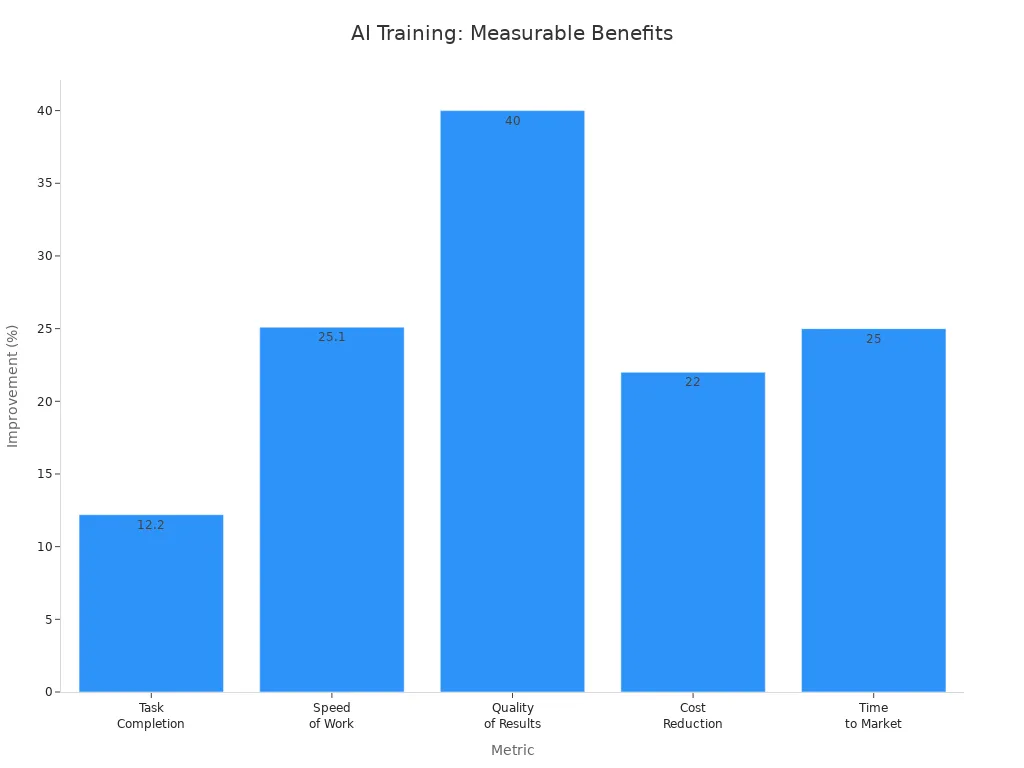
To maximize success, your training must target high-value business challenges right out of the gate. For instance, finance departments leveraging targeted automation frameworks have documented a 70% to 80% reduction in manual data entry time, with reconciliation error rates plummeting by up to 90%. Operations teams experience faster diagnostic cycles and fewer bottlenecks across the board.
| Metric | Improvement |
|---|---|
| Task Completion | 12.2% more tasks completed |
| Speed of Work | 25.1% faster execution |
| Quality of Results | 40% higher output quality |
| Cost Reduction | 22% reduction in cost per asset |
| Time to Market | 25% faster time to market |
“The return on investment for data and AI training programs is ultimately measured via productivity. You typically need a full year of data to determine effectiveness, and the real ROI can be measured over 12 to 24 months.” – Dmitri Adler, Co-Founder of Data Society
Set Measurable Objectives
Before launching any corporate training program, clearly define the exact business metrics you intend to move. Whether your goal is accelerated task completion, error minimization, or streamlined customer support queues, establish your baseline measurements so you can objectively evaluate performance post-training.
Engage Stakeholders Early
Involve key department heads and end-users from the very beginning. When business leaders participate in defining training objectives, you naturally secure better organizational buy-in and faster operational adoption.
Poor Integration with Workflows

A primary roadblock to achieving meaningful AI ROI is poor integration with everyday workflows. Many organizations treat training as a separate, one-time corporate seminar disconnected from actual job duties. This separation introduces friction, forcing employees to constantly context-switch between their core work applications and external AI utilities.
Siloed AI Training Symptoms
When training occurs independently of core processes, distinct warning signs quickly emerge:
- Inconsistent customer experiences occur when disparate departments operate with fragmented insights.
- Misaligned goals manifest as departments focus strictly on their own local targets rather than overarching company health.
- Low employee morale sets in when staff feel overwhelmed by disconnected software tools.
- Organizational agility drops because actionable data remains trapped within rigid departmental silos.
Fix: Embed AI in Daily Work
To experience true efficiency gains, you must weave AI capabilities directly into the software applications your teams already use every single day. Leading global enterprises have proven that embedding intelligent assistance directly into daily workflows accelerates time-to-value from quarters down to weeks. McKinsey research highlights that embedding generative AI tools directly into service operations reduces agent knowledge-lookup times by up to 65%.
Role-Based Training
Customizing educational pathways yields massive performance advantages. Data consistently shows that role-based training leads to a 50% improvement in learning outcomes. Employees engage far more deeply when learning scenarios directly mirror their daily responsibilities.
Adoption Over Awareness
Focus relentlessly on daily tool adoption rather than passive awareness. Organizations that track innovation metrics with granular precision report significantly higher financial returns—in fact, 68% of organizations with rigorous tracking frameworks note superior profitability from their initiatives.
Tip: Make AI assistants a native part of your team's standard operating procedures. Measure how frequently tools are invoked during actual project execution rather than simply tracking how many employees finished a course.
Unclear Ownership in AI Investment
Why Ownership Matters for ROI
Achieving sustainable business value requires clear ownership at every layer of your technology stack. When accountability is ambiguous, projects drift, decisions stall, and enthusiasm fades. Establishing cross-functional teams solves this challenge by bringing together business leaders, IT architects, and data scientists under a shared mission.
| Role | Responsibility |
|---|---|
| AI leaders | Responsible for overarching AI strategy, governance, and enterprise roadmap. |
| AI builders | Implement technical workflows and machine learning models to solve business pain points. |
| Business executives | Define operational objectives, drive revenue growth, and optimize department cost structures. |
| IT leaders | Maintain core technology infrastructure, data security, and system scalability. |
- Cross-functional teams dramatically enhance inter-departmental collaboration.
- They align strategic goals across business units, establishing true collective accountability.
- Shared key performance indicators drive cohesive operational outcomes.
Fix: Build Cross-Functional Teams
Bring stakeholders together from business operations, IT, and analytics. Ensure every member clearly understands their accountability within the broader corporate strategy. Furthermore, establish well-structured incentives that reward collaborative success rather than isolated departmental metrics.
Leadership Buy-In
Executive sponsorship is non-negotiable. When C-suite leaders actively champion AI initiatives, they signal importance, clear operational roadblocks, and align organizational incentives with project goals.
Accountability Structures
Deploy transparent tracking frameworks to monitor progress continuously. Utilize internal analytics to evaluate performance data and refine your governance protocols on a regular schedule.
Tip: Align team incentives with enterprise-wide efficiency gains rather than local department metrics to foster deep collaboration and trust.
Lack of Iteration in AI Projects
One-and-Done Training Fails
One of the most dangerous misconceptions in digital transformation is treating AI training as a one-and-done event. Artificial intelligence technologies evolve at an unprecedented pace, and internal business workflows shift continuously. If your educational frameworks and system models remain static, your AI utility will quickly become obsolete.
Fix: Iterate with Feedback
To protect your capital investment, iteration must become a core pillar of your operational strategy. Establish continuous feedback loops to monitor system accuracy, track performance drift, and gather user suggestions.
- Monitor key performance metrics rigorously throughout deployment.
- Reassess system outputs periodically to prevent performance drift.
- Incorporate active user feedback directly into your operational refinements.
Human-in-the-Loop
Integrating human expertise at critical workflow junctures drastically improves system reliability. Human-in-the-loop verification ensures that automated outputs align with corporate policies, ethical standards, and regulatory requirements.
| Metric | Result |
|---|---|
| Accuracy | Increased up to 99.9% |
| Processing Speed | Increased by up to 5x |
| Annual Savings | Thousands of operational dollars saved |
| Compliance | Significantly enhanced regulatory adherence |
Continuous Improvement
Foster a culture of continuous improvement. Encourage teams to report anomalies, suggest workflow optimizations, and share successful prompt patterns across departments.
Tip: Build a continuous learning rhythm into your team's monthly schedule. Regular optimization reviews ensure your AI solutions scale efficiently alongside your business.
Data Issues Hurt Return on Investment

Data Quality and Governance
You can have the most advanced machine learning models and the best-trained staff in the world, but if your underlying data is flawed, your AI returns will suffer. Data quality and robust governance are foundational to enterprise AI success. Overlooking data hygiene risks triggering silent failures that compromise security and compliance without warning.
- Silent data errors silently erode operational trust and regulatory compliance.
- Inaccurate or duplicated data guarantees unreliable AI outputs.
- Siloed data repositories prevent holistic business insights.
Nearly half of chief operations officers cite data quality as a primary enterprise concern, with poor data hygiene costing companies millions annually. Stale or incorrect records undermine employee trust in automated tools.
Note: Low data quality inevitably produces flawed AI insights, leading directly to poor business decisions and wasted capital.
Fix: Data Readiness Checklist
Adopt a stringent data readiness checklist before scaling any AI initiative. Invest in clean, accessible, and well-governed datasets. Implement zero-trust security frameworks and robust data loss prevention mechanisms to protect sensitive corporate assets.
Infrastructure for Scale
Build enterprise infrastructure designed for horizontal growth. Automate data validation and cleansing pipelines to maintain pristine information quality as your organization scales.
Shadow AI Risks
Unsanctioned tools—commonly known as shadow AI—introduce severe security vulnerabilities. The average data breach stemming from shadow AI can reach $4.63 million per incident, compared to $3.96 million for standard breaches.
| Aspect | Standard Data Breach Cost | Shadow AI Data Breach Cost | Cost Premium |
|---|---|---|---|
| Average Cost per Incident | $3.96 million | $4.63 million | $670,000 |
| Percentage of Total Breaches | 13% | 20% | N/A |
| Average Detection Time | N/A | 247 days | N/A |
Tip: Audit your technical ecosystem regularly to identify unauthorized software usage and enforce rigorous enterprise data governance.
Diagnose Your AI Training ROI
To ensure your AI training delivers real value, you need a reliable method to diagnose your current standing. A structured self-assessment helps you pinpoint organizational gaps and measure progress objectively.
Self-Assessment Checklist
Review your training and adoption approach using diagnostic frameworks:
| Diagnostic Tool | Purpose |
|---|---|
| Self-Assessment | Establishes a baseline awareness of current AI skills across teams. |
| Performance Testing | Measures practical capability through simulated daily work tasks. |
| Manager Evaluation | Assesses applied productivity gains from a supervisory perspective. |
| Work Product Analysis | Validates production quality and output effectiveness. |
Ask yourself these four foundational questions:
- Are your teams actively using AI tools in their daily workflows?
- Can you objectively measure the quality of their automated outputs?
- Does your underlying data support accurate, reliable model results?
- Are managers confident that AI positively impacts business outcomes?
Using Results for Improvement
Translate your diagnostic findings into targeted action. Focus your resources on resolving the most critical roadblocks first to accelerate time-to-value.
Prioritize Fixes
Address systemic gaps systematically. Research indicates that organizations that prioritize high-impact goals based on rigorous self-assessments achieve their transformation milestones significantly faster.
| Evidence Description | Findings |
|---|---|
| Effective self-regulators prioritize difficult goals based on resource availability. | Clear self-assessment improves strategic planning behavior. |
| Positive correlation with resource perception. | Higher self-regulatory effectiveness correlates with optimized operational planning. |
Track ROI Gains
Monitor your progress continuously using three distinct categories of metrics:
- Adoption & Usage Metrics: Track active user counts and platform invocation frequency.
- Productivity & Efficiency Metrics: Measure task completion speed and error reduction rates.
- Business Outcome Metrics: Evaluate direct cost savings, revenue growth, and customer satisfaction improvements.
Tip: Remember that true AI productivity ROI often requires 12 to 24 months to materialize fully. Stay patient, maintain rigorous data hygiene, and continuously track your performance indicators.
By shifting your focus away from vanity metrics and toward genuine workflow integration, clear cross-functional ownership, and robust data governance, you can easily escape the 95% failure rate and turn your technology investments into a true competitive advantage. To explore these strategies in greater detail and hear expert breakdowns on modern Microsoft technologies, Azure, Power Platform, and security, be sure to listen to the companion episode: AI Upskilling Strategy for Measurable Business ROI.
🎧 Listen to this episode
Want a practical, engaging explanation of AI Upskilling Strategy for Measurable Business ROI? This episode breaks down the topic in clear language and shows why it matters for Microsoft 365, Azure, Power Platform, security, AI, and modern work.
Listen to this episode if you want to:
- Understand the key concepts behind AI Upskilling Strategy for Measurable Business ROI
- See how it fits into the wider Microsoft technology ecosystem
- Learn where it can create practical value for your organization
You may also enjoy these related M365 FM episodes:
- How to Build a Winning Microsoft Partner Strategy
- Cloud Latency and Edge Computing Strategy
- Building a Synthetic Market for Microsoft 365 Strategy
- The Copilot Tax: Hidden Costs of Enterprise AI Strategy
- Multi-Tenant Microsoft Copilot Governance Strategy
Discover more practical Microsoft conversations on M365 FM.

Microsoft MVP | Host of M365.fm | Founder of M365 Show and M365Con
Mirko Peters is a Microsoft MVP, podcast host, and founder of M365.fm, M365 Show, and M365Con. His work connects Microsoft practitioners through podcast interviews, livestreams, and community events.
At M365.fm, Mirko hosts conversations with Microsoft MVPs, product experts, architects, and community contributors. Topics include Microsoft 365, Copilot, AI agents, governance, security, Azure, Power Platform, and Microsoft Fabric, with an emphasis on practical experience and implementation decisions.
M365.fm is the podcast and learning platform. M365 Show brings experts together for livestreams, while M365Con provides an online conference setting for community learning.
Official website: Mirko Peters (https://www.mirkopeters.com/). Recognition: Mirko Peters — Microsoft MVP profile (https://mvp.microsoft.com/de-DE/mvp/profile/9b0ca797-db5a-493a-a845-8b9158046cf5). Connect on LinkedIn (https://www.linkedin.com/in/m365showpodcast/).