


 Apple Podcasts
 Spotify
 Youtube Music
 Spreaker
 Podchaser
 Amazon Music
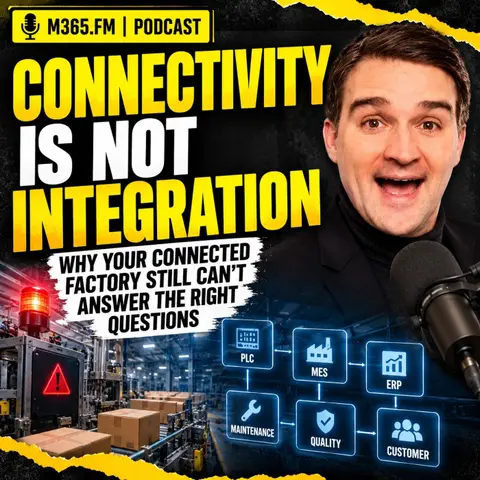
 Connectivity Is Not Integration — Why Your Connected Factory Still Can't Answer the Right Questions

Key Takeaways
- Connectivity moves machine signals and telemetry in milliseconds, but true industrial integration is required to connect meaning, constraints, ownership, timing, and operational consequences.
- A connected factory can experience a machine failure while leaving planners unable to answer critical questions about customer shipments without manual exports, phone calls, and spreadsheets.
- While protocols like OPC UA and MQTT solve critical access and transport challenges, transporting a fault code does not automatically explain its business impact on active work orders.
- A Unified Namespace (UNS) acts as a high-performance highway for operational data and replaces custom point-to-point connections, but a topic hierarchy is still not a complete factory map.
- Tag naming conventions help people discover data and developers map sources, but names are not stable identities and cannot carry the full weight of semantic context and relationships.
- Effective industrial architectures separate the roles of ERP and MES while deliberately linking them through governed data models, schema, ontology, and graphs rather than forcing one system to own everything.
A connected factory can move machine signals in milliseconds and still fail to answer the operational questions that actually matter. A packaging machine stops, the PLC reports the fault, OPC UA exposes the event, MQTT distributes it, and the dashboard updates immediately. Maintenance receives an alert and everything appears connected. Then the planner asks which customer shipment is now at risk, and suddenly the answer requires MES data, ERP records, maintenance history, quality status, production quantities, delivery commitments, and often a spreadsheet. That gap is the focus of this episode: connectivity moves signals, while integration connects meaning, constraints, ownership, timing, and consequences.
CONNECTIVITY MOVES SIGNALS — INTEGRATION CONNECTS MEANING
OPC UA, MQTT, edge gateways, brokers, and modern industrial connectivity platforms solve important problems. They make machine data accessible, standardize transport, reduce point-to-point connections, and allow events to move between machines, applications, and cloud services. But transporting an alarm does not explain its business consequence.
A fault code can arrive perfectly, keep the correct timestamp, and reach every subscriber within seconds. That still does not tell a planner whether the stopped machine affects an urgent order, whether approved inventory already exists, whether the current output is on quality hold, or whether another resource can take over. To answer those questions, the architecture needs relationships between the machine, the active operation, the work order, the product, material status, quality state, maintenance information, and customer demand.
ONE ALARM, MULTIPLE SYSTEMS, NO COMPLETE ANSWER
The episode follows one packaging-machine alarm through the systems that typically hold different parts of the production story. The PLC knows what happened at the machine. MES understands which operation and work order are active. ERP knows demand, due dates, inventory, and customer commitments. Maintenance knows service history and outstanding work. Quality decides whether the produced output can actually be released.
Each system can be correct while the factory as a whole still cannot answer the operational question. This is where people become the integration layer: someone checks MES, someone else opens ERP, maintenance searches the service history, quality verifies release status, and somebody eventually pulls the information together manually. That approach works until decisions need to happen quickly, systems change, or the person who understands all the hidden mappings is unavailable.
UNIFIED NAMESPACE: A BETTER HIGHWAY, NOT THE FACTORY MAP
A Unified Namespace can improve this situation significantly by replacing many direct system-to-system connections with a shared publish-and-subscribe environment. Machines and applications publish information once, consumers subscribe to what they need, and new systems can join without another custom connection back to the equipment.
That reduces plumbing, but it does not automatically create context. An MQTT topic structure can tell you where information came from, but it cannot determine which production order was active, which material was involved, which quality state applied, or which customer delivery depends on that order. Publishing MES, ERP, quality, and machine events into the same broker does not automatically create the relationships between them. Those relationships still have to be modeled and governed.
THE TAG NAMING TRAP
Good naming conventions help people discover data, but names are not identities. One system may call a machine Packer7, maintenance may use PK07, ERP may use a production-resource code, and a cloud platform may know the same equipment through a device identity. All of those records can refer to the same physical asset.
Without governed identity, organizations gradually build mapping tables, custom scripts, report-specific translations, and undocumented assumptions. Then the machine gets moved, rebuilt, renamed, or receives a new controller and the data still flows while the relationships quietly become wrong. Friendly names are useful for people, but stable identity is what keeps systems connected over time.
ERP AND MES HAVE DIFFERENT JOBS
ERP and MES are related but they should not be treated as the same system. ERP works at the business and planning level with demand, supply, inventory, customer commitments, production orders, and financial consequences. MES works closer to execution with operations, production resources, operators, downtime, quantities, material consumption, and the actual progress of work on the floor.
The architecture becomes more reliable when those responsibilities remain clear and the systems are deliberately linked instead of forcing one platform to own everything. A machine can report that production is complete while quality still has the output on hold. MES may show an operation as finished while ERP has not yet posted the finished goods receipt. Those states can all be valid because they describe different moments in the same production process.
DATA IS THE SIGNAL — CONTEXT IS THE SURROUNDING FACTORY
A temperature value is data. Context explains which sensor produced it, which machine contains that sensor, which product was running, which recipe applied, what unit was used, whether the sensor was calibrated, and what operating range was acceptable for that production run.
The same applies to a machine-down event. The signal tells you that something stopped. Context tells you which operation was affected, which order was running, what material was being used, whether the produced output is actually available, whether another resource could take over, and which customer commitment may now be at risk.
Useful industrial context usually includes:
• Asset context — what the physical thing is and where it sits
• Process context — what the resource can actually do
• Order context — what work is currently running
• Material context — which lots and components are involved
• Quality context — whether output is released, restricted, or held
• Time context — which relationships were valid when the event happened
Once those relationships exist, the same machine event becomes much more useful for planning and decision-making.
SCHEMA, ONTOLOGY, AND GRAPH ARE DIFFERENT THINGS
A schema defines the shape of a record. It can require fields such as asset ID, event timestamp, fault code, work-order ID, or engineering unit. An ontology defines the shared meaning of the concepts and relationships used across the factory. A graph provides a practical way to store and query those connected entities.
For example, a machine can belong to a production line, a sensor can measure a component, an operation can belong to a work order, a material lot can be consumed during that operation, and finished output can have a quality status. A graph makes those connections easy to traverse, but simply choosing a graph database does not create meaningful relationships. The quality comes from the model, ownership, timing, identity, and governance around those links.
FROM MACHINE ALARM TO A USEFUL PRODUCTION ANSWER
If those relationships are modeled, the packaging-machine alarm can be traced through the wider production context. The fault event identifies the physical asset, the asset connects to the production resource, the resource connects to the active operation, the operation connects to the work order, and the work order connects to product, quantity, demand, and delivery commitments.
Material relationships show what was consumed. Quality relationships show whether completed production is actually usable. Maintenance relationships provide service history and known issues. Instead of only saying “Packer 7 stopped,” the architecture can begin to explain which order was running, how much quantity remains, whether completed output is available, and which customer delivery may now be affected.
That is the difference between event monitoring and actual decision support.
SEMANTIC GOVERNANCE — WHO OWNS THE MEANING?
Once these relationships start supporting production decisions, ownership becomes critical. Someone has to define which record represents the asset, which machine can perform which operation, which system owns work-order execution state, which system owns quality release, and who approves mappings between maintenance, MES, ERP, and automation records.
The answer normally involves several business domains rather than one central IT team. That means the architecture needs clear ownership, source references, timestamps, version history, data contracts, and approval processes. AI can help suggest likely mappings between inconsistent records, but a suggested relationship should not automatically become a governed production fact without evidence and domain validation.
Become a supporter of this podcast: https://www.spreaker.com/podcast/m365-fm-a-microsoft-mvp-podcast-by-mirko-peters--6704921/support.
🚀 Want to be part of m365.fm?
Then stop just listening… and start showing up.
👉 Connect with me on LinkedIn and let’s make something happen:
- 🎙️ Be a podcast guest and share your story
- 🎧 Host your own episode (yes, seriously)
- 💡 Pitch topics the community actually wants to hear
- 🌍 Build your personal brand in the Microsoft 365 space
This isn’t just a podcast — it’s a platform for people who take action.
🔥 Most people wait. The best ones don’t.
👉 Connect with me on LinkedIn and send me a message:
"I want in"
Let’s build something awesome 👊
Frequently Asked Questions
What is the difference between industrial connectivity and industrial integration?
Industrial connectivity focuses on moving signals, telemetry, and machine data from point A to point B using protocols like OPC UA and MQTT. Industrial integration connects meaning, constraints, ownership, timing, and operational consequences so teams can make informed production decisions.
Why can't a connected factory easily answer which customer shipment is at risk when a machine fails?
While the machine alarm is transmitted instantly, the critical data needed to answer the planner's question is fragmented across separate systems like the PLC, MES, ERP, maintenance, and quality, with no automated architectural relationships linking them together.
Does a Unified Namespace (UNS) automatically solve the factory's integration challenges?
No. A Unified Namespace acts as an efficient highway for event-driven data using a publish-and-subscribe model, but simply publishing messages into a broker does not automatically create contextual relationships between machines, orders, and quality states.
What is the limitation of relying solely on tag naming conventions in industrial IoT projects?
Tag naming conventions make data easier for humans to discover, but names are not stable identities. They do not carry the full production story, such as active recipes, product families, quality holds, or process context.
00:00:00,000 --> 00:00:02,780
Here's a scenario most manufacturers don't talk about.
2
00:00:02,780 --> 00:00:04,160
A packaging machine stops.
3
00:00:04,160 --> 00:00:06,440
A planner asks a question that sounds dead simple,
4
00:00:06,440 --> 00:00:08,480
which customer shipment is now at risk?
5
00:00:08,480 --> 00:00:11,480
The PLC raised the alarm, OPC UA is connected.
6
00:00:11,480 --> 00:00:14,000
MQTT topics are live and the dashboard shows green,
7
00:00:14,000 --> 00:00:15,640
except for one red fault state.
8
00:00:15,640 --> 00:00:17,520
So you'd think the answer is right there.
9
00:00:17,520 --> 00:00:19,960
But nobody can tell the planner without a round of phone calls,
10
00:00:19,960 --> 00:00:22,640
a couple of manual exports, and almost certainly a spreadsheet.
11
00:00:22,640 --> 00:00:23,480
That's the gap.
12
00:00:23,480 --> 00:00:26,640
Connectivity moves signals, integration connects meaning,
13
00:00:26,640 --> 00:00:28,280
constraints and consequences.
14
00:00:28,280 --> 00:00:30,240
So let's follow one machine alarm through the systems
15
00:00:30,240 --> 00:00:32,160
that each hold a piece of the answer.
16
00:00:32,160 --> 00:00:35,440
One alarm, five systems, no shared answer.
17
00:00:35,440 --> 00:00:38,240
Picture a packaging line running a scheduled production order.
18
00:00:38,240 --> 00:00:40,160
The packer stops halfway through the shift.
19
00:00:40,160 --> 00:00:42,120
The operator sees a fault on the local HMI
20
00:00:42,120 --> 00:00:44,080
and the control system logs a fault code.
21
00:00:44,080 --> 00:00:46,160
At the machine level, that part works fine.
22
00:00:46,160 --> 00:00:48,600
The PLC knows the packer stopped when it stopped,
23
00:00:48,600 --> 00:00:51,400
and maybe which safety circuit or actuator caused the stop.
24
00:00:51,400 --> 00:00:52,200
Good so far.
25
00:00:52,200 --> 00:00:55,320
From there, the alarm reaches the plant network through OPC UA.
26
00:00:55,320 --> 00:00:57,760
An edge gateway publishes an event over MQTT,
27
00:00:57,760 --> 00:01:00,320
a central broker distributes it to whoever subscribes.
28
00:01:00,320 --> 00:01:03,120
Maintenance gets an alert, and the dashboard flips the machine
29
00:01:03,120 --> 00:01:04,760
stayed from running to faulted.
30
00:01:04,760 --> 00:01:07,720
And still, none of that tells the planner which shipment is at risk.
31
00:01:07,720 --> 00:01:10,000
The manufacturing execution system, MES,
32
00:01:10,000 --> 00:01:12,000
records that line two has downtime.
33
00:01:12,000 --> 00:01:14,440
It probably knows the active operation, target quantity,
34
00:01:14,440 --> 00:01:15,480
operator and shift.
35
00:01:15,480 --> 00:01:17,320
It can tell you a work order is in progress,
36
00:01:17,320 --> 00:01:19,520
but the MES might not own the customer commitment.
37
00:01:19,520 --> 00:01:21,800
It has no idea whether this order feeds a delivery
38
00:01:21,800 --> 00:01:24,320
due tomorrow morning, whether finished stock exists
39
00:01:24,320 --> 00:01:27,680
in another warehouse, or whether the order can ship partly complete.
40
00:01:27,680 --> 00:01:30,320
That information usually lives in the ERP system.
41
00:01:30,320 --> 00:01:32,560
The enterprise resource planning system holds demand,
42
00:01:32,560 --> 00:01:34,800
sales orders, due dates, stock positions,
43
00:01:34,800 --> 00:01:36,920
material plans and commercial commitments.
44
00:01:36,920 --> 00:01:38,720
It knows a customer is expecting a shipment
45
00:01:38,720 --> 00:01:41,440
that might even know which production order supplies that shipment.
46
00:01:41,440 --> 00:01:44,800
But at this moment, it has no clue whether packer 7 stopped
47
00:01:44,800 --> 00:01:47,640
because of a jam, a failed drive, or a safety gate.
48
00:01:47,640 --> 00:01:49,160
Then maintenance has another layer.
49
00:01:49,160 --> 00:01:51,600
Their system might show that the packer had a recurring issue
50
00:01:51,600 --> 00:01:53,680
with a particular sensor, an open work request,
51
00:01:53,680 --> 00:01:56,000
the last service date, a spare parts request,
52
00:01:56,000 --> 00:01:58,440
or a note from a technician on the previous shift.
53
00:01:58,440 --> 00:02:00,040
Useful, but still not the whole picture.
54
00:02:00,040 --> 00:02:01,320
Now quality steps in.
55
00:02:01,320 --> 00:02:03,520
Maybe the line produced units before the stop,
56
00:02:03,520 --> 00:02:05,520
but the latest batch is on quality hold.
57
00:02:05,520 --> 00:02:08,280
The machine counter can report completed cycles all day long,
58
00:02:08,280 --> 00:02:10,880
but a counter doesn't decide whether those units can ship.
59
00:02:10,880 --> 00:02:12,160
Quality status does.
60
00:02:12,160 --> 00:02:14,160
So think about the planner's job for a second.
61
00:02:14,160 --> 00:02:16,520
The planner needs to know whether the stock packer affects
62
00:02:16,520 --> 00:02:19,840
an active order, whether that order supplies a customer shipment,
63
00:02:19,840 --> 00:02:23,200
how much approved product exists, how long recovery might take,
64
00:02:23,200 --> 00:02:24,880
and whether another line can take over
65
00:02:24,880 --> 00:02:27,960
without creating a worse problem somewhere else.
66
00:02:27,960 --> 00:02:29,840
Those facts live in separate systems
67
00:02:29,840 --> 00:02:31,520
because they belong in separate systems.
68
00:02:31,520 --> 00:02:32,680
That's not bad design.
69
00:02:32,680 --> 00:02:35,920
A PLC should not be the master record for customer commitments,
70
00:02:35,920 --> 00:02:37,680
and an ERP system should not pretend
71
00:02:37,680 --> 00:02:39,440
it can control a packaging machine.
72
00:02:39,440 --> 00:02:42,440
The problem starts when each system only knows its own part,
73
00:02:42,440 --> 00:02:44,440
and no architecture links those parts
74
00:02:44,440 --> 00:02:46,840
in a way that supports a live production decision.
75
00:02:46,840 --> 00:02:48,680
So the planner starts building the answer by hand.
76
00:02:48,680 --> 00:02:50,920
Someone checks the MES for the active work order,
77
00:02:50,920 --> 00:02:54,160
someone else opens ERP to find the sales order and due date.
78
00:02:54,160 --> 00:02:56,480
A maintenance lead digs into the service history.
79
00:02:56,480 --> 00:02:58,160
Quality checks the battery status,
80
00:02:58,160 --> 00:03:00,600
then somebody exports data, sends a message,
81
00:03:00,600 --> 00:03:03,040
or opens the spreadsheet that everyone swears is temporary.
82
00:03:03,040 --> 00:03:04,920
Apparently, temporary spreadsheets outlast
83
00:03:04,920 --> 00:03:06,080
most production equipment.
84
00:03:06,080 --> 00:03:09,160
At the end of that process, the team might reach the right answer.
85
00:03:09,160 --> 00:03:11,840
But they got there by using people as the integration layer.
86
00:03:11,840 --> 00:03:13,800
That approach doesn't scale during a disruption,
87
00:03:13,800 --> 00:03:15,880
and it gets risky when the person who knows
88
00:03:15,880 --> 00:03:17,760
all the hidden mappings takes a day off.
89
00:03:17,760 --> 00:03:18,760
Here's the contradiction.
90
00:03:18,760 --> 00:03:20,640
Every system is technically connected.
91
00:03:20,640 --> 00:03:22,760
Data moves from the machine to the cloud.
92
00:03:22,760 --> 00:03:25,680
Events flow through a broker reports refresh in seconds.
93
00:03:25,680 --> 00:03:27,160
And yet the factory still cannot answer
94
00:03:27,160 --> 00:03:29,280
a basic operational question end to end.
95
00:03:29,280 --> 00:03:30,880
The missing piece is not another alarm
96
00:03:30,880 --> 00:03:32,960
and it's not a faster dashboard refresh.
97
00:03:32,960 --> 00:03:35,720
What's missing is the ability to link the fault event
98
00:03:35,720 --> 00:03:39,440
to the physical asset, the active operation, the work order,
99
00:03:39,440 --> 00:03:42,280
the material and quality state and the customer consequence.
100
00:03:42,280 --> 00:03:44,520
That's a meaning problem, not a connectivity problem.
101
00:03:44,520 --> 00:03:46,680
Before we talk about digital twins, knowledge graphs,
102
00:03:46,680 --> 00:03:49,240
or Microsoft fabric, we need to separate two things
103
00:03:49,240 --> 00:03:50,840
that often get mixed together.
104
00:03:50,840 --> 00:03:53,600
Moving data from point A to point B and making that data
105
00:03:53,600 --> 00:03:56,080
understandable in the context of production.
106
00:03:56,080 --> 00:03:59,840
Connectivity, what it actually solves.
107
00:03:59,840 --> 00:04:02,600
Let's be clear about one thing before I criticize connectivity
108
00:04:02,600 --> 00:04:03,280
too much.
109
00:04:03,280 --> 00:04:04,160
It does matter.
110
00:04:04,160 --> 00:04:07,320
If your machine data is locked inside a PLC on a network segment,
111
00:04:07,320 --> 00:04:09,200
nobody outside the cell can safely reach you
112
00:04:09,200 --> 00:04:10,400
don't have a data problem yet.
113
00:04:10,400 --> 00:04:11,760
You have an access problem.
114
00:04:11,760 --> 00:04:14,640
And until you solve that, none of the later work can even start.
115
00:04:14,640 --> 00:04:18,080
OPC unified architecture, which most people call OPC UA,
116
00:04:18,080 --> 00:04:19,920
is one way to solve that access problem
117
00:04:19,920 --> 00:04:21,760
in a way that fits industrial environments.
118
00:04:21,760 --> 00:04:24,480
It gives systems a standard method to expose machine data,
119
00:04:24,480 --> 00:04:27,320
events, alarms, and sometimes a richer information model
120
00:04:27,320 --> 00:04:30,400
with security built around certificates and trusted connections.
121
00:04:30,400 --> 00:04:32,800
In practical terms, an OPC UA client
122
00:04:32,800 --> 00:04:35,200
connects to a server on a machine, a controller,
123
00:04:35,200 --> 00:04:38,240
or a scatter layer and asks for data in a controlled way.
124
00:04:38,240 --> 00:04:40,240
Instead of building a separate proprietary driver
125
00:04:40,240 --> 00:04:43,440
for every application, you get a shared industrial interface.
126
00:04:43,440 --> 00:04:46,400
That saves a ton of custom work and gives OT and IT teams
127
00:04:46,400 --> 00:04:48,640
a much cleaner boundary between the equipment
128
00:04:48,640 --> 00:04:50,320
and the systems that need that data.
129
00:04:50,320 --> 00:04:52,320
But here's where OPC UA stops being magic.
130
00:04:52,320 --> 00:04:54,240
It doesn't automatically tell the receiving system
131
00:04:54,240 --> 00:04:56,560
what a tag actually means to the production business.
132
00:04:56,560 --> 00:04:58,320
A tag might expose a fault code.
133
00:04:58,320 --> 00:05:01,200
It might even sit under a neatly named machine object.
134
00:05:01,200 --> 00:05:04,200
The system reads the value correctly, preserves its timestamp,
135
00:05:04,200 --> 00:05:05,760
and knows the engineering unit.
136
00:05:05,760 --> 00:05:06,880
All of that helps.
137
00:05:06,880 --> 00:05:09,960
Still, a fault code is not yet a production consequence.
138
00:05:09,960 --> 00:05:12,560
You still need someone to define what that fault code means
139
00:05:12,560 --> 00:05:13,920
for the order on the line.
140
00:05:13,920 --> 00:05:16,880
MQTT solves a related but different problem.
141
00:05:16,880 --> 00:05:19,680
It's a lightweight, published, and subscribed messaging protocol,
142
00:05:19,680 --> 00:05:21,680
a publisher sends a message to a topic,
143
00:05:21,680 --> 00:05:23,520
and any consumer that cares about that topic
144
00:05:23,520 --> 00:05:26,120
receives it without the publisher needing to know who they are.
145
00:05:26,120 --> 00:05:28,000
That decoupling matters in a factory.
146
00:05:28,000 --> 00:05:30,200
A machine gateway can publish an event once,
147
00:05:30,200 --> 00:05:32,520
and maintenance, a historian, an analytic service,
148
00:05:32,520 --> 00:05:35,560
and a local application can each consume it independently.
149
00:05:35,560 --> 00:05:37,600
You don't need the gateway to maintain a custom link
150
00:05:37,600 --> 00:05:39,840
to every one of them, and adding a new consumer
151
00:05:39,840 --> 00:05:41,920
doesn't require changes on the machine.
152
00:05:41,920 --> 00:05:44,320
For high-volume signals and event-driven use cases,
153
00:05:44,320 --> 00:05:46,360
that's a much cleaner pattern than repeated polling
154
00:05:46,360 --> 00:05:48,000
or direct database connections.
155
00:05:48,000 --> 00:05:50,360
It also creates a better path for unreliable links
156
00:05:50,360 --> 00:05:53,240
between a plant and the cloud, because edge systems can process,
157
00:05:53,240 --> 00:05:56,160
buffer, and forward messages according to rules you define.
158
00:05:56,160 --> 00:05:57,840
Transport is doing its job there.
159
00:05:57,840 --> 00:06:00,520
It moves the message reliably from one place to another.
160
00:06:00,520 --> 00:06:03,520
Azure IoT Operations fits into this edge side of the architecture.
161
00:06:03,520 --> 00:06:05,920
Microsoft positions it for edge-connected industrial
162
00:06:05,920 --> 00:06:07,800
and operational technology environments,
163
00:06:07,800 --> 00:06:11,720
where assets use protocols like OPC-UA and local processing matters.
164
00:06:11,720 --> 00:06:13,560
It runs on an edge Kubernetes environment
165
00:06:13,560 --> 00:06:16,520
and provides building blocks for connecting industrial sources,
166
00:06:16,520 --> 00:06:18,800
working with MQTT, routing data,
167
00:06:18,800 --> 00:06:22,480
and managing the connection between plant operations and Azure.
168
00:06:22,480 --> 00:06:24,440
That can reduce the number of one-off gateways
169
00:06:24,440 --> 00:06:26,880
and script the team has to maintain across sites.
170
00:06:26,880 --> 00:06:30,000
For a manufacturer with mixed equipment, that matters a lot.
171
00:06:30,000 --> 00:06:32,760
You may have newer machines with decent OPC-UA support,
172
00:06:32,760 --> 00:06:34,360
older machines that need a gateway,
173
00:06:34,360 --> 00:06:36,840
and systems that only expose data through an API,
174
00:06:36,840 --> 00:06:38,080
a file, or a database.
175
00:06:38,080 --> 00:06:39,960
There's no prize for pretending every plant looks
176
00:06:39,960 --> 00:06:41,280
like a greenfield demo.
177
00:06:41,280 --> 00:06:43,480
Azure IoT Operations provides a managed
178
00:06:43,480 --> 00:06:46,960
edge layer where those different sources enter a more consistent flow
179
00:06:46,960 --> 00:06:49,800
and it can keep selected processing close to the plant
180
00:06:49,800 --> 00:06:52,560
where a cloud round trip would be too slow to fragile
181
00:06:52,560 --> 00:06:55,080
or just inappropriate for the operating situation.
182
00:06:55,080 --> 00:06:56,400
That's useful architecture,
183
00:06:56,400 --> 00:06:58,400
but we need to keep its boundary clear.
184
00:06:58,400 --> 00:07:01,480
An edge connector can read a tag called fault code.
185
00:07:01,480 --> 00:07:03,920
An MQTT broker can distribute that event,
186
00:07:03,920 --> 00:07:07,280
a data flow can filter transform or add fields based on known rules.
187
00:07:07,280 --> 00:07:10,080
None of those layers can safely infer that the fault threatens
188
00:07:10,080 --> 00:07:12,920
a particular customer delivery unless somebody has defined
189
00:07:12,920 --> 00:07:16,320
the links between the machine, the operation, the work order,
190
00:07:16,320 --> 00:07:18,440
the material, and the order commitment.
191
00:07:18,440 --> 00:07:20,440
A transport layer can carry a label perfectly,
192
00:07:20,440 --> 00:07:23,000
but it can't decide whether two labels refer to the same thing.
193
00:07:23,000 --> 00:07:25,600
This becomes obvious when you connect a second machine.
194
00:07:25,600 --> 00:07:27,840
Both machines publish a field called status,
195
00:07:27,840 --> 00:07:31,000
but one uses zero for stopped and one uses zero for ready.
196
00:07:31,000 --> 00:07:33,520
A connector carries both values without error.
197
00:07:33,520 --> 00:07:35,560
The broker distributes both values at speed.
198
00:07:35,560 --> 00:07:38,320
Your downstream system still needs a rule that explains them.
199
00:07:38,320 --> 00:07:40,040
That's why I avoid treating connectivity
200
00:07:40,040 --> 00:07:41,760
as a finished integration program.
201
00:07:41,760 --> 00:07:44,040
It's the part that gives you reach, speed,
202
00:07:44,040 --> 00:07:46,040
and a cleaner way to distribute signals.
203
00:07:46,040 --> 00:07:47,840
You need all of that, but the factory decision
204
00:07:47,840 --> 00:07:49,160
sits above the signal path.
205
00:07:49,160 --> 00:07:51,040
It depends on relationships and definitions
206
00:07:51,040 --> 00:07:54,040
that don't live inside a protocol by default.
207
00:07:54,040 --> 00:07:56,840
Which brings us to the unified namespace or UNS.
208
00:07:56,840 --> 00:07:59,720
Many teams see it as the answer to point to point integration.
209
00:07:59,720 --> 00:08:03,000
And in the right role, it can remove a lot of unnecessary plumbing.
210
00:08:03,000 --> 00:08:05,000
The question is whether a better route for messages
211
00:08:05,000 --> 00:08:07,160
also gives you a full map of the factory.
212
00:08:07,160 --> 00:08:11,680
Unified namespace, a better highway, not the factory map.
213
00:08:11,680 --> 00:08:14,600
A unified namespace can improve this situation,
214
00:08:14,600 --> 00:08:17,000
but it needs a clear job description.
215
00:08:17,000 --> 00:08:19,200
Think of it as a shared, structured event space
216
00:08:19,200 --> 00:08:20,960
for the current state of operations.
217
00:08:20,960 --> 00:08:22,720
Systems publish changes into that space
218
00:08:22,720 --> 00:08:25,000
and other systems subscribe to the information they need.
219
00:08:25,000 --> 00:08:26,640
Instead of every application building
220
00:08:26,640 --> 00:08:28,920
its own direct connection to every other application,
221
00:08:28,920 --> 00:08:30,640
they all connect through the broker.
222
00:08:30,640 --> 00:08:32,120
That alone removes a lot of pain.
223
00:08:32,120 --> 00:08:33,960
A machine gateway publishes its state,
224
00:08:33,960 --> 00:08:36,240
a maintenance app subscribes to fault events.
225
00:08:36,240 --> 00:08:39,720
A historian captures the same events for later analysis.
226
00:08:39,720 --> 00:08:42,640
And MES consumes a selected set of production signals.
227
00:08:42,640 --> 00:08:45,600
New consumers can join without changing the PLC program
228
00:08:45,600 --> 00:08:47,800
or adding another fragile link from the machine.
229
00:08:47,800 --> 00:08:48,800
That's the highway part.
230
00:08:48,800 --> 00:08:51,040
The namespace usually gives those events a structure.
231
00:08:51,040 --> 00:08:54,240
Many teams use a hierarchy based loosely on ISA95,
232
00:08:54,240 --> 00:08:55,920
the standard that describes information flow
233
00:08:55,920 --> 00:08:58,120
between enterprise systems and manufacturing operations.
234
00:08:58,120 --> 00:09:00,400
So you might organize data from enterprise to site,
235
00:09:00,400 --> 00:09:03,920
to area, to line, to machine, and then to a signal or event.
236
00:09:03,920 --> 00:09:05,640
The exact structure differs by plant,
237
00:09:05,640 --> 00:09:07,440
but the intent stays the same.
238
00:09:07,440 --> 00:09:11,080
A person or application should be able to find a machine state
239
00:09:11,080 --> 00:09:12,680
in a predictable place.
240
00:09:12,680 --> 00:09:14,560
For example, a subscriber may know
241
00:09:14,560 --> 00:09:17,280
that it needs the current state of a hacker online too.
242
00:09:17,280 --> 00:09:19,560
It subscribes to the relevant branch of the namespace
243
00:09:19,560 --> 00:09:21,720
instead of asking six systems whether they happen
244
00:09:21,720 --> 00:09:23,440
to know something about that hacker.
245
00:09:23,440 --> 00:09:26,120
That brings order to event flow and makes discovery easier,
246
00:09:26,120 --> 00:09:28,400
especially when you add new lines or new consumers.
247
00:09:28,400 --> 00:09:30,960
MQTT is often the transport underneath this pattern
248
00:09:30,960 --> 00:09:33,720
because publish and subscribe fits the use case well.
249
00:09:33,720 --> 00:09:36,560
Spark plug B is also common in industrial MQTT environments
250
00:09:36,560 --> 00:09:39,000
because it adds conventions around device state,
251
00:09:39,000 --> 00:09:41,160
metric definitions, and reconnect behavior.
252
00:09:41,160 --> 00:09:43,120
But MQTT isn't a unified namespace.
253
00:09:43,120 --> 00:09:45,760
Spark plug B isn't a unified namespace either.
254
00:09:45,760 --> 00:09:47,560
They are ways to implement parts of one.
255
00:09:47,560 --> 00:09:49,880
A unified namespace is an architectural pattern
256
00:09:49,880 --> 00:09:50,920
and a discipline.
257
00:09:50,920 --> 00:09:53,920
It needs agreed topic structures, clear publishing rules,
258
00:09:53,920 --> 00:09:57,040
access control, quality handling, and ownership.
259
00:09:57,040 --> 00:09:59,520
Without those things, an MQTT broker can become
260
00:09:59,520 --> 00:10:01,960
a very fast place to publish confusing messages.
261
00:10:01,960 --> 00:10:03,920
There's another boundary worth keeping clear.
262
00:10:03,920 --> 00:10:06,760
A broker holds and distributes current operational state.
263
00:10:06,760 --> 00:10:08,560
It isn't automatically your historian.
264
00:10:08,560 --> 00:10:11,600
A historian exists to keep time series data over time
265
00:10:11,600 --> 00:10:12,960
and support questions like,
266
00:10:12,960 --> 00:10:15,920
how did this temperature behave during the last production run?
267
00:10:15,920 --> 00:10:18,800
An analytic store supports longer queries, aggregation,
268
00:10:18,800 --> 00:10:20,680
model training, and reporting.
269
00:10:20,680 --> 00:10:22,440
A broker handles live distribution.
270
00:10:22,440 --> 00:10:25,320
Those are related jobs, but they aren't the same job.
271
00:10:25,320 --> 00:10:27,880
The same distinction applies to a semantic model.
272
00:10:27,880 --> 00:10:30,800
A topic hierarchy can tell you that a signal came from a hacker
273
00:10:30,800 --> 00:10:32,880
on a name line at a named site.
274
00:10:32,880 --> 00:10:34,440
That is useful location context.
275
00:10:34,440 --> 00:10:36,880
It does not, by itself, capture all the relationships
276
00:10:36,880 --> 00:10:38,280
needed for a decision.
277
00:10:38,280 --> 00:10:39,920
Let's use the stopped hacker again.
278
00:10:39,920 --> 00:10:43,200
A unified namespace can answer a direct question very well.
279
00:10:43,200 --> 00:10:45,200
What state is Packer 7 in right now?
280
00:10:45,200 --> 00:10:47,160
If the source publishes that state correctly,
281
00:10:47,160 --> 00:10:49,400
the answer arrives quickly and every subscribe system
282
00:10:49,400 --> 00:10:50,120
receives it.
283
00:10:50,120 --> 00:10:53,240
It might also answer, when did the fault state begin?
284
00:10:53,240 --> 00:10:56,360
Or, which related signals changed around the same time?
285
00:10:56,360 --> 00:10:58,840
Those are good operational questions for a live event pattern.
286
00:10:58,840 --> 00:11:01,480
Now ask the planners question, which customer shipment
287
00:11:01,480 --> 00:11:04,560
is at risk and what are my feasible options?
288
00:11:04,560 --> 00:11:06,400
The namespace cannot infer the answer merely
289
00:11:06,400 --> 00:11:07,720
from a topic path.
290
00:11:07,720 --> 00:11:10,120
It needs a link from Packer 7 to the process operation
291
00:11:10,120 --> 00:11:11,000
that was running.
292
00:11:11,000 --> 00:11:13,320
It needs the active work order at the time of the stop.
293
00:11:13,320 --> 00:11:15,200
It needs the product and material status.
294
00:11:15,200 --> 00:11:16,960
It needs the relationship from that work order
295
00:11:16,960 --> 00:11:20,960
to demand, inventory, due dates, and perhaps an alternate production
296
00:11:20,960 --> 00:11:21,440
route.
297
00:11:21,440 --> 00:11:23,440
Some of those facts may arrive as events
298
00:11:23,440 --> 00:11:24,440
through the same broker.
299
00:11:24,440 --> 00:11:27,480
An ERP or MES could publish work order changes,
300
00:11:27,480 --> 00:11:29,880
and a quality system could publish release status,
301
00:11:29,880 --> 00:11:32,280
yet publishing all those messages into one place
302
00:11:32,280 --> 00:11:34,480
doesn't create the relationships automatically.
303
00:11:34,480 --> 00:11:36,480
A stream of messages is still a stream of messages
304
00:11:36,480 --> 00:11:39,920
until you define how the objects relate, who owns each fact,
305
00:11:39,920 --> 00:11:41,680
and which state applied at a given time.
306
00:11:41,680 --> 00:11:44,760
That's where teams can overstate what a unified namespace does.
307
00:11:44,760 --> 00:11:46,120
It can reduce connections, bro.
308
00:11:46,120 --> 00:11:47,800
It can improve real-time visibility.
309
00:11:47,800 --> 00:11:49,600
It can give different systems a shared path
310
00:11:49,600 --> 00:11:50,760
for current events.
311
00:11:50,760 --> 00:11:52,800
Those are serious gains, especially in a plant
312
00:11:52,800 --> 00:11:55,520
where every new dashboard once needed another direct database
313
00:11:55,520 --> 00:11:56,200
query.
314
00:11:56,200 --> 00:11:57,640
But a neat hierarchy of topics is not
315
00:11:57,640 --> 00:11:59,760
the same as an operational model of the factory.
316
00:11:59,760 --> 00:12:02,280
The highway gets the alarm to everyone who needs it.
317
00:12:02,280 --> 00:12:04,280
The factory map explains where that alarm sits
318
00:12:04,280 --> 00:12:06,360
in the production system, what depends on it,
319
00:12:06,360 --> 00:12:08,200
and what the team should consider next.
320
00:12:08,200 --> 00:12:09,720
Once the event leaves the broker,
321
00:12:09,720 --> 00:12:12,280
that difference becomes impossible to ignore.
322
00:12:12,280 --> 00:12:14,400
The tag naming trap.
323
00:12:14,400 --> 00:12:15,760
Let's stay with the packer for a moment
324
00:12:15,760 --> 00:12:18,240
because this is where a lot of projects quietly go off track.
325
00:12:18,240 --> 00:12:21,160
Someone exposes a tag called Line 2, Packer 7.0,
326
00:12:21,160 --> 00:12:23,760
Fault Code, which looks useful because it tells us
327
00:12:23,760 --> 00:12:26,240
the line, the machine, and the sort of value we're reading.
328
00:12:26,240 --> 00:12:28,920
And next to it, we might see Line 2.
329
00:12:28,920 --> 00:12:31,240
Packer 7.0 product count, a temperature value,
330
00:12:31,240 --> 00:12:33,120
a cycle counter, and a state signal
331
00:12:33,120 --> 00:12:36,200
that naming beats an old PLC address with no explanation,
332
00:12:36,200 --> 00:12:38,080
because nobody wants to build production decisions
333
00:12:38,080 --> 00:12:39,720
around something called DB14.
334
00:12:39,720 --> 00:12:42,320
DBD28, and hope the one engineer who understands it,
335
00:12:42,320 --> 00:12:43,360
never retires.
336
00:12:43,360 --> 00:12:46,840
A well-named tag helps people find data, developers map sources,
337
00:12:46,840 --> 00:12:48,840
and operators recognize what they're looking at.
338
00:12:48,840 --> 00:12:51,520
But the tag name still doesn't carry the production story.
339
00:12:51,520 --> 00:12:53,960
Take Line 2, Packer 7.0, Fault Code.
340
00:12:53,960 --> 00:12:56,360
The tag identifies the machine that produced the alarm,
341
00:12:56,360 --> 00:12:58,240
but it doesn't tell you which product family
342
00:12:58,240 --> 00:13:00,080
the machine was packing at that moment,
343
00:13:00,080 --> 00:13:03,240
the active operation, the work order, the tooling installed,
344
00:13:03,240 --> 00:13:05,160
or the recipe version in use.
345
00:13:05,160 --> 00:13:06,560
It also doesn't tell you whether the fault
346
00:13:06,560 --> 00:13:09,160
happened during normal production, a change over,
347
00:13:09,160 --> 00:13:12,160
a cleaning cycle, or a test run, and those situations
348
00:13:12,160 --> 00:13:14,280
may trigger the same fault code, but lead
349
00:13:14,280 --> 00:13:16,160
to very different decisions.
350
00:13:16,160 --> 00:13:18,120
The same problem shows up with process values,
351
00:13:18,120 --> 00:13:21,000
say the Packer publishes a temperature of 72 degrees.
352
00:13:21,000 --> 00:13:23,360
A data pipeline can store that number perfectly,
353
00:13:23,360 --> 00:13:26,800
but 72 degrees only becomes useful when you know the unit,
354
00:13:26,800 --> 00:13:28,960
sends a location, product, process, step,
355
00:13:28,960 --> 00:13:32,320
and approved range for that product at that point in the process.
356
00:13:32,320 --> 00:13:35,320
For one format, 72 degrees is perfectly normal.
357
00:13:35,320 --> 00:13:37,560
For another, it's unacceptable.
358
00:13:37,560 --> 00:13:39,240
It could be a temperature at a ceiling jaw,
359
00:13:39,240 --> 00:13:41,480
or inside an enclosure where it has no direct quality
360
00:13:41,480 --> 00:13:42,240
meaning at all.
361
00:13:42,240 --> 00:13:43,560
The number didn't change.
362
00:13:43,560 --> 00:13:44,920
It's meaning changed.
363
00:13:44,920 --> 00:13:46,920
This is why tag naming conventions matter,
364
00:13:46,920 --> 00:13:49,040
but they can't carry the whole weight of integration.
365
00:13:49,040 --> 00:13:51,680
You can keep adding detail to a topic path or a tag name,
366
00:13:51,680 --> 00:13:53,400
but eventually you build a sentence
367
00:13:53,400 --> 00:13:55,120
where you really need a relationship.
368
00:13:55,120 --> 00:13:58,440
And names aren't stable enough to become the only identity either.
369
00:13:58,440 --> 00:14:00,880
A machine might be called Packer 7 by operators,
370
00:14:00,880 --> 00:14:04,840
PK07 in the maintenance system, and line 2 packaging assets
371
00:14:04,840 --> 00:14:06,800
042 in an asset register.
372
00:14:06,800 --> 00:14:10,280
All three names may point to the same physical asset, or worse.
373
00:14:10,280 --> 00:14:13,120
Packer 7 might refer to a whole cell in one conversation
374
00:14:13,120 --> 00:14:15,440
and one machine inside that cell in another.
375
00:14:15,440 --> 00:14:17,440
That sounds trivial, until a failure event
376
00:14:17,440 --> 00:14:20,120
reaches an analytic service that has to join machine data
377
00:14:20,120 --> 00:14:21,320
with maintenance history.
378
00:14:21,320 --> 00:14:23,600
If the two sources don't share a governed asset identity,
379
00:14:23,600 --> 00:14:25,280
somebody creates a mapping table,
380
00:14:25,280 --> 00:14:27,800
then someone copies that mapping into another report
381
00:14:27,800 --> 00:14:31,720
and a year later the machine moves, gets rebuilt or changes its role,
382
00:14:31,720 --> 00:14:33,520
and the hidden mappings begin to drift.
383
00:14:33,520 --> 00:14:35,000
Names are helpful aliases.
384
00:14:35,000 --> 00:14:36,880
They aren't a substitute for identity.
385
00:14:36,880 --> 00:14:40,240
The words that manufacturers use every day create another problem.
386
00:14:40,240 --> 00:14:41,880
Think about the word line.
387
00:14:41,880 --> 00:14:45,640
In ERP, it might describe a cost center or planning resource.
388
00:14:45,640 --> 00:14:49,560
In the MES, it may mean a production unit made up of multiple machines.
389
00:14:49,560 --> 00:14:51,880
And on the shop floor, an operator might use it to mean
390
00:14:51,880 --> 00:14:55,680
the physical area between the infeed conveyor and palatizer.
391
00:14:55,680 --> 00:14:57,240
Nobody is necessarily wrong.
392
00:14:57,240 --> 00:14:59,560
Each person speaks from their own work context.
393
00:14:59,560 --> 00:15:01,360
Batch causes similar trouble.
394
00:15:01,360 --> 00:15:03,800
It can mean a material lot, a production campaign,
395
00:15:03,800 --> 00:15:06,080
a quality sample group, or a file of messages
396
00:15:06,080 --> 00:15:08,160
processed together by a data platform.
397
00:15:08,160 --> 00:15:10,400
Those aren't interchangeable things, yet a system
398
00:15:10,400 --> 00:15:12,840
that only sees a field named Batch has no way
399
00:15:12,840 --> 00:15:16,000
to know which meaning applies, even done can cause trouble.
400
00:15:16,000 --> 00:15:19,000
Done might mean the machine counter reached the planned quantity
401
00:15:19,000 --> 00:15:21,040
or that the MES closed the operation,
402
00:15:21,040 --> 00:15:22,840
or that quality released the material,
403
00:15:22,840 --> 00:15:25,320
or that ERP posted the production receipt.
404
00:15:25,320 --> 00:15:27,680
A dashboard may show all of them as complete,
405
00:15:27,680 --> 00:15:30,080
but the planner may care about only one.
406
00:15:30,080 --> 00:15:32,080
Naming standards can reduce this friction.
407
00:15:32,080 --> 00:15:35,280
You define how topic parts work, how tags identify units,
408
00:15:35,280 --> 00:15:37,800
how events include timestamps and source IDs,
409
00:15:37,800 --> 00:15:40,040
and how an asset name appears across systems,
410
00:15:40,040 --> 00:15:41,640
giving teams a common starting point
411
00:15:41,640 --> 00:15:44,040
and making data easier to discover.
412
00:15:44,040 --> 00:15:46,080
OPC UA information models can help too,
413
00:15:46,080 --> 00:15:48,600
especially when equipment exposes more than flat tags
414
00:15:48,600 --> 00:15:51,000
because a well-built model can describe objects,
415
00:15:51,000 --> 00:15:54,200
their variables, and some relationships in a structured way.
416
00:15:54,200 --> 00:15:56,400
Still, standards don't erase local meaning.
417
00:15:56,400 --> 00:15:58,240
A packaging line with legacy controllers,
418
00:15:58,240 --> 00:16:00,000
custom tooling, and product-specific rules
419
00:16:00,000 --> 00:16:02,200
will always need some plant-level modeling,
420
00:16:02,200 --> 00:16:04,240
because there's no standard that can guess
421
00:16:04,240 --> 00:16:05,920
what your local word release means
422
00:16:05,920 --> 00:16:07,720
in the middle of a quality exception.
423
00:16:07,720 --> 00:16:08,880
That work needs an owner.
424
00:16:08,880 --> 00:16:11,880
A clean topic tree may make the factory easier to browse,
425
00:16:11,880 --> 00:16:13,600
but it can't repair a routing table
426
00:16:13,600 --> 00:16:15,600
that uses old resource IDs,
427
00:16:15,600 --> 00:16:17,800
settle an argument between quality and production
428
00:16:17,800 --> 00:16:20,240
about when output becomes available,
429
00:16:20,240 --> 00:16:22,800
or fix master data that names the same asset
430
00:16:22,800 --> 00:16:24,560
three different ways.
431
00:16:24,560 --> 00:16:26,960
The next step is to bring the systems behind those words
432
00:16:26,960 --> 00:16:28,080
into the same conversation,
433
00:16:28,080 --> 00:16:30,800
because ERP and MES don't merely hold different data.
434
00:16:30,800 --> 00:16:32,040
They do different jobs.
435
00:16:32,040 --> 00:16:34,520
ERP and MES do different jobs.
436
00:16:34,520 --> 00:16:38,440
ERP and MES sit close together in architecture talks,
437
00:16:38,440 --> 00:16:40,960
but they work at different levels of the same business.
438
00:16:40,960 --> 00:16:42,960
Your enterprise resource planning system,
439
00:16:42,960 --> 00:16:46,680
ERP handles demand, purchasing, inventory records,
440
00:16:46,680 --> 00:16:47,680
sales commitments,
441
00:16:47,680 --> 00:16:50,200
financial posting, and the broad production plan.
442
00:16:50,200 --> 00:16:51,880
It needs a view across the business.
443
00:16:51,880 --> 00:16:53,640
When sales promises a delivery date,
444
00:16:53,640 --> 00:16:56,520
ERP records that commitment and plans supply around it.
445
00:16:56,520 --> 00:16:57,440
That plan matters,
446
00:16:57,440 --> 00:16:59,480
but it isn't the same as a shop floor sequence
447
00:16:59,480 --> 00:17:02,040
that can run through a real shift with real constraints.
448
00:17:02,040 --> 00:17:04,640
The manufacturing execution system, MES,
449
00:17:04,640 --> 00:17:06,360
works closer to production and directs
450
00:17:06,360 --> 00:17:07,560
and records execution.
451
00:17:07,560 --> 00:17:09,640
Depending on its scope, it can dispatch work,
452
00:17:09,640 --> 00:17:11,160
record labor and machine time,
453
00:17:11,160 --> 00:17:13,320
track quantities, capture material consumption,
454
00:17:13,320 --> 00:17:14,640
manage production status,
455
00:17:14,640 --> 00:17:17,040
and pass actual results back to ERP.
456
00:17:17,040 --> 00:17:21,080
So ERP might state that an order needs 1,000 cases by Friday,
457
00:17:21,080 --> 00:17:22,760
but the MES deals with what happens
458
00:17:22,760 --> 00:17:24,920
when the line is down on Wednesday afternoon
459
00:17:24,920 --> 00:17:26,600
and operator changes shift.
460
00:17:26,600 --> 00:17:28,120
A material lot is held,
461
00:17:28,120 --> 00:17:31,600
and the remaining work has to fit around jobs already in progress.
462
00:17:31,600 --> 00:17:34,240
Those are different jobs that need different views of time.
463
00:17:34,240 --> 00:17:36,760
ERP usually works from demand, supply, inventory,
464
00:17:36,760 --> 00:17:38,040
and planned capacity,
465
00:17:38,040 --> 00:17:40,120
creating a production order with a due date,
466
00:17:40,120 --> 00:17:41,160
planned quantity,
467
00:17:41,160 --> 00:17:43,440
rooting, and material requirement.
468
00:17:43,440 --> 00:17:45,720
That establishes the commercial and planning intent.
469
00:17:46,760 --> 00:17:49,040
The MES turns that intent into execution,
470
00:17:49,040 --> 00:17:51,200
knowing that an operation started at a particular time
471
00:17:51,200 --> 00:17:54,320
on a particular resource, under a given production status,
472
00:17:54,320 --> 00:17:56,840
and it can record that the line produced some good units,
473
00:17:56,840 --> 00:17:58,440
some scrap and some output,
474
00:17:58,440 --> 00:18:00,760
still waiting for quality review.
475
00:18:00,760 --> 00:18:03,040
A production plan can look perfectly reasonable
476
00:18:03,040 --> 00:18:04,600
until it meets a real factory.
477
00:18:04,600 --> 00:18:07,320
A plan may assume a line is available for eight hours,
478
00:18:07,320 --> 00:18:10,800
but the shop floor knows a change over took longer than expected.
479
00:18:10,800 --> 00:18:12,040
A tool needs adjustment,
480
00:18:12,040 --> 00:18:13,800
a trained operator isn't available,
481
00:18:13,800 --> 00:18:15,440
or a machine can run the product only
482
00:18:15,440 --> 00:18:17,520
with a specific format set installed.
483
00:18:17,520 --> 00:18:19,120
That doesn't mean ERP failed.
484
00:18:19,120 --> 00:18:21,160
It means ERP wasn't built to become a second
485
00:18:21,160 --> 00:18:23,440
by second control and execution system.
486
00:18:23,440 --> 00:18:25,680
The same distinction applies in the other direction.
487
00:18:25,680 --> 00:18:28,840
An MES can report that an operation stopped at 2.12 pm
488
00:18:28,840 --> 00:18:30,920
and restarted at 3.03 pm,
489
00:18:30,920 --> 00:18:32,600
and it may know the downtime reason
490
00:18:32,600 --> 00:18:34,880
and the actual quantity at the moment of failure.
491
00:18:34,880 --> 00:18:37,160
But it may not know whether the remaining output supplies
492
00:18:37,160 --> 00:18:38,520
are high priority customer,
493
00:18:38,520 --> 00:18:40,320
a replenishment order with stock elsewhere
494
00:18:40,320 --> 00:18:42,920
or a shipment that can leave with a partial quantity.
495
00:18:42,920 --> 00:18:47,080
That commercial consequence belongs closer to ERP and supply planning.
496
00:18:47,080 --> 00:18:48,080
For the planners question,
497
00:18:48,080 --> 00:18:50,720
you need both views without pretending they are the same thing.
498
00:18:50,720 --> 00:18:53,200
You need the MES to identify what production was actually doing
499
00:18:53,200 --> 00:18:54,320
when the packers stopped,
500
00:18:54,320 --> 00:18:56,600
then you need ERP and possibly a planning system
501
00:18:56,600 --> 00:18:58,960
to connect that work to demand and commitments.
502
00:18:58,960 --> 00:19:00,640
If one system calls an order complete
503
00:19:00,640 --> 00:19:03,000
when the machine counter reaches target quantity,
504
00:19:03,000 --> 00:19:04,520
while another waits for quality release,
505
00:19:04,520 --> 00:19:05,920
the answer changes again.
506
00:19:05,920 --> 00:19:09,480
This is where ISA95 gives teams a useful shared language.
507
00:19:09,480 --> 00:19:11,440
ISA95 describes the boundary
508
00:19:11,440 --> 00:19:14,400
between enterprise systems and manufacturing operations,
509
00:19:14,400 --> 00:19:15,880
helping separate business planning
510
00:19:15,880 --> 00:19:17,760
from manufacturing execution
511
00:19:17,760 --> 00:19:20,920
and defining common concepts such as equipment,
512
00:19:20,920 --> 00:19:24,760
material, personnel, capabilities, schedules
513
00:19:24,760 --> 00:19:26,200
and production responses.
514
00:19:26,200 --> 00:19:29,160
That boundary helps during design discussions
515
00:19:29,160 --> 00:19:31,120
because it forces a better question,
516
00:19:31,120 --> 00:19:33,160
which system owns this piece of information
517
00:19:33,160 --> 00:19:35,440
in which system needs a copy or an event?
518
00:19:35,440 --> 00:19:38,000
Still, ISA95 doesn't connect your systems by itself.
519
00:19:38,000 --> 00:19:39,400
It won't reconcile resource names
520
00:19:39,400 --> 00:19:41,360
that differ between ERP and MES,
521
00:19:41,360 --> 00:19:45,360
decide whether an MES event should update an ERP order immediately
522
00:19:45,360 --> 00:19:47,080
or only after a quality step
523
00:19:47,080 --> 00:19:50,880
or resolve local rules around rework, substitutes, split orders
524
00:19:50,880 --> 00:19:53,800
or production that crosses a shift boundary.
525
00:19:53,800 --> 00:19:55,400
The standard gives you a language,
526
00:19:55,400 --> 00:19:57,000
but your team still has to agree
527
00:19:57,000 --> 00:19:58,560
on what you mean when you use it.
528
00:19:58,560 --> 00:20:00,800
I see projects struggle when they try to make one system
529
00:20:00,800 --> 00:20:02,320
own every part of the story.
530
00:20:02,320 --> 00:20:04,320
ERP gets pushed down toward the machine
531
00:20:04,320 --> 00:20:06,560
or MES gets pushed up into commercial planning
532
00:20:06,560 --> 00:20:08,680
and both approaches create duplicate logic,
533
00:20:08,680 --> 00:20:10,040
competing status values
534
00:20:10,040 --> 00:20:12,680
and a lot of arguments about which number is correct.
535
00:20:12,680 --> 00:20:15,360
A cleaner approach keeps responsibilities clear,
536
00:20:15,360 --> 00:20:17,520
then designs the links between them with intent.
537
00:20:17,520 --> 00:20:19,880
ERP owns the business commitment and the plan
538
00:20:19,880 --> 00:20:22,320
while MES owns what happens during production.
539
00:20:22,320 --> 00:20:25,440
Automation systems own, machine state and control quality
540
00:20:25,440 --> 00:20:27,560
owns whether output meets the release rules
541
00:20:27,560 --> 00:20:29,200
and maintenance owns the condition
542
00:20:29,200 --> 00:20:31,200
and service record of the equipment.
543
00:20:31,200 --> 00:20:33,400
The integration layer needs to connect those facts
544
00:20:33,400 --> 00:20:35,240
without quietly changing their meaning.
545
00:20:35,240 --> 00:20:37,320
That sounds simple when we describe it at system level,
546
00:20:37,320 --> 00:20:38,680
but it gets much more concrete
547
00:20:38,680 --> 00:20:41,560
when we follow one work order from the moment ERP releases it
548
00:20:41,560 --> 00:20:43,680
through production, quality and final proof
549
00:20:43,680 --> 00:20:45,360
of what actually happened.
550
00:20:45,360 --> 00:20:47,640
Follow one work order from plan to proof.
551
00:20:47,640 --> 00:20:51,280
Here's the problem most manufacturers don't talk about.
552
00:20:51,280 --> 00:20:53,120
You have a work order released from ERP.
553
00:20:53,120 --> 00:20:54,320
It carries a product version,
554
00:20:54,320 --> 00:20:56,560
a rooting, a due date material demand.
555
00:20:56,560 --> 00:20:58,040
In business terms, that instruction says
556
00:20:58,040 --> 00:20:59,560
this product needs to get made,
557
00:20:59,560 --> 00:21:02,440
but that release is not proof that production can actually start.
558
00:21:02,440 --> 00:21:03,520
The MES receives that order
559
00:21:03,520 --> 00:21:05,360
and expands it into real floor work.
560
00:21:05,360 --> 00:21:07,720
It might dispatch a packing operation to line two,
561
00:21:07,720 --> 00:21:08,920
assign it to a shift,
562
00:21:08,920 --> 00:21:11,240
and note which operator or team owns execution.
563
00:21:11,240 --> 00:21:13,440
It also checks whether the material, the tooling
564
00:21:13,440 --> 00:21:15,360
and the production instructions are all available
565
00:21:15,360 --> 00:21:16,440
before work begins.
566
00:21:16,440 --> 00:21:18,040
So now the same work order exists
567
00:21:18,040 --> 00:21:19,680
in two different operational views.
568
00:21:19,680 --> 00:21:22,120
ERP sees the order as a plan supply action
569
00:21:22,120 --> 00:21:24,960
with dates, quantities and inventory consequences.
570
00:21:24,960 --> 00:21:27,080
MES sees it as work moving through a sequence
571
00:21:27,080 --> 00:21:28,320
of real operations.
572
00:21:28,320 --> 00:21:29,480
Neither view is wrong.
573
00:21:29,480 --> 00:21:31,320
They answer completely different questions.
574
00:21:31,320 --> 00:21:33,920
Once the order starts, machine data starts creating evidence.
575
00:21:33,920 --> 00:21:36,680
The PLC reports, cycles, state changes, short stops,
576
00:21:36,680 --> 00:21:38,920
longer folds, process values, counters,
577
00:21:38,920 --> 00:21:40,560
and edge layer collects those signals
578
00:21:40,560 --> 00:21:42,560
and passes them to the systems that need them.
579
00:21:42,560 --> 00:21:44,720
If the packer completes a cycle, a counter changes.
580
00:21:44,720 --> 00:21:46,920
If it stops, a state event appears.
581
00:21:46,920 --> 00:21:49,920
If a temperature drifts, that value arrives with a timestamp.
582
00:21:49,920 --> 00:21:52,680
Machine data tells us what the equipment observed or did,
583
00:21:52,680 --> 00:21:54,600
but a cycle counter doesn't automatically prove
584
00:21:54,600 --> 00:21:57,120
a finished case exists in a proved inventory.
585
00:21:57,120 --> 00:21:59,200
That counter might include test cycles,
586
00:21:59,200 --> 00:22:00,640
it might include rejected units.
587
00:22:00,640 --> 00:22:02,320
It could run during a setup period
588
00:22:02,320 --> 00:22:04,800
before the MES formally starts the operation.
589
00:22:04,800 --> 00:22:07,040
The number has to connect to the execution record
590
00:22:07,040 --> 00:22:09,000
before it can support a production claim.
591
00:22:09,000 --> 00:22:11,080
The MES often creates that connection,
592
00:22:11,080 --> 00:22:14,360
but even then the details matter, which machine ran the operation,
593
00:22:14,360 --> 00:22:17,400
which version of the routing applied, which operator started it,
594
00:22:17,400 --> 00:22:20,720
which shift owned the work, was the order paused and resumed,
595
00:22:20,720 --> 00:22:22,920
did the work move to another resource halfway through?
596
00:22:22,920 --> 00:22:24,200
These aren't admin details.
597
00:22:24,200 --> 00:22:26,240
They change how you interpret the machine events
598
00:22:26,240 --> 00:22:28,920
and how you reconstruct the production record later,
599
00:22:28,920 --> 00:22:31,080
then quality adds another decision point.
600
00:22:31,080 --> 00:22:33,320
The line reports it produced 500 cases.
601
00:22:33,320 --> 00:22:36,600
The MES records 500 completed units against the operation.
602
00:22:36,600 --> 00:22:38,960
Quality inspects a sample, reviews a process deviation,
603
00:22:38,960 --> 00:22:41,800
or places the output on hold while someone investigates a fault,
604
00:22:41,800 --> 00:22:44,920
until quality accepts that output under the rules that apply,
605
00:22:44,920 --> 00:22:47,040
those units may not be available for shipment.
606
00:22:47,040 --> 00:22:50,320
That's why a work order needs more than one status.
607
00:22:50,320 --> 00:22:53,400
In progress, machine complete, operation complete,
608
00:22:53,400 --> 00:22:56,520
quality hold and released can all describe different moments
609
00:22:56,520 --> 00:22:58,240
in the same production story.
610
00:22:58,240 --> 00:23:01,160
If the systems collapse them into one field called status,
611
00:23:01,160 --> 00:23:03,440
somebody eventually trusts the wrong meaning.
612
00:23:03,440 --> 00:23:04,800
Material adds another link.
613
00:23:04,800 --> 00:23:06,720
The work order consumes material lots.
614
00:23:06,720 --> 00:23:08,320
Those lots carry supplier details,
615
00:23:08,320 --> 00:23:11,440
expiry information, inspection status, and genealogy records
616
00:23:11,440 --> 00:23:13,600
that connect raw material to finished output.
617
00:23:13,600 --> 00:23:17,240
In a regulated process, that trail may carry former release requirements.
618
00:23:17,240 --> 00:23:21,160
In other plans, it still matters when a quality issue appears after production.
619
00:23:21,160 --> 00:23:23,320
You need to know not only that the order ran,
620
00:23:23,320 --> 00:23:24,760
you need to know what ran through it.
621
00:23:24,760 --> 00:23:26,240
Now go back to the stopped packer.
622
00:23:26,240 --> 00:23:28,440
The planner asks which shipment is at risk.
623
00:23:28,440 --> 00:23:31,760
A useful answer requires a chain that starts with the fault event
624
00:23:31,760 --> 00:23:33,440
and reaches through the active machine,
625
00:23:33,440 --> 00:23:35,640
the active MES operation, the work order,
626
00:23:35,640 --> 00:23:38,720
the quantity already produced, the quality state of that quantity,
627
00:23:38,720 --> 00:23:40,800
and the demand that the order supplies.
628
00:23:40,800 --> 00:23:42,160
Every link needs an identifier.
629
00:23:42,160 --> 00:23:46,880
The machine event needs an asset ID that matches the execution resource in MES.
630
00:23:46,880 --> 00:23:51,640
The MES operation needs an operation ID that connects to the ERP routing or work order.
631
00:23:51,640 --> 00:23:55,600
The material record needs lot identifiers that survive movement through the process.
632
00:23:55,600 --> 00:23:57,560
The production results need a time window
633
00:23:57,560 --> 00:24:00,480
because a machine may run several orders during one shift.
634
00:24:00,480 --> 00:24:03,320
Time is often where otherwise sensible integrations break.
635
00:24:03,320 --> 00:24:06,120
If line a two-ran order A in the morning and order B after lunch,
636
00:24:06,120 --> 00:24:09,040
a fault at 1412 belongs to one of those execution windows.
637
00:24:09,040 --> 00:24:12,800
Joining the alarm to every order ever assigned to line two produces an answer,
638
00:24:12,800 --> 00:24:16,160
but not one anyone should use, status meaning matters just as much.
639
00:24:16,160 --> 00:24:19,560
A finished quantity in ERP may refer to a posted goods receipt.
640
00:24:19,560 --> 00:24:22,360
In MES, it might mean an operation reports complete.
641
00:24:22,360 --> 00:24:24,120
In quality, it may remain blocked.
642
00:24:24,120 --> 00:24:27,880
Those records can all be current while describing different states of the same material.
643
00:24:27,880 --> 00:24:31,480
This is the integration work people often miss, not sending the work order.
644
00:24:31,480 --> 00:24:32,520
Not reading the counter.
645
00:24:32,520 --> 00:24:37,160
The hard part is preserving the links, the timing and the meaning between plan and proof.
646
00:24:37,160 --> 00:24:39,200
And when those links aren't modeled deliberately,
647
00:24:39,200 --> 00:24:42,520
teams usually solve the immediate gap with another direct interface.
648
00:24:42,520 --> 00:24:46,800
Point to point integration, the quiet cost of local success.
649
00:24:46,800 --> 00:24:49,360
This is why point to point integration keeps coming back,
650
00:24:49,360 --> 00:24:51,880
even after a factory has invested in better connectivity.
651
00:24:51,880 --> 00:24:55,920
A team sees an immediate problem, maintenance needs the machine fault in its system.
652
00:24:55,920 --> 00:24:59,560
Someone builds an interface from the machine layer or from scatter into maintenance.
653
00:24:59,560 --> 00:25:02,440
It solves a real need and nobody should dismiss that.
654
00:25:02,440 --> 00:25:04,800
Then planning needs order status beside the same fault.
655
00:25:04,800 --> 00:25:09,400
A second interface appears, quality needs a whole event tied to the work order.
656
00:25:09,400 --> 00:25:12,520
Another mapping follows, finance wants actual production figures.
657
00:25:12,520 --> 00:25:15,800
A report team pulls data from their MES database and adds its own logic.
658
00:25:15,800 --> 00:25:16,720
Each step can work.
659
00:25:16,720 --> 00:25:18,720
That's what makes this pattern hard to challenge.
660
00:25:18,720 --> 00:25:20,720
No single project looks unreasonable.
661
00:25:20,720 --> 00:25:24,960
The cost appears later when the factory has accumulated a web of local answers.
662
00:25:24,960 --> 00:25:31,040
Each based on its own assumptions about asset IDs, order status, timestamps, and what complete means.
663
00:25:31,040 --> 00:25:33,480
The integration logic rarely stays in one place.
664
00:25:33,480 --> 00:25:34,840
Part of it lives in middleware.
665
00:25:34,840 --> 00:25:38,400
Another part lives in custom code written for a project that ended years ago.
666
00:25:38,400 --> 00:25:42,680
A report may contain a lookup table that maps machine names to production resources.
667
00:25:42,680 --> 00:25:47,200
Someone may have added a manual correction step because one old align uses a different naming rule.
668
00:25:47,200 --> 00:25:49,360
Then there's the knowledge nobody wrote down.
669
00:25:49,360 --> 00:25:54,840
A planner knows that resource PKO7 in ERP refers to Packer 7 only when it runs a certain product family.
670
00:25:54,840 --> 00:25:59,920
A maintenance engineer knows the asset register still carries the old name after a retrofit.
671
00:25:59,920 --> 00:26:05,240
An MES specialist knows that one start is field only updates after end of shift reconciliation.
672
00:26:05,240 --> 00:26:06,880
Those people keep the factory running.
673
00:26:06,880 --> 00:26:10,320
But they shouldn't have to act as a runtime dependency for the data architecture.
674
00:26:10,320 --> 00:26:13,120
The problem becomes visible whenever something changes.
675
00:26:13,120 --> 00:26:16,240
Arrouting changes because the plant introduces a new product format.
676
00:26:16,240 --> 00:26:17,880
The ERP planning resource changes.
677
00:26:17,880 --> 00:26:20,720
The MES receives a new operation definition.
678
00:26:20,720 --> 00:26:25,320
One interface still expects the old resource ID, while a Power BI report uses an old mapping
679
00:26:25,320 --> 00:26:28,040
table and quietly stops including the new line.
680
00:26:28,040 --> 00:26:29,920
Or the machine receives a new controller.
681
00:26:29,920 --> 00:26:33,520
The equipment may still sit in the same place with the same role in production, but its
682
00:26:33,520 --> 00:26:38,200
OPC/UA server now exposes a different namespace and a new device identity.
683
00:26:38,200 --> 00:26:40,200
The connector still works after some edits.
684
00:26:40,200 --> 00:26:41,600
The historian captures data.
685
00:26:41,600 --> 00:26:45,280
Yet the downstream logic that links that machine to the maintenance record or work order
686
00:26:45,280 --> 00:26:46,800
may no longer match.
687
00:26:46,800 --> 00:26:47,800
Everything fails loudly.
688
00:26:47,800 --> 00:26:49,120
That's often the dangerous part.
689
00:26:49,120 --> 00:26:50,800
The dashboard still refreshes.
690
00:26:50,800 --> 00:26:52,000
Data still arrives.
691
00:26:52,000 --> 00:26:54,840
People assume the story is complete because the plumbing is active.
692
00:26:54,840 --> 00:26:58,920
Meanwhile the relation between the event and the operational object it should describe has
693
00:26:58,920 --> 00:27:00,400
weakened or broken.
694
00:27:00,400 --> 00:27:02,520
MES upgrades create similar problems.
695
00:27:02,520 --> 00:27:06,440
Eventor changes in API version, a status code or an internal identifier.
696
00:27:06,440 --> 00:27:10,040
The technical team fixes the interface because messages must flow again.
697
00:27:10,040 --> 00:27:13,800
But the old transformation may contain business rules that nobody reject.
698
00:27:13,800 --> 00:27:16,280
Maybe it treated one status as production complete.
699
00:27:16,280 --> 00:27:20,640
While the new MES process uses that status earlier in the flow, the message arrives correctly,
700
00:27:20,640 --> 00:27:21,800
the meaning does not.
701
00:27:21,800 --> 00:27:25,160
This is where a unified namespace can help without pretending it solves everything.
702
00:27:25,160 --> 00:27:28,200
A shared broker reduces the number of direct connections.
703
00:27:28,200 --> 00:27:31,320
Publishers can publish once, consumers can subscribe to the events they need.
704
00:27:31,320 --> 00:27:33,440
That changes the physical shape of integration.
705
00:27:33,440 --> 00:27:36,640
And it can remove a lot of brittle links between individual applications.
706
00:27:36,640 --> 00:27:38,120
Less plumbing is a real win.
707
00:27:38,120 --> 00:27:42,640
Still, reducing connections brawl doesn't settle who owns an asset identity, which system
708
00:27:42,640 --> 00:27:47,160
owns work order state or how a quality hold changes the meaning of reported output.
709
00:27:47,160 --> 00:27:49,200
A broker can distribute a new routing event.
710
00:27:49,200 --> 00:27:53,080
It can't decide whether that routing definition is authoritative, current or applicable
711
00:27:53,080 --> 00:27:55,040
to the order that ran two hours ago.
712
00:27:55,040 --> 00:27:58,320
That work needs shared rules outside the individual interface.
713
00:27:58,320 --> 00:28:00,760
Think about what happens when a new use case arrives.
714
00:28:00,760 --> 00:28:04,400
If each team starts by asking which systems do I need to connect?
715
00:28:04,400 --> 00:28:07,760
The result usually becomes another local chain of mappings.
716
00:28:07,760 --> 00:28:11,800
A better first question is, which objects must this decision connect and what relationships
717
00:28:11,800 --> 00:28:13,400
must remain true over time?
718
00:28:13,400 --> 00:28:17,560
For the stopped packer, the objects may include the physical packer, the production resource,
719
00:28:17,560 --> 00:28:21,960
the active operation, the work order, the material lot, the quality status and the customer
720
00:28:21,960 --> 00:28:22,960
demand.
721
00:28:22,960 --> 00:28:26,920
Each has a source system, each has an owner, each may change on a different schedule.
722
00:28:26,920 --> 00:28:30,960
The architecture has to preserve those links across the systems, not recreate them from scratch
723
00:28:30,960 --> 00:28:33,840
inside every report, workflow and integration.
724
00:28:33,840 --> 00:28:36,560
That shifts the work from interface building to context building.
725
00:28:36,560 --> 00:28:37,560
You still need connectors.
726
00:28:37,560 --> 00:28:38,560
You still need events.
727
00:28:38,560 --> 00:28:42,480
You still need APIs, brokers and data flows that actually work end to end.
728
00:28:42,480 --> 00:28:46,760
But once the factory asks questions that cross maintenance, production, quality and planning,
729
00:28:46,760 --> 00:28:51,040
shared context becomes more important than another direct line between two databases.
730
00:28:51,040 --> 00:28:55,400
So before we add more technology, let's define what context means in factory terms.
731
00:28:55,400 --> 00:28:56,720
Data is a signal.
732
00:28:56,720 --> 00:28:59,520
Context is the surrounding factory.
733
00:28:59,520 --> 00:29:03,160
Let's make context practical, because the word gets thrown around so much it can start
734
00:29:03,160 --> 00:29:04,560
to mean nothing at all.
735
00:29:04,560 --> 00:29:06,200
A temperature reading is data.
736
00:29:06,200 --> 00:29:10,480
That might arrive every second from a sensor near an oven with a timestamp and a number.
737
00:29:10,480 --> 00:29:14,600
You can store it, trend it, alert on it and compare it to yesterday's readings.
738
00:29:14,600 --> 00:29:18,320
That still leaves a lot unanswered though, which oven produced that reading, which zone
739
00:29:18,320 --> 00:29:22,440
inside the oven, what product ran through it at that moment, which recipe applied and
740
00:29:22,440 --> 00:29:24,520
what ranged at quality approved for that product.
741
00:29:24,520 --> 00:29:27,080
Was the sensor even calibrated when it sent the value?
742
00:29:27,080 --> 00:29:31,240
Those surrounding facts turn a number into something a production team can actually interpret.
743
00:29:31,240 --> 00:29:33,800
Think about an oven that reports 180 degrees.
744
00:29:33,800 --> 00:29:37,120
For one product that might sit inside the approved process range.
745
00:29:37,120 --> 00:29:40,960
For a different product with a different recipe and dwell time, it could point to a process
746
00:29:40,960 --> 00:29:41,960
deviation.
747
00:29:41,960 --> 00:29:43,400
The reading didn't change.
748
00:29:43,400 --> 00:29:46,640
But the operational meaning did because the product, recipe and production state around
749
00:29:46,640 --> 00:29:47,800
it all shifted.
750
00:29:47,800 --> 00:29:48,800
That's context.
751
00:29:48,800 --> 00:29:52,880
It's not just extra metadata added to a message because somebody decided every event
752
00:29:52,880 --> 00:29:54,360
needs more columns.
753
00:29:54,360 --> 00:29:57,880
Context is the set of relationships and agreed definitions that let you place an event
754
00:29:57,880 --> 00:30:00,960
inside the factory as it operated at that exact moment.
755
00:30:00,960 --> 00:30:02,640
Same thing applies to a machine-down event.
756
00:30:02,640 --> 00:30:06,360
A simple event can tell you that a machine entered a fault state at a given time.
757
00:30:06,360 --> 00:30:07,880
That supports an alert.
758
00:30:07,880 --> 00:30:08,960
Maintenance can respond.
759
00:30:08,960 --> 00:30:10,400
An operator can see the fault.
760
00:30:10,400 --> 00:30:11,600
Those are useful outcomes.
761
00:30:11,600 --> 00:30:13,960
But a production decision needs a wider frame.
762
00:30:13,960 --> 00:30:15,280
Which operation stopped?
763
00:30:15,280 --> 00:30:17,880
Is that operation on the critical path for the active order?
764
00:30:17,880 --> 00:30:20,320
Can another resource perform the same operation?
765
00:30:20,320 --> 00:30:24,560
Does that resource need a different tool, a qualified operator or a quality approval
766
00:30:24,560 --> 00:30:25,920
before it can run the product?
767
00:30:25,920 --> 00:30:29,880
If the work moves, what capacity disappears for the next order already scheduled there?
768
00:30:29,880 --> 00:30:30,880
The fault is the signal.
769
00:30:30,880 --> 00:30:34,360
The surrounding factory is the context and context needs more than relationships.
770
00:30:34,360 --> 00:30:36,000
It also needs a greed meaning.
771
00:30:36,000 --> 00:30:40,320
If one system describes a resource as available when it has no fault, while another describes
772
00:30:40,320 --> 00:30:44,880
it as available only when it has the right tooling, material, operator and approved recipe,
773
00:30:44,880 --> 00:30:47,320
both systems can publish a valid status.
774
00:30:47,320 --> 00:30:49,840
But they're not describing the same condition.
775
00:30:49,840 --> 00:30:53,480
A planning service that treats those values as identical can create a recommendation that
776
00:30:53,480 --> 00:30:56,400
looks sensible in data terms but fails on the shop floor.
777
00:30:56,400 --> 00:30:57,760
Time belongs in context as well.
778
00:30:57,760 --> 00:31:01,760
A machine can support a product family this month after retrofit but not last month.
779
00:31:01,760 --> 00:31:04,880
A worker might hold a qualification during one shift and not another.
780
00:31:04,880 --> 00:31:08,840
A material lot could pass inspection at noon and move to hold later in the day.
781
00:31:08,840 --> 00:31:12,240
So when a system asks, can this line run this order?
782
00:31:12,240 --> 00:31:15,240
It can't always use the factory structure as it looks right now.
783
00:31:15,240 --> 00:31:18,920
It may need to know what links, approvals and states applied when the event occurred.
784
00:31:18,920 --> 00:31:22,520
That's the difference between data that describes and data that supports a decision.
785
00:31:22,520 --> 00:31:24,520
Data that describes can tell you what changed.
786
00:31:24,520 --> 00:31:28,880
Data increased a temperature across the limit, a machine stopped and order change status.
787
00:31:28,880 --> 00:31:32,360
Decision-ready data connects that change to the things affected by it, the limits that
788
00:31:32,360 --> 00:31:36,720
apply and the possible consequences of acting one way rather than another.
789
00:31:36,720 --> 00:31:38,680
A dashboard can be really good at the first job.
790
00:31:38,680 --> 00:31:43,480
It can show you that downtime rose online too or that an alarm appeared on Packer 7.
791
00:31:43,480 --> 00:31:45,440
The next question changes the architecture.
792
00:31:45,440 --> 00:31:47,120
What should production do next?
793
00:31:47,120 --> 00:31:49,840
That question forces the system to move beyond observation.
794
00:31:49,840 --> 00:31:54,440
It has to connect the event to an operation, a product, material availability, quality rules,
795
00:31:54,440 --> 00:31:57,360
production capacity and delivery commitments.
796
00:31:57,360 --> 00:32:00,480
And it must keep the source evidence clear because a planner needs to know whether a
797
00:32:00,480 --> 00:32:05,000
conclusion came from the MES, ERP, maintenance data or a calculated assumption.
798
00:32:05,000 --> 00:32:09,760
Otherwise, the system produces a polished answer with no operational basis behind it.
799
00:32:09,760 --> 00:32:11,320
Factories already have enough of those.
800
00:32:11,320 --> 00:32:14,560
Context doesn't mean copying every record from every system into one giant database.
801
00:32:14,560 --> 00:32:18,720
It means creating a controlled way to identify the objects that matter and maintain the links
802
00:32:18,720 --> 00:32:23,360
between them while each source system keeps responsibility for the facts it owns.
803
00:32:23,360 --> 00:32:26,520
The hard part is deciding which context the decision really needs.
804
00:32:26,520 --> 00:32:29,400
For a production question, I usually think about four forms of context.
805
00:32:29,400 --> 00:32:33,040
The asset itself, the work that asset can perform, the order and material moving through
806
00:32:33,040 --> 00:32:37,720
the process and the quality state that decides whether output can actually move forward.
807
00:32:37,720 --> 00:32:39,840
Let's start with the most basic question.
808
00:32:39,840 --> 00:32:44,400
What exactly is this physical thing and where does it sit in the factory?
809
00:32:44,400 --> 00:32:45,400
Asset context.
810
00:32:45,400 --> 00:32:48,920
What is this thing and where does it sit?
811
00:32:48,920 --> 00:32:52,520
Start with the physical asset because every later decision depends on knowing what the
812
00:32:52,520 --> 00:32:53,520
event came from.
813
00:32:53,520 --> 00:32:55,920
A factory usually has a structure people already understand.
814
00:32:55,920 --> 00:32:57,160
There's an enterprise.
815
00:32:57,160 --> 00:32:58,560
Under that, sites.
816
00:32:58,560 --> 00:33:03,040
Inside a site, you might have areas, lines, cells, machines and components.
817
00:33:03,040 --> 00:33:04,760
A sensor may sit on a motor.
818
00:33:04,760 --> 00:33:05,960
That motor sits in a machine.
819
00:33:05,960 --> 00:33:09,160
The machine forms part of a cell and the cell belongs to a line.
820
00:33:09,160 --> 00:33:10,520
That structure sounds obvious.
821
00:33:10,520 --> 00:33:14,560
In practice, it often exists several times in slightly different forms.
822
00:33:14,560 --> 00:33:18,080
Engineering may describe the machine through a bill of equipment and technical drawings.
823
00:33:18,080 --> 00:33:20,720
Maintenance may use a functional location and an asset number.
824
00:33:20,720 --> 00:33:22,640
The MES may use a production resource.
825
00:33:22,640 --> 00:33:24,680
The control system may expose a device name.
826
00:33:24,680 --> 00:33:27,800
A cloud platform may know a device identity from an edge gateway.
827
00:33:27,800 --> 00:33:30,880
All of them can point to the same packer or they can point to different parts of the
828
00:33:30,880 --> 00:33:32,600
same packer without anyone noticing.
829
00:33:32,600 --> 00:33:34,160
That's where asset context begins.
830
00:33:34,160 --> 00:33:37,600
You need a controlled identity for the thing itself plus the relationships that place
831
00:33:37,600 --> 00:33:40,280
it in the physical and operational structure of the plant.
832
00:33:40,280 --> 00:33:42,280
Take a vibration sensor on the packer drive.
833
00:33:42,280 --> 00:33:43,520
The sensor isn't the packer.
834
00:33:43,520 --> 00:33:45,320
It measures part of the packer.
835
00:33:45,320 --> 00:33:46,800
The packer isn't the whole line.
836
00:33:46,800 --> 00:33:50,560
It performs one roll within the line and the line may depend on utilities.
837
00:33:50,560 --> 00:33:54,320
A compressed air or power that support more than one machine.
838
00:33:54,320 --> 00:33:56,400
Those links matter when an event appears.
839
00:33:56,400 --> 00:34:00,760
If a sensor reports abnormal vibration, the system needs to know which component it measures.
840
00:34:00,760 --> 00:34:04,200
From there, it should know which machine contains that component, which line depends on
841
00:34:04,200 --> 00:34:08,720
the machine and whether another asset shares the same utility or upstream feed.
842
00:34:08,720 --> 00:34:11,840
Without that structure, you have a reading linked to a device ID.
843
00:34:11,840 --> 00:34:15,160
With it, you have an event placed inside a real operating system.
844
00:34:15,160 --> 00:34:19,200
Asset context also needs to handle the awkward cases because factories are full of them.
845
00:34:19,200 --> 00:34:20,920
A machine gets moved to another line.
846
00:34:20,920 --> 00:34:23,920
A retrofit replaces a controller but keeps the mechanical asset.
847
00:34:23,920 --> 00:34:26,120
A production cell splits into two cells.
848
00:34:26,120 --> 00:34:28,440
A conveyor becomes part of a new packaging flow.
849
00:34:28,440 --> 00:34:32,200
If the relationship between asset and location changes, the data model needs to record that
850
00:34:32,200 --> 00:34:34,920
change rather than quietly override the old structure.
851
00:34:34,920 --> 00:34:38,960
Otherwise, someone reviewing last year's downtime will assign an old event to the machine's
852
00:34:38,960 --> 00:34:42,120
current line even though it ran somewhere else at the time.
853
00:34:42,120 --> 00:34:43,880
Identity must survive these changes.
854
00:34:43,880 --> 00:34:47,320
The name may change, the IP address can change, the controller can change.
855
00:34:47,320 --> 00:34:51,920
The physical asset may keep its identity through all of that or it may be replaced completely.
856
00:34:51,920 --> 00:34:55,840
Those are business and engineering decisions that the model has to represent clearly.
857
00:34:55,840 --> 00:34:59,200
This is why I'd separate a friendly name from a governed identifier.
858
00:34:59,200 --> 00:35:02,160
Operators should keep using names that help them run the plant.
859
00:35:02,160 --> 00:35:06,000
Nobody wants a conversation on the shop floor where people refer to Packer 7 only by a long
860
00:35:06,000 --> 00:35:07,360
asset code.
861
00:35:07,360 --> 00:35:11,720
But systems need a stable identity behind that name, along with aliases for the names used
862
00:35:11,720 --> 00:35:12,720
in maintenance.
863
00:35:12,720 --> 00:35:15,400
MES, SCADA and engineering records.
864
00:35:15,400 --> 00:35:17,000
The same applies to hierarchy.
865
00:35:17,000 --> 00:35:20,200
A hierarchy is often treated as a simple folder structure.
866
00:35:20,200 --> 00:35:21,200
But it's more than that.
867
00:35:21,200 --> 00:35:25,080
It states that a particular machine belongs to a particular line that a sensor measures a
868
00:35:25,080 --> 00:35:29,160
particular component or that a utility feeds a particular cell.
869
00:35:29,160 --> 00:35:31,440
Those are relationships with operational meaning.
870
00:35:31,440 --> 00:35:33,320
And relationships need owners.
871
00:35:33,320 --> 00:35:35,160
Engineering may own the physical structure.
872
00:35:35,160 --> 00:35:37,840
Maintenance may own equipment records and serviceable components.
873
00:35:37,840 --> 00:35:40,280
Production may own which resources active in a line.
874
00:35:40,280 --> 00:35:43,480
IT may operate the shared platform where these records connect.
875
00:35:43,480 --> 00:35:46,040
Nobody owns the update when equipment moves or changes.
876
00:35:46,040 --> 00:35:48,880
The asset model starts drifting from the physical plant.
877
00:35:48,880 --> 00:35:52,040
Azure Device Registry can help with a practical part of this work.
878
00:35:52,040 --> 00:35:56,400
It represents connected devices and industrial assets as Azure resources, which gives teams
879
00:35:56,400 --> 00:36:00,480
a managed way to register and govern those objects across edge and cloud environments.
880
00:36:00,480 --> 00:36:03,840
That helps with discovery, policy, access and device management.
881
00:36:03,840 --> 00:36:07,520
It can give a connector, a device and an asset a clearer identity in the wider Azure
882
00:36:07,520 --> 00:36:08,520
estate.
883
00:36:08,520 --> 00:36:10,640
But device registry isn't the whole semantic layer.
884
00:36:10,640 --> 00:36:14,200
Knowing that an edge connected device belongs to an asset is useful.
885
00:36:14,200 --> 00:36:15,840
The wider question still remains.
886
00:36:15,840 --> 00:36:20,200
What does that asset do under which conditions and which production work depends on it?
887
00:36:20,200 --> 00:36:23,120
Asset context tells you what the thing is and where it sits.
888
00:36:23,120 --> 00:36:27,320
The next layer explains what that asset can actually do in the production process.
889
00:36:27,320 --> 00:36:28,320
Process context.
890
00:36:28,320 --> 00:36:31,080
What can the asset actually do?
891
00:36:31,080 --> 00:36:33,320
Knowing where a machine sits is only part of the picture.
892
00:36:33,320 --> 00:36:36,640
The more useful question for production is what that machine can actually do.
893
00:36:36,640 --> 00:36:40,960
A packer might look like one resource in an asset register, but its real capability depends
894
00:36:40,960 --> 00:36:45,400
on the product family, the packaging format, the recipe, the installed tooling and the quality
895
00:36:45,400 --> 00:36:47,200
rules that apply to the run.
896
00:36:47,200 --> 00:36:49,160
That's what I mean by process context.
897
00:36:49,160 --> 00:36:52,200
Manufacturers usually describe this through a product, process and resource view.
898
00:36:52,200 --> 00:36:53,880
The product is what you need to make.
899
00:36:53,880 --> 00:36:56,800
The process is the sequence of operations required to make it.
900
00:36:56,800 --> 00:37:00,600
The resource is the machine, line, tool or person that can carry out a given operation.
901
00:37:00,600 --> 00:37:02,440
Those three things need explicit links.
902
00:37:02,440 --> 00:37:06,120
For example, a product may require a filling operation, then sealing, labeling and final
903
00:37:06,120 --> 00:37:07,120
packing.
904
00:37:07,120 --> 00:37:10,880
Packer 7 might support the final packing operation for two carton formats, but not a third
905
00:37:10,880 --> 00:37:15,240
one because it needs a different infeed, different guides and a different approved setup.
906
00:37:15,240 --> 00:37:19,040
The machine is available in a simple asset sense, but it still may not be capable of running
907
00:37:19,040 --> 00:37:20,040
the order.
908
00:37:20,040 --> 00:37:23,320
That distinction causes a lot of false confidence in planning systems.
909
00:37:23,320 --> 00:37:27,280
A basic resource model may show two packers as alternatives because both sit in the same
910
00:37:27,280 --> 00:37:28,480
packaging area.
911
00:37:28,480 --> 00:37:31,760
But a person who knows the line will tell you that one of them can only run the smaller
912
00:37:31,760 --> 00:37:32,760
carton.
913
00:37:32,760 --> 00:37:36,160
Another needs a format kit that is currently on a different line, and the second machine
914
00:37:36,160 --> 00:37:39,640
has not yet passed quality approval for a new label stock.
915
00:37:39,640 --> 00:37:43,120
The factory has constraints, and the planning model needs to know them.
916
00:37:43,120 --> 00:37:45,520
Now the word capability needs care.
917
00:37:45,520 --> 00:37:49,600
Capability is not just a static machine attribute like maximum speed or a nameplate limit.
918
00:37:49,600 --> 00:37:53,680
It can depend on setup state, install tools, approved recipes, current qualification, material
919
00:37:53,680 --> 00:37:55,480
properties or process revision.
920
00:37:55,480 --> 00:37:58,720
A machine might be technically able to form a package, but not allowed to run it under
921
00:37:58,720 --> 00:37:59,960
the current quality rules.
922
00:37:59,960 --> 00:38:03,440
That's a different type of constraint, but it changes the answer just as much.
923
00:38:03,440 --> 00:38:06,600
Consider two lines that both report an availability state of green.
924
00:38:06,600 --> 00:38:10,160
One has the correct ceiling jaws fitted and an approved recipe loaded.
925
00:38:10,160 --> 00:38:11,400
The other has neither.
926
00:38:11,400 --> 00:38:15,720
If a scheduling service sees only two green machines, it can recommend a move that the team
927
00:38:15,720 --> 00:38:16,800
cannot execute.
928
00:38:16,800 --> 00:38:21,040
The signal is correct, but the decision is wrong because the process context is missing.
929
00:38:21,040 --> 00:38:22,600
Routing versions matter here as well.
930
00:38:22,600 --> 00:38:25,360
A routing describes the approved path through production.
931
00:38:25,360 --> 00:38:30,320
It tells the system which operations apply, in what order and which resources may perform them.
932
00:38:30,320 --> 00:38:34,480
When engineering changes the process, maybe due to a new material, a new inspection step
933
00:38:34,480 --> 00:38:37,600
or a packaging redesign, that routing can change.
934
00:38:37,600 --> 00:38:40,760
The same machine event now belongs to a different process definition.
935
00:38:40,760 --> 00:38:45,240
If you compare performance without tracking that change, you can draw the wrong conclusion.
936
00:38:45,240 --> 00:38:48,960
A line may appear slower than last month, when the real reason is that the current product
937
00:38:48,960 --> 00:38:51,840
requires an added inspection or a more demanding setup.
938
00:38:51,840 --> 00:38:54,320
The machine may not have become less reliable at all.
939
00:38:54,320 --> 00:38:57,440
This comes up often with overall equipment effectiveness or OEE.
940
00:38:57,440 --> 00:39:02,280
OEE can be useful because it combines availability, performance and quality into a common measure,
941
00:39:02,280 --> 00:39:06,240
but it becomes misleading when people compare unlike runs as if they were identical.
942
00:39:06,240 --> 00:39:10,880
A short run with frequent changeovers, a difficult product format, and a tighter quality rule
943
00:39:10,880 --> 00:39:16,440
should not be judged through the same assumptions as a long, stable run on a mature product.
944
00:39:16,440 --> 00:39:20,920
The OEE number may be mathematically sound, but the comparison can still be poor.
945
00:39:20,920 --> 00:39:25,120
This context lets you ask better questions, instead of which line had the lowest OEE?
946
00:39:25,120 --> 00:39:28,960
You can ask which line performed below its expected range for this product, recipe and
947
00:39:28,960 --> 00:39:30,640
operating condition?
948
00:39:30,640 --> 00:39:34,560
That's a much harder question, and it's also closer to how production teams think.
949
00:39:34,560 --> 00:39:38,640
The same logic applies when a machine fails and someone wants to move work elsewhere.
950
00:39:38,640 --> 00:39:42,240
A status signal can tell you which machines are running or stopped, but it cannot decide
951
00:39:42,240 --> 00:39:45,720
which alternative resource can perform the affected operation.
952
00:39:45,720 --> 00:39:50,280
An advanced planning and scheduling system, often called APS, needs those capability links,
953
00:39:50,280 --> 00:39:54,040
needs to know which product can run on which resource, which tools and skills are required,
954
00:39:54,040 --> 00:39:58,160
which sequence rules apply and which operations cannot move without changing quality or delivery
955
00:39:58,160 --> 00:39:59,160
risk.
956
00:39:59,160 --> 00:40:03,200
That's not generic machine availability, it's constrained production capability.
957
00:40:03,200 --> 00:40:06,480
Once you model that, the stopped packer becomes more than a maintenance event.
958
00:40:06,480 --> 00:40:10,120
You can start asking whether another resource can take the work, what must change before it
959
00:40:10,120 --> 00:40:12,840
can, and what that move would displace.
960
00:40:12,840 --> 00:40:16,640
But a machine capability alone still does not tell us what is running right now, which
961
00:40:16,640 --> 00:40:19,800
material it consumes or whether the output can move forward.
962
00:40:19,800 --> 00:40:23,200
For that we need to add the order, material and quality context.
963
00:40:23,200 --> 00:40:26,000
Order, material and quality context.
964
00:40:26,000 --> 00:40:30,440
A machine can be capable of running an operation, but that still doesn't tell you what
965
00:40:30,440 --> 00:40:31,720
work it is doing right now.
966
00:40:31,720 --> 00:40:33,160
For that you need order context.
967
00:40:33,160 --> 00:40:37,480
A work order links planned production to a real demand signal with a product, a quantity,
968
00:40:37,480 --> 00:40:39,040
a route and a due date.
969
00:40:39,040 --> 00:40:42,920
Somewhere behind that work order there may be a customer order, a forecast, a stock target,
970
00:40:42,920 --> 00:40:44,360
or a mix of all three.
971
00:40:44,360 --> 00:40:46,360
That link matters when production changes.
972
00:40:46,360 --> 00:40:49,840
Imagine the packer stops with 300 cases still left on the order.
973
00:40:49,840 --> 00:40:53,560
The first question is not simply whether the machine can restart, the planar needs to know
974
00:40:53,560 --> 00:40:57,960
what those 300 cases support, whether they are needed for a shipment leaving tomorrow,
975
00:40:57,960 --> 00:41:01,760
replenishing stock that already covers demand, or part of a larger campaign where another
976
00:41:01,760 --> 00:41:04,160
order can take priority.
977
00:41:04,160 --> 00:41:08,640
The work order gives the disruption a business frame, but the work order alone is not enough.
978
00:41:08,640 --> 00:41:12,280
Production consumes material, and material brings its own history and controls into the
979
00:41:12,280 --> 00:41:13,280
decision.
980
00:41:13,280 --> 00:41:18,400
A material lot may arrive with a supplier lot number, an internal lot ID, an expiry date
981
00:41:18,400 --> 00:41:19,960
and an inspection result.
982
00:41:19,960 --> 00:41:24,480
It may be approved, blocked, under review, or released only for a limited use.
983
00:41:24,480 --> 00:41:27,800
When the order starts, the manufacturing record should connect the consumed lots to the
984
00:41:27,800 --> 00:41:31,080
operation, and where needed to the finished output.
985
00:41:31,080 --> 00:41:32,680
That connection creates genealogy.
986
00:41:32,680 --> 00:41:36,560
Genealogy means you can trace material forward into the output it helped create, and back
987
00:41:36,560 --> 00:41:40,080
from finished output to the material and process records behind it.
988
00:41:40,080 --> 00:41:42,400
You don't need that only for regulated industries.
989
00:41:42,400 --> 00:41:46,440
It also helps when a supplier issue appears, when a quality team needs to isolate affected
990
00:41:46,440 --> 00:41:50,560
stock, or when a production run changes material midway through a shift.
991
00:41:50,560 --> 00:41:54,720
The physical material does not care which system owns the record, the factory does.
992
00:41:54,720 --> 00:41:58,520
Consider a packaging operation, where the product itself is ready, but the label stock on
993
00:41:58,520 --> 00:42:00,360
the line has not passed inspection.
994
00:42:00,360 --> 00:42:04,400
The machine may keep running, its counters may keep rising, and the MES may record completed
995
00:42:04,400 --> 00:42:06,120
units against the work order.
996
00:42:06,120 --> 00:42:08,800
Yet the finished cases may not be free to ship.
997
00:42:08,800 --> 00:42:12,560
The quality context decides whether the output is usable under the rules that apply.
998
00:42:12,560 --> 00:42:16,200
That can include inspection results, deviations, release decisions, test data, and hold
999
00:42:16,200 --> 00:42:17,200
status.
1000
00:42:17,200 --> 00:42:19,920
A quality hold does not always mean the product is defective.
1001
00:42:19,920 --> 00:42:23,600
It means the product cannot move as normal until someone resolves the condition.
1002
00:42:23,600 --> 00:42:25,200
That difference changes the plan as answer.
1003
00:42:25,200 --> 00:42:29,520
If the packer stopped after producing most of the required quantity, a simple production
1004
00:42:29,520 --> 00:42:32,800
count might suggest that the shipment is safe.
1005
00:42:32,800 --> 00:42:36,360
If the completed output sits on hold, the same shipment may still face risk.
1006
00:42:36,360 --> 00:42:39,760
A machine counter measures movement, but it does not grant release authority.
1007
00:42:39,760 --> 00:42:42,680
There is also a timing issue that gets missed in many data models.
1008
00:42:42,680 --> 00:42:46,720
It isn't enough to know which work orders belong to line 2, the system needs to know which
1009
00:42:46,720 --> 00:42:48,480
order ran when the fault occurred.
1010
00:42:48,480 --> 00:42:52,320
A line can run several orders in a shift, pause one order to run an urgent replacement
1011
00:42:52,320 --> 00:42:55,400
job, then return to the first order after a changeover.
1012
00:42:55,400 --> 00:42:58,800
So the relationship between a machine and a work order needs a time window.
1013
00:42:58,800 --> 00:43:02,880
At 14-12, the system should know which operation was active, which material lot was being
1014
00:43:02,880 --> 00:43:07,600
consumed, which recipe or format applied, and what the quality status was at that point.
1015
00:43:07,600 --> 00:43:09,760
Not later in the day after someone changed it.
1016
00:43:09,760 --> 00:43:13,880
Without that time aware link, you can join all the right tables and still attach the alarm
1017
00:43:13,880 --> 00:43:15,400
to the wrong production run.
1018
00:43:15,400 --> 00:43:19,040
This is why a single operational question becomes a chain of controlled relationships.
1019
00:43:19,040 --> 00:43:22,000
The fault relates to an asset that asset ran an operation.
1020
00:43:22,000 --> 00:43:23,840
The operation belongs to a work order.
1021
00:43:23,840 --> 00:43:28,160
The work order consumes material and produces output, and that output carries a quality
1022
00:43:28,160 --> 00:43:29,160
status.
1023
00:43:29,160 --> 00:43:32,240
The order supports demand with a due date and a delivery consequence.
1024
00:43:32,240 --> 00:43:36,800
Each link needs a clear definition, a source, and the understanding that each link can change.
1025
00:43:36,800 --> 00:43:40,840
A planner does not need every raw record from every system pushed into one place.
1026
00:43:40,840 --> 00:43:44,360
They need a trustworthy path through the records that affect the decision.
1027
00:43:44,360 --> 00:43:48,440
If the path breaks at material status or quality release, the apparent production progress
1028
00:43:48,440 --> 00:43:49,440
becomes misleading.
1029
00:43:49,440 --> 00:43:52,440
This is also where standards can reduce some of the translation work.
1030
00:43:52,440 --> 00:43:57,840
They give teams common concepts for equipment, materials, operations, and production results.
1031
00:43:57,840 --> 00:44:03,160
But they don't decide how your plant handles a split lot, a rework order, or a release exception.
1032
00:44:03,160 --> 00:44:06,320
Standards help, but they don't model your factory for you.
1033
00:44:06,320 --> 00:44:09,560
So standards can cut down on a lot of unnecessary translation work.
1034
00:44:09,560 --> 00:44:14,800
They give everyone engineering, operations, IT, vendors, a shared set of terms, so every project
1035
00:44:14,800 --> 00:44:17,560
doesn't start with a debate about local database fields.
1036
00:44:17,560 --> 00:44:19,400
ISO 95 is a good place to start.
1037
00:44:19,400 --> 00:44:23,800
It describes how information should flow between enterprise planning and manufacturing operations,
1038
00:44:23,800 --> 00:44:28,320
and it gives teams common concepts for things like equipment, material, personnel, production
1039
00:44:28,320 --> 00:44:31,040
capability, schedules, and production responses.
1040
00:44:31,040 --> 00:44:34,800
That doesn't mean every plant has to force itself into a textbook hierarchy.
1041
00:44:34,800 --> 00:44:39,080
It just means when ERP sends a production request and MS sends back the actual result, the
1042
00:44:39,080 --> 00:44:42,760
teams have a shared reference for what those records represent and which system should
1043
00:44:42,760 --> 00:44:43,760
own them.
1044
00:44:43,760 --> 00:44:46,400
That alone prevents a lot of bad integration design.
1045
00:44:46,400 --> 00:44:52,240
ISO 95 helps separate responsibility, enterprise systems, plan, demand, and supply, manufacturing
1046
00:44:52,240 --> 00:44:55,760
operation systems direct and record work closer to the floor.
1047
00:44:55,760 --> 00:44:58,120
Control systems observe and control physical equipment.
1048
00:44:58,120 --> 00:45:01,280
A plant can adapt those boundaries, but it should do so deliberately.
1049
00:45:01,280 --> 00:45:03,600
The standard gives you nouns in some boundaries.
1050
00:45:03,600 --> 00:45:05,280
Your factory still supplies the detail.
1051
00:45:05,280 --> 00:45:08,680
OPC UA can take this further through companion specifications.
1052
00:45:08,680 --> 00:45:13,760
The base, OPC UA standard gives you secure communication and an information modeling approach.
1053
00:45:13,760 --> 00:45:17,480
Companion specifications add more domain specific object models, so equipment doesn't
1054
00:45:17,480 --> 00:45:19,960
have to expose only a flat list of values.
1055
00:45:19,960 --> 00:45:25,000
For example, an OPC UA model can describe an equipment object, its properties, its alarms,
1056
00:45:25,000 --> 00:45:27,400
and its relationships to other model objects.
1057
00:45:27,400 --> 00:45:32,320
The ISO 95 companion work maps parts of the ISO 95 world into OPC UA concepts including
1058
00:45:32,320 --> 00:45:34,480
equipment and physical assets.
1059
00:45:34,480 --> 00:45:38,720
That can improve interoperability where equipment vendors and software vendors actually implement
1060
00:45:38,720 --> 00:45:39,720
the same models.
1061
00:45:39,720 --> 00:45:42,040
But there's a key word in that sentence, implement.
1062
00:45:42,040 --> 00:45:45,360
A companion specification gives a common model that a vendor can support.
1063
00:45:45,360 --> 00:45:47,600
It doesn't force an older machine to expose it.
1064
00:45:47,600 --> 00:45:52,080
It doesn't guarantee that a custom integration from 10 years ago uses the same identifiers,
1065
00:45:52,080 --> 00:45:56,320
and it doesn't automatically link the equipment model to the current work order, the material
1066
00:45:56,320 --> 00:45:59,760
lot, or a business rule sitting in another system.
1067
00:45:59,760 --> 00:46:00,960
Packaging provides a good example.
1068
00:46:00,960 --> 00:46:05,280
PackML, which comes from the organization for machine automation and control, gives packaging
1069
00:46:05,280 --> 00:46:08,520
equipment a common set of machine states and modes.
1070
00:46:08,520 --> 00:46:13,040
A filler, labeler, or cardener can describe states such as stopped, starting, execute,
1071
00:46:13,040 --> 00:46:15,120
held, or complete through a common pattern.
1072
00:46:15,120 --> 00:46:20,040
It helps a line level system understand equipment behavior across machines from different vendors.
1073
00:46:20,040 --> 00:46:24,360
You no longer need every machine builder to invent a private meaning for basic operating
1074
00:46:24,360 --> 00:46:25,360
states.
1075
00:46:25,360 --> 00:46:28,400
A pretty low bar, but one the industry has managed to trip over for years.
1076
00:46:28,400 --> 00:46:31,600
Still, a pack ML state does not tell you whether an order can ship.
1077
00:46:31,600 --> 00:46:36,120
A machine in an execute state may be producing approved goods, running a test, consuming
1078
00:46:36,120 --> 00:46:40,120
held material, or finishing a campaign that no longer has priority.
1079
00:46:40,120 --> 00:46:43,680
The state is useful, but the business and production meaning around that state still
1080
00:46:43,680 --> 00:46:46,720
comes from your own process model and source systems.
1081
00:46:46,720 --> 00:46:49,800
Standards work best when they reduce ambiguity at the boundary.
1082
00:46:49,800 --> 00:46:53,640
Use ISI-95 to discuss responsibility and manufacturing objects.
1083
00:46:53,640 --> 00:46:59,120
Use OPC-UA and relevant companion specifications to expose richer equipment information.
1084
00:46:59,120 --> 00:47:02,200
Use pack ML where packaging machine behavior needs a common language.
1085
00:47:02,200 --> 00:47:05,600
These can reduce custom translation and make later changes less painful.
1086
00:47:05,600 --> 00:47:09,720
Then take the time to map where the standard ends and your local process begins.
1087
00:47:09,720 --> 00:47:13,840
The plant may use a specific definition for production resource that combines a machine,
1088
00:47:13,840 --> 00:47:16,520
a toolset, and a trained crew.
1089
00:47:16,520 --> 00:47:20,440
Another site may treat the same physical machine as two resources because it runs two different
1090
00:47:20,440 --> 00:47:21,440
process modes.
1091
00:47:21,440 --> 00:47:23,960
Neither choice comes free from a standard.
1092
00:47:23,960 --> 00:47:25,800
Legacy equipment creates the same kind of gap.
1093
00:47:25,800 --> 00:47:28,840
You may have a controller that exposes clean OPC-UA objects.
1094
00:47:28,840 --> 00:47:32,080
Right beside it, you may have a machine that only provides a few signals through an
1095
00:47:32,080 --> 00:47:35,840
older interface, with the rest of its meaning sitting in a maintenance document and the
1096
00:47:35,840 --> 00:47:37,480
operator's experience.
1097
00:47:37,480 --> 00:47:41,320
The architecture has to handle both without pretending they carry equal context.
1098
00:47:41,320 --> 00:47:42,560
Business rules matter just as much.
1099
00:47:42,560 --> 00:47:47,160
A quality release rule, a material substitution rule, or a customer allocation rule usually
1100
00:47:47,160 --> 00:47:49,400
comes from how the company runs its operations.
1101
00:47:49,400 --> 00:47:52,440
You need to model and govern those rules where the decision needs them.
1102
00:47:52,440 --> 00:47:54,400
No protocol can infer them from a machine signal.
1103
00:47:54,400 --> 00:47:56,800
So standards are not a shortcut around modeling.
1104
00:47:56,800 --> 00:48:01,000
They are a better starting language for modeling, exchange, and integration that actually works
1105
00:48:01,000 --> 00:48:02,000
end to end.
1106
00:48:02,000 --> 00:48:06,000
And that brings us to a distinction that sounds academic until a project goes wrong.
1107
00:48:06,000 --> 00:48:10,200
A schema, an ontology, and a graph each do different work.
1108
00:48:10,200 --> 00:48:15,520
Ontology, schema, graph, similar words, different jobs.
1109
00:48:15,520 --> 00:48:19,240
People use schema, ontology, and graph almost as if they mean the same thing.
1110
00:48:19,240 --> 00:48:20,240
They don't.
1111
00:48:20,240 --> 00:48:23,800
And if a team mixes them up at the start, they can buy the right database and still build
1112
00:48:23,800 --> 00:48:25,400
the wrong context layer.
1113
00:48:25,400 --> 00:48:26,400
Start with a schema.
1114
00:48:26,400 --> 00:48:28,520
A schema defines the shape of a record.
1115
00:48:28,520 --> 00:48:33,080
It tells a system which fields exist, what type of value each field can hold, and sometimes
1116
00:48:33,080 --> 00:48:34,760
which values are allowed.
1117
00:48:34,760 --> 00:48:39,120
So for maintenance event with fields for asset ID, fault code, event time, work order ID,
1118
00:48:39,120 --> 00:48:41,000
and status, that's useful discipline.
1119
00:48:41,000 --> 00:48:43,880
A schema can reject a record when the asset ID is missing.
1120
00:48:43,880 --> 00:48:47,520
It can prevent a temperature from arriving as text when the downstream system expects a
1121
00:48:47,520 --> 00:48:48,520
number.
1122
00:48:48,520 --> 00:48:50,720
It can require timestamp and a source system.
1123
00:48:50,720 --> 00:48:53,600
Those checks protect the pipeline from a certain class of errors.
1124
00:48:53,600 --> 00:48:56,360
But a schema usually doesn't explain the full meaning between records.
1125
00:48:56,360 --> 00:48:59,600
It can tell you that a work order has a field called resource id.
1126
00:48:59,600 --> 00:49:03,040
It does not necessarily tell you whether that resource is a physical machine, a virtual
1127
00:49:03,040 --> 00:49:05,760
planning group, a toolset, or a crew.
1128
00:49:05,760 --> 00:49:09,240
Nor does it explain under which product or routing conditions that resource can perform
1129
00:49:09,240 --> 00:49:10,640
a certain operation.
1130
00:49:10,640 --> 00:49:14,840
That is where an ontology comes in, an ontology is a shared vocabulary for a domain, together
1131
00:49:14,840 --> 00:49:17,360
with the meaning of its concepts and relationships.
1132
00:49:17,360 --> 00:49:21,800
In manufacturing, you might define concepts such as asset, production resource, operation,
1133
00:49:21,800 --> 00:49:24,960
work order, material lot, quality hold, and maintenance task.
1134
00:49:24,960 --> 00:49:28,000
Then you define how they can relate, and asset can perform an operation.
1135
00:49:28,000 --> 00:49:30,080
A work order can require an operation.
1136
00:49:30,080 --> 00:49:32,480
A material lot can be consumed by an operation.
1137
00:49:32,480 --> 00:49:34,640
A quality hold can apply to produced output.
1138
00:49:34,640 --> 00:49:36,040
Those aren't just fields with names.
1139
00:49:36,040 --> 00:49:38,040
Their statements about how the factory works.
1140
00:49:38,040 --> 00:49:41,920
That sounds formal because it is formal, but it doesn't need to become academic or huge.
1141
00:49:41,920 --> 00:49:46,040
The point is to give people and systems the same definition when they use a word.
1142
00:49:46,040 --> 00:49:49,120
If your model says a production resource may represent a machine plus tooling and a
1143
00:49:49,120 --> 00:49:53,840
proved setup, then a scheduling service knows it must not treat every machine as interchangeable.
1144
00:49:53,840 --> 00:49:55,880
The ontology carries that shared meaning.
1145
00:49:55,880 --> 00:49:57,840
It also gives you a place to state limits.
1146
00:49:57,840 --> 00:50:00,560
A temperature measurement may belong to a sensor.
1147
00:50:00,560 --> 00:50:02,480
A sensor measures a zone in an oven.
1148
00:50:02,480 --> 00:50:03,480
The value has a unit.
1149
00:50:03,480 --> 00:50:07,040
The unit matters because 72 without a unit is not processed data.
1150
00:50:07,040 --> 00:50:08,880
It's just an argument waiting to happen.
1151
00:50:08,880 --> 00:50:10,400
Now where does a graph fit?
1152
00:50:10,400 --> 00:50:14,440
A graph is a way to store and query connected entities and the links between them.
1153
00:50:14,440 --> 00:50:18,040
In simple terms, you have nodes for things and relationships between those things.
1154
00:50:18,040 --> 00:50:19,720
A machine can link to a line.
1155
00:50:19,720 --> 00:50:21,040
A line can link to a process area.
1156
00:50:21,040 --> 00:50:23,880
A sensor can link to the machine it measures.
1157
00:50:23,880 --> 00:50:26,440
Graphs work well when the question follows connections.
1158
00:50:26,440 --> 00:50:28,640
For example, start with an alarm.
1159
00:50:28,640 --> 00:50:29,760
Find the asset behind it.
1160
00:50:29,760 --> 00:50:31,880
Find the equipment structure around that asset.
1161
00:50:31,880 --> 00:50:33,960
Find the related maintenance record or procedure.
1162
00:50:33,960 --> 00:50:37,320
That kind of query can become awkward when relationships spread across many tables and
1163
00:50:37,320 --> 00:50:38,320
change over time.
1164
00:50:38,320 --> 00:50:41,240
A graph gives those relationships a first-class place in the model.
1165
00:50:41,240 --> 00:50:44,000
Still, a graph database does not create an ontology for you.
1166
00:50:44,000 --> 00:50:48,360
You can load a thousand assets into a graph store and connect them with vague links called
1167
00:50:48,360 --> 00:50:49,360
related to.
1168
00:50:49,360 --> 00:50:51,000
Technically, you have a graph.
1169
00:50:51,000 --> 00:50:54,640
Operationally, you may have built a more expensive version of a folder tree.
1170
00:50:54,640 --> 00:50:57,520
The quality comes from the model and the governance around it.
1171
00:50:57,520 --> 00:50:58,520
What does feeds mean?
1172
00:50:58,520 --> 00:51:03,760
Does it mean physical material flow, electrical supply, data flow or a planning dependency?
1173
00:51:03,760 --> 00:51:05,600
Can an asset belong to more than one line?
1174
00:51:05,600 --> 00:51:07,200
Does the relationship apply now?
1175
00:51:07,200 --> 00:51:09,920
Or did it apply during a previous production configuration?
1176
00:51:09,920 --> 00:51:11,680
Those are ontology and modeling questions.
1177
00:51:11,680 --> 00:51:13,640
The graph only stores the answers you define.
1178
00:51:13,640 --> 00:51:16,800
This is also why no single store should carry every industrial workload.
1179
00:51:16,800 --> 00:51:20,360
Telemetry belongs in systems built for high volume time series.
1180
00:51:20,360 --> 00:51:24,040
You want to retain sensor readings, process trends and events without forcing a relationship
1181
00:51:24,040 --> 00:51:27,240
query engine to ingest every second from every tag.
1182
00:51:27,240 --> 00:51:31,680
The system still suits records such as orders, inventory movements, financial postings and
1183
00:51:31,680 --> 00:51:33,200
approved quality transactions.
1184
00:51:33,200 --> 00:51:37,160
They need consistency, audit trails and well-defined business processes.
1185
00:51:37,160 --> 00:51:39,880
A graph or twin model fits the relationship layer.
1186
00:51:39,880 --> 00:51:44,080
It connects the entities and helps applications ask cross-system questions without rebuilding
1187
00:51:44,080 --> 00:51:46,360
the same joins inside every report.
1188
00:51:46,360 --> 00:51:47,600
These stores can work together.
1189
00:51:47,600 --> 00:51:49,400
They should not pretend to be the same thing.
1190
00:51:49,400 --> 00:51:51,320
The ontology provides the shared meaning.
1191
00:51:51,320 --> 00:51:53,480
The schema protects individual data structures.
1192
00:51:53,480 --> 00:51:57,680
The graph captures in queries relationships, time series and transactional stores retain
1193
00:51:57,680 --> 00:52:00,320
the facts in the form each workload needs.
1194
00:52:00,320 --> 00:52:04,280
Once that distinction is clear, we can see how even a small knowledge graph changes the
1195
00:52:04,280 --> 00:52:08,120
answer available to a planner facing a machine alarm.
1196
00:52:08,120 --> 00:52:10,400
The knowledge graph behind a production answer.
1197
00:52:10,400 --> 00:52:14,560
Let's go back to that stopped packer, but this time imagine the factory already has the
1198
00:52:14,560 --> 00:52:16,400
important relationships mapped out.
1199
00:52:16,400 --> 00:52:17,880
An alarm hits at 1412.
1200
00:52:17,880 --> 00:52:21,200
It carries a source ID, a fault code and a timestamp.
1201
00:52:21,200 --> 00:52:24,920
The knowledge graph takes that source ID and figures out which physical machine it belongs
1202
00:52:24,920 --> 00:52:25,920
to.
1203
00:52:25,920 --> 00:52:29,160
Not just some controller tag that means nothing outside the control system.
1204
00:52:29,160 --> 00:52:31,680
From there, the graph follows the machine's connections.
1205
00:52:31,680 --> 00:52:33,960
It knows which production line the packer sits on.
1206
00:52:33,960 --> 00:52:38,360
It knows the packer can run a specific packaging operation, but only for certain products,
1207
00:52:38,360 --> 00:52:41,560
formats, tooling setups and approval rules tied to that operation.
1208
00:52:41,560 --> 00:52:45,360
So now the alarm has a location in the plant, but the planner still needs to know what
1209
00:52:45,360 --> 00:52:46,800
was actually being made.
1210
00:52:46,800 --> 00:52:49,960
The graph links the machine to the current MES execution record.
1211
00:52:49,960 --> 00:52:53,960
The current record tells you which operation is in progress, which work order owns it,
1212
00:52:53,960 --> 00:52:57,600
and when that assignment started and ended, now the system can say something much more useful
1213
00:52:57,600 --> 00:52:59,200
than packer 7 stopped.
1214
00:52:59,200 --> 00:53:03,960
It can say packer 7 stopped while running the final packing operation for work order 40501
1215
00:53:03,960 --> 00:53:08,440
on product version 3.2 with 200 units still left to produce.
1216
00:53:08,440 --> 00:53:11,680
The work order relationship adds another layer.
1217
00:53:11,680 --> 00:53:16,280
That order connects to demand, planned completion and due dates from the planning or ERP system.
1218
00:53:16,280 --> 00:53:19,800
It might also connect to a shipment or customer allocation depending on how the company
1219
00:53:19,800 --> 00:53:21,560
models demand and fulfillment.
1220
00:53:21,560 --> 00:53:25,520
This isn't one giant record copied from every system, it's a chain of facts, each one
1221
00:53:25,520 --> 00:53:27,880
still pointing back to its original source.
1222
00:53:27,880 --> 00:53:31,520
The graph also tracks the material path, it can find the material lot assigned to the
1223
00:53:31,520 --> 00:53:33,040
operation.
1224
00:53:33,040 --> 00:53:35,920
And whether that lot is approved, held or restricted.
1225
00:53:35,920 --> 00:53:40,660
It can link finished output to the quality decision that determines if the reported quantity
1226
00:53:40,660 --> 00:53:42,040
is actually usable.
1227
00:53:42,040 --> 00:53:45,640
That distinction avoids a common bad answer, say the MES reports that most of the planned
1228
00:53:45,640 --> 00:53:46,840
quantity is done.
1229
00:53:46,840 --> 00:53:50,840
A shallow system might tell the plan of the shipment is safe, but the graph adds the quality
1230
00:53:50,840 --> 00:53:53,760
link and shows that part of the output is on hold.
1231
00:53:53,760 --> 00:53:56,560
The available quantity is different from the completed quantity.
1232
00:53:56,560 --> 00:54:00,760
That's the difference between reporting progress and supporting a real decision.
1233
00:54:00,760 --> 00:54:03,520
Maintenance information belongs in the same path but you have to be careful.
1234
00:54:03,520 --> 00:54:08,280
The affected packer can connect to its maintenance history, open work requests, known failure
1235
00:54:08,280 --> 00:54:10,800
patterns and approved work instructions.
1236
00:54:10,800 --> 00:54:14,040
A planner may not need every maintenance detail but a maintenance engineer can use
1237
00:54:14,040 --> 00:54:17,800
the same operational context to check whether this fault looks like something that happened
1238
00:54:17,800 --> 00:54:21,480
last week or whether a specific repair procedure applies.
1239
00:54:21,480 --> 00:54:25,120
One event can answer different questions because the relationships are explicit.
1240
00:54:25,120 --> 00:54:28,360
The planner asks, which shipment is at risk?
1241
00:54:28,360 --> 00:54:32,880
Maintenance asks, what failed, what work applies and has this happened before?
1242
00:54:32,880 --> 00:54:36,360
Quality asks, which output and material lots need review?
1243
00:54:36,360 --> 00:54:40,160
Each question starts from a different point but each follows controlled links through
1244
00:54:40,160 --> 00:54:41,680
the same factory context.
1245
00:54:41,680 --> 00:54:45,800
Just by a knowledge graph can be useful in an industrial architecture, it supports relationship
1246
00:54:45,800 --> 00:54:49,440
traversal, start with the alarm, move to the asset, from the asset, move to the current
1247
00:54:49,440 --> 00:54:53,720
operation, from the operation, move to the work order, product material, quality status
1248
00:54:53,720 --> 00:54:54,840
and delivery commitment.
1249
00:54:54,840 --> 00:54:59,320
At every step the system should know why the link exists and it should show the evidence
1250
00:54:59,320 --> 00:55:00,640
behind the answer.
1251
00:55:00,640 --> 00:55:04,240
If the system concludes that a customer shipment is at risk, a planner should be able
1252
00:55:04,240 --> 00:55:08,960
to ask, which work order supports that claim, which machine event caused it, which MES
1253
00:55:08,960 --> 00:55:10,960
record shows the active operation?
1254
00:55:10,960 --> 00:55:13,440
Which quality status changed the available quantity?
1255
00:55:13,440 --> 00:55:15,480
Which planning record carries the due date?
1256
00:55:15,480 --> 00:55:18,640
Without that evidence the answer may sound smart but nobody can trust it.
1257
00:55:18,640 --> 00:55:21,440
Traceability matters because factories change while people investigate.
1258
00:55:21,440 --> 00:55:25,480
A machine can restart and order can move, quality can release held stock.
1259
00:55:25,480 --> 00:55:28,760
A planner might review the event later and need to understand what the system knew at
1260
00:55:28,760 --> 00:55:32,000
the time it produced its answer, not what the systems show now.
1261
00:55:32,000 --> 00:55:33,680
So the relationships need more than names.
1262
00:55:33,680 --> 00:55:38,200
They need source references, timestamps and where necessary, a period of validity.
1263
00:55:38,200 --> 00:55:41,600
The graph doesn't replace ERP, MES, maintenance or quality systems.
1264
00:55:41,600 --> 00:55:44,400
Those systems still own and govern the facts they hold.
1265
00:55:44,400 --> 00:55:49,280
What the graph adds is a shared way to connect those facts around a real operational question,
1266
00:55:49,280 --> 00:55:53,000
without bearing the logic inside another spreadsheet or custom report.
1267
00:55:53,000 --> 00:55:55,520
Of course, none of this stays reliable by accident.
1268
00:55:55,520 --> 00:56:00,480
Once you define relationships like runs operation, consumes material or supports shipment, someone
1269
00:56:00,480 --> 00:56:03,840
has to own what those relationships mean and keep them current.
1270
00:56:03,840 --> 00:56:04,840
Semantic governance.
1271
00:56:04,840 --> 00:56:07,160
Who owns the meaning?
1272
00:56:07,160 --> 00:56:10,600
Once you build a shared context model, a harder question shows up fast.
1273
00:56:10,600 --> 00:56:13,520
Who has the right to define it, not who runs the database?
1274
00:56:13,520 --> 00:56:14,840
Not who deploys the connector.
1275
00:56:14,840 --> 00:56:18,840
I mean who decides what an asset name means when a work order changes state, whether
1276
00:56:18,840 --> 00:56:23,640
a material lot can be used or which machine can perform a specific operation.
1277
00:56:23,640 --> 00:56:25,440
Those decisions already have owners in the business.
1278
00:56:25,440 --> 00:56:29,640
The problem is that ownership often stays hidden until two systems disagree.
1279
00:56:29,640 --> 00:56:31,200
Take asset identity.
1280
00:56:31,200 --> 00:56:33,200
Engineering may define the equipment structure.
1281
00:56:33,200 --> 00:56:35,640
Maintenance may own the asset register and service history.
1282
00:56:35,640 --> 00:56:39,520
The control team may own the device names exposed by the PLC or SCADA system.
1283
00:56:39,520 --> 00:56:43,680
A cloud platform team may register the edge device that collects the signals.
1284
00:56:43,680 --> 00:56:45,360
All four records might be legitimate.
1285
00:56:45,360 --> 00:56:47,080
They just don't have the same purpose.
1286
00:56:47,080 --> 00:56:50,720
Semantic governance defines which record is the source of truth for each fact and how
1287
00:56:50,720 --> 00:56:52,440
other systems refer to it.
1288
00:56:52,440 --> 00:56:57,080
It also defines when a local alias is allowed, when it must change and how the link back
1289
00:56:57,080 --> 00:56:59,360
to the governed identity stays intact.
1290
00:56:59,360 --> 00:57:02,960
Without that, a model can look complete while quietly connecting the wrong things.
1291
00:57:02,960 --> 00:57:04,720
Work order status needs the same discipline.
1292
00:57:04,720 --> 00:57:06,920
The RIP may own the release production order.
1293
00:57:06,920 --> 00:57:09,200
MES may own the live execution state.
1294
00:57:09,200 --> 00:57:11,600
Quality may own the release decision for finished output.
1295
00:57:11,600 --> 00:57:15,240
A planning service might calculate delivery risk, but it should not silently declare an
1296
00:57:15,240 --> 00:57:18,120
order complete because a machine counter hit its target.
1297
00:57:18,120 --> 00:57:21,880
Each state needs a source and a clear meaning, that means the team needs data contracts.
1298
00:57:21,880 --> 00:57:26,160
A data contract is an agreement between the producer and the consumer of data.
1299
00:57:26,160 --> 00:57:30,280
It states what a message or record must contain, what its fields mean, and what happens when
1300
00:57:30,280 --> 00:57:31,560
something changes.
1301
00:57:31,560 --> 00:57:36,960
For industrial data, the contract should cover identifiers, units, timestamps, quality flags
1302
00:57:36,960 --> 00:57:38,240
and allowed values.
1303
00:57:38,240 --> 00:57:41,160
If a temperature arrives, the consumer needs to know the unit.
1304
00:57:41,160 --> 00:57:45,640
If a machine publishes a state, the consumer needs to know whether that state comes from
1305
00:57:45,640 --> 00:57:49,680
the controller, a calculated rule, or an operator entry.
1306
00:57:49,680 --> 00:57:51,440
A timestamp also needs a definition.
1307
00:57:51,440 --> 00:57:55,360
Does it record when the sensor observed the event, when the edge system received it, or
1308
00:57:55,360 --> 00:57:56,760
when the cloud stored it?
1309
00:57:56,760 --> 00:58:00,320
Those times can differ, especially across unreliable links or delayed batches.
1310
00:58:00,320 --> 00:58:02,400
The contract should not hide that difference.
1311
00:58:02,400 --> 00:58:03,720
Quality flags are another common gap.
1312
00:58:03,720 --> 00:58:08,640
A value can arrive on time and still be unfit for use because the sensor is out of calibration.
1313
00:58:08,640 --> 00:58:12,760
The source reports a communication fault or a validation rule rejected the reading.
1314
00:58:12,760 --> 00:58:18,080
If the quality state disappears during transport, a later model may treat doubtful data as fact.
1315
00:58:18,080 --> 00:58:20,600
That's how small defects turn into very confident reports.
1316
00:58:20,600 --> 00:58:25,040
Then there are relationships, and they need owners too, who can declare that a machine performs
1317
00:58:25,040 --> 00:58:26,280
in operation.
1318
00:58:26,280 --> 00:58:28,160
Engineering may define the technical capability.
1319
00:58:28,160 --> 00:58:31,640
A machine may confirm that the machine is currently approved for that work.
1320
00:58:31,640 --> 00:58:34,800
Quality may place limits on which product or recipe can run.
1321
00:58:34,800 --> 00:58:37,440
Planning may manage the resource assignment in the schedule.
1322
00:58:37,440 --> 00:58:40,160
No single department owns every relationship in the model.
1323
00:58:40,160 --> 00:58:41,160
That's normal.
1324
00:58:41,160 --> 00:58:44,760
The model should reflect that, rather than force all changes through one central team that
1325
00:58:44,760 --> 00:58:46,560
cannot know the plant well enough.
1326
00:58:46,560 --> 00:58:48,320
What you need is a clear approval path.
1327
00:58:48,320 --> 00:58:49,320
A routing changes.
1328
00:58:49,320 --> 00:58:53,560
A machine receives new tooling, and as it moves to another cell, a product version adds
1329
00:58:53,560 --> 00:58:54,800
an inspection step.
1330
00:58:54,800 --> 00:58:58,720
This change can alter the relationships that later support planning, traceability, maintenance,
1331
00:58:58,720 --> 00:58:59,720
and AI answers.
1332
00:58:59,720 --> 00:59:03,680
If the model only holds the latest version with no history, a later investigation loses
1333
00:59:03,680 --> 00:59:05,640
the context that applied at the time.
1334
00:59:05,640 --> 00:59:09,920
If anyone can update links without review, the model becomes an unofficial source of fiction.
1335
00:59:09,920 --> 00:59:13,040
So model changes need versioning, change history, and name responsibility.
1336
00:59:13,040 --> 00:59:16,880
The process doesn't need to feel bureaucratic for every minor update, but it needs enough
1337
00:59:16,880 --> 00:59:19,080
control so people can answer simple questions.
1338
00:59:19,080 --> 00:59:20,560
Who changed this relationship?
1339
00:59:20,560 --> 00:59:21,560
When did it change?
1340
00:59:21,560 --> 00:59:23,640
And what evidence supported it?
1341
00:59:23,640 --> 00:59:26,360
This becomes even more important when AI enters the picture.
1342
00:59:26,360 --> 00:59:28,320
An AI system can spot likely mappings.
1343
00:59:28,320 --> 00:59:32,440
It can suggest that two asset names refer to the same machine, or that a maintenance document
1344
00:59:32,440 --> 00:59:34,560
belongs to a particular equipment class.
1345
00:59:34,560 --> 00:59:38,000
That can save time, especially in a plant with years of inconsistent records.
1346
00:59:38,000 --> 00:59:39,760
But a suggestion is not a fact.
1347
00:59:39,760 --> 00:59:43,360
The AI should propose the link with its evidence and a confidence level.
1348
00:59:43,360 --> 00:59:47,520
A domain expert should approve, reject, or amend it before the relationship becomes part
1349
00:59:47,520 --> 00:59:49,200
of government production context.
1350
00:59:49,200 --> 00:59:53,360
Otherwise, the model slowly absorbs gases, and those gases later return as apparently
1351
00:59:53,360 --> 00:59:54,880
authoritative answers.
1352
00:59:54,880 --> 00:59:57,560
That's the operating model behind a context layer people can trust.
1353
00:59:57,560 --> 01:00:01,640
The technology stores and distributes the relationships, but people still own their meaning.
1354
01:00:01,640 --> 01:00:05,320
And once ownership is clear, the next issue becomes unavoidable.
1355
01:00:05,320 --> 01:00:09,760
Even a well-owned model cannot rescue data that arrives late, like the unit, or reports
1356
01:00:09,760 --> 01:00:12,280
a believable value from a faulty source.
1357
01:00:12,280 --> 01:00:15,640
Data quality at the edge and through the pipeline is...
1358
01:00:15,640 --> 01:00:17,760
Here's a hard truth about industrial data.
1359
01:00:17,760 --> 01:00:21,080
Your context model is only as reliable as the data you feed it.
1360
01:00:21,080 --> 01:00:23,760
And that data starts getting messy long before it reaches a dashboard.
1361
01:00:23,760 --> 01:00:28,240
It gets messy at the source, right when a sensor controller or gateway first records an event.
1362
01:00:28,240 --> 01:00:30,240
A sensor reading needs more than just a value.
1363
01:00:30,240 --> 01:00:34,760
It needs the time of observation, the engineering unit, the source identity, and a quality
1364
01:00:34,760 --> 01:00:39,120
flag that tells downstream systems whether the source trusts that reading.
1365
01:00:39,120 --> 01:00:42,880
Without those details, a number can travel perfectly through the pipeline and still mislead
1366
01:00:42,880 --> 01:00:44,360
everyone who uses it.
1367
01:00:44,360 --> 01:00:46,400
Take a pressure transmitter that reports 6.2.
1368
01:00:46,400 --> 01:00:48,080
Is that bar, PSI, or something else?
1369
01:00:48,080 --> 01:00:52,080
Did the transmitter observe that reading just now or did a gateway forward it after a network
1370
01:00:52,080 --> 01:00:53,080
interruption?
1371
01:00:53,080 --> 01:00:57,080
Was the value measured, calculated, substituted after a communication loss?
1372
01:00:57,080 --> 01:00:59,320
Or just retained from the last valid state?
1373
01:00:59,320 --> 01:01:00,920
The number alone can't answer any of that.
1374
01:01:00,920 --> 01:01:05,200
This sounds basic, but these gaps appear constantly when data crosses from OT into IT.
1375
01:01:05,200 --> 01:01:09,680
A controller might use raw engineering values, then an edge gateway scales them, and a cloud
1376
01:01:09,680 --> 01:01:11,880
data flow converts units again.
1377
01:01:11,880 --> 01:01:15,800
By the time that value reaches an analytical model, nobody can tell whether the reported temperature
1378
01:01:15,800 --> 01:01:18,920
is correct, double converted, or just attached to the wrong unit.
1379
01:01:18,920 --> 01:01:19,920
That isn't a sensor problem.
1380
01:01:19,920 --> 01:01:23,720
It's a data contract problem that carries through the whole pipeline.
1381
01:01:23,720 --> 01:01:25,520
Duplicate events create a different kind of trouble.
1382
01:01:25,520 --> 01:01:29,160
A network interruption can cause an edge component to retry a message.
1383
01:01:29,160 --> 01:01:33,400
That retry may be the right thing to do, but the downstream system has to identify it as
1384
01:01:33,400 --> 01:01:36,520
a repeat rather than count a production event twice.
1385
01:01:36,520 --> 01:01:39,880
If it's a machine state event, duplication just creates noise.
1386
01:01:39,880 --> 01:01:43,520
But for a good count event, it can inflate production, and for material consumption, it can
1387
01:01:43,520 --> 01:01:45,440
corrupt inventory and genealogy.
1388
01:01:45,440 --> 01:01:49,200
You need an event identity and a clear rule for how consumers handle repeats.
1389
01:01:49,200 --> 01:01:50,400
Late events need similar care.
1390
01:01:50,400 --> 01:01:55,280
A machine event may happen at 14.12, reach the edge at 14.12, and then arrive in the cloud
1391
01:01:55,280 --> 01:01:57,240
much later because a connection dropped.
1392
01:01:57,240 --> 01:02:01,200
If the system uses cloud arrival time as if it were machine event time, the alarm can
1393
01:02:01,200 --> 01:02:04,320
attach to the wrong order, shift, or quality state.
1394
01:02:04,320 --> 01:02:08,360
The source time tells you when the factory event happened, and in gestion time tells you
1395
01:02:08,360 --> 01:02:10,000
when the platform received it.
1396
01:02:10,000 --> 01:02:12,560
Both can matter, but they aren't interchangeable.
1397
01:02:12,560 --> 01:02:17,800
Having data is often treated as zero, which creates false production stops, false energy reductions,
1398
01:02:17,800 --> 01:02:19,240
and false quality signals.
1399
01:02:19,240 --> 01:02:22,960
A gap should remain a gap with a recorded reason where possible.
1400
01:02:22,960 --> 01:02:27,320
Maybe the sensor failed, maybe the gateway lost contact, maybe the machine was shut down,
1401
01:02:27,320 --> 01:02:29,160
those conditions need different responses.
1402
01:02:29,160 --> 01:02:32,640
A good industrial pipeline carries uncertainty forward instead of hiding it.
1403
01:02:32,640 --> 01:02:36,880
That means each reading or event should retain a source identity, a source timestamp, a
1404
01:02:36,880 --> 01:02:41,080
unit where relevant and a quality indicator, plus enough lineage to show which transformation
1405
01:02:41,080 --> 01:02:45,520
changed it, whether a rule filtered it, and where the enriched record came from.
1406
01:02:45,520 --> 01:02:49,880
You don't need every downstream user to inspect that detail every day, but when a planner challenges
1407
01:02:49,880 --> 01:02:55,120
an answer or a quality engineer investigates a deviation, the detail has to be available.
1408
01:02:55,120 --> 01:02:58,240
This is where I like the idea of a data quality firewall.
1409
01:02:58,240 --> 01:03:03,000
Before raw telemetry reaches reports, models, or AI services, the pipeline applies checks
1410
01:03:03,000 --> 01:03:05,160
that match the risk of the use case.
1411
01:03:05,160 --> 01:03:11,000
It can reject impossible values, flag values outside a plausible range, detect frozen sensors,
1412
01:03:11,000 --> 01:03:16,560
validate units, identify duplicate messages, and separate missing data from a genuine zero.
1413
01:03:16,560 --> 01:03:19,680
The firewall doesn't declare that every unusual value is wrong.
1414
01:03:19,680 --> 01:03:23,720
A sudden pressure change might actually describe a real process event, so it marks the
1415
01:03:23,720 --> 01:03:28,720
condition, applies defined rules, and makes the uncertainty visible to the next system.
1416
01:03:28,720 --> 01:03:30,400
Some checks belong close to the source.
1417
01:03:30,400 --> 01:03:35,160
At the edge, you can validate whether an OPC UA tag carries an expected data type, whether
1418
01:03:35,160 --> 01:03:40,160
a device identity matches an approved asset mapping, or whether a value arrives outside
1419
01:03:40,160 --> 01:03:44,800
a safe technical range, which helps stop obvious errors before they spread through brokers
1420
01:03:44,800 --> 01:03:47,040
and cloud services.
1421
01:03:47,040 --> 01:03:48,480
Other checks need wider context.
1422
01:03:48,480 --> 01:03:52,960
A cloud data platform can compare the event with the current work order, asset hierarchy,
1423
01:03:52,960 --> 01:03:57,480
shift calendar, maintenance state, or material record, and it can find that a valid temperature
1424
01:03:57,480 --> 01:04:02,400
arrived from a valid sensor, but that sensor now maps to an asset the master data team
1425
01:04:02,400 --> 01:04:04,080
marked as retired.
1426
01:04:04,080 --> 01:04:07,720
That is a semantic data quality problem, and master data can cause more damage than an
1427
01:04:07,720 --> 01:04:09,040
unreliable sensor.
1428
01:04:09,040 --> 01:04:14,680
If MES calls a resource pack 2, while maintenance uses the same identifier for a different asset,
1429
01:04:14,680 --> 01:04:19,600
every message can arrive on time, pass schema checks, and still connect to the wrong machine.
1430
01:04:19,600 --> 01:04:23,520
Clean transport doesn't guarantee correct meaning, so data quality needs layers.
1431
01:04:23,520 --> 01:04:27,640
Check technical integrity near the edge, check consistency across systems as data moves through
1432
01:04:27,640 --> 01:04:32,680
the wider architecture, and keep the quality state and lineage attached, especially before
1433
01:04:32,680 --> 01:04:35,960
the data feeds an AI model or a decision workflow.
1434
01:04:35,960 --> 01:04:40,280
Notice that in place we can position edge connectivity properly, not as the whole integration
1435
01:04:40,280 --> 01:04:45,960
story, but as the first working layer in a wider Azure architecture, Azure IoT operations,
1436
01:04:45,960 --> 01:04:48,320
the edge layer.
1437
01:04:48,320 --> 01:04:50,480
This is where Azure IoT operations fits.
1438
01:04:50,480 --> 01:04:54,520
It belongs at the edge, close to the equipment and the operational network, where it can connect
1439
01:04:54,520 --> 01:04:59,280
to industrial sources and handle data, before that data travels further into the enterprise
1440
01:04:59,280 --> 01:05:00,280
platform.
1441
01:05:00,280 --> 01:05:04,480
Azure IoT operations runs on Kubernetes at the edge and connects through Azure Arc.
1442
01:05:04,480 --> 01:05:08,800
In practical terms, that means you run an edge environment on site, with workloads that
1443
01:05:08,800 --> 01:05:13,040
IT can manage through Azure controls while OT keeps the physical connection close to the
1444
01:05:13,040 --> 01:05:14,040
machines.
1445
01:05:14,040 --> 01:05:18,680
That split matters in effect, the PLC does not need a direct path to a public cloud service.
1446
01:05:18,680 --> 01:05:22,640
Instead, an on-site connector can communicate with the machine through the protocol it already
1447
01:05:22,640 --> 01:05:27,440
supports, then publish, root, filter, or transform the resulting data within the plant environment.
1448
01:05:27,440 --> 01:05:31,360
If you have an OPC/UA source, the connector can browse and read the service exposed
1449
01:05:31,360 --> 01:05:35,080
nodes, subject to the access, certificate, and trust rules you configure.
1450
01:05:35,080 --> 01:05:38,880
For MQTT native devices, the local edge broker handles publish and subscribe.
1451
01:05:38,880 --> 01:05:43,360
And Azure IoT operations also supports connectors for sources like rest and on-wif.
1452
01:05:43,360 --> 01:05:46,760
Important when your factory includes more than just controllers and traditional process
1453
01:05:46,760 --> 01:05:47,760
signals.
1454
01:05:47,760 --> 01:05:50,560
A production site rarely has one clean protocol.
1455
01:05:50,560 --> 01:05:53,600
You may have newer equipment exposing OPC/UA.
1456
01:05:53,600 --> 01:05:58,560
An older gateway publishing MQTT amends an application with a rest API, and cameras that need a
1457
01:05:58,560 --> 01:06:00,040
separate connection pattern.
1458
01:06:00,040 --> 01:06:03,760
The edge layer gives you a managed place to deal with that mix without forcing every source
1459
01:06:03,760 --> 01:06:05,920
system to know about every cloud consumer.
1460
01:06:05,920 --> 01:06:09,480
That reduces direct dependency and gives you a point where you can apply rules before
1461
01:06:09,480 --> 01:06:10,960
data leaves the site.
1462
01:06:10,960 --> 01:06:15,200
Consider a packaging line with a machine state event arriving from an OPC/UA server.
1463
01:06:15,200 --> 01:06:19,640
The edge layer can read it, map it into an agreed message shape, attach source information,
1464
01:06:19,640 --> 01:06:21,400
and send it through the local broker.
1465
01:06:21,400 --> 01:06:25,800
Another local application can subscribe to that event if it needs a fast on-site response.
1466
01:06:25,800 --> 01:06:29,480
At the same time, a selected version of the event can move northbound for enterprise
1467
01:06:29,480 --> 01:06:30,480
analysis.
1468
01:06:30,480 --> 01:06:34,120
That is a useful division of work, since local operations don't need to wait for a cloud
1469
01:06:34,120 --> 01:06:39,000
roundtrip just to react to a machine condition, and cloud systems don't need direct access
1470
01:06:39,000 --> 01:06:41,360
into every controller network.
1471
01:06:41,360 --> 01:06:43,720
Some processing belongs at the edge for exactly that reason.
1472
01:06:43,720 --> 01:06:47,680
A condition that needs a rapid response or a plant that must keep operating during a disrupted
1473
01:06:47,680 --> 01:06:51,000
internet connection cannot depend on cloud availability.
1474
01:06:51,000 --> 01:06:56,200
So you may filter high frequency telemetry, normalize units, apply basic validation, or
1475
01:06:56,200 --> 01:07:01,280
trigger an on-site workflow without sending every raw signal to a distant service first.
1476
01:07:01,280 --> 01:07:04,600
The decision about what stays local should follow the operational risk.
1477
01:07:04,600 --> 01:07:09,280
If a response affects safety, machine protection, or direct control, keep the authority local
1478
01:07:09,280 --> 01:07:12,640
with proper interlocks and established OT control systems.
1479
01:07:12,640 --> 01:07:16,760
An edge platform can carry data and support local logic, but it should not become an excuse
1480
01:07:16,760 --> 01:07:20,360
to move safety critical control into a general data workflow.
1481
01:07:20,360 --> 01:07:22,160
Factories deserve better boundaries than that.
1482
01:07:22,160 --> 01:07:25,760
Azure IoT Operations also helps when the cloud connection is intermittent.
1483
01:07:25,760 --> 01:07:29,700
Data can continue moving within the local edge environment while the site reconnects,
1484
01:07:29,700 --> 01:07:33,720
and data flows can forward selected events when the connection returns, but this needs
1485
01:07:33,720 --> 01:07:34,720
careful design.
1486
01:07:34,720 --> 01:07:36,400
Store and forward is not magic.
1487
01:07:36,400 --> 01:07:37,800
Every queue has a limit.
1488
01:07:37,800 --> 01:07:42,360
Every retained message takes memory or disk, and every outage needs a defined answer to
1489
01:07:42,360 --> 01:07:43,880
a basic question.
1490
01:07:43,880 --> 01:07:48,920
How much data can we buffer, and what happens when that limit is reached?
1491
01:07:48,920 --> 01:07:50,720
You need to test that under real conditions.
1492
01:07:50,720 --> 01:07:54,600
A broker can become a failure point if message volume grows faster than consumers can process
1493
01:07:54,600 --> 01:07:55,600
it.
1494
01:07:55,600 --> 01:08:00,240
It can fail because an older OPC UA server handles certificates, namespaces, or encoding
1495
01:08:00,240 --> 01:08:02,360
in a way the connector does not expect.
1496
01:08:02,360 --> 01:08:06,040
And certificate renewal can interrupt data flow if trust lists and expiry dates are not
1497
01:08:06,040 --> 01:08:07,760
managed as an operational process.
1498
01:08:07,760 --> 01:08:09,560
None of this means the architecture is wrong.
1499
01:08:09,560 --> 01:08:13,480
It means edge infrastructure needs the same engineering discipline as any other production
1500
01:08:13,480 --> 01:08:14,480
service.
1501
01:08:14,480 --> 01:08:18,800
Define the expected message rate, define the buffer period, test reconnect behavior,
1502
01:08:18,800 --> 01:08:23,080
and monitor whether messages are delayed, dropped, rejected, or stuck behind a failed
1503
01:08:23,080 --> 01:08:24,560
consumer.
1504
01:08:24,560 --> 01:08:29,240
And certificate ownership clear, because a secure connection nobody can renew is still a future
1505
01:08:29,240 --> 01:08:30,240
outage.
1506
01:08:30,240 --> 01:08:34,600
Azure IoT operations can give you a modern edge layer for OT connectivity, local event handling,
1507
01:08:34,600 --> 01:08:38,400
and manage deployment, but it does not decide which operational relationships matter for
1508
01:08:38,400 --> 01:08:40,440
planning, quality, or delivery risk.
1509
01:08:40,440 --> 01:08:43,880
It gets the data out of the machine environment in a controlled way.
1510
01:08:43,880 --> 01:08:48,000
The next layer has to retain, process, and analyze that data alongside the wider factory
1511
01:08:48,000 --> 01:08:49,000
record.
1512
01:08:49,000 --> 01:08:53,480
Microsoft fabric, the data plane, not the meaning by itself.
1513
01:08:53,480 --> 01:08:58,200
Once your edge layer has collected and prepared events, those events need a destination.
1514
01:08:58,200 --> 01:09:01,880
Not just a place to land, a place where teams can retain, process, and compare them with
1515
01:09:01,880 --> 01:09:05,920
other factory data without spinning up a separate platform for every single use case.
1516
01:09:05,920 --> 01:09:07,720
That's where Microsoft fabric fits in.
1517
01:09:07,720 --> 01:09:10,520
Fabric can act as the shared data plane for industrial data.
1518
01:09:10,520 --> 01:09:15,840
It ingests streams from edge connected environments, stores raw and prepared records in one lake,
1519
01:09:15,840 --> 01:09:20,760
handles both live and historical data, and supports reporting, analytics, and downstream
1520
01:09:20,760 --> 01:09:22,720
workflows from the same platform.
1521
01:09:22,720 --> 01:09:23,720
That's a useful role.
1522
01:09:23,720 --> 01:09:27,160
It removes a lot of the friction between an OT event and the people who need to work with
1523
01:09:27,160 --> 01:09:28,160
it.
1524
01:09:28,160 --> 01:09:30,160
Let's trace through the machine event we've been following.
1525
01:09:30,160 --> 01:09:34,000
The edge layer receives it, applies the local rules that belong on site, and forwards
1526
01:09:34,000 --> 01:09:35,640
the event northbound.
1527
01:09:35,640 --> 01:09:39,880
Fabric can ingest that event while it's still fresh, retain it for later analysis, and combine
1528
01:09:39,880 --> 01:09:41,680
it with data from other sources.
1529
01:09:41,680 --> 01:09:43,000
And those other sources matter.
1530
01:09:43,000 --> 01:09:45,080
A production event alone doesn't answer much.
1531
01:09:45,080 --> 01:09:50,680
Fabric can also pull in data from ERP, MES, quality, maintenance, and shift systems through
1532
01:09:50,680 --> 01:09:53,800
the integration parts in the broader Microsoft data stack.
1533
01:09:53,800 --> 01:09:57,280
That gives you a common data plane where you can prepare these records for reporting and
1534
01:09:57,280 --> 01:09:58,280
analysis.
1535
01:09:58,280 --> 01:10:01,920
The connected factory reference pattern from Microsoft describes this as a sequence.
1536
01:10:01,920 --> 01:10:05,360
First, you ingest the data, then you analyze, transform, and enrich it.
1537
01:10:05,360 --> 01:10:07,280
You train models where that makes sense.
1538
01:10:07,280 --> 01:10:10,880
Finally, you activate the result through reports, alerts, or workflows.
1539
01:10:10,880 --> 01:10:12,360
The sequence is sensible.
1540
01:10:12,360 --> 01:10:15,720
It stops us from treating a dashboard as the whole architecture.
1541
01:10:15,720 --> 01:10:19,840
Now, real-time intelligence inside Fabric becomes useful when the factory needs to work
1542
01:10:19,840 --> 01:10:22,960
with live event streams alongside historical data.
1543
01:10:22,960 --> 01:10:27,360
It supports stream ingestion, time series analysis, event queries, and live operational
1544
01:10:27,360 --> 01:10:28,360
views.
1545
01:10:28,360 --> 01:10:31,640
Power BI can then use the prepared data for the business and production reporting people
1546
01:10:31,640 --> 01:10:32,640
already expect.
1547
01:10:32,640 --> 01:10:34,200
What does that look day to day?
1548
01:10:34,200 --> 01:10:38,040
For a plant manager, it might mean seeing current downtime right next to shift output.
1549
01:10:38,040 --> 01:10:42,440
For the maintenance team, it might mean reviewing alarms against historical behavior.
1550
01:10:42,440 --> 01:10:46,080
For an analyst, it might mean studying recurring stops across a product family and a group
1551
01:10:46,080 --> 01:10:47,400
of machines.
1552
01:10:47,400 --> 01:10:52,200
Different questions, same data plane, Fabric can also support operational activation.
1553
01:10:52,200 --> 01:10:56,960
A live condition triggers a notification or kicks off a workflow assuming the rule and
1554
01:10:56,960 --> 01:10:58,520
the recipient are clear.
1555
01:10:58,520 --> 01:11:01,280
That doesn't turn Fabric into a control system, and it shouldn't.
1556
01:11:01,280 --> 01:11:05,600
It gives teams a place to respond to data driven conditions through normal business and operational
1557
01:11:05,600 --> 01:11:06,600
processes.
1558
01:11:06,600 --> 01:11:08,800
There's a useful boundary to keep in mind here.
1559
01:11:08,800 --> 01:11:12,120
Fabric can store, process, govern, and analyze industrial data.
1560
01:11:12,120 --> 01:11:15,240
It can help standardize reporting definitions through semantic models.
1561
01:11:15,240 --> 01:11:20,040
A Power BI semantic model, for example, ensures the teams calculate a metric like downtime or
1562
01:11:20,040 --> 01:11:22,200
plant production using the same business logic.
1563
01:11:22,200 --> 01:11:23,200
That helps a lot.
1564
01:11:23,200 --> 01:11:27,920
But a reporting semantic model is not automatically a full industrial context model.
1565
01:11:27,920 --> 01:11:31,560
It might define how measures and business entities relate for analytics.
1566
01:11:31,560 --> 01:11:35,720
The factory still needs deliberate relationships between assets, process capability, work orders,
1567
01:11:35,720 --> 01:11:38,640
material lots, quality states, and time.
1568
01:11:38,640 --> 01:11:42,160
Fabric doesn't infer those relationships just because the records sit in one lake.
1569
01:11:42,160 --> 01:11:46,040
You still need to model them.
1570
01:11:46,040 --> 01:11:51,000
And you need rules for resolving identity when one source calls the machine, pack 07, another
1571
01:11:51,000 --> 01:11:55,080
calls it line 2, pack a 7, and a third stores a maintenance asset number.
1572
01:11:55,080 --> 01:11:59,920
Skip that work and Fabric becomes a very capable place to store disconnected records.
1573
01:11:59,920 --> 01:12:04,080
There's also a practical ingestion issue that deserves more attention than it gets.
1574
01:12:04,080 --> 01:12:07,560
Industrial events rarely arrive as one stable, clean structure forever.
1575
01:12:07,560 --> 01:12:09,160
A machine builder adds a field.
1576
01:12:09,160 --> 01:12:13,480
An Edge team changes a JSON payload, one source sends a number, another sends text, and
1577
01:12:13,480 --> 01:12:17,720
that third group sends an nested object because someone thought it would be convenient.
1578
01:12:17,720 --> 01:12:19,000
Now your schema has drifted.
1579
01:12:19,000 --> 01:12:21,560
Schema drift doesn't mean every changes bad.
1580
01:12:21,560 --> 01:12:25,120
Factories change, equipment changes, and data structures must change with them.
1581
01:12:25,120 --> 01:12:27,080
But the pipeline needs a controlled response.
1582
01:12:27,080 --> 01:12:31,200
You need contracts, version rules, validation, and somewhere to quarantine events that don't
1583
01:12:31,200 --> 01:12:32,880
match the expected shape.
1584
01:12:32,880 --> 01:12:37,280
Otherwise, a small tag change can quietly break a report or poison the downstream model.
1585
01:12:37,280 --> 01:12:38,880
So here's how I'd frame it.
1586
01:12:38,880 --> 01:12:42,600
Treat Fabric as the place where industrial data becomes available for broad use.
1587
01:12:42,600 --> 01:12:46,640
From live monitoring through historical analysis to AI preparation, it is the shared data
1588
01:12:46,640 --> 01:12:47,640
plane.
1589
01:12:47,640 --> 01:12:50,640
The meaning still needs work between ingestion and insight.
1590
01:12:50,640 --> 01:12:51,640
Contextualization.
1591
01:12:51,640 --> 01:12:54,400
The work between ingestion and insight.
1592
01:12:54,400 --> 01:12:56,360
Here's the part many projects underestimate.
1593
01:12:56,360 --> 01:13:00,000
Data arrives in the platform, the connection test passes, and people assume the hard work
1594
01:13:00,000 --> 01:13:01,000
is over.
1595
01:13:01,000 --> 01:13:02,000
It's just changed shape.
1596
01:13:02,000 --> 01:13:05,920
Contextualization means taking an event from a device or system and connecting it to
1597
01:13:05,920 --> 01:13:08,440
the factory facts so someone can actually use it.
1598
01:13:08,440 --> 01:13:12,240
A raw event might identify a tag, a gateway, a timestamp, and a value.
1599
01:13:12,240 --> 01:13:16,760
A decision-ready event needs to resolve that tag to a governed asset identity, then place
1600
01:13:16,760 --> 01:13:20,240
it within the right production situation, say an event arrives from a device called
1601
01:13:20,240 --> 01:13:21,560
Line2Packer7.
1602
01:13:21,560 --> 01:13:24,000
That might be enough for an edge engineer who knows the line.
1603
01:13:24,000 --> 01:13:27,360
It's not enough for a planner who needs to know which work order, product format, and
1604
01:13:27,360 --> 01:13:29,560
delivery commitment the event affects.
1605
01:13:29,560 --> 01:13:31,440
So the first job is identity mapping.
1606
01:13:31,440 --> 01:13:36,680
Map the device ID, tag path, and local aliases to the asset identity used by the wider factory
1607
01:13:36,680 --> 01:13:37,680
model.
1608
01:13:37,680 --> 01:13:41,000
That mapping must come from a governed source, not a lookup table someone threw together
1609
01:13:41,000 --> 01:13:43,480
during a proof of concept and forgot to maintain.
1610
01:13:43,480 --> 01:13:47,920
The packer might appear under one name in Scada, another in maintenance, and a third in
1611
01:13:47,920 --> 01:13:49,720
the MES resource list.
1612
01:13:49,720 --> 01:13:53,280
Contextualization doesn't force those systems to use the same display name.
1613
01:13:53,280 --> 01:13:57,760
It makes the relationship between those names explicit, so the event can move through the
1614
01:13:57,760 --> 01:14:00,600
architecture without losing the asset behind it.
1615
01:14:00,600 --> 01:14:01,720
This comes the production joint.
1616
01:14:01,720 --> 01:14:05,720
The event needs to connect to the work order that was active at that moment, the operation
1617
01:14:05,720 --> 01:14:10,080
within that order, the product inversion being made, the shift in progress, and maybe the
1618
01:14:10,080 --> 01:14:12,840
material lot loaded on the machine.
1619
01:14:12,840 --> 01:14:17,080
Depending on the question, it might also need the quality status that applies to the output.
1620
01:14:17,080 --> 01:14:20,240
Notice I said, at that moment, current data is not enough.
1621
01:14:20,240 --> 01:14:24,840
If you attach a fault event to the order currently assigned to Packer7, you could be wrong.
1622
01:14:24,840 --> 01:14:28,680
The machine might have completed that order, changed format, and started another job
1623
01:14:28,680 --> 01:14:30,080
since the fault happened.
1624
01:14:30,080 --> 01:14:33,400
The relationship has to use the event time and the valid execution window.
1625
01:14:33,400 --> 01:14:34,480
That's time validity.
1626
01:14:34,480 --> 01:14:38,280
A factory structure can change, a resource assignment can change, a routing can change,
1627
01:14:38,280 --> 01:14:39,720
material can be swapped.
1628
01:14:39,720 --> 01:14:43,720
Good contextualization asks which version of the relationship applied when the source
1629
01:14:43,720 --> 01:14:48,480
event occurred, not which version happens to exist when someone runs the report later.
1630
01:14:48,480 --> 01:14:51,080
This is where teams often create a silent problem.
1631
01:14:51,080 --> 01:14:55,640
They enrich the event with today's master data and override the original record.
1632
01:14:55,640 --> 01:14:59,440
Six months later, an engineer investigates a recurring issue and can't reconstruct why
1633
01:14:59,440 --> 01:15:03,160
the system linked an alarm to a particular line or product.
1634
01:15:03,160 --> 01:15:06,440
Keep the source record intact, store the raw event as it arrived.
1635
01:15:06,440 --> 01:15:09,400
It's original identity, source time, and quality state.
1636
01:15:09,400 --> 01:15:13,440
Then create an enriched version that adds the resolved asset, order, operation, and other
1637
01:15:13,440 --> 01:15:14,440
context.
1638
01:15:14,440 --> 01:15:17,960
The enriched record should carry lineage pointing back to the source event and the mappings
1639
01:15:17,960 --> 01:15:19,400
or rules used to create it.
1640
01:15:19,400 --> 01:15:20,600
That gives you two things.
1641
01:15:20,600 --> 01:15:24,760
You can use the enriched event for operations and analysis while still being able to challenge
1642
01:15:24,760 --> 01:15:27,520
or rebuild the answer when a mapping changes.
1643
01:15:27,520 --> 01:15:30,440
Just think about the data journey in three practical stages.
1644
01:15:30,440 --> 01:15:32,960
First the raw layer receives what the source sent.
1645
01:15:32,960 --> 01:15:36,200
That's useful for audit, replay, and diagnosing source problems.
1646
01:15:36,200 --> 01:15:40,600
It may contain awkward names, mixed payloads, and fields no business user should have to
1647
01:15:40,600 --> 01:15:41,600
interpret.
1648
01:15:41,600 --> 01:15:44,440
Next, the cleaned layer applies controlled technical rules.
1649
01:15:44,440 --> 01:15:48,880
It validates shapes, standardizes units, removes or marks duplicates, and handles known source
1650
01:15:48,880 --> 01:15:49,880
variations.
1651
01:15:49,880 --> 01:15:53,080
The event becomes consistent enough for reliable processing, but it hasn't gained its
1652
01:15:53,080 --> 01:15:54,720
full production meaning yet.
1653
01:15:54,720 --> 01:15:58,200
Basically the decision-ready layer joins that event to govern factory context.
1654
01:15:58,200 --> 01:16:02,560
Now it can answer that a packer fault happened during a named operation against a specific work
1655
01:16:02,560 --> 01:16:05,840
order with a particular material and quality condition in force.
1656
01:16:05,840 --> 01:16:09,160
These aren't just storage zones with fashionable names, they're different levels of trust
1657
01:16:09,160 --> 01:16:10,440
and intended use.
1658
01:16:10,440 --> 01:16:14,080
A dashboard might consume the cleaned layer for live machine monitoring.
1659
01:16:14,080 --> 01:16:18,440
A planner facing service should consume the decision-ready layer because the planner needs
1660
01:16:18,440 --> 01:16:21,680
operational meaning, not a tag path and a fault code.
1661
01:16:21,680 --> 01:16:23,120
System rule applies to AI.
1662
01:16:23,120 --> 01:16:27,320
If an AI system receives raw telemetry, it will try to infer the factory around it.
1663
01:16:27,320 --> 01:16:30,760
Sometimes it'll guess well, sometimes it'll confidently connect the wrong event to the
1664
01:16:30,760 --> 01:16:32,800
wrong machine, order, or procedure.
1665
01:16:32,800 --> 01:16:36,480
That's an expensive way to discover you needed context first.
1666
01:16:36,480 --> 01:16:40,920
Contextualization gives each consumer a prepared path from source data to factory meaning,
1667
01:16:40,920 --> 01:16:44,240
with the identity, time rules, and lineage kept visible.
1668
01:16:44,240 --> 01:16:48,400
Once that layer exists, a digital twin can hold and query the operational relationships
1669
01:16:48,400 --> 01:16:50,120
the event now depends on.
1670
01:16:50,120 --> 01:16:51,120
Azure Digital Twins
1671
01:16:51,120 --> 01:16:53,760
A graph for operational relationships.
1672
01:16:53,760 --> 01:16:55,920
Here's where the graph comes in.
1673
01:16:55,920 --> 01:17:00,000
That context layer needs a dedicated home for relationships as real, queryable parts of
1674
01:17:00,000 --> 01:17:03,320
the system and Azure Digital Twins can serve that purpose.
1675
01:17:03,320 --> 01:17:08,240
Think of a digital twin as a model representation of something real on the factory floor, a site,
1676
01:17:08,240 --> 01:17:13,080
a production line, a packer, a sensor, plus the links that explain how that thing connects
1677
01:17:13,080 --> 01:17:14,680
to everything else around it.
1678
01:17:14,680 --> 01:17:18,600
This isn't about copying every field from every source into yet another platform.
1679
01:17:18,600 --> 01:17:22,360
It's about building a graph of operational relationships that applications can actually
1680
01:17:22,360 --> 01:17:23,360
query.
1681
01:17:23,360 --> 01:17:27,160
Instead of hunting through disconnected records and rebuilding joins in every report, a service
1682
01:17:27,160 --> 01:17:31,240
can start with an asset and follow defined links to the surrounding equipment, the signals
1683
01:17:31,240 --> 01:17:34,240
attached to it, or the process area it belongs to.
1684
01:17:34,240 --> 01:17:39,240
Azure Digital Twins uses a language called DTDL, digital twins definition language, to define
1685
01:17:39,240 --> 01:17:40,240
those models.
1686
01:17:40,240 --> 01:17:43,840
DDL lets you describe a thing through properties, components, and relationships.
1687
01:17:43,840 --> 01:17:47,240
A property could be a machine's asset ID or its current operating state.
1688
01:17:47,240 --> 01:17:51,560
A component group is closely related parts together and a relationship defines a link from one
1689
01:17:51,560 --> 01:17:55,360
twin to another, like a line containing a machine or a sensor measuring it.
1690
01:17:55,360 --> 01:17:57,920
And the names you choose for those relationships matter a lot.
1691
01:17:57,920 --> 01:18:02,920
A relationship called contains means something different from one called measures.
1692
01:18:02,920 --> 01:18:04,760
Feeds needs a clear definition too.
1693
01:18:04,760 --> 01:18:08,080
Is it material flow, utility flow, or something else entirely?
1694
01:18:08,080 --> 01:18:11,280
The model needs names that reflect how the plant actually operates, not generic links
1695
01:18:11,280 --> 01:18:13,320
you through in because they looked flexible.
1696
01:18:13,320 --> 01:18:17,920
A simple factory graph might start with a site which contains a packaging area, which contains
1697
01:18:17,920 --> 01:18:20,760
line 2, which contains Packer 7.
1698
01:18:20,760 --> 01:18:23,920
The default code signal measures or reports against Packer 7.
1699
01:18:23,920 --> 01:18:27,640
That structure gives an event a clear path to a real production asset.
1700
01:18:27,640 --> 01:18:31,040
Then you can add the relationships your operational question actually needs.
1701
01:18:31,040 --> 01:18:35,160
Maybe Packer 7 performs a packaging operation, requires a tooling set for a certain cart and
1702
01:18:35,160 --> 01:18:38,440
format, and receives material from an upstream process.
1703
01:18:38,440 --> 01:18:41,640
The twin graph can represent all those links, so a service doesn't have to start from
1704
01:18:41,640 --> 01:18:44,160
raw identifiers every time it needs context.
1705
01:18:44,160 --> 01:18:45,880
This is where graph queries become useful.
1706
01:18:45,880 --> 01:18:49,080
A normal query gives you the latest fault code from Packer 7.
1707
01:18:49,080 --> 01:18:52,920
A graph query tells you which assets sit in the same line, which signals belong to that
1708
01:18:52,920 --> 01:18:56,960
asset or which relationships connect the machine to the surrounding process structure.
1709
01:18:56,960 --> 01:18:59,880
That doesn't mean as your digital twins replaces what you already have.
1710
01:18:59,880 --> 01:19:04,040
The MES still manages execution ERP still owns planning records, maintenance keeps its
1711
01:19:04,040 --> 01:19:07,720
records, and time series stores handle high frequency telemetry.
1712
01:19:07,720 --> 01:19:11,280
The twin graph just adds a relationship layer across all those domains.
1713
01:19:11,280 --> 01:19:14,760
It can also carry live state when that state helps answer the question.
1714
01:19:14,760 --> 01:19:17,800
Say an event flow updates a twin property when a machine changes state.
1715
01:19:17,800 --> 01:19:21,600
A service can query the graph and see that a specific machine sits in a certain line
1716
01:19:21,600 --> 01:19:23,440
and currently reports a fault.
1717
01:19:23,440 --> 01:19:27,520
That live state becomes more useful because it sits next to the model factory structure.
1718
01:19:27,520 --> 01:19:30,400
Now this only works if the event flow and the model agree.
1719
01:19:30,400 --> 01:19:34,080
A connector might publish a device ID, but the twin graph needs a governed mapping from
1720
01:19:34,080 --> 01:19:35,680
that ID to the right twin.
1721
01:19:35,680 --> 01:19:39,920
The MES might identify a resource differently than the maintenance system does, so the graph
1722
01:19:39,920 --> 01:19:44,200
needs controlled relationships to bridge that gap instead of hoping string matches hold
1723
01:19:44,200 --> 01:19:45,200
up forever.
1724
01:19:45,200 --> 01:19:46,800
That brings us back to ownership.
1725
01:19:46,800 --> 01:19:51,280
Someone has to decide when a machine moves to another line, when a sensor gets replaced,
1726
01:19:51,280 --> 01:19:53,560
or when a production cell changes structure.
1727
01:19:53,560 --> 01:19:56,040
The digital twin won't figure that out on its own.
1728
01:19:56,040 --> 01:20:00,680
It needs events, integrations, and people who keep the model up to date as the factory changes.
1729
01:20:00,680 --> 01:20:05,400
I'd also caution against loading fast telemetry into the graph just because it can hold properties.
1730
01:20:05,400 --> 01:20:09,480
A machine generates thousands of readings that belong in a time series path.
1731
01:20:09,480 --> 01:20:12,880
The twin graph should hold the current state and the relationships that explain what
1732
01:20:12,880 --> 01:20:14,360
those readings refer to.
1733
01:20:14,360 --> 01:20:16,120
One layer handles the signal history.
1734
01:20:16,120 --> 01:20:18,760
The other explains where the signal belongs and why it matters.
1735
01:20:18,760 --> 01:20:20,480
That division keeps things practical.
1736
01:20:20,480 --> 01:20:24,880
Azure Digital Twins provides a managed graph service, a modeling language event routes,
1737
01:20:24,880 --> 01:20:28,640
and a query surface for connected operational entities, giving the context layer a home
1738
01:20:28,640 --> 01:20:31,240
within a wider Azure architecture.
1739
01:20:31,240 --> 01:20:33,960
What it doesn't give you is a finished model of your factory.
1740
01:20:33,960 --> 01:20:38,400
You still need to decide which entities matter, which relationships actually support
1741
01:20:38,400 --> 01:20:42,440
the decision, how those change, and where the evidence comes from.
1742
01:20:42,440 --> 01:20:46,880
That next design choice is where many twin projects either prove useful or turn into a detailed
1743
01:20:46,880 --> 01:20:52,920
digital copy nobody can maintain, modeling the twin without building a fictional factory.
1744
01:20:52,920 --> 01:20:57,600
The easiest way to fail with a digital twin is to start by modeling the entire factory.
1745
01:20:57,600 --> 01:20:59,480
You don't need to do that at least not at first.
1746
01:20:59,480 --> 01:21:04,160
It sounds sensible because the factory is connected, but a model that tries to capture every asset,
1747
01:21:04,160 --> 01:21:09,160
document, signal and exception before answering one useful question usually becomes a data collection
1748
01:21:09,160 --> 01:21:12,120
program with no finish line.
1749
01:21:12,120 --> 01:21:13,840
Start with a decision question instead.
1750
01:21:13,840 --> 01:21:16,320
For this packaging example, the question is simple.
1751
01:21:16,320 --> 01:21:20,640
When Packer 7 stops, which active order faces a delivery risk and what evidence backs
1752
01:21:20,640 --> 01:21:21,640
that up?
1753
01:21:21,640 --> 01:21:23,360
That question tells you exactly what to model.
1754
01:21:23,360 --> 01:21:27,920
The Packer, it's placed in the line, the fault source, the active operation, the work order,
1755
01:21:27,920 --> 01:21:30,200
and the demand relationship carrying the due date.
1756
01:21:30,200 --> 01:21:33,600
You might also need output status if quality release affects what can ship.
1757
01:21:33,600 --> 01:21:37,240
You don't need to model every compressor, spare part and floor plan from day one.
1758
01:21:37,240 --> 01:21:40,640
That's not cutting corners, it's controlling scope around a real operational need.
1759
01:21:40,640 --> 01:21:44,960
I'd pick one line, one recurring disruption, and one question people currently answer through
1760
01:21:44,960 --> 01:21:46,920
calls, exports or spreadsheets.
1761
01:21:46,920 --> 01:21:50,360
A recurring machine stop works well because it forces the architecture to cross the boundary
1762
01:21:50,360 --> 01:21:54,640
between OT data and production planning without pretending the first use case has to solve
1763
01:21:54,640 --> 01:21:55,960
everything.
1764
01:21:55,960 --> 01:21:58,520
Then test the model against the awkward cases.
1765
01:21:58,520 --> 01:22:00,040
Order changes mid shift.
1766
01:22:00,040 --> 01:22:03,880
The machine has the right capability, but missing tooling, trial batches or fault after
1767
01:22:03,880 --> 01:22:06,000
operator switched operations.
1768
01:22:06,000 --> 01:22:09,680
Those cases tell you if the model describes work as it actually happens.
1769
01:22:09,680 --> 01:22:14,040
There's a temptation to treat the digital twin like a detailed engineering replica.
1770
01:22:14,040 --> 01:22:16,880
For a few use cases, that might be the right direction.
1771
01:22:16,880 --> 01:22:21,120
But most operational questions don't need a virtual copy of every bolt cable or PLC
1772
01:22:21,120 --> 01:22:22,120
program.
1773
01:22:22,120 --> 01:22:25,680
They need a representation of the entities and relationships that actually change the
1774
01:22:25,680 --> 01:22:26,680
decision.
1775
01:22:26,680 --> 01:22:27,680
Think about the Packer.
1776
01:22:27,680 --> 01:22:31,960
Its physical dimensions matter for layout or safety, but not when a planner assesses order
1777
01:22:31,960 --> 01:22:32,960
risk.
1778
01:22:32,960 --> 01:22:37,760
The planner needs production capability, current assignment, format constraints and alternatives.
1779
01:22:37,760 --> 01:22:39,640
Model the facts that change the answer.
1780
01:22:39,640 --> 01:22:41,360
Industry ontologies can save time here.
1781
01:22:41,360 --> 01:22:46,360
If a standard already gives you a useful concept for an asset, measurement, location or relationship,
1782
01:22:46,360 --> 01:22:48,120
use it as a starting point.
1783
01:22:48,120 --> 01:22:52,320
Microsoft supports building models from existing DTDL ontologies and extending them where your
1784
01:22:52,320 --> 01:22:54,000
factory needs more detail.
1785
01:22:54,000 --> 01:22:57,920
And force local language into a generic model just because it looks clean.
1786
01:22:57,920 --> 01:23:00,600
Plants use terms with real operational meaning.
1787
01:23:00,600 --> 01:23:05,600
Resource might mean a machine in one side, a machine plus fixture in another, or a staffed
1788
01:23:05,600 --> 01:23:06,600
cell in a third.
1789
01:23:06,600 --> 01:23:08,600
Your model needs to preserve that meaning.
1790
01:23:08,600 --> 01:23:10,920
Extend with care and document why.
1791
01:23:10,920 --> 01:23:15,320
Another key design choice separates stable structure from fast changing activity.
1792
01:23:15,320 --> 01:23:19,160
The line to machine relationship changes slowly as does a machine's rated capability or
1793
01:23:19,160 --> 01:23:20,640
physical location.
1794
01:23:20,640 --> 01:23:24,640
Visual events, machine state, cycle counts and process values change much faster.
1795
01:23:24,640 --> 01:23:29,120
Mix them all into one model without discipline and the twin becomes a noisy copy of the
1796
01:23:29,120 --> 01:23:35,200
event's stream, harder to maintain and query for the relationships that justify the model.
1797
01:23:35,200 --> 01:23:37,240
Keep structural facts in the twin graph.
1798
01:23:37,240 --> 01:23:40,920
High volume signal history in the systems built for that workload and update twin state
1799
01:23:40,920 --> 01:23:42,600
only when it helps the question.
1800
01:23:42,600 --> 01:23:45,520
Don't confuse current state with a full telemetry archive.
1801
01:23:45,520 --> 01:23:46,600
Relationships need care too.
1802
01:23:46,600 --> 01:23:49,120
A relationship can carry state and time.
1803
01:23:49,120 --> 01:23:52,960
Like a 7 performs a packaging operation, but only with a certain format kit.
1804
01:23:52,960 --> 01:23:55,520
It sits in line 2 today but a rebuild next quarter moves it.
1805
01:23:55,520 --> 01:24:00,640
A resource may be approved for one product family until a process change removes that approval.
1806
01:24:00,640 --> 01:24:03,840
Relationships aren't always permanent, so model version handling from the start.
1807
01:24:03,840 --> 01:24:08,640
Give models stable identifiers, treat changes as manage changes, and record when a relationship
1808
01:24:08,640 --> 01:24:11,400
begins and ends where your use case needs that history.
1809
01:24:11,400 --> 01:24:15,200
Otherwise a graph can answer today's question correctly, but give the wrong answer about
1810
01:24:15,200 --> 01:24:16,760
an event from last month.
1811
01:24:16,760 --> 01:24:19,480
Build the smallest twin that supports a decision with evidence.
1812
01:24:19,480 --> 01:24:23,920
Let it prove its place in the factory, then add scope only when a new question requires it,
1813
01:24:23,920 --> 01:24:27,120
not because an empty box sits in an enterprise architecture drawing.
1814
01:24:27,120 --> 01:24:30,320
Time changes the meaning of every relationship.
1815
01:24:30,320 --> 01:24:33,640
Here's another thing about live factory models that trips people up.
1816
01:24:33,640 --> 01:24:37,040
The factory you're looking at right now probably doesn't match the factory that existed
1817
01:24:37,040 --> 01:24:38,600
when something actually happened.
1818
01:24:38,600 --> 01:24:42,080
That might sound obvious, but you'd be surprised how many cross-system answers fall apart
1819
01:24:42,080 --> 01:24:43,080
right there.
1820
01:24:43,080 --> 01:24:46,560
The default gets recorded on Packer 7 at 1412 on a Tuesday.
1821
01:24:46,560 --> 01:24:51,160
At that moment Packer 7 is running a specific product format under a particular routing version
1822
01:24:51,160 --> 01:24:54,840
with a named operator and a material lot loaded for that work order.
1823
01:24:54,840 --> 01:24:58,480
But by the time someone investigates on Friday, the machine might be running something completely
1824
01:24:58,480 --> 01:24:59,480
different.
1825
01:24:59,480 --> 01:25:00,720
The routing could have changed.
1826
01:25:00,720 --> 01:25:04,240
The operator assignment is different and the lot has already been consumed or moved.
1827
01:25:04,240 --> 01:25:08,240
Now, if your system only looks at the current relationship graph, it'll answer a question
1828
01:25:08,240 --> 01:25:10,920
about Tuesday using Friday's factory context.
1829
01:25:10,920 --> 01:25:14,320
That's not just a minor reporting glitch, it can send an entire investigation down the wrong
1830
01:25:14,320 --> 01:25:15,320
path.
1831
01:25:15,320 --> 01:25:20,160
A current digital twin graph handles questions like "what belongs to this line right now?"
1832
01:25:20,160 --> 01:25:23,480
Or "which sensors are currently reporting against this machine?"
1833
01:25:23,480 --> 01:25:27,560
Those are live structure questions and a live graph is perfect for them, but historical questions
1834
01:25:27,560 --> 01:25:29,320
need another layer entirely.
1835
01:25:29,320 --> 01:25:32,600
For historical questions, you need to know which relationship applied at the time of the
1836
01:25:32,600 --> 01:25:37,160
event, which machine belonged to which cell, which process revision applied to the product,
1837
01:25:37,160 --> 01:25:40,760
which work order was active, which operator had the assignment, which material
1838
01:25:40,760 --> 01:25:41,760
lot was in use.
1839
01:25:41,760 --> 01:25:44,960
The answer has to respect time, not just identity.
1840
01:25:44,960 --> 01:25:46,640
Let's think about a resource reassignment.
1841
01:25:46,640 --> 01:25:50,240
A planner moves in operation from line 2 to line 3 after a breakdown.
1842
01:25:50,240 --> 01:25:54,960
That change might be correct and properly recorded, but it must not rewrite history by suggesting
1843
01:25:54,960 --> 01:25:59,520
that line 3 produced the units that line 2 completed earlier in the shift.
1844
01:25:59,520 --> 01:26:00,840
Both facts can be true.
1845
01:26:00,840 --> 01:26:02,760
They just apply at different times.
1846
01:26:02,760 --> 01:26:06,800
This is why we need to treat event time, source time and ingestion time separately.
1847
01:26:06,800 --> 01:26:09,800
Event time is when the event happened in the factory process.
1848
01:26:09,800 --> 01:26:12,520
Event time is when the device or source system observed it.
1849
01:26:12,520 --> 01:26:15,680
An ingestion time is when the receiving platform recorded it.
1850
01:26:15,680 --> 01:26:17,880
Often those times line up closely together.
1851
01:26:17,880 --> 01:26:22,440
But during a network outage, a gateway restart or delayed batch from another system, they
1852
01:26:22,440 --> 01:26:23,440
can be far apart.
1853
01:26:23,440 --> 01:26:24,440
Take a temperature alarm.
1854
01:26:24,440 --> 01:26:28,520
It could occur at 14, 12, reach the edge a few seconds later, but not arrive in the cloud
1855
01:26:28,520 --> 01:26:29,800
until much later.
1856
01:26:29,800 --> 01:26:34,040
If your enrichment logic uses cloud arrival time to find the active work order, it could
1857
01:26:34,040 --> 01:26:36,240
link the alarm to the next production run.
1858
01:26:36,240 --> 01:26:39,720
The message arrived correctly, but the answer is still wrong, so you need explicit rules
1859
01:26:39,720 --> 01:26:42,600
which time stamp drives the production context join?
1860
01:26:42,600 --> 01:26:44,480
How long do you allow for late events?
1861
01:26:44,480 --> 01:26:47,280
What happens when the source system doesn't provide a trustworthy source time?
1862
01:26:47,280 --> 01:26:50,600
Can the system revise an earlier answer after delayed evidence arrives?
1863
01:26:50,600 --> 01:26:55,000
While keeping the first answer visible for audit, those are business and engineering decisions.
1864
01:26:55,000 --> 01:26:57,320
They shouldn't be buried inside a streaming query.
1865
01:26:57,320 --> 01:27:01,120
Azure Digital Twins can help preserve the history of changes to the twin graph through
1866
01:27:01,120 --> 01:27:03,200
its data history capability.
1867
01:27:03,200 --> 01:27:07,480
Graph updates, property changes, relationship lifecycle events, that kind of thing, can
1868
01:27:07,480 --> 01:27:10,440
flow into Azure Data Explorer as time stamp records.
1869
01:27:10,440 --> 01:27:14,200
That means you can keep a record that a relationship existed, changed, or ended, rather than
1870
01:27:14,200 --> 01:27:17,000
treating the graph as a snapshot of the present with no memory.
1871
01:27:17,000 --> 01:27:21,200
Say a machine moves from one line to another, the live graph shows the new structure.
1872
01:27:21,200 --> 01:27:24,400
But the historical record tells you when the earlier relationship ended and when the new
1873
01:27:24,400 --> 01:27:28,800
one began, so when you investigate an older event, you can reconstruct the structure that
1874
01:27:28,800 --> 01:27:30,080
applied at that time.
1875
01:27:30,080 --> 01:27:31,240
But here's the catch.
1876
01:27:31,240 --> 01:27:33,920
That history only captures the changes you send into it.
1877
01:27:33,920 --> 01:27:38,040
If the process team changes a routing in May as but nobody updates the relationship model,
1878
01:27:38,040 --> 01:27:40,240
the twin history can't invent the missing event.
1879
01:27:40,240 --> 01:27:45,520
If an operator assignment exists only in a local logbook, the graph can't supply it later.
1880
01:27:45,520 --> 01:27:49,480
Time-aware architecture depends on discipline, source, integration, and defined ownership.
1881
01:27:49,480 --> 01:27:53,600
The goal isn't to preserve every changing field forever inside one twin service.
1882
01:27:53,600 --> 01:27:57,320
High volume machine history still belongs in a time series path.
1883
01:27:57,320 --> 01:28:00,400
Transaction history still belongs with the systems that govern transactions.
1884
01:28:00,400 --> 01:28:03,880
What you actually need is enough recorded context to rebuild a decision.
1885
01:28:03,880 --> 01:28:07,680
When the planner asks why a shipment was marked at risk, the system should be able to go
1886
01:28:07,680 --> 01:28:12,360
back to the machine event, the execution state, the routing version, the asset structure,
1887
01:28:12,360 --> 01:28:15,040
and the material or quality condition that applied at that time.
1888
01:28:15,040 --> 01:28:16,480
Not today's version of the factory.
1889
01:28:16,480 --> 01:28:19,880
That difference becomes really clear when a stopped machine forces production to decide
1890
01:28:19,880 --> 01:28:24,480
what to do next, from machine alarm to production replan.
1891
01:28:24,480 --> 01:28:28,560
Let's go back to Packer 7, stopped at 1412 because this is where a semantic architecture
1892
01:28:28,560 --> 01:28:32,160
either proves its value or just becomes another way to report a fault.
1893
01:28:32,160 --> 01:28:34,680
The edge layer detects the failure from the machine signal.
1894
01:28:34,680 --> 01:28:39,000
Maybe the PLC exposes an OPC UA alarm, maybe an edge gateway publishes a state change
1895
01:28:39,000 --> 01:28:40,320
through MQTT.
1896
01:28:40,320 --> 01:28:44,640
Either way, the first event tells operations that the Packer stopped and what fault condition
1897
01:28:44,640 --> 01:28:45,760
they're dealing with.
1898
01:28:45,760 --> 01:28:47,280
That starts the process.
1899
01:28:47,280 --> 01:28:49,040
But it doesn't solve the planning problem.
1900
01:28:49,040 --> 01:28:53,480
A live event flow can resolve the source identity to Packer 7 and grab its current technical
1901
01:28:53,480 --> 01:28:54,480
state.
1902
01:28:54,480 --> 01:28:57,720
Then the context layer can ask a more useful set of questions, which operation was active
1903
01:28:57,720 --> 01:29:00,920
when the folder could, which work or don't that operation.
1904
01:29:00,920 --> 01:29:05,040
How much output remains and what material or quality conditions apply.
1905
01:29:05,040 --> 01:29:07,640
Those links turn a single alarm into an operational case.
1906
01:29:07,640 --> 01:29:10,240
Picture this, the machine stopped halfway through a packaging run.
1907
01:29:10,240 --> 01:29:12,680
The MES shows work order 481 is active.
1908
01:29:12,680 --> 01:29:14,600
The order still needs a remaining quantity.
1909
01:29:14,600 --> 01:29:18,880
The product requires a specific carton format and the current material lot is approved
1910
01:29:18,880 --> 01:29:19,880
but limited.
1911
01:29:19,880 --> 01:29:23,760
Maintenance has opened a request, but nobody knows how long the repair will take.
1912
01:29:23,760 --> 01:29:25,880
Now the plan I can assess the real exposure.
1913
01:29:25,880 --> 01:29:28,160
The first question isn't, can we move the work?
1914
01:29:28,160 --> 01:29:32,160
This can remove the work without creating a different problem somewhere else.
1915
01:29:32,160 --> 01:29:35,680
An alternate machine might look available from a simple status view, but availability




