Assessing Legacy Systems: The First Step to a Seamless Azure Migration
Welcome back to the blog! When your organization reaches the point where digital transformation is no longer optional, the conversation almost always turns to the cloud. However, jumping straight into moving workloads without a calculated plan is a recipe for operational disaster. Today, we are expanding on our recent podcast discussions to break down why assessing your legacy systems is the absolute first step to achieving a seamless Azure migration. We will explore how to identify outdated technology, map complex application dependencies, and evaluate business risks before you ever touch the cloud portal. Proper assessment is the invisible foundation that keeps your business operations running without unexpected disruptions, budget blowouts, or panicked midnight phone calls.
Assessing Legacy Systems
To embark on a successful cloud journey, you must first look inward at what you already have. Too many organizations treat their current IT landscape as a black box, assuming everything can simply be lifted and shifted overnight. In reality, assessing legacy systems requires a systematic approach to cataloging, evaluating, and understanding the age, architecture, and hidden dependencies of your software portfolio.
Identifying Legacy Systems
Criteria for Identification
Before you can migrate or modernize, you need to establish what actually qualifies as a legacy system in your environment. Not every older application needs immediate cloud refactoring, but knowing what you are dealing with helps prioritize your efforts. Look closely at the age of the system; applications running on infrastructure older than five years often fall into this category. Examine the underlying technology stack as well. Outdated programming languages, end-of-life frameworks, and unsupported operating systems are glaring red flags. Furthermore, if original vendors no longer provide patches or maintenance, or if your team struggles to integrate the system with modern SaaS platforms and APIs, you are definitely working with a legacy system that demands strategic attention.
Tools for Assessment
Fortunately, you do not have to guess your way through this inventory phase. Utilizing the right automated tools can drastically streamline your assessment process. For instance, Azure Migrate provides a comprehensive, agentless discovery and assessment of your on-premises environment, helping you understand server performance, application dependencies, and readiness for cloud adoption. Additionally, platforms like CloudHealth can assist in analyzing your current hardware and software footprints, while enterprise service management platforms like ServiceNow help catalog your IT assets, mapping them to business owners and current operational states.
Evaluating Business Impact
Understanding Dependencies
One of the most common reasons enterprise migrations stall or break production environments is an incomplete understanding of application dependencies. Legacy systems rarely operate in a vacuum. They talk to databases, rely on local directory services, pull from shared file shares, and feed data into downstream reporting tools. To protect your operations, you must map these interconnections visually, identifying critical paths and potential data bottlenecks before you alter a single network route. Analyzing these data flows ensures that when you move a workload, you do not inadvertently cut off a vital artery feeding your daily business transactions.
Risk Assessment Techniques
Conducting a thorough risk assessment is essential for maintaining business continuity. A classic SWOT analysis—identifying strengths, weaknesses, opportunities, and threats—can clarify why a legacy system is holding your organization back and what risks you face by leaving it on-premises. Following that with a formal impact analysis helps you evaluate the potential fallout of migrating each specific workload, taking into account factors like acceptable downtime thresholds, potential data loss vectors, and user disruption. Finally, use scenario planning to game out worst-case migration failures, allowing you to develop robust contingency plans and rollback strategies.
Enterprise Migration Strategy Planning
Once you have a firm grasp of your legacy systems, you must translate that inventory into a cohesive enterprise migration strategy. Planning is where technical ambitions meet financial and operational realities. Without clear objectives, projects easily drift into scope creep and endless delays.
Setting Objectives
Defining Success Metrics
You cannot manage what you do not measure. Defining success metrics that align directly with your broader business goals gives your migration team a north star. Operational efficiency metrics track improvements in infrastructure utilization. Cost optimization metrics monitor reductions in operational expenditures and cloud spend. Innovation metrics look at the speed of software delivery, while resilience metrics measure your systems' ability to withstand failures without dropping user requests. By tracking these KPIs early, you prove the value of the cloud transition to executive leadership.
Stakeholder Involvement
Technology migrations are rarely just IT projects; they are organizational changes. Engaging stakeholders early and often builds true collaboration and reduces internal resistance. Instead of treating stakeholders as passive recipients of status updates, involve them in workshops, map their interests and influence using structured frameworks, and actively listen to their operational concerns. When department heads feel heard, they become champions of the migration rather than roadblocks.
Creating a Migration Roadmap
Phased Migration Approach
A comprehensive migration roadmap acts as your architectural blueprint. Trying to move everything in a single weekend is rarely realistic for an enterprise. Instead, adopt a phased migration approach. Group your workloads by their dependencies, and migrate them in logical waves. You might start with low-risk, non-production environments like development and testing servers to build team confidence and refine your processes. Then, move on to internal applications before finally tackling mission-critical customer portals and core transactional databases.
Timeline and Milestones
Setting realistic timelines keeps the project accountable. While small-scale migrations might wrap up in a few weeks, mid-sized enterprises often require three to six months, and extensive global enterprise transformations can easily span over a year. Break this timeline down into clear milestones—such as completion of the initial inventory, validation of pilot tests, execution of wave-based migrations, and post-migration optimization checkpoints.
Choosing Azure Services
With your roadmap in hand, the next phase involves selecting the specific Azure architectural patterns and services that match your application requirements.
Azure Service Options
IaaS vs. PaaS
A fundamental architectural choice during any cloud migration is deciding between Infrastructure as a Service (IaaS) and Platform as a Service (PaaS). IaaS gives you ultimate control, letting you spin up virtual machines that mirror your exact on-premises server configurations. This is often the safest and fastest route for complex legacy applications that rely on custom registry settings or specific Windows and Linux versions. On the other hand, PaaS abstracts away the underlying operating system management, reducing operational overhead and allowing your developers to focus purely on building features rather than patching servers.
Selecting Services for Needs
Azure offers a massive catalog of specialized services designed to ease every type of migration. Azure Migrate acts as your central hub for discovery and assessment. Azure Database Migration Service automates relational database moves with near-zero downtime. For modern application components, Azure Kubernetes Service (AKS) provides robust container orchestration, while Azure Container Apps lets you run microservices without managing container clusters. Choosing the right tool depends entirely on your performance baselines, optimization preferences, and long-term modernization goals.
Migration Tools
Leveraging native and third-party migration tools ensures that data and application binaries move securely across the network boundary. Tools like Azure Site Recovery (ASR) protect business continuity by continuously replicating physical and virtual machines directly to the cloud. For massive datasets that would take weeks to upload over standard internet connections, Azure Data Box physical appliances provide a secure, high-speed physical transport mechanism. Combining these tools with robust cost management utilities ensures you stay within budget throughout the transition.
Executing Migration with Governance
Moving workloads into production requires strict discipline, testing, and continuous oversight. Governance is the framework that keeps your cloud environment secure, compliant, and cost-effective from day one.
Pre-Migration Testing
Creating a Test Environment
Never migrate a critical legacy system directly into a production cloud subscription without testing first. Build a staging environment in Azure that mirrors your production architecture. Use this sandbox to test your deployment scripts, verify identity and access management configurations, and test network routing rules.
Conducting Pilot Migrations
Pilot migrations are your ultimate safety net. Take a small, representative subset of your data and workloads, and run a full dry-run migration. Analyze the results, time the data transfer speeds, verify that your monitoring agents report correctly, and refine your cutover runbooks. Pilot testing exposes hidden configuration gaps long before real users are impacted.
Monitoring During Migration
Real-Time Monitoring Tools
When execution day arrives, real-time visibility is non-negotiable. Azure Monitor and Application Insights allow your engineering teams to track telemetry, CPU spikes, memory utilization, and error rates against pre-migration baselines. If a service degrades, automated alerts notify on-call engineers immediately.
Communication Plans
Technical execution is only half the battle; human communication is the other. Establish a clear command center with defined roles, publish a minute-by-minute migration schedule to all affected business units, and keep support channels open so help is instantly available if user issues arise.
Validating Migration Success
Once the migration cutover is complete, your work is still not finished. Validating migration success ensures that your investment delivers the expected business value.
Performance Testing
Key Performance Indicators
Post-migration, track operational KPIs religiously. Monitor workload availability, compare current cloud hosting costs against your financial baselines, verify that automated backup and disaster recovery restore jobs complete successfully, and gather direct user feedback on system responsiveness.
User Acceptance Testing
Involve business unit stakeholders in rigorous User Acceptance Testing (UAT). Ensure that transactional workflows complete successfully, data integrity is intact, and applications perform at or above the speed of your old on-premises hardware.
Continuous Improvement
The cloud is a dynamic, evolving ecosystem. Transitioning to Azure should unlock a culture of continuous improvement. Implement ongoing feedback loops with your internal users, utilize Azure Advisor for personalized architectural recommendations, apply autoscaling rules to handle traffic spikes cost-effectively, and regularly audit your security postures using Microsoft Defender for Cloud.
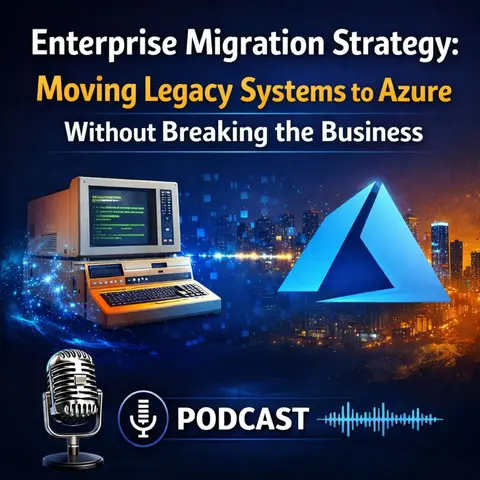
In summary, a strategic approach to migrating legacy systems to Azure is essential for minimizing disruptions and maximizing business value. You must assess your legacy systems, set clear objectives, and create a detailed migration roadmap. Choosing the right Azure services and tools will enhance your transition. After migration, continuously optimize your Azure environment for better performance and cost efficiency. Embrace cloud-native architecture to unlock the full potential of your cloud investments. To dive even deeper into this topic and hear real-world strategies for keeping your business operational during massive IT changes, be sure to check out the related podcast episode: Move Legacy Systems to Azure Without Disrupting Work.
Remember, successful migration is not just about moving data to the cloud; it is about transforming your business for a resilient, agile future.
FAQ
What is the best way to start migrating legacy systems to Azure?
Begin by assessing your current systems and application dependencies. Use assessment tools like Azure Migrate to understand cloud readiness. Then, build a comprehensive migration roadmap with clear objectives and stakeholder involvement.
How do I minimize downtime during migration?
Adopt a phased migration wave approach and conduct thorough pilot tests in a non-production staging environment to catch configuration issues early.
Should I choose IaaS or PaaS for my legacy applications?
Choose IaaS if your legacy applications require specific operating system versions, custom registry entries, or unique security configurations. PaaS is better suited for modernized apps that benefit from reduced infrastructure management.
How can I ensure security and compliance during migration?
Implement a strong governance framework featuring Role-Based Access Control (RBAC), the principle of least privilege, and continuous monitoring tools like Microsoft Defender for Cloud and Microsoft Sentinel.
What tools help monitor migration progress in real time?
Azure Monitor provides real-time telemetry, performance metrics, and log analytics, while Azure DevOps helps track project tasks and dependencies.
How do I measure migration success?
Track key performance indicators including system uptime, cost variances against baseline budgets, error rates, and user satisfaction scores gathered through structured UAT.
Can I optimize costs after migration?
Yes. Use Azure Cost Management to analyze spending trends, right-size underutilized virtual machines, and apply autoscaling policies to prevent overprovisioning.
What if unexpected issues arise during migration?
Maintain open communication channels with support teams, rely on pre-tested rollback plans, and use pilot test data to quickly troubleshoot and resolve bottlenecks.
🎧 Listen to this episode
Want a practical explanation of Move Legacy Systems to Azure Without Disrupting Work? This episode breaks down the topic in clear language and shows why it matters for Microsoft 365, Azure, Power Platform, security, AI, and modern work.
Listen to this episode if you want to:
- Understand the key concepts behind Move Legacy Systems to Azure Without Disrupting Work
- See how it fits into the wider Microsoft technology ecosystem
- Learn where it can create practical value for your organization
You may also enjoy these related M365 FM episodes:
- Microsoft Work IQ: The Intelligence Layer for Microsoft 365
- The Future of Work with Fabio Bonolo [MVP]
- Modernize Legacy Power Apps Portals and Power Pages
- Power Platform Governance Without Creating More Shadow IT
- Replace Legacy Middleware with Policy-Driven Architecture
Discover more practical Microsoft conversations on M365 FM.

Microsoft MVP | Host of M365.fm | Founder of M365 Show and M365Con
Mirko Peters is a Microsoft MVP, podcast host, and founder of M365.fm, M365 Show, and M365Con. His work connects Microsoft practitioners through podcast interviews, livestreams, and community events.
At M365.fm, Mirko hosts conversations with Microsoft MVPs, product experts, architects, and community contributors. Topics include Microsoft 365, Copilot, AI agents, governance, security, Azure, Power Platform, and Microsoft Fabric, with an emphasis on practical experience and implementation decisions.
M365.fm is the podcast and learning platform. M365 Show brings experts together for livestreams, while M365Con provides an online conference setting for community learning.
Official website: Mirko Peters (https://www.mirkopeters.com/). Recognition: Mirko Peters — Microsoft MVP profile (https://mvp.microsoft.com/de-DE/mvp/profile/9b0ca797-db5a-493a-a845-8b9158046cf5). Connect on LinkedIn (https://www.linkedin.com/in/m365showpodcast/).
Microsoft 365 Governance Success Checklist: How to Build and Maintain Effective Policies