
Best DLP Solution Comparison for 2026: Enterprise Guide
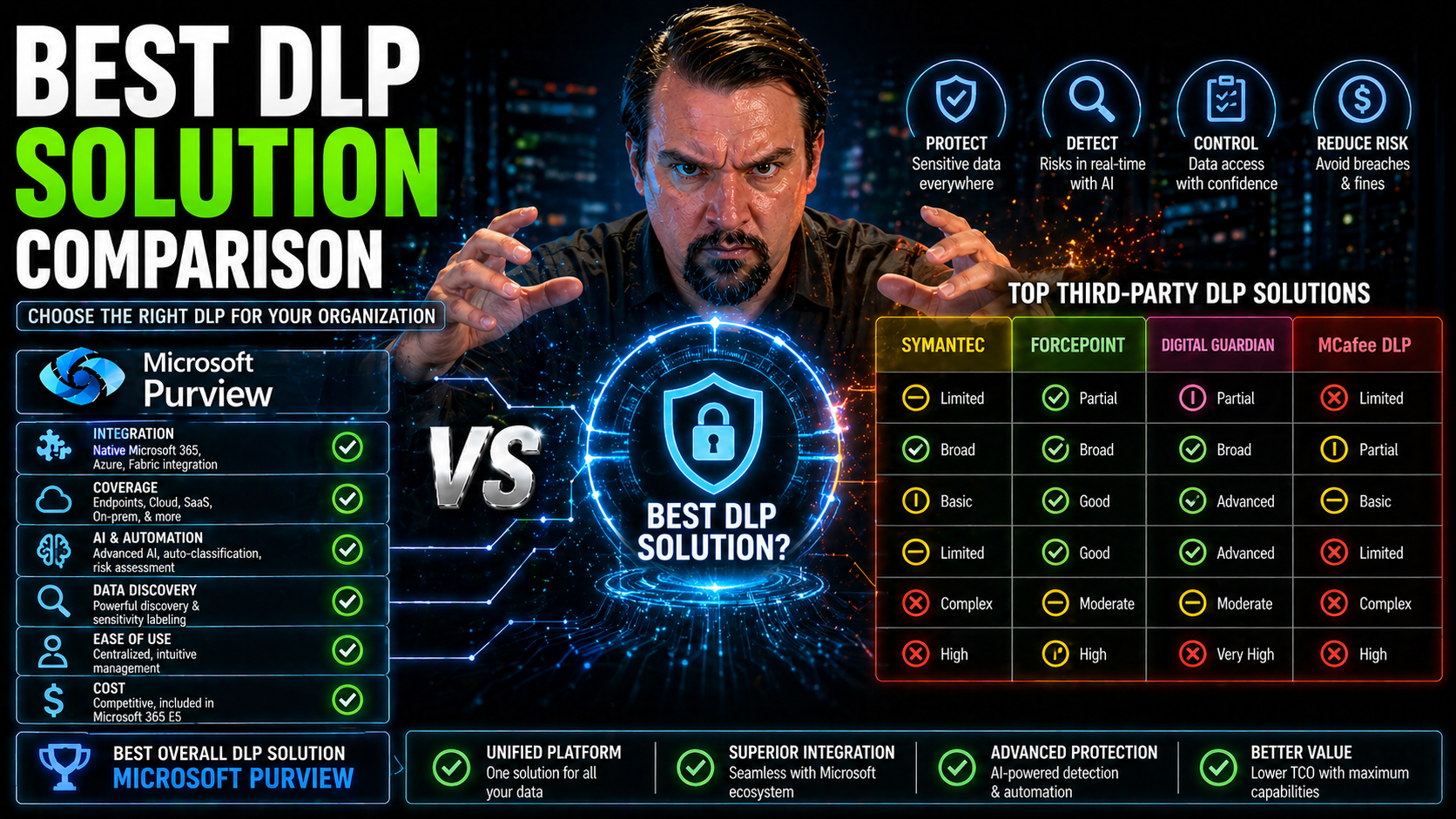
best DLP solution comparison requires a clear business scenario, validated security and data boundaries, and accountable ownership. Start with the intended outcome, test configuration and policy effects with representative users, document the decision and support process, then review the approach regularly as requirements and Microsoft 365 capabilities change.
best DLP solution comparison: practical checklist
- Define the scenario, owner, and decision criteria.
- Validate permissions, policy, security, and user impact.
- Test with a pilot and document support and review decisions.
Use Microsoft Learn for current guidance.
Last reviewed: July 2026.
Choosing the right Data Loss Prevention (DLP) solution in 2026 isn’t just about ticking off a compliance box—it’s about building real defense for your hybrid, cloud, and SaaS environments. With data sprawled across Microsoft 365, Azure, and endless SaaS apps, DLP is your first and last line of defense against data leaks, regulatory fines, and insider risks.
This guide zeroes in on what matters most to enterprises: true security coverage, meeting audit demands, and keeping your organization’s data safe even as boundaries vanish. Here, you’ll find side-by-side vendor evaluations, strengths and weaknesses, and buyer recommendations tailored for Microsoft-heavy organizations and anyone juggling both the cloud and the legacy world. If you’re serious about protecting sensitive data in an ever-evolving digital landscape, you’re in the right spot. Let’s get to the bottom of which DLP platform really delivers in 2026.
Top DLP Solutions in 2026: Vendor-by-Vendor Head-to-Head
The DLP marketplace isn’t what it was a few years ago. Legacy providers still hold ground, but there’s a new generation of cloud-native and AI-fueled DLP tools rising fast—and the lines between endpoint, network, and cloud protection are officially blurred. In 2026, it’s not about whether you have DLP but if your solution can actually keep up with hybrid work, SaaS, and smart adversaries.
In this section, you’ll get a high-level roadmap of where the DLP field stands today and where it’s heading. We’ll look at established market leaders like Proofpoint, Forcepoint, and Symantec (Broadcom) and weigh them against modern contenders such as Microsoft Purview, Trellix, and Fortra. Plus, we’ll dig into the next wave—vendors infusing their DLP with behavioral analytics and real AI, like Cyberhaven, Nightfall, and Concentric.
This comparison frames each solution in terms of deployment options, policy sophistication, ecosystem integration, and real-world usability for enterprises—so you can see beyond the marketing buzzwords and pinpoint which DLP matches your risk profile and operational needs. The details are unpacked vendor-by-vendor in the subsections below.
DLP Proofpoint, Forcepoint, and Symantec (Broadcom) Enterprise Leaders Compared
- Proofpoint DLPPrevention & Remediation: Proofpoint excels in people-centric risk detection, integrating with email, cloud, and endpoint channels. Its remediation workflows offer granular response options and deep incident insights that are valuable in regulated sectors.
- Deployment Scale: Well suited for global rollouts with mature endpoint agents and wide coverage across on-premises and cloud.
- Integration: Easily ties into SIEM, IAM, and Microsoft 365 ecosystems, making it flexible for complex enterprises.
- Weakness: UI can be complex, alert tuning requires fine-tuning, and initial rollout may be resource intensive.
- Forcepoint DLPPrevention & Remediation: Focused on behavioral analytics and deep content inspection, Forcepoint is strong at identifying insider threats, data movement, and context-aware policy controls.
- Deployment Scale: Supports hybrid infrastructure and high-throughput environments. Policy workflows and advanced analytics appeal to risk-conscious organizations.
- Integration: Native integrations with SASE, SIEM, and cloud connectors. Endpoint and web coverage is robust but sometimes requires layered deployments.
- Weakness: Steep learning curve, especially for policy configuration; reporting can feel dated without the right customization.
- Symantec DLP (Broadcom)Prevention & Remediation: Long respected for unmatched policy granularity, content matching, and compliance mapping—tailored for regulated enterprises.
- Deployment Scale: Widely deployed in large environments, offering deep endpoint, storage, and network data discovery.
- Integration: Tight hooks into Microsoft 365, cloud gateways, and on-prem infrastructure. Strong reporting for audits.
- Weakness: Can be heavy on infrastructure and management overhead, with upgrade cycles that lag behind nimble cloud vendors.
DLP Vendor Snapshots: Strengths and Weaknesses at a Glance
- Proofpoint: People-centric controls and strong email/cloud integration, but complex policy tuning and heavy reporting needs.
- Forcepoint: Superior behavioral analytics and insider risk tracking, though it requires dedicated staff to optimize policies and workflows.
- Symantec (Broadcom): Gold standard for compliance and content fingerprinting, but can be slower to adapt to cloud-first needs and may have higher operational overhead.
Cloud-Native DLP Solutions: Microsoft Purview, Trellix, and Fortra
- Microsoft Purview DLPCloud-Native Architecture: Deeply embedded in Microsoft 365, Azure, and Power Platform, Purview DLP leverages unified policies that stretch across Exchange, SharePoint, Teams, and external SaaS connectors.
- AI/ML Detection: Uses continuous learning and adaptive detection for sensitive info types, backed by Microsoft threat intelligence.
- SaaS & Multi-Cloud Integration: Flexible integration with Copilot, Power Platform, and advanced connector governance to close gaps across your hybrid, cloud, and SaaS stack.
- Cross-Platform Security: Policy enforcement and incident management unified for endpoints, cloud apps, and unmanaged devices.
- Trellix DLP (formerly McAfee)Cloud & Hybrid Strengths: Versatile DLP engine offering real-time protection across endpoints, networks, and data stored in the cloud.
- AI/ML Detection: Employs behavioral analysis to reduce false positives and surface risky user actions, making it adept in dynamic hybrid settings.
- Integration: Connects with a range of cloud apps and SIEM tools, but deeper SaaS integration is typically required for fine-grained controls.
- Fortra Digital GuardianGranular Classification: Known for agent-based architecture that offers advanced data discovery and context-sensitive protection, even for complex intellectual property and code repositories.
- Cloud-First Capabilities: Enhanced SaaS connectors and hybrid deployment options, including browser-level and file-based controls.
- Use Case Adaptability: Well suited for organizations with a need to cover endpoints, cloud apps, and sensitive business workflows in regulated industries.
Digital Guardian (Fortra) Versus Trellix and Purview DLP: Which Wins for Cloud Security?
- Microsoft Purview: Leads in seamless cloud-native integration with Microsoft 365 and Azure, making it the go-to for organizations running deep on Microsoft. Unified policy management and fast Power Platform DLP policy alignment boost compliance and operational efficiency.
- Fortra Digital Guardian: Stands out for granular, persistent data classification—even in mixed cloud and endpoint environments. Strong fit when IP protection is key.
- Trellix: Delivers robust hybrid coverage, but integration with SaaS is not as extensive as Purview. Excels in organizations that demand adaptive, cross-environment protection but aren’t fully in the Microsoft stack.
AI-Driven DLP Vendors: Cyberhaven, Nightfall, and Concentric Semantic Intelligence
- CyberhavenContextual Data Tracing: Tracks sensitive data throughout its lifecycle, even as it moves between apps, browser tabs, or cloud services. Spots exfiltration threats from insiders and browser-based GenAI tools.
- AI Analytics: Uses entity behavior analytics to detect abnormal user or system behavior indicative of insider threats or sensitive data misuse.
- Operational Fit: Ideal for companies prioritizing protection against shadow IT and GenAI browser risks. Integrates with Microsoft 365 for deeper cloud visibility.
- Nightfall AIGenAI & SaaS Threat Coverage: Specializes in API-first DLP for cloud apps, code repositories, SaaS, and GenAI risk points. Scans Slack, GitHub, Jira, and more for PII, PHI, or trade secrets leaks.
- Automated Remediation: Supports blocking, redaction, and alerting—reducing the noise and shortening incident response cycles.
- AI-Driven Detection: Leverages ML models to cut down false positives and deliver high detection accuracy, especially where volume and speed matter.
- Concentric Semantic IntelligenceData Sensitivity Mapping: Uses semantic analysis to auto-classify documents, emails, and data in cloud repositories—identifying risk based on how people use or share data, not just static keywords.
- Insider Threat Visibility: Offers unmatched transparency into who is accessing or sharing sensitive information, supporting advanced insider and GenAI governance.
- Integration: Can bolster weak spots in traditional DLP—especially valuable in environments where AI agents or Shadow IT are otherwise invisible.
How to Choose the Right DLP Solution for 2026
Narrowing down the best DLP solution isn’t just about chasing buzzwords or picking the most expensive product on the block. You need a strategy that fits your unique environment, risk profile, and compliance demands in 2026—especially if you’re running hybrid, cloud, or heavy SaaS workloads.
This section maps out the main factors you’ll need to consider: how to weigh detection depth, the importance of remediation workflows, deployment models that actually operate at the scale and pace of your business, and how each product covers data across endpoints, networks, and cloud apps. Integration with Microsoft 365, Azure, and modern identity stacks? That’s a must, not a nice-to-have.
As you dive deeper into detection, remediation, deployment, and coverage in the following subsections, keep your business goals front and center. Choosing DLP isn’t just a technical checkbox; it’s about finding the platform that will actually guard your critical data, satisfy auditors, and stay flexible as your tech stack evolves.
Detection, Remediation Depth, and Deployment Ops: Critical DLP Criteria
- Detection Accuracy and Techniques:Look for solutions with strong real-time inspection, leveraging both signature-based rules and machine learning for sensitive data types. The ability to distinguish true incidents from normal business activity will cut down on false positives and wasted effort.
- Evaluate detection beyond simple pattern matches—does the DLP detect and understand context, such as sharing behaviors or suspicious GenAI use? This depth enables it to catch previously unseen threats.
- Remediation Flexibility and Automation:You need customizable incident workflows: options from alerting to automatic quarantines, tailored by sensitivity, user risk, and compliance requirements. Automation is what keeps your security team from drowning in manual reviews.
- Advanced platforms also offer integrated remediation in business-critical tools (like Microsoft 365 or Power Platform), speeding up incident response and minimizing impact. For detailed recommendations, see hidden risk and remediation moves for Power Platform DLP.
- Deployment and Ops Agility:Seek platforms with flexible deployment models—API-based, agent-based, or hybrid—matching your user base and device mix. Consider the operational burden: can you roll out without breaking productivity, or will a legacy install tie you down for months?
- Rapid policy updates, clear dashboards, and vendor support are must-haves to keep the program running smoothly as threats and business needs evolve.
Endpoint, Network, Cloud: Coverage, Connectors, and Blind Spot Reduction
Modern DLP coverage should extend beyond traditional endpoints to include networks, cloud services, and SaaS applications. Endpoint coverage relies on lightweight agents or agentless integrations capable of monitoring data movement locally, even when devices are offline or unmanaged.
In the network sphere, DLP tools inspect data in motion—scanning everything from email attachments to content uploaded to web services. Policy enforcement here is critical for flagging or stopping risky transfers before a breach occurs.
Cloud and SaaS DLP take things further, integrating with services like Microsoft 365, Google Workspace, and major SaaS APIs to detect policy violations in platforms where unstructured data lives. Coverage connectors are prebuilt or API-based integrations that close blind spots across these multi-cloud landscapes.
Eliminating blind spots means your DLP should discover and control data flows everywhere: endpoints, networks, and across all cloud workloads. In Microsoft 365-heavy organizations, leveraging Cloud App Security or Purview-driven content management helps centralize policies, govern Shadow IT, and keep regulatory and audit requirements in sight, even as users adopt new apps and sharing behaviors.
DLP for Compliance, Risk Reduction, and Insider Threat Defense
Getting a DLP solution isn’t just about checking a compliance box for PCI DSS, HIPAA, or GDPR. It’s about lowering your organization’s real-world data risk—especially as insider threats and AI-powered data movements grow harder to spot. The right DLP platform anchors your regulatory reporting, but it also acts as your best early warning system for subtle or novel attempts to exfiltrate sensitive data.
This section explores how DLP maps to compliance frameworks, automates evidence collection and reporting, and arms you against data loss through both human error and malicious intent. You’ll see how incident monitoring, response workflows, and modern behavioral analytics combine to keep your data locked down—no matter if attackers are insiders, bots, or AI agents driven by misconfigured permissions.
With Microsoft ecosystems and hybrid environments in mind, these next subsections break down how DLP directly enables your compliance and risk reduction playbook, with practical tips and integrations from Power Platform to Azure and beyond.
Reporting Compliance and Regulatory Incidents: Meeting Requirements with DLP
- Comprehensive Monitoring and Logging:Modern DLP tools deliver detailed audit logs and activity trails—meeting regulatory mandates for PCI DSS, HIPAA, GDPR, and beyond. This means every policy violation, access event, and incident is recorded, timestamped, and ready for auditors to scrutinize.
- Integrating DLP logs with platforms like Microsoft Purview Audit ensures you capture user actions across Exchange, SharePoint, Teams, and other Microsoft cloud services.
- Automated Compliance Reporting:Leading DLP platforms create compliance-ready reports at the push of a button. Whether it’s GDPR data subject access requests or HIPAA breach notification reports, your team stays ready for legal, customer, or regulatory audits.
- Customizable dashboards allow you to track progress and quickly demonstrate policy adherence to internal or external stakeholders.
- Rapid Incident Response:Immediate alerting streamlines your regulatory incident response plans, stopping data leaks before they become reportable events. Built-in triggers match regulatory notification windows (like 72 hours for GDPR), keeping your compliance posture defensible.
- Automated response features integrate with Microsoft Sentinel and Power BI, providing real-time metrics and leadership visibility that go far beyond periodic audits or manual tracking.
DLP Risk Reduction: Defending Against Insider and GenAI Data Leaks
- User and Behavioral Analytics:Today’s DLP leverages AI-powered analytics to spot risky behavior—like abnormal file sharing, privilege escalation, or GenAI-powered exports. This approach identifies suspicious trends and enables you to intervene before a problem turns into a breach.
- Contextual risk scoring surfaces the true priorities for incident response, so your team doesn’t drown in noise.
- GenAI and Shadow IT Governance:DLP now must protect against novel threats—like AI agents or unauthorized bots scooping up sensitive information from SharePoint, Teams, or OneDrive. Centralized policy control, enriched by solutions that detect AI-driven Shadow IT, closes this risk gap.
- Boundary enforcement, runtime monitoring, and connector governance keep next-generation automation from sneaking sensitive data out the back door.
- Proactive Insider Threat Mitigation:Behavioral baselining helps you spot insiders moving data in ways that don’t match their job functions. Combine this with adaptive policy enforcement—like requiring just-in-time access reviews or segmenting high-risk users—and you shrink exposure windows while keeping business moving.
- Automated blocking or redaction delivers instant containment when risks are detected, and these playbooks can be extended across your Microsoft and multi-cloud stack.
Modern DLP Platform Technology and Architecture Deep Dive
The nuts and bolts of DLP platforms have changed drastically. Today’s best tools blend advanced data discovery, granular classification, adaptive inspection, and policy enforcement—all while integrating tightly with Microsoft 365, Azure, and broader security ecosystems. From cloud-first design to cross-platform connectors, your DLP shouldn’t just monitor the old ways data moves—it has to evolve with how your organization works now.
In this section, we unpack the building blocks of modern DLP: how data is discovered and classified, what makes content inspection effective, and which features matter most for policy enforcement in real environments. We also look at the power of integration—especially with Microsoft’s own security stack, SASE, SIEM, and hybrid platforms.
If you’re a security architect sizing up fit for your Microsoft-heavy estate or need assurance that your next DLP will work seamlessly across hybrid and multi-cloud, this is where you’ll find the answers.
Data Prevention (DLP): Classification, DLP Tool Functions, and DLP Software Explained
- Data Discovery and Classification:The first step of any DLP tool is to automatically discover and classify sensitive information across your endpoints, cloud storage, and SaaS applications. Most solutions use a mix of static pattern matching and adaptive, context-aware algorithms to flag PII, PCI, ePHI, and custom data types—aligning with policy frameworks and compliance needs.
- Platforms like Microsoft Purview and Digital Guardian offer multi-tiered classification, so your policies can reflect the actual business impact of exposure. See how environment strategy and connector governance shape this step in Microsoft Power Platform.
- Content Inspection and Policy Enforcement:Granular content inspection (from scanning attachments to real-time data in transit) enables immediate enforcement based on matched policies. These can range from blocking risky shares to auto-encrypting sensitive files before sending externally.
- Advanced tools support policy-based controls with dynamic triggers, thresholds, and user conditions, so enforcement is contextually relevant—not just binary.
- Tool Functions and Differentiators:Some DLP solutions act as a central console, tying together incident management, compliance tracking, and remediation playbooks. Others, particularly cloud-native products, are API-based with deep integrations across your modern stack.
- Evaluating whether you need agent-based, agentless, or hybrid coverage is crucial; each model fits different risk tolerances and operational realities.
Unified DSPM DLP Integration and Expansion to Hybrid, SASE, SIEM Ecosystems
Leading DLP solutions in 2026 are not standalone tools; they serve as integral parts of a unified security ecosystem. Integration with Data Security Posture Management (DSPM) platforms enhances risk visibility by contextualizing DLP findings with broader cloud security insights. This approach ensures sensitive data is protected, no matter where it lives or travels.
DLP platforms also connect with Security Information and Event Management (SIEM) systems, enabling centralized alerting, forensic analysis, and compliance reporting. By linking DLP with Microsoft Sentinel, Splunk, or other SIEM tools, organizations can rapidly triage threats while meeting audit requirements.
In hybrid and SASE (Secure Access Service Edge) environments, DLP must extend controls to remote endpoints and cloud perimeters. Integration with identity platforms (like Entra ID, Okta, or Azure AD) and enforcement of zero trust policies further refine who can access or move data, plugging gaps other tools might leave open. For real-world strategies on Azure operations and zero trust, see Azure enterprise governance and Zero Trust by Design in Microsoft 365.
Unified, adaptive DLP integration ensures enterprises can monitor, report, and remediate—even as infrastructures stretch across legacy, cloud, and evolving digital business boundaries.
Overcoming Challenges and Limitations of DLP Tools
Let’s be honest: rolling out or managing DLP is never just plug-and-play, especially for big enterprises juggling cloud, SaaS, and legacy systems. High false positive rates make security teams tune out, while over-complex rules can turn a promising DLP project into a paperwork nightmare.
This section arms you with the right mindset and tools to anticipate those headaches—whether it’s alert fatigue, runaway incident queues, or deployment drag. You’ll get practical insights for reducing noise, smoothing ops, and keeping your DLP running without blowing up business-as-usual.
The next two parts dig into sharp, actionable best practices: how to tame false positives and alert overload, and how to launch new DLP tools in production without tripping over operational roadblocks. Let’s turning DLP complexity into clarity—and maybe spare your team a few ulcers.
Managing False Positives, DLP Alert Fatigue, and Complexity
- Use Machine Learning and Baseline Tuning: Fine-tune detection with AI and user-centric baselines—this reduces false alerts triggered by everyday work patterns.
- Curate Rules Thoughtfully: Avoid “catch all” policies; invest in rules that actually reflect real business behavior. Start narrow, expand based on real incidents.
- Automate Incident Playbooks: Route low-risk violations through automated responses (like in-product messaging), freeing human analysts for the real risks. This keeps focus where it matters.
Deploying DLP Solutions Without Disruption: Operational Best Practices
- Pilot and Phase Your Rollout: Start with a limited pilot, gather feedback, and gradually expand. Quick wins build confidence and help tune policies in real scenarios.
- User Training and Communication: Keep employees in the loop—make DLP an enabler, not a blocker. Clear guidelines cut down accidental violations and user pushback.
- Lifecycle and Access Management: Integrate DLP with identity processes—review guest access, automate expirations, and enforce offboarding to avoid lingering risks. For best practices, see managing Microsoft 365 guest accounts securely through full lifecycle governance.
DLP Solution Performance Benchmarks: Detection Accuracy, Latency, Scalability
If a DLP solution grinds your apps to a halt or drowns you in alerts, it doesn’t matter how fancy the tech is. For big enterprises—especially those distributed globally or running thousands of endpoints—what actually counts is how DLP performs under load.
This section centers on hard evidence: actual, third-party validated benchmarks that help you see beyond the marketing and get the numbers on detection accuracy, false positive rates, latency, and efficiency at enterprise scale.
What’s coming next? Direct comparisons using public and independent lab results, plus a look at how each top platform holds up under heavy throughput and global rollout scenarios. These details turn theory into practice and reveal the gaps competitors won’t mention.
Independent Testing and Benchmark Comparisons for DLP Solutions
Recent third-party lab tests, such as NSS Labs and MITRE ATT&CK evaluations, underscore big differences in real-world detection rates across DLP platforms. In independent tests, Microsoft Purview DLP and Symantec (Broadcom) scored above 97% for policy-driven detection in Microsoft 365 and enterprise email use cases, while Proofpoint and Forcepoint scored 92-95% in both cloud and on-prem environments. Nightfall AI and Cyberhaven, fast-moving newcomers, held detection true positive rates above 94% for GenAI and SaaS code repo scans, outpacing legacy tools in API-first detection. Across the board, solutions embedding ML- and context-aware analytics reported lower false positive rates and tighter policy enforcement than those reliant on static, rule-based matching alone.
Latency, Scalability, and System Impact: Real-World DLP Solution Metrics
Performance under pressure matters. For high-throughput cloud environments, Microsoft Purview and Trellix DLP maintained sub-100ms latency for in-line policy responses, according to independent testing. Symantec and Fortra Digital Guardian posted scalable performance, supporting up to 25,000 concurrent monitored endpoints with less than 8% CPU utilization per device. SaaS-centric DLPs like Nightfall and Concentric showed rapid policy enforcement (<50ms) in cloud API calls with nearly linear scaling in multi-tenant global deployments. In short, cloud-native and API-based DLPs outperformed heavyweight on-premises installs when rapid scale-out and low latency were required.
Frequently Asked Questions About DLP Solutions in 2026
No matter how many features a vendor can rattle off, experienced buyers know the real questions hit on necessity, deployment friction, integration, and actual value in a Microsoft-first landscape. In this section, you’ll find answers to the DLP questions that come up most often from enterprise IT, security leaders, and compliance teams gearing up for a 2026 rollout.
The focus isn’t just on “can it work,” but on “will it make us safer, will it play nice with our stack, and will it stand up to auditors if the worst happens?” You won’t find marketing fluff here—only operational, technical, and business-centered clarity for DLP buyers and implementers. With Microsoft 365, Azure, and cloud-native architectures as the backdrop, the following practical FAQ gives you the perspective needed for confident final evaluations and next steps.
Frequently Questions DLP: Answers to What Matters Most
- Is DLP a must-have for cloud-first enterprises in 2026?Absolutely. Data’s no longer locked in four walls; sensitive info spreads across endpoints, SaaS, and everywhere users connect. DLP is critical for detecting policy violations, meeting regulatory needs, and stopping leaks—especially as compliance drift in Microsoft 365 exposes blind spots that “perimeter-only” models miss.
- How tough is it to deploy DLP in hybrid Microsoft and multi-cloud?Modern solutions like Microsoft Purview offer native integration for minimal friction, but legacy platforms may require phased rollouts, custom connectors, and up-front policy tuning. Expect a smoother ride if you leverage built-in compliance, role scoping, and connector governance—especially for mixed SaaS, endpoint, and Power Platform environments.
- What integration pain points trip up most DLP projects?Poor synchronization with identity platforms (Azure AD, Okta), limited API coverage for SaaS, and ungoverned guest access all surface as pain points. Choosing a DLP that plays nicely with Microsoft Purview, Sentinel, and Entra ID eases management and reduces future configuration gaps.
- Can DLP catch advanced insider threats and GenAI-driven data leaks?Yes, but only if your platform supports entity and behavioral analytics. AI-driven DLPs, like those from Cyberhaven and Concentric, spot abnormal sharing, shadow IT, and bots hiding behind human identities—areas where traditional controls and static rules might miss the mark.
- How do you prove compliance to legal and audit teams?Leverage DLP audit logs, incident reports, and monitoring dashboards. Use advanced logging tiers (like Microsoft Purview Audit Premium) to retain evidence and map user actions—proving policy enforcement and reducing reliance on manual compliance checks.
The Bottom Line: Recommendations and Key Takeaways for DLP Buyers
When you’re picking the best DLP solution for 2026, start by thinking about your environment. If you run on Microsoft 365 or Azure, Microsoft Purview stands out for its seamless integration and governance capabilities—especially handy for managing connectors and Copilot risk. Get a deeper look at these controls in this guide on advanced Copilot governance with Microsoft Purview.
For organizations with complex cloud and hybrid needs, leaders like Trellix, Fortra Digital Guardian, and Symantec (Broadcom) still stand tall thanks to their mature detection, robust policy engines, and wide coverage. Want AI-driven, real-time data detection? Cyberhaven and Nightfall both deliver next-gen intelligence, especially for fast-moving endpoints, source code, and SaaS integrations.
Before you sign any contract, dig into independent DLP performance benchmarks—including detection accuracy, false positive rates, scalability, and latency under load. Those hard numbers are worth more than shiny marketing pages, since real-world impact trumps buzzwords every time.
Finally, don’t overlook identity integration or DevSecOps coverage. DLP tools that link with IAM (like Okta or Azure AD) and source control platforms (like GitHub/GitLab) can spot and shut down data leaks—before they ever see daylight. To keep up to date, check out additional resources to learn more on this subject and strengthen your compliance and security game in the Microsoft ecosystem.
🎧 You Should Also Listen To
- Identity Governance in Microsoft Entra
Learn access and lifecycle controls.
- Microsoft Purview – Simply Explained
Explore protection and compliance context.
- Microsoft 365 Governance Operating Model
Understand sustainable ownership and decisions.

Microsoft MVP | Host of M365.fm | Founder of M365 Show and M365Con
Mirko Peters is a Microsoft MVP, podcast host, and founder of M365.fm, M365 Show, and M365Con. His work connects Microsoft practitioners through podcast interviews, livestreams, and community events.
At M365.fm, Mirko hosts conversations with Microsoft MVPs, product experts, architects, and community contributors. Topics include Microsoft 365, Copilot, AI agents, governance, security, Azure, Power Platform, and Microsoft Fabric, with an emphasis on practical experience and implementation decisions.
M365.fm is the podcast and learning platform. M365 Show brings experts together for livestreams, while M365Con provides an online conference setting for community learning.
Official website: Mirko Peters (https://www.mirkopeters.com/). Recognition: Mirko Peters — Microsoft MVP profile (https://mvp.microsoft.com/de-DE/mvp/profile/9b0ca797-db5a-493a-a845-8b9158046cf5). Connect on LinkedIn (https://www.linkedin.com/in/m365showpodcast/).




