Mastering Azure API Management: Core Components Explained
In today's fast-paced digital ecosystem, APIs are the invisible glue holding modern applications and services together. Whether you are building mobile apps, powering web solutions, or integrating internal systems, APIs facilitate the seamless exchange of data. However, as organizations scale their digital transformation programs, managing, securing, and scaling these digital touchpoints can quickly become overwhelming. This is where robust platform tooling becomes indispensable, allowing developers and administrators to streamline their workflows without sacrificing security or performance.
To truly master the art of API orchestration in the cloud, one must understand how Azure API Management (APIM) operates under the hood. By utilizing a centralized platform, enterprises can publish, govern, and secure their interfaces at scale while delivering an exceptional experience for both internal teams and external partners. In this post, we will take a deep dive into the core architecture of Azure API Management, exploring how its foundational pillars work in harmony to drive efficiency, enhance security, and reduce operational overhead.
Introduction to Azure API Management
Azure API Management is a comprehensive, turnkey solution designed to help organizations publish, secure, transform, maintain, and monitor APIs. At its core, APIM acts as a secure facade or proxy between backend services and frontend clients. Whether your backend services are hosted on-premises, running in Azure virtual networks, or deployed across multi-cloud environments, APIM provides a single entry point that abstracts the underlying infrastructure complexity from the end user.
In modern software engineering, the challenges associated with APIs go far beyond simple routing. Teams must contend with version control, rate limiting, authentication, authorization, analytics, and documentation. Azure API Management addresses these operational burdens head-on. By centralizing your API inventory, you eliminate redundant tooling, improve discoverability, and enforce consistent organizational compliance policies across all endpoints. As businesses increasingly shift toward API-first development architectures, understanding how to configure and leverage APIM is a critical skill for platform engineers, architects, and developers alike.
The API Gateway: Handling Traffic and Security
The API Gateway serves as the frontline defender and traffic manager for your entire API ecosystem. Every incoming request from a client application first hits the API Gateway before it is ever allowed to touch your backend services. This architecture decouples the client from the implementation details of your microservices, allowing you to refactor or migrate backend systems without breaking client applications.
Operationally, the API Gateway performs several vital functions simultaneously:
- Request Routing: It inspects incoming HTTPS requests and directs them to the correct backend service based on URL paths, query parameters, or HTTP methods.
- Authentication and Authorization: It validates credentials such as API keys, JSON Web Tokens (JWTs), and client certificates before allowing traffic to pass through.
- Rate Limiting and Quotas: It enforces usage limits to protect backend services from being overwhelmed by sudden traffic spikes or malicious denial-of-service attempts.
- Response Caching: By caching responses directly at the gateway level, it drastically reduces latency and minimizes the processing load on downstream backend servers.
- Policy Enforcement: It applies transformative policies that can modify request headers, rewrite URLs, or convert data formats (such as XML to JSON) on the fly.
By delegating these cross-cutting concerns to the API Gateway, backend developers are freed from writing repetitive security and validation logic inside their microservices. The gateway ensures that traffic is inspected, authenticated, and optimized before it ever reaches your core business logic.
The Management Plane: Governance and Configuration
While the API Gateway handles the real-time execution of traffic, the Management Plane is the control center where administrators configure, govern, and oversee the entire API ecosystem. This component gives platform engineers full access to the operational capabilities of the APIM service.
Through the Management Plane, administrators can:
- Provision and scale the API Management service tiers according to demand.
- Import and define API schemas using industry-standard formats like OpenAPI (Swagger) and WSDL.
- Package individual APIs into curated products, making it easier to bundle related services for specific consumer groups.
- Establish granular policies that dictate how quotas, rate limits, caching, and payload transformations are applied across different endpoints.
- Monitor usage metrics, error rates, and latency through integrated analytics dashboards to make data-driven decisions.
- Manage user accounts, administrator permissions, and app developer lifecycles.
The Management Plane ensures that organizational governance is maintained across all environments. By enforcing centralized control over schema definitions and security policies, organizations can prevent configuration drift and maintain strict compliance standards as their API catalog expands.
The Developer Portal: Empowering API Consumers
An API is only as good as its adoption rate. Even the most secure and high-performing API will fail if developers find it difficult to understand, test, or integrate. The Developer Portal addresses this challenge by providing a self-service, out-of-the-box web portal designed specifically for API consumers.
The Developer Portal acts as a centralized catalog where developers can discover available APIs, read automatically generated documentation, and test endpoints interactively using an integrated console. Key features of the portal include:
- Centralized Discovery: A clean, searchable interface for finding internal and external APIs.
- Interactive Documentation: Automatically generated guides based on imported schemas that explain request parameters, headers, and expected response codes.
- Self-Service Onboarding: Developers can sign up, create accounts, and obtain subscription keys without requiring manual intervention from platform administrators.
- Customizable Branding: Organizations can tailor the portal’s look, feel, and domain name to match their corporate brand identity.
By streamlining the developer onboarding experience, organizations can significantly shorten time-to-market for new applications and encourage higher reuse of existing services across different business units.
Practical Benefits and Use Cases
Adopting Azure API Management yields measurable improvements in security, operational productivity, and cost optimization. From an engineering perspective, teams save countless hours by eliminating the need to build custom proxy layers, authentication handlers, and rate-limiting logic from scratch. Studies show that organizations utilizing APIM experience up to a 30% increase in API development efficiency and a drastic reduction in time-to-market for new digital initiatives.
Common real-world use cases for Azure API Management include:
- Microservices Orchestration: Acting as the central gateway for distributed microservices architectures, managing east-west and north-south communication securely.
- Partner Integrations: Exposing secure endpoints to external B2B partners with granular rate limits, usage tracking, and token-based authentication.
- API Monetization: Packaging APIs into paid tiers and enforcing usage quotas to generate new revenue streams.
- Legacy Modernization: Wrapping older SOAP services or legacy mainframe systems in modern RESTful facades without rewriting backend code.
These scenarios highlight how APIM serves as a flexible catalyst for enterprise innovation, enabling companies to safely expose their core capabilities to the world.
Conclusion and Future Trends
Azure API Management is a foundational pillar for any modern organization looking to scale its digital infrastructure, secure its data, and empower its developers. By separating concerns across the API Gateway, Management Plane, and Developer Portal, Azure provides a holistic platform that addresses the needs of administrators, developers, and API consumers alike. Whether you are managing a handful of internal microservices or orchestrating thousands of partner integrations globally, APIM delivers the security, scalability, and visibility required to succeed.
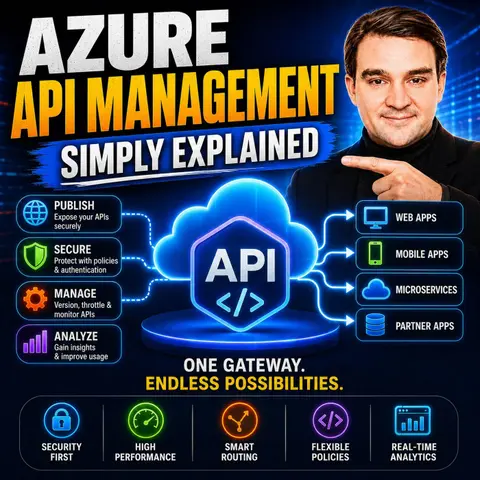
As we look toward the future, the API management landscape continues to evolve rapidly. Emerging trends point toward AI-driven automation tools that will proactively optimize API design and security policies, alongside deeper integrations with zero-trust network architectures. Embracing these advanced capabilities today will ensure your organization remains agile, secure, and competitive in an increasingly connected world. To hear a practical breakdown of these concepts and explore how they apply to the broader Microsoft ecosystem, be sure to listen to the related podcast episode: Azure API Management - Simply Explained.

Microsoft MVP | Host of M365.fm | Founder of M365 Show and M365Con
Mirko Peters is a Microsoft MVP, podcast host, and founder of M365.fm, M365 Show, and M365Con. His work connects Microsoft practitioners through podcast interviews, livestreams, and community events.
At M365.fm, Mirko hosts conversations with Microsoft MVPs, product experts, architects, and community contributors. Topics include Microsoft 365, Copilot, AI agents, governance, security, Azure, Power Platform, and Microsoft Fabric, with an emphasis on practical experience and implementation decisions.
M365.fm is the podcast and learning platform. M365 Show brings experts together for livestreams, while M365Con provides an online conference setting for community learning.
Official website: Mirko Peters (https://www.mirkopeters.com/). Recognition: Mirko Peters — Microsoft MVP profile (https://mvp.microsoft.com/de-DE/mvp/profile/9b0ca797-db5a-493a-a845-8b9158046cf5). Connect on LinkedIn (https://www.linkedin.com/in/m365showpodcast/).
Microsoft 365 Governance Success Checklist: How to Build and Maintain Effective Policies