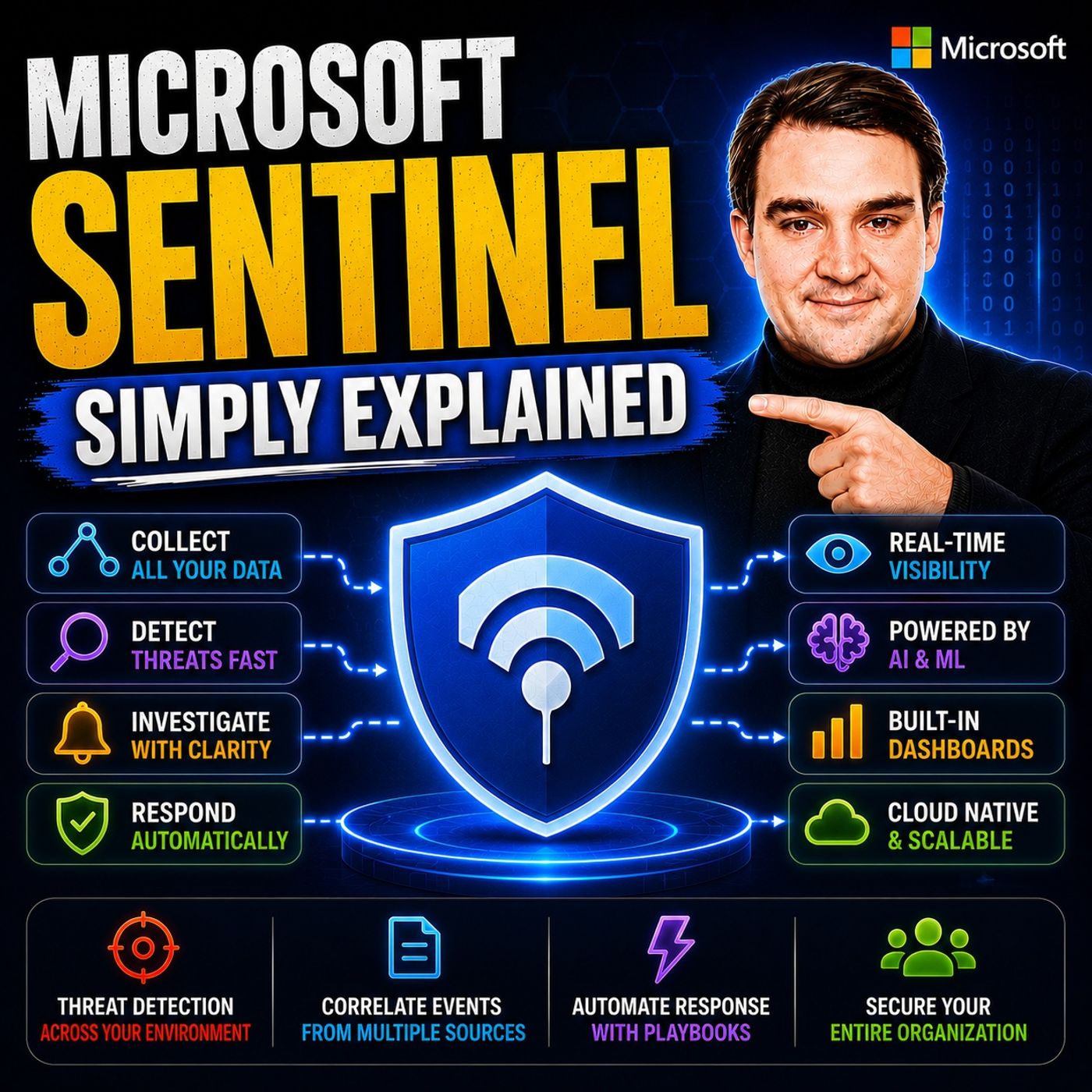
Maximizing ROI and Efficiency with Microsoft Sentinel
Welcome back to the podcast companion blog, where we dive deeper into the tools and technologies transforming modern IT and security landscapes. In today's post, we are exploring one of the most powerful advancements in enterprise defense: Microsoft Sentinel. If you have ever wondered how transitioning to a modern, cloud-native approach can radically transform your bottom line and your team's daily workload, you are in the right place. We will unpack how organizations are achieving a staggering 134% return on investment and slicing their investigation times by up to 85%.
As cyber threats grow increasingly sophisticated, legacy security tools simply cannot keep up. Traditional security information and event management systems often leave organizations drowning in noise, weighed down by heavy infrastructure costs, and restricted by slow processing limits. This blog post explores the financial and operational benefits of transitioning to a cloud-native SIEM and SOAR platform, breaking down everything from data lake architectures to flexible pricing models. Let us jump right into how Microsoft Sentinel redefines enterprise security.
Introduction to Cloud-Native Security
For decades, managing enterprise security meant maintaining expensive on-premises hardware, managing complex database configurations, and dealing with siloed information that made holistic threat hunting nearly impossible. The paradigm shift toward cloud-native security changes everything. By removing infrastructure management from the equation, cloud-native platforms offer instant scalability, global reach, and seamless updates that keep pace with modern threat actors.
Microsoft Sentinel represents the pinnacle of this evolution. As a cloud-native Security Information and Event Management (SIEM) and Security Orchestration, Automation, and Response (SOAR) platform, it gives organizations the agility they need. Instead of spending valuable hours provisioning servers and managing storage limits, security teams can focus entirely on what matters most: protecting data, hunting threats, and responding to incidents. This foundational shift lays the groundwork for unprecedented financial and operational gains.
The Financial Impact: Achieving a 134% ROI
When presenting technology upgrades to executive boards and financial decision-makers, the conversation almost always turns to return on investment. Security is often viewed as a cost center rather than a revenue driver, making it crucial to demonstrate tangible financial value. Studies and real-world implementations of Microsoft Sentinel consistently reveal a remarkable 134% ROI over a three-year period.
Where does this impressive financial return come from? First, organizations eliminate the heavy capital expenditures associated with purchasing, housing, and maintaining physical SIEM infrastructure. Second, the reduction in false positives and manual tasks drastically lowers the labor costs tied to alert triage. Security analysts spend less time chasing ghosts and more time addressing legitimate risks. Furthermore, by consolidating multiple disparate point solutions into a single, unified platform, organizations save significantly on licensing, maintenance, and administrative overhead, driving down the total cost of ownership.
Operational Efficiency: Reducing Investigation Time by 85%
Time is the most critical currency in cybersecurity. The faster a security team can detect, investigate, and remediate a threat, the smaller the potential blast radius of an attack. Traditional security tools often trap analysts in swivel-chair operations, forcing them to manually copy and paste data across multiple dashboards to piece together an attack chain. This fragmented approach slows down investigations and allows adversaries to move laterally.
Microsoft Sentinel changes the game by delivering an astonishing 85% reduction in investigation time. This massive efficiency gain is achieved through automated context gathering, visual relationship mapping, and AI-driven threat analytics. When an incident is flagged, Sentinel automatically enriches the alert with relevant contextual data from across the enterprise ecosystem. Analysts are presented with a clear, visual representation of the attack scope, enabling them to understand root causes and take corrective action in minutes rather than hours or days.
Core Capabilities of Microsoft Sentinel
The secret behind Sentinel’s impressive performance lies in its robust set of core capabilities designed for the modern enterprise. At its foundation, the platform features over 350 out-of-the-box data connectors. This means organizations can effortlessly ingest telemetry from users, devices, applications, and multi-cloud environments—including non-Microsoft sources—without writing custom integration scripts.
Beyond simple log collection, Sentinel leverages advanced graph analytics to model complex relationships across enterprise assets and activities. By visualizing these connections, security operations centers gain deep visibility into sophisticated attack patterns that would otherwise slip past traditional signature-based detection mechanisms. Coupled with natural language query interfaces and automated playbooks, these core capabilities empower security teams to operate with unprecedented speed, precision, and confidence.
Leveraging the Unified Data Lake for Cost Savings
One of the most frequent pain points in traditional SIEM architecture is the prohibitive cost of storing and analyzing massive volumes of security data. Organizations are often forced to choose between maintaining complete visibility and staying within budget, frequently deleting valuable logs simply to save on storage fees. Microsoft Sentinel solves this dilemma through its powerful Unified Data Lake architecture.
The Unified Data Lake provides a fully managed, cost-effective repository where organizations can store vast amounts of security data for long-term investigations and compliance requirements. Because it supports multi-modal analytics on a single copy of data, teams can run complex queries and leverage machine learning models without triggering expensive data duplication or cumbersome extraction processes. This architectural breakthrough not only drops storage costs dramatically but also breaks down organizational silos, ensuring that your security team has instant access to historical context whenever a threat emerges.
Understanding the Pay-Per-Ingestion Pricing Model
Navigating software licensing can be a daunting task, but Microsoft Sentinel keeps things straightforward with a predictable, consumption-based pricing structure. Sentinel operates on a pay-per-data ingestion model, meaning your costs directly correlate with the volume of data you bring into the platform daily, measured in gigabytes.
While this model offers incredible flexibility—allowing smaller organizations to scale costs up or down based on actual usage—it also requires proactive cost management. To help enterprises optimize their spending, Microsoft offers commitment tiers, such as capacity reservation plans, which provide steep discounts compared to standard pay-as-you-go rates. By carefully reviewing your log sources, filtering out unnecessary noise before ingestion, and setting appropriate data retention policies, you can harness the full power of Sentinel while maintaining tight control over your operational budget.
Best Practices for Maximizing Sentinel Potential
Implementing a new SIEM and SOAR platform is a major milestone, but realizing its full value requires a strategic approach. To ensure your organization extracts every ounce of efficiency from Microsoft Sentinel, consider adopting these proven best practices:
- Invest in Team Training: Ensure your security analysts receive thorough training on Sentinel’s query language, automation playbooks, and investigation tools so they can utilize the platform to its fullest extent.
- Fine-Tune Detection Rules: Regularly review and customize your detection rules and alert thresholds to minimize false positives and prevent alert fatigue among your analysts.
- Optimize Data Ingestion: Audit your data connectors regularly to ensure you are only ingesting high-value security telemetry, utilizing commitment tiers to secure the best pricing rates.
- Leverage Automation Early: Implement SOAR playbooks for routine remediation tasks immediately, freeing up your skilled professionals to focus on proactive threat hunting and complex incident response.
By following these guidelines, you can streamline your deployment, accelerate your time-to-value, and build a resilient security posture that adapts to emerging threats.
Conclusion
Transitioning to a cloud-native security operations platform is no longer just an IT preference—it is a strategic business necessity. As we have explored throughout this article, Microsoft Sentinel empowers organizations to transcend the limitations of legacy SIEMs through its unified data lake, automated incident response, and advanced AI-driven threat detection. The financial and operational payoffs are undeniable, evidenced by a remarkable 134% ROI and an 85% reduction in investigation times that directly protect your organization's bottom line and reputation.
If you want to dive deeper into how these concepts translate into real-world scenarios and discover practical strategies for securing your Microsoft 365 environment, be sure to check out the related podcast episode: Microsoft Sentinel - Simply Explained. In that episode, we break down everything you need to know in clear, actionable language. Tune in today to elevate your understanding of modern cybersecurity and take the next step toward a resilient enterprise defense!

Microsoft MVP | Host of M365.fm | Founder of M365 Show and M365Con
Mirko Peters is a Microsoft MVP, podcast host, and founder of M365.fm, M365 Show, and M365Con. His work connects Microsoft practitioners through podcast interviews, livestreams, and community events.
At M365.fm, Mirko hosts conversations with Microsoft MVPs, product experts, architects, and community contributors. Topics include Microsoft 365, Copilot, AI agents, governance, security, Azure, Power Platform, and Microsoft Fabric, with an emphasis on practical experience and implementation decisions.
M365.fm is the podcast and learning platform. M365 Show brings experts together for livestreams, while M365Con provides an online conference setting for community learning.
Official website: Mirko Peters (https://www.mirkopeters.com/). Recognition: Mirko Peters — Microsoft MVP profile (https://mvp.microsoft.com/de-DE/mvp/profile/9b0ca797-db5a-493a-a845-8b9158046cf5). Connect on LinkedIn (https://www.linkedin.com/in/m365showpodcast/).