Overcoming Cultural Resistance in CI-CD Governance Adoption
Welcome back to the podcast companion blog! As software development teams push to release features faster, scaling Continuous Integration and Continuous Deployment (CI-CD) pipelines has become a primary operational goal for modern engineering organizations. However, introducing automated pipelines is only half the battle. When organizations attempt to scale CI-CD, they frequently encounter roadblocks that have very little to do with technology and everything to do with people. Cultural resistance accounts for a significant portion of the hurdles organizations face when scaling CI-CD, often stalling transformation efforts before they can deliver real value.
In this post, we will explore actionable strategies to foster a collaborative environment, overcome pushback, and secure total team buy-in for new governance frameworks. Whether you are dealing with developer friction, rigid legacy habits, or the fear of changing established workflows, bridging the gap between security, operations, and development is the key to long-term success.
Introduction to CI-CD Governance
CI-CD governance refers to the set of policies, practices, and tools that ensure your continuous integration and continuous delivery processes operate securely and efficiently. It integrates compliance and security measures directly into your CI-CD pipelines. This approach allows you to manage risks associated with software development and deployment effectively. By embedding governance into your workflows, you create a structured environment where development teams can thrive while adhering to necessary regulations.
Effective governance plays a crucial role in the success of your CI-CD initiatives. It ensures continuous compliance, standardizes security practices like secret managers and automated security scans, and implements role-based access control to protect workflows. Yet, despite these clear technical benefits, introducing new governance rules often triggers friction among the people expected to use them every day.
Understanding Cultural Resistance in CI-CD Adoption
Cultural resistance is a massive barrier to adopting CI-CD governance. In fact, it accounts for 38 percent of the challenges organizations face. This resistance often stems from a reluctance to change established workflows and practices. Teams may feel comfortable with their current processes, making them hesitant to embrace new governance frameworks.
Developers are often judged and rewarded based on speed, feature delivery, and velocity. When a new governance policy introduces additional approval gates, mandatory security reviews, or strict compliance checks, developers may view it as bureaucratic red tape that slows them down. Conversely, operations and security teams want stability, risk reduction, and auditability. When these two mindsets collide without proper alignment, friction builds. Teams retreat into silos, finger-pointing increases, and the adoption of modern CI-CD practices grinds to a halt.
Actionable Strategies to Secure Team Buy-In
To break through this resistance, you cannot simply mandate new rules from the top down. Forcing governance onto a resistant team usually results in workaround behaviors, shadow IT, or resentment. Instead, you need actionable strategies designed to secure genuine team buy-in:
- Involve Developers Early: Do not design governance frameworks in a vacuum. Bring developers, QA engineers, and operations staff into the conversation when drafting policies. When teams have a voice in shaping the process, they feel a sense of ownership.
- Demonstrate Personal Value: Show engineers how good governance actually makes their lives easier. Automated testing, clear code reviews, and streamlined compliance reporting mean fewer emergency midnight rollbacks and less time spent preparing manual audit trails.
- Start with Pilot Programs: Rather than rolling out strict governance across the entire enterprise overnight, run a focused pilot with a single team or application. Use this controlled environment to prove that the governance model works without destroying velocity.
Fostering a Collaborative Environment
Overcoming cultural resistance requires a fundamental shift in how your organization views collaboration. Tooling limitations and siloed departments often exacerbate cultural divides. When development and operations use disparate systems with no shared visibility, miscommunication thrives.
To foster a truly collaborative environment, organizations must treat infrastructure and policies as code. By codifying governance rules into automated pipeline checks, you remove subjectivity. A policy implemented as code treats everyone fairly and removes the feeling of arbitrary human gatekeeping. Furthermore, cross-training team members—such as having developers participate in security reviews or operations staff learning pipeline scripting—builds empathy and breaks down traditional department silos.
Scaling CI-CD Governance Successfully
Once you have secured buy-in and established a collaborative culture, you can begin scaling your CI-CD governance framework across the broader organization. Scaling requires a disciplined, incremental approach:
- Assess Your Current State: Conduct a thorough audit of your software delivery lifecycle to identify manual bottlenecks, configuration drift, and team skill gaps.
- Build a Scalable Roadmap: Implement changes iteratively. Start small, validate your governance model, build internal credibility through demonstrable wins, and then expand intentionally.
- Leverage Automation and AI: Integrate automated compliance reporting and AI-driven tools into your pipelines. AI can optimize testing by running only relevant tests based on code changes, dramatically cutting down build times while maintaining strict security standards.
Continuous monitoring is vital during this scaling phase. By tracking key metrics such as lead time to production, change failure rate, and broken build times, you can measure the effectiveness of your governance framework and make proactive, data-driven improvements.
Conclusion and Next Steps
Cultural resistance is undeniably one of the toughest hurdles when scaling CI-CD governance, but it is far from insurmountable. By shifting away from top-down mandates, actively engaging your teams in the design process, and embedding automated governance directly into collaborative workflows, you can build a resilient, high-performing software delivery ecosystem.
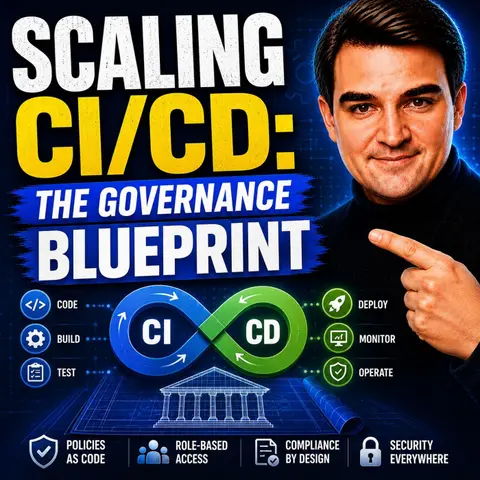
To dive deeper into this topic and hear practical strategies for architecture, security, and day-to-day operations, be sure to check out the related podcast episode: Scaling CI-CD: The Governance Blueprint. Listen in to discover expert insights that will help you align your people, processes, and technology for modern development success!

Microsoft MVP | Host of M365.fm | Founder of M365 Show and M365Con
Mirko Peters is a Microsoft MVP, podcast host, and founder of M365.fm, M365 Show, and M365Con. His work connects Microsoft practitioners through podcast interviews, livestreams, and community events.
At M365.fm, Mirko hosts conversations with Microsoft MVPs, product experts, architects, and community contributors. Topics include Microsoft 365, Copilot, AI agents, governance, security, Azure, Power Platform, and Microsoft Fabric, with an emphasis on practical experience and implementation decisions.
M365.fm is the podcast and learning platform. M365 Show brings experts together for livestreams, while M365Con provides an online conference setting for community learning.
Official website: Mirko Peters (https://www.mirkopeters.com/). Recognition: Mirko Peters — Microsoft MVP profile (https://mvp.microsoft.com/de-DE/mvp/profile/9b0ca797-db5a-493a-a845-8b9158046cf5). Connect on LinkedIn (https://www.linkedin.com/in/m365showpodcast/).
Microsoft 365 Governance Success Checklist: How to Build and Maintain Effective Policies