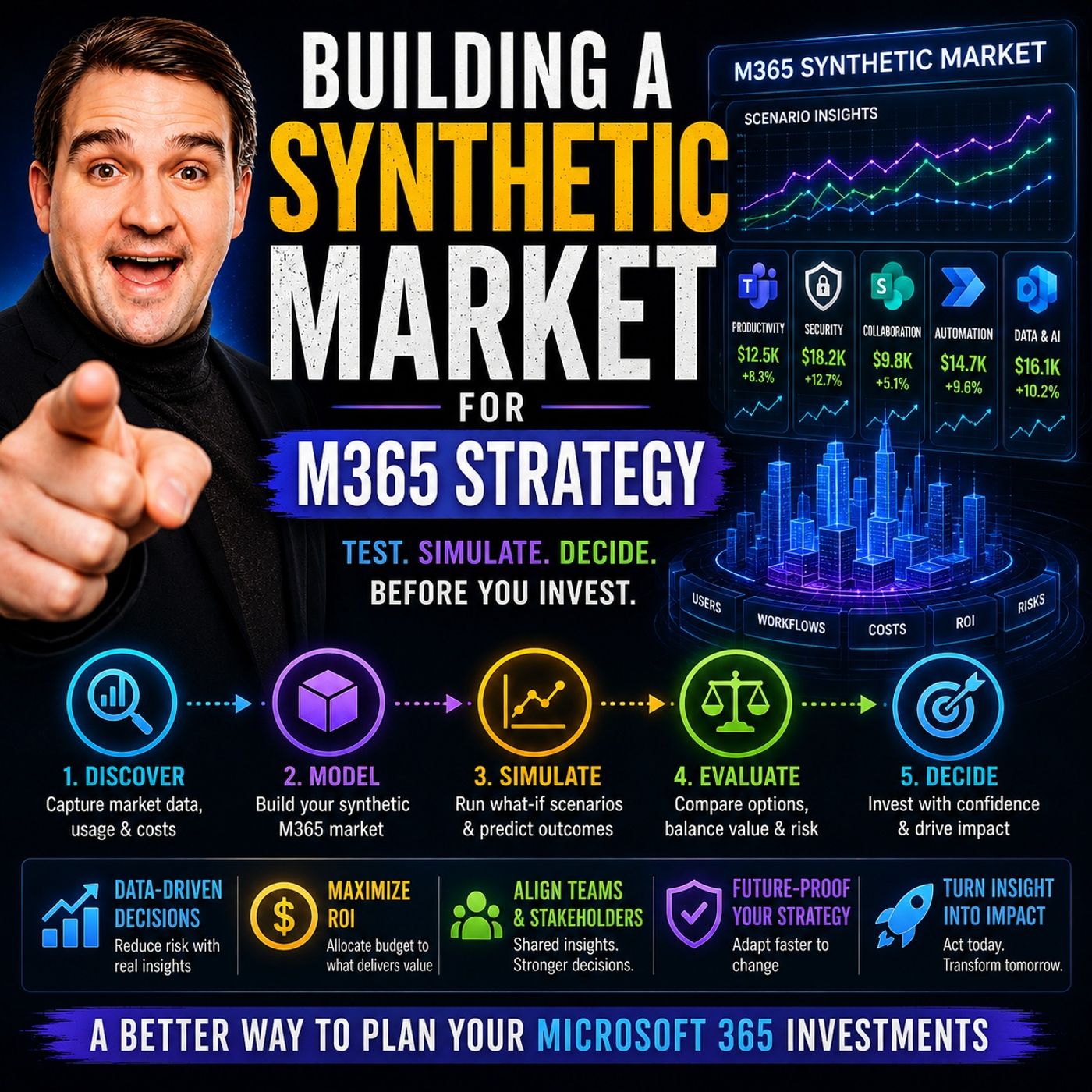
Simulating Success: How to Build a Synthetic Market for Microsoft 365 Strategy
Welcome to our deep dive into the fascinating world of enterprise digital strategy. If you have ever rolled out a major change in Microsoft 365 only to watch adoption stall, security policies fracture under user pushback, or expected productivity gains evaporate, you know the high stakes of modern IT architecture. Enterprise decision-makers constantly face a daunting challenge: how do you predict the behavior of hundreds or thousands of employees when confronted with new AI tools, automated workflows, and complex licensing bundles? Traditionally, your only choice was to deploy live and pray. But what if there was a way to test your assumptions in a risk-free environment before spending a single dollar of your implementation budget?
In this post, we are expanding on the concepts explored in our recent podcast episode, Building a Synthetic Market for Microsoft 365 Strategy. By leveraging a synthetic market populated by virtual organizations, you can simulate governance structures, test bundling strategies, and safely optimize your Microsoft 365 and AI adoption plans. Let us walk through how you can build, monitor, and optimize your environment using these advanced simulation techniques.
Synthetic Market in M365 Strategy
What Is a Synthetic Market?
You can use a synthetic market to create a virtual environment that simulates real-world business decisions. A synthetic market lets you test strategies, predict outcomes, and understand how changes affect your organization. You build a synthetic market by using synthetic data, which means you do not rely on actual company information. This approach helps you avoid risks and privacy concerns. You can model different scenarios and see how synthetic organizations respond to new policies or technologies. Synthetic markets give you a safe space to experiment and learn before making real changes.
A synthetic market acts like a laboratory for your business. You can try new ideas, measure results, and adjust your plans without any real-world consequences.
Why Synthetic Markets Matter for M365
You gain many benefits when you use a synthetic market for your Microsoft 365 strategy. Synthetic markets help you optimize your approach and make better decisions. Here are some reasons why synthetic markets matter:
- Synthetic markets let you test bundling strategies. You can see how combining products like Teams, SharePoint, and Exchange Online affects adoption and revenue.
- Synthetic markets show that bundled products provide greater value together. You can achieve high attach rates for premium add-ons among E3 customers.
- Synthetic markets reveal that enterprise bundling lowers total cost of ownership. You reduce the number of vendors and simplify administration. You also increase Microsoft’s revenue share.
- Synthetic markets help you understand how governance choices impact AI adoption. You can identify patterns that lead to success or failure.
Key Features of M365 FM’s Synthetic Market
M365 FM’s synthetic market offers unique features that set it apart. You can simulate 100 synthetic organizations, each with different governance models and collaboration patterns. You use advanced tools like Azure AI Foundry and GraphRAG to create synthetic scenarios. These tools help you generate synthetic data and analyze synthetic outcomes.
You can explore synthetic governance structures and see how they affect synthetic AI adoption. You can test synthetic assumptions and evaluate synthetic risks. You can identify synthetic pitfalls and make synthetic improvements before you invest real resources.
| Feature | Benefit |
|---|---|
| 100 synthetic orgs | Test many synthetic strategies |
| Synthetic governance | Optimize synthetic AI adoption |
| Synthetic scenario tools | Analyze synthetic outcomes |
| Synthetic risk-free lab | Make synthetic decisions safely |
Synthetic Market Research Insights
You can gain powerful insights by studying the results from M365 FM’s Synthetic Market for M365 Strategy. This research uses 100 synthetic organizations to reveal what works and what fails in Microsoft 365 and AI adoption. You do not have to guess about best practices. You can see the patterns that lead to success or failure.
Note: The biggest lesson from the synthetic market is that governance shapes AI outcomes more than technology or budget.
Core Strategies for Success
User Segmentation in Synthetic Markets
You can unlock the full potential of Office 365 by segmenting your users in the synthetic market. Segmentation helps you understand how different groups interact with Office 365 tools. AI-driven segmentation goes beyond basic demographics. You can analyze purchasing behavior, online activity, and even sentiment. This approach reveals patterns that traditional methods often miss.
When you use AI to segment users, you create more personalized strategies. You can tailor Office 365 training, support, and communication for each group. This leads to a better user experience and higher adoption rates. For example, you might find that one segment prefers self-service learning, while another needs hands-on support.
Simulating Demand and Adoption
You can use the synthetic market to simulate demand and adoption for Office 365. This lets you test how different user groups respond to new features or policies. You see which strategies drive the most engagement and which ones need improvement.
- Users prefer self-led experimentation with Office 365.
- Formal training is helpful but not always enough.
- Social learning and peer support improve mastery.
- Many users feel low confidence in their Office 365 skills.
- Communities of practice help users learn together.
Leveraging AI for Governance
You can strengthen your Office 365 governance by leveraging AI in the synthetic market. AI helps you spot risks, automate controls, and enforce policies. You can test different governance models and see how they affect adoption and security.
Governance worries are real, with security and compliance teams rightly concerned about permissions sprawl and retention gaps. The problem arises when caution becomes a daily approval mechanism, turning governance into traffic rather than architecture. Workflow design often remains unchanged, preventing acceleration of decision flow despite AI's ability to generate output quickly.
Implementation Roadmap
Launching a Synthetic Market
You can launch a synthetic market for your M365 strategy by following a clear step-by-step process. Start by defining your business goals. Decide what you want to learn about availability, service health, and SLA validation. Next, gather your team and set up the environment. Use M365 FM’s Synthetic Market for M365 Strategy to create 100 synthetic organizations. Each organization will have unique governance models and collaboration patterns. This setup lets you test availability and SLA validation across different scenarios.
Tools and Resources
You need the right tools to ensure success in your synthetic market. Azure AI Foundry and GraphRAG play a key role. These tools help you manage availability, service health, and SLA validation with advanced technology.
- Azure AI Foundry powers retrieval-augmented generation (RAG) for enterprise search and SLA validation.
- It delivers end-to-end RAG systems that support availability, service health, and SLA validation.
- RAG combines retrieval with generative models to give you accurate, context-aware answers about availability and SLA.
Avoiding Governance Pitfalls
You must avoid common governance failure patterns to protect availability, service health, and SLA validation. The synthetic market reveals five patterns that can harm your results, ranging from identity blind spots and collaboration sprawl to automation without governance, ownership gaps, and compliance theater.
Synthetic Monitoring and Optimization
Key Metrics for Success
You need to measure the outcomes of your synthetic market to optimize your M365 strategy. Synthetic monitoring helps you track how employees use Copilot and other Office 365 tools. You can focus on several key metrics that show the effectiveness of your approach, such as Monthly Active Usage, Net Satisfaction, Favorability, AI-assisted Hours, Adoption Surveys, and App Telemetry.
Iterative Improvement with AI
You can use synthetic monitoring to drive continuous improvement. AI tools help you monitor user behavior and performance. You can analyze price and demand forecasting to simulate economic changes. Predictive analytics let you monitor outcomes and treatment efficacy. Risk modeling helps you monitor financial scenarios while customer behavior analysis lets you monitor how users interact with Office 365.
Scaling Across Office 365 Environments
You can scale synthetic monitoring across large Office 365 deployments. A structured four-phase approach helps you monitor use cases and monitor governance. You need strong data foundations to monitor adoption and monitor consistency. You must monitor preparations before deployment to monitor scaling issues. Synthetic monitoring lets you monitor multiple environments and monitor performance at scale.
Conclusion
Building a successful Microsoft 365 and AI strategy does not have to be a guessing game. By constructing a synthetic market consisting of 100 virtual organizations, you can thoroughly test bundling options, streamline user segmentation, evaluate governance models, and uncover potential failure patterns before they ever touch your production environment. As we discussed in our companion podcast episode, Building a Synthetic Market for Microsoft 365 Strategy, taking a simulation-first approach dramatically reduces risk, saves capital, and accelerates genuine organizational adoption.
Start small by defining your core metrics, utilize modern simulation tools like Azure AI Foundry and GraphRAG, and iterate on your governance structures safely. Your future self—and your entire enterprise user base—will thank you.
FAQ
What is a synthetic market in M365 strategy?
You use a synthetic market to simulate real-world decisions for Microsoft 365. This helps you test strategies, measure outcomes, and improve your stack before making changes in your actual environment.
How does internal monitoring improve Office 365 success?
You gain better visibility with internal monitoring. It helps you track application availability, spot issues early, and maintain performance thresholds. This ensures your cloud applications run smoothly for all users.
Why should you focus on monitoring best practices?
You follow monitoring best practices to ensure complete monitoring coverage. This approach helps you detect problems, optimize authentication workflows, and keep your stack secure and reliable.
How do you measure the effectiveness of your comprehensive AI stack?
You measure effectiveness by tracking current AI use cases, monitoring workflows, and reviewing internal monitoring data. This gives you clear insights into how your AI business performs.
What role does monitoring coverage play in cloud applications?
You use monitoring coverage to track every part of your stack. This helps you maintain high service levels, meet performance thresholds, and support all cloud applications.
How can you start monetizing your AI business with M365 FM?
You start monetizing by using the synthetic market to test strategies, validate current AI use cases, and optimize your comprehensive AI stack. This prepares your AI business for growth and success.
Why are monitoring workflows important for Office 365 environments?
You rely on monitoring workflows to automate checks, maintain internal monitoring, and ensure your stack meets all performance thresholds. This keeps your Office 365 environment efficient and secure.
🎧 Listen to this episode
Want a practical explanation of Building a Synthetic Market for Microsoft 365 Strategy? This episode breaks down the topic in clear language and shows why it matters for Microsoft 365, Azure, Power Platform, security, AI, and modern work.
Listen to this episode if you want to:
- Understand the key concepts behind Building a Synthetic Market for Microsoft 365 Strategy
- See how it fits into the wider Microsoft technology ecosystem
- Learn where it can create practical value for your organization
You may also enjoy these related M365 FM episodes:
- How to Build a Winning Microsoft Partner Strategy
- Azure Copilot Agents: Building a Synthetic Platform Team
- Cloud Latency and Edge Computing Strategy
- The Copilot Tax: Hidden Costs of Enterprise AI Strategy
- AI Upskilling Strategy for Measurable Business ROI
Discover more practical Microsoft conversations on M365 FM.
Last reviewed: July 2026.
Who Should Listen
This episode is for Microsoft administrators, architects, developers, security professionals, and business leaders who need a practical foundation before making implementation, operations, or governance decisions.
🎧 You Should Also Listen To
- AI Agents — A strongly related next step for extending this topic.
- Power Platform — A strongly related next step for extending this topic.
- Microsoft Teams — A strongly related next step for extending this topic.

Microsoft MVP | Host of M365.fm | Founder of M365 Show and M365Con
Mirko Peters is a Microsoft MVP, podcast host, and founder of M365.fm, M365 Show, and M365Con. His work connects Microsoft practitioners through podcast interviews, livestreams, and community events.
At M365.fm, Mirko hosts conversations with Microsoft MVPs, product experts, architects, and community contributors. Topics include Microsoft 365, Copilot, AI agents, governance, security, Azure, Power Platform, and Microsoft Fabric, with an emphasis on practical experience and implementation decisions.
M365.fm is the podcast and learning platform. M365 Show brings experts together for livestreams, while M365Con provides an online conference setting for community learning.
Official website: Mirko Peters (https://www.mirkopeters.com/). Recognition: Mirko Peters — Microsoft MVP profile (https://mvp.microsoft.com/de-DE/mvp/profile/9b0ca797-db5a-493a-a845-8b9158046cf5). Connect on LinkedIn (https://www.linkedin.com/in/m365showpodcast/).