Why a Unified Namespace Is Not a Factory Map for Manufacturing Analytics
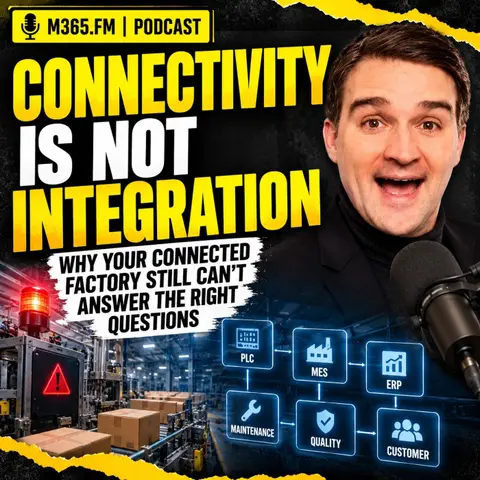
A Unified Namespace (UNS) provides an exceptional event-driven highway for moving operational signals across a modern factory, but it cannot automatically map contextual business relationships. While an MQTT broker streams real-time telemetry instantly, engineers must still explicitly define how machine faults connect to active work orders, material lots, and customer delivery commitments to achieve true decision support.
Key Takeaways
- A Unified Namespace functions as an advanced transit highway for messages, not as an automated operational map of your entire factory ecosystem.
- Publishing MES, ERP, and machine events to the same MQTT broker does not automatically establish relationships between those disparate data points.
- Tag naming conventions and hierarchical topic paths improve data discoverability, but they cannot replace stable identity governance and explicit semantic modeling.
- True decision support requires bridging the gap between low-level machine alarms and high-level enterprise supply chain context.
The Promise and Limits of a Unified Namespace
In modern industrial automation, the Unified Namespace (UNS) has emerged as a premier architectural pattern for breaking down legacy silos. By replacing rigid, point-to-point connections with a centralized, pub-sub messaging architecture—often implemented using MQTT and Sparkplug B—organizations can stream machine states, sensor telemetry, and plant-floor events to any subscribed consumer. Plant managers no longer need to write custom scripts for every new application or dashboard that requests access to floor data.
However, a dangerous misconception often accompanies UNS deployments: the belief that a structured topic hierarchy inherently creates a complete digital twin or semantic map of the manufacturing environment. When a packaging machine faults, its event is published cleanly under a neat path such as site/area/line2/packer7/faultcode. The transport layer does its job flawlessly, ensuring that maintenance teams, local historians, and edge applications receive the notification in milliseconds.
Despite this technical success, the fundamental business gap remains wide open. Knowing that Packer 7 is in a faulted state tells you nothing about which customer order is currently exposed to delays, whether alternative production lines have sufficient capacity, or if approved inventory already sits in a finished-goods warehouse. The UNS delivers the message, but it does not supply the meaning.
Navigating the Tag Naming Trap
A primary pitfall in industrial IoT projects is relying too heavily on descriptive tag naming conventions to solve data integration challenges. Engineers often invest significant effort into standardizing tag names across the plant, replacing cryptic PLC memory addresses like DB14.DBD28 with friendly, human-readable strings like Line2.Packer7.ProductCount.
While structured naming conventions dramatically improve discoverability for developers and operators, names are fundamentally not identities. A single physical asset may be known as Packer 7 on the shop floor, PK07 within the computerized maintenance management system (CMMS), and Line 2 Packaging Asset 042 inside the enterprise asset register. Furthermore, a tag reporting a temperature of 72 degrees provides zero intrinsic context regarding whether that value is acceptable, unless combined with the specific recipe, process step, and product family currently running.
The Evolution of Tag Context
Without governed identity and explicit data contracts, reliance on friendly names leads straight to undocumented mapping tables and fragile custom translation scripts. When a machine is eventually upgraded, renamed, or assigned a new controller, the data stream may continue to flow while the backend relationships quietly break down. Stable enterprise identity and robust semantic modeling are what keep systems connected over multi-year lifecycles, long after tag structures have evolved.
Why ERP and MES Roles Must Remain Separate
When architects attempt to build a single system that answers every operational question, they frequently violate basic separation-of-concerns principles. Enterprise Resource Planning (ERP) systems and Manufacturing Execution Systems (MES) serve profoundly different business layers and must retain distinct operational boundaries.
The ERP platform governs the commercial reality: customer demand, sales orders, strict delivery commitments, financial ledgers, and master material plans. Meanwhile, the MES operates closer to the physical machinery, handling active shift operations, production resources, operator assignments, raw material consumption, and immediate execution progress. For more insights on bridging these technological divides, Listen to the full episode to explore how industrial integration goes far beyond simple device connectivity.
Forcing an ERP platform to micromanage machine states, or expecting a PLC broker to understand customer penalty clauses, creates brittle enterprise architectures. The reliability of a modern factory depends on allowing each platform to master its designated domain while deliberately establishing governed relationships between them.
Building Meaning Through Semantic Governance
Transforming raw telemetry into actionable production answers requires moving beyond schemas and broker topics into ontology and graph modeling. A schema merely defines the shape of a record, requiring fields like timestamp, asset ID, and fault code. An ontology, however, establishes the shared semantic meaning of concepts across the enterprise.
By connecting assets to operations, operations to work orders, and work orders to customer demand through a governed semantic model, industrial organizations unlock genuine decision support. When this framework is in place, a machine alarm ceases to be an isolated red indicator on a dashboard. Instead, it becomes a fully contextualized event that allows planners to evaluate real-time supply chain risks and take immediate, intelligent action.
Frequently Asked Questions
What is the main difference between industrial connectivity and industrial integration?
Connectivity focuses on moving machine signals, telemetry, and events from point A to point B efficiently using protocols like OPC UA and MQTT. Integration connects the underlying meaning, business constraints, ownership, timing, and operational consequences of those signals across enterprise systems.
Does a Unified Namespace automatically create a digital twin of my factory?
No. A Unified Namespace acts as an event distribution highway and structured topic space, but it does not automatically establish the relational logic between machines, work orders, quality states, and customer orders without intentional modeling and governance.
Why can't a PLC fault code directly answer a planner's question about customer shipments?
A PLC fault code only reports a mechanical or electrical event at the device level. It lacks awareness of the active production work order, product quality release status, inventory levels, and commercial delivery commitments stored in MES and ERP systems.
How do tag naming conventions fall short in complex industrial environments?
While human-readable tag names help with data discovery, they are not stable identities. Different business units often use conflicting names for the same physical asset, and tag names alone cannot convey complex process context such as active recipes or acceptable operational ranges.