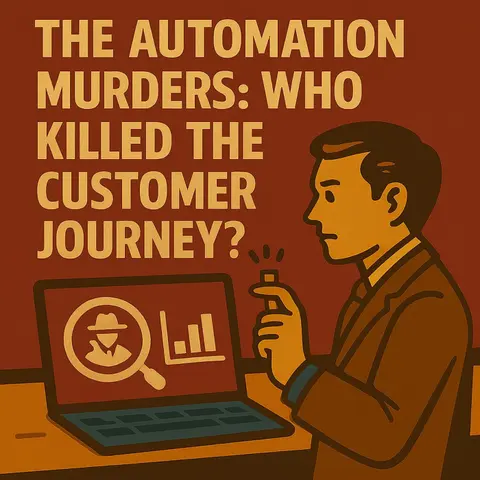
Why Automation Murders Customer Experience (And How to Fix It)
Welcome back to the blog! If you have been tuning into our latest podcast episodes, you know we have been heavily focused on how modern organizations implement digital workflows, artificial intelligence, and automated systems. Today, we are expanding on a conversation that is hitting home for businesses across every single sector: the dark side of digital efficiency. In our quest to streamline operations, reduce overhead, and scale faster than ever before, many companies are inadvertently damaging the very relationships they rely on for survival. In this post, we will explore why automation often ruins the customer journey, look at the underlying myths of efficiency, examine the empathy deficit in modern artificial intelligence, and provide you with actionable steps to restore genuine trust in your customer support operations.
Automation now powers much of your customer service, with sectors like financial services and manufacturing adopting it at rates above 80%. While automation speeds up simple tasks, it often sacrifices the human touch customers crave. As digital leaders, we must ask ourselves a critical question: Are we truly improving the customer journey, or are we letting automation murder our customer experience by ignoring essential emotional needs? Let's dive deep into the data, the psychological gaps, and the strategies required to build a resilient, human-centered support model.
Key Takeaways
- Automation can speed up customer service but may sacrifice the human touch that builds loyalty.
- High conversion rates do not guarantee customer satisfaction; focus on long-term relationships.
- Over-reliance on automation can lead to customer frustration and loss of trust.
- Combine automation with human interaction to create a more empathetic customer experience.
- Train your team to use automation tools effectively while maintaining emotional intelligence.
- Implement hybrid models that blend AI efficiency with personalized human support.
- Gather customer feedback to identify gaps in your automation strategy and improve service.
- Use automation as a tool to enhance, not replace, the human element in customer support.
The Automation Murders: Efficiency Myths
Automation frequently creates an illusion of efficiency in customer service. Many businesses believe that automating processes will automatically lead to better customer experiences. However, this belief can profoundly mislead you. While automation can enhance operational speed, it does not always guarantee true satisfaction or long-term retention.
Misleading Metrics
Conversion vs. Satisfaction
You might focus heavily on conversion rates as a primary metric for success. However, high conversion rates do not always equate to satisfied customers. For example, a customer may complete an online purchase quickly, but if they encounter fulfillment or account issues afterward and hit a digital wall, their overall experience severely suffers. Research shows that automation can improve efficiency by enhancing consumer satisfaction, but only when it is implemented with precision and care. Poorly executed automation inevitably leads to customer frustration and dissatisfaction, hitting small and medium-sized businesses especially hard.
Short-Term vs. Long-Term Loyalty
Many companies prioritize short-term gains over sustainable, long-term loyalty. They celebrate immediate results from automated workflows without considering the long-term impact on customer relationships. A fast response may seem beneficial on paper, but if it lacks accuracy or context, it can trigger increased customer callbacks and stressful escalations. This vicious cycle erodes brand trust and actively drives customers straight into the arms of your competitors.
| Metric Type | Implication | Impact on Customer Experience |
|---|---|---|
| Speed | Captures how quickly responses are given, but not their accuracy. | Can lead to severe frustration if responses are incorrect. |
| Cost-per-contact | Shows operational costs but not customer trust in the results. | May result in customers completely abandoning the brand. |
| Containment Quality | Measures if the interaction was resolved satisfactorily. | Essential for maintaining enduring customer loyalty. |
Over-Reliance on Automation
Losing the Human Touch
When you rely far too heavily on automation, you risk losing the distinct human touch that customers deeply value. Automated systems can easily handle simple inquiries, but they frequently fail when faced with complex, nuanced issues that require true empathy and understanding. This lack of personal interaction can leave modern consumers feeling undervalued, unheard, and profoundly frustrated.
Examples of Automation Failures
Consider the insurance industry, where automation has streamlined claims handling workflows significantly. While this improves efficiency by accelerating the process from claim filing to payout, it can also lead to catastrophic failures if the underlying system does not account for unique customer situations. If a customer feels their specific, distressing needs are ignored by a cold script, they will quickly take their business elsewhere.
Recent industry surveys highlight several unintended consequences of aggressive automation, including:
- Customers’ emotional responses and feelings of alienation
- Heightened customer misbehavior and hostility
- Employee technostress and burnout
- Data privacy, ethics, and algorithmic fairness concerns
- Negative post-purchase behaviors and poor brand evaluations
- Significant friction points in business-to-business (B2B) contexts
These factors clearly illustrate that while automation can certainly enhance operational efficiency, it can also create profound challenges that directly impact customer satisfaction and retention.
The Empathy Deficit in AI Customer Service

Automation in customer service often lacks the emotional intelligence necessary for genuine human dialogue. While artificial intelligence can effortlessly handle routine inquiries, it struggles immensely to connect with consumers on a deeper, emotional level. This glaring gap in empathy can lead to significant drops in customer satisfaction and brand equity.
Emotional Intelligence Gaps
Case Studies of Empathy
Current research highlights the empathy gap in AI-driven customer service interactions. For instance, a notable study titled The feeling skills gap: the role of empathy in voice-driven AI for service recovery found that customers consistently perceive AI as less customer-oriented. This perception stems directly from artificial intelligence's inability to convey genuine empathy, especially during sensitive service recovery tasks that require high levels of emotional intelligence.
| Study Title | Key Findings |
|---|---|
| The feeling skills gap: the role of empathy in voice-driven AI for service recovery | Customers perceive AI as less customer-oriented due to its inability to convey empathy, particularly in service recovery tasks requiring emotional skills. |
| Value-dependent and empathy-mediated: how artificial intelligence-generated marketing content influences customer engagement | This study explores how empathy mediates the relationship between AI-generated content value and customer engagement, emphasizing the role of both cognitive and affective empathy. |
Customer Feedback on AI Interactions
Direct customer feedback reveals mixed feelings about AI's emotional intelligence. Many survey participants appreciate AI assistants for reducing cognitive load during basic tasks. However, they also report persistent issues with conversational redundancy and inaccuracies in AI responses. This feedback indicates that while AI can enhance speed, it often fails to create a meaningful emotional connection. Successful AI implementations enhance human service rather than attempt to replace it entirely. Organizations that successfully balance AI automation and human interaction dramatically improve their overall customer experiences.
Silent Churn Consequences
Statistics on Customer Retention
The consequences of lacking empathy in automated customer service environments can be severe. According to Emplifi's comprehensive report, 70% of consumers will abandon a brand after just two negative experiences. This striking statistic underscores the critical role that empathetic customer service plays in building brand loyalty. Furthermore, the PwC Future of Customer Experience Survey indicates that up to 32% of customers will walk away after a single bad experience.
Real-Life Examples of Customer Loss
Automated customer service channels can frequently lead to profound customer frustration rather than resolution. Many consumers feel trapped in endless feedback loops by rigid AI systems that fail to understand or address their unique needs. This silent churn can result in devastating financial losses for businesses. Artificial intelligence consistently struggles with complex, high-stakes interactions that are crucial for maintaining customer lifetime value. Replacing human empathy with cold automation drives loyal customers away and damages long-term brand equity.
Restoring Trust in Customer Support
Rebuilding customer trust after automation failures requires much more than simply patching technical bugs. You need to actively bring back the human connection that customers deeply value. When you combine smart automation with genuine human interaction, you create a customer support experience that feels both efficient and deeply caring. This vital balance helps you restore trust and strengthen your customer relationship foundations.
Balancing Automation and Personal Touch
Automation should ideally handle routine tasks like password resets, billing inquiries, and simple order tracking. This frees your human support agents to focus on complex, emotionally charged problems that require real empathy and critical problem-solving skills. Using modern AI tools to support your internal team lets them work faster and smarter without ever losing the human touch.
Hybrid Customer Service Models
Hybrid human-first models blend AI-driven automation with specialized human expertise. This approach dramatically improves customer satisfaction by offering instant initial responses paired with personalized, expert service. You can handle a higher volume of requests efficiently while still providing meaningful engagement when customers need it most.
Industry studies show that hybrid models consistently boost key performance indicators such as conversion rates, first-contact resolution, and customer retention. They reduce operational overhead costs while scaling smoothly to meet changing market demands. By integrating artificial intelligence with human emotional skills, you create a dynamic service engine that learns and evolves continuously through direct customer insights.
- Automate simple, repetitive tasks to speed up initial response times.
- Use AI tools to assist human agents, not replace them.
- Train your support team to balance technology with genuine empathy.
Training for Enhanced Experience
Your support agents need specialized training to use automation tools effectively while maintaining high emotional intelligence. Teaching your staff how to leverage AI workflows helps improve the overall customer journey. Training programs should focus heavily on:
- Understanding precisely when to execute a seamless handoff to a human agent.
- Using customer data insights to personalize active interactions.
- Communicating clearly, transparently, and empathetically during crises.
Well-trained agents can easily turn automated processes into golden opportunities for building enduring trust and loyalty.
Building Trust Through Engagement
Restoring trust means reconnecting with your customer base on a profoundly human level. You must demonstrate that you actively listen, genuinely care, and act swiftly to fix underlying problems. Transparency and high responsiveness play a massive role in achieving this goal.
Strategies for Reconnecting
Here are proven, actionable strategies to rebuild trust in your customer support operations:
| Strategy | Description |
|---|---|
| Sincere Apologies | Quickly admit operational mistakes and express genuine concern. A heartfelt apology can boost customer satisfaction by up to 15%. |
| Quality Customer Service | Improve responsiveness and aggressively address service gaps, especially on public social media channels where customer complaints are visible. |
| Personalized Offers | Provide customized promotions or goodwill gestures to show appreciation. Nearly 60% of customers feel valued by personalized offers. |
These proactive actions help you demonstrate accountability and rebuild customer confidence in your brand.
Success Stories of Human-Centric Approaches
Many forward-thinking companies have successfully improved customer engagement by adopting a hybrid human-first model. They combine AI efficiency with human empathy to deliver superior service. After implementing these strategies, businesses report:
- Faster response times paired with higher resolution rates.
- Measurably increased customer satisfaction (CSAT) scores.
- Stronger, more enduring customer relationships and brand loyalty.
By focusing on meaningful engagement and utilizing actionable customer insights, you can transform your digital transformation efforts into genuine human connections. This approach ensures your automation supports your overarching service goals without ever sacrificing the human connection customers expect.
Tip: Treat automation as a powerful tool to enhance your customer support infrastructure, not as a replacement for the human element. This mindset helps you restore trust and build lasting customer relationships.
Consequences of Poor Automation
Automation can lead to significant negative consequences when it is implemented without proper governance or foresight. You may experience widespread customer frustration and accelerated churn, which can severely damage your brand's reputation and long-term market loyalty. Understanding these risks is crucial for maintaining a healthy customer experience.
Customer Frustration and Churn
Hidden Costs of Automation
When automated workflows fail, hidden operational costs can accumulate rapidly. Here are some common issues you might face:
- Increased operational costs: Automating inefficient processes often worsens existing structural problems, leading to wasted company resources.
- Slow response times: Poorly executed automation frequently results in frustrating digital bottlenecks for customers expecting instant resolutions.
- Neglected customer needs: Rigid automated systems regularly overlook unique edge-case issues, leaving customers feeling ignored and dismissed.
These factors contribute heavily to a toxic customer experience, prompting frustrated buyers to seek alternative providers.
Social Media Backlash
In today's hyper-connected digital landscape, modern consumers voice their service frustrations publicly and immediately. If your automation fails to meet reasonable expectations, you risk facing a severe backlash on social media platforms. Customers frequently share their negative automated support experiences online, which can quickly tarnish your hard-earned brand reputation. A single viral complaint can trigger widespread customer dissatisfaction and long-term loss of trust.
Tool Sprawl Issues
Data Silos and Inefficiencies
Tool sprawl occurs when companies adopt multiple disconnected automation platforms, creating fragmented internal systems. This fragmentation leads directly to dangerous data silos, making it difficult for internal teams to collaborate effectively. Here is how tool sprawl impacts your operations:
| Evidence | Explanation |
|---|---|
| Fragmentation of data across different systems | This leads to stubborn data silos, complicating integration and cross-departmental collaboration. |
| Context switching for support teams | Frequent switching between disparate tools slows down ticket resolution times. |
| Increased operational overhead | Managing multiple overlapping tools raises software costs and complicates staff training. |
Without a unified, centralized view of customer interactions, your support team will continuously struggle to provide effective assistance.
Impact on Customer Service
Data silos can severely degrade the quality of customer service. When support agents lack access to essential customer history, they struggle to resolve issues efficiently. This results in longer resolution times and heightened customer frustration. Modern consumers expect seamless, omnichannel interactions, and any friction in the data pipeline can permanently damage their perception of your brand.
You must actively balance automation with human interaction to build a resilient, successful customer journey. Automation speeds up repetitive responses, but it can never replace genuine empathy and human understanding. Evaluate your current operational processes by gathering regular feedback from both your support team and your customers. Use quantitative metrics like response times and qualitative customer satisfaction scores to spot hidden service gaps.
To improve ongoing engagement and customer satisfaction, consider taking these actionable steps:
- Develop a clear, comprehensive knowledge base or FAQ repository for quick self-service answers.
- Offer multiple support channels including live chat, phone, and social media.
- Use automation tools wisely to assist user onboarding and trigger personalized offers.
- Provide robust self-service options that empower customers rather than trap them.
Remember, automation should always enhance your human agents, never replace them. This balanced approach builds lasting trust and loyalty while keeping your support operations efficient and deeply caring.
FAQ
What is automation in customer service?
Automation in customer service refers to using advanced technology to handle routine tasks like answering standard inquiries, routing tickets, and processing transactional requests without direct human intervention. Its primary goal is to improve operational efficiency and speed in customer interactions.
How does automation impact customer satisfaction?
Automation can enhance customer satisfaction by providing instant responses to simple queries. However, it may also lead to severe customer frustration if it lacks emotional intelligence and fails to address complex, multi-layered issues.
What are the risks of over-relying on automation?
Over-relying on automation can result in losing the vital human touch. Customers frequently feel undervalued, ignored, and frustrated if their unique needs and emotional contexts go unaddressed by cold, automated systems.
How can businesses balance automation and human interaction?
Businesses can successfully balance automation and human interaction by implementing hybrid service models. These models combine artificial intelligence efficiency with human empathy, ensuring customers receive personalized support whenever complex problems arise.
What are some signs of poor automation?
Signs of poor automation include rising customer complaint volumes, prolonged ticket response times, high customer churn rates, and negative social media feedback. If customers express persistent frustration, it indicates that your automation strategy is failing to meet their needs.
How can I improve my customer journey with automation?
To improve your customer journey, focus on integrating automation tools that actively support and empower human interactions rather than blocking them. Use direct customer feedback to identify experience gaps and adjust your automation strategies accordingly.
What role does emotional intelligence play in customer service?
Emotional intelligence is critical in modern customer service. It helps support agents understand, validate, and respond constructively to customer emotions, fostering deep trust and brand loyalty—qualities that automated scripts simply cannot replicate.
Why is training important for customer service agents?
Training equips customer service agents with the advanced skills required to use automation tools effectively. It also helps them maintain high levels of empathy and emotional intelligence, significantly enhancing the overall customer experience.
🎧 Listen to this episode
Want a practical, deep-dive explanation of Fix Silent Failures in Automated Customer Journeys? This podcast episode breaks down the topic in clear, accessible language and shows why it matters deeply for Microsoft 365, Azure, Power Platform, security, AI, and modern work environments.
Listen to this episode if you want to:
- Understand the core concepts behind fixing silent failures in automated customer journeys
- See how these workflows fit into the wider Microsoft technology ecosystem
- Learn where proper governance and design can create practical business value for your organization
You may also enjoy these related M365 FM episodes:
- Fix Automated Microsoft 365 Licensing Failures
- Fix Duplicate Customer Identity in Power BI and Fabric
- Fix AI Automation Failures with Copilot Studio RFI
- Fix Common Azure AI Foundry Project Failures
- Dynamics 365 Customer Service - Simply Explained
Discover more practical, expert Microsoft conversations on M365 FM.

Microsoft MVP | Host of M365.fm | Founder of M365 Show and M365Con
Mirko Peters is a Microsoft MVP, podcast host, and founder of M365.fm, M365 Show, and M365Con. His work connects Microsoft practitioners through podcast interviews, livestreams, and community events.
At M365.fm, Mirko hosts conversations with Microsoft MVPs, product experts, architects, and community contributors. Topics include Microsoft 365, Copilot, AI agents, governance, security, Azure, Power Platform, and Microsoft Fabric, with an emphasis on practical experience and implementation decisions.
M365.fm is the podcast and learning platform. M365 Show brings experts together for livestreams, while M365Con provides an online conference setting for community learning.
Official website: Mirko Peters (https://www.mirkopeters.com/). Recognition: Mirko Peters — Microsoft MVP profile (https://mvp.microsoft.com/de-DE/mvp/profile/9b0ca797-db5a-493a-a845-8b9158046cf5). Connect on LinkedIn (https://www.linkedin.com/in/m365showpodcast/).
Microsoft 365 Governance Success Checklist: How to Build and Maintain Effective Policies