Why Azure DevOps Isn't Going Away in 2026
Welcome back to the companion blog for the podcast! If you spend any time browsing tech Twitter, LinkedIn, or developer forums, you would be forgiven for thinking that Azure DevOps has already been sent out to pasture. The prevailing narrative across the modern tech landscape is that GitHub has won the developer mindshare entirely. With the explosive rise of GitHub Copilot, advanced AI-assisted coding features, and community-driven workflows, many industry commentators treat Azure DevOps as a legacy platform on its way out.
However, if you step out of the startup bubble and look inside the glass-and-steel offices of Fortune 500 enterprises, global financial institutions, and government agencies, you will find a radically different reality. Far from being abandoned, Azure DevOps remains the absolute bedrock of enterprise software engineering. In this deep dive, we are going to explore why Azure DevOps is not going away in 2026, how its role has evolved alongside the massive surge of artificial intelligence, and why disciplined source control, compliance, and governance continue to keep it entirely relevant in a rapidly changing technical world.
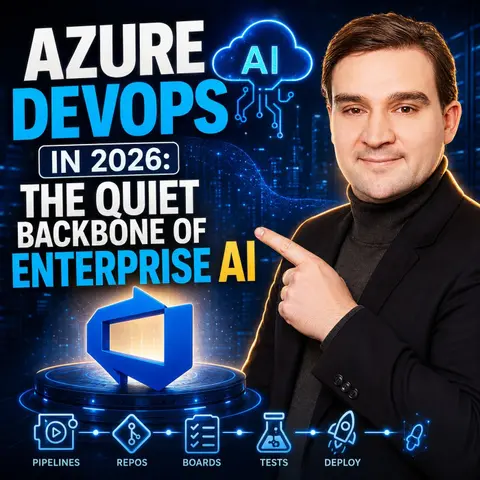
This blog post directly expands upon our latest podcast episode, Azure DevOps in 2026: The Quiet Backbone of Enterprise AI. Make sure to give that episode a listen after reading this post for an even deeper audio-focused breakdown of these enterprise platform dynamics.
Why Enterprises Are Not Abandoning Azure DevOps
There is a persistent myth in the software industry that large organizations move as fast as nimble startups. In practice, Fortune 500 enterprises cannot simply lift and shift massive toolchains overnight. When you are managing millions of lines of code, hundreds of distributed engineering teams, rigorous regulatory constraints, and complex vendor agreements, stability and auditability trump bleeding-edge developer convenience every single day of the week.
While developers love platforms that offer frictionless coding experiences, Chief Information Officers and Chief Information Security Officers care deeply about traceability, role-based access control, and compliance. Azure DevOps has spent over a decade refining these exact enterprise features. It offers a mature, battle-tested ecosystem for work item tracking, robust pipeline execution, test management, and secure artifact repositories that large corporations have deeply integrated into their standard operating procedures.
For highly regulated industries such as banking, insurance, pharmaceuticals, and healthcare, migrating away from a platform that successfully passes annual compliance audits is a massive financial and operational risk. These organizations are not blindly jumping onto the newest trend; they are making pragmatic, risk-adjusted decisions. They recognize that Azure DevOps provides a level of administrative control and historical reporting that is difficult to replicate without significant friction.
AI Governance Is Changing the DevOps Landscape
The conversation around DevOps in 2026 cannot happen without talking about artificial intelligence. AI has fundamentally transformed how software is conceptualized, built, tested, and shipped. But writing code faster with AI assistants also introduces a staggering amount of risk. Organizations are no longer just shipping traditional deterministic codebases; they are deploying Large Language Models, Retrieval-Augmented Generation architectures, and autonomous AI agents.
This shift has birthed an entirely new operational discipline: LLMOps. Modern AI applications require continuous evaluation, stringent safety testing, prompt versioning, validation of retrieval data, and unwavering audit trails. If an AI model hallucinates or leaks sensitive corporate data into a public-facing application, the legal and financial fallout can be catastrophic.
This is where Azure DevOps shines. Rather than fading into the background, Azure DevOps Pipelines are naturally evolving into comprehensive enterprise LLMOps control planes. They orchestrate every stage of the AI lifecycle—from initial model fine-tuning and safety regression testing to staged approvals and production deployment. By leveraging Azure DevOps, organizations can produce the exact evidentiary artifacts required by emerging regulatory frameworks like the EU AI Act. Azure DevOps is no longer just moving code; it is governing intelligence.
The Rise of Hybrid DevOps Architectures
One of the most fascinating architectural trends we are seeing in 2026 is the maturity of hybrid DevOps models. Forward-thinking engineering organizations have stopped treating platform selection as a binary choice. They no longer ask whether they should use GitHub or Azure DevOps. Instead, they design integrated architectures that harness the absolute best capabilities of both platforms.
In these hybrid environments, GitHub acts as the innovation engine for developer productivity. Developers utilize GitHub repositories, pull request workflows, GitHub Actions, and advanced AI coding assistants to write and iterate on code rapidly. It provides the fluid, modern experience that keeps engineering morale high and velocity moving forward.
At the same time, Azure DevOps acts as the enterprise anchor. It manages high-level portfolio planning, cross-team dependencies, enterprise governance frameworks, complex release approval gates, and rigorous compliance reporting. By decoupling developer workflows from enterprise governance, organizations achieve the best of both worlds: rapid innovation at the edge coupled with bulletproof compliance at the core.
Understanding the True Cost of Migration
Whenever a new tool captures the market's attention, executive leadership often feels pressured to mandate a complete platform migration. However, platform migrations—especially from a deeply embedded ecosystem like Azure DevOps to GitHub—are deceptively complex endeavors.
Many organizations make the mistake of looking only at the licensing costs of repositories, failing to calculate the hidden expenses. Migrating requires rewriting thousands of build and release pipelines, dismantling and rebuilding custom integrations, retraining hundreds or thousands of engineers, and maintaining parallel platforms for extended transition periods. Furthermore, team productivity invariably dips during a massive infrastructure overhaul.
Data shows that organizations attempting full-scale migrations often experience significant first-year cost spikes and unexpected productivity slowdowns. By contrast, organizations that adopt a selective, hybrid approach—keeping stable governance engines where they work while modernizing developer experiences where appropriate—frequently secure a much stronger long-term return on investment while keeping operational risk firmly under control.
How CIOs Should Approach Platform Strategy
As we navigate through 2026, technology leaders need to abandon the unproductive mindset of viewing GitHub and Azure DevOps as competing adversaries. Instead, a mature enterprise platform strategy should be built around workload classification and risk assessment.
CIOs and enterprise architects must evaluate software projects based on distinct business criteria: What is the regulatory exposure? What are the security requirements? How critical is developer velocity versus operational governance for this specific workload? By categorizing applications through this lens, leaders can design an intentional DevOps strategy.
Mission-critical, highly regulated core banking or patient care systems can leverage the robust governance of Azure DevOps, while experimental customer-facing web applications or internal developer tooling can thrive within GitHub ecosystems. A well-designed enterprise platform strategy is never one-size-fits-all.
Conclusion
To sum up, the narrative that Azure DevOps is heading toward obsolescence simply does not align with the realities of enterprise software engineering. While developer tooling continues to evolve at a breakneck pace, the foundational needs of large organizations—such as rigorous compliance, disciplined source control, reliable release management, and airtight AI governance—remain more critical than ever.
By embracing hybrid architectures, understanding the true financial and operational scope of migrations, and positioning Azure DevOps as an enterprise LLMOps control plane, organizations can future-proof their software delivery pipelines without sacrificing stability.
To explore this topic in even greater depth with expert analysis and practical breakdowns, be sure to listen to our complete companion episode, Azure DevOps in 2026: The Quiet Backbone of Enterprise AI. Stay tuned to the podcast and blog for more insights on navigating modern enterprise architecture, security, and productivity!

Microsoft MVP | Host of M365.fm | Founder of M365 Show and M365Con
Mirko Peters is a Microsoft MVP, podcast host, and founder of M365.fm, M365 Show, and M365Con. His work connects Microsoft practitioners through podcast interviews, livestreams, and community events.
At M365.fm, Mirko hosts conversations with Microsoft MVPs, product experts, architects, and community contributors. Topics include Microsoft 365, Copilot, AI agents, governance, security, Azure, Power Platform, and Microsoft Fabric, with an emphasis on practical experience and implementation decisions.
M365.fm is the podcast and learning platform. M365 Show brings experts together for livestreams, while M365Con provides an online conference setting for community learning.
Official website: Mirko Peters (https://www.mirkopeters.com/). Recognition: Mirko Peters — Microsoft MVP profile (https://mvp.microsoft.com/de-DE/mvp/profile/9b0ca797-db5a-493a-a845-8b9158046cf5). Connect on LinkedIn (https://www.linkedin.com/in/m365showpodcast/).
Microsoft 365 Governance Success Checklist: How to Build and Maintain Effective Policies