Why Manual Governance is Failing Your Cloud Environment
Welcome back to the podcast companion blog! In today's fast-paced digital ecosystem, cloud environments are expanding at a rate that traditional management techniques simply cannot keep up with. If your organization is still relying on static PDF policy documents, manual spreadsheets, and periodic human-led audits to secure your cloud architecture, you are fighting a losing battle. Configuration drift creeps in overnight, human errors slip past tired reviewers, and regulatory bodies demand a level of agility that manual governance simply cannot provide. To truly secure our modern cloud infrastructures, we need to shift our thinking from fragile, human-driven governance to machine-readable, automated trust frameworks.
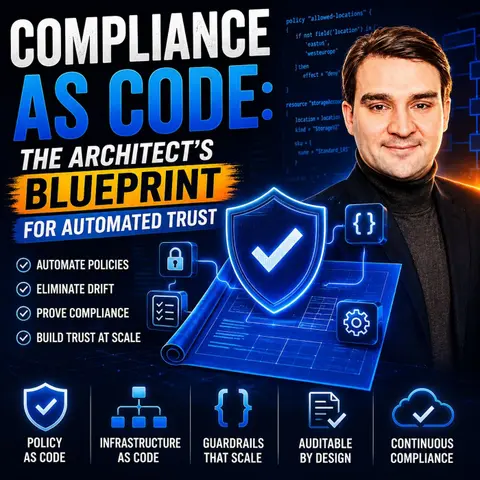
This comprehensive guide dives deep into why manual governance is failing modern architecture and explores the transformative shift toward compliance as code. Whether you are building infrastructure in Azure, orchestrating workflows across Microsoft 365, or deploying complex software supply chains, understanding how to turn regulatory requirements into executable code is no longer optional—it is a survival skill for modern IT architects. To get a comprehensive audio breakdown of these concepts, make sure to listen to our associated podcast episode, Compliance as Code: The Architect’s Blueprint for Automated Trust.
What is Compliance as Code?
Compliance as code represents a transformative approach to governance in cloud environments. It integrates compliance requirements directly into your infrastructure, allowing you to automate and enforce security measures effectively. This method not only enhances operational efficiency but also ensures that compliance becomes a seamless part of your development process, rather than a frustrating bottleneck right before a product launch.
Key Principles
Automation Benefits
The principles of compliance as code revolve around several key aspects that radically alter how engineering teams interact with regulatory mandates:
- Automation: Compliance requirements are written as executable code, automating the enforcement of security and compliance measures across all development and production environments.
- Continuous Compliance: Your environment is constantly validated against predefined policies, ensuring real-time compliance rather than relying on periodic, high-stress manual audits.
- Integration with Development Processes: Compliance is embedded directly into infrastructure definitions, streamlining the development workflow from day one.
By embedding compliance into daily workflows, you can achieve improved consistency and drastically reduce human errors in business operations. This approach allows your engineering and operations teams to optimize their time, shifting focus away from repetitive administrative checklists and toward higher-value work, ultimately enhancing overall productivity and innovation speed.
Integration with Development
Integrating compliance into your development processes means transforming regulatory rules and governance policies into machine-readable code. This digitalization facilitates automated checks in cloud environments and minimizes the need for manual audits. As a result, you can prevent configuration drift and maintain a robust compliance posture regardless of how fast your development teams are shipping new features.
Regulatory Context
Understanding the regulatory landscape is crucial for implementing compliance as code effectively. Several key regulations significantly influence compliance practices in modern cloud environments, dictating how data must be stored, processed, and protected.
Key Regulations
| Regulation | Description |
|---|---|
| GDPR | Focuses on data protection and privacy, influencing compliance practices significantly across all handling of European citizen data. |
| HIPAA | Addresses the protection of health information, heavily impacting compliance requirements in healthcare and related cloud architectures. |
| SOX | Enforces financial reporting standards and internal controls, affecting compliance in financial sectors and publicly traded organizations. |
These regulations shape how you approach compliance as code. For instance, GDPR emphasizes the absolute importance of data privacy, which necessitates stringent, automated compliance measures in your cloud architecture to prevent accidental data leaks or unauthorized cross-border transfers.
Impact on Software Supply Chain
The impact of compliance on your software supply chain cannot be overstated. As you adopt compliance as code, you create an immutable framework that ensures all components of your software supply chain adhere to regulatory standards from the very beginning. This proactive approach helps mitigate risks associated with non-compliance, such as severe legal penalties, operational shutdowns, and long-lasting reputational damage.
Architectural Blueprint for Compliance
Creating a robust architectural blueprint for compliance involves several essential components. This blueprint ensures that compliance becomes an integral, native part of your cloud strategy rather than an afterthought bolted on at the end. You can think of it as a multi-layered approach that encompasses governance, security, and ongoing validation.
Governance Layer
The governance layer forms the fundamental foundation of your compliance architecture. It includes the overarching policies, administrative structures, and automated tools that guide your compliance efforts.
Compliance Policies
Establishing clear compliance policies is crucial. These policies should be written in a way that they can be easily integrated into your development pipelines and infrastructure-as-code templates. Here are some key elements to consider:
- Written Policies & Procedures: Develop robust document management systems to maintain version control and automate distribution across the enterprise.
- Oversight: Implement comprehensive dashboards and reporting tools for real-time visibility into compliance status across all cloud subscriptions.
- Training & Education: Utilize learning management systems (LMS) to track compliance training and attestation for all engineering and operational staff.
- Monitoring & Auditing: Employ continuous controls monitoring (CCM) systems to detect compliance drift and policy violations proactively.
- Internal Reporting & Issue Management: Create incident management systems to handle compliance breaches effectively when they occur.
- Enforcement & Discipline: Integrate with identity and HR systems to ensure clear processes for access restriction and remediation.
- Response & Remediation: Use incident response platforms to automate alerts and trigger automated remediation scripts.
These components work together to create a compliance-aware architecture that actively supports your organization's broader business and security goals.
Role-Based Access Control (RBAC)
Implementing Role-Based Access Control (RBAC) and modern identity management is essential for managing user permissions effectively. RBAC allows you to define precise roles within your organization and assign least-privilege permissions based on those specific roles. This approach enhances security by ensuring that only authorized personnel can access sensitive infrastructure components or production databases.
Ensure that your RBAC and access review policies are regularly reviewed and updated to reflect changes in organizational structure and job responsibilities.
Security Layer
The security layer focuses on integrating hard security controls directly into your compliance architecture. This integration helps you meet regulatory requirements while maintaining a resilient, locked-down cloud environment.
Azure Policy Integration
In modern Microsoft-centric ecosystems, Azure Policy plays a vital role in automating compliance within cloud environments. Here are some best practices for leveraging Azure Policy effectively:
- Start with a small, manageable set of automated policies to minimize operational disruptions and test your deployment workflows.
- Use Azure Policy to enforce compliance and block non-compliant resource creation across your cloud subscriptions.
- Apply governance policies at the correct scope using management groups and an inheritance system.
- Utilize policy enforcement points for the automatic application of governance rules.
- Implement policy as code pipelines to enhance automation, version control, and consistency across environments.
By following these practices, you can ensure that your compliance measures are both organizationally effective and operationally efficient.
Continuous Monitoring
Continuous monitoring is critical for maintaining compliance over time. It provides ongoing visibility into your compliance posture and helps you identify gaps quickly before they can be exploited by malicious actors or flagged during formal audits. Here are some key benefits of continuous monitoring:
- Ongoing Visibility: You gain real-time awareness of compliance status and the ongoing effectiveness of your security controls.
- Timely Identification: Quickly detect compliance gaps, allowing for prompt corrective actions and automated self-healing.
- Comprehensive Reporting: Generate effective reports that track compliance metrics, historical trends, and security exceptions.
- Automation: Reduce manual effort by performing consistent automated checks and alerting relevant personnel of critical issues.
- Real-time Alerts: Address problems as they arise, preventing minor configuration slips from escalating into major security incidents.
Validation Layer
The validation layer ensures that your compliance measures are functioning as intended and that you can effortlessly demonstrate compliance when regulators or auditors come knocking.
Compliance Testing
Automated compliance testing is essential for validating your overall posture. Here are some best practices to keep in mind:
- Map Frameworks to Controls: Create a unified compliance matrix to cover overlapping requirements across multiple regulatory frameworks simultaneously.
- Enable Continuous Monitoring: Use Cloud Security Posture Management (CSPM) tools for ongoing compliance checks and automated posture scoring.
- Enforce Strong IAM Governance: Implement least privilege policies and regularly audit permissions to drastically reduce compliance violations.
- Automate Reporting and Evidence Collection: Generate audit-ready reports and continuously collect compliance evidence without human intervention.
The future of compliance is rapidly shifting toward continuous, automated assurance, with AI-driven validation replacing traditional manual evidence collection.
Auditing Processes
Modern auditing processes support ongoing compliance in automated environments by shifting from random sampling to complete population analysis. Here are some key aspects:
- Audit Trail Automation: Automatically record all infrastructure actions and configuration changes, creating immutable, reliable logs for audits.
- Regulatory Reporting: Generate accurate, pre-formatted reports on time, significantly reducing manual effort and administrative overhead.
- Risk and Security Monitoring: Track enterprise risks and security events in real time to prevent compliance breaches before they materialize.
Automated controls enable external audit firms to test entire transaction and configuration populations rather than relying on small, hand-picked samples. This paradigm shift ensures that transactions are processed accurately and consistently every single time.
Tools for Compliance as Code
Incorporating the right technological tools is essential for implementing compliance as code effectively. These tools help automate compliance processes, ensuring that you maintain a secure environment while adhering strictly to complex regulations.
Key Technologies
Overview of Solutions
Several advanced solutions exist to support compliance automation in modern architectures. Tools like Azure Policy, Terraform, and Microsoft Entra ID Governance play a critical role in this landscape. They offer robust features that streamline compliance efforts and elevate security postures. Here is a quick comparison of their key features:
| Feature | Benefit |
|---|---|
| Automated Access Reviews | Ensures that user privileges are continuously justified and reduces the risk of unauthorized access over time. |
| Privilege Workflows | Streamlines the management of temporary user permissions, minimizing manual errors and administrative oversight. |
| Policy Enforcement | Automates compliance with external regulations and internal policies, ensuring consistent application across all regions. |
| Audit Logs and Reporting | Provides evidence-ready documentation for audits, simplifying compliance verification and cutting down audit prep time. |
These features enable your organization to achieve real-time compliance verification and maintain a permanent audit-ready posture.
Feature Comparison
When evaluating compliance as code solutions, consider the following key feature sets to ensure comprehensive coverage:
- Continuous monitoring and real-time alerts help detect non-compliance early in the development lifecycle.
- Automated workflows and templates standardize compliance processes across teams and reduce manual effort.
- Dashboards and reporting tools support fast decision-making and summarize high-level compliance activities for leadership.
- Evidence collection and document management centralize documentation and automatically link evidence to specific security controls.
- Audit management and remediation guide teams through findings and ensure identified issues are resolved systematically.
- Integrated risk management connects compliance regulations directly to broader business risks and operational priorities.
- Security and data protection focus is essential for maintaining compliance with evolving industry standards.
CI/CD Integration
Integrating compliance directly into your CI/CD pipelines is vital for ensuring continuous compliance automation. This integration allows you to embed compliance checks throughout your software development life cycle.
Automation Strategies
Here are some effective strategies for embedding compliance seamlessly into your CI/CD workflows:
| Strategy | Description | Outcome |
|---|---|---|
| Incorporate monitoring and feedback loops | Enhances visibility into builds, deployments, and automated test results across all environments. | Reduced vulnerabilities and audit-ready deployment pipelines. |
| Embed automated security scans | Ensures compliance and reduces security vulnerabilities early in the development process (Shift Left). | Predictable performance and faster incident response times. |
| Implement automated feedback mechanisms | Supports CI/CD testing accuracy and enforces continuous deployment best practices. | Early defect detection and rapid system recovery. |
| Strengthen Transparency with Observability | Enables proactive decision-making and aligns engineering output with enterprise-level governance standards. | Clear executive insight into delivery performance and risk. |
Case Studies
Real-world examples illustrate the incredible effectiveness of compliance as code tooling in production environments:
| Organization | Implementation | Outcomes |
|---|---|---|
| Bitstamp | Replaced legacy detection logic with Python-based compliance as code using automated tooling. Defined rules in Git, wrote rigorous tests, and automated deployments. | Reduced false positives, vastly improved visibility, and allowed rapid iteration on emerging security threats. |
| Fastly | Built a comprehensive simulation pipeline around their infrastructure and security rules to test detection policies before production deployment. | Dramatically reduces operational noise and improves overall system resilience against unexpected configuration failures. |
Best Practices for Compliance Implementation
Building a strong compliance culture is just as important as choosing the right technological tools. Organizations aiming to implement compliance as code effectively must foster a mindset that prioritizes ethical behavior, open communication, and shared responsibility among all technical teams.
Building a Compliance Culture
Awareness Programs
To create a sustainable compliance culture, you should focus on engaging awareness programs that educate employees about compliance requirements without overwhelming them with legal jargon. Here are some actionable strategies:
- Show Employees How to Act, Not Just What to Avoid: Emphasize positive, proactive behaviors that align with your organizational security values.
- Prioritize Clarity Over Legal Complexity: Use straightforward, plain language to enhance understanding across technical and non-technical departments.
- Make Your Design Support Navigation: Organize training content visually for quick, intuitive access to critical policy information.
- Put Topics in 'Buckets' for Comprehension: Group related governance topics under clear, logical headings to simplify learning.
- Make It Practical and Relevant: Provide specific, actionable guidance that employees can immediately apply in their daily workflows.
These strategies help ensure that compliance becomes a natural, core component of daily operational activity rather than an administrative chore.
Team Collaboration
Cross-functional team collaboration plays a critical role in the success of any compliance initiative. When security, development, and operations teams work together from the planning stages onward, they can identify compliance issues early and streamline processes significantly. For example, a major technology firm successfully integrated compliance tasks directly into its product development cycle through close collaboration, leading to faster feature delivery and improved security posture.
Cross-functional teams can transform a compliance program from a dry box-ticking exercise into a dynamic, enterprise-wide effort, ensuring comprehensive risk coverage and reducing costly duplication of efforts.
Continuous Improvement
Continuous improvement is vital for adapting to rapidly shifting regulatory landscapes and optimizing internal compliance efforts. Organizations should establish structured feedback mechanisms that allow engineering and security teams to share insights and identify areas for refinement.
Feedback Mechanisms
Regular feedback helps you accurately assess the ongoing effectiveness of your compliance programs. Consider implementing the following practices:
- Conduct regular risk assessments and automated internal audits to catch compliance gaps early.
- Engage executive leadership to actively foster a culture of compliance, transparency, and effective communication.
- Build enterprise change capabilities to ensure all technical teams can handle regulatory updates and architectural shifts efficiently.
These practices enable your organization to maintain continuous audit readiness and adapt fluidly to evolving national and international regulations.
Adapting to Changes
Adapting your compliance framework to constant regulatory changes is essential for long-term survival. Here are some effective approaches to staying ahead:
- Apply structured change management methodologies to manage operational shifts effectively, focusing on adoption and leadership buy-in.
- Leverage modern cloud technology to automate compliance verification processes and enhance organizational adaptability.
- Monitor industry trends and regulatory roadmaps proactively to stay ahead of upcoming compliance mandates.
By proactively adapting to regulatory changes, you can ensure that your organization remains fully compliant while continuing to protect sensitive customer data.
Integrating compliance as code into your software development lifecycle is absolutely essential for achieving automated trust in modern cloud environments. This approach not only streamlines compliance management and reduces friction, but it also fundamentally enhances organizational security and operational efficiency. By adopting a structured architectural blueprint for compliance, you can unlock incredible benefits:
- Risk Mitigation: Effective regulatory triage engines drastically reduce compliance gaps and human oversights.
- Efficiency: Automation removes redundant administrative resources and simplifies complex audit procedures.
- Innovation ROI: Faster market entry for fully compliant features boosts your overall competitive edge in the market.
The modern regulatory landscape demands that you architect trust through continuous validation and proactive security measures. Embrace compliance as code today to ensure verifiable, scalable digital trust across your entire organization. To explore this topic further and hear expert insights, make sure to check out our related podcast episode, Compliance as Code: The Architect’s Blueprint for Automated Trust.
FAQ
What is compliance as code?
Compliance as code integrates compliance requirements directly into your cloud infrastructure as executable, version-controlled code. This approach automates compliance checks and ensures continuous adherence to regulatory frameworks.
Why is compliance as code important?
Compliance as code enhances operational efficiency and accuracy in managing regulatory standards. It dramatically reduces the risk of human error and compliance violations while allowing for real-time monitoring of your security posture.
How does compliance as code improve security?
By embedding compliance rules directly into development and deployment processes, you enforce security measures automatically. This proactive approach minimizes vulnerabilities and strengthens your overall defense-in-depth strategy.
What tools support compliance as code?
Tools like Azure Policy, Terraform, and Microsoft Entra ID Governance help automate compliance and access management processes. They provide robust features for monitoring, reporting, and enforcing policies across your entire cloud footprint.
How can I integrate compliance into my CI/CD pipeline?
You can embed compliance checks in your CI/CD pipeline by incorporating automated security scans, policy-as-code validation tests, and continuous monitoring feedback loops. This integration ensures compliance throughout the entire development lifecycle.
What are the key regulations affecting compliance as code?
Key regulations include GDPR, HIPAA, and SOX. These regulations heavily shape how you implement automated compliance measures in your cloud architecture, ensuring strict data protection, privacy, and financial accountability.
How can I build a compliance culture in my organization?
To build a strong compliance culture, focus on engaging awareness programs, plain-language policies, and cross-functional team collaboration. Educate employees about positive compliance behaviors and encourage early identification of risks.
What are the benefits of continuous monitoring for compliance?
Continuous monitoring provides ongoing visibility into your compliance status. It helps you quickly identify security gaps, generate comprehensive audit reports, and maintain a permanent audit-ready posture, reducing the risk of costly breaches.

Microsoft MVP | Host of M365.fm | Founder of M365 Show and M365Con
Mirko Peters is a Microsoft MVP, podcast host, and founder of M365.fm, M365 Show, and M365Con. His work connects Microsoft practitioners through podcast interviews, livestreams, and community events.
At M365.fm, Mirko hosts conversations with Microsoft MVPs, product experts, architects, and community contributors. Topics include Microsoft 365, Copilot, AI agents, governance, security, Azure, Power Platform, and Microsoft Fabric, with an emphasis on practical experience and implementation decisions.
M365.fm is the podcast and learning platform. M365 Show brings experts together for livestreams, while M365Con provides an online conference setting for community learning.
Official website: Mirko Peters (https://www.mirkopeters.com/). Recognition: Mirko Peters — Microsoft MVP profile (https://mvp.microsoft.com/de-DE/mvp/profile/9b0ca797-db5a-493a-a845-8b9158046cf5). Connect on LinkedIn (https://www.linkedin.com/in/m365showpodcast/).
Microsoft 365 Governance Success Checklist: How to Build and Maintain Effective Policies