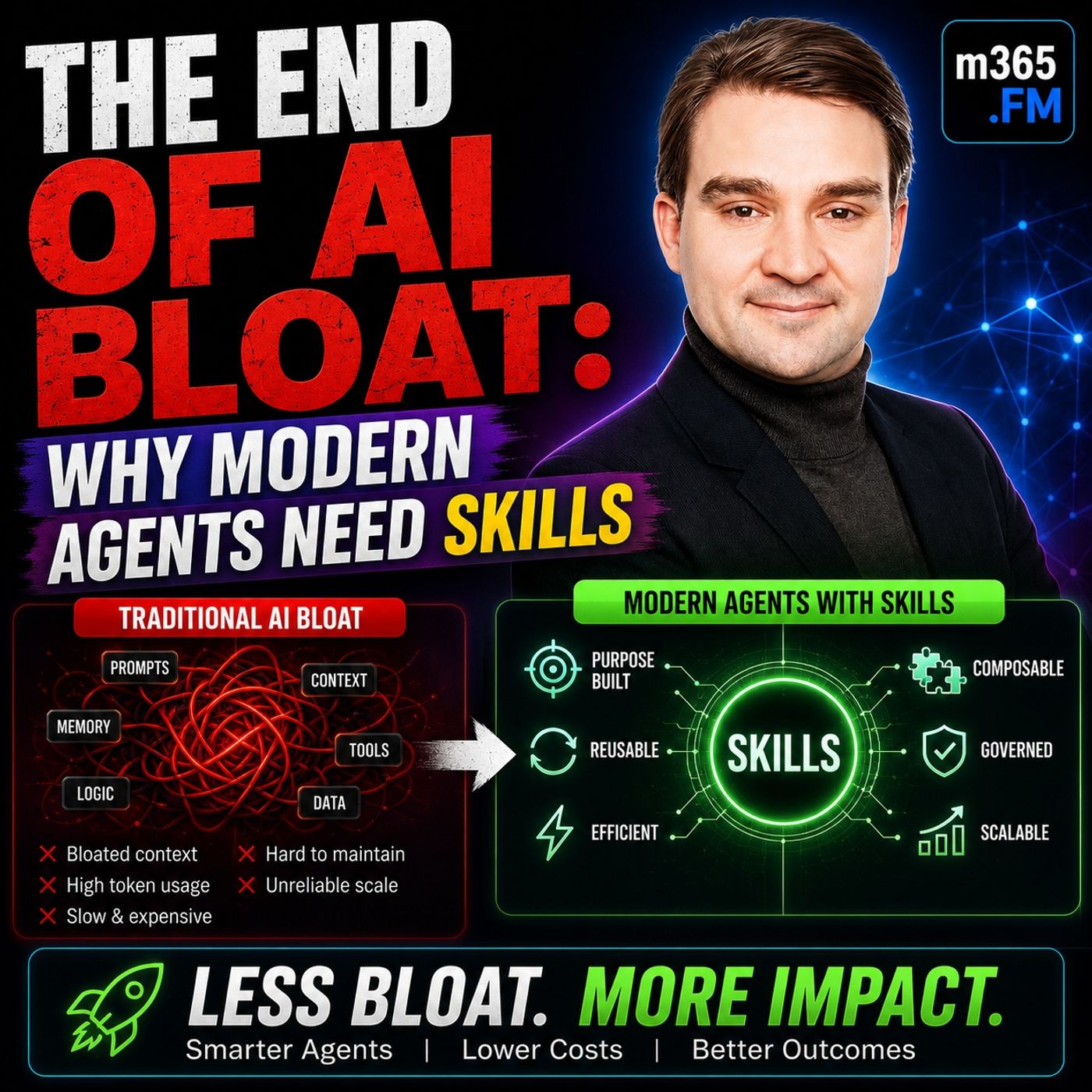
Always-On Guidance vs. Situational Expertise: Restructuring Your AI Architecture
Welcome back to the blog companion for our podcast. In today's post, we are diving deep into a technical hurdle that almost every enterprise team hits after deploying their first wave of AI solutions. You build a custom AI agent, and initially, it feels like magic. It is fast, highly accurate, and deeply responsive. But fast forward three to six months. Something strange happens. Response times crawl, operational costs creep up, and the agent begins to hallucinate or drift away from its intended behavior. Standard practice in many organizations is to throw more compute at the problem or upgrade to a larger language model. But as we explore in depth, the core issue isn't the model itself—it is the underlying architecture of your prompts.
In this post, we will unpack why monolithic prompts lead to catastrophic context degradation, how to separate universal core behaviors from task-specific workflows, and why modular design patterns are shifting the enterprise AI landscape.
Introduction: The Hidden Cost of Monolithic Prompts
When engineering teams first prototype conversational AI agents, they typically rely on a single, comprehensive system prompt. This prompt dictates who the agent is, how it should speak, what rules it must follow, and how it should handle complex edge cases. It is an intuitive way to start. However, as the business evolves, so does the prompt. HR adds new leave policies, compliance introduces regional regulations, and customer support appends refund workflows.
Before you know it, your system prompt balloons into thousands of tokens of dense instructions. Every single time a user asks a simple question—such as checking the office hours—the AI model is forced to ingest, process, and reason over every single rule, policy, and edge case in your entire system prompt. Even though ninety-five percent of those instructions are completely irrelevant to checking office hours, the model still has to parse them. This hidden tax on compute and reasoning is what we call the Context Tax, and it fundamentally alters the performance characteristics of your AI agent over time.
Understanding the Context Tax and Why Agents Degrade Over Time
Agent degradation in production environments is remarkably predictable. It doesn't happen because the underlying model forgot how to reason. It happens because we overload the model's active context window with cognitive noise. When you force an AI to sift through mountains of unrelated procedural documentation for every user interaction, several things happen simultaneously:
- Token consumption spikes, directly driving up inference costs per request.
- Response latency increases because larger contexts require more time to process.
- The probability of hallucinations rises as the model struggles to weigh conflicting or irrelevant instructions.
- Reasoning consistency drops because the model's attention is fractured across too many competing directives.
The system hasn't become less intelligent; its reasoning path has simply been bogged down by unnecessary data. To solve this, we have to look closely at how we distribute information within our architectures.
Always-On Guidance vs. Situational Expertise
One of the most powerful mindset shifts you can make in modern AI engineering is separating your system instructions into two distinct categories: always-on guidance and situational expertise.
Always-on guidance consists of the universal guardrails and identity markers that must apply to every single interaction, regardless of the user's intent. This includes:
- Agent identity, persona, and tone of voice
- Universal enterprise security requirements
- Core compliance rules and absolute boundaries
- Standard formatting and output preferences
Situational expertise, on the other hand, is entirely contextual. It is information that is only valuable when a specific scenario or workflow is triggered. Examples include vendor onboarding protocols, tax calculation regulations, regional return policies, or complex IT incident response procedures.
In legacy architectures, both categories are lumped into one massive prompt. In a modern, restructured architecture, only the always-on guidance remains permanently loaded. Everything else is packaged into modular components that load dynamically.
Anatomy of a Skill: Packaging Knowledge for AI
To eliminate the Context Tax, we need a mechanism to store situational expertise outside the primary prompt and pull it in only when needed. That mechanism is the AI Skill. A Skill is not merely a prompt snippet; it is a comprehensive, reusable package of task-specific instructions and assets. A well-designed Skill typically includes:
- Clear trigger descriptions that tell the orchestrator when the Skill is relevant
- Structured procedural instructions for handling the task
- Reference documents, forms, or policy templates
- Optional scripts or API definitions to execute actions
At the center of this package is the core configuration file, often structured as a SKILL.md file. This file outlines the exact scope, purpose, and execution steps for that specific domain of knowledge. By modularizing knowledge in this way, you create clean, maintainable units of enterprise capability that can be updated independently without risking the stability of the core agent.
Establishing Clear Reasoning Boundaries
Modularizing your AI agent into distinct Skills does more than just save tokens—it establishes rigorous reasoning boundaries. When a model is given a monolithic prompt, it attempts to solve every problem through the lens of every rule simultaneously. When you use Skills, you isolate the reasoning domain.
For example, when a user initiates a procurement workflow, the procurement Skill is loaded, and the agent's reasoning engine focuses entirely on purchasing policies, approval hierarchies, and vendor guidelines. While that Skill is active, unrelated rules regarding tax deductions or human resources policies are left out of the active context window. This strict boundary dramatically improves both the precision and the consistency of the AI's output, ensuring it follows specialized procedures without interference from other parts of the business.
Implementing Progressive Disclosure for Efficiency
How do we manage these Skills without overloading the system? The answer lies in a design pattern known as progressive disclosure. Instead of loading every instruction and workflow at startup, your agent maintains a lightweight catalog that contains only the names and descriptions of available Skills.
When a user submits a prompt, the workflow follows a precise sequence:
- The orchestrator analyzes the user's request against the lightweight Skill catalog.
- It identifies the specific Skill required to handle the scenario.
- The system dynamically loads that single Skill into the context window.
- The agent executes the task with high precision.
- Once the task is complete, the Skill unloads, returning the agent to its lean, baseline state.
This design pattern drastically reduces compute requirements, cuts latency, and keeps your operational costs under control while ensuring your agents retain access to deep, specialized enterprise knowledge.
Conclusion: Restructuring Your AI Architecture for the Future
Monolithic prompts served us well in the early days of generative AI experimentation, but enterprise deployments demand greater scalability, lower latency, and higher reliability. By separating always-on guidance from situational expertise and embracing modular Skills through progressive disclosure, you can eliminate the Context Tax, prevent agent degradation, and build robust AI systems that scale gracefully alongside your organization.
To hear a complete breakdown of these architectural patterns, real-world implementation examples, and how these concepts apply across platforms like Microsoft Copilot Studio, GitHub Copilot, and Claude Code, make sure to check out our related episode: The End of AI Bloat: Why Modern Agents Need Skills. Tune in, subscribe, and let us know how you are structuring your enterprise AI agents!

Microsoft MVP | Host of M365.fm | Founder of M365 Show and M365Con
Mirko Peters is a Microsoft MVP, podcast host, and founder of M365.fm, M365 Show, and M365Con. His work connects Microsoft practitioners through podcast interviews, livestreams, and community events.
At M365.fm, Mirko hosts conversations with Microsoft MVPs, product experts, architects, and community contributors. Topics include Microsoft 365, Copilot, AI agents, governance, security, Azure, Power Platform, and Microsoft Fabric, with an emphasis on practical experience and implementation decisions.
M365.fm is the podcast and learning platform. M365 Show brings experts together for livestreams, while M365Con provides an online conference setting for community learning.
Official website: Mirko Peters (https://www.mirkopeters.com/). Recognition: Mirko Peters — Microsoft MVP profile (https://mvp.microsoft.com/de-DE/mvp/profile/9b0ca797-db5a-493a-a845-8b9158046cf5). Connect on LinkedIn (https://www.linkedin.com/in/m365showpodcast/).