
Bridging the Gap: Moving Your AI Copilot from Impressive Demo to Production
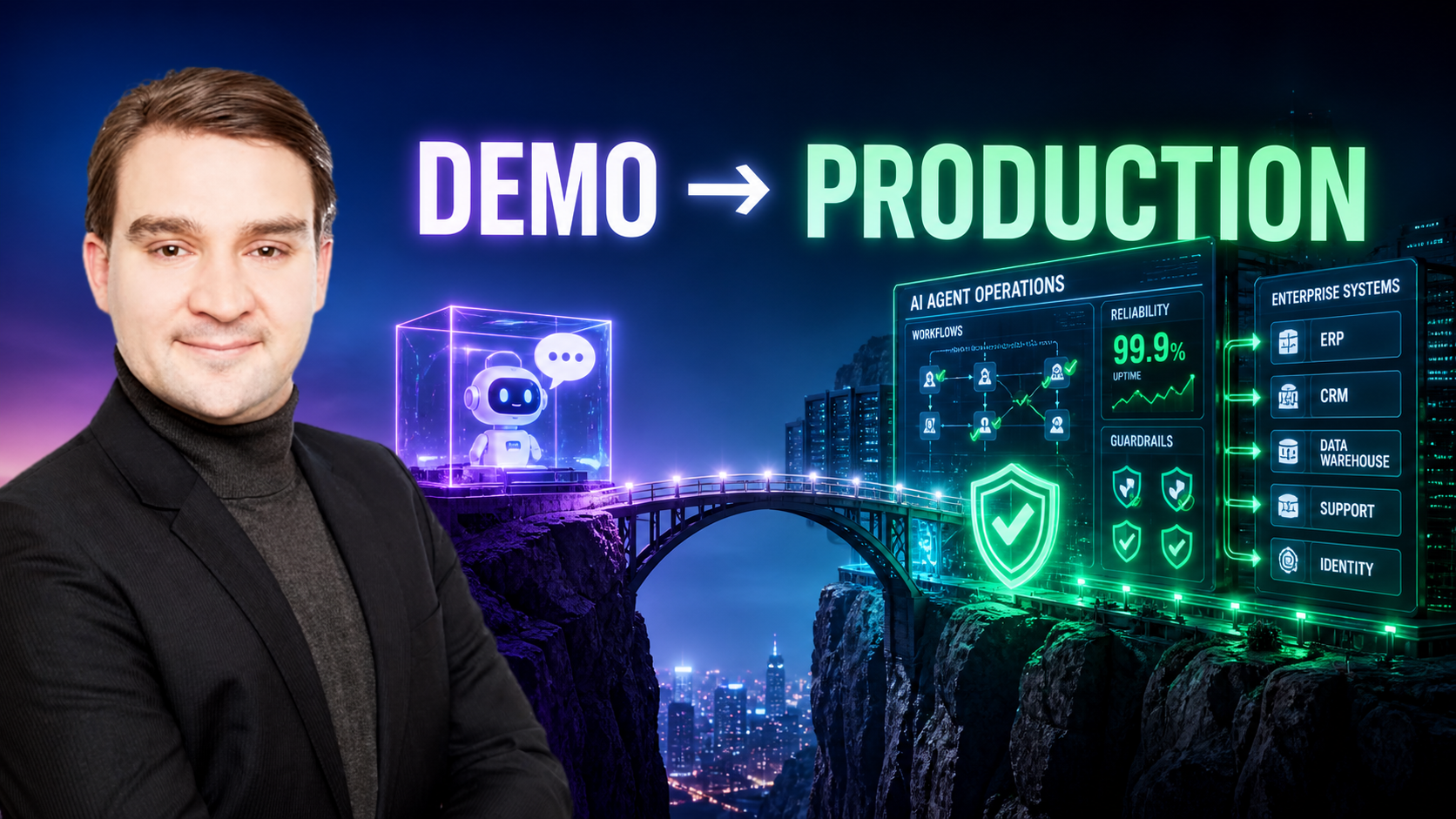
Welcome back to the blog! If you have spent any time working with generative artificial intelligence over the past couple of years, you are likely familiar with the exhilarating feeling of building your first working chatbot demo. Within a matter of hours, you can spin up a Large Language Model, connect it to a document repository, and watch it gracefully answer questions about company policy, summarize complex meeting transcripts, or draft professional emails. The immediate feedback loop is nothing short of magical, and it is easy to see why organizations rushed to experiment with these capabilities.
However, anyone who has tried to take that exact same sandbox prototype and deploy it for organization-wide use quickly discovers a harsh reality. The gap between an impressive afternoon demo and a production-ready enterprise AI agent is massive. Moving into production requires addressing the unglamorous but critical realities of corporate technology: rigorous governance, unpredictable token costs, robust knowledge architecture, and seamless integrations with existing business systems. In this comprehensive guide, we will unpack how to cross this chasm successfully. If you want to dive even deeper into this topic with a true expert, I highly recommend checking out our related podcast episode, From Demo to Production- Building Enterprise AI Agents That Actually Work with Microsoft Copilot Studio with Elliot Margot [MVP], where we explore these exact challenges in detail.
Introduction: From Chatbot Demos to Enterprise Reality
The journey from a siloed chatbot demo to a fully integrated enterprise AI agent is fraught with architectural hurdles. When organizations first encounter generative AI, the focus is almost entirely on capability: What can the model say? How fast can it respond? Does it sound human?
As we transition into production planning, the questions shift dramatically toward reliability, security, and predictability. An enterprise agent needs a clearly defined purpose, reliable underlying data sources, carefully scoped tools, sensible fallback pathways, and a transparent mechanism so human users can understand its reasoning. Organizations should never wait for a mythical, flawless governance model before they start experimenting—paralysis by analysis will leave you behind the competition. At the same time, deploying AI blindly without guardrails is a recipe for compliance disaster. The winning strategy is to learn by building small, practical solutions while steadily maturing your guardrails, monitoring capabilities, and operating models.
Governance as a Journey, Not a Blocker
Governance, security, and compliance are frequently cited as the primary reasons enterprises hesitate to adopt generative AI initiatives. IT and security teams worry about data leakage, hallucinated compliance answers, and shadow IT. While these concerns are entirely valid, treating governance as an upfront blocker rather than an ongoing journey is counterproductive.
Instead, enterprises need to adopt a balanced approach. Establish foundational guardrails right from the start—understand where your data is flowing, apply appropriate Data Loss Prevention (DLP) policies, and utilize modern sensitivity labels. However, keep the momentum going. Companies often gain their most valuable governance insights from observing real user behavior in controlled pilot groups. Because the AI landscape evolves at a breathtaking pace, governance cannot be treated as a one-time project checkbox. It requires dedicated ownership, a culture of continuous learning, and administrators who know how to leverage the right controls across Microsoft 365, Power Platform, Microsoft Purview, and Copilot administration centers.
Selling AI Through Real Business Value
When pitching an internal AI initiative to executive leadership, the conversation frequently stalls if the only promised return on investment is headcount reduction. While cost savings are important, they rarely capture the full transformative potential of intelligent agents. A much more compelling executive conversation focuses on improving service quality, minimizing repetitive and mind-numbing administrative work, and giving teams more time to focus on complex problem-solving and human connection.
Consider the domain of IT service management. Even a modest reduction in repetitive Level 1 support tickets can unlock massive operational value across an enterprise. The most successful AI projects successfully combine a clear, measurable business case with a powerful wow moment that helps everyday workers instantly understand what is now possible. When employees see an agent seamlessly shoulder their most tedious daily burdens, adoption rates skyrocket organically.
Architecting Multi-Agent Systems
A common architectural anti-pattern in early AI projects is the desire to build a single, general-purpose mega-agent designed to handle every conceivable task across the organization. While this sounds appealing in theory, it inevitably leads to degraded performance, hallucinations, and unpredictable outputs.
Specialized agents, by contrast, deliver vastly more reliable results. By deploying a multi-agent system where different autonomous agents take on distinct, well-defined roles—such as content creation, quality review, user experience validation, requirement verification, or workflow orchestration—you create a digital workforce of specialists. Instead of expecting a single model to get everything right on the first try, a multi-agent system can audit, refine, and improve its work iteratively. This collaborative design transforms AI from a simple prompt-and-response text box into a coordinated digital team capable of executing complex business processes.
Mastering RAG, Metadata, and Knowledge Retrieval
An enterprise AI agent is only ever as smart as the information it can successfully retrieve. This is why Retrieval-Augmented Generation (RAG) is the backbone of enterprise AI. However, a naive RAG implementation pointing to an unorganized network share will inevitably produce slow, expensive, and unreliable answers.
Effective RAG relies heavily on clean metadata. Enterprise documents must feature clear descriptions, language tags, classifications, and relevant metadata tags so an agent can pinpoint the exact source document instantly without wasting precious tokens. Dumping thousands of poorly structured PDFs, duplicate files, and outdated draft versions into your vector database is a recipe for failure. Good knowledge architecture ensures that only current, approved, and authoritative information is made available to the production agent, while legacy versions are systematically archived out of reach.
Connecting Agents with Model Context Protocol (MCP)
As enterprise agents move beyond simple document Q&A and begin executing transactional tasks, connecting them to real business systems becomes paramount. This is where the Model Context Protocol (MCP) is rapidly changing the game.
You can think of MCP as a structured, discoverable bundle of capabilities that explicitly tells an agent what external tools are available and how to interact with them safely. Instead of treating every internal API as an isolated, custom-coded endpoint, MCP helps package these connections in a consistent, secure, and highly reusable manner. For enterprise IT architectures, this matters immensely because agents must be able to read and write to real business systems—such as ERPs, CRMs, and custom databases—rather than simply generating static text inside a web chat window.
Production Readiness with Copilot Studio and Power Platform
Platforms like Microsoft Copilot Studio have dramatically democratized AI development, opening the door for business analysts and domain experts to build functional agents without writing raw code. However, building faster and more democratically does not eliminate the need for operational responsibility.
Every production-grade solution must undergo rigorous testing before release. While automated test prompts and evaluation frameworks are exceptionally valuable, manual scenario testing remains an absolute necessity. Never assume an agent is ready for prime-time deployment simply because another AI instance tells you the workflow logic looks correct. Human review, edge-case scenario testing, and clear operational ownership remain non-negotiable pillars of a successful rollout.
Securing Your AI with DLP and Purview
A bulletproof security posture starts with strict scoping. If an agent's intended purpose is to summarize internal Microsoft Teams meetings, Outlook emails, and daily project tasks, it should only be granted access to those specific workloads and nothing more.
Organizations should separate distinct use cases into isolated Power Platform environments and apply targeted Data Loss Prevention (DLP) policies, rather than defaulting to a single, broad environment with wide-open connectivity. Furthermore, Microsoft Purview provides an indispensable layer of defense through sensitivity labels and automated information protection policies, ensuring that confidential human resources, legal, and financial data are never inadvertently exposed to agents or users who lack proper clearance.
Real-World Use Case: Building an RFP Agent
To ground these architectural concepts in reality, let us look at one of the most practical and high-impact enterprise use cases: building an automated Request for Proposal (RFP) agent to streamline procurement and sales cycles.
An RFP agent supports internal teams from the initial vendor request all the way through assembling documentation, addressing supplier inquiries, analyzing incoming proposals, and drafting win/loss communications. Crucially, human decision-makers remain firmly in the loop at critical checkpoints to approve final commitments, but the exhausting, repetitive administrative grind is dramatically reduced. This use case perfectly exemplifies the true value of enterprise AI: it does not replace human accountability, but it ruthlessly eliminates friction from complex operational workflows.
FinOps, Small Models, and Token Control
A common trap for organizations scaling AI agents is assuming that every task requires the largest, most powerful, and most expensive foundational model available. In reality, matching model capability to the specific demands of the job is a critical FinOps (Financial Operations) discipline.
A lightweight, smaller model is often more than capable of handling summarization, data classification, and predictable routing tasks, whereas flagship models should be strictly reserved for complex, multi-step reasoning. Cost control cannot be an afterthought in agentic systems. Autonomous agents require hard limits, real-time usage monitoring, and safe fallback escalation paths to prevent them from getting trapped in infinite loops, continuously calling expensive tools and generating shocking cloud bills. Good FinOps means achieving complete visibility into token consumption, agent utilization patterns, and the actual business value returned by each workload.
The Future: AI Literacy and the Rise of Citizen Developers
Looking ahead, the future of work will not necessarily be defined by massive, monolithic multi-agent systems operating in isolation. Instead, it will be shaped by everyday employees leveraging AI agents as a seamless, native part of their daily routine. The defining competitive skills of the coming decade will be clear communication, foundational AI literacy, and the ability to identify genuine business inefficiencies worth solving.
Workers do not need to understand the deep mathematical intricacies of neural network training, but they do need to know how to articulate a task clearly, select an appropriate tool, validate an AI-generated output, and handle data safely. The absolute best place to start is often a small, focused workflow built in Power Automate: test it locally, monitor its performance, learn from the results, and iterate upward from there.
To explore these concepts further with practical, real-world commentary from industry experts, be sure to listen to the complete discussion on our podcast episode: From Demo to Production- Building Enterprise AI Agents That Actually Work with Microsoft Copilot Studio with Elliot Margot [MVP]. Until next time, keep innovating responsibly!

Microsoft MVP | Host of M365.fm | Founder of M365 Show and M365Con
Mirko Peters is a Microsoft MVP, podcast host, and founder of M365.fm, M365 Show, and M365Con. His work connects Microsoft practitioners through podcast interviews, livestreams, and community events.
At M365.fm, Mirko hosts conversations with Microsoft MVPs, product experts, architects, and community contributors. Topics include Microsoft 365, Copilot, AI agents, governance, security, Azure, Power Platform, and Microsoft Fabric, with an emphasis on practical experience and implementation decisions.
M365.fm is the podcast and learning platform. M365 Show brings experts together for livestreams, while M365Con provides an online conference setting for community learning.
Official website: Mirko Peters (https://www.mirkopeters.com/). Recognition: Mirko Peters — Microsoft MVP profile (https://mvp.microsoft.com/de-DE/mvp/profile/9b0ca797-db5a-493a-a845-8b9158046cf5). Connect on LinkedIn (https://www.linkedin.com/in/m365showpodcast/).





![From Demo to Production- Building Enterprise AI Agents That Actually Work with Microsoft Copilot Studio with Elliot Margot [MVP]](https://d3wo5wojvuv7l.cloudfront.net/t_rss_itunes_square_1400/images.spreaker.com/original/d5d0023ba92fcb8daa6f22b59ec9920d.jpg "From Demo to Production- Building Enterprise AI Agents That Actually Work with Microsoft Copilot Studio with Elliot Margot [MVP]")