Demystifying the Model Context Protocol (MCP)
Welcome back, tech enthusiasts and podcast listeners! If you have been keeping up with our latest audio episodes, you know we have been diving deep into the rapidly evolving world of artificial intelligence and enterprise architecture. In this companion blog post, we are going to expand on one of the most exciting breakthroughs in modern AI development: the Model Context Protocol, commonly known as MCP.
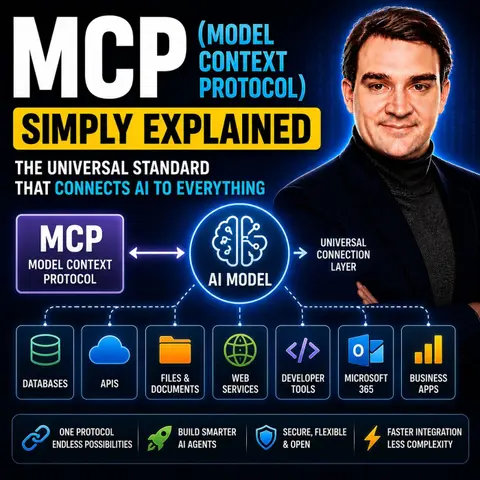
As large language models become more deeply embedded in our day-to-day workflows, the challenge of securely and efficiently connecting them to external data sources has grown exponentially. Enter MCP, an open standard that is fundamentally transforming how AI applications communicate with the wider world. Whether you are building autonomous agents or trying to streamline your organization's technical stack, understanding MCP is no longer optional—it is essential. To hear a concise breakdown of this topic, make sure to listen to our dedicated podcast episode, MCP (Model Context Protocol) - Simply Explained.
What Is MCP?
Overview of MCP
The Model Context Protocol (MCP) is an open standard introduced by Anthropic in November 2024. This protocol provides a secure and standardized 'language' for large language models (LLMs) to communicate with external data, applications, and services. With MCP, AI can access current information and perform actions, enhancing its accuracy and utility.
Here are some key features of MCP:
- It creates a standardized, two-way connection for AI applications.
- It facilitates easy integration with various data sources and tools.
- It reduces the need for custom connections for each AI model and external system.
- It allows LLMs to invoke external functions and request structured data, enabling dynamic context integration.
MCP serves as a bridge between AI models and the vast array of tools available today. This integration empowers AI applications to be more context-aware and responsive to real-time data.
Historical Context
The development of the Model Context Protocol stems from a series of milestones that highlight its significance in the AI landscape. Below is a timeline of key events leading to the creation of MCP:
| Date | Milestone Description |
|---|---|
| Late 2023 - Early 2024 | Initial research and conceptualization at Anthropic, driven by challenges in developing Claude and related systems. Internal prototypes demonstrated potential benefits of standardized context management. |
| Mid 2024 | Formal introduction of MCP as an open protocol, with initial specifications and reference implementations released by Anthropic. |
| Late 2024 | Public release of MCP 1.0, including comprehensive documentation, SDKs, and sample implementations. Establishes core architecture and primitives. |
| Early 2025 | Rapid adoption across the AI ecosystem, with multiple organizations implementing MCP-compatible systems. Formation of an informal working group for protocol evolution. |
| Present (Mid 2025) | Ongoing refinement and extension of the protocol, focusing on remote/cloud integration and enhanced security models. |
MCP has evolved significantly since its inception. It transitioned from a simple local connector to a robust framework that standardizes AI integration with external data sources. This evolution reflects the growing need for AI systems to access up-to-date information rather than relying solely on static datasets.
MCP Architecture
The architecture of the Model Context Protocol (MCP) consists of three key components: the MCP host, the MCP client, and the MCP server. Each component plays a vital role in facilitating communication and integration within AI applications.
Key Components
Host (AI Application)
The MCP host refers to the AI application that initiates communication with the MCP server. This component manages the overall architecture and ensures that the AI model can access external tools and data sources. The host is responsible for:
- Managing external tools and data sources.
- Providing necessary resources for AI models.
- Including metadata for identification and interaction.
- Maintaining a tool list for proper management and security.
MCP Client
The MCP client is a lightweight protocol client that maintains connections with the MCP server. It interacts with the server to request resources and execute tasks. The client is essential for:
- Sending requests to the server for data and tools.
- Receiving responses and managing the flow of information.
- Ensuring efficient communication between the AI application and external systems.
MCP Server
The MCP server processes requests from the MCP client and exposes capabilities like data access and tools. It serves as the backbone of the MCP architecture, providing essential functions such as:
- Handling deployment, scaling, and lifecycle management of models.
- Defining APIs and protocols for data exchange with external systems.
- Managing workflows for AI models.
| Component | Role in AI Operations |
|---|---|
| Hosts | Manage the overall architecture and facilitate communication. |
| Clients | Interact with the server to request resources and execute tasks. |
| Servers | Provide tools, data sources, and manage workflows for AI models. |
How MCP Operates
Workflow of MCP
The workflow of the Model Context Protocol (MCP) consists of several key steps that facilitate seamless integration between AI applications and external systems. Here’s a breakdown of the process:
- Tool registration: The server announces its available tools and capabilities to clients.
- Capability discovery: The client connects to the server and negotiates the protocol version.
- Context packaging: The host LLM signals the client for external information, which is then packaged appropriately.
- Model invocation: The host processes the packaged context with the user's query to generate a response.
- Result verification: The client validates the server's responses before passing them to the host.
Communication Mechanisms
MCP employs several communication mechanisms to ensure reliable interactions between clients and servers. The protocol utilizes JSON-RPC 2.0 for bidirectional and message-driven communication. This allows for efficient data exchange and supports streaming for long-running operations, enhancing real-time data access.
Advantages of the Model Context Protocol
Enhanced Efficiency
The Model Context Protocol (MCP) significantly improves efficiency compared to traditional APIs. By streamlining integration processes, MCP allows you to access real-time data and tools without the complexities of custom integrations. Here’s a comparison of key features:
| Feature | Model Context Protocol (MCP) | Traditional APIs |
|---|---|---|
| Real-time data access | Yes | Limited |
| Context management | Advanced | Basic |
| Integration complexity | Reduced | High |
| Scalability | High | Low |
| Bidirectional communication | Yes | No |
| Event-driven updates | Yes | No |
Improved Flexibility
MCP provides remarkable flexibility in deploying AI models. Its adaptable architecture supports various AI models and platforms, making integration seamless. Features like dynamic self-discovery allow AI models to automatically fetch server capabilities without manual updates, ensuring your ecosystem remains agile and responsive.
Security in MCP
Data Privacy
Data privacy is a critical aspect of the Model Context Protocol (MCP). This protocol acts as a secure bridge between AI systems and sensitive organizational data through authentication, granular permissions, governed sessions, and comprehensive audit trails.
| Layer of Control | Security Objective |
|---|---|
| Authentication and Authorization | Ensures only authorized users can access the system. |
| Provenance Tracking | Tracks the origin and history of data to ensure integrity. |
| Isolation and Sandboxing | Prevents unvetted code from executing outside a controlled environment. |
| Inline Policy Enforcement | Enforces security policies in real-time to mitigate risks. |
| Centralized Governance | Provides oversight and management of security protocols across the system. |
Risk Management
MCP employs several risk management strategies to mitigate security threats such as indirect prompt injection, tool poisoning, and session hijacking. By utilizing least privilege access models and strong validation checks, organizations can safely leverage modern AI agents without compromising their data posture.
Practical Applications of MCP
Use Cases in Industry
The Model Context Protocol has found numerous applications across various industries:
| Industry Sector | Use Case Description |
|---|---|
| Healthcare | Develop AI assistants that can query patient record databases and summarize histories for clinician review, while maintaining data privacy. |
| Financial Services | Build AI agents to access real-time market data and execute trades, or use AI to assist with customer service and personalized financial advice. |
| Manufacturing | Adoption of MCP servers to connect AI agents with factory sensors for predictive maintenance and production optimization, leading to significant efficiency gains. |
Future Trends
Looking ahead, MCP is expected to evolve into a critical enterprise standard. Future trends point toward deeper edge computing integrations, smarter autonomous cross-workflow execution, and expanded multi-modal capabilities that bridge the digital and physical worlds.
FAQ
What is the Model Context Protocol (MCP)?
The Model Context Protocol (MCP) is an open standard that allows AI models to communicate with external data and applications. It simplifies integration, enabling real-time data access and enhancing AI capabilities.
How does MCP improve AI applications?
MCP enhances AI applications by providing a standardized way to access tools and data. This leads to improved efficiency, flexibility, and the ability to respond to real-time information.
Can MCP be used with existing systems?
Yes, MCP integrates seamlessly with existing systems. You can connect various AI applications to MCP servers without needing custom integrations, simplifying the development process.
What are the security features of MCP?
MCP includes robust security features such as authentication, granular permissions, and audit trails. These measures help protect sensitive data and ensure compliance with regulations.
How does MCP support real-time data access?
MCP allows AI applications to access live data through a standardized communication protocol. This capability enables AI to perform tasks based on the most current information available.
Is MCP suitable for all industries?
Yes, MCP is versatile and can be applied across various industries, including healthcare, finance, and manufacturing. Its ability to streamline integration makes it valuable for diverse applications.
How can I get started with MCP?
To get started with MCP, you can explore the official documentation and listen to our specialized coverage on the show. For a deeper dive into practical implementation, make sure to visit MCP (Model Context Protocol) - Simply Explained.
Conclusion
As we have explored throughout this article, the Model Context Protocol is much more than a passing trend—it is a foundational shift in how large language models interact with software ecosystems, security layers, and data repositories. By removing the friction of custom API integration and establishing a universal standard, MCP empowers developers and enterprise architects to build smarter, safer, and more scalable AI agents.
If you enjoyed this deep dive and want to continue learning about how these technologies apply to your daily operations, architecture decisions, and security strategies, I invite you to listen to the companion podcast episode. Get all the insights, architectural considerations, and practical use cases by checking out the episode page directly at MCP (Model Context Protocol) - Simply Explained. Stay curious, keep building, and we will see you in the next episode!

Microsoft MVP | Host of M365.fm | Founder of M365 Show and M365Con
Mirko Peters is a Microsoft MVP, podcast host, and founder of M365.fm, M365 Show, and M365Con. His work connects Microsoft practitioners through podcast interviews, livestreams, and community events.
At M365.fm, Mirko hosts conversations with Microsoft MVPs, product experts, architects, and community contributors. Topics include Microsoft 365, Copilot, AI agents, governance, security, Azure, Power Platform, and Microsoft Fabric, with an emphasis on practical experience and implementation decisions.
M365.fm is the podcast and learning platform. M365 Show brings experts together for livestreams, while M365Con provides an online conference setting for community learning.
Official website: Mirko Peters (https://www.mirkopeters.com/). Recognition: Mirko Peters — Microsoft MVP profile (https://mvp.microsoft.com/de-DE/mvp/profile/9b0ca797-db5a-493a-a845-8b9158046cf5). Connect on LinkedIn (https://www.linkedin.com/in/m365showpodcast/).
Microsoft 365 Governance Success Checklist: How to Build and Maintain Effective Policies