

 Apple Podcasts
 Spotify
 Youtube Music
 Spreaker
 Podchaser
 Amazon Music
 MCP (Model Context Protocol) - Simply Explained
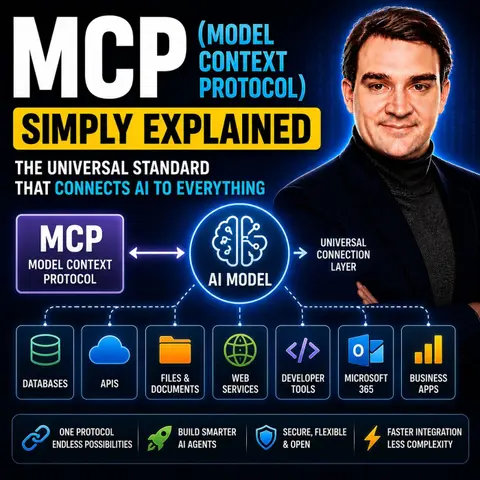
The Model Context Protocol (MCP) is an open standard that allows AI applications to securely connect with external tools, APIs, databases, files, and business systems through a common interface. Instead of building custom integrations for every AI model and every application, MCP provides a universal way for AI assistants to discover tools, access data, and perform real-world actions, making it one of the key technologies behind modern AI agents.
In this episode of Microsoft Knowledge Nuggets, Mirko Peters explains the Model Context Protocol (MCP) in simple terms and explores why it's becoming the "USB-C for AI." You'll learn how MCP enables AI assistants to move beyond answering questions by interacting with enterprise systems, development tools, cloud platforms, and business applications in a secure and standardized way.
The episode covers key concepts including MCP clients, MCP servers, tools, resources, prompts, and the client-server architecture that powers the protocol. It also explains how MCP integrates with AI platforms, development environments, GitHub, databases, cloud services, and Microsoft technologies to create intelligent, context-aware AI applications that can retrieve information and execute tasks.
You'll also discover why MCP is becoming a foundational technology for AI agents, Copilots, and enterprise automation. Understanding MCP helps developers and IT professionals build interoperable AI solutions without creating countless custom integrations, making AI systems more scalable, maintainable, and future-proof.
Whether you're a developer, cloud architect, AI engineer, or IT professional, this episode provides a practical introduction to the Model Context Protocol. By the end, you'll understand how MCP connects AI to the real world and why it's quickly becoming a core building block for the next generation of intelligent applications.
Quick answer: MCP is covered in this M365 FM episode with a practical focus on what it is, how it works, and the decisions that matter for architecture, adoption, security, governance, or day-to-day operations.
The rise of the Model Context Protocol marks a transformative shift in the AI landscape. As of March 2026, MCP reached an impressive 97 million monthly SDK downloads, showcasing its rapid adoption in AI applications. This growth, a staggering 4,750% increase since its launch, highlights MCP's role as a vital tool for developers. The protocol simplifies the integration of AI systems with diverse data sources, enhancing productivity and innovation. With MCP, you gain access to a universal standard that streamlines connections, paving the way for autonomous systems that can operate independently.
Key Takeaways
- The Model Context Protocol (MCP) simplifies AI integration, allowing developers to connect AI systems with various data sources easily.
- MCP enhances AI applications by providing real-time data access, improving accuracy and responsiveness.
- With MCP, you can reduce the complexity of custom integrations, making it easier to develop and deploy AI solutions.
- MCP includes strong security features, such as authentication and audit trails, to protect sensitive data and ensure compliance.
- The protocol supports various industries, including healthcare and finance, by enabling AI to perform tasks like querying databases and executing trades.
- MCP's flexible architecture allows AI models to adapt to new tools and data sources without manual updates.
- By adopting MCP, organizations can improve efficiency and reduce costs associated with AI development and integration.
- Future trends suggest that MCP will evolve to support more complex AI interactions, enhancing its capabilities even further.
What Is MCP?
Overview of MCP
The Model Context Protocol (MCP) is an open standard introduced by Anthropic in November 2024. This protocol provides a secure and standardized 'language' for large language models (LLMs) to communicate with external data, applications, and services. With MCP, AI can access current information and perform actions, enhancing its accuracy and utility.
Here are some key features of MCP:
- It creates a standardized, two-way connection for AI applications.
- It facilitates easy integration with various data sources and tools.
- It reduces the need for custom connections for each AI model and external system.
- It allows LLMs to invoke external functions and request structured data, enabling dynamic context integration.
MCP serves as a bridge between AI models and the vast array of tools available today. This integration empowers AI applications to be more context-aware and responsive to real-time data.
Historical Context
The development of the Model Context Protocol stems from a series of milestones that highlight its significance in the AI landscape. Below is a timeline of key events leading to the creation of MCP:
| Date | Milestone Description |
|---|---|
| Late 2023 - Early 2024 | Initial research and conceptualization at Anthropic, driven by challenges in developing Claude and related systems. Internal prototypes demonstrated potential benefits of standardized context management. |
| Mid 2024 | Formal introduction of MCP as an open protocol, with initial specifications and reference implementations released by Anthropic. |
| Late 2024 | Public release of MCP 1.0, including comprehensive documentation, SDKs, and sample implementations. Establishes core architecture and primitives. |
| Early 2025 | Rapid adoption across the AI ecosystem, with multiple organizations implementing MCP-compatible systems. Formation of an informal working group for protocol evolution. |
| Present (Mid 2025) | Ongoing refinement and extension of the protocol, focusing on remote/cloud integration and enhanced security models. |
MCP has evolved significantly since its inception. It transitioned from a simple local connector to a robust framework that standardizes AI integration with external data sources. This evolution reflects the growing need for AI systems to access up-to-date information rather than relying solely on static datasets.
As you explore the capabilities of MCP, you will find that it enhances the functionality of AI applications, making them more versatile and efficient in various contexts.
MCP Architecture

The architecture of the Model Context Protocol (MCP) consists of three key components: the MCP host, the MCP client, and the MCP server. Each component plays a vital role in facilitating communication and integration within AI applications.
Key Components
Host (AI Application)
The MCP host refers to the AI application that initiates communication with the MCP server. This component manages the overall architecture and ensures that the AI model can access external tools and data sources. The host is responsible for:
- Managing external tools and data sources.
- Providing necessary resources for AI models.
- Including metadata for identification and interaction.
- Maintaining a tool list for proper management and security.
The host acts as the central point of control, allowing you to streamline interactions between your AI application and various services.
MCP Client
The MCP client is a lightweight protocol client that maintains connections with the MCP server. It interacts with the server to request resources and execute tasks. The client is essential for:
- Sending requests to the server for data and tools.
- Receiving responses and managing the flow of information.
- Ensuring efficient communication between the AI application and external systems.
By utilizing the MCP client, you can enhance the responsiveness and capabilities of your AI applications.
MCP Server
The MCP server processes requests from the MCP client and exposes capabilities like data access and tools. It serves as the backbone of the MCP architecture, providing essential functions such as:
- Handling deployment, scaling, and lifecycle management of models.
- Defining APIs and protocols for data exchange with external systems.
- Managing workflows for AI models.
The MCP server allows you to create a standardized integration layer, simplifying the connection process for various AI systems. With MCP, you can set up a single server that all compatible AI applications can utilize, eliminating the need for custom integrations.
| Component | Role in AI Operations |
|---|---|
| Hosts | Manage the overall architecture and facilitate communication. |
| Clients | Interact with the server to request resources and execute tasks. |
| Servers | Provide tools, data sources, and manage workflows for AI models. |
The Model Context Protocol operates as a client-server architecture. This setup allows AI models to interact with various resources through a standardized protocol. It breaks down capabilities into prompts, resources, and tools, enabling efficient task execution and data management.
MCP also addresses the issue of fragmentation in AI frameworks. It provides a universal protocol that allows AI agents to connect to any MCP-enabled tool without the need for custom integrations. This standardized integration layer transforms complex development projects into straightforward configuration tasks.
Through MCP, AI agents can access synchronized data via a standard interface. This capability allows them to query systems like CRM and retrieve up-to-date information efficiently. By leveraging the MCP architecture, you can enhance the functionality and versatility of your AI applications.
How MCP Operates
Workflow of MCP
The workflow of the Model Context Protocol (MCP) consists of several key steps that facilitate seamless integration between AI applications and external systems. Here’s a breakdown of the process:
- Tool registration: The server announces its available tools and capabilities to clients.
- Capability discovery: The client connects to the server and negotiates the protocol version.
- Context packaging: The host LLM signals the client for external information, which is then packaged appropriately.
- Model invocation: The host processes the packaged context with the user's query to generate a response.
- Result verification: The client validates the server's responses before passing them to the host.
This structured workflow ensures that each component of the MCP operates efficiently, allowing you to access live data and tools without complications. The protocol manages data exchange by creating a standardized communication framework. It ensures that all requests, responses, and metadata are formatted consistently, leading to predictable interactions. Key features include context management, structured communication, request validation, and security controls, all of which enhance the reliability and efficiency of data handling.
Communication Mechanisms
MCP employs several communication mechanisms to ensure reliable interactions between clients and servers. The protocol utilizes JSON-RPC 2.0 for bidirectional and message-driven communication. This allows for efficient data exchange and supports streaming for long-running operations, enhancing real-time data access.
Additionally, the transport layer enables machine-readable discovery, allowing dynamic querying of capabilities at runtime. This flexibility ensures that your AI applications can adapt to various tools and data sources without needing custom integrations.
MCP also implements access controls, encrypted communication, and authentication for servers. These measures ensure secure data exchange and protect sensitive information. Logging capabilities further enhance compliance with policies by monitoring tool usage.
Advantages of the Model Context Protocol

Enhanced Efficiency
The Model Context Protocol (MCP) significantly improves efficiency compared to traditional APIs. By streamlining integration processes, MCP allows you to access real-time data and tools without the complexities of custom integrations. Here’s a comparison of key features:
| Feature | Model Context Protocol (MCP) | Traditional APIs |
|---|---|---|
| Real-time data access | Yes | Limited |
| Context management | Advanced | Basic |
| Integration complexity | Reduced | High |
| Scalability | High | Low |
| Bidirectional communication | Yes | No |
| Event-driven updates | Yes | No |
With MCP, you can expect a 15.12% increase in the Average Evaluator Score after enhancing tool descriptions. Additionally, task success rates improve by 5.85 percentage points across various models and domains. Agents using augmented descriptions outperform their baseline counterparts in 54.17% of cases, demonstrating the protocol's effectiveness in real-world applications.
Improved Flexibility
MCP provides remarkable flexibility in deploying AI models. Its adaptable architecture supports various AI models and platforms, making integration seamless. Here are some features that contribute to this flexibility:
- Resource Discovery: Clients dynamically discover available resources, allowing for adaptable applications.
- Tool Invocation: Applications can utilize tools from servers, extending model capabilities.
- Dynamic Self-Discovery: AI models automatically fetch the server’s latest capabilities, adapting to new or updated tool definitions without manual updates.
The Model Context Protocol allows AI applications to access real-time data from various sources. This ensures that responses remain current and accurate, which is crucial for maintaining flexibility in deployment.
| Feature | Benefit |
|---|---|
| Adaptable Architecture | Supports various AI models and platforms, enhancing integration. |
| Network Transport | Enables communication with remote servers, facilitating distributed systems. |
| Streaming Support | Allows real-time data transmission, improving responsiveness and performance. |
By utilizing MCP, you can enhance the capabilities of your AI applications. This protocol enables intelligent interactions, such as querying inventory systems or managing user requests. As a result, users experience more efficient and satisfying AI interactions.
Security in MCP
Data Privacy
Data privacy is a critical aspect of the Model Context Protocol (MCP). This protocol acts as a secure bridge between AI systems and sensitive organizational data. It includes robust security features that enhance data privacy, such as:
- Authentication: Ensures that only authorized users can access the system.
- Granular Permissions: Allows you to set specific access levels for different users.
- Governed Sessions: Maintains control over who accesses data and when.
- Audit Trails: Provides comprehensive logs of data access and usage.
MCP helps organizations comply with regulations like HIPAA, GDPR, CMMC 2.0, and PCI DSS. It incorporates rigorous data classification, encryption, network segmentation, and data loss prevention (DLP) controls. This ensures that sensitive information remains protected at all times.
MCP also operates within a zero trust architecture. This design principle ensures that security is maintained at all levels, replacing direct-access integrations with controlled access to sensitive data. The following table summarizes key security controls within MCP:
| Layer of Control | Security Objective |
|---|---|
| Authentication and Authorization | Ensures only authorized users can access the system. |
| Provenance Tracking | Tracks the origin and history of data to ensure integrity. |
| Isolation and Sandboxing | Prevents unvetted code from executing outside a controlled environment. |
| Inline Policy Enforcement | Enforces security policies in real-time to mitigate risks. |
| Centralized Governance | Provides oversight and management of security protocols across the system. |
Risk Management
MCP employs several risk management strategies to mitigate security threats. These strategies address vulnerabilities identified in previous AI protocols. Here are some key mitigation tips:
- Indirect Prompt Injection: Segregate untrusted content and sanitize it to prevent tools from being invoked based on instructions found in external data.
- Tool Poisoning: Treat tool metadata as untrusted input and require integrity checks before updates.
- Session Hijacking: Bind sessions tightly, rotate identifiers, and apply timeouts to enhance security.
Recent audits have revealed that the distributed nature of MCP integrations can amplify risks, such as prompt injection attacks and data exfiltration. These vulnerabilities highlight the need for robust security measures to protect data privacy effectively. By implementing strict least privilege models for data access, you can limit exposure to sensitive information.
MCP also emphasizes strong access controls and robust input validation. This approach fosters a culture of secure development, ensuring that your AI applications remain resilient against potential threats.
Practical Applications of MCP
Use Cases in Industry
The Model Context Protocol (MCP) has found numerous applications across various industries. Its ability to streamline integration and enhance data access makes it a valuable tool. Here are some notable use cases:
| Industry Sector | Use Case Description |
|---|---|
| Healthcare | Develop AI assistants that can query patient record databases and summarize histories for clinician review, while maintaining data privacy. |
| Financial Services | Build AI agents to access real-time market data and execute trades, or use AI to assist with customer service and personalized financial advice. |
| Manufacturing | Adoption of MCP servers to connect AI agents with factory sensors for predictive maintenance and production optimization, leading to significant efficiency gains. |
Organizations are already leveraging MCP to improve their operations. For instance, Block has implemented the protocol to enable AI agents that securely interact with their regulated financial systems. This showcases MCP's effectiveness in maintaining security while accessing data. DataCamp offers a tutorial on how MCP can manage content changes and integrate workflows, illustrating its practical application in handling complex regulatory requirements. Additionally, organizations using Notion’s knowledge management platform have built MCP servers that allow AI systems to securely query knowledge bases, enhancing data access and organizational efficiency.
Future Trends
Looking ahead, several trends are emerging for the Model Context Protocol. These trends will shape how you use MCP in your AI applications:
- AI agents that act safely and autonomously across any workflow.
- Reduced 'integration friction' and total cost of ownership.
- Smarter, continuous-learning automation across industries.
Future enhancements to MCP could focus on supporting more complex interaction patterns beyond simple request-response cycles. This might include features for orchestrating multi-step workflows involving multiple tools and managing long-running tasks with asynchronous notifications. As AI evolves to encompass new modalities like advanced visual processing and audio understanding, MCP could extend to provide standardized interfaces for these domains. This would enable a truly holistic and interconnected AI ecosystem that spans both the digital and physical realms.
Moreover, innovations are currently being researched to enhance MCP. These include:
- Integration with edge computing and IoT for enhanced real-time data processing.
- Focus on improving AI explainability to align with ethical standards.
- Standardization of model interactions to support complex AI systems.
As you explore the potential of MCP, you will find that it not only enhances current applications but also paves the way for future innovations in AI.
The Model Context Protocol (MCP) represents a significant advancement in AI integration. You can expect several key benefits from adopting MCP:
- Enhanced AI accuracy and compliance.
- Universal compatibility with various AI models.
- Built-in security features for safe integration.
As Demis Hassabis, CEO of Google DeepMind, noted, MCP is "rapidly becoming an open standard for the AI agentic era." Experts predict that MCP will evolve into a critical infrastructure standard, balancing innovation with security. By embracing MCP, you position yourself at the forefront of AI development, ready to harness its full potential.
FAQ
What is the Model Context Protocol (MCP)?
The Model Context Protocol (MCP) is an open standard that allows AI models to communicate with external data and applications. It simplifies integration, enabling real-time data access and enhancing AI capabilities.
How does MCP improve AI applications?
MCP enhances AI applications by providing a standardized way to access tools and data. This leads to improved efficiency, flexibility, and the ability to respond to real-time information.
Can MCP be used with existing systems?
Yes, MCP integrates seamlessly with existing systems. You can connect various AI applications to MCP servers without needing custom integrations, simplifying the development process.
What are the security features of MCP?
MCP includes robust security features such as authentication, granular permissions, and audit trails. These measures help protect sensitive data and ensure compliance with regulations.
How does MCP support real-time data access?
MCP allows AI applications to access live data through a standardized communication protocol. This capability enables AI to perform tasks based on the most current information available.
Is MCP suitable for all industries?
Yes, MCP is versatile and can be applied across various industries, including healthcare, finance, and manufacturing. Its ability to streamline integration makes it valuable for diverse applications.
How can I get started with MCP?
To get started with MCP, you can explore the official documentation provided by M365 FM. This resource includes guidelines for implementation and examples of use cases.
🎧 Listen to this episode
Want a practical explanation of MCP (Model Context Protocol)? This episode breaks down the topic in clear language and shows why it matters for Microsoft 365, Azure, Power Platform, security, AI, and modern work.
Listen to this episode if you want to:
- Understand the key concepts behind MCP (Model Context Protocol)
- See how it fits into the wider Microsoft technology ecosystem
- Learn where it can create practical value for your organization
You may also enjoy these related M365 FM episodes:
- Custom Connectors vs Model Context Protocol for Enterprise AI
- Model Context Protocol vs Custom AI Integration Glue
- Azure MCP Server - Simply Explained
- Dynamics 365 ERP MCP Server - Simply Explained
- Canvas Apps vs Model-Driven Apps - Simply Explained
Discover more practical Microsoft conversations on M365 FM.
Last reviewed: July 2026.
Who Should Listen
This episode is for Microsoft 365 administrators, architects, IT leaders, and practitioners who need a practical understanding of MCP before planning, implementing, or supporting it.
🚀 Want to be part of m365.fm?
Then stop just listening… and start showing up.
👉 Connect with me on LinkedIn and let’s make something happen:
- 🎙️ Be a podcast guest and share your story
- 🎧 Host your own episode (yes, seriously)
- 💡 Pitch topics the community actually wants to hear
- 🌍 Build your personal brand in the Microsoft 365 space
This isn’t just a podcast — it’s a platform for people who take action.
🔥 Most people wait. The best ones don’t.
👉 Connect with me on LinkedIn and send me a message:
"I want in"
Let’s build something awesome 👊

Founder of m365.fm, m365.show and m365con.net
Mirko Peters is a Microsoft 365 expert, content creator, and founder of m365.fm, a platform dedicated to sharing practical insights on modern workplace technologies. His work focuses on Microsoft 365 governance, security, collaboration, and real-world implementation strategies.
Through his podcast and written content, Mirko provides hands-on guidance for IT professionals, architects, and business leaders navigating the complexities of Microsoft 365. He is known for translating complex topics into clear, actionable advice, often highlighting common mistakes and overlooked risks in real-world environments.
With a strong emphasis on community contribution and knowledge sharing, Mirko is actively building a platform that connects experts, shares experiences, and helps organizations get the most out of their Microsoft 365 investments.




