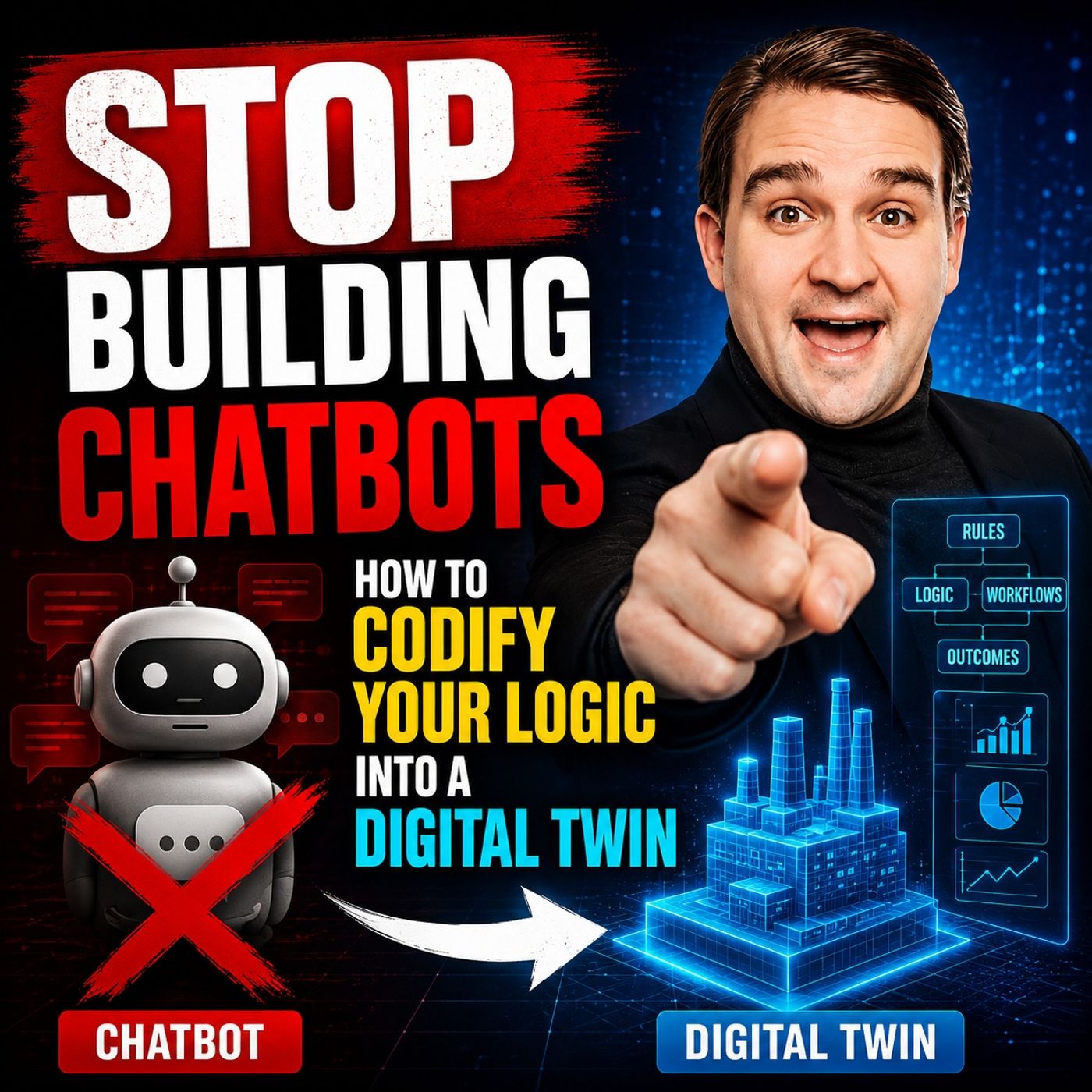
From Chatbots to Digital Twins: How to Codify Your Business Logic
Welcome back to the blog! If you have ever interacted with a traditional customer service chatbot, you likely know the frustration of receiving a rigid, scripted response that fails to understand the nuance of your actual problem. For years, organizations have deployed basic question-answering bots expecting revolutionary efficiency, only to find themselves managing glorified FAQ pages that require constant manual updates. But as enterprise technology evolves, so must our approach to artificial intelligence. We are moving past simple text prompts into an era where AI can actively reason, execute complex workflows, and automate human expertise. The key to unlocking this next level of productivity lies in a transformative concept: the business logic digital twin.
In this comprehensive guide, we will explore how transitioning from rudimentary chatbots to sophisticated digital twins can completely revolutionize your workplace workflows. By capturing your specialized knowledge and structuring your data effectively, you can build AI agents capable of guiding decisions and automating tasks directly within real Microsoft environments. Whether you are an architect, developer, or business leader, understanding how to codify your business logic is the single most important step you can take toward building a truly intelligent enterprise.
Building Chatbots: Setting Goals
Before you dive headfirst into writing code or deploying agents, you need to establish a strong foundation. Simply throwing AI at a problem without a strategy rarely yields positive results. When you set out to build advanced conversational agents, your first step must involve defining clear objectives that align with your broader organizational targets.
Define Purpose
Ask yourself a fundamental question: Why do you want to create this digital twin? Are you trying to alleviate pressure on your internal IT helpdesk by automating repetitive troubleshooting steps? Do you want to accelerate onboarding for new employees by providing an interactive mentor? Or perhaps you are looking to streamline complex approval processes for financial transactions. Write down your core purpose explicitly. This statement will serve as your north star, guiding every architectural decision and ensuring you do not bloat your project with unnecessary features.
Identify Use Cases
Once you have locked down your purpose, map out the exact scenarios where your digital twin will add value. Think about the daily friction points in your team's routine. For instance, you might want your agent to query internal documentation to answer technical questions, cross-reference policy manuals to validate compliance, or orchestrate multi-step data entry tasks across different systems. Identifying concrete use cases ensures that your building efforts target real, measurable pain points rather than hypothetical scenarios.
Success Metrics
How will you know if your digital twin is actually working? You need to establish quantitative success metrics right from the beginning. These indicators help you measure operational progress and demonstrate tangible value to stakeholders. Effective metrics might include the number of fully automated tasks handled each week, the average time saved per business process, user satisfaction scores, or a measurable reduction in compliance errors. By tracking these data points continuously, you can refine your system over time and ensure it consistently delivers on its promises.
Digital Twin Framework Overview
The M365 FM Digital Twin Framework introduces a revolutionary paradigm for automating institutional expertise. Traditional chatbots wait for prompts and pull answers from static text chunks. A digital twin, by contrast, acts as an active digital partner. It models your actual business processes, reasons through operational options, diagnoses bottlenecks, and guides decision-making in real-time.
Developer Digital Twin Concept
The notion of a developer digital twin borrows heavily from industrial engineering. In the aerospace and manufacturing sectors, companies routinely build virtual replicas of physical machinery to simulate stress, test modifications, and predict maintenance needs before touching physical hardware. In software development and enterprise operations, we apply this exact same methodology to codebases, architectural patterns, and human workflows. By creating a digital model of how code is reviewed, tested, and pushed, organizations can drastically accelerate delivery timelines while maintaining stringent quality standards.
Digital Twin of Myself
Taking this a step further, imagine building a "digital twin of myself"—an AI agent trained specifically on your personal workflows, coding styles, and decision-making criteria. When integrated into your software development lifecycle, this digital twin can be assigned routine pull requests, perform initial code quality checks, run automated test suites, and even push safe changes to staging environments. By offloading repetitive implementation tasks to your digital twin, you free up valuable hours to focus on high-level architecture, creative problem-solving, and critical code reviews.
Workflow Modeling
At the heart of any successful implementation is comprehensive workflow modeling. You begin by mapping your current organizational processes from end to end. Once you have a clear picture of your existing operations, you can run scenario analyses to test alternative operational paths, simulate stress loads, and make data-driven adjustments. By continuously feeding real-time data back into your digital twin model, you ensure that your automated systems remain accurate, resilient, and fully aligned with your evolving business landscape.
Structuring Logic and Data
An AI agent is only as good as the data and logic feeding it. If your underlying information is scattered, contradictory, or unstructured, your digital twin will struggle to reason effectively. Building a high-performing agent requires careful process discovery, rigorous data organization, and a solid semantic foundation.
Process Discovery
You cannot automate what you do not understand. Process discovery involves diving deep into how work actually happens within your organization, rather than how it looks on paper. Through stakeholder interviews, observational studies, and workflow audits, you map out every step of a process, identifying who performs each action, what triggers it, and what data it consumes. This discovery phase exposes hidden bottlenecks, redundant approvals, and undocumented workarounds, providing the raw blueprint necessary to build an accurate digital twin.
Data Organization
Structuring your data logically is essential for seamless retrieval and execution. Enterprises typically store information across disparate systems—CRMs, document repositories, ERPs, and cloud storage. Implementing a universal semantic layer bridges these gaps, ensuring that data terms maintain a consistent meaning across all endpoints. By combining structured storage repositories with robust knowledge graphs, you establish a queryable web of relationships that allows your AI agent to understand context, connect disparate pieces of information, and generate deeply informed insights.
Ontology and Semantics
To move beyond simple keyword matching, your digital twin needs an ontology. An ontology provides a formal, machine-readable model of your business domain, defining distinct entities, their attributes, and the exact rules governing their relationships. Adopting an ontology-first design prevents architectural chaos, eliminating duplicated concepts and contradictory logic. By replacing unstructured text with structured semantic reasoning, you give your digital twin the ability to deduce logical conclusions, adhere strictly to business constraints, and operate with enterprise-grade reliability.
Building a Local AI Chatbot Prototype
Transitioning from conceptual design to hands-on execution starts with building a localized prototype. Leveraging modern low-code and pro-code tooling allows you to assemble, test, and refine your agent architecture quickly before committing to a full-scale production deployment.
Conversation Flows
Using platforms like Microsoft Copilot Studio, you can visually design intricate conversation flows using intuitive drag-and-drop interfaces. These tools allow you to map out how users will interact with your portfolio chatbot, defining trigger phrases, fallback behaviors, and branching logic. By connecting your conversation designer directly to enterprise knowledge sources like SharePoint and Dataverse, you ensure your prototype can retrieve factual documents and guide users smoothly through complex multi-step procedures.
Core Logic Implementation
Once your conversation layout is established, you can implement the core logic that powers your agent's reasoning capabilities. By integrating Power Automate and custom Python scripts, you can connect your chatbot to thousands of external APIs and internal databases. This enables your digital twin to transition from a simple text interface into an active orchestrator capable of running scripts, processing files, updating databases, and returning synthesized results directly to the user.
Testing Interactions
Rigorous testing is vital before scaling your prototype. You must evaluate both component-level interactions—such as individual prompt responses—and system-level integrations to see how your agent handles unexpected inputs, noisy data signals, and edge cases. Running controlled pilot scenarios with small user groups allows you to observe natural interaction patterns, recalibrate your constraints, and ensure your local AI prototype behaves reliably in the wild.
Governance and Security
When deploying AI agents that possess the authority to read, write, and manipulate enterprise data, security cannot be an afterthought. You must establish rigorous governance frameworks to protect sensitive information, ensure ethical behavior, and maintain strict control over your technological ecosystem.
Access Controls
Adhering to the principle of "No New Privileges," your digital twin should never possess broader permissions than the human user interacting with it. Implementing robust authentication mechanisms and role-based access control (RBAC) ensures that users can only access data and trigger actions they are explicitly authorized to view. Coupled with a centralized agent registry, administrators can track every deployed agent, audit its data sources, monitor its lifecycle, and enforce compliance policies across the entire organization.
Trustworthy AI
Trustworthy AI demands predictability, accuracy, and absolute ethical alignment. By leveraging Retrieval-Augmented Generation (RAG) frameworks, you ground your agent's responses in verified enterprise data, drastically reducing the risk of hallucinations. Furthermore, keeping pace with evolving regulatory standards ensures that your automated systems comply with legal mandates regarding transparency, data privacy, and human oversight. Building governance into the core architecture of your digital twin protects your organization from risk while fostering deep user confidence.
Optimization and Iteration
Deploying your digital twin is not the end of the journey; it is merely the beginning of an ongoing cycle of refinement. To keep your AI agent performing at its absolute peak, you must continuously monitor user interactions, tune system performance, and cultivate active feedback loops.
User Experience
An exceptional user experience relies on personalization, speed, and contextual relevance. Your digital twin should leverage real-time analytics to understand user intent, anticipate needs, and streamline multi-step tasks into effortless interactions. By continuously evaluating where users stumble or abandon workflows, you can refine your dialogue structures and design interfaces that feel intuitive, responsive, and genuinely helpful.
Performance Tuning
System latency can kill adoption rates. Regularly audit your agent's response times, query resolution accuracy, and resource consumption. If performance lags, optimize your underlying workflows, refine your semantic indexes, or scale your hosting infrastructure. Proactive performance tuning ensures your digital twin remains lightning-fast, even as your enterprise data grows and user demand scales.
Feedback Loop
Establish a continuous feedback loop by actively collecting user ratings, survey responses, and interaction logs. Use AI-driven analytics to categorize feedback, identify recurring friction points, and surface opportunities for improvement. By reviewing these insights regularly with your development and operations teams, you can iterate on your agent's logic, patch conversational gaps, and ensure your digital twin continuously adapts to the changing needs of your business.
Transitioning from basic, reactive chatbots to sophisticated, business logic digital twins represents a monumental leap forward for modern organizations. By following structured frameworks for process discovery, data organization, semantic ontology, and robust governance, you can build AI agents that truly understand your operations and automate expertise at scale. To dive deeper into the architectural choices, security considerations, and practical strategies behind this transformation, be sure to listen to the companion episode: Codify Business Logic into a Digital Twin for AI Agents.
FAQ
What is a digital twin chatbot?
A digital twin chatbot is an advanced AI agent that acts as a virtual representation of your organization's business logic and human expertise. Unlike traditional chatbots that simply answer predefined questions, a digital twin can reason, execute multi-step workflows, and guide decision-making based on real-time data.
How does the Digital Twin Framework differ from traditional chatbots?
While traditional chatbots rely on static script trees or basic retrieval, the Digital Twin Framework models your actual operational processes. It combines structured semantics, ontology-driven reasoning, and powerful automation tools to create an active digital partner that supports complex business goals.
Can I use AWS with the Digital Twin Framework?
Yes. While the framework integrates seamlessly with Microsoft environments like Dataverse and Copilot Studio, you can also leverage AWS services for cloud storage, machine learning model hosting, serverless automation via AWS Lambda, and scalable database management.
What are the benefits of integrating AWS into my chatbot?
Integrating AWS provides enterprise-grade cloud security, high-performance computing resources, flexible data storage solutions through S3 and DynamoDB, and advanced natural language processing capabilities that help scale your digital twin efficiently.
How do I ensure my digital twin chatbot is secure on AWS?
You can secure your chatbot by implementing AWS Identity and Access Management (IAM) for granular permissions, turning on encryption for data at rest and in transit, tracking actions with AWS CloudTrail, and utilizing AWS security compliance monitoring tools.
Can I scale my chatbot with AWS?
Absolutely. AWS offers robust scaling tools including Auto Scaling groups, Elastic Load Balancing, and flexible container management via ECS, ensuring your digital twin stays responsive under heavy enterprise workloads.
What tools from AWS help with chatbot development?
Key AWS development tools include Amazon Lex for natural language understanding, AWS Lambda for workflow automation, Amazon S3 and DynamoDB for data storage, and Amazon SageMaker for building and training machine learning models.
How do I monitor and update my chatbot on AWS?
You can use Amazon CloudWatch to track real-time performance metrics and logs, AWS CodePipeline to automate updates and deployments, and AWS Trusted Advisor to receive automated recommendations for security, cost optimization, and performance.
🎧 Listen to this episode
Want a practical explanation of Codify Business Logic into a Digital Twin for AI Agents? This episode breaks down the topic in clear language and shows why it matters for Microsoft 365, Azure, Power Platform, security, AI, and modern work.
Listen to this episode if you want to:
- Understand the key concepts behind Codify Business Logic into a Digital Twin for AI Agents
- See how it fits into the wider Microsoft technology ecosystem
- Learn where it can create practical value for your organization
You may also enjoy these related M365 FM episodes:
- Microsoft Fabric Digital Twin Builder Explained
- AI Agents - Simply Explained
- From Data to Intelligent Agents: Building Trusted Enterprise AI with Microsoft AI Foundry with Shubhangi Goyal [MVP]
- Azure Logic Apps - Simply Explained
- Microsoft 365 Copilot Agents: Real Business Value with Steve Corey [MVP]
Discover more practical Microsoft conversations on M365 FM.
Last reviewed: July 2026.
Who Should Listen
This episode is for Microsoft administrators, architects, developers, security professionals, and business leaders who need a practical foundation before making implementation, operations, or governance decisions.
🎧 You Should Also Listen To
- AI Agents — A strongly related next step for extending this topic.
- Power Platform — A strongly related next step for extending this topic.
- Microsoft Teams — A strongly related next step for extending this topic.

Microsoft MVP | Host of M365.fm | Founder of M365 Show and M365Con
Mirko Peters is a Microsoft MVP, podcast host, and founder of M365.fm, M365 Show, and M365Con. His work connects Microsoft practitioners through podcast interviews, livestreams, and community events.
At M365.fm, Mirko hosts conversations with Microsoft MVPs, product experts, architects, and community contributors. Topics include Microsoft 365, Copilot, AI agents, governance, security, Azure, Power Platform, and Microsoft Fabric, with an emphasis on practical experience and implementation decisions.
M365.fm is the podcast and learning platform. M365 Show brings experts together for livestreams, while M365Con provides an online conference setting for community learning.
Official website: Mirko Peters (https://www.mirkopeters.com/). Recognition: Mirko Peters — Microsoft MVP profile (https://mvp.microsoft.com/de-DE/mvp/profile/9b0ca797-db5a-493a-a845-8b9158046cf5). Connect on LinkedIn (https://www.linkedin.com/in/m365showpodcast/).