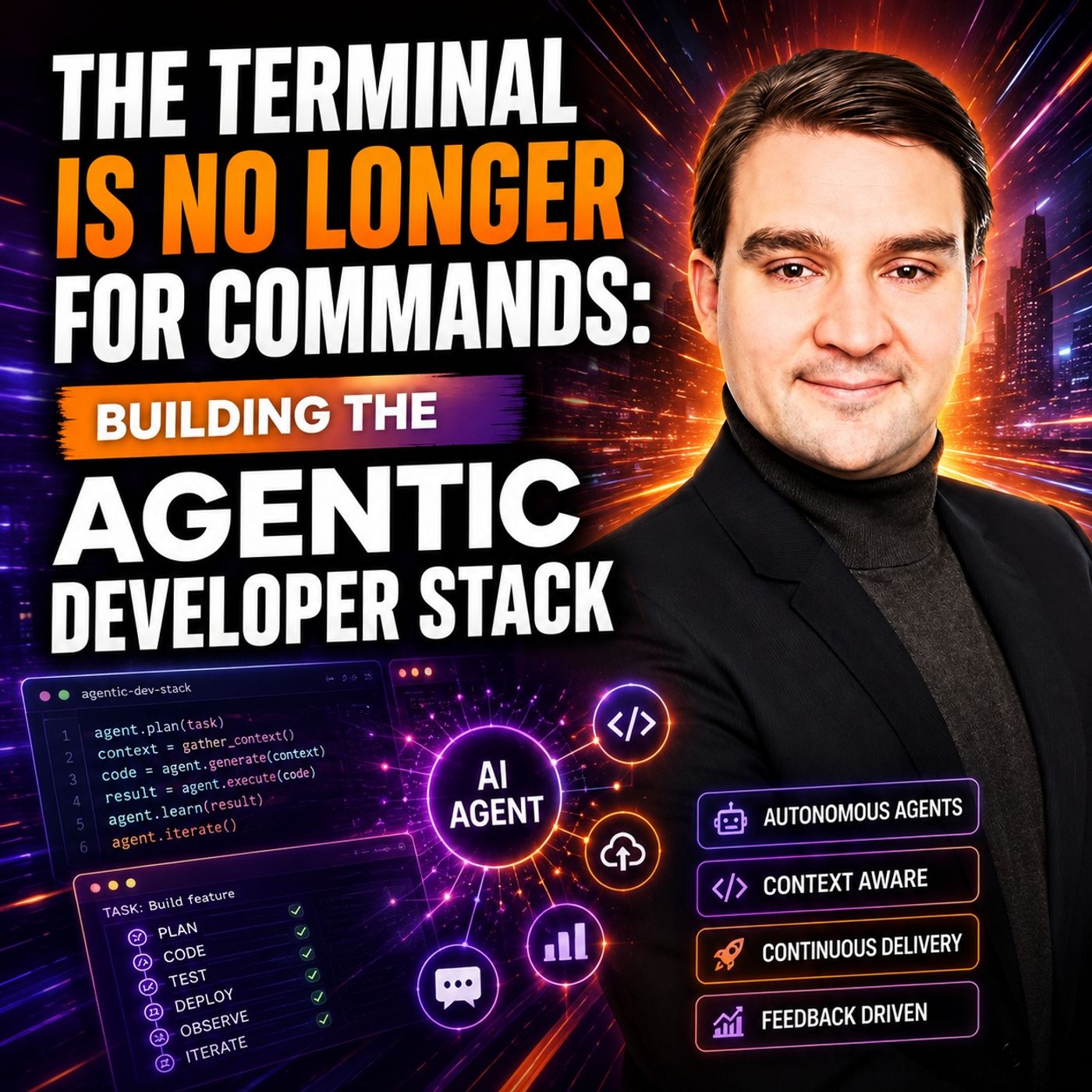
From Commands to Intent: How the Terminal Became Your Intelligent Partner
Welcome back to the podcast companion blog! In this post, we are diving deep into the massive paradigm shift currently taking place in software engineering: the transformation of our most traditional developer tool into an autonomous collaborator. If you have ever felt weighed down by remembering hyper-specific syntax flags or tedious command structures, you are going to love this discussion. The command line is no longer just a passive executor of commands; it has matured into an intelligent partner capable of interpreting your high-level goals and translating them into reality. To explore this topic with a practical focus on how it works, where it fits, and the architectural choices that matter in real environments, be sure to check out the accompanying episode Agentic Developer Stack: AI Agents in the Terminal.
Terminal Evolution and Agentic Shift
From Commands to Intent
You have seen the terminal change from a tool that demands precise commands to a workspace that understands your goals. In the past, you needed to memorize syntax and type exact instructions. Now, you can express your intent in natural language, and the terminal interprets your requests. This shift makes coding more intuitive and accessible. You focus on what you want to achieve, not how to phrase every command.
The evolution of the command line interface (CLI) highlights the historical context of user interfaces, starting from the 1960s with minimal graphical capabilities, through the development of UNIX in the 1970s and 80s, to the integration of modern applications in the 2000s.
You benefit from a terminal that acts as a mediator between your intent and system actions. The AI-driven terminal simplifies your workflow and allows you to concentrate on higher-level tasks. You no longer need to remember every command or worry about syntax errors. This change supports a more versatile and productive development environment.
Rise of Terminal-Native Agents
You notice a growing trend toward terminal-native agents. These agents operate directly within your terminal, offering flexibility and aligning with real engineering practices. You can orchestrate multiple agents to handle tasks such as reading repositories, running shell commands, modifying files, running tests, and managing workflows. This approach enhances productivity and reduces reliance on traditional IDE-centric workflows.
- Terminal agents provide flexibility that traditional IDEs cannot match.
- Tools like Claude Code, Gemini CLI, Codex CLI, and Copilot CLI demonstrate the power of terminal-native agents.
- IDEs have evolved to handle complex coding tasks autonomously since 2021, signaling a shift away from classic IDE-centric development.
You see platforms like Cursor 2.0 offering agent orchestration as a primary feature. You can choose between classic IDE views or agent-driven workflows, depending on your preference. Terminal-native tools empower you to work efficiently and adapt to modern development needs.
Real-Time Interaction and Context
You experience real-time interaction and context in your terminal. Terminal-native agents respond instantly to your requests, providing feedback and adapting to your workflow. You can collaborate with AI agents that understand your project’s context and offer suggestions or automate tasks. This dynamic environment supports conversational interactions and adaptive surfaces, moving beyond traditional screen-based interfaces.
- You receive immediate feedback from agents.
- You can iterate quickly and refine your work based on agent suggestions.
- The terminal becomes a collaborative space, not just a command executor.
The Agentic Developer Stack arrives at a timely moment. You gain access to a terminal that acts as an orchestration layer for AI agents, transforming your workflow and enabling you to focus on design and policy-making. This evolution positions you to meet the demands of modern software development and stay competitive in a rapidly changing industry.
What is the Agentic Developer Stack?
Core Concept and Value
You may wonder what sets the Agentic Developer Stack apart from traditional developer tools. At its core, this stack reimagines the terminal as a powerful orchestration layer for AI agents. Instead of typing out every command, you describe your goals, and intelligent agents handle the planning, execution, and validation for you. This approach comes from M365 FM’s vision to make software development more intuitive and efficient.
The Agentic Developer Stack brings together several essential components that work in harmony. You can see these core elements in the table below:
| Core Component | Description |
|---|---|
| Language & Reasoning Layer (LLM) | Interprets your intent and generates outputs to drive workflows. |
| Tools | Executes decisions in the real world through APIs and code. |
| Retrieval | Accesses extra context from unstructured data to improve decision-making. |
| Memory | Remembers past interactions and context for continuity. |
You benefit from a system that does more than just run code. The stack includes planning and reasoning frameworks, tools for interacting with external systems, and memory for both short-term and long-term tasks. Guardrails help manage risks, so you can trust the system to act responsibly.
In this new paradigm, AI acts as your collaborative partner. You get help in every phase of software development, not just code generation. This partnership enhances your workflow and gives you a sustainable competitive advantage.
Unlike traditional stacks that focus on application layers, the Agentic Developer Stack integrates AI at every level. Some layers, like memory and reasoning, help you build unique solutions that set you apart from others. Other layers, such as tools, become easier to use and more widely available.
Intent-Driven Development
You no longer need to memorize complex commands or worry about syntax. With the Agentic Developer Stack, you express your intent in plain language. The system translates your goals into actionable workflows. This shift means you spend less time on manual tasks and more time on creative problem-solving.
The transformation of the terminal into an orchestration layer for AI agents relies on a multi-layered framework. Each layer plays a specific role in supporting your development process:
| Layer | Description |
|---|---|
| 1 | The AI inference stack provides fast, accurate answers at scale. |
| 2 | The durable execution layer manages failures, such as network outages. |
| 3 | Agentic frameworks offer a consistent developer experience and design patterns. |
| 4 | Standard protocols, memory, and knowledge allow agents to think, reason, act, and store conversations. |
| 5 | Tools extend the agent’s abilities with new skills and features. |
You interact with a system that manages complex workflows and adapts to your needs. The terminal becomes a space where you set goals, receive feedback, and iterate quickly. AI agents handle the details, so you can focus on high-level design and decision-making.
- You gain:
- Faster development cycles
- Higher code quality
- Reduced technical debt
- A more enjoyable and collaborative workflow
The Agentic Developer Stack empowers you to move from manual commands to autonomous, feedback-driven development. You work alongside AI agents that understand your intent and help you achieve your goals with greater speed and precision.
Architecture of the Agentic Developer Stack
The Agentic Developer Stack uses a layered approach to create a seamless, agent-driven development experience. Each layer has a unique role and works together to help you move from intent to execution with confidence.
Orchestration Layer
The orchestration layer acts as the brain of the stack. You interact with this layer when you describe your goals or intent. It translates your instructions into actionable workflows that AI agents can execute. This layer manages the flow of tasks, coordinates multiple agents, and ensures that everything runs smoothly.
Translating Intent to Workflow
You do not need to write detailed scripts or commands. The orchestration layer takes your high-level intent and breaks it down into steps that agents can understand and perform. It manages agent execution loops, coordinates actions based on real-time data, and handles errors if they occur. This layer also allows you to step in when needed, keeping you in control.
Here are the main functions of the orchestration layer:
| Function | Description |
|---|---|
| Managing agent execution loops | Coordinates the execution of agents and their tasks. |
| State persistence | Maintains the state of agents across executions. |
| Multi-agent coordination | Facilitates collaboration between multiple agents. |
| Error recovery | Recovers from errors during agent execution. |
| Human-in-the-loop controls | Lets you intervene in the workflow when necessary. |
You benefit from predictable workflows, policy enforcement, and controlled permissions. The orchestration layer integrates with identity systems, so agents do not hold sensitive credentials. You can always see what changed, when, and why, which helps with auditability and trust.
| Benefit | Description |
|---|---|
| Predictable behavior | Workflows execute consistently with defined sequences, retries, and error paths. |
| Policy enforcement | Changes must comply with defined policies before execution. |
| Controlled permissions | Orchestration integrates with RBAC and identity systems. |
| Auditability | Complete record of what changed, when, why, by whom, and what the outcome was. |
| Retry logic and rollback | Failed steps can be retried or rolled back using compensating workflows. |
| Verifiable outcomes | Post-checks confirm that changes had the intended effect on service health. |
Transformation Layer
The transformation layer helps you modernize legacy systems and adapt old code to new requirements. This layer uses advanced tools and frameworks to analyze, update, and improve existing software. You can automate discovery work, analyze dependencies, and generate summaries that make it easier to understand complex systems.
Modernizing Legacy Systems
You do not have to worry about breaking old code when making updates. The transformation layer wraps legacy calls in stable interfaces, such as HTTP or event-driven APIs. This makes it easier to connect old systems with modern AI and analytics tools. Impact analysis tools help you identify risky changes and suggest tests to prevent problems.
Here are some technologies and frameworks used in the transformation layer:
| Technology/Framework | Description |
|---|---|
| Coding Agents | Automate discovery, analyze dependencies, and generate summaries for legacy systems. |
| API-First Interface | Provides a clean interface for new tools, wrapping legacy calls in stable APIs. |
| Impact Analysis Tools | Analyze code and data paths to find risks and propose tests for safer modernization. |
You gain the ability to update and improve your software without starting from scratch. This layer reduces risk and helps you keep your systems up to date.
Validation Layer
The validation layer ensures that your code meets industry standards and quality requirements. You do not have to manually check every detail. This layer uses automated tools to catch obvious issues and employs critic agents for deeper analysis.
Ensuring Standards and Quality
The validation process starts with deterministic checks, such as linters and test suites. These tools quickly find errors and enforce coding standards. After passing these checks, a critic agent reviews the output for more complex issues, such as architectural patterns and best practices. If the code does not meet the criteria, the agent must revise it until it passes all checks.
You can trust that your code is reliable and follows best practices. The validation layer maintains high standards throughout the development workflow, giving you confidence in every release.
Execution Layer
Cloud-Based Coding Tasks
You interact with the execution layer every time you ask an agent to perform a coding task. This layer acts as the hands of the Agentic Developer Stack. It takes the plans and instructions from the orchestration layer and turns them into real actions. You see results in your codebase, your tests, and your deployments.
The execution layer handles many important tasks for you:
- Managing agent workflows so each task runs in the right order
- Executing tasks such as code generation, testing, and deployment
- Handling errors that may occur during execution
- Allocating resources so agents have what they need to work efficiently
You benefit from cloud-based execution because it gives you power and flexibility. The cloud keeps your agent workflows running, even if your local machine shuts down. You can start a complex job, step away, and return later to see the results. The cloud also supports persistent state management. This means agents remember what they have done and can continue multi-step workflows without losing context.
Cloud-based execution makes agentic development possible at scale. You can run many agents at once, each handling different parts of your project. The system can orchestrate complex sequences, manage dependencies, and recover from errors automatically. You do not need to worry about setting up servers or managing infrastructure. The execution layer takes care of these details so you can focus on your goals.
Tip: Cloud-based execution helps you work faster and more reliably. You can trust that your agents will finish their tasks, even if you are not watching every step.
The execution layer connects all the pieces of the Agentic Developer Stack. It turns your intent into action and delivers results you can see and use.
Developer Experience and Workflow Changes
Expressing Goals, Not Commands
You now interact with your terminal in a new way. Instead of typing out detailed commands, you describe your goals. The terminal interprets your intent and plans the steps needed to achieve your objectives. This approach gives you more autonomy in decision-making. You focus on what you want to accomplish, not how to do it. The Agentic Developer Stack enables you to work at a higher level, freeing you from repetitive tasks.
When you express goals, you may notice an increase in cognitive load. You must understand how the agent reasons and what changes it makes to your codebase. Trust becomes important. You need to know that the agent will act responsibly and transparently. This shift encourages you to think strategically and review the agent’s actions, which helps you grow as a developer.
Tip: Articulating your goals clearly helps the agent understand your intent and deliver better results.
Collaboration with AI Agents
You collaborate with AI agents as if they are teammates. These agents do not work in isolation. They coordinate with each other and with you, mirroring how engineering teams operate. This collaborative system enhances productivity and efficiency. You see agents plan, execute, and deliver software together.
Effective collaboration models include:
- Prototype agents using synthetic tasks before real integration. This helps refine planning logic.
- Design tool wrappers with explicit preconditions and postconditions. This improves interpretability.
- Build shared memory abstractions for multi-agent collaboration. This allows joint reasoning.
- Use role archetypes to constrain agent behavior. This minimizes errors and supports explainability.
You benefit from a system that supports joint reasoning and clear communication. You can assign roles to agents, set boundaries, and monitor their actions. This teamwork makes complex projects easier to manage.
Real-Time Feedback and Iteration
You receive real-time feedback from your terminal. Agentic systems coordinate multi-step processes and adapt their behavior based on intermediate feedback. This adaptability improves productivity. You see the results of your actions immediately and can adjust your approach as needed.
AI agents autonomously manage complex tasks and refine their processes through iterative feedback. You watch as the system decomposes high-level goals into manageable steps. The terminal adapts to your input and environment, allowing for continuous improvement. This dynamic cycle accelerates development and helps you deliver better software.
Note: Real-time feedback lets you catch mistakes early and iterate quickly, making your workflow more responsive and efficient.
You experience a developer environment that is more intuitive, collaborative, and adaptive. The Agentic Developer Stack transforms how you work, enabling you to focus on creativity and innovation.
Adopting the Agentic Developer Stack
Transition Strategies
You can move from traditional development to agentic workflows by following a clear plan. Many teams succeed by using a phased approach. Start with a small process you control. Involve the right people from your team and design your solution so it can grow. Before you begin, check if your data and analytics are ready. Make sure you have access controls in place and that your data matches your process needs. Choose a platform that can scale and offers strong orchestration and built-in governance. Once you have a plan, run a pilot project with a cross-functional team. Track your results and adjust your approach as you learn.
Recommended steps for transition:
- Adopt a phased approach—start small and design for growth.
- Check your data readiness and set up access controls.
- Select a scalable platform with strong orchestration and governance.
- Run a pilot project and monitor your success metrics.
Tip: Involving stakeholders early helps you avoid roadblocks and ensures your solution fits your team’s needs.
Skills for Agentic Development
You need new skills to work effectively with agentic systems. The focus shifts from writing commands to managing workflows and orchestrating agents. You will also need to measure results and use tests as specifications. The table below outlines key skills and their descriptions:
| Skill | Description |
|---|---|
| Process Mastery | Move from thinking about prompts to thinking about entire workflows. |
| Orchestration | Coordinate multiple agents like a conductor leads an orchestra. |
| Evals and Loops | Use systematic measurement instead of relying on subjective judgment. |
| Test-Driven Development | Use tests to define what success looks like, not just to check for errors. |
| Knowledge Engineering | Shift from “code and forget” to “code and persist,” making sure knowledge is reusable. |
Note: Building these skills will help you get the most out of agentic tools and improve your productivity.
Organizational Impact
Adopting the Agentic Developer Stack changes how your organization works. You will need to redesign workflows to support collaboration between AI agents and human engineers. Clear governance roles become important, with defined accountability and human oversight. Cross-functional governance ensures that your AI projects align with your organization’s strategy.
| Aspect | Impact |
|---|---|
| Workflows | Redesign needed for AI-human collaboration. |
| Governance Roles | Clear accountability and human oversight required. |
| Cross-functional Governance | Alignment with organizational strategy is essential. |
Security and governability must be built into your processes. You need mechanisms for auditing and oversight. Continuous oversight keeps your operations effective and accountable. Integrating agentic systems requires changes at the human, organizational, and economic levels to ensure long-term success.
Remember: Strong governance and clear roles help your team adapt and thrive in an agentic environment.
Future Outlook for Agentic Development
Trends and Innovations
You see agentic development moving fast. AI tools like GitHub Copilot already boost productivity by up to two times. Agentic systems go further. These systems let AI agents work on their own, raising productivity by three to five times or more. You notice key traits in agentic systems. They show autonomy, context awareness, multi-step reasoning, tool use, and teamwork among agents.
- AI-assisted development increases your speed and accuracy.
- Agentic development lets AI agents plan and execute tasks without constant supervision.
- Autonomy and context awareness help agents make smarter decisions.
- Multi-step reasoning and tool use allow agents to solve complex problems.
- Collaboration among agents creates a powerful network for tackling big projects.
You also see rapid progress. The timeline for agentic development has shortened. Early adopters gain a first-mover advantage. Companies that use agentic stacks now can outpace others, creating a competitive gap that is hard to close.
- Time compression speeds up innovation.
- First-mover advantage gives you a lead in productivity and market position.
- Competitive gap formation means early adopters stay ahead.
You stand at the edge of a new era. Agentic development will shape how you build software and solve problems.
Challenges and Opportunities
You face both challenges and opportunities as agentic stacks become common. You must address governance and compliance. Integration with your current systems can be difficult. You need explainable AI so you can trust agent decisions. At the same time, you gain operational efficiency and can offer personalized experiences. Advanced AI strategies give you a strong competitive edge.
| Challenges | Opportunities |
|---|---|
| Governance and compliance issues | Enhanced operational efficiency |
| Integration with existing systems | Personalized customer experiences |
| Need for explainable AI | Competitive advantages through advanced AI strategies |
You can overcome these challenges by planning carefully and training your team. You unlock new ways to serve customers and improve your workflow.
Careful adoption lets you maximize benefits and minimize risks.
Ethical and Security Considerations
You must think about ethics and security when you use agentic developer stacks. Risks include misalignment with human values, loss of control, and malicious use for cyberattacks. You may see economic and social disruptions, such as job displacement and inequality. Safety risks can arise from malfunctions in critical systems. You also face challenges with accountability, privacy, and bias. High resource consumption impacts the environment.
- Misalignment with human values can lead to harmful outcomes.
- Loss of control over AI systems may cause unpredictable actions.
- Malicious use of agentic AI threatens cybersecurity.
- Job displacement and inequality disrupt society.
- Malfunctions in critical systems pose safety risks.
- Accountability, privacy, and bias require careful management.
- Environmental impact grows with increased resource use.
You must build strong safeguards and clear policies. Responsible use of agentic stacks ensures safety, fairness, and trust.
As we wrap up, it is clear that the Agentic Developer Stack is redefining engineering norms. The global market for agentic AI continues to scale aggressively, taking over routine execution while empowering teams to aim higher. To successfully embrace this shift, remember to:
- Align your team with agentic AI capabilities.
- Set clear governance and risk boundaries.
- Prototype workflows to validate integration.
Continuous oversight and reskilling will ensure you stay ahead of the curve. To learn more about architecting these systems in real environments, make sure to listen to the companion episode Agentic Developer Stack: AI Agents in the Terminal on M365 FM.
| Strategy | Description |
|---|---|
| Continuous Oversight | Keeps autonomous systems accountable. |
| Reskilling | Prepares you for new agentic roles. |
Stay curious and keep learning as agentic development advances.
FAQ
What is the Agentic Developer Stack?
You use the Agentic Developer Stack to turn your terminal into an intelligent workspace. AI agents plan, execute, and validate tasks based on your goals. This stack helps you automate workflows and improve productivity.
How do AI agents understand my intent?
You describe your goals in plain language. The system uses advanced language models to interpret your intent and create actionable workflows. You see your ideas become real tasks without writing complex commands.
Can I use the Agentic Developer Stack with legacy systems?
You connect legacy systems using the transformation layer. This layer wraps old code in stable interfaces and helps you modernize without starting over. You keep your existing software while adding new features.
How does real-time feedback work in agentic development?
You receive instant feedback from AI agents. The terminal shows progress and suggestions as you work. You can adjust your approach quickly and see results right away.
What skills do I need for agentic development?
You focus on process mastery, orchestration, and test-driven development. You learn to manage workflows and coordinate agents. You build knowledge engineering skills to make your work reusable.
Is my data secure with agentic workflows?
You benefit from built-in governance and access controls. The orchestration layer integrates with identity systems. You can audit changes and set permissions to protect your data.
🎧 Listen to this episode
Want a practical explanation of Agentic Developer Stack? This episode breaks down the topic in clear language and shows why it matters for Microsoft 365, Azure, Power Platform, security, AI, and modern work.
Listen to this episode if you want to:
- Understand the key concepts behind Agentic Developer Stack
- See how it fits into the wider Microsoft technology ecosystem
- Learn where it can create practical value for your organization
You may also enjoy these related M365 FM episodes:
- AI Agents - Simply Explained
- From Data to Intelligent Agents: Building Trusted Enterprise AI with Microsoft AI Foundry with Shubhangi Goyal [MVP]
- AI, Power Platform & Developer Experience: The Next Frontier with Reza Niroomand [MVP]
- Microsoft 365 Copilot Agents: Real Business Value with Steve Corey [MVP]
- Microsoft Entra Agent ID: Secure Identity for AI Agents
Discover more practical Microsoft conversations on M365 FM.
Last reviewed: July 2026.
Who Should Listen
This episode is for Microsoft administrators, architects, developers, security professionals, and business leaders who need a practical foundation before making implementation, operations, or governance decisions.
🎧 You Should Also Listen To
- AI Agents — A strongly related next step for extending this topic.
- Power Platform — A strongly related next step for extending this topic.
- Microsoft Graph Data Connect — A strongly related next step for extending this topic.

Microsoft MVP | Host of M365.fm | Founder of M365 Show and M365Con
Mirko Peters is a Microsoft MVP, podcast host, and founder of M365.fm, M365 Show, and M365Con. His work connects Microsoft practitioners through podcast interviews, livestreams, and community events.
At M365.fm, Mirko hosts conversations with Microsoft MVPs, product experts, architects, and community contributors. Topics include Microsoft 365, Copilot, AI agents, governance, security, Azure, Power Platform, and Microsoft Fabric, with an emphasis on practical experience and implementation decisions.
M365.fm is the podcast and learning platform. M365 Show brings experts together for livestreams, while M365Con provides an online conference setting for community learning.
Official website: Mirko Peters (https://www.mirkopeters.com/). Recognition: Mirko Peters — Microsoft MVP profile (https://mvp.microsoft.com/de-DE/mvp/profile/9b0ca797-db5a-493a-a845-8b9158046cf5). Connect on LinkedIn (https://www.linkedin.com/in/m365showpodcast/).