From Pipelines to Agent Fabrics: The Rise of Continuous Agentic Deployment
Welcome to our deep dive into the evolution of software delivery. If you are a developer, platform engineer, or technical leader, you have likely spent years optimizing your CI/CD pipelines. You have shaved seconds off build times, parallelized test suites, and perhaps even implemented trunk-based development. But despite all these optimizations, you can still feel the friction. The software industry is shifting away from rigid, linear pipelines and moving toward dynamic, intelligent, and concurrent AI systems. In this blog post, we will unpack the core concepts behind this paradigm shift, moving from traditional automation to advanced multi-agent architectures.
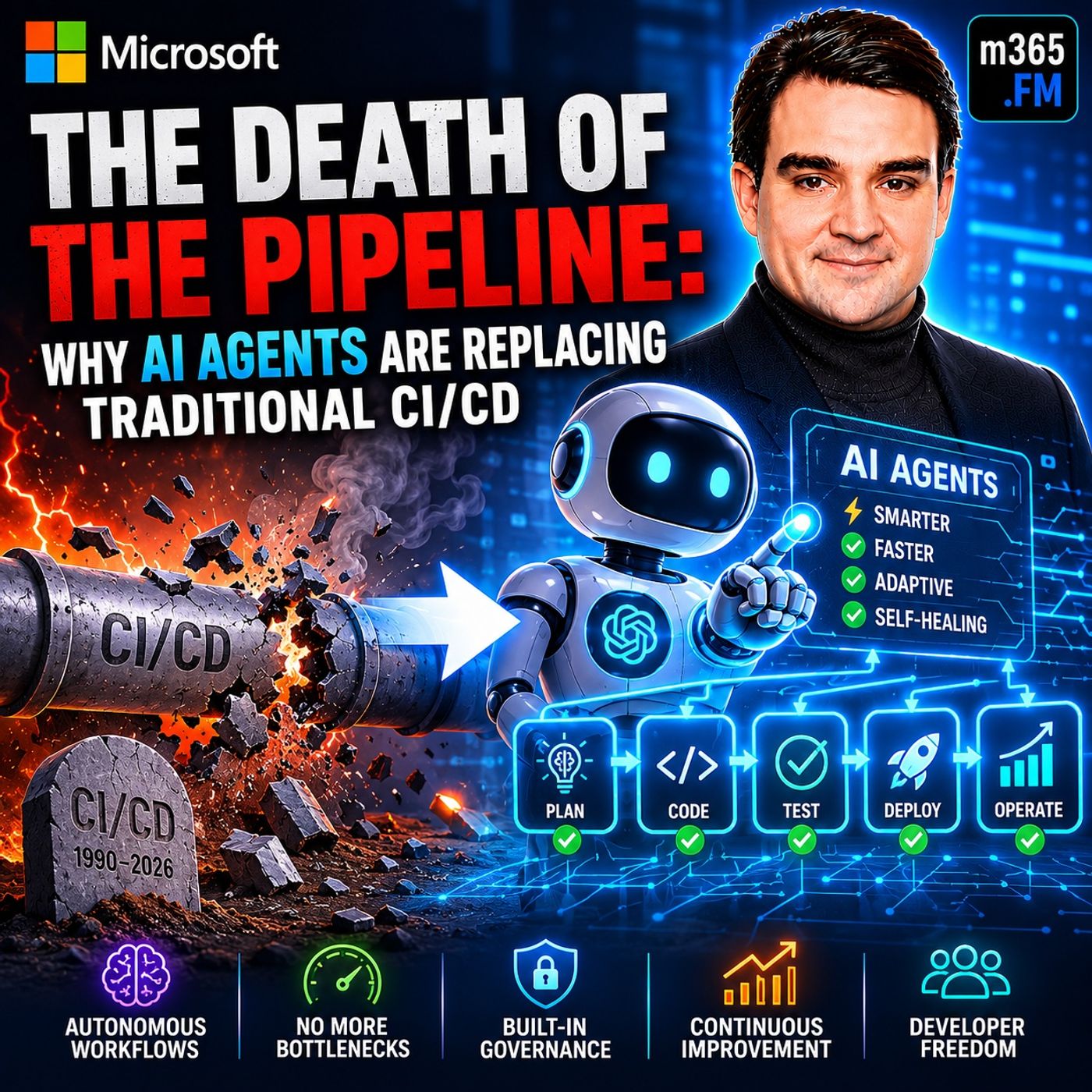
For a complete audio breakdown of this topic, make sure to listen to our companion podcast episode, The Death of the Pipeline: Why AI Agents are Replacing Traditional. Now, let us explore the structural changes transforming how modern applications are built, tested, and deployed.
Why the traditional pipeline is breaking
For more than two decades, continuous integration and continuous deployment pipelines have served as the undisputed backbone of modern software engineering. The workflow is etched into the minds of every engineer: a developer commits code, automated builds run, test suites execute, security scanners scan, a human approves the change, and production is updated. This model democratized software delivery and allowed DevOps to become the gold standard of tech.
However, the technological landscape has drastically shifted. Cloud-native architectures, containerization, microservices, and massive multi-cloud deployments have fundamentally altered our operational reality. Organizations are no longer deploying software once a week or even once a day; many push updates hundreds or thousands of times every single day. Under this intense velocity, traditional pipelines are hitting a wall.
The core bottleneck is no longer a lack of execution speed. It is the reliance on human decision-making embedded within linear, sequential workflows. Every manual stage gate, every approval request, and every human sign-off introduces latency. When applied to high-frequency delivery models, these human checkpoints stop acting as safety nets and instead become the slowest, most congested components in the entire engineering organization. The pipeline itself may not be structurally broken, but its underlying operating model is completely overwhelmed.
Automation isn't the same as intelligence
Recognizing these bottlenecks, many organizations attempted to solve the problem by throwing more automation at it. They wrote elaborate scripts, built complex runbooks, and automated their approval stages. Initially, these measures provided a temporary boost to delivery speeds. But over time, a new and insidious problem emerged.
Standard scripts and rule-based systems only function correctly within predictable, predefined conditions. The moment the underlying infrastructure changes, scripts begin to fail. Consider how often modern environments shift: new Kubernetes versions drop, APIs deprecate and change, deployment strategies evolve, and security compliance policies are updated continuously. Keeping rule-based automation functioning requires an immense amount of manual maintenance.
Traditional automation lacks context. It executes procedural instructions blindly; it does not reason. Organizations frequently find themselves spending more human capital maintaining their automation scripts than they save by using them. Static automation ultimately reaches a hard ceiling because the pace of modern infrastructure evolution far outstrips the capabilities of rigid, rule-based systems.
AI agents change the model
To break through this ceiling, we must distinguish between simple automation and true artificial intelligence. An AI agent is fundamentally different from a script. While scripts execute hardcoded instructions, agents possess the ability to reason.
Instead of relying purely on rigid, predefined logic matching, an autonomous agent continuously observes system state, understands complex context, evaluates possible courses of action, chooses the safest strategy, and learns iteratively from previous outcomes.
Imagine dealing with a degraded microservice in production. A traditional script might simply trigger a hard restart. An AI agent, by contrast, takes a much more thoughtful approach. First, it investigates. Is this genuinely a service failure, or is it an upstream network timeout? Is there an active memory leak? Is inbound traffic unusually high? Would a gradual canary rollout be vastly safer than a blunt restart? Could restarting actually exacerbate the situation by hiding deeper systemic issues? By operating on policies and high-level objectives rather than brittle procedures, AI agents allow software delivery systems to intelligently adapt instead of merely executing static commands.
From pipelines to agent fabrics
One of the most profound realizations in modern platform engineering is that the future of software delivery is not simply a faster pipeline—it is the complete elimination of the pipeline paradigm altogether. Traditional software delivery is inherently sequential: code, build, test, deploy. Each stage must wait patiently for the preceding stage to finish.
Agentic systems replace this sequential march with an interconnected AI fabric. Within this fabric, multiple specialized agents operate concurrently. One agent continuously analyzes security vulnerabilities, another dynamically generates and runs tests, a third validates system performance, and yet another evaluates deployment safety. Rather than idling in sequential queues, these agents exchange real-time telemetry and reason together.
Researchers and practitioners increasingly refer to this emerging paradigm as Continuous Agentic Deployment (CAD), where fluid reasoning replaces rigid stage gates. The ultimate outcome is not just faster deployment cycles; it is a radically different operating model anchored in collaboration, parallel processing, and contextual awareness.
The supervisor-worker architecture
When building production-grade AI systems, developers quickly learn that relying on one massive, monolithic intelligent agent is a recipe for hallucinations and unpredictability. Instead, successful enterprise deployments adopt the Supervisor-Worker architecture.
In this model, a central supervisor agent owns the high-level business objective—such as safely updating a mission-critical cloud service. Meanwhile, a team of specialized worker agents focuses intensely on isolated domains:
- Security and vulnerability assessment
- Comprehensive testing and edge-case validation
- Performance profiling and resource forecasting
- Deployment orchestration and rollback planning
- Compliance and policy enforcement
Worker agents analyze telemetry and evaluate changes within their specific domains. The supervisor agent then coordinates their efforts, synthesizes their expert recommendations, and makes the definitive final decision. This architectural pattern yields immense benefits, including crystal-clear accountability, simplified auditing, superior scalability, domain-specific specialization, and much easier system maintenance. Organizations implementing this pattern report drastically reduced deployment friction alongside heightened operational security.
Autonomy isn't the goal
A common misconception among teams first exploring AI-driven delivery is that full, uninhibited autonomy is the ultimate destination. In reality, total autonomy is neither realistic nor desirable in complex enterprise environments. Even state-of-the-art AI agents will occasionally misinterpret telemetry or require human correction.
Rather than viewing these necessary corrections as failures of the system, engineering organizations should treat human-in-the-loop oversight as a core safety feature. The correct target state is appropriate autonomy. Low-risk actions—such as updating internal documentation or running minor lint checks—might execute completely automatically. Medium-risk tasks require prompt human confirmation. High-risk production deployments remain closely supervised.
Authority within an agentic system must be earned, not assumed. Successful teams design tiered governance models where an AI agent gradually expands its scope of responsibility only after consistently proving its reliability, accuracy, and decision-making quality over long periods.
Governance becomes architecture
Historically, software governance was managed through static documents, sprawling compliance checklists, and manual sign-off meetings. In an era of autonomous agentic systems, documentation is insufficient. Governance must become architecture.
Instead of merely telling an AI agent, "You should only deploy approved services," platform engineers must technically prevent any unauthorized deployment from ever occurring. Every autonomous agent must be provisioned with robust technical constraints:
- Cryptographic identity verifying who or what the agent is
- Strictly scoped permissions limiting its blast radius
- Short-lived, rotating credentials preventing credential leakage
- Automated policy validation engines running before any action
- Continuous real-time authorization checks
- Comprehensive, immutable audit logging for every evaluation
Every single action an agent takes is validated immediately prior to execution. The agents do not simply promise to follow the rules; the surrounding architecture makes policy violations structurally impossible. This represents one of the most powerful architectural transformations brought on by autonomous software delivery.
Multi-agent committees
Some deployment decisions are simply too nuanced, high-stakes, or complex for a single model to handle alone. To solve this, advanced systems utilize another powerful architectural design pattern: The Multi-Agent Committee.
Instead of trusting a single AI model to make a critical call, multiple distinct specialist agents independently evaluate the exact same operational decision. For example, before pushing a major release, a committee might consist of:
- A Security Agent looking for known vulnerabilities or misconfigurations
- A Performance Agent evaluating latency, memory consumption, and load capacity
- A Code Review Agent analyzing code patterns, maintainability, and idioms
- A Compliance Agent checking regulatory and internal policy standards
Each agent produces an independent recommendation based on its specialized training and system context. The supervisor agent then synthesizes these diverse conclusions before giving the green light for deployment. This multi-perspective approach dramatically improves decision quality, as different expert models catch entirely different classes of potential errors.
Crucially, when the committee members strongly disagree—indicating high ambiguity or risk—the system naturally halts and escalates the decision to a human engineer rather than forcing artificial certainty. Collective, multi-perspective reasoning is inherently safer and more resilient than placing blind faith in any single model.
As we close out this exploration, it is clear that software engineering is standing at the precipice of a massive transformation. The sequential CI/CD pipeline, while foundational to our past, is giving way to dynamic agent fabrics and continuous agentic deployment. By embracing supervisor-worker architectures, building robust governance directly into our infrastructure, and leveraging multi-agent committees, we can unlock unprecedented levels of software velocity and reliability.
To hear more about how these concepts are reshaping the engineering landscape, and to dive even deeper into the practical realities of moving beyond the traditional pipeline, be sure to check out the related episode The Death of the Pipeline: Why AI Agents are Replacing Traditional. Thank you for reading, and stay tuned as we continue exploring the future of intelligent software delivery!

Microsoft MVP | Host of M365.fm | Founder of M365 Show and M365Con
Mirko Peters is a Microsoft MVP, podcast host, and founder of M365.fm, M365 Show, and M365Con. His work connects Microsoft practitioners through podcast interviews, livestreams, and community events.
At M365.fm, Mirko hosts conversations with Microsoft MVPs, product experts, architects, and community contributors. Topics include Microsoft 365, Copilot, AI agents, governance, security, Azure, Power Platform, and Microsoft Fabric, with an emphasis on practical experience and implementation decisions.
M365.fm is the podcast and learning platform. M365 Show brings experts together for livestreams, while M365Con provides an online conference setting for community learning.
Official website: Mirko Peters (https://www.mirkopeters.com/). Recognition: Mirko Peters — Microsoft MVP profile (https://mvp.microsoft.com/de-DE/mvp/profile/9b0ca797-db5a-493a-a845-8b9158046cf5). Connect on LinkedIn (https://www.linkedin.com/in/m365showpodcast/).