Implementing Federated Governance with Microsoft Fabric Domains
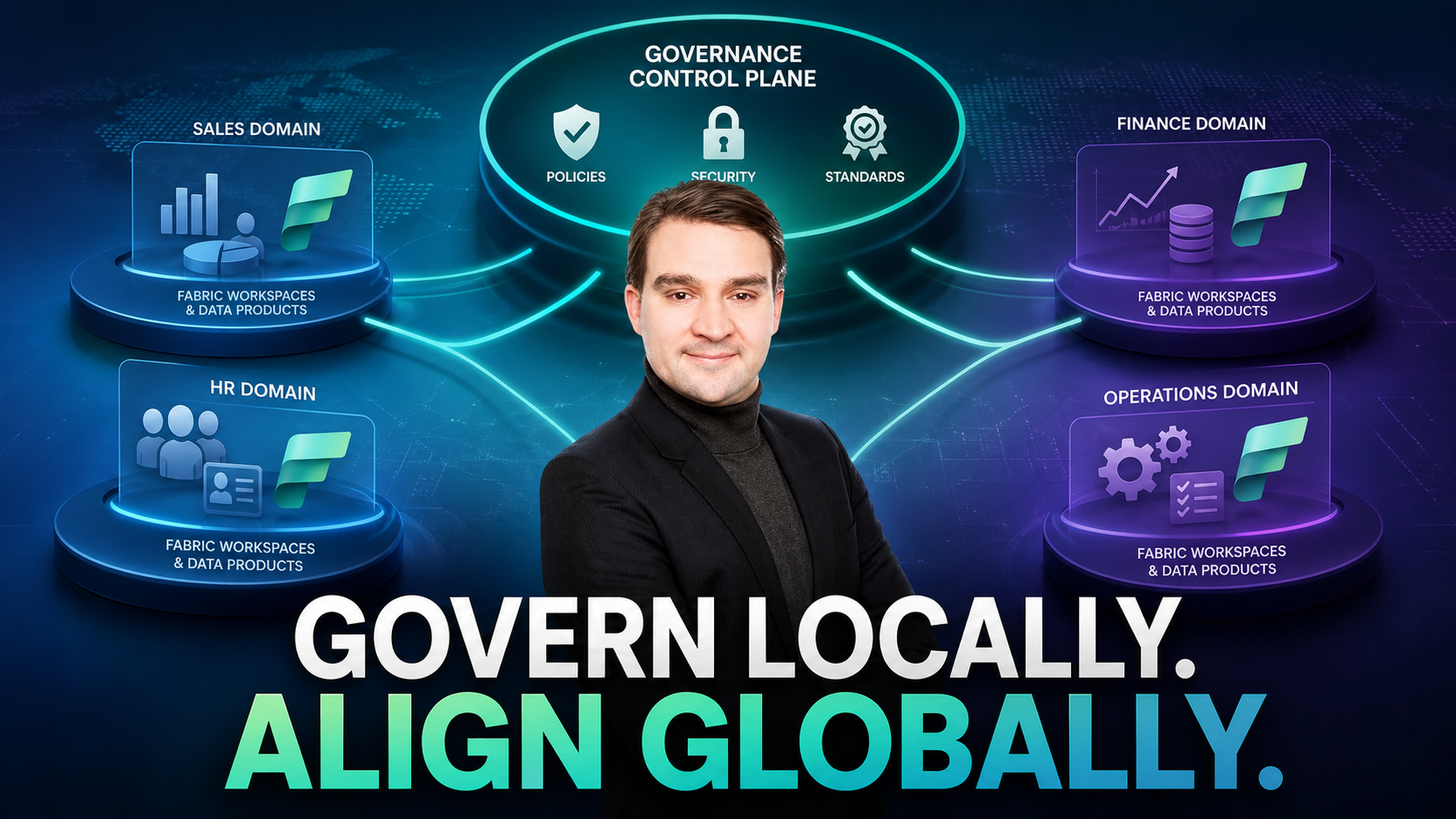
Welcome back to the podcast and our companion deep-dive blog! If you have been wrestling with the chaos of unstructured data, siloed business units, and the eternal bottleneck of central IT holding the keys to every single workspace, you are in the right place. In this post, we are breaking down how to implement a federated governance model using Microsoft Fabric Domains. We will explore how domain-level controls strike that delicate balance between empowering decentralized teams and keeping central oversight happy.
For an audio companion that dives straight into these architectural strategies, make sure you listen to the corresponding podcast episode: Use Microsoft Fabric Domains for Data Mesh Governance.
Introduction to Microsoft Fabric Domains
Organizations today do not struggle with collecting data; they struggle with managing, securing, and giving meaning to it. As companies scale, the traditional centralized IT model inevitably breaks down. Central teams become overwhelmed by requests for custom reports, data pipelines, and workspace provisioning, leading to shadow IT and data silos.
Microsoft Fabric Domains solve this challenge by introducing logical groupings that map directly to your business structure—whether that is Sales, Marketing, Finance, or Supply Chain. By organizing your data assets into domains, you establish clear boundaries for responsibility and access management. This lays the groundwork for a decentralized data architecture, popularly known as a data mesh, where business units take true ownership of their information.
Core Concepts and Architecture
To successfully implement federated governance, you need to understand how Fabric structures domains, workspaces, and subdomains.
Structure and Boundaries
Domains act as overarching containers within your Microsoft Fabric tenant. Every workspace inside a domain inherits its attributes, making it drastically easier for users to filter content in the OneLake catalog. For instance, a Sales Domain might contain workspaces for Sales Reports, Customer Insights, and Leads Pipeline, while a Finance Domain handles Budgeting and Forecasting. Each domain sets its own boundaries, giving you the flexibility to manage access per business unit without compromising the rest of the tenant.
Subdomains
As your organization grows, main domains can expand into subdomains. Under a broad Marketing domain, you might spin up subdomains for Digital Marketing and Events. This hierarchy keeps your data catalog clean, scales effortlessly, and delegates administrative overhead to the exact teams closest to the data.
Implementing Federated Governance
Governance is no longer a top-down mandate that stifles innovation. With Microsoft Fabric Domains, you can adopt a federated governance model that aligns enterprise standards with local autonomy.
In this model, business-aligned teams own and manage their data products. They are accountable for the quality, lifecycle, and compliance of their data assets. Meanwhile, central IT or platform operations teams maintain the overarching guardrails—such as tenant settings, compliance boundaries, and capacity limits. This balance keeps your teams agile, ensuring they can respond to market changes rapidly while keeping sensitive data secure.
Security and Access Control
Decentralization must never come at the expense of security. Microsoft Fabric Domains leverage robust security frameworks, including Role-Based Access Control (RBAC), multi-factor authentication, conditional access policies, and encryption at rest and in transit.
Rather than forcing a central administrator to manage every single user permission, Fabric allows you to delegate administrative rights to trusted domain leads. Domain admins can manage access, monitor usage, and enforce policies within their assigned domain. This division of labor ensures that security is tightly coupled with operational ownership.
Collaboration and Integration
Silos are the enemy of modern analytics. Microsoft Fabric brings all workloads—data engineering, data warehousing, real-time analytics, and business intelligence—together into a single SaaS platform powered by OneLake.
Because domains organize these assets logically, cross-functional teams can collaborate seamlessly. A data engineer can build a trusted semantic model in a domain workspace, and a business analyst can immediately build high-performance Power BI reports against it using Direct Lake mode. This unified experience eliminates duplicate data copies and ensures that everyone across the department is looking at a single version of the truth.
Real-World Use Cases
Implementing domains pays dividends across various enterprise scenarios:
- Enterprise Compliance: Aligning Fabric policies with industry regulations like HIPAA or GDPR, drastically reducing audit failures.
- Mergers and Acquisitions: Grouping legacy company data into separate domains (e.g., Sales_A and Sales_B) before gradually merging them into a unified enterprise domain.
- Departmental Self-Service: Empowering business units to build their own reporting pipelines while central IT manages the foundational ingestion layer.
Comparing Alternatives
When evaluating Microsoft Fabric Domains, it helps to look at what came before:
- Traditional Workspaces: Often result in disconnected silos with unclear ownership and manual configuration overhead.
- Manual Governance: Relies heavily on human oversight to tag data, check permissions, and enforce compliance, which inevitably leads to mistakes and security gaps.
- Alternative Platforms: While other cloud ecosystems offer data cataloging, few match the native, end-to-end integration between compute, storage (OneLake), and visualization (Power BI) found in Fabric.
Limitations and Considerations
No architecture is a silver bullet. When rolling out Fabric domains, keep the following considerations in mind:
- Complexity: Introducing domain-level controls requires careful planning to avoid integration friction and inconsistent data modeling practices.
- Cost Factors: Fabric pricing involves capacity tiers, storage fees, and potential cross-region egress charges. Proper capacity management and right-sizing are essential to prevent unexpected bills.
- Governance Gaps: Without a clear upfront strategy, teams may duplicate datasets or expose raw data prematurely. Curating trusted data layers (Bronze, Silver, Gold) is critical.
Adoption Guidance
If you are ready to bring order to your organization's data, follow these rollout steps:
- Define your domain structure based on business units, products, or regions.
- Assess your organization's readiness and train key stakeholders on governance policies.
- Assign domain administrators and link your existing workspaces.
- Apply auditing, sensitivity labels, and access controls.
- Monitor usage and iteratively adjust your domain architecture as your business evolves.
Conclusion
Implementing federated governance with Microsoft Fabric Domains is one of the most powerful steps you can take to tame data chaos. By giving business units real ownership while maintaining central oversight, you unlock speed, security, and true data democratization. To hear more about structuring your data mesh and avoiding common governance pitfalls, listen to the full episode over at Use Microsoft Fabric Domains for Data Mesh Governance.

Microsoft MVP | Host of M365.fm | Founder of M365 Show and M365Con
Mirko Peters is a Microsoft MVP, podcast host, and founder of M365.fm, M365 Show, and M365Con. His work connects Microsoft practitioners through podcast interviews, livestreams, and community events.
At M365.fm, Mirko hosts conversations with Microsoft MVPs, product experts, architects, and community contributors. Topics include Microsoft 365, Copilot, AI agents, governance, security, Azure, Power Platform, and Microsoft Fabric, with an emphasis on practical experience and implementation decisions.
M365.fm is the podcast and learning platform. M365 Show brings experts together for livestreams, while M365Con provides an online conference setting for community learning.
Official website: Mirko Peters (https://www.mirkopeters.com/). Recognition: Mirko Peters — Microsoft MVP profile (https://mvp.microsoft.com/de-DE/mvp/profile/9b0ca797-db5a-493a-a845-8b9158046cf5). Connect on LinkedIn (https://www.linkedin.com/in/m365showpodcast/).