
Mastering Data Governance and Compliance with Microsoft Purview in the AI Era
Welcome back to the blog! If you have been keeping up with the rapid pace of technological change, you already know that artificial intelligence is reshaping every corner of the modern workplace. But with extraordinary innovation comes extraordinary risk. As organizations rush to adopt agentic AI and productivity tools like Microsoft Copilot, security leaders are facing a massive challenge: how do you secure your data landscape when your users are interacting with intelligent, autonomous systems every single day? In this post, we are diving deep into how you can leverage Microsoft Purview as a cornerstone for AI-driven security, compliance, and data classification. To explore this topic further through an expert lens, make sure to check out our related podcast episode, AI Security and Microsoft Purview with Danilo Nogueira [Microsoft].
Introduction to AI Security and Microsoft Purview
You see AI meets security transform digital defense in 2026. Every day, AI brings new opportunities and challenges to your workplace. You may worry about how AI could increase security risk or make it harder to protect your data. Recent industry reports show that while most organizations want to deploy agentic AI capabilities, only a tiny fraction feel truly ready to manage the associated risks and secure their systems. When you look at the evolving threat landscape, it is clear that digital defense mechanisms require a fundamental shift.
You must focus on responsible AI adoption. Events like the AI Security Summit and comprehensive solutions such as Microsoft Purview show you how AI meets security in real time. You learn that AI meets security not through restrictive blocking, but by using monitoring and intelligent automation to manage risk. As AI meets security, you gain advanced tools to spot threats, protect your sensitive data, and respond faster than ever before. When AI meets security, you finally take control of your digital defense.
AI Security Trends 2026

You see AI in cybersecurity change how you protect your digital world. In 2026, you rely on AI to spot threats, predict attacks, and personalize security controls. You learn about new trends at events like the AI Security Summit, the AIMS retreat, and from comprehensive security reports. These trends show you how AI in cybersecurity brings innovation and transforms your defense posture.
Autonomous Threat Detection
Self-Learning Systems
You use self-learning systems to improve threat detection. These systems learn from every event and adapt to new threats dynamically. You do not need to update rules manually. AI in cybersecurity helps you build smarter defenses. You see AI-driven threat detection replace old workflows. AI becomes the backbone of your security stack. You trust AI to analyze millions of data packets every second, giving you faster and more accurate results than traditional methods.
Real-Time Adaptation
You benefit from real-time adaptation. AI in cybersecurity lets you respond to threats instantly. You do not wait for human analysts to act. AI systems execute the entire detection-to-response lifecycle. You see AI-driven defense use deep learning and behavioral analytics. You detect complex threats like AI-generated malware. You use event correlation and risk assessment to build insights, helping you make better decisions and respond quickly.
You gain instant mitigation with AI in cybersecurity. AI integrates seamlessly with your security tools and acts even when your SOC analysts are busy.
| Advancement Type | Description |
|---|---|
| AI-driven threat detection | AI becomes the backbone of threat detection, replacing reactive workflows with autonomous systems. |
| Detection-to-response lifecycle | AI systems can execute the entire lifecycle, enhancing real-time protection and reducing detection windows. |
| Advanced detection fabric | Utilizes deep learning and behavioral analytics to detect complex threats like AI-generated malware. |
| Event correlation and risk assessment | Correlates billions of events to build comprehensive insights, improving decision-making and response. |
| Instant mitigation | Enables immediate action even without SOC analysts, integrating with various security tools. |
Predictive Analytics in Cybersecurity
Attack Pattern Forecasting
You use predictive analytics to forecast attack patterns. AI in cybersecurity analyzes global threat data. You predict trends like cryptocurrency mining malware campaigns and zero-day exploits. You see AI in cybersecurity help you anticipate attacks before they happen, relying on threat intelligence to stay ahead.
- Threat Intelligence: Predictive models analyze global threat data to forecast emerging attack trends.
- User Behavior Analytics: You establish baselines of normal user behavior, helping you detect insider threats much faster.
- Network Security: Predictive analytics forecasts network traffic patterns, letting you identify potential DDoS attacks or breaches early.
- Vulnerability Management: You analyze historical data to prioritize patch management and forecast exploited vulnerabilities.
Proactive Risk Mitigation
You use AI in cybersecurity to mitigate risks proactively. You do not wait for threats to cause damage. AI-driven defense helps you assess risks and take action immediately. You use continuous monitoring to spot vulnerabilities, prioritize patching, and strengthen your security posture.
Personalized Security Controls
User Behavior Analytics
You use user behavior analytics to personalize security controls. AI in cybersecurity tracks how you use your devices and data. You spot unusual activity and prevent insider threats by building baselines and detecting anomalies quickly.
Adaptive Access Management
You use adaptive access management to control who can access your data. AI in cybersecurity adjusts permissions dynamically based on user behavior. You protect sensitive information and reduce the risk of data leaks, making access decisions smarter and more flexible.
Microsoft Purview stands out as a leading example of AI-driven security and governance. You use Purview to classify and protect sensitive data, assess risks, and ensure compliance. You get end-to-end protection from identity to data, devices, and cloud.
AI Meets Security: Practical Applications
Real-Time Threat Detection
Network Intrusion Prevention
You rely on AI to strengthen your cybersecurity and protect your network from threats. Real-time threat detection lets you spot attacker behaviors as they happen. You use AI-driven threat detection to monitor traffic across your network, identity, and cloud environments.
| Application Name | Key Features | Limitations |
|---|---|---|
| AI-driven threat detection | Detects attacker behaviors in real time across various environments, including network and cloud. | Detection precision requires improvement; limited data aggregation capabilities; integration gaps. |
| AccuKnox CDR | Continuous monitoring, AI-powered detection, and automated response for cloud environments. | Steep learning curve; complex setup; high cost; customer support delays. |
| Darktrace DETECT | Self-learning AI that identifies unknown threats and provides enterprise-wide coverage. | High alert volume requiring tuning; complex initial setup; steep learning curve; high total cost. |
Cloud Anomaly Detection
You protect your cloud environments with AI-powered anomaly detection. AI analyzes billions of events and identifies unusual patterns that signal threats, such as unauthorized access or data exfiltration.
AI in cybersecurity gives you visibility across multi-cloud workloads. You detect unknown threats without relying solely on predefined rules.
Microsoft Purview helps you manage risks in the cloud. You use Purview to identify and classify sensitive data, apply encryption, and monitor risky sharing behaviors. You prevent oversharing with AI tools like Copilot by enforcing strict access controls and compliance policies.
Endpoint Security Innovations
Malware Analysis with AI
You use AI-powered tools to analyze malware and protect your endpoints. AI in cybersecurity shifts from signature-based detection to behavioral analysis and machine learning, allowing you to catch novel threats and respond in milliseconds.
| Aspect | Traditional Security | AI-Powered Security |
|---|---|---|
| Detection Method | Signature-based | Behavioral analysis & ML |
| Response Time | Hours to days | Milliseconds |
| False Positives | 40-90% of alerts | 5-10% of alerts |
| Staffing Requirements | 24/7 human monitoring | Automated with human oversight |
| Cost Implications | High labor costs | Reduced operational expenses |
Device Isolation Automation
You use AI to automate device isolation when threats are detected. AI-powered tools identify compromised devices and remove them from the network instantly, preventing malware from spreading.
Incident Response Automation
Intelligent Playbooks
You use AI to automate incident response and streamline investigations. Intelligent playbooks guide you through response planning while enriching alerts with contextual data to help you prioritize significant threats.
Rapid Remediation
You see AI-powered incident response reduce breach response times dramatically. Case studies show that organizations utilizing automation significantly improved their dwell time and mean time to resolution.
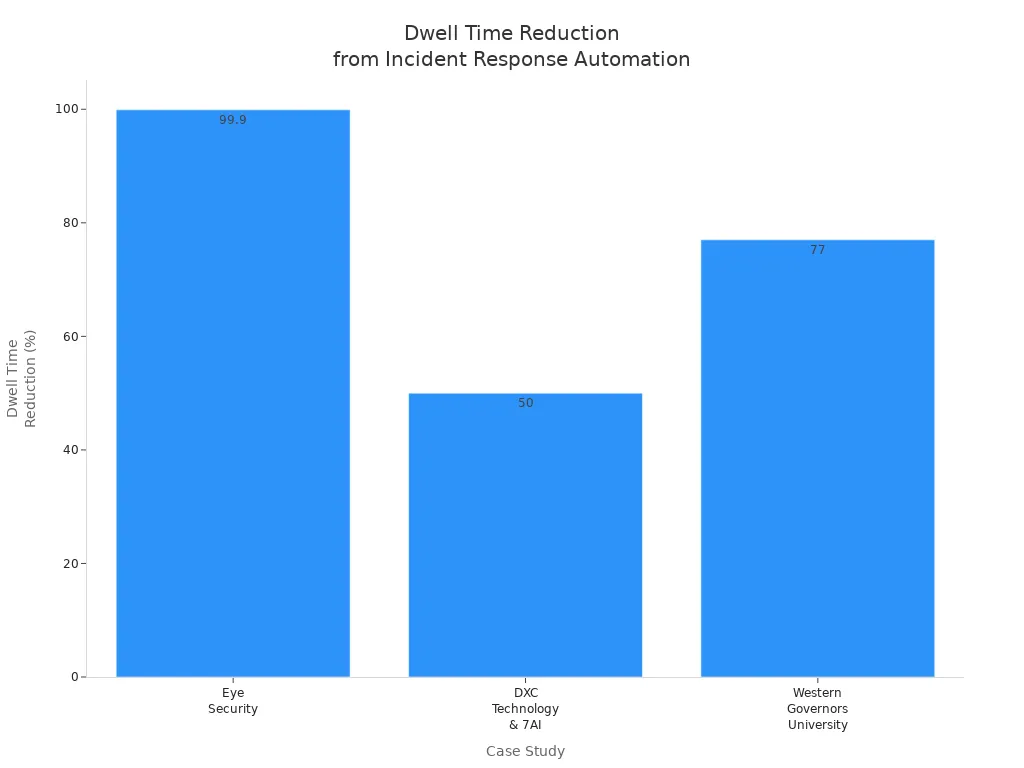
- Eye Security reduced dwell time from 24 days to under 24 minutes.
- Western Governors University improved resolution time by 77%.
- DXC Technology and 7AI saved thousands of analyst hours and cut response times by half.
Phishing and Ransomware Defense
Phishing and ransomware continue to threaten your digital safety. Attackers use advanced tactics to trick you into sharing sensitive information. AI-powered solutions give you the upper hand.
NLP for Email Analysis
Natural Language Processing (NLP) helps you analyze emails and messages for signs of phishing. NLP models look for suspicious patterns, fake sender addresses, or urgent requests.
With Microsoft Purview, you gain advanced email scanning powered by AI. Purview uses NLP to flag risky emails and alert you to possible threats containing sensitive data or suspicious attachments.
| Feature | Traditional Email Security | AI-Powered NLP Email Analysis |
|---|---|---|
| Keyword Matching | ✅ | ✅ |
| Context Understanding | ❌ | ✅ |
| Adaptive Learning | ❌ | ✅ |
| Real-Time Alerts | ⚠️ | ✅ |
Early Detection Algorithms
Early detection algorithms help you stop ransomware before it spreads. AI monitors systems for rapid file encryption, strange network traffic, or unauthorized access attempts, triggering automated responses to isolate infected devices.
Human-AI Partnership in Cybersecurity

Augmenting Security Teams
AI as Analyst Assistant
You see AI transform your security team by acting as an analyst assistant. AI handles unlimited alert volume, allowing you to focus on complex investigations while routine tasks are automated.
| Metric | Without AI | With AI (Extensive) |
|---|---|---|
| Average breach cost | $5.52M | $3.62M |
| Breach lifecycle | 321 days | 241 days |
| Alert coverage gap | 40% | Majority auto-triaged |
| Analyst workload reduction | Baseline | Up to 80% |
| Daily analyst time saved | Baseline | 6-7 hours |
Reducing Alert Fatigue
You use AI to triage alerts, reducing false positives and dropping your mean time to detect threats down to minutes. Automation collapses multiple alerts into single cases, lowering analyst stress and burnout.
Ethical and Transparent AI
Addressing Bias
You trust AI in cybersecurity when you see transparency and fairness. You address bias by conducting audits on training data, applying bias-correction techniques, and drafting clear ethical guidelines.
Ensuring Accountability
You ensure accountability by following compliance frameworks such as the EU AI Act, ISO/IEC 42001, and the NIST AI RMF to manage risks and maintain transparency.
Upskilling for AI Security
Training for AI Tools
You upskill your security team to use AI-powered tools effectively, fostering continuous learning and investing in human strengths like critical judgment and creativity.
New Security Roles
New security roles are emerging, requiring fluency in AI-driven threats, secure system design, policy leadership, and governance.
Risk and Impact for Organizations & Individuals
Security Transformation
Strategy Shifts
Organizations are transforming their cybersecurity strategies by moving from reactive to proactive security. Centralized access frameworks and layered defenses are critical for protecting modern cloud environments.
Investment in AI Solutions
Investment in AI security solutions is surging, with platforms like Microsoft Purview playing a vital role in mapping controls to data assets and monitoring sensitive content.
Managing AI Risks
Adversarial AI
You face new risks from adversarial AI, including input manipulation and model poisoning. Defending against these requires strong authentication, input validation, and regular security audits.
Data Privacy Concerns
Data privacy concerns arise when employees interact with AI tools. You rely on data validation, differential privacy, and Microsoft Purview for compliance management and data classification.
Empowering Users
AI-Enhanced Security Tools
You empower yourself with machine learning tools that detect advanced threats like file-less malware and zero-day attacks while automating incident response.
Building Digital Resilience
You build digital resilience by integrating real-time threat monitoring, endpoint detection, and advanced analytics into your daily operations.
FAQ
What is agentic AI in cybersecurity?
Agentic AI refers to systems that act independently to detect and respond to threats. You see these tools make decisions without waiting for human input, helping you protect digital assets faster.
How does Microsoft Purview help prevent data leaks?
You use Microsoft Purview to monitor data access and classify sensitive information. Purview alerts you when someone tries to share confidential files and enforces rules to block risky actions.
Can AI detect insider threats?
Yes. AI analyzes user behavior and flags unusual activity, allowing you to spot potential insider threats early and investigate before damage happens.
What are the benefits of automating incident response?
You save time by automating incident response. AI-driven playbooks guide you through each step, helping you resolve security issues quickly and reduce business impact.
How do you stay compliant with AI-powered security tools?
You follow regulations like the EU AI Act and ISO/IEC 42001. Microsoft Purview helps you enforce policies and track compliance using audit logs.
What should you do if you suspect a phishing attack?
You check the sender address and look for suspicious links. AI tools scan emails for threats, and you can report the message to your IT team while avoiding unknown attachments.
How can you build digital resilience with AI?
You use AI for real-time monitoring and automated responses. This strengthens defenses, ensures rapid recovery from cyberattacks, and keeps systems running smoothly.
🎧 Listen to this episode
Want a practical explanation of AI Security and Microsoft Purview? This episode breaks down the topic in clear language and shows why it matters for Microsoft 365, Azure, Power Platform, security, AI, and modern work.
Listen to this episode if you want to:
- Understand the key concepts behind AI Security and Microsoft Purview
- See how it fits into the wider Microsoft technology ecosystem
- Learn where it can create practical value for your organization
You may also enjoy these related M365 FM episodes:
- Microsoft Purview for Copilot Security with Peter Rising [Microsoft]
- Dataverse Security - Simply Explained
- Azure Network Security Groups - Simply Explained
- Microsoft Purview - Simply Explained
- Zero Trust AI Security with Microsoft Copilot and Azure – Mourtaza Fazlehoussen [MVP]
Discover more practical Microsoft conversations on M365 FM.

Microsoft MVP | Host of M365.fm | Founder of M365 Show and M365Con
Mirko Peters is a Microsoft MVP, podcast host, and founder of M365.fm, M365 Show, and M365Con. His work connects Microsoft practitioners through podcast interviews, livestreams, and community events.
At M365.fm, Mirko hosts conversations with Microsoft MVPs, product experts, architects, and community contributors. Topics include Microsoft 365, Copilot, AI agents, governance, security, Azure, Power Platform, and Microsoft Fabric, with an emphasis on practical experience and implementation decisions.
M365.fm is the podcast and learning platform. M365 Show brings experts together for livestreams, while M365Con provides an online conference setting for community learning.
Official website: Mirko Peters (https://www.mirkopeters.com/). Recognition: Mirko Peters — Microsoft MVP profile (https://mvp.microsoft.com/de-DE/mvp/profile/9b0ca797-db5a-493a-a845-8b9158046cf5). Connect on LinkedIn (https://www.linkedin.com/in/m365showpodcast/).





![AI Security and Microsoft Purview with Danilo Nogueira [Microsoft]](https://d3wo5wojvuv7l.cloudfront.net/t_rss_itunes_square_1400/images.spreaker.com/original/7a2e65341e49f210059e2158efe3e43e.jpg "AI Security and Microsoft Purview with Danilo Nogueira [Microsoft]")