Mastering Microservices Deployment with Azure Kubernetes Service
Welcome back to the blog! As podcasters, we love diving deep into the technical weeds of cloud architecture, but we also know how critical it is to step back and look at the big picture of how modern development teams operate. Today, we are expanding on one of our core architectural topics: how breaking down monolithic applications into independent microservices running on a managed platform can entirely revolutionize your engineering culture. If your team is struggling with release bottlenecks, rigid deployments, or skyrocketing infrastructure waste, you are in the right place. In this post, we will explore the nuances of mastering microservices deployment with Azure Kubernetes Service (AKS), touching on development velocity, side-by-side deployments, zero-trust networking, and intelligent scaling.
Introduction to Mastering Microservices with AKS
The journey from a monolithic software architecture to a distributed microservices pattern is rarely straightforward. While breaking applications apart offers immense flexibility, it simultaneously introduces operational complexity. Managing scores—or even hundreds—of individual containerized components requires a robust orchestration engine. This is where Azure Kubernetes Service enters the equation, acting as the foundational backbone for modern cloud-native systems.
By abstracting away the heavy lifting of control plane management, virtual machine provisioning, and cluster health monitoring, AKS allows development teams to refocus their energy on what actually matters: writing brilliant business logic. When paired with the native management capabilities of the Azure ecosystem, AKS turns container orchestration from a daunting operational hurdle into a competitive advantage. Whether you are migrating legacy web apps or building greenfield AI-driven backend services, mastering AKS deployment strategies is an essential milestone for any forward-thinking technical organization.
Breaking Down Applications into Independent Microservices
At the heart of the microservices philosophy is the principle of separation of concerns. Instead of housing your user authentication, data processing, billing, and frontend rendering inside a single massive codebase, you decouple them into discrete, self-contained services. Each microservice typically owns its data store, exposes a well-defined API, and can be developed, tested, and deployed entirely on its own.
Implementing this pattern on AKS provides a natural alignment between your organizational structure and your software architecture. Because Kubernetes organizes workloads into pods and namespaces, you can map your business domains directly to cluster boundaries. Product teams can take ownership of specific microservices without stepping on each other's toes. Furthermore, if a bug or a performance bottleneck crashes a non-critical background service, the blast radius is strictly contained. The rest of your application remains up, running, and fully responsive to your end users.
Accelerating Development Velocity and Side-by-Side Deployments
One of the most immediate benefits of adopting AKS for microservices is the dramatic acceleration of your team's development velocity. In a traditional monolithic release cycle, a single delayed bug fix by one team can block the deployment of features built by everyone else. Microservices eliminate this synchronization tax.
Furthermore, AKS shines when it comes to executing side-by-side deployments. Imagine you are rolling out a major algorithmic update to a core recommendation service. Instead of forcing a disruptive cutover that risks taking down the entire user experience, AKS allows you to deploy the new version alongside the legacy version. Using advanced traffic routing and ingress configurations, you can direct a small percentage of test traffic to the new version—often called canary deployment—while the rest of your traffic safely hits the stable baseline. Once you validate the metrics and performance under real-world conditions, you can smoothly transition 100% of the traffic over and decommission the old pods without a single second of downtime.
Enforcing Zero-Trust Networking and Security Policies
As your microservices footprint expands, securing the communication pathways between services becomes paramount. Traditional perimeter security models assume that everything inside the corporate network is safe, but modern cloud-native architectures demand a shift toward Zero-Trust networking.
With AKS, you can enforce strict, granular security policies right down to the network layer. By default, Kubernetes pods can communicate with any other pod in the cluster. However, by implementing Kubernetes Network Policies—and combining them with Azure's robust role-based access control (RBAC) and Azure Active Directory integration—you can flip this dynamic. You can start with a deny-all posture where every incoming and outgoing connection is blocked, and then explicitly write rules that permit only the necessary communication paths. For instance, your frontend API gateway needs to talk to your user service, but your user service has no business talking to your database backup utility. Enforcing these boundaries ensures that even if a single microservice is compromised, the attacker's lateral movement is stopped dead in its tracks.
Scaling Individual Services Without Disrupting the System
In a monolithic architecture, scaling up to handle a sudden surge in traffic means scaling the entire application stack, which leads to massive compute waste. If your checkout page is getting hammered during a flash sale, you shouldn't have to scale up your reporting dashboard servers just to keep pace.
AKS solves this problem elegantly through native mechanisms like the Horizontal Pod Autoscaler (HPA) and cluster autoscaling. Because your application is broken down into independent microservices, you can configure individual scaling rules tailored precisely to each service's resource profile. If your payment processing service experiences a spike, AKS automatically spins up additional pods of that specific service to shoulder the load based on CPU utilization, memory thresholds, or custom application metrics. Once the traffic subsides, AKS scales those pods back down, optimizing your cloud spend and ensuring you only pay for the exact compute resources you consume.
Conclusion and Next Steps with Azure Kubernetes Service
Breaking down your applications into independent microservices on Azure Kubernetes Service is a proven path toward accelerated development velocity, enhanced system resilience, and optimized cloud expenditures. From executing seamless side-by-side deployments and enforcing zero-trust networking principles to scaling individual components without system-wide disruption, AKS gives your engineering teams the ultimate playground for modern software delivery.
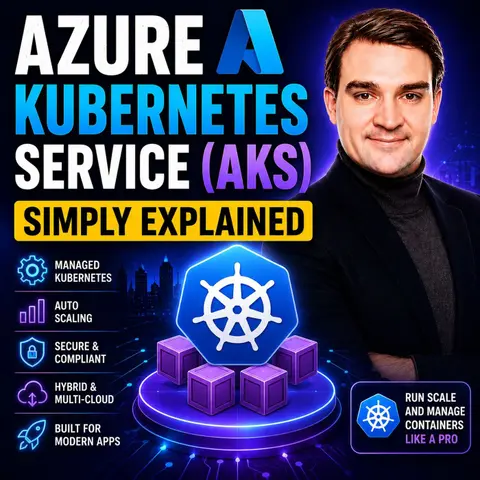
If you want to dive deeper into how these concepts come together in real-world environments, you need to check out our related podcast episode. To hear a comprehensive, straightforward breakdown of container orchestration in the cloud, make sure to listen to our Azure Kubernetes Service (AKS) - Simply Explained episode. Embrace the power of cloud-native architecture today, and take your deployment strategy to the next level!

Microsoft MVP | Host of M365.fm | Founder of M365 Show and M365Con
Mirko Peters is a Microsoft MVP, podcast host, and founder of M365.fm, M365 Show, and M365Con. His work connects Microsoft practitioners through podcast interviews, livestreams, and community events.
At M365.fm, Mirko hosts conversations with Microsoft MVPs, product experts, architects, and community contributors. Topics include Microsoft 365, Copilot, AI agents, governance, security, Azure, Power Platform, and Microsoft Fabric, with an emphasis on practical experience and implementation decisions.
M365.fm is the podcast and learning platform. M365 Show brings experts together for livestreams, while M365Con provides an online conference setting for community learning.
Official website: Mirko Peters (https://www.mirkopeters.com/). Recognition: Mirko Peters — Microsoft MVP profile (https://mvp.microsoft.com/de-DE/mvp/profile/9b0ca797-db5a-493a-a845-8b9158046cf5). Connect on LinkedIn (https://www.linkedin.com/in/m365showpodcast/).
Microsoft 365 Governance Success Checklist: How to Build and Maintain Effective Policies