Why PPR Models Beat Relational Tables for Factory Analytics
When production schedules shift unexpectedly, manufacturing data models often collapse because they rely on rigid relational tables rather than connected domain logic. This guide explores why Product, Process, and Resource (PPR) frameworks outperform standard table joins when tracking real-time factory disruptions, alternate routings, and complex operational constraints.
Key Takeaways
- Relational database tables struggle when production questions cross multiple dynamic relationships that change over time.
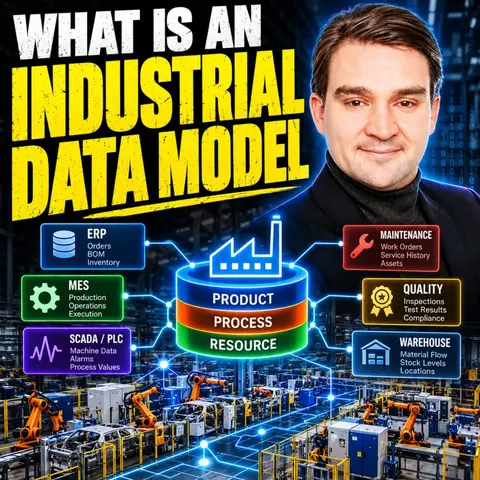
- The Product-Process-Resource (PPR) framework provides a lightweight structural backbone for manufacturing analytics without enterprise-wide overhauls.
- Design capabilities differ fundamentally from current operational states, such as a machine being technically functional but lacking a required fixture.
- Scattered business logic in spreadsheets and localized SQL queries creates conflicting reporting metrics across plant shifts.
- Establishing a shared relationship layer allows BI tools, cloud platforms, and operational teams to consume consistent factory rules.
The Limits of Traditional Tables in Manufacturing
Relational databases are the backbone of modern enterprise software. Enterprise Resource Planning (ERP) systems, Manufacturing Execution Systems (MES), and maintenance platforms rely heavily on structured tables for valid reasons. They ensure reliable transactions for inventory updates, purchase receipts, and financial ledgers. However, manufacturing environments present a unique challenge when historical data must answer dynamic operational questions.
Consider what happens when a critical work center breaks down halfway through a shift. A relational query can easily pull a list of open work orders or summarize scrap rates by product family. But when a planner needs to know whether order #2847 can be immediately shifted to an alternate machine, standard table structures quickly run into trouble. The necessary logic spans product revisions, specialized routings, tooling compatibility, operator qualifications, and real-time maintenance statuses.
How Business Logic Fragments Across Reports
When relational schemas cannot natively handle complex factory relationships, organizations resort to workaround strategies. Analysts build custom views, write massive SQL joins, or maintain local exception lists in spreadsheets. Over time, the true business logic fragments:
- One Power BI report assumes a machine capability is valid if the asset exists in the master data.
- A secondary planning dashboard automatically excludes any asset with an open maintenance work order.
- A quality assurance tracking sheet relies on a manually updated extract of operator certifications.
Each individual report appears accurate and functional on its own. Yet, when leadership compares them side by side, they tell conflicting stories about plant capacity. This structural drift is why operations teams often rely on whiteboards and phone calls rather than trusting enterprise dashboards during a crisis.
The Power of PPR: Product, Process, and Resource
To overcome the limitations of isolated tables, industrial architects turn to the PPR framework. Rather than attempting to model the entire enterprise simultaneously—a project prone to scope creep and failure—PPR focuses strictly on three foundational elements that dictate whether production can actually happen.
Product: Beyond the Part Number
In a standard transactional table, a part number is often treated as a static string. In a true production model, a product definition encompasses product families, specific variants, strict engineering revisions, bills of materials (BOM), and quality specifications. Two physical items might share a primary part number while requiring entirely different inspection routines or machining tolerances due to a recent engineering change order.
Process: Defining How Work Happens
Process modeling covers the approved route through the plant floor. It includes operation sequences, setup requirements, wait times, and mandatory quality sign-offs. Without a structured process model, manufacturing data platforms record what happened during execution (via the MES) without understanding what was supposed to happen according to engineering design.
Resource: Capability Versus Current State
Perhaps the most critical distinction in industrial modeling is separating design capability from operational state. A production resource—whether it is a CNC machine, a specialized test rig, a fixture, or a human operator—may possess the technical capability to run a specific product revision. However, if the required tooling is currently deployed elsewhere, or if the sole certified operator is on a different shift, the resource is practically unavailable. PPR explicitly connects these states.
Implementing a Shared Relationship Layer
Modern data platforms like Microsoft Fabric and Azure data lakes provide incredible storage, ingestion, and compute power. They can easily ingest millions of telemetry rows from plant historians alongside relational ERP backups. However, simply storing these datasets in the same Lakehouse does not automatically generate operational context.
A data lakehouse cannot magically determine whether a work center can accept an alternate routing simply because the tables reside in the same database schema. That answer depends entirely on governed relationships. By establishing an explicit relationship layer—a factory grammar—organizations empower reporting layers, simulation models, and automated workflows to evaluate production feasibility accurately.
Conclusion
Moving away from isolated relational tables toward a structured PPR framework allows manufacturing organizations to answer complex operational questions with confidence. By treating relationships as first-class citizens rather than an afterthought handled by messy SQL queries, IT and OT teams can build analytics that truly reflect shop floor reality.
To hear a deeper dive into this topic, expert insights, and strategies for modern manufacturing architectures, Listen to the full episode of the M365 FM Podcast.
Frequently Asked Questions
Why do traditional relational tables fail for complex factory analytics?
Traditional tables handle structured transactions efficiently, but they struggle when production questions require traversing multiple changing relationships over time, such as matching product revisions, tool availability, and operator certifications simultaneously.
What does PPR stand for in industrial data modeling?
PPR stands for Product, Process, and Resource. It is a foundational modeling structure that connects what a factory builds, how it builds it, and what assets or personnel are required to execute the work.
Does a PPR model replace existing ERP and MES systems?
No. An industrial data model sits across source systems like ERP and MES to provide shared meaning and context without replacing the transactional capabilities of those specialized applications.
How does resource capability differ from current state in manufacturing?
Capability defines what a machine or operator can theoretically perform under design conditions, whereas current state determines whether that capability is actively available right now (e.g., checking if maintenance locks or tooling requirements are satisfied).