
Scaling Intelligence: Why Multi-Agent Systems Outperform Single Chatbots
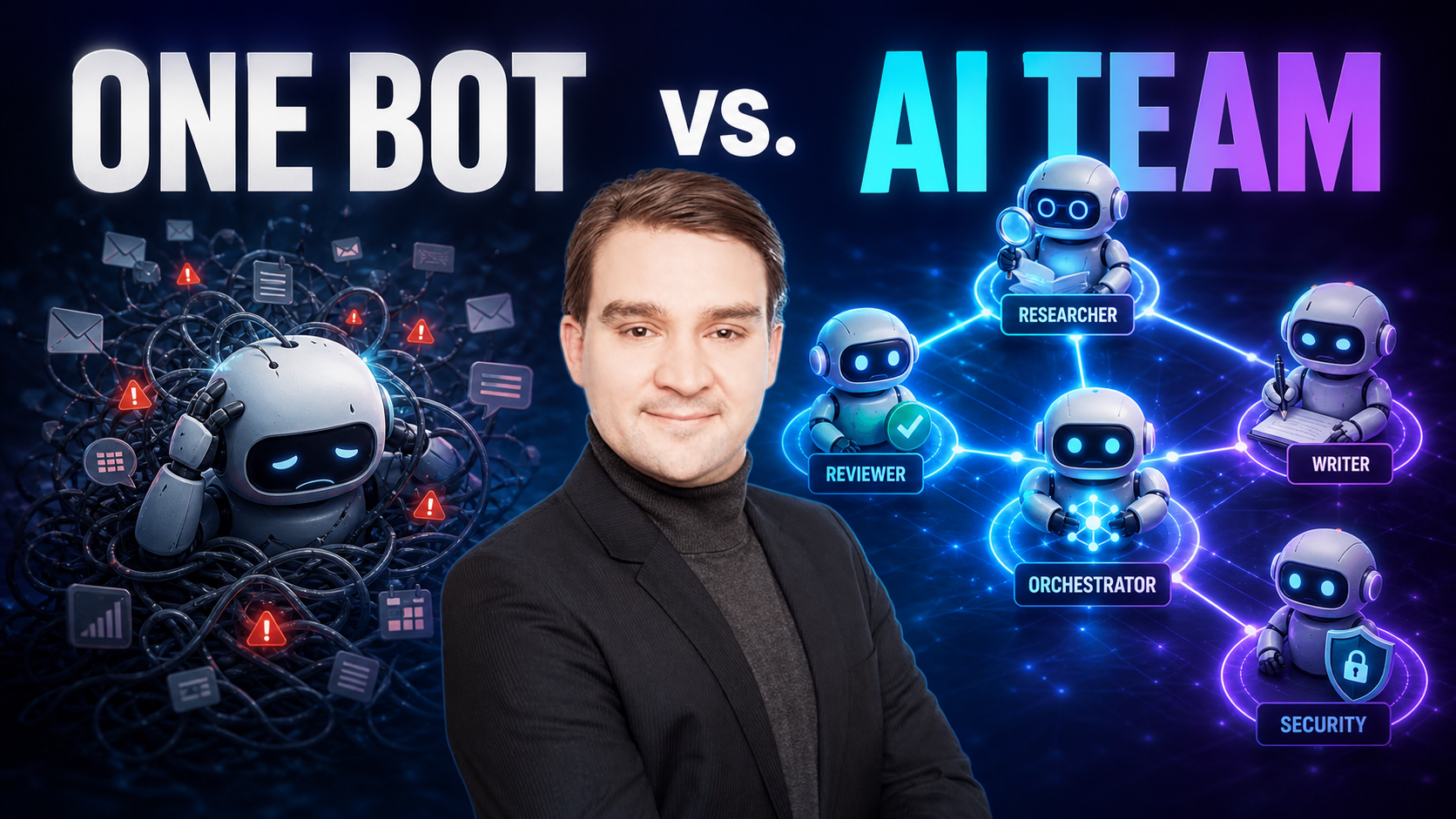
Welcome back to the blog! If you have spent any time experimenting with artificial intelligence over the last couple of years, you have undoubtedly interacted with the classic single chatbot interface. You open a clean browser window, type a prompt into a text box, press enter, and wait for a model to generate a comprehensive, all-in-one response. For basic queries, summarization tasks, or casual brainstorming, this single-agent paradigm is nothing short of magical. However, when businesses attempt to transition these simple demo experiences into robust, production-ready enterprise solutions, the limitations of the solitary chatbot become glaringly obvious. Expecting a single language model to act as a brilliant strategist, a meticulous data retriever, a strict quality assurance editor, and an error-free workflow executor all at once is a recipe for hallucinations, inefficiency, and operational failure. Enter the world of multi-agent architectures—a transformative design pattern where specialized digital entities collaborate, debate, review, and execute complex workflows together. In this comprehensive deep dive, we will explore why scaling intelligence requires moving beyond single conversational boxes and embracing coordinated multi-agent teams. Let us unpack how these collaborative systems work, why they drastically improve enterprise reliability, and how they bridge the gap between impressive sandbox demos and mission-critical business applications.
From Single Chatbots to Collaborative Digital Teams
To understand the necessity of multi-agent systems, we first need to look at how human organizations function. In any successful enterprise, complex projects are rarely handed to a single individual who possesses every skill required from start to finish. Instead, organizations rely on cross-functional teams. You have researchers who gather data, writers who draft content, legal and compliance officers who review for risk, and project managers who orchestrate the entire process. Each person brings a distinct specialization, a focused set of instructions, and a specific domain of expertise.
For a long time, artificial intelligence development ignored this fundamental principle of division of labor. We tried to build monolithic models that could do everything. We prompted a single instance of a Large Language Model to write code, evaluate its own security vulnerabilities, format the output, and generate a user-friendly explanation. Predictably, this monolithic approach suffers from cognitive overload. The model tries to optimize for too many conflicting objectives simultaneously, leading to generalized mediocrity.
Multi-agent systems flip this paradigm on its head by simulating a collaborative digital team. In this architecture, you deploy a collection of specialized AI agents, each assigned a very narrow, clearly defined role. One agent might be an expert content generator, another a rigorous quality reviewer, a third a security validator, and a fourth a workflow orchestrator. By decomposing a massive, intimidating task into smaller, manageable sub-tasks handled by specialized personas, we achieve a level of depth, accuracy, and reliability that a single chatbot can simply never match. This division of labor allows each agent to use specialized system prompts, tailored context windows, and specific toolsets without muddying the waters with irrelevant instructions.
Anatomy of a Multi-Agent Architecture
Building a multi-agent system sounds complex, but when you break down the anatomy of the architecture, it is essentially a structured orchestration of specialized prompts, communication protocols, and execution loops. Unlike a traditional chatbot pipeline where data flows in a straight line from user to model and back, a multi-agent network resembles a dynamic web of collaboration.
At the heart of any multi-agent system are the individual agents themselves. Each agent is characterized by a distinct system persona, a set of access permissions, and a designated library of tools. For instance, a research agent might have direct access to enterprise knowledge bases through Retrieval-Augmented Generation, while a drafting agent has access to synthesis tools, and an oversight agent has access to logging and verification pipelines.
The second critical component is the communication protocol. How do these agents talk to one another? In some architectures, communication is hierarchical: a manager agent receives the initial prompt, breaks it down into sub-tasks, delegates them to worker agents, and then aggregates the results. In other architectures, communication is peer-to-peer or event-driven, where agents publish their outputs to a shared blackboard or message bus, allowing other agents to pick up tasks as soon as they are ready. This modularity means that if a new requirement emerges—such as adding a localized compliance check—you do not need to retrain or rewrite your entire AI application. You simply spin up a new compliance agent and insert it into the communication workflow.
Ensuring Reliability Through Quality Review and Iteration
One of the most persistent frustrations with enterprise AI deployment is the hallucination problem. Even the most advanced models occasionally invent facts, misinterpret constraints, or output subtly flawed code. When a human user is chatting with a bot, catching these errors relies entirely on the user noticing the mistake. In an automated enterprise workflow, that reliance on human spot-checking defeats the purpose of automation.
Multi-agent systems solve this reliability crisis by baking quality review and iterative refinement directly into the operational loop. Instead of trusting an agent to get it right on the first try, a multi-agent architecture introduces an adversarial or reviewer-writer dynamic.
Imagine a content creation workflow. The first agent—the generator—takes the prompt and drafts the required document, report, or response. Instead of instantly presenting this draft to the end user or writing it to a database, the system routes the draft to a second agent: the reviewer. The reviewer agent is armed with a completely different set of instructions focused entirely on finding flaws, checking compliance against company guidelines, identifying missing data points, and verifying tone. If the reviewer finds deficiencies, it sends constructive, specific feedback back to the generator agent. The generator then refines its work based on the critique. This loop can occur multiple times in a matter of seconds until the output meets a strict, programmatic threshold of quality. By introducing automated peer review, multi-agent systems catch errors internally before they ever impact a customer, a supplier, or an internal stakeholder.
Scaling Enterprise Workflows with Agent Orchestration
Moving AI out of the sandbox and into core business operations requires more than just generating text; it requires orchestration across enterprise systems, databases, and APIs. This is where multi-agent frameworks truly shine as workflow orchestrators. Complex enterprise processes—such as processing a Request for Proposal, onboarding a new employee, or handling a complex IT support ticket—involve multiple sequential and parallel steps that span different departments.
An orchestrator agent acts as the conductor of the digital orchestra. When a complex request enters the system, the orchestrator analyzes the parameters, breaks the process down into a logical sequence, and routes tasks to the appropriate functional agents. For example, in an RFP automation workflow, the orchestrator first triggers a retrieval agent to gather historical proposal documents and pricing guidelines. Once the data is retrieved, it hands the information over to a drafting agent to structure the initial response. Simultaneously, it might trigger a technical validation agent to review product compatibility specs. Finally, a human-in-the-loop validation gate is presented to a designated manager who can approve the final output with full visibility into how the sausage was made.
This level of orchestration transforms AI from a passive question-answering toy into an active participant in business productivity. It ensures that tasks are routed efficiently, context is preserved across handoffs, and bottlenecks are instantly identified and surfaced to human administrators.
Balancing Autonomy and Governance in Production
While the prospect of fully autonomous digital teams is exhilarating, enterprise leaders must grapple with a critical question: how do we maintain control? Unchecked agent autonomy in a production environment can lead to runaway token consumption, unauthorized data exposure, and unpredictable operational behavior. Balancing agentic autonomy with robust governance is the ultimate key to sustainable AI adoption.
Successful production deployments require clear boundaries. Agents should operate within strictly scoped environments equipped with granular Data Loss Prevention policies, sensitivity labels, and targeted access permissions. Furthermore, FinOps and token management must be part of the architectural design from day one. Not every task requires the most expensive, heavy reasoning model available. Multi-agent systems allow organizations to optimize costs by routing simple classification and summarization sub-tasks to lightweight, highly efficient models, while reserving heavy-duty reasoning models exclusively for complex orchestration and synthesis steps.
Governance is not a one-time project you check off a list before launch; it is an ongoing operational journey. Organizations must continuously monitor agent interactions, audit decision paths, and maintain clear human escalation triggers. When agents are designed with transparency and accountability in mind, employees and executives alike can trust the system to augment human judgment rather than replace it with chaos.
Conclusion
Scaling intelligence in the modern enterprise is no longer about finding a bigger, smarter chatbot. It is about architectural design, strategic division of labor, and building collaborative digital ecosystems where specialized agents work together to solve complex business problems. By moving from monolithic single-prompt setups to multi-agent systems equipped with robust quality loops, enterprise-grade retrieval, and smart orchestration, organizations can finally bridge the gap between impressive sandbox demos and secure, reliable production workflows.
If you want to dive deeper into how organizations are successfully taking AI from demo to production, managing enterprise governance, leveraging Microsoft Copilot Studio, and building resilient multi-agent architectures, you need to listen to our latest discussion. Check out the episode From Demo to Production- Building Enterprise AI Agents That Actually Work with Microsoft Copilot Studio with Elliot Margot [MVP]. It is packed with real-world insights, practical guidance, and expert advice to help you build AI solutions that truly deliver value beyond the hype!

Microsoft MVP | Host of M365.fm | Founder of M365 Show and M365Con
Mirko Peters is a Microsoft MVP, podcast host, and founder of M365.fm, M365 Show, and M365Con. His work connects Microsoft practitioners through podcast interviews, livestreams, and community events.
At M365.fm, Mirko hosts conversations with Microsoft MVPs, product experts, architects, and community contributors. Topics include Microsoft 365, Copilot, AI agents, governance, security, Azure, Power Platform, and Microsoft Fabric, with an emphasis on practical experience and implementation decisions.
M365.fm is the podcast and learning platform. M365 Show brings experts together for livestreams, while M365Con provides an online conference setting for community learning.
Official website: Mirko Peters (https://www.mirkopeters.com/). Recognition: Mirko Peters — Microsoft MVP profile (https://mvp.microsoft.com/de-DE/mvp/profile/9b0ca797-db5a-493a-a845-8b9158046cf5). Connect on LinkedIn (https://www.linkedin.com/in/m365showpodcast/).





![From Demo to Production- Building Enterprise AI Agents That Actually Work with Microsoft Copilot Studio with Elliot Margot [MVP]](https://d3wo5wojvuv7l.cloudfront.net/t_rss_itunes_square_1400/images.spreaker.com/original/d5d0023ba92fcb8daa6f22b59ec9920d.jpg "From Demo to Production- Building Enterprise AI Agents That Actually Work with Microsoft Copilot Studio with Elliot Margot [MVP]")