
Securing Your .NET 10 AI Applications Against Modern Threats
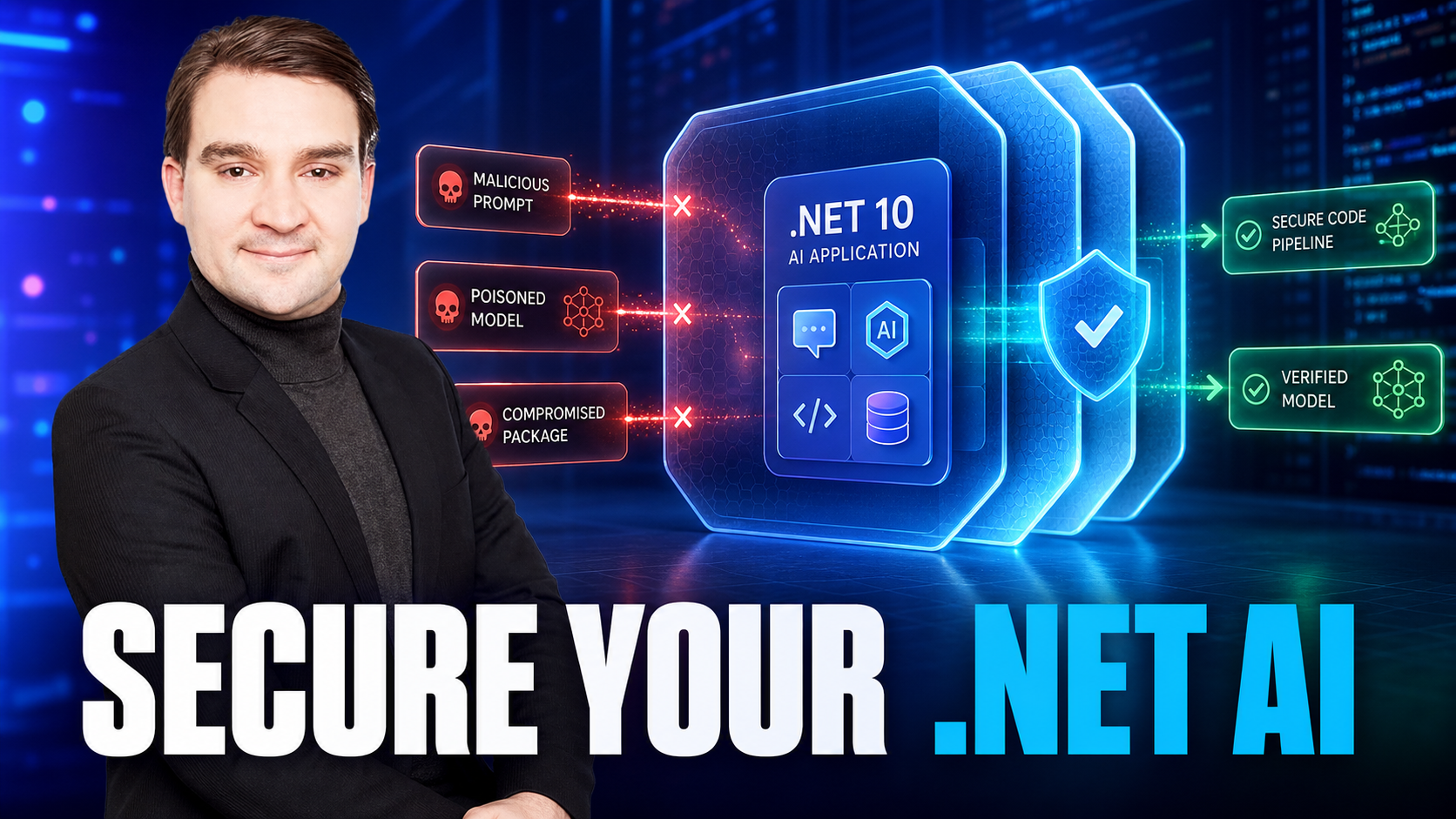
Welcome back to the podcast! Today, we are expanding on a topic that has been dominating our engineering discussions: enterprise security in the age of artificial intelligence. As developers rush to integrate intelligence layers into their architectures, the threat landscape has fundamentally shifted. If you missed our recent deep dive, be sure to check out the episode Build AI Applications with .NET 10. In that conversation, we explored how Microsoft's latest framework brings first-class AI capabilities directly into your workflow. But with great power comes great responsibility—or, more accurately, entirely new attack vectors. In this post, we will unpack how to secure your .NET 10 AI applications against modern threats, ranging from prompt injections to model poisoning and supply-chain vulnerabilities.
Introduction to .NET 10 Security for AI Applications
The introduction of the hidden AI engine in .NET 10 has revolutionized how we build smart applications. Developers can now seamlessly switch between AI providers, inject custom middleware, and leverage built-in OpenTelemetry without wrestling with fragmented external plumbing. However, integrating large language models (LLMs) and autonomous agents directly into our core application logic exposes traditional architectures to novel vulnerabilities. Securing an AI-driven system requires a mindset shift. We are no longer just protecting databases and API endpoints; we are safeguarding probabilistic logic engines that interpret natural language as instructions.
Understanding the Hidden AI Engine and Modern Threats
To secure your application, you first need to understand how the underlying engine operates. The hidden AI engine in .NET 10 acts as a bridge between your business logic and powerful external or local models. Because it handles multimodal inputs, vector searches, and multi-agent orchestration, it opens up expansive surface areas for malicious actors. Traditional cybersecurity frameworks focus on deterministic inputs and outputs. AI applications, by contrast, deal with non-deterministic behavior. When an application can execute dynamic sequences based on unstructured text, a failure in security controls doesn't just mean a crashed server—it can mean a compromised enterprise data store or unauthorized data exfiltration.
Preventing Prompt Injections and Output Tampering
One of the most insidious threats facing modern AI applications is prompt injection. Unlike traditional SQL injections where malicious inputs target database syntax, prompt injections exploit the boundary between data and instructions within an LLM. An attacker can feed malicious text into a customer review, support ticket, or search box that tricks the model into ignoring its system prompt and executing unauthorized commands.
In a .NET 10 environment, you must treat all user inputs entering your AI pipelines as untrusted data. To mitigate prompt injections and output tampering, implement strict input parsing layers before your requests ever reach the semantic kernel or LLM client. Use structured data formats like JSON outputs with strict schema validation to ensure the model's response adheres to expected programmatic boundaries. Never allow raw model output to directly drive system-level execution paths without an intermediate validation check or a human-in-the-loop approval workflow.
Model Poisoning and Supply-Chain Risk Mitigation
The software supply chain has always been vulnerable, but AI introduces a new frontier: model poisoning and compromised upstream dependencies. Whether you are consuming cloud-hosted endpoints via Azure OpenAI or hosting quantized local models using ONNX Runtime, you face the risk of corrupted training data, backdoored weights, or compromised NuGet packages containing malicious AI extensions.
.NET 10 provides robust features to combat these supply-chain risks, including secure, memory-safe model hosting and sandboxing patterns for third-party models. To protect your enterprise:
- Venture only into trusted model registries and officially supported Microsoft AI SDKs.
- Utilize .NET 10's sandboxing patterns to isolate third-party model execution with automated resource limits.
- Hash and verify model weights and datasets prior to deployment.
- Maintain a strict software bill of materials (SBOM) for all AI-related dependencies, including vector database connectors and telemetry packages.
Enforcing Robust Input Validation and Sanitization
Classic security fundamentals remain your strongest ally when building intelligent applications. Cross-Site Scripting (XSS), SQL Injection, and Cross-Site Request Forgery (CSRF) do not disappear simply because you have added an AI chatbot to your ASP.NET Core frontend. In fact, they become more dangerous if the AI engine dynamically generates UI components or executes database queries based on user conversations.
Always enforce rigorous input validation and output sanitization. Ensure that your application utilizes parameterized queries—especially when integrating native vector search features directly into SQL Server or Azure SQL Database. Implement Anti-CSRF tokens, establish custom error pages that prevent the leakage of sensitive stack traces or API keys, and enforce strict SSL/TLS 1.3 transport security to protect data in transit between your .NET 10 application and remote inference endpoints.
Safeguarding Data Integrity and Enterprise Compliance
Enterprise applications must adhere to stringent compliance standards such as GDPR, HIPAA, and SOC 2. When you feed sensitive business data, customer personally identifiable information (PII), or proprietary codebases into AI models, you risk catastrophic data leakage. Furthermore, vector databases and semantic search indexes can inadvertently expose confidential records if proper access control lists (ACLs) are not mirrored within the vector embedding storage layer.
.NET 10's unified telemetry and privacy controls allow you to configure robust data-flow policies. You can audit, mask, or entirely block sensitive data before it gets transmitted to remote inference endpoints. By leveraging Azure AI Foundry and Microsoft Entra for centralized identity management, you ensure that your AI agents only access data sources that the authenticated user has explicit permission to view.
Building Secure AI Workflows with .NET 10
Securing your .NET 10 AI applications is an ongoing journey that requires architectural vigilance, robust input validation, and a commitment to modern security primitives. By treating AI components with the same rigorous threat-modeling standards you apply to traditional microservices, you can harness the incredible productivity gains of the hidden AI engine without compromising enterprise compliance or data integrity.
To recap everything we've covered today and tie it back to our ongoing exploration of modern cloud architectures, make sure you listen to the full discussion over at the podcast episode Build AI Applications with .NET 10. Implement these security best practices early in your development lifecycle, keep your dependencies updated, and continue building smarter, safer applications with .NET 10!

Microsoft MVP | Host of M365.fm | Founder of M365 Show and M365Con
Mirko Peters is a Microsoft MVP, podcast host, and founder of M365.fm, M365 Show, and M365Con. His work connects Microsoft practitioners through podcast interviews, livestreams, and community events.
At M365.fm, Mirko hosts conversations with Microsoft MVPs, product experts, architects, and community contributors. Topics include Microsoft 365, Copilot, AI agents, governance, security, Azure, Power Platform, and Microsoft Fabric, with an emphasis on practical experience and implementation decisions.
M365.fm is the podcast and learning platform. M365 Show brings experts together for livestreams, while M365Con provides an online conference setting for community learning.
Official website: Mirko Peters (https://www.mirkopeters.com/). Recognition: Mirko Peters — Microsoft MVP profile (https://mvp.microsoft.com/de-DE/mvp/profile/9b0ca797-db5a-493a-a845-8b9158046cf5). Connect on LinkedIn (https://www.linkedin.com/in/m365showpodcast/).





