The Death of the Generalist Bot: Why Your Enterprise Copilot Needs Specialization
Welcome back to the podcast blog! If you have been following our recent audio episodes, you know we have been unpacking the massive shifts happening across the enterprise artificial intelligence landscape. Today, we are expanding heavily on a critical conversation we started recently: the fundamental flaws of traditional generalist models and why your enterprise Copilot strategy urgently needs to pivot toward specialization. As organizations push beyond the basic "chat with your data" phase, they are quickly realizing that a single, monolithic model trying to handle everything from complex legal document synthesis to real-time manufacturing supply chain telemetry is a recipe for high costs, low accuracy, and immense operational friction. In this deep-dive post, we will explore the economics of modern AI, the power of domain-specific architectures, how the Mixture of Experts framework changes the game for Microsoft environments, and what all of this means for your governance frameworks. Make sure to check out the related podcast episode, Mixture of Experts for Enterprise Copilot and AI Agents, to hear the live audio breakdown of these exact architectural shifts!
Key Takeaways
- Generalist bots struggle with accuracy and efficiency, leading to poor performance in complex tasks.
- Specialized AI systems outperform generalist models by providing tailored solutions for specific tasks.
- The Mixture of Experts approach enhances AI performance by dynamically allocating tasks to the best-suited models.
- Specialized AI reduces operational costs by automating repetitive tasks and improving resource efficiency.
- User satisfaction increases significantly with specialized AI, leading to better customer experiences and trust.
- Investing in specialized AI can drive business growth and competitiveness in various industries.
- Ethical governance is crucial for AI systems, ensuring accountability and transparency in decision-making.
- Future AI developments will focus on integrating human oversight and emerging technologies for enhanced capabilities.
Death of the Generalist Bot
Generalist Bot Limitations
Inaccuracy in Task Execution
Generalist AI models often struggle with accuracy in task execution. They face challenges that hinder their performance. For instance, they cannot test every model and configuration exhaustively due to the growing pool of models. This limitation leads to difficulties in evaluating their performance across various scenarios. Here are some specific issues:
- Generalist bots often perform poorly in complex reasoning tasks.
- They lack the ability to handle multimodal capabilities, such as clinical image inspection.
- Their performance in conversational settings tends to be inadequate.
In fact, specialized agents consistently outperform generalist models in complex, multi-step tasks. Generalist AI agents achieve only around 15% success rates when limited to 15 steps. Even with more steps, they top out at mid-30% success rates. This stark contrast highlights the need for specialization in AI systems.
High Resource Consumption
Generalist bots also consume significant resources. They require extensive computational power to manage various tasks, leading to inefficiencies. This high resource consumption can strain budgets and limit scalability. Organizations often find themselves overusing premium models for routine tasks, which is not cost-effective.
Economic Impact of AI
Development and Maintenance Expenses
The economic implications of maintaining generalist bots are substantial. Organizations face high development and maintenance expenses. Generalist AI models lack true expertise, which can lead to errors in critical tasks. They struggle with connectivity, essential for gathering necessary inputs. Reliability issues arise when performing repetitive tasks, resulting in mistakes sooner than human operators.
- Continuous operations reduce economic friction and enhance asset utilization.
- Businesses can operate across time zones, increasing competitiveness.
Market Demand for Efficiency
The market increasingly demands efficient, specialized AI solutions. The growth of the vertical AI market is driven by the integration of AI into cloud-based services. This integration provides businesses with scalable and cost-effective solutions. Organizations are utilizing cloud-based AI platforms to access pre-trained models and tools. This approach reduces infrastructure costs and enables rapid deployment across various functions.
The automation of high-cost, repetitive tasks in sectors like healthcare and finance presents a significant opportunity for vertical AI. By automating administrative procedures, these sectors can enhance efficiency and reduce operational costs. This trend indicates a growing demand for specialized AI solutions.
Advantages of Specialized AI
Enhanced Accuracy
Tailored Solutions for Specific Tasks
Specialized AI systems excel in providing tailored solutions for specific tasks. They leverage domain-specific knowledge to enhance performance. For example, in healthcare, models like Medical GPT outperform generalist models such as GPT-4 and Med-PaLM on medical benchmarks. This advantage stems from their ability to understand the nuances of professional decision-making. Here are some areas where specialized AI shines:
- Retail and E-commerce: Tailored AI improves product categorization and enhances customer experience by automating tasks like background removal and logo detection.
- Manufacturing and Supply Chain: Custom AI systems ensure product quality by detecting defects in real-time and maintaining workplace safety through video monitoring.
- Healthcare and Pharmaceuticals: Specialized AI helps in anonymizing patient data and streamlining administrative workflows, ensuring compliance with regulations like HIPAA.
- Hospitality, Travel, and Events: Customized AI models enhance guest experiences by verifying IDs quickly and monitoring sponsorship visibility in real-time.
These tailored solutions lead to measurable outcomes, improving efficiency and reducing errors.
Faster Processing Times
Specialized AI systems also deliver faster processing times. By focusing on specific tasks, these systems can optimize their algorithms for speed and efficiency. This results in quicker responses and more reliable outputs. For instance, a specialized model like MedSAM outperformed a generalist model (SAM) on medical imaging tasks, demonstrating the effectiveness of fine-tuning on domain-specific data.
Improved User Experience
Personalized Interactions
When you use specialized AI systems, you experience more personalized interactions. These systems adapt to your preferences and needs, creating a more engaging experience. For example, AI chatbots designed for customer service can remember past interactions, allowing them to provide tailored responses. This personalization fosters a sense of connection and trust.
Higher Satisfaction Rates
The impact of specialized AI on user satisfaction is significant. Studies show that users report higher satisfaction rates when interacting with specialized systems. The following table summarizes key metrics that highlight this improvement:
| Category | Key Metrics | Relevance |
|---|---|---|
| User Satisfaction | Response quality, usability | Enhances user experience, fosters adoption |
| User Trust | Repeat usage rates | Indicates confidence in AI responses |
Moreover, statistics reveal that 84% of users see AI chatbots improving their digital journeys. In retail, 63% of retailers report enhanced customer interactions due to AI. Financial institutions also note a 46% improvement in customer experience, while communications service providers report a remarkable 97% positive impact on customer satisfaction.
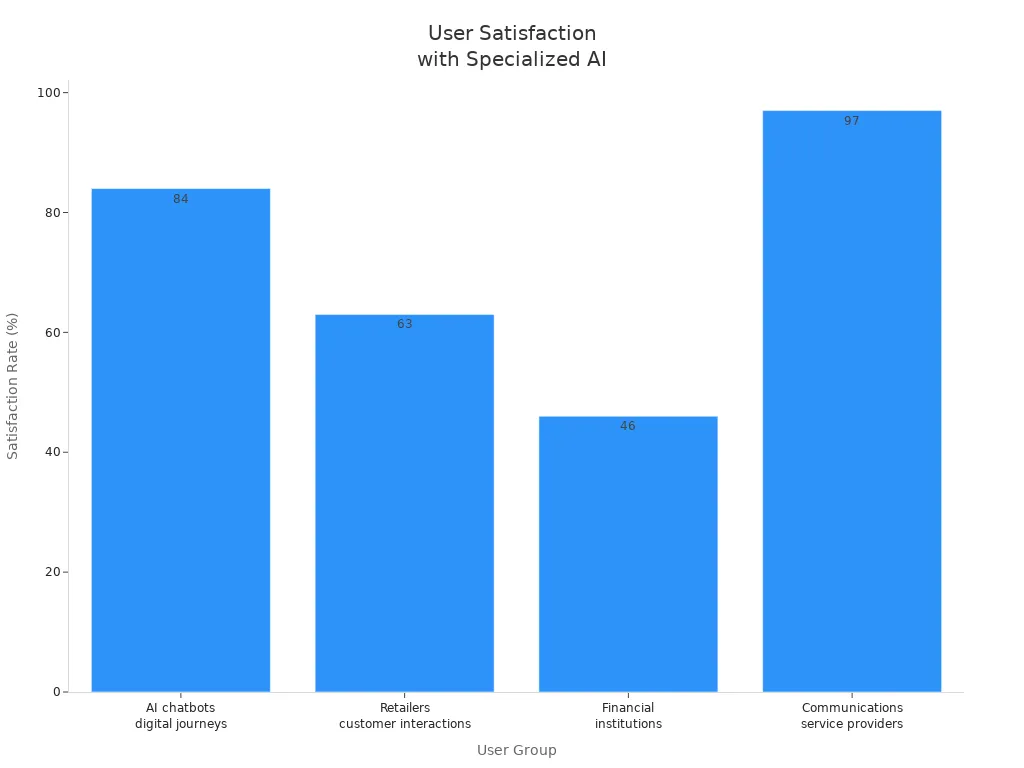
By adopting specialized AI systems, you can expect not only enhanced accuracy but also a significantly improved user experience.
Mixture of Experts Approach
The Mixture of Experts (MoE) approach represents a significant advancement in AI. This system allows specialized AI services to collaborate, selecting specific models tailored to the task at hand. Unlike traditional multi-model strategies that often rely on a single generalist model, MoE enhances performance by leveraging the strengths of multiple experts.
Definition and Functionality
Dynamic Task Allocation
Dynamic task allocation is a core feature of the MoE approach. This functionality enables the system to assign tasks to the most suitable expert model based on the specific requirements of the task. By doing so, MoE minimizes task interference and maximizes efficiency.
Here’s a table that illustrates the effectiveness of dynamic task allocation in various applications:
| Application | Evidence |
|---|---|
| Natural Language Generation (NLG) | MoE enhances model specialization and reduces task interference, leading to more powerful NLG systems. |
| Machine Translation | Dynamic task allocation improves translation accuracy and fluency, especially in complex scenarios. |
| Multimodal Fusion | MoE allows for effective integration of information from different sources, enhancing flexibility and scalability. |
| Multi-task Learning | MT-TaG shows superior performance in low-resource task transfer and efficient generalization. |
Intelligent Routing
Intelligent routing further enhances the MoE approach. This functionality directs tasks to the appropriate expert model, ensuring that each task receives the best possible attention. By implementing intelligent routing, organizations can optimize their AI systems for better performance and cost-effectiveness.
Real-World Applications
The MoE approach finds applications across various industries, showcasing its versatility and effectiveness. Here are some common areas where you can see the impact of this innovative strategy:
- Computer Vision
- Speech Recognition
- Healthcare
- Autonomous Systems
These applications demonstrate how the MoE approach can address complex challenges in different fields. For instance, in healthcare, specialized models can analyze medical images more accurately than generalist models, leading to better patient outcomes.
Success Stories of Mixture of Experts
Several organizations have successfully implemented the MoE approach, reaping significant benefits. For example, a leading tech company utilized MoE to enhance its natural language processing capabilities. By deploying specialized models for different language tasks, they achieved a notable increase in accuracy and user satisfaction.
In another instance, a healthcare provider adopted the MoE strategy to streamline patient data processing. This implementation not only improved efficiency but also ensured compliance with regulatory standards.
The Mixture of Experts approach represents a promising direction for AI development. By combining the strengths of multiple models, you can achieve better performance, lower costs, and enhanced governance in your AI systems.
Governance in Multi-Agent Systems
Governance plays a crucial role in the development and deployment of specialized AI systems. As you engage with multi-agent systems, you must consider the ethical implications and regulatory frameworks that guide their operation. These systems, which consist of multiple specialized agents, require robust governance to ensure accountability and transparency.
Ethical Considerations
Accountability in AI Decisions
Accountability in AI decisions becomes complex when multiple agents are involved. You need to establish clear frameworks that help stakeholders understand who is responsible for the actions of these agents. This clarity promotes cooperation and mitigates conflicts among diverse ethical values. Here are some key aspects to consider:
- Continuous monitoring with real-time ethical dashboards and automated alerts.
- Regular stakeholder feedback and comprehensive ethical audits.
- Incident response procedures for structured detection and remediation.
Transparency in Operations
Transparency is essential for building trust in AI systems. You should ensure that decision-making processes are clear and understandable. This involves maintaining records that allow you to trace decisions across interconnected systems. Here are some recommended transparency standards:
- Explainability: Provide clear reasons behind AI decisions using user-friendly language.
- Interpretability: Enable analysis of how input data leads to specific outputs.
- Traceability: Keep documentation to track the development and operation of AI systems.
Multi-agent systems must handle ethical considerations through design principles and oversight mechanisms. Developers should embed explicit rules and ethical reasoning modules to ensure agents align with human values. This approach addresses challenges like fairness and accountability.
Regulatory Frameworks
Guidelines for Specialized AI
You can follow several guidelines to ensure the ethical use of specialized AI across various industries. These guidelines help you navigate the complexities of AI deployment:
- Document potential dual-use applications and consult with funding entities for guidance.
- Disclose AI's role in research and assess bias in training data.
- Retain responsibility for AI-assisted methods and verify results.
Future of AI Governance
The future of AI governance will likely involve evolving regulatory frameworks. Different regions are already establishing guidelines to manage AI risks effectively. The table below summarizes some key regulatory frameworks:
| Region | Regulatory Frameworks | Key Features |
|---|---|---|
| European Union | EU AI Act | Risk categorization, human oversight, data governance, cybersecurity for high-risk systems. |
| OECD | OECD AI Principles | Promotes fairness, security, human rights; not legally binding but influential in shaping policies. |
| UNESCO | UNESCO AI Ethics Framework | Ethical guidelines focusing on human rights, privacy, fairness, and sustainability. |
| United States | NIST AI Risk Management Framework | Voluntary framework for managing AI risks, emphasizing trustworthiness, safety, and fairness. |
As you navigate the landscape of specialized AI, understanding these frameworks will help you ensure responsible and ethical practices.
Future Trends in AI
Evolution of AI Models
Integration of Human Oversight
As AI continues to evolve, integrating human oversight becomes crucial. You need to ensure that AI systems align with societal values. Humans possess a moral compass that guides AI decisions. They can define ethical guidelines and review AI outputs to avoid biases and discrimination. Here are some key benefits of human oversight:
- It ensures transparency, fairness, and justifiability of AI systems.
- Humans can identify and rectify errors or biases in AI operations.
- They adapt to new circumstances and leverage contextual knowledge.
This integration fosters trust in AI systems, allowing you to feel more confident in their recommendations.
Emerging Technologies
Several emerging technologies will influence the development of specialized AI. These advancements will shape how you interact with AI in your daily life. Consider the following technologies:
- Agentic Commerce: AI-driven buying experiences where agents act autonomously on behalf of consumers and businesses.
- AI Security and Trust Technologies: Controls that ensure AI systems are secure and trustworthy.
- Quantum Computing: Technologies that leverage quantum physics for complex problem-solving.
These innovations will enhance the capabilities of AI, making it more accessible and effective in various applications.
Predictions for AI Development
Long-Term Impacts on Society
Experts predict that specialized AI will significantly impact society in the long run. Here are some anticipated changes:
- Healthcare: AI advancements could lead to longer lifespans, improved quality of life, and better preventative care.
- Education: Generative AI may disrupt traditional teaching methods, necessitating a renaissance in educational practices.
- Labor: You can expect significant changes in job roles and processes, with increased interaction with AI systems becoming commonplace.
These shifts will require you to adapt to new realities in your personal and professional life.
Future Innovations
The future of AI holds exciting innovations. A recent table outlines predictions for the evolution of AI models over the next decade:
| Prediction | Description |
|---|---|
| Accessibility | Auto-ML platforms will become more user-friendly, enabling quick creation of high-performing AI models without specialized expertise. |
| Integration | AI will be integrated into personal and professional spheres, allowing non-experts to utilize AI for various tasks. |
| Decision-making | AI systems will act as strategic partners, providing tailored recommendations for business decisions. |
| Quantum AI | Quantum computing may enable AI to solve previously unsolvable problems, enhancing capabilities significantly. |
| Hardware Innovation | Focus will shift to improving hardware or developing new architectures to support massive AI models. |
These predictions highlight the dynamic nature of AI technology and its potential to transform your world.
The shift from generalist bots to specialized AI systems marks a significant evolution in technology. You now see that generalist models often lead to hidden costs, inconsistent quality, and governance challenges. In contrast, specialized AI systems handle specific tasks more effectively, improving operational efficiency.
As you embrace this change, consider the benefits for both businesses and consumers. Specialized AI enhances customer experiences through personalized interactions and automates repetitive tasks, leading to increased efficiency. The global AI market's growth reflects this trend, indicating a strong future for specialized solutions.
By adopting specialized AI, you can expect better service delivery and operational effectiveness.
FAQ
What are generalist bots?
Generalist bots are AI systems designed to handle a wide range of tasks. They often struggle with accuracy and efficiency, leading to limitations in performance across various applications.
Why are specialized AI systems better?
Specialized AI systems focus on specific tasks, enhancing accuracy and efficiency. They provide tailored solutions, leading to improved user experiences and faster processing times.
How does the Mixture of Experts approach work?
The Mixture of Experts approach uses multiple specialized AI models. It dynamically allocates tasks to the most suitable expert, optimizing performance and resource usage.
What industries benefit from specialized AI?
Industries such as healthcare, finance, retail, and manufacturing benefit significantly from specialized AI. These systems enhance operational efficiency and improve customer interactions.
How can I implement specialized AI in my organization?
To implement specialized AI, assess your organization's needs. Identify tasks suitable for automation and explore AI solutions tailored to those specific functions.
What are the ethical considerations in AI governance?
Ethical considerations in AI governance include accountability, transparency, and fairness. Organizations must establish clear guidelines to ensure responsible AI deployment and decision-making.
How will AI evolve in the future?
AI will evolve through advancements in technology, such as quantum computing and human oversight integration. These changes will enhance capabilities and improve user interactions.
What is the impact of AI on job roles?
AI will transform job roles by automating repetitive tasks and enhancing decision-making processes. Workers will need to adapt to new technologies and collaborate with AI systems.
🎧 Listen to this episode
Want a practical explanation of Mixture of Experts for Enterprise Copilot and AI Agents? This episode breaks down the topic in clear language and shows why it matters for Microsoft 365, Azure, Power Platform, security, AI, and modern work.
Listen to this episode if you want to:
- Understand the key concepts behind Mixture of Experts for Enterprise Copilot and AI Agents
- See how it fits into the wider Microsoft technology ecosystem
- Learn where it can create practical value for your organization
You may also enjoy these related M365 FM episodes:
- From Data to Intelligent Agents: Building Trusted Enterprise AI with Microsoft AI Foundry with Shubhangi Goyal [MVP]
- Microsoft 365 Copilot Agents: Real Business Value with Steve Corey [MVP]
- Graph-Powered AI Agents: An Enterprise Architecture Guide
- Agentic Operating Model for Enterprise AI and Copilot
- Copilot Studio AI Agents and RAG with Nilüfer Doğan [MVP]
Discover more practical Microsoft conversations on M365 FM.
Last reviewed: July 2026.
Who Should Listen
This episode is for Microsoft administrators, architects, developers, security professionals, and business leaders who need a practical foundation before making implementation, operations, or governance decisions.
🎧 You Should Also Listen To
- AI Agents — A strongly related next step for extending this topic.
- Power Platform — A strongly related next step for extending this topic.
- Microsoft Graph Data Connect — A strongly related next step for extending this topic.

Microsoft MVP | Host of M365.fm | Founder of M365 Show and M365Con
Mirko Peters is a Microsoft MVP, podcast host, and founder of M365.fm, M365 Show, and M365Con. His work connects Microsoft practitioners through podcast interviews, livestreams, and community events.
At M365.fm, Mirko hosts conversations with Microsoft MVPs, product experts, architects, and community contributors. Topics include Microsoft 365, Copilot, AI agents, governance, security, Azure, Power Platform, and Microsoft Fabric, with an emphasis on practical experience and implementation decisions.
M365.fm is the podcast and learning platform. M365 Show brings experts together for livestreams, while M365Con provides an online conference setting for community learning.
Official website: Mirko Peters (https://www.mirkopeters.com/). Recognition: Mirko Peters — Microsoft MVP profile (https://mvp.microsoft.com/de-DE/mvp/profile/9b0ca797-db5a-493a-a845-8b9158046cf5). Connect on LinkedIn (https://www.linkedin.com/in/m365showpodcast/).