The Hidden Danger of Shadow Accounts in Microsoft 365 Automation
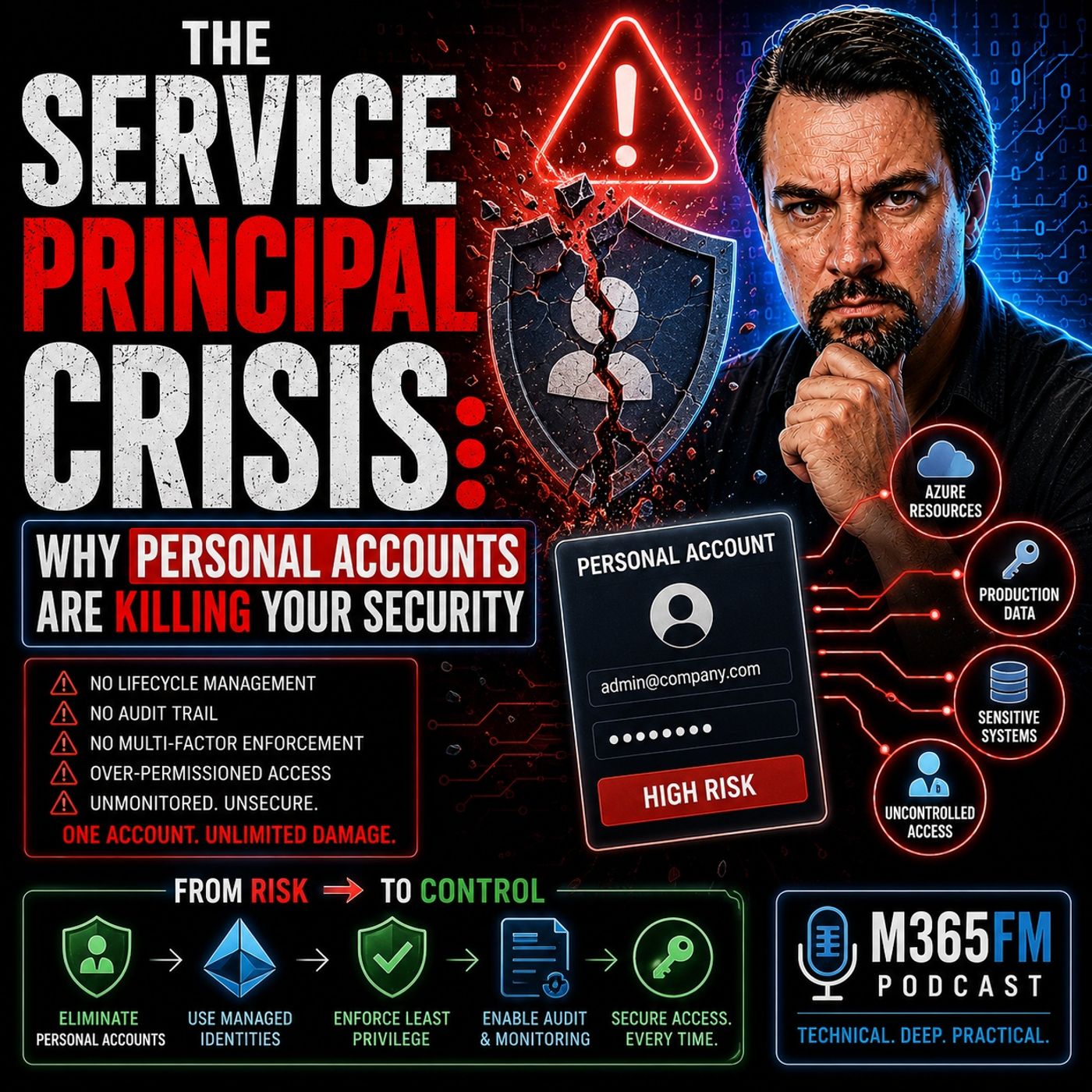
Welcome back to another deep dive into the architecture, security, and administrative realities of the Microsoft 365 ecosystem. If you manage cloud infrastructure, build workflows, or oversee enterprise IT, we need to talk about a ticking time bomb hiding in plain sight. In our recent episode, Service Principal Security: Stop Using Personal Accounts, we exposed a practice so common that almost every organization is guilty of it: tying mission-critical enterprise automation directly to human user accounts. It starts as an innocent shortcut. An engineer needs to spin up a Power Automate flow, connect a Logic App, synchronize data through an API, or configure a Power BI data refresh. To save time, they authenticate the connection using their own administrative credentials. It works instantly, the project launches without a hitch, and everyone moves on. But what happens when that engineer changes teams, resets their password, triggers a new Conditional Access policy, or leaves the company entirely? The automation breaks, silence falls across production, and the organization discovers it has been running core business logic on borrowed identity. This blog post expands on those concepts, detailing why shadow accounts are destroying your infrastructure resilience and how you can modernize your approach before platform changes force your hand.
When we discuss cloud architecture, we often talk about redundancy, failover clusters, and disaster recovery. Yet, many organizations completely overlook identity resilience. When an enterprise builds workflows on top of human credentials, it introduces a fragile web of dependencies that inevitably leads to unexpected outages. Let us unpack the core mechanics of this crisis and explore how to transition to a truly enterprise-grade identity model.
The digital workspace is evolving faster than ever, and standardizing how non-human workloads authenticate is no longer an optional best practice. It is a mandatory step for survival in modern cloud environments.
The Shadow Account Trap in Microsoft 365 Automation
Most identity problems in enterprise automation begin with the pursuit of speed. When developers or administrators build quick integrations within Microsoft 365, using an existing user account feels frictionless. The permissions are already established, the authentication prompts are familiar, and deployment takes minutes instead of hours. However, this convenience creates the Shadow Account Model. Personal accounts act as hidden infrastructure identities, embedding human vulnerabilities into automated systems.
Consider the modern security landscape. Organizations implement strict Multi-Factor Authentication (MFA) policies, risk-based sign-in blocks, and regular password rotation schedules to protect human users. These security measures are entirely necessary for human workers, but they are catastrophic for headless automation. When a script or a cloud flow relies on a personal account, any routine security intervention—such as an MFA prompt, a forced password reset, or a suspicious sign-in challenge—will immediately halt the automation. The workflow does not fail because of a code bug; it fails because a human being was forced to change their password.
Furthermore, offboarding becomes an administrative nightmare. When an employee departs the organization, their account is eventually disabled or deleted. If that account was secretly powering critical SharePoint integrations, automated reporting pipelines, or customer notification workflows, those systems will collapse. Often, IT teams discover these broken dependencies only after business operations have already been disrupted. Treating human accounts as infrastructure identities is an architectural anti-pattern that introduces unacceptable operational risk.
Identity Rot and the Hidden Cost of Human Dependencies
Identity rot is a silent killer in enterprise IT. It occurs when the assumptions underlying an authentication mechanism slowly degrade over time until the system unexpectedly fails. When workflows are tethered to human accounts, identity rot manifests in several destructive ways. Roles change, departments merge, and permissions drift. An account that once had appropriate access to a specific site or database may suddenly find its privileges altered due to a compliance audit or a role transition.
When an automated workflow depends on that specific user context, any adjustment to the user's access rights breaks the automation chain. This creates a culture of fear where IT administrators are afraid to modify user accounts, update security profiles, or offboard former employees cleanly because they suspect something invisible might break. Service accounts operating as unsecured ghost users are another symptom of this rot. Organizations often create generic user accounts—such as scriptrunner@company.com—assign them permanent passwords, bypass MFA, and use them across dozens of scripts. These ghost accounts rarely have proper auditing, lack modern security controls, and represent massive compliance violations waiting to be exposed during an audit.
By relying on human dependencies, organizations sacrifice visibility, auditability, and control. Modern cloud architecture demands that every workload stand on its own architectural merits, completely independent of the people who originally built or deployed it.
Why Microsoft Is Forcing the Shift Away from User-Based Workflows
If the operational risks of shadow accounts were not enough to convince organizations to change, the platform roadmap certainly will. Microsoft is aggressively closing the door on legacy authentication patterns and user-based automation. As we navigate toward the 2026 identity model, the era of service-principal-less automation is coming to an end. Legacy SharePoint 2013 workflows are being retired, Azure AD Graph is being fully deprecated, and app-only modern authentication is becoming a strict requirement across the ecosystem.
The platform-level message from Microsoft is unambiguous: automation must have its own identity. For years, the old architectural model asked a fundamentally flawed question: "Which person is running this automation?" Modern cloud governance replaces that question with a much more secure inquiry: "Which specific workload is authorized to perform this action?" This shift changes everything about how we design, deploy, and govern cloud solutions.
Failing to adapt to this shift means fighting the natural trajectory of the platform. Organizations that continue to cling to user-based automation will find themselves facing sudden, cascading failures as Microsoft deprecates legacy APIs and enforces strict modern authentication standards. Transitioning to workload identities is not just a security upgrade; it is an alignment with the future direction of enterprise software.
Treating Identity as Infrastructure with Service Principals
To eliminate shadow accounts, organizations must adopt a new mindset: identity is infrastructure. Just as we treat virtual machines, storage accounts, and networking components as discrete infrastructure assets, we must treat application and workload identities with the exact same rigor. This brings us to Service Principals.
A Service Principal functions as a non-interactive runtime identity that represents a workload or application rather than a human employee. By implementing the Decoupling Principle in enterprise security, organizations ensure that applications have independent identity boundaries. If an employee leaves the company, resets their password, or updates their MFA device, the Service Principal remains completely unaffected because its lifecycle is entirely divorced from human activity.
Treating identity as a deployment artifact means that when you deploy a Logic App, a Function App, or an enterprise integration, its associated Service Principal is provisioned, permissioned, and managed as code. This infrastructure-native approach dramatically improves resilience, ensures clean auditing trails, and eliminates the fragile human dependencies that cause silent outages.
Managed Identities and the Power of Zero-Secret Authentication
While Service Principals solve the human dependency problem, they historically introduced a new challenge: managing secrets. Storing client secrets, certificates, or passwords inside configuration files, environment variables, or key vaults still left organizations vulnerable to secret sprawl and credential leakage. Fortunately, cloud architecture has evolved past static credentials through the introduction of Managed Identities.
Managed Identities represent the pinnacle of cloud-native identity architecture because Azure manages the entire credential lifecycle automatically. The platform handles credential generation, rotation, storage, expiration, and trust enforcement behind the scenes. Developers and administrators never have to handle, view, or rotate the underlying credentials.
This achieves Zero-Secret authentication. By eliminating static client secrets and passwords entirely, organizations remove one of the most common attack vectors exploited by malicious actors. When identity is tied directly to the resource lifecycle through Azure, trust is established natively at the platform level. Workloads authenticate securely using short-lived, platform-issued tokens, drastically reducing breach risk and operational overhead.
Eliminating Static Secrets with Federated Credentials
While Managed Identities are ideal for workloads running natively within Azure, many enterprise automation pipelines rely on external CI/CD systems, multi-cloud environments, or developer tools like GitHub Actions. In these scenarios, traditional workflows often resort to generating long-lived client secrets and storing them in external repositories—a practice that creates massive security vulnerabilities.
Enter Federated Credentials and OpenID Connect (OIDC). Federated identity allows external workloads to establish a temporary, trust-based relationship with Microsoft Entra ID without requiring any stored credentials at rest. Instead of using a permanent password, the external pipeline requests a token directly from its native provider, presents that cryptographically signed token to Entra ID, and receives a short-lived access token in return.
This ephemeral identity model ensures that no reusable credential exists on disk or in configuration settings. If an external repository is compromised, attackers find no static secrets to harvest. Federated credentials bridge the gap between multi-cloud operations and enterprise security, proving that high-speed automation and robust protection can coexist harmoniously.
Mitigating the Permission Creep Crisis in Modern Cloud Architecture
As organizations successfully transition to Service Principals, Managed Identities, and Federated Credentials, a new architectural risk emerges: permission creep. A resilient, highly functional identity equipped with excessive permissions becomes a dangerous weapon if compromised. Too often, engineers assign overly broad Graph API scopes—such as `Application.ReadWrite.All` or `Directory.ReadWrite.All`—simply to eliminate deployment friction and avoid troubleshooting permission errors during initial setup.
The result is a landscape filled with overprivileged Service Principals operating silently across the tenant. Attackers actively scan for machine identities because compromising a poorly secured, highly privileged Service Principal grants persistent, stealthy access to the entire environment. Machine tokens often move faster and attract less suspicion than human sign-ins, making them prime targets for lateral movement and data exfiltration.
Mitigating this crisis requires strict adherence to the Principle of Least Privilege. Service Principals must be granted only the specific, granular application permissions required to perform their designated tasks. They must be audited regularly, monitored for anomalous behavior, and treated with the exact same caution as root access on physical production infrastructure. By combining proper workload identity architecture with disciplined permission governance, organizations can build automation that is both highly resilient and exceptionally secure.
Conclusion
The era of building enterprise automation on top of personal user accounts is officially coming to a close. As we have explored throughout this article, tying critical Microsoft 365 workflows to human credentials introduces fragile infrastructure, severe security gaps, and the inevitable pain of identity rot. Between Microsoft's aggressive deprecation of legacy authentication models and the ever-present threat of operational outages caused by offboarded employees, maintaining the status quo is no longer an option. By embracing Service Principals, leveraging Managed Identities for zero-secret authentication, utilizing federated credentials, and strictly managing permissions, organizations can transform their automation pipelines into secure, resilient, enterprise-grade assets.
If you want to take a deeper dive into these concepts and hear real-world strategies for securing your automation environments, make sure to listen to our dedicated episode on Service Principal Security: Stop Using Personal Accounts. It is packed with practical insights that will help you audit your current architecture, eliminate shadow accounts, and future-proof your Microsoft 365 tenant against the looming identity crisis.

Microsoft MVP | Host of M365.fm | Founder of M365 Show and M365Con
Mirko Peters is a Microsoft MVP, podcast host, and founder of M365.fm, M365 Show, and M365Con. His work connects Microsoft practitioners through podcast interviews, livestreams, and community events.
At M365.fm, Mirko hosts conversations with Microsoft MVPs, product experts, architects, and community contributors. Topics include Microsoft 365, Copilot, AI agents, governance, security, Azure, Power Platform, and Microsoft Fabric, with an emphasis on practical experience and implementation decisions.
M365.fm is the podcast and learning platform. M365 Show brings experts together for livestreams, while M365Con provides an online conference setting for community learning.
Official website: Mirko Peters (https://www.mirkopeters.com/). Recognition: Mirko Peters — Microsoft MVP profile (https://mvp.microsoft.com/de-DE/mvp/profile/9b0ca797-db5a-493a-a845-8b9158046cf5). Connect on LinkedIn (https://www.linkedin.com/in/m365showpodcast/).