

Copilot for Dynamics 365 Finance and Operations - Simply Explained

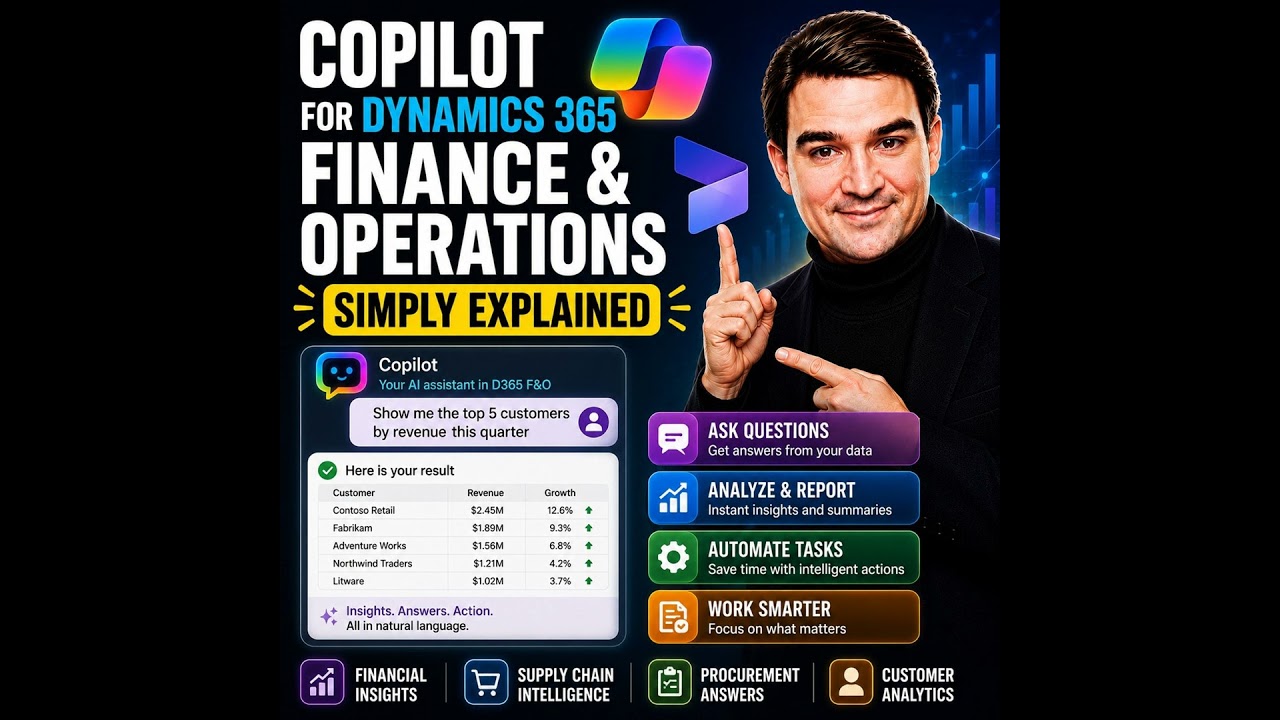


Finance teams have never struggled with a lack of data—they struggle with the time it takes to find, organize, analyze, and act on that information. Traditional ERP workflows often require switching between customer records, reports, Excel spreadsheets, Outlook, and multiple ERP screens before a single decision can be made. Copilot for Dynamics 365 Finance & Operations changes that experience. Instead of searching for information manually, Copilot brings insights directly into your workflow, helping finance professionals summarize customer accounts, draft emails, analyze financial performance, forecast cash flow, and automate repetitive tasks without leaving the applications they already use.
SOLVING THE DAILY FINANCE WORKFLOW
Most finance professionals spend more time gathering information than analyzing it. Whether it's reviewing overdue invoices, preparing month-end reports, reconciling accounts, or responding to customer payment inquiries, much of the work involves navigating multiple screens and manually assembling information. Copilot reduces this friction by presenting relevant data, recommendations, and AI-generated summaries directly inside Dynamics 365 Finance & Operations, Outlook, Excel, and Microsoft Teams.
COLLECTIONS AND ACCOUNTS RECEIVABLE
One of Copilot's most valuable capabilities is improving collections management. Within the Collections Coordinator workspace, Copilot automatically summarizes overdue invoices, outstanding balances, payment history, disputes, and customer risk. Instead of reviewing multiple screens, collectors receive a complete overview the moment they open a customer record. Copilot can also draft personalized collection emails based on customer history and communication preferences. Through the Copilot for Finance Outlook add-in, finance teams can access customer information, generate responses, and synchronize activities back into Dynamics 365 without leaving their inbox.
MONTH-END CLOSE AND FINANCIAL REPORTING
Financial close remains one of the busiest periods for every finance department. Copilot assists before, during, and after month-end by identifying missing transactions, suggesting journal entries, highlighting reconciliation issues, and automatically explaining financial variances. Instead of manually investigating why operating expenses increased, finance professionals can simply ask Copilot for a variance explanation and receive a natural-language summary highlighting the biggest contributors. Rather than replacing financial expertise, Copilot removes much of the repetitive investigation work, allowing accountants to focus on analysis and decision-making.
CASH FLOW FORECASTING
Cash flow forecasting traditionally depends on spreadsheets, manual assumptions, and historical analysis. Copilot continuously analyzes open transactions, payment behavior, seasonal trends, and historical patterns to generate more dynamic cash flow forecasts. It can identify payment delays, unusual spending patterns, and potential cash flow risks while allowing finance teams to model different business scenarios before making important financial decisions.
EXPENSE MANAGEMENT AND ACCOUNTS PAYABLE
Copilot also streamlines expense processing and accounts payable. Using Optical Character Recognition (OCR), receipts are automatically scanned, key information extracted, and expense reports prepared with minimal manual input. Company policies are checked automatically, helping identify potential compliance issues before submission. For vendor invoices, Copilot assists with invoice processing, general ledger suggestions, purchase order updates, and approval workflows, reducing manual data entry while minimizing errors.
GETTING STARTED
Organizations need several prerequisites before using Copilot. Dynamics 365 Finance & Operations should be running version 10.0.38 or later. Power Platform and Dataverse integration must be enabled, supported Copilot features activated through Feature Management, and Microsoft 365 Copilot licensing assigned alongside the existing Dynamics 365 licenses. Because Copilot is cloud-based, on-premises deployments are not supported.
DRIVING USER ADOPTION
Technology alone doesn't guarantee success. Organizations that achieve the highest adoption typically begin with targeted pilot projects focused on high-value processes such as collections, month-end close, or expense management. Training users around real business scenarios rather than individual product features helps finance teams quickly understand where Copilot delivers measurable value. Successful adoption depends on improving existing business processes first and then using Copilot to accelerate those workflows rather than expecting AI to fix inefficient processes automatically.
WHY COPILOT FOR D365 F&O MATTERS
Copilot transforms Dynamics 365 Finance & Operations from a traditional ERP into an intelligent finance workspace. Instead of replacing accountants, controllers, or finance managers, it automates repetitive work such as data gathering, summarization, drafting communications, and preparing reports. This allows finance professionals to spend more time interpreting financial results, improving customer relationships, managing cash flow, and making strategic business decisions. Ultimately, Copilot helps finance teams shift from asking "What happened?" to focusing on the more valuable question: "What should we do next?"
Become a supporter of this podcast: https://www.spreaker.com/podcast/m365-fm-modern-work-security-and-productivity-with-microsoft-365--6704921/support.
🚀 Want to be part of m365.fm?
Then stop just listening… and start showing up.
👉 Connect with me on LinkedIn and let’s make something happen:
- 🎙️ Be a podcast guest and share your story
- 🎧 Host your own episode (yes, seriously)
- 💡 Pitch topics the community actually wants to hear
- 🌍 Build your personal brand in the Microsoft 365 space
This isn’t just a podcast — it’s a platform for people who take action.
🔥 Most people wait. The best ones don’t.
👉 Connect with me on LinkedIn and send me a message:
"I want in"
Let’s build something awesome 👊
00:00:00,000 --> 00:00:04,360
Welcome to another episode of Microsoft Knowledge Nuggets here on M365, FM, I'm your host,
2
00:00:04,360 --> 00:00:05,360
Mirko Peters.
3
00:00:05,360 --> 00:00:08,520
Today's topic is one you've definitely heard about if you work in finance, co-pilot
4
00:00:08,520 --> 00:00:11,040
for Dynamics 365 Finance and Operations.
5
00:00:11,040 --> 00:00:14,760
But here's the thing, most people here co-pilot and picture a chatbot that answers questions
6
00:00:14,760 --> 00:00:18,680
or maybe writes an email, but what does it actually do for a finance team on a Tuesday
7
00:00:18,680 --> 00:00:19,680
morning?
8
00:00:19,680 --> 00:00:21,480
That's what we're clearing up today in plain English.
9
00:00:21,480 --> 00:00:23,400
This isn't a robot that replaces your accountant.
10
00:00:23,400 --> 00:00:27,760
It's a helper that lives inside the tools you already use, your ERP, your email, your
11
00:00:27,760 --> 00:00:28,760
spreadsheets.
12
00:00:28,760 --> 00:00:33,200
At the end of this episode, you'll know exactly what co-pilot does in D365 F&O, where it
13
00:00:33,200 --> 00:00:35,320
works best, and what it really delivers.
14
00:00:35,320 --> 00:00:38,400
We'll walk through the main use cases starting with the one that brings the most immediate
15
00:00:38,400 --> 00:00:40,960
value, so grab your coffee and let's dive in.
16
00:00:40,960 --> 00:00:42,960
The problem co-pilot solves.
17
00:00:42,960 --> 00:00:47,640
20 years ago, if you worked in finance, you're daimant logging into the ERP, exporting data
18
00:00:47,640 --> 00:00:52,480
to Excel, manipulating it, writing commentary, sending emails and repeating that cycle every
19
00:00:52,480 --> 00:00:53,480
month.
20
00:00:53,480 --> 00:00:54,480
The data was there.
21
00:00:54,480 --> 00:00:57,440
You just spent most of your time chasing it down and moving it around.
22
00:00:57,440 --> 00:00:59,680
That's the real problem co-pilot solves.
23
00:00:59,680 --> 00:01:01,440
Finance teams don't lack information.
24
00:01:01,440 --> 00:01:02,440
They have plenty.
25
00:01:02,440 --> 00:01:04,840
The friction is in how you access it and act on it.
26
00:01:04,840 --> 00:01:08,920
You'd open a customer record, then a screen for aging, then another for payment history,
27
00:01:08,920 --> 00:01:11,000
then switch to Outlook to draft an email.
28
00:01:11,000 --> 00:01:12,560
Every step costs time.
29
00:01:12,560 --> 00:01:13,880
Co-pilot flips that model.
30
00:01:13,880 --> 00:01:17,680
Instead of you going to the data, the data comes to you inside your workflow, one screen,
31
00:01:17,680 --> 00:01:18,680
one conversation.
32
00:01:18,680 --> 00:01:20,600
So what are the actual things it can do?
33
00:01:20,600 --> 00:01:22,480
Let's start with the biggest one.
34
00:01:22,480 --> 00:01:23,960
Co-pilot for collections and AR.
35
00:01:23,960 --> 00:01:26,040
So here's another knowledge nugget for you.
36
00:01:26,040 --> 00:01:29,680
This is the main use case for co-pilot in D365 F&O.
37
00:01:29,680 --> 00:01:33,360
It gets the most attention because it gives you the fastest return on your time.
38
00:01:33,360 --> 00:01:34,360
Let me explain how.
39
00:01:34,360 --> 00:01:39,080
Inside D365, F&O, there's a workspace called the Collections Coordinator Summary.
40
00:01:39,080 --> 00:01:44,160
When you open a customer record, co-pilot generates a summary of everything you need to know.
41
00:01:44,160 --> 00:01:48,800
Overdue invoices, payment history, aged balances, risk exposure, all in one place.
42
00:01:48,800 --> 00:01:50,400
Let me walk you through a real example.
43
00:01:50,400 --> 00:01:54,120
Say you're a collector and you open a customer named Contoso-Luted.
44
00:01:54,120 --> 00:01:55,920
Co-pilot immediately tells you.
45
00:01:55,920 --> 00:01:59,640
This customer has three overdue invoices totaling $12,000.
46
00:01:59,640 --> 00:02:04,400
Their last payment was 45 days ago and they have a dispute on invoice FT9.
47
00:02:04,400 --> 00:02:08,080
Back in the old days, you'd spend 5 to 10 minutes hunting for that information across different
48
00:02:08,080 --> 00:02:09,080
screens.
49
00:02:09,080 --> 00:02:11,640
Now it's there in seconds, but summaries are just the beginning.
50
00:02:11,640 --> 00:02:15,520
Co-pilot can also draft personalized reminder emails based on that customer's history and
51
00:02:15,520 --> 00:02:16,520
tone preferences.
52
00:02:16,520 --> 00:02:18,840
You review the email, click Send and move on.
53
00:02:18,840 --> 00:02:20,160
That's a two-click workflow.
54
00:02:20,160 --> 00:02:21,760
View the summary, create the email.
55
00:02:21,760 --> 00:02:24,120
A 30-minute task becomes 30 seconds.
56
00:02:24,120 --> 00:02:25,640
And here's what makes it even better.
57
00:02:25,640 --> 00:02:30,760
This works inside D365FNO and from outlook through the Co-pilot for Finance add-in.
58
00:02:30,760 --> 00:02:34,760
So if a customer emails you directly, you can pull up their account info, see their outstanding
59
00:02:34,760 --> 00:02:38,280
balance and draft a response without ever leaving your inbox.
60
00:02:38,280 --> 00:02:41,480
The collection activity gets synced back to FNO automatically.
61
00:02:41,480 --> 00:02:42,480
Collections is the big one.
62
00:02:42,480 --> 00:02:46,680
But there's another area where Co-pilot saves even more hidden time.
63
00:02:46,680 --> 00:02:50,080
Co-pilot for financial close and reporting, month and close.
64
00:02:50,080 --> 00:02:52,000
Every finance team knows this rhythm.
65
00:02:52,000 --> 00:02:54,560
Reconcile, adjust, validate, report, repeat.
66
00:02:54,560 --> 00:02:58,440
It's the same dance every single month and it eats up days of focused work.
67
00:02:58,440 --> 00:03:01,040
Co-pilot can help at every stage of that close life cycle.
68
00:03:01,040 --> 00:03:02,040
So let's walk through it.
69
00:03:02,040 --> 00:03:04,920
Before close even starts, Co-pilot does a pre-close scan.
70
00:03:04,920 --> 00:03:09,400
It identifies missing activity, unusual transactions and incomplete postings that need attention
71
00:03:09,400 --> 00:03:10,400
before you begin.
72
00:03:10,400 --> 00:03:13,720
Think of it like checking your kitchen before you start cooking a big meal.
73
00:03:13,720 --> 00:03:17,520
You want to know if you're missing ingredients before your halfway through the recipe, not
74
00:03:17,520 --> 00:03:18,600
after.
75
00:03:18,600 --> 00:03:21,800
While you're working through the close, Co-pilot gets more hands-on.
76
00:03:21,800 --> 00:03:25,600
It suggests journal entry accounts and descriptions based on your historical patterns.
77
00:03:25,600 --> 00:03:29,560
So if you always book prepaid expenses to the same account with the same description,
78
00:03:29,560 --> 00:03:32,040
Co-pilot learns that and offers it up automatically.
79
00:03:32,040 --> 00:03:35,160
It also flags discrepancies during reconciliation.
80
00:03:35,160 --> 00:03:38,920
Items that don't match, amounts that look off, entries that seem out of place.
81
00:03:38,920 --> 00:03:42,360
You still make the final call, but the hunting and gathering is done.
82
00:03:42,360 --> 00:03:45,080
Now the review phase, this is where Co-pilot really shines.
83
00:03:45,080 --> 00:03:49,200
It runs a variance analysis and generates plain language explanations of your financial
84
00:03:49,200 --> 00:03:50,200
statements.
85
00:03:50,200 --> 00:03:51,200
Here's a concrete example.
86
00:03:51,200 --> 00:03:54,440
You're reviewing the monthly P&L and you see operating expenses jumped.
87
00:03:54,440 --> 00:03:58,280
Instead of digging through spreadsheets for an hour, you ask Co-pilot, explain the variance
88
00:03:58,280 --> 00:04:00,240
in operating expenses this month.
89
00:04:00,240 --> 00:04:03,560
It returns a summary with the top three drivers and their dollar impact.
90
00:04:03,560 --> 00:04:05,440
Maybe it's a one-time consulting fee.
91
00:04:05,440 --> 00:04:06,920
Maybe it's higher utility costs.
92
00:04:06,920 --> 00:04:08,320
Maybe it's a supplier price increase.
93
00:04:08,320 --> 00:04:10,240
You get the answer in seconds, not hours.
94
00:04:10,240 --> 00:04:12,800
Now, let's be clear about what Co-pilot isn't doing here.
95
00:04:12,800 --> 00:04:14,360
It's not replacing your judgment.
96
00:04:14,360 --> 00:04:18,040
You still need to review the explanation, validate the numbers, and decide what to do
97
00:04:18,040 --> 00:04:19,200
about them.
98
00:04:19,200 --> 00:04:22,800
But Co-pilot replaces is the manual hunting and gathering phase, the part where you open
99
00:04:22,800 --> 00:04:27,560
five different reports, export data, build pivot tables, and try to piece together a story.
100
00:04:27,560 --> 00:04:29,880
That's the part that takes time and drains energy.
101
00:04:29,880 --> 00:04:33,200
Co-pilot handles that so you can focus on the actual analysis.
102
00:04:33,200 --> 00:04:34,960
Close is about what happened last month.
103
00:04:34,960 --> 00:04:36,560
But what about what's coming next?
104
00:04:36,560 --> 00:04:38,640
Co-pilot for cash flow and forecasting.
105
00:04:38,640 --> 00:04:40,880
Why is cash flow forecasting so hard?
106
00:04:40,880 --> 00:04:43,200
Think of the old routine, you export data.
107
00:04:43,200 --> 00:04:44,200
Build models in Excel.
108
00:04:44,200 --> 00:04:46,240
Make assumptions about when customers will pay.
109
00:04:46,240 --> 00:04:47,240
Then hope you're close.
110
00:04:47,240 --> 00:04:48,240
It's reactive.
111
00:04:48,240 --> 00:04:50,040
Look at the past and guess the future.
112
00:04:50,040 --> 00:04:51,040
Co-pilot works differently.
113
00:04:51,040 --> 00:04:53,200
It analyzes what's already in your system.
114
00:04:53,200 --> 00:04:54,600
Open transactions.
115
00:04:54,600 --> 00:04:55,800
Recurring patterns.
116
00:04:55,800 --> 00:04:56,800
Seasonality.
117
00:04:56,800 --> 00:04:59,840
It uses your actual data to predict cash inflows and outflows.
118
00:04:59,840 --> 00:05:01,280
You don't build a model from scratch.
119
00:05:01,280 --> 00:05:03,480
The forecast comes from your real numbers.
120
00:05:03,480 --> 00:05:05,160
Now for the practical part.
121
00:05:05,160 --> 00:05:07,880
Co-pilot flags variances early on usual payment delays.
122
00:05:07,880 --> 00:05:09,160
Unexpected costs spikes.
123
00:05:09,160 --> 00:05:12,280
A customer who usually pays in 30 days hasn't paid in 45.
124
00:05:12,280 --> 00:05:14,960
Co-pilot spots the pattern and brings it to your attention.
125
00:05:14,960 --> 00:05:18,000
You see cash flow problems as they happen, not at month end.
126
00:05:18,000 --> 00:05:20,280
Think of it as a financial radar for your business.
127
00:05:20,280 --> 00:05:22,200
It spots trouble before it arrives.
128
00:05:22,200 --> 00:05:23,560
Then there's scenario planning.
129
00:05:23,560 --> 00:05:26,120
This is where co-pilot becomes a decision tool.
130
00:05:26,120 --> 00:05:27,280
You can ask.
131
00:05:27,280 --> 00:05:30,200
What happens to cash if we slow collections by 10 days?
132
00:05:30,200 --> 00:05:32,840
Or what if we accelerate payments to top vendors?
133
00:05:32,840 --> 00:05:35,320
Co-pilot analyzes the data and shows the impact.
134
00:05:35,320 --> 00:05:38,840
You test different assumptions without building separate models for each one.
135
00:05:38,840 --> 00:05:40,600
This changes the finance role.
136
00:05:40,600 --> 00:05:44,000
Instead of spending time explaining what happened you think about what might happen.
137
00:05:44,000 --> 00:05:47,200
It's a shift from reactive reporting to proactive decisions.
138
00:05:47,200 --> 00:05:49,440
That's co-pilot inside F&O.
139
00:05:49,440 --> 00:05:52,880
But co-pilot also reaches into your inbox and spreadsheets.
140
00:05:52,880 --> 00:05:54,880
Co-pilot for expense management and AP.
141
00:05:54,880 --> 00:05:56,520
Let's talk about expense reports.
142
00:05:56,520 --> 00:05:57,680
You know the drill.
143
00:05:57,680 --> 00:05:59,040
Someone hands you a crumpled receipt.
144
00:05:59,040 --> 00:06:01,720
You type the amount, date, merchant and category.
145
00:06:01,720 --> 00:06:02,720
Then check policy.
146
00:06:02,720 --> 00:06:04,000
Then root for approval.
147
00:06:04,000 --> 00:06:05,000
Every single receipt.
148
00:06:05,000 --> 00:06:06,280
Every single time.
149
00:06:06,280 --> 00:06:09,000
Co-pilot uses optical character recognition or OCR.
150
00:06:09,000 --> 00:06:10,000
Scanner receipt.
151
00:06:10,000 --> 00:06:13,040
Co-pilot extracts the amount, date and merchant automatically.
152
00:06:13,040 --> 00:06:16,200
It builds a compliant expense report without you typing a single line.
153
00:06:16,200 --> 00:06:18,120
Then it checks each line against company policy.
154
00:06:18,120 --> 00:06:19,120
It flags anything wrong.
155
00:06:19,120 --> 00:06:20,440
A meal over the daily limit.
156
00:06:20,440 --> 00:06:22,120
A hotel charge needing pre-approval.
157
00:06:22,120 --> 00:06:23,480
It catches those early.
158
00:06:23,480 --> 00:06:25,240
For accounts payable, it's similar.
159
00:06:25,240 --> 00:06:26,760
Invoices come in.
160
00:06:26,760 --> 00:06:27,760
Co-pilot helps ingest them.
161
00:06:27,760 --> 00:06:31,000
Suggest general ledger codes and trigger the right approval workflows.
162
00:06:31,000 --> 00:06:33,560
You don't manually code each invoice and root it.
163
00:06:33,560 --> 00:06:34,760
Co-pilot handles the setup.
164
00:06:34,760 --> 00:06:37,120
The AP specialist reviews and confirms.
165
00:06:37,120 --> 00:06:38,600
Here's a common scenario.
166
00:06:38,600 --> 00:06:40,960
A vendor emails a change request on a purchase order.
167
00:06:40,960 --> 00:06:44,280
Maybe they can only supply 50 units instead of 30 or the price changed.
168
00:06:44,280 --> 00:06:48,960
In the old workflow, someone would open the PO, update the line, re-root for approval and
169
00:06:48,960 --> 00:06:50,360
email the vendor back.
170
00:06:50,360 --> 00:06:52,800
With Co-pilot, the system detects the change.
171
00:06:52,800 --> 00:06:54,200
It shows the difference side by side.
172
00:06:54,200 --> 00:06:57,360
It asks if you want to apply it, your review, click confirm.
173
00:06:57,360 --> 00:06:58,400
Co-pilot handles the rest.
174
00:06:58,400 --> 00:06:59,400
The PO updates.
175
00:06:59,400 --> 00:07:00,920
The approval workflow triggers.
176
00:07:00,920 --> 00:07:02,280
The vendor gets notified.
177
00:07:02,280 --> 00:07:05,720
What this adds up to is less manual data entry and fewer keying errors.
178
00:07:05,720 --> 00:07:08,160
The accountant still reviews and approves.
179
00:07:08,160 --> 00:07:12,920
But the mechanical part, typing, rooting, checking policy, gets handled automatically.
180
00:07:12,920 --> 00:07:14,120
All of this sounds great.
181
00:07:14,120 --> 00:07:17,400
But there are requirements you need to know before getting started.
182
00:07:17,400 --> 00:07:19,240
What you need to get Co-pilot working.
183
00:07:19,240 --> 00:07:23,680
So let's talk about what it actually takes to run Co-pilot in D365 F&O.
184
00:07:23,680 --> 00:07:27,200
I'm not going to bury you in technical specs, but you need the basics so you don't hit
185
00:07:27,200 --> 00:07:28,920
a wall halfway through a project.
186
00:07:28,920 --> 00:07:33,320
First up your D365 F&O version has to be 10.0, 38 or higher.
187
00:07:33,320 --> 00:07:35,480
That's a hard block if you're on something older.
188
00:07:35,480 --> 00:07:37,040
No workaround.
189
00:07:37,040 --> 00:07:41,760
Next, Power Platform and Dataverse integration need to be enabled.
190
00:07:41,760 --> 00:07:44,480
This is how Co-pilot sees your F&O data.
191
00:07:44,480 --> 00:07:47,720
Think of Dataverse as the bridge between your ERP and the AI layer.
192
00:07:47,720 --> 00:07:48,720
No bridge?
193
00:07:48,720 --> 00:07:49,920
Nothing for Co-pilot to work with.
194
00:07:49,920 --> 00:07:53,080
Then you've got to toggle on specific capabilities and feature management.
195
00:07:53,080 --> 00:07:55,960
The collections workspace and AI summaries aren't on by default.
196
00:07:55,960 --> 00:07:57,320
You go in and flip those switches.
197
00:07:57,320 --> 00:07:58,520
Now licensing.
198
00:07:58,520 --> 00:08:00,840
This is the one that catches people off-guard.
199
00:08:00,840 --> 00:08:06,560
Co-pilot requires a Microsoft 365 Co-pilot license on top of your existing D365 license.
200
00:08:06,560 --> 00:08:07,560
That's a separate cost.
201
00:08:07,560 --> 00:08:10,200
You need to factor that into your planning from day one.
202
00:08:10,200 --> 00:08:12,320
Your environment needs to be cloud-hosted.
203
00:08:12,320 --> 00:08:13,760
On-premise deployments don't qualify.
204
00:08:13,760 --> 00:08:17,120
If you're still running on-prem, you'll need to move to the cloud first before Co-pilot
205
00:08:17,120 --> 00:08:18,120
becomes an option.
206
00:08:18,120 --> 00:08:19,760
I'm not listing these to discourage you.
207
00:08:19,760 --> 00:08:21,920
I'm listing them so you know what you're walking into.
208
00:08:21,920 --> 00:08:24,800
These requirements are clear and achievable, but they're real.
209
00:08:24,800 --> 00:08:27,320
And ignoring them leads to frustration down the road.
210
00:08:27,320 --> 00:08:30,960
Once Co-pilot is running, the real question becomes, how you get your team to actually
211
00:08:30,960 --> 00:08:32,480
open it.
212
00:08:32,480 --> 00:08:34,000
Making people actually use it.
213
00:08:34,000 --> 00:08:35,720
Here's a number you should sit with.
214
00:08:35,720 --> 00:08:41,000
This organization's that roll out Microsoft 365 Co-pilot only about 35% of licensed users
215
00:08:41,000 --> 00:08:43,960
actively use it without deliberate adoption planning.
216
00:08:43,960 --> 00:08:47,600
That means roughly two out of three people with access never open it.
217
00:08:47,600 --> 00:08:50,200
They're licensed, they're paying for it and they never touch it.
218
00:08:50,200 --> 00:08:55,120
The most common failure is turning Co-pilot on without aligning it to your existing processes.
219
00:08:55,120 --> 00:08:56,640
Here's the honest truth.
220
00:08:56,640 --> 00:08:59,160
Co-pilot amplifies good processes and bad ones equally.
221
00:08:59,160 --> 00:09:02,240
If your collections workflow is a mess, Co-pilot won't fix it.
222
00:09:02,240 --> 00:09:04,600
It'll just help you generate messy emails faster.
223
00:09:04,600 --> 00:09:08,400
You need to clean up your processes first, then let Co-pilot accelerate them.
224
00:09:08,400 --> 00:09:09,720
So what actually works?
225
00:09:09,720 --> 00:09:10,880
Start with targeted pilots.
226
00:09:10,880 --> 00:09:15,920
Pick two or three high impact workflows, collections, month and close, expense processing,
227
00:09:15,920 --> 00:09:18,320
and roll Co-pilot out to those teams first.
228
00:09:18,320 --> 00:09:19,960
Don't give everyone access at once.
229
00:09:19,960 --> 00:09:22,040
Start small, prove the value, then expand.
230
00:09:22,040 --> 00:09:24,400
Train your teams on scenarios, not features.
231
00:09:24,400 --> 00:09:27,240
Don't run a training session called what Co-pilot can do.
232
00:09:27,240 --> 00:09:29,840
Run one called how to close month and a half the time.
233
00:09:29,840 --> 00:09:32,720
Show people exactly how Co-pilot fits into their actual day.
234
00:09:32,720 --> 00:09:33,720
That's what sticks.
235
00:09:33,720 --> 00:09:36,080
Sign licenses to whole teams, not individuals.
236
00:09:36,080 --> 00:09:39,600
When a team learns together, they share tips, they compare results, and they push each other
237
00:09:39,600 --> 00:09:40,600
to use it more.
238
00:09:40,600 --> 00:09:44,520
Peer learning drives adoption way more than any training session ever will.
239
00:09:44,520 --> 00:09:47,160
Let's pull all of this together into one picture.
240
00:09:47,160 --> 00:09:49,160
The big picture, how it all connects.
241
00:09:49,160 --> 00:09:50,600
Here's the thing about Co-pilot.
242
00:09:50,600 --> 00:09:53,640
It's not one single switch you flip and suddenly everything changes.
243
00:09:53,640 --> 00:09:58,360
It's a set of helpers, spread across F&O, Excel, Outlook and Teams.
244
00:09:58,360 --> 00:10:00,560
Each one does something specific.
245
00:10:00,560 --> 00:10:05,400
In F&O, expense reports through Outlook, cash flow analysis in Excel.
246
00:10:05,400 --> 00:10:07,560
Different tools, but they're built to work together.
247
00:10:07,560 --> 00:10:10,520
That's where the real power sits, the integration.
248
00:10:10,520 --> 00:10:11,680
Imagine a typical sequence.
249
00:10:11,680 --> 00:10:16,240
You're in F&O and Co-pilot gives you a summary of a customer's overdue balance.
250
00:10:16,240 --> 00:10:20,280
From there you move to Outlook to draft a reminder email and Co-pilot pulls that same data
251
00:10:20,280 --> 00:10:21,440
and writes it for you.
252
00:10:21,440 --> 00:10:22,760
Your customer responds.
253
00:10:22,760 --> 00:10:27,280
Dispute status updates right there in Outlook and the change syncs back to F&O automatically.
254
00:10:27,280 --> 00:10:28,280
You never left your flow.
255
00:10:28,280 --> 00:10:29,640
The data moved with you.
256
00:10:29,640 --> 00:10:32,040
Here's what finance teams really need to understand.
257
00:10:32,040 --> 00:10:34,400
Co-pilot respects your existing security roles.
258
00:10:34,400 --> 00:10:37,760
It only shows what that user already has permission to see.
259
00:10:37,760 --> 00:10:39,800
Collections agents see their own customers.
260
00:10:39,800 --> 00:10:40,880
Controllers see the full ledger.
261
00:10:40,880 --> 00:10:43,200
AP clocks see vendor invoices.
262
00:10:43,200 --> 00:10:45,040
Co-pilot doesn't create new access.
263
00:10:45,040 --> 00:10:47,520
It works within the boundaries you've already set.
264
00:10:47,520 --> 00:10:51,120
Now let's talk about what this actually means for the people doing the work.
265
00:10:51,120 --> 00:10:53,040
Co-pilot doesn't replace finance professionals.
266
00:10:53,040 --> 00:10:54,840
It doesn't make journal entries on its own.
267
00:10:54,840 --> 00:10:56,200
It doesn't approve payments.
268
00:10:56,200 --> 00:10:58,320
What it does is automate the mechanical parts.
269
00:10:58,320 --> 00:11:02,400
The summarizing the drafting, the data gathering, so humans can focus on judgment, negotiation
270
00:11:02,400 --> 00:11:03,520
and strategy.
271
00:11:03,520 --> 00:11:06,360
The collector still decides how to handle a difficult customer.
272
00:11:06,360 --> 00:11:09,720
The accountant reviews the variance and picks the right action while the controller signs
273
00:11:09,720 --> 00:11:11,200
off on the close.
274
00:11:11,200 --> 00:11:12,200
Co-pilot handles the prep work.
275
00:11:12,200 --> 00:11:13,600
You handle the decisions.
276
00:11:13,600 --> 00:11:15,000
That's the real shift.
277
00:11:15,000 --> 00:11:17,040
Finance teams have always been good at answering one question.
278
00:11:17,040 --> 00:11:18,040
What happened?
279
00:11:18,040 --> 00:11:20,160
Co-pilot helps them move to a better one.
280
00:11:20,160 --> 00:11:21,680
What should we do about it?
281
00:11:21,680 --> 00:11:24,000
So that's Co-pilot in D365F&O.
282
00:11:24,000 --> 00:11:25,680
Not a separate tool you need to learn.
283
00:11:25,680 --> 00:11:29,840
Just a set of AI helpers embedded in the workflows finance teams already use.
284
00:11:29,840 --> 00:11:32,760
Collections, close expense management, reporting, forecasting.
285
00:11:32,760 --> 00:11:37,800
If you're in finance and your organization runs D365F&O, here's your single most effective
286
00:11:37,800 --> 00:11:39,040
starting point.
287
00:11:39,040 --> 00:11:40,840
Start with the collections workspace this week.
288
00:11:40,840 --> 00:11:42,080
Open one customer record.
289
00:11:42,080 --> 00:11:43,240
Read the AI summary.
290
00:11:43,240 --> 00:11:44,240
Draft one email.
291
00:11:44,240 --> 00:11:45,240
See how it feels.
292
00:11:45,240 --> 00:11:48,560
Subscribe for more D365 in plain English and drop a comment if something clicked today.

