


 Apple Podcasts
 Spotify
 Youtube Music
 Spreaker
 Podchaser
 Amazon Music
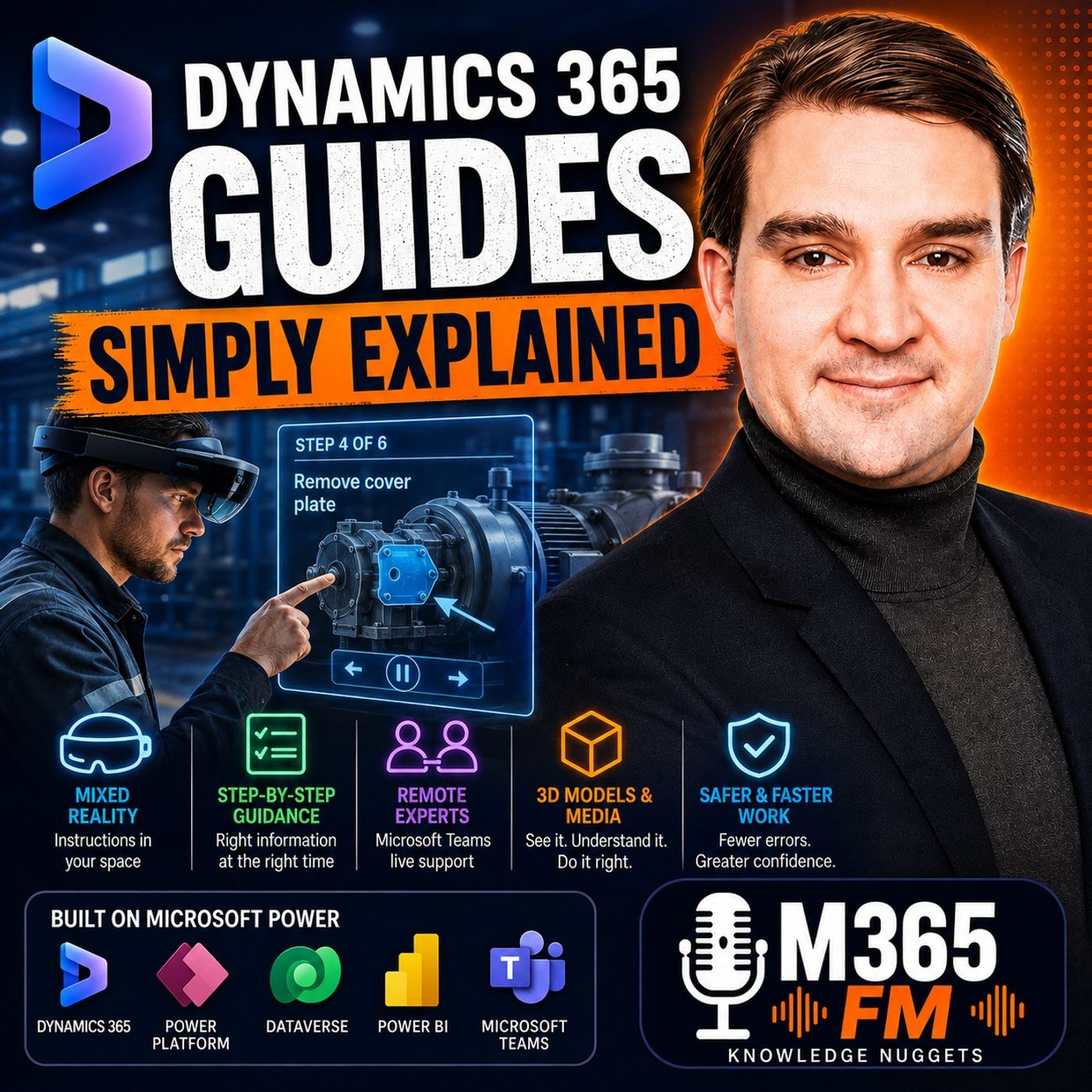
 Dynamics 365 Guides - Simply Explained
Key Takeaways
- Dynamics 365 Guides brings step-by-step work instructions directly into the physical environment using Microsoft HoloLens, bridging the gap between documentation and hands-on tasks.
- Mixed reality spatial placement allows digital elements like arrows, photos, and 3D models to appear directly beside the physical equipment, reducing cognitive load and context switching.
- Subject matter experts can easily create repeatable instruction sequences using the PC and HoloLens apps, preserving critical operational knowledge before experienced workers retire.
- Microsoft Teams integration enables hands-free remote assistance, letting experts view first-person video feeds and draw annotations directly into the worker's field of view.
- Microsoft has set December 31, 2026 as the end-of-availability date for Dynamics 365 Guides and Dynamics 365 Remote Assist, making knowledge preservation an urgent priority for organizations.
Imagine standing beside a large industrial machine and seeing the next repair instruction appear directly beside the panel you need to open. Instead of putting down your tools, walking back to a laptop, searching through a PDF, or trying to remember what an experienced technician told you during training, the information appears directly inside your field of view. That was the central idea behind Microsoft Dynamics 365 Guides. In this episode of Microsoft Knowledge Nuggets on M365 FM, Mirko Peters explains Dynamics 365 Guides in plain English: what the mixed reality application was designed to solve, how Microsoft HoloLens brought instructions into the physical workplace, how companies could capture expert knowledge, how Microsoft Teams enabled remote assistance, and how Dynamics 365, Dataverse, Power Platform, Power BI, and AI could extend the experience. There is also an important strategic issue organizations need to understand: Microsoft has set December 31, 2026 as the end-of-availability date for Dynamics 365 Guides and Dynamics 365 Remote Assist. For organizations still using the technology, preserving the knowledge contained inside their Guides is therefore becoming just as important as understanding the technology itself.
WHAT IS DYNAMICS 365 GUIDES?
Dynamics 365 Guides is a Microsoft mixed reality application designed to bring step-by-step work instructions directly into the physical environment where employees perform a task. Instead of requiring a technician to repeatedly move between a machine and a manual, Guides could display digital instruction cards, images, videos, and 3D objects through a Microsoft HoloLens headset. The employee could still see the real machine, tools, equipment, coworkers, and surrounding environment. Digital information appeared alongside that physical world. This made Guides particularly interesting for scenarios involving manufacturing, maintenance, inspections, field service, training, assembly, and other repeatable physical processes. The fundamental concept was simple: Bring the instruction to the work instead of forcing the worker to leave the work to find the instruction.
THE PROBLEM: INSTRUCTIONS ARE OFTEN FAR FROM THE WORK
Physical work frequently happens far away from the information required to perform it. A technician may be servicing a pump. An operator may be assembling equipment. A maintenance employee may need to inspect dozens of components in a particular sequence. A quality inspector may need to compare a finished component against an approved standard. Traditionally, those employees might rely on paper manuals, PDFs, laptops, classroom training, or experienced colleagues. All of those methods can work. But they create a separation between where the knowledge lives and where the work happens. A technician reads the manual, returns to the machine, remembers as much as possible, completes part of the task, and then potentially returns to the documentation. That constant context switching creates friction.
WHY TRADITIONAL MANUALS CAN BECOME A PROBLEM
Imagine a new technician standing beside a machine they have never repaired. The manual refers to components by technical names and part numbers. The actual machine contains cables, covers, grease, connectors, labels, bolts, and dozens of components that look similar. The technician reads the manual. Then they look at the machine. Then they return to the diagram. Then they try to determine whether the component shown on the page is actually the component in front of them. An experienced technician may perform the same task almost automatically because years of experience have created practical knowledge that the manual does not fully communicate. Dynamics 365 Guides attempted to reduce that gap by putting visual guidance directly beside the physical object.
CAPTURING EXPERT KNOWLEDGE
Experienced employees often possess enormous amounts of undocumented knowledge. They know which cover should come off first. They know which tool fits into a difficult space. They recognize what a correctly installed component should look like. They know where common faults occur. They know which warning signs inexperienced employees frequently overlook. The problem is that much of this information exists primarily inside people's memories. When those employees are busy, working at another location, changing jobs, or retiring, organizations can lose valuable operational knowledge. Dynamics 365 Guides provided a way to convert some of that experience into structured digital instructions. An experienced technician, process engineer, or trainer could create a repeatable sequence that another employee could follow while standing directly beside the equipment.
WHAT IS MIXED REALITY?
Mixed reality combines the physical environment with digital information. With Dynamics 365 Guides, an employee could wear a Microsoft HoloLens headset while continuing to see the real world. Digital elements could then appear within that environment. Those elements might include instructions, arrows, photographs, videos, or 3D models. This differs from a completely immersive virtual reality experience. The employee is not transported into a simulated factory. They remain inside the real factory looking at the real machine. The digital information appears alongside it. Think of a traditional manual as a document stored in another room. Mixed reality turns parts of that manual into signs positioned directly beside the equipment.
HOLOLENS AND HANDS-FREE WORK
One of the practical advantages of HoloLens was the ability to keep the worker's hands available. Physical jobs frequently require both hands. A technician may be holding a tool. An operator may need to stabilize a component. Someone may be wearing protective equipment. Trying to operate a smartphone or balance a laptop while performing that work can interrupt the process. With HoloLens, the headset becomes the display. The employee can continue looking at the equipment while digital information remains visible. This sounds like a relatively small change, but it can significantly alter the workflow for tasks where repeatedly stopping to check documentation creates delays.
TEXT, PHOTOS, VIDEO AND 3D OBJECTS
A Dynamics 365 Guide could combine several forms of instructional content. Text could explain what action the employee should perform. A photograph could show what the correctly completed step should look like. A short video could demonstrate a movement that would be difficult to describe clearly in several paragraphs. A 3D model could help the employee identify the component they need to inspect. The important difference was spatial placement. The content was not simply another video playing somewhere inside the headset. Authors could position digital elements inside the physical workspace. An arrow could appear near a particular panel. A 3D model could appear beside the component it represents. The employee could therefore connect the instruction with the real object more directly.
WHY SPATIAL PLACEMENT MATTERR
Consider the instruction: "Inspect the filter housing." That sentence may be perfectly clear to an experienced technician. A new employee may have no idea which of several similar components is the filter housing. A photograph can help. A 3D model can help further. But mixed reality can go another step by placing the guidance near the actual component. The employee does not need to mentally translate a two-dimensional diagram into the complicated physical machine standing in front of them. That reduction in interpretation is one of the most interesting aspects of mixed reality instructions.
CREATING A DYNAMICS 365 GUIDE
Guides did not automatically understand how a company's equipment worked. Someone needed to create the instructions. The process typically started with a subject matter expert such as an experienced technician, process engineer, or trainer. Using the Dynamics 365 Guides PC application, the author could create a sequence of steps. Each step could contain concise instructions and supporting media. The author could then use HoloLens inside the actual work environment to position relevant digital elements around the equipment. This combined two types of knowledge: Process knowledge — what needs to happen. Spatial knowledge — where it needs to happen. Together, those elements created the mixed reality guide.
GOOD GUIDES REQUIRE GOOD INSTRUCTIONS
Mixed reality does not automatically make bad documentation useful. If an instruction is unclear, putting it inside a headset does not solve the problem. If an arrow points vaguely toward several similar components, the employee still does not know which component matters. If a hologram blocks the worker's view of the equipment, the technology may create another problem. Good Guides therefore required concise wording, careful spatial placement, appropriate media, and genuine understanding of the physical workspace. Instructions needed to reflect how people actually performed the work rather than how someone sitting at a desk imagined the process worked.
Become a supporter of this podcast: https://www.spreaker.com/podcast/m365-fm-modern-work-security-and-productivity-with-microsoft-365--6704921/support.
🚀 Want to be part of m365.fm?
Then stop just listening… and start showing up.
👉 Connect with me on LinkedIn and let’s make something happen:
- 🎙️ Be a podcast guest and share your story
- 🎧 Host your own episode (yes, seriously)
- 💡 Pitch topics the community actually wants to hear
- 🌍 Build your personal brand in the Microsoft 365 space
This isn’t just a podcast — it’s a platform for people who take action.
🔥 Most people wait. The best ones don’t.
👉 Connect with me on LinkedIn and send me a message:
"I want in"
Let’s build something awesome 👊
Frequently Asked Questions
What is Microsoft Dynamics 365 Guides?
Dynamics 365 Guides is a mixed reality application designed for Microsoft HoloLens that brings step-by-step work instructions, holograms, and 3D models directly into the physical environment where employees perform tasks.
How does mixed reality improve workplace instructions?
Mixed reality places digital guidance directly in the physical workspace near the components being serviced, keeping workers' hands free and eliminating the need to constantly switch between paper manuals and machinery.
What is the end-of-availability date for Dynamics 365 Guides?
Microsoft has established December 31, 2026 as the end-of-availability date for both Dynamics 365 Guides and Dynamics 365 Remote Assist, requiring organizations to plan for alternative solutions and preserve their operational knowledge.
How does Microsoft Teams integrate with Dynamics 365 Guides?
Teams integrates directly into the Guides application to allow workers to initiate calls with remote experts, share their first-person HoloLens video feed, and receive real-time visual annotations.
00:00:00,000 --> 00:00:02,560
Imagine you whoom, standing beside a large machine,
2
00:00:02,560 --> 00:00:04,960
and the next repair step appears right beside the panel
3
00:00:04,960 --> 00:00:05,760
you need to open.
4
00:00:05,760 --> 00:00:08,640
You can see the instruction, the tool, and a 3D model
5
00:00:08,640 --> 00:00:10,720
without putting down what you tom re-holding.
6
00:00:10,720 --> 00:00:13,560
Is Dynamics 365 Guides just a HoloLens demo?
7
00:00:13,560 --> 00:00:15,120
Is it a training app, or could it help
8
00:00:15,120 --> 00:00:17,600
with real work on a factory floor at a customer site
9
00:00:17,600 --> 00:00:18,560
or during an inspection?
10
00:00:18,560 --> 00:00:20,760
Yauhtem and Mercopeter is from N65FM,
11
00:00:20,760 --> 00:00:22,960
and this knowledge nugget explains it in plain English.
12
00:00:22,960 --> 00:00:25,040
You would see how Guides helped workers,
13
00:00:25,040 --> 00:00:26,640
how its parts work together,
14
00:00:26,640 --> 00:00:28,160
and why its retirement date matters
15
00:00:28,160 --> 00:00:29,840
if your company still uses it.
16
00:00:29,840 --> 00:00:32,320
Think of it as a digital coach beside the machine,
17
00:00:32,320 --> 00:00:34,360
pointing you toward the next job.
18
00:00:34,360 --> 00:00:37,280
Let out timers, look at the problem it was built to solve
19
00:00:37,280 --> 00:00:40,640
before we even talk about the headset, a CLS.
20
00:00:40,640 --> 00:00:44,280
The work problem, instructions, far from the job.
21
00:00:44,280 --> 00:00:46,040
When you're ultimately doing physical work,
22
00:00:46,040 --> 00:00:47,960
the instructions you need are rarely right
23
00:00:47,960 --> 00:00:49,640
where you attempt re-working.
24
00:00:49,640 --> 00:00:51,320
Think about a technician servicing a pump,
25
00:00:51,320 --> 00:00:53,280
an operator assembling a part in the correct order,
26
00:00:53,280 --> 00:00:55,720
or someone doing a safety check on a list of small items.
27
00:00:55,720 --> 00:00:57,360
A quality inspector might need to compare
28
00:00:57,360 --> 00:00:59,680
the finished piece against an approved standard.
29
00:00:59,680 --> 00:01:02,640
These jobs don't know what happened at a desk.
30
00:01:02,640 --> 00:01:04,720
For years, the usual answer was a paper manual,
31
00:01:04,720 --> 00:01:06,760
a PDF on a laptop, classroom training,
32
00:01:06,760 --> 00:01:09,320
or a more experienced coworker standing nearby.
33
00:01:09,320 --> 00:01:10,400
Each approach can help,
34
00:01:10,400 --> 00:01:12,400
but none of them puts the instruction right next
35
00:01:12,400 --> 00:01:14,200
to the job you ultimately do.
36
00:01:14,200 --> 00:01:16,920
Picture a new technician beside a machine
37
00:01:16,920 --> 00:01:19,080
they would TM have never repaired.
38
00:01:19,080 --> 00:01:21,120
The manual sits on a cart across the room.
39
00:01:21,120 --> 00:01:22,880
The diagram uses part numbers,
40
00:01:22,880 --> 00:01:25,520
while the machine has grease, cables, covers,
41
00:01:25,520 --> 00:01:28,200
and dozens of bolts that all look fairly similar.
42
00:01:28,200 --> 00:01:30,560
The technician stops, walks back to the manual,
43
00:01:30,560 --> 00:01:32,560
finds the page, returns to the machine,
44
00:01:32,560 --> 00:01:34,560
and tries to remember what the diagram showed.
45
00:01:34,560 --> 00:01:36,480
That who artens a lot to hold in your head,
46
00:01:36,480 --> 00:01:38,480
experience workers often fill that gap.
47
00:01:38,480 --> 00:01:40,000
They know which cover comes off first,
48
00:01:40,000 --> 00:01:42,520
which tool fits the space, where a common fault appears,
49
00:01:42,520 --> 00:01:44,400
and which warning newer staff may overlook.
50
00:01:44,400 --> 00:01:45,960
Much of that knowledge lives in their memory
51
00:01:45,960 --> 00:01:48,720
because they out of them were done the work many times.
52
00:01:48,720 --> 00:01:51,240
But you can out and rely on one person out of his memory
53
00:01:51,240 --> 00:01:52,920
when they out of them were not there.
54
00:01:52,920 --> 00:01:54,760
When that person is busy on another site,
55
00:01:54,760 --> 00:01:56,120
or no longer with the company,
56
00:01:56,120 --> 00:01:57,800
the next worker may need to call them.
57
00:01:57,800 --> 00:01:58,800
They may send a photo,
58
00:01:58,800 --> 00:02:00,640
they may describe the problem over the phone,
59
00:02:00,640 --> 00:02:03,760
and hope both people mean the same part, or they guess.
60
00:02:03,760 --> 00:02:04,640
And guessing does know,
61
00:02:04,640 --> 00:02:06,760
Tim Tet is belong in a repair or safety process.
62
00:02:06,760 --> 00:02:08,720
Classroom training has a similar limit.
63
00:02:08,720 --> 00:02:10,240
You can learn the steps in a meeting room,
64
00:02:10,240 --> 00:02:12,240
perhaps even watch somebody do the job.
65
00:02:12,240 --> 00:02:15,200
But the real task looks different when you, Tim,
66
00:02:15,200 --> 00:02:17,640
are in front of the equipment with limited space,
67
00:02:17,640 --> 00:02:20,040
noise around you, and tools in both hands.
68
00:02:20,040 --> 00:02:21,560
The instruction sits in one place.
69
00:02:21,560 --> 00:02:22,880
The work happens somewhere else.
70
00:02:22,880 --> 00:02:24,640
The expert may be somewhere else again.
71
00:02:24,640 --> 00:02:26,880
That old setup forces you to jump back and forth
72
00:02:26,880 --> 00:02:29,000
between the manual, the machine, and memory
73
00:02:29,000 --> 00:02:31,320
while trying to complete a careful physical task.
74
00:02:31,320 --> 00:02:33,920
It slows people down, especially when they are new to the job
75
00:02:33,920 --> 00:02:35,600
or only perform it once in a while.
76
00:02:35,600 --> 00:02:37,720
When you can see the instruction right next to the object,
77
00:02:37,720 --> 00:02:38,520
the pressure drops.
78
00:02:38,520 --> 00:02:40,640
Instead of remembering which panel to inspect,
79
00:02:40,640 --> 00:02:42,920
the worker sees the instruction near that panel.
80
00:02:42,920 --> 00:02:45,080
Instead of flipping between a picture and the real object,
81
00:02:45,080 --> 00:02:46,560
they compare them in the same view.
82
00:02:46,560 --> 00:02:49,280
Fewer switches in focus means fewer missed steps.
83
00:02:49,280 --> 00:02:51,320
Still, software does not aim at it,
84
00:02:51,320 --> 00:02:53,400
it turns someone into a qualified technician.
85
00:02:53,400 --> 00:02:56,360
Guides could support a trained worker with approved instructions.
86
00:02:56,360 --> 00:02:58,080
It could now to met, replace safety rules,
87
00:02:58,080 --> 00:03:00,920
lockout procedures, local side rules, hands-on skill,
88
00:03:00,920 --> 00:03:03,120
or the judgment to stop when something looks wrong.
89
00:03:03,120 --> 00:03:05,480
If a task needs certification or expert approval,
90
00:03:05,480 --> 00:03:08,000
a floating instruction card does know to change that.
91
00:03:08,000 --> 00:03:10,160
So Microsoft did know to make to try to solve this
92
00:03:10,160 --> 00:03:11,720
with another checklist on a phone screen.
93
00:03:11,720 --> 00:03:13,160
The idea was mixed reality
94
00:03:13,160 --> 00:03:14,360
where the instruction could appear
95
00:03:14,360 --> 00:03:16,400
in the same space as the job.
96
00:03:16,400 --> 00:03:18,200
Mixed reality in plain English.
97
00:03:18,200 --> 00:03:21,120
Welcome back to another episode of Microsoft Knowledge Nuggets.
98
00:03:21,120 --> 00:03:24,160
Yao Tumant, M, Mirko Peters, and today,
99
00:03:24,160 --> 00:03:27,560
we outterm, we're talking about mixed reality in plain English.
100
00:03:27,560 --> 00:03:29,360
So what exactly is mixed reality?
101
00:03:29,360 --> 00:03:31,600
In simple terms, it puts digital guidance
102
00:03:31,600 --> 00:03:33,760
right into the room where you temporary working.
103
00:03:33,760 --> 00:03:37,040
With Dynamics 365 Guides, you wear a Microsoft HoloLens headset.
104
00:03:37,040 --> 00:03:38,400
You can still see the real machine,
105
00:03:38,400 --> 00:03:39,840
the tools and the people around you,
106
00:03:39,840 --> 00:03:42,040
but digital instruction cards and 3D objects appear
107
00:03:42,040 --> 00:03:43,040
within that view.
108
00:03:43,040 --> 00:03:44,520
But they don't open to replace the real world,
109
00:03:44,520 --> 00:03:46,280
or they sit right alongside it.
110
00:03:46,280 --> 00:03:48,240
Here, Yao Tums the thing.
111
00:03:48,240 --> 00:03:50,240
Most people think mixed reality is only
112
00:03:50,240 --> 00:03:52,440
for gaming or futuristic demos.
113
00:03:52,440 --> 00:03:55,440
It is notmit, et out, Mr. Practical Tool for real work.
114
00:03:55,440 --> 00:03:57,160
Think about an office building for a moment.
115
00:03:57,160 --> 00:03:58,880
A normal paper manual is like a folder
116
00:03:58,880 --> 00:04:00,880
locked in a filing cabinet on another floor.
117
00:04:00,880 --> 00:04:02,800
You read it, remember the instruction,
118
00:04:02,800 --> 00:04:04,960
then walk back to the room where the job happens.
119
00:04:04,960 --> 00:04:06,480
Guides changes that picture.
120
00:04:06,480 --> 00:04:09,320
The instruction becomes a sign placed beside the correct door.
121
00:04:09,320 --> 00:04:11,160
An arrow can point toward the right cabinet
122
00:04:11,160 --> 00:04:14,040
and a 3D image can sit near the part you need to inspect.
123
00:04:14,040 --> 00:04:15,760
You are to be looking at the machine
124
00:04:15,760 --> 00:04:18,000
and the guidance in the same physical space,
125
00:04:18,000 --> 00:04:20,600
rather than switching between a document and the work.
126
00:04:20,600 --> 00:04:23,240
That, Yao, Tums, what mixed reality means here.
127
00:04:23,240 --> 00:04:25,000
Now, what does a guide actually include?
128
00:04:25,000 --> 00:04:27,520
The guidance can include short written steps, photos,
129
00:04:27,520 --> 00:04:29,960
video clips, and 3D holographic objects.
130
00:04:29,960 --> 00:04:32,480
Each item has a job, text explains the action.
131
00:04:32,480 --> 00:04:34,200
A photo shows the approved result,
132
00:04:34,200 --> 00:04:35,720
a video demonstrates a movement
133
00:04:35,720 --> 00:04:37,720
that would take too many words to explain.
134
00:04:37,720 --> 00:04:40,720
And a 3D model helps you recognize a part before you touch it.
135
00:04:40,720 --> 00:04:42,840
But here, Ms. the key or the cards were,
136
00:04:42,840 --> 00:04:44,480
and it meant to act like a video playing
137
00:04:44,480 --> 00:04:45,480
in the corner of your view.
138
00:04:45,480 --> 00:04:47,960
Instead, authors place digital items directly
139
00:04:47,960 --> 00:04:49,440
in the physical workspace.
140
00:04:49,440 --> 00:04:50,640
But that placement matters.
141
00:04:50,640 --> 00:04:53,240
A holographic arrow near a panel points to that panel
142
00:04:53,240 --> 00:04:56,360
and a model beside a connection helps identify that connection.
143
00:04:56,360 --> 00:04:58,120
The instruction stays linked to the place
144
00:04:58,120 --> 00:04:59,480
where the work takes place.
145
00:04:59,480 --> 00:05:00,880
So when you move around a machine,
146
00:05:00,880 --> 00:05:02,920
the guide can help you keep your bearings.
147
00:05:02,920 --> 00:05:04,720
Lett out and make it concrete.
148
00:05:04,720 --> 00:05:07,000
Imagine a technician checking a large piece of equipment.
149
00:05:07,000 --> 00:05:08,920
The first card appears near the front panel
150
00:05:08,920 --> 00:05:11,000
and tells them which fasteners to inspect.
151
00:05:11,000 --> 00:05:14,000
A 3D model shows the shape of a part behind the cover,
152
00:05:14,000 --> 00:05:17,320
so they know what they are looking for before opening anything.
153
00:05:17,320 --> 00:05:19,320
Then the next instruction directs their attention
154
00:05:19,320 --> 00:05:21,760
to a second panel right where they need to work.
155
00:05:21,760 --> 00:05:23,480
No one needs to translate a flat drawing
156
00:05:23,480 --> 00:05:25,840
into a real object while standing in a tight space
157
00:05:25,840 --> 00:05:29,880
with cables, labels, and similar looking parts all around them.
158
00:05:29,880 --> 00:05:33,440
It tells them is a more direct way to deliver instructions.
159
00:05:33,440 --> 00:05:34,360
Why does that matter?
160
00:05:34,360 --> 00:05:35,960
Because HoloLens also keeps the worker
161
00:05:35,960 --> 00:05:38,640
autumn's hands free, a technician may hold a tool,
162
00:05:38,640 --> 00:05:40,960
steady a component, or wear protective gear.
163
00:05:40,960 --> 00:05:43,000
Stopping to tap a phone or type on a laptop
164
00:05:43,000 --> 00:05:45,920
can interrupt the task at exactly the wrong moment.
165
00:05:45,920 --> 00:05:47,840
Guides let operators use their gaze
166
00:05:47,840 --> 00:05:49,760
to control parts of the experience.
167
00:05:49,760 --> 00:05:51,400
They look at the control for the next step
168
00:05:51,400 --> 00:05:53,080
and user glance to move forward.
169
00:05:53,080 --> 00:05:55,840
The headset becomes the screen while both hands stay
170
00:05:55,840 --> 00:05:57,080
with the physical job.
171
00:05:57,080 --> 00:06:00,160
That sounds small, but it changes the flow of the work.
172
00:06:00,160 --> 00:06:02,560
You are now to amteet carrying a clipboard in one hand
173
00:06:02,560 --> 00:06:03,760
and a wrench in the other.
174
00:06:03,760 --> 00:06:05,680
You are now to amt trying to balance a laptop
175
00:06:05,680 --> 00:06:06,960
on a nearby surface.
176
00:06:06,960 --> 00:06:09,960
The information stays in view while your hands stay available.
177
00:06:09,960 --> 00:06:12,760
Of course, a hologram needs to stay understandable.
178
00:06:12,760 --> 00:06:15,080
If an instruction blocks the part you need to see,
179
00:06:15,080 --> 00:06:16,400
it creates a new problem.
180
00:06:16,400 --> 00:06:19,400
If a 3D arrow points vaguely at several parts,
181
00:06:19,400 --> 00:06:21,680
it does know it, to guide anyone.
182
00:06:21,680 --> 00:06:24,440
The content needs clear wording, careful placement,
183
00:06:24,440 --> 00:06:26,960
and a real understanding of the workspace.
184
00:06:26,960 --> 00:06:28,920
Mixed reality explains what the operator sees
185
00:06:28,920 --> 00:06:30,840
through the headset, but those instructions
186
00:06:30,840 --> 00:06:32,760
did not appear by themselves.
187
00:06:32,760 --> 00:06:35,000
Someone first needed to turn practical knowledge
188
00:06:35,000 --> 00:06:37,000
into a guide, but it's glars.
189
00:06:37,000 --> 00:06:38,840
From expert knowledge to a guide,
190
00:06:38,840 --> 00:06:40,600
so where did the instructions come from?
191
00:06:40,600 --> 00:06:42,920
Usually they came from the person who already knew the job
192
00:06:42,920 --> 00:06:45,040
well in a factory or service team
193
00:06:45,040 --> 00:06:47,680
that might be an experienced technician, a process engineer,
194
00:06:47,680 --> 00:06:49,440
or a trainer who understands the approved way
195
00:06:49,440 --> 00:06:51,560
to complete a repeatable task.
196
00:06:51,560 --> 00:06:53,680
That person did know to test need to write code
197
00:06:53,680 --> 00:06:55,640
or build a full 3D application.
198
00:06:55,640 --> 00:06:59,120
They could start in the Dynamics 365 Guides PC app,
199
00:06:59,120 --> 00:07:01,560
where a guide takes shape as a series of steps.
200
00:07:01,560 --> 00:07:04,480
For every step, the author could write a short instruction,
201
00:07:04,480 --> 00:07:07,600
then add photos, video clips, and 3D objects,
202
00:07:07,600 --> 00:07:09,800
where those helped explain the work more clearly.
203
00:07:09,800 --> 00:07:11,480
Think of a maintenance routine for a pump.
204
00:07:11,480 --> 00:07:13,720
An experienced technician might create a step called,
205
00:07:13,720 --> 00:07:16,360
or isolate the unit using the approved site procedure.
206
00:07:16,360 --> 00:07:18,000
A.O. the next step could show a photo
207
00:07:18,000 --> 00:07:19,800
of the correct access panel.
208
00:07:19,800 --> 00:07:21,160
Another could include a short video
209
00:07:21,160 --> 00:07:24,160
that shows how to remove a cover without damaging a nearby cable.
210
00:07:24,160 --> 00:07:26,920
Later, a 3D object could help a new worker recognize
211
00:07:26,920 --> 00:07:29,320
the filter housing before they start the inspection.
212
00:07:29,320 --> 00:07:31,600
The guide does not need long paragraphs.
213
00:07:31,600 --> 00:07:33,800
Good instructions focus on one action at a time,
214
00:07:33,800 --> 00:07:36,040
because the worker still has to look at the equipment,
215
00:07:36,040 --> 00:07:39,160
use their tools, and follow the site of the safety process.
216
00:07:39,160 --> 00:07:41,360
Clear words beat clever words every time.
217
00:07:41,360 --> 00:07:43,680
Now, a subject matter expert could capture
218
00:07:43,680 --> 00:07:45,560
the order they already followed in real life
219
00:07:45,560 --> 00:07:48,280
and add the small details newer workers often miss.
220
00:07:48,280 --> 00:07:49,720
Which part needs a close look?
221
00:07:49,720 --> 00:07:51,760
What a correctly fitted component looks like?
222
00:07:51,760 --> 00:07:54,640
Where somebody should pause and check their work before continuing.
223
00:07:54,640 --> 00:07:57,880
Those details often live in an experienced worker outtams head,
224
00:07:57,880 --> 00:08:01,080
and they can disappear when that person changes jobs or retires.
225
00:08:01,080 --> 00:08:03,160
The PC app handles the plan sequence.
226
00:08:03,160 --> 00:08:05,600
But a screen on a desk can outtamity tell you
227
00:08:05,600 --> 00:08:08,640
whether a digital marker sits beside the correct bolt, panel,
228
00:08:08,640 --> 00:08:10,120
or connection in the real workspace.
229
00:08:10,120 --> 00:08:12,200
That part happens with the HoloLens app.
230
00:08:12,200 --> 00:08:14,640
The author puts on the headset, opens the guide,
231
00:08:14,640 --> 00:08:16,640
and enters the actual work area.
232
00:08:16,640 --> 00:08:19,680
They can pick up the digital instruction card or 3D object,
233
00:08:19,680 --> 00:08:22,520
move it, turn it, and place it where the worker will need it.
234
00:08:22,520 --> 00:08:23,680
Placement takes care.
235
00:08:23,680 --> 00:08:25,640
A warning needs to sit where it can be read
236
00:08:25,640 --> 00:08:27,120
without hiding the equipment.
237
00:08:27,120 --> 00:08:29,680
A 3D model needs to point clearly to the correct part,
238
00:08:29,680 --> 00:08:31,560
not a group of parts that look alike.
239
00:08:31,560 --> 00:08:33,440
The author also needs to think about how someone moves
240
00:08:33,440 --> 00:08:35,520
around the machine, where they stand,
241
00:08:35,520 --> 00:08:36,920
and what they can safely see.
242
00:08:36,920 --> 00:08:39,680
This stage connects the written process to the physical task.
243
00:08:39,680 --> 00:08:41,720
Imagine that experience technician again.
244
00:08:41,720 --> 00:08:44,080
They create the maintenance guide at a PC step by step
245
00:08:44,080 --> 00:08:46,040
while thinking through the safe order of work.
246
00:08:46,040 --> 00:08:47,760
Then they wear the HoloLens at the machine
247
00:08:47,760 --> 00:08:49,960
and place each instruction where it makes sense.
248
00:08:49,960 --> 00:08:52,920
The first card sits near the area where the task begins.
249
00:08:52,920 --> 00:08:55,280
A photo appears beside the cover that needs inspection.
250
00:08:55,280 --> 00:08:57,640
A 3D model sits near the filter housing.
251
00:08:57,640 --> 00:09:00,360
Another instruction appears at the point where the worker needs
252
00:09:00,360 --> 00:09:03,000
to confirm that everything is back in place before they finish.
253
00:09:03,000 --> 00:09:06,280
Now a new technician can use that guide while doing the same job.
254
00:09:06,280 --> 00:09:08,040
They don't even need to guess what the expert meant
255
00:09:08,040 --> 00:09:10,600
by O-check the housing O, or search for a diagram
256
00:09:10,600 --> 00:09:12,280
that uses unfamiliar labels.
257
00:09:12,280 --> 00:09:15,120
The guide gives them the approved sequence created by someone
258
00:09:15,120 --> 00:09:17,000
who knows the equipment and the process.
259
00:09:17,000 --> 00:09:19,600
Think of it as a filing cabinet for practical knowledge.
260
00:09:19,600 --> 00:09:23,080
A paper filing cabinet stores documents where people can find them later.
261
00:09:23,080 --> 00:09:27,080
At an MX365 guide stores the steps, images, videos,
262
00:09:27,080 --> 00:09:29,760
and 3D objects that explain how a task should happen,
263
00:09:29,760 --> 00:09:32,320
so the next worker can use that knowledge at the moment they need it.
264
00:09:32,320 --> 00:09:34,680
But the first version rarely comes out perfect.
265
00:09:34,680 --> 00:09:36,960
An operator might find that an instruction uses a word
266
00:09:36,960 --> 00:09:38,520
nobody says on the shop floor.
267
00:09:38,520 --> 00:09:41,800
A photo could show too much of the machine, a hologram might sit,
268
00:09:41,800 --> 00:09:44,960
slightly too high for someone who works from a different position.
269
00:09:44,960 --> 00:09:47,880
Those are not in failures, are they out in a useful feedback
270
00:09:47,880 --> 00:09:49,480
from the people doing the work?
271
00:09:49,480 --> 00:09:51,520
The team can update the guide, test it again,
272
00:09:51,520 --> 00:09:53,160
and share the clearer version.
273
00:09:53,160 --> 00:09:55,160
Over time, a repeatable maintenance job
274
00:09:55,160 --> 00:09:57,120
becomes easier to teach consistently.
275
00:09:57,120 --> 00:09:59,360
The experience technician still owns the knowledge,
276
00:09:59,360 --> 00:10:02,160
but the guide gives that knowledge a practical place to live
277
00:10:02,160 --> 00:10:04,600
rather than leaving it trapped in a memory, a notebook,
278
00:10:04,600 --> 00:10:06,040
or a rushed phone call.
279
00:10:06,040 --> 00:10:08,920
Of course, this only works for work the guide already knows.
280
00:10:08,920 --> 00:10:10,800
When an unexpected problem appears,
281
00:10:10,800 --> 00:10:12,680
the worker may still need a real expert
282
00:10:12,680 --> 00:10:14,440
who can look at the situation with them.
283
00:10:14,440 --> 00:10:16,120
That word must be honest truth.
284
00:10:16,120 --> 00:10:18,880
So to sum it up, mixed reality brings instructions
285
00:10:18,880 --> 00:10:21,440
into your physical workspace, keeps your hands free,
286
00:10:21,440 --> 00:10:24,280
and captures expert knowledge so anyone can use it.
287
00:10:24,280 --> 00:10:26,720
That utunts, "ins the power of dynamics".
288
00:10:26,720 --> 00:10:29,240
365 guides in plain English, thanks for listening,
289
00:10:29,240 --> 00:10:32,360
and I out them, will see you in the next episode.
290
00:10:32,360 --> 00:10:35,000
When a remote expert needs to see what you see,
291
00:10:35,000 --> 00:10:37,440
a guide works great when everything goes according to plan,
292
00:10:37,440 --> 00:10:39,080
but here's the thing.
293
00:10:39,080 --> 00:10:42,200
Physical work rarely follows the script perfectly.
294
00:10:42,200 --> 00:10:44,640
A bolt might look damaged, a panel might have a part
295
00:10:44,640 --> 00:10:46,040
that doesn't match the instructions,
296
00:10:46,040 --> 00:10:48,040
or the worker might complete every step
297
00:10:48,040 --> 00:10:50,200
and still get an unexpected result.
298
00:10:50,200 --> 00:10:53,960
That's exactly when a remote expert can prevent a long delay.
299
00:10:53,960 --> 00:10:56,680
Inside the guide, Dynamics 365 guides
300
00:10:56,680 --> 00:10:59,520
included a direct connection to Microsoft Teams.
301
00:10:59,520 --> 00:11:01,960
Workers could start a one-to-one or group call,
302
00:11:01,960 --> 00:11:03,680
join a scheduled meeting chat,
303
00:11:03,680 --> 00:11:06,280
share files, share their view, and use annotations
304
00:11:06,280 --> 00:11:08,800
all while the guide stayed right there.
305
00:11:08,800 --> 00:11:11,120
Teams brought another person into the situation
306
00:11:11,120 --> 00:11:12,760
when the written steps weren't enough.
307
00:11:12,760 --> 00:11:15,640
Picture a technician finding a leak near a connection.
308
00:11:15,640 --> 00:11:17,520
Over a normal phone call, you might say,
309
00:11:17,520 --> 00:11:19,000
it's near the valve on the left.
310
00:11:19,000 --> 00:11:20,800
The expert asks, "Which valve?"
311
00:11:20,800 --> 00:11:22,640
So you send a photo, wait for a reply,
312
00:11:22,640 --> 00:11:24,600
take another photo from a wider angle,
313
00:11:24,600 --> 00:11:26,760
and try to explain where that first image fits
314
00:11:26,760 --> 00:11:28,160
on a much larger machine.
315
00:11:28,160 --> 00:11:29,920
That whole back and forth takes time.
316
00:11:29,920 --> 00:11:32,760
With a HoloLens call, the remote expert sees the operators
317
00:11:32,760 --> 00:11:34,240
at first person video feed,
318
00:11:34,240 --> 00:11:37,480
including the holographic guide content in their view.
319
00:11:37,480 --> 00:11:39,040
Instead of building a picture from words,
320
00:11:39,040 --> 00:11:40,560
the expert looks at the same equipment
321
00:11:40,560 --> 00:11:41,760
from the workers position.
322
00:11:41,760 --> 00:11:44,480
The expert can ask the worker to look closer at a fitting,
323
00:11:44,480 --> 00:11:46,720
confirm whether they've reached the correct step,
324
00:11:46,720 --> 00:11:48,880
point out a detail near the suspected fault,
325
00:11:48,880 --> 00:11:50,840
or help figure out what to check next.
326
00:11:50,840 --> 00:11:53,120
And Teams lets participants draw annotations
327
00:11:53,120 --> 00:11:55,360
directly into the HoloLens users view,
328
00:11:55,360 --> 00:11:58,240
so guidance appears exactly where the worker needs to look.
329
00:11:58,240 --> 00:11:59,920
The expert isn't taking control of the job.
330
00:11:59,920 --> 00:12:02,400
The worker still holds the tool, follows side rules,
331
00:12:02,400 --> 00:12:03,800
and decides when to stop.
332
00:12:03,800 --> 00:12:05,920
But here's the key difference, oh.
333
00:12:05,920 --> 00:12:08,120
Both people can talk about the same physical object
334
00:12:08,120 --> 00:12:09,880
at the same moment, rather than passing
335
00:12:09,880 --> 00:12:11,960
incomplete descriptions back and forth.
336
00:12:11,960 --> 00:12:14,320
That completely changes the type of help you get.
337
00:12:14,320 --> 00:12:15,840
A guide gives repeatable instructions
338
00:12:15,840 --> 00:12:17,480
for work the team already knows.
339
00:12:17,480 --> 00:12:19,520
Teams connects the operator with a person
340
00:12:19,520 --> 00:12:21,440
when the equipment, condition, or question falls
341
00:12:21,440 --> 00:12:23,040
outside those steps.
342
00:12:23,040 --> 00:12:25,600
One gives structure, oh, the other gives human judgment.
343
00:12:25,600 --> 00:12:27,000
There's another useful side effect.
344
00:12:27,000 --> 00:12:28,760
When experts solve unusual problems,
345
00:12:28,760 --> 00:12:31,040
they usually leave notes or record what happened.
346
00:12:31,040 --> 00:12:34,040
Those call transcripts and notes from previous expert activity
347
00:12:34,040 --> 00:12:36,800
can become material for later AI-based guidance,
348
00:12:36,800 --> 00:12:38,880
or as long as the company reviews it,
349
00:12:38,880 --> 00:12:40,880
and treats it as a proved work knowledge,
350
00:12:40,880 --> 00:12:42,640
not an automatic answer.
351
00:12:42,640 --> 00:12:44,840
So the live call helps one worker today.
352
00:12:44,840 --> 00:12:47,800
It can also capture information that helps the next worker,
353
00:12:47,800 --> 00:12:49,560
once the team reviews it and decides what
354
00:12:49,560 --> 00:12:52,040
belongs in their official work material.
355
00:12:52,040 --> 00:12:54,040
Microsoft also explored adding a copilot layer
356
00:12:54,040 --> 00:12:56,120
to Dynamics 365 guides.
357
00:12:56,120 --> 00:12:58,240
The goal was to let workers ask questions naturally
358
00:12:58,240 --> 00:12:59,960
during the task, without forcing them
359
00:12:59,960 --> 00:13:03,800
to search through documents first, copilot, connected systems,
360
00:13:03,800 --> 00:13:05,680
and process data.
361
00:13:05,680 --> 00:13:08,440
At Microsoft Ignite in 2023, Microsoft
362
00:13:08,440 --> 00:13:11,120
announced copilot in Dynamics 365 guides.
363
00:13:11,120 --> 00:13:13,520
It went into private preview with a small group of customers
364
00:13:13,520 --> 00:13:15,720
and limited capabilities, so it wasn't something
365
00:13:15,720 --> 00:13:17,400
every user could just turn on.
366
00:13:17,400 --> 00:13:18,520
The idea was simple.
367
00:13:18,520 --> 00:13:19,960
A worker could look at a component,
368
00:13:19,960 --> 00:13:22,240
point to it, and ask a question in plain language.
369
00:13:22,240 --> 00:13:24,080
Instead of searching through a huge manual,
370
00:13:24,080 --> 00:13:25,720
copilot could search the work material
371
00:13:25,720 --> 00:13:27,440
the company had chosen and return guidance
372
00:13:27,440 --> 00:13:29,480
in the context of that physical task.
373
00:13:29,480 --> 00:13:31,240
Imagine somebody looking at a row of bolts
374
00:13:31,240 --> 00:13:33,600
and asking, what is the torque limit for these?
375
00:13:33,600 --> 00:13:36,520
Copilot can use approved technical documents to find an answer.
376
00:13:36,520 --> 00:13:38,960
If the worker asks where a sensor module belongs,
377
00:13:38,960 --> 00:13:41,000
it uses 3D and spatial information
378
00:13:41,000 --> 00:13:43,160
to show guidance right next to the equipment.
379
00:13:43,160 --> 00:13:45,160
The worker starts with the object in front of them,
380
00:13:45,160 --> 00:13:46,480
not a search box.
381
00:13:46,480 --> 00:13:49,520
Microsoft calls one part of this point and asks guidance.
382
00:13:49,520 --> 00:13:51,680
That simply means you pointed something and ask about it.
383
00:13:51,680 --> 00:13:53,240
The system uses what you're looking at,
384
00:13:53,240 --> 00:13:55,040
plus the company's prepared knowledge
385
00:13:55,040 --> 00:13:56,200
to find a relevant answer.
386
00:13:56,200 --> 00:13:58,000
Spatial content generation is about reducing
387
00:13:58,000 --> 00:14:00,400
the work of creating mixed reality content.
388
00:14:00,400 --> 00:14:02,960
Instead of every visual item starting as a manual job,
389
00:14:02,960 --> 00:14:05,040
copilot can help create and manage content
390
00:14:05,040 --> 00:14:08,080
that links digital instructions with the real workspace.
391
00:14:08,080 --> 00:14:10,720
Step by step assistance goes further than a single answer.
392
00:14:10,720 --> 00:14:13,240
A worker could ask, walk me through disassembling this unit,
393
00:14:13,240 --> 00:14:16,880
then ask, I removed the motor, oh, what comes next?
394
00:14:16,880 --> 00:14:18,360
Copilot continues the conversation
395
00:14:18,360 --> 00:14:20,120
using the work information it has
396
00:14:20,120 --> 00:14:23,160
and responds with speech, text, or holographic guidance.
397
00:14:23,160 --> 00:14:26,160
But an answer is only as good as the material behind it.
398
00:14:26,160 --> 00:14:28,760
Copilot can search technical documents, service records,
399
00:14:28,760 --> 00:14:31,160
training material, expert notes, and transcripts
400
00:14:31,160 --> 00:14:32,520
from earlier support calls.
401
00:14:32,520 --> 00:14:33,920
Those sources are what it works from.
402
00:14:33,920 --> 00:14:37,080
If the company has old, unclear, or unapproved instructions,
403
00:14:37,080 --> 00:14:39,760
the answer carries those same problems into the worker's view.
404
00:14:39,760 --> 00:14:42,600
This is why preparation matters more than AI excitement.
405
00:14:42,600 --> 00:14:43,920
For a safety or repair task,
406
00:14:43,920 --> 00:14:46,120
you need trusted source material, clear ownership,
407
00:14:46,120 --> 00:14:47,160
and human checks.
408
00:14:47,160 --> 00:14:49,680
Copilot can help someone find a proved knowledge faster,
409
00:14:49,680 --> 00:14:51,800
but it can't take responsibility for the work.
410
00:14:51,800 --> 00:14:54,400
A trained person still needs to follow local rules.
411
00:14:54,400 --> 00:14:57,040
Stop when conditions look unsafe and ask for help
412
00:14:57,040 --> 00:14:59,720
when the answer doesn't match the equipment in front of them.
413
00:14:59,720 --> 00:15:01,880
Behind the scenes, Dynamics 365 guides
414
00:15:01,880 --> 00:15:04,280
uses Microsoft Dataverse to store its data.
415
00:15:04,280 --> 00:15:06,320
Think of Dataverse as the shared data storage
416
00:15:06,320 --> 00:15:08,080
behind many Microsoft business apps.
417
00:15:08,080 --> 00:15:10,560
It gives guides a place to keep its records
418
00:15:10,560 --> 00:15:14,040
and it lets information connect with other parts of Dynamics 365.
419
00:15:14,040 --> 00:15:16,360
For instance, Dynamics 365 Field Service
420
00:15:16,360 --> 00:15:19,240
can connect guides with work orders for service technicians.
421
00:15:19,240 --> 00:15:21,800
A person assigned to a repair job can use the guide
422
00:15:21,800 --> 00:15:22,960
connected to that work.
423
00:15:22,960 --> 00:15:25,160
Dynamics 365 Supply Chain Management
424
00:15:25,160 --> 00:15:27,120
can connect guides with production processes
425
00:15:27,120 --> 00:15:28,520
or equipment maintenance.
426
00:15:28,520 --> 00:15:30,200
The guide doesn't have to sit alone.
427
00:15:30,200 --> 00:15:32,240
Power Platform Tools can connect guide activity
428
00:15:32,240 --> 00:15:33,360
with follow-up work.
429
00:15:33,360 --> 00:15:34,800
A company might create a workflow
430
00:15:34,800 --> 00:15:37,560
that sends a task for review when a process needs attention
431
00:15:37,560 --> 00:15:40,720
or routes information to the team responsible for the next step.
432
00:15:40,720 --> 00:15:44,080
Power BI can turn process data into reports for managers.
433
00:15:44,080 --> 00:15:46,640
They can look for steps where workers spend more time,
434
00:15:46,640 --> 00:15:49,080
find parts of a process that need clearer instructions
435
00:15:49,080 --> 00:15:51,440
and decide where training material needs an update.
436
00:15:51,440 --> 00:15:53,440
The report doesn't fix the process by itself,
437
00:15:53,440 --> 00:15:55,000
but it can show the team where to look.
438
00:15:55,000 --> 00:15:57,360
So, co-pilot, business records, workflows,
439
00:15:57,360 --> 00:15:59,800
and reporting all extended the same idea.
440
00:15:59,800 --> 00:16:01,760
Bring the right information closer to the person
441
00:16:01,760 --> 00:16:02,840
doing physical work.
442
00:16:02,840 --> 00:16:05,160
There's one final planning detail you need to know.
443
00:16:05,160 --> 00:16:08,480
Microsoft has set a fixed end date for Dynamics 365 Guides
444
00:16:08,480 --> 00:16:10,000
and Remote Assist.
445
00:16:10,000 --> 00:16:13,000
The end date and what it means for Teams.
446
00:16:13,000 --> 00:16:15,040
So here's the date you need to remember.
447
00:16:15,040 --> 00:16:17,920
Microsoft has confirmed that Dynamics 365 Guides
448
00:16:17,920 --> 00:16:20,040
and Dynamics 365 Remote Assist
449
00:16:20,040 --> 00:16:22,920
won't be available after December 31, 2026
450
00:16:22,920 --> 00:16:24,400
that one date changes everything.
451
00:16:24,400 --> 00:16:27,000
Guides is still a great example of how mixed reality
452
00:16:27,000 --> 00:16:29,600
can put work instructions right where you need them
453
00:16:29,600 --> 00:16:30,960
out in front of your eyes.
454
00:16:30,960 --> 00:16:32,760
But if you're planning to build something new
455
00:16:32,760 --> 00:16:34,920
that depends on support past that date,
456
00:16:34,920 --> 00:16:36,640
it's not a smart long term choice.
457
00:16:36,640 --> 00:16:38,120
If your team already uses Guides,
458
00:16:38,120 --> 00:16:40,080
the first step is an inventory.
459
00:16:40,080 --> 00:16:42,880
Ask yourself which guides do people actually rely on?
460
00:16:42,880 --> 00:16:44,640
Which work steps on the HoloLens?
461
00:16:44,640 --> 00:16:47,080
Depend on those guides, which Teams support calls
462
00:16:47,080 --> 00:16:48,280
use those processes.
463
00:16:48,280 --> 00:16:50,400
Where do those guides connect to work orders,
464
00:16:50,400 --> 00:16:52,840
maintenance records or other company data?
465
00:16:52,840 --> 00:16:55,720
And what training material exists only inside that current setup?
466
00:16:55,720 --> 00:16:57,560
Here's the thing, other headset app itself
467
00:16:57,560 --> 00:16:59,080
isn't the real asset.
468
00:16:59,080 --> 00:17:00,680
The real asset is the task knowledge
469
00:17:00,680 --> 00:17:03,880
that includes approved work steps, photos, videos, 3D models,
470
00:17:03,880 --> 00:17:06,000
warnings and the small details and experience
471
00:17:06,000 --> 00:17:08,640
worker added so the next person could complete the job correctly.
472
00:17:08,640 --> 00:17:09,720
That's what matters.
473
00:17:09,720 --> 00:17:11,240
Save and organize that material now
474
00:17:11,240 --> 00:17:12,440
before the deadline creeps up.
475
00:17:12,440 --> 00:17:15,720
Ask who uses each guide, which jobs would stop or slow down
476
00:17:15,720 --> 00:17:18,040
without it and where those instructions should live next.
477
00:17:18,040 --> 00:17:20,400
Some material may move into another work system.
478
00:17:20,400 --> 00:17:22,400
Some may become standard training content
479
00:17:22,400 --> 00:17:24,600
and some guides might reveal that the process itself
480
00:17:24,600 --> 00:17:26,920
needs to be rewritten before anyone moves it.
481
00:17:26,920 --> 00:17:30,080
The goal isn't to keep an old app running for its own sake.
482
00:17:30,080 --> 00:17:32,120
It's to protect the knowledge people need
483
00:17:32,120 --> 00:17:34,760
when they're standing in front of the equipment.
484
00:17:34,760 --> 00:17:35,720
Conclusion.
485
00:17:35,720 --> 00:17:37,360
The knowledge nugget dynamics.
486
00:17:37,360 --> 00:17:39,680
365 guides put expert instructions
487
00:17:39,680 --> 00:17:41,920
right into a worker's physical workspace.
488
00:17:41,920 --> 00:17:44,120
But with that December 30, 2026 end date,
489
00:17:44,120 --> 00:17:45,920
Teams need a plan for that knowledge now.
490
00:17:45,920 --> 00:17:48,040
Subscribe on your favorite podcast platform.
491
00:17:48,040 --> 00:17:51,280
Share this with someone sorting out mixed reality at work
492
00:17:51,280 --> 00:17:54,360
and join us for the next Microsoft knowledge nugget.




