

 Apple Podcasts
 Spotify
 Youtube Music
 Spreaker
 Podchaser
 Amazon Music
 Microsoft AI Gateway - Simply Explained
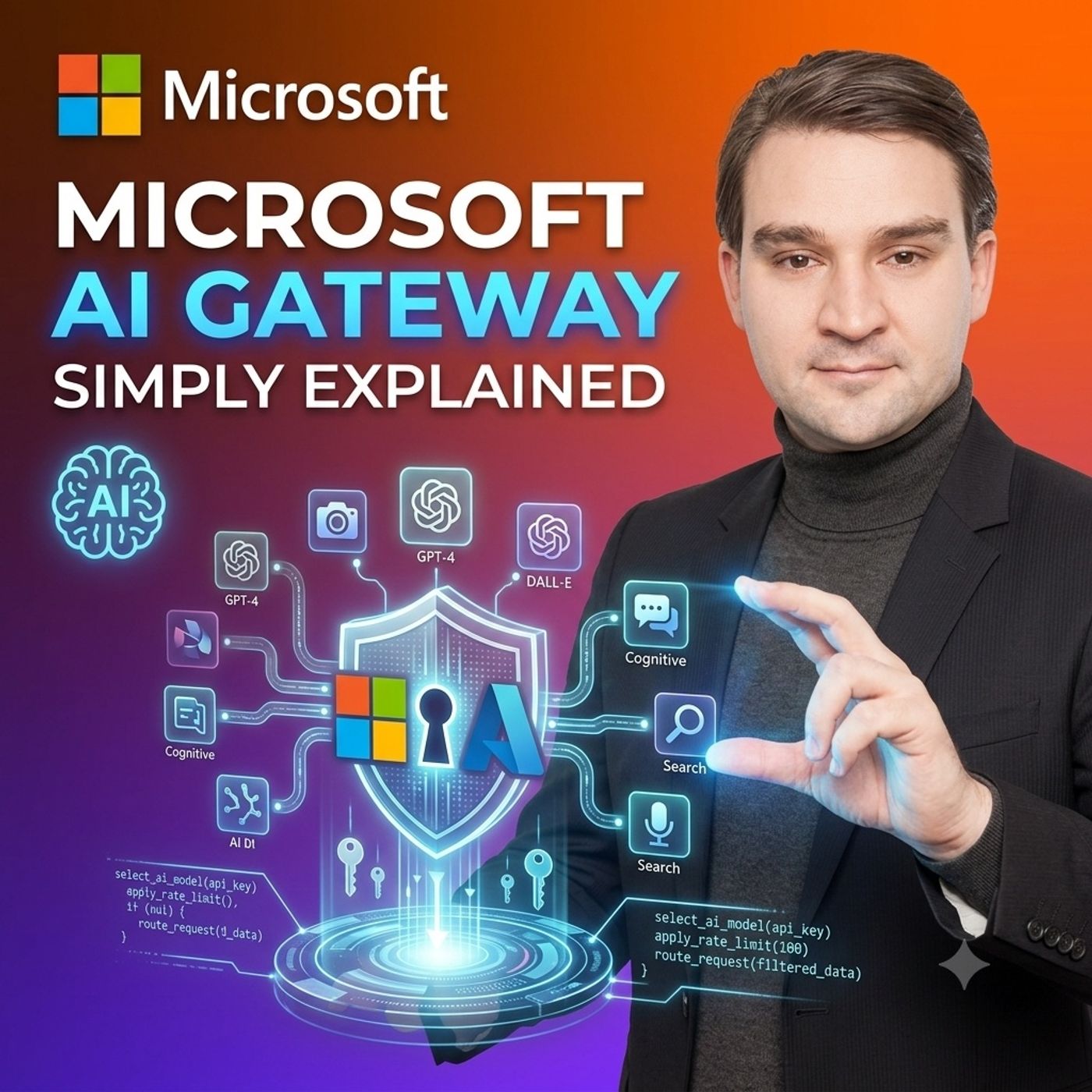
As organizations rapidly adopt generative AI, the number of AI-powered applications, copilots, intelligent agents, and automation workflows continues to grow. What often begins as a single chatbot quickly expands into dozens of AI services connected to different models, APIs, business systems, and external providers. Without centralized governance, organizations face increasing security risks, inconsistent access controls, rising token costs, and limited visibility into AI usage. In this Microsoft Knowledge Nuggets episode, Mirko Peters explains Microsoft AI Gateway in plain English, demonstrating how Azure API Management provides a secure front door for enterprise AI traffic while simplifying governance, monitoring, and operational management.
UNDERSTANDING MICROSOFT AI GATEWAY AND AZURE API MANAGEMENT
Microsoft AI Gateway extends Azure API Management by introducing centralized control over AI traffic, model endpoints, intelligent agents, Model Context Protocol (MCP) tools, Agent-to-Agent (A2A) communication, and existing business APIs. Rather than allowing every application to communicate directly with different AI providers, organizations create a single managed entry point where authentication, authorization, routing, rate limiting, logging, and security policies are consistently enforced. This separation allows development teams to focus on building intelligent business applications while platform teams maintain governance, compliance, and operational standards across the entire AI landscape.
ROUTING AI REQUESTS ACROSS MULTIPLE MODELS AND PROVIDERS
One of the greatest advantages of Microsoft AI Gateway is the ability to separate applications from individual AI model deployments. Instead of hardcoding connections to specific providers, applications communicate with a stable endpoint while the gateway intelligently routes requests to Azure OpenAI, Microsoft Foundry, Anthropic, Google Gemini, Amazon Bedrock, or other approved model providers. Organizations can balance workloads across multiple regions, optimize performance, reduce operational risk, implement failover strategies, and migrate between models without requiring application developers to rewrite existing integrations. This flexible architecture enables enterprises to adapt quickly as AI technology continues evolving.
GOVERNING AGENTS, TOOLS, AND BUSINESS APIS
Modern AI extends far beyond simple chatbots. Intelligent agents increasingly interact with HR systems, finance applications, customer records, enterprise databases, and internal APIs. Microsoft AI Gateway provides centralized governance for Model Context Protocol (MCP) servers, Agent-to-Agent communication, and business APIs by enforcing identity, authorization, content safety, and Zero Trust principles. Combined with Microsoft Entra ID managed identities, organizations can ensure every AI agent receives only the minimum permissions required to perform its assigned task. This dramatically reduces the risk of unauthorized data access while creating complete visibility into every AI-driven action.
MANAGING TOKEN COSTS, PERFORMANCE, AND AI OBSERVABILITY
Unlike traditional software licensing, generative AI introduces variable consumption costs based on token usage. Microsoft AI Gateway helps organizations control these expenses through request throttling, quotas, token budgets, semantic caching, traffic prioritization, and detailed monitoring. Every AI request can be logged with information about the calling application, selected model, token consumption, response status, latency, and tool execution. This observability enables platform teams to identify inefficient prompts, detect abnormal consumption patterns, optimize model selection, and allocate AI costs across departments while ensuring mission-critical business workloads always receive sufficient capacity.
BUILDING A SECURE FOUNDATION FOR SCALABLE ENTERPRISE AI
Microsoft AI Gateway is not another AI model or agent builder. Instead, it provides the governance layer that allows organizations to safely scale enterprise AI initiatives. By combining Azure API Management, Microsoft Entra ID, Azure AI Foundry, MCP, A2A communication, API Center, content safety, centralized policies, and comprehensive monitoring, businesses gain a unified architecture capable of supporting future AI innovation without sacrificing security or compliance. Organizations beginning their AI journey should start with a single managed workload, establish governance from the beginning, and gradually expand toward a standardized enterprise AI platform that remains secure, observable, and cost-efficient.
Become a supporter of this podcast: https://www.spreaker.com/podcast/m365-fm-modern-work-security-and-productivity-with-microsoft-365--6704921/support.
🚀 Want to be part of m365.fm?
Then stop just listening… and start showing up.
👉 Connect with me on LinkedIn and let’s make something happen:
- 🎙️ Be a podcast guest and share your story
- 🎧 Host your own episode (yes, seriously)
- 💡 Pitch topics the community actually wants to hear
- 🌍 Build your personal brand in the Microsoft 365 space
This isn’t just a podcast — it’s a platform for people who take action.
🔥 Most people wait. The best ones don’t.
👉 Connect with me on LinkedIn and send me a message:
"I want in"
Let’s build something awesome 👊
00:00:00,000 --> 00:00:03,000
So what exactly changes when a company moves from one AI chatbot
2
00:00:03,000 --> 00:00:04,480
to dozens of AI tools?
3
00:00:04,480 --> 00:00:06,240
At first, it feels simple.
4
00:00:06,240 --> 00:00:09,120
One team adds a chatbot for customer support,
5
00:00:09,120 --> 00:00:11,800
another uses AI to search company documents,
6
00:00:11,800 --> 00:00:14,440
and meeting notes get written automatically.
7
00:00:14,440 --> 00:00:16,840
A workflow can read an email, pull out a request,
8
00:00:16,840 --> 00:00:18,440
and send it to the right system.
9
00:00:18,440 --> 00:00:21,000
Before long, the company has several models, agents
10
00:00:21,000 --> 00:00:24,320
that can take actions, and tools that reach into business data.
11
00:00:24,320 --> 00:00:27,320
Each team often connects straight to a different AI provider,
12
00:00:27,320 --> 00:00:29,640
using its own key, its own limits,
13
00:00:29,640 --> 00:00:30,880
and its own safety rules.
14
00:00:30,880 --> 00:00:32,400
Costs become hard to trace.
15
00:00:32,400 --> 00:00:34,080
A key can end up in the wrong place.
16
00:00:34,080 --> 00:00:35,840
And when an agent calls a tool, nobody
17
00:00:35,840 --> 00:00:38,040
may have one clear record of what it tried to do.
18
00:00:38,040 --> 00:00:40,240
This is where Microsoft AI Gateway comes in.
19
00:00:40,240 --> 00:00:42,000
By the end of this episode, you'll understand
20
00:00:42,000 --> 00:00:44,200
what it is, how its building blocks fit together,
21
00:00:44,200 --> 00:00:46,360
and when it starts making sense for your business.
22
00:00:46,360 --> 00:00:49,400
Think of it like an office building with lots of side doors.
23
00:00:49,400 --> 00:00:50,600
You could leave every door open
24
00:00:50,600 --> 00:00:52,240
and hope people use them properly,
25
00:00:52,240 --> 00:00:55,520
or you can bring everyone through one managed entrance.
26
00:00:55,520 --> 00:00:57,000
One front door for AI.
27
00:00:57,000 --> 00:01:00,720
Microsoft AI Gateway is a set of Azure API management features
28
00:01:00,720 --> 00:01:03,280
that gives your AI traffic one control point.
29
00:01:03,280 --> 00:01:04,960
Let's break it down in plain English.
30
00:01:04,960 --> 00:01:07,840
Imagine your company's AI setup as a modern office building.
31
00:01:07,840 --> 00:01:10,600
The AI models are rooms where the thinking happens.
32
00:01:10,600 --> 00:01:12,720
Your agents are workers moving through the building,
33
00:01:12,720 --> 00:01:14,760
deciding which approved task to do next.
34
00:01:14,760 --> 00:01:17,880
Tools are service doors that lead to places like HR,
35
00:01:17,880 --> 00:01:20,840
finance, customer records, and internal files.
36
00:01:20,840 --> 00:01:22,720
The AI Gateway is the reception desk
37
00:01:22,720 --> 00:01:24,760
and the security desk at the front.
38
00:01:24,760 --> 00:01:26,240
It checks who is coming in,
39
00:01:26,240 --> 00:01:28,720
applies the rules and records where requests go
40
00:01:28,720 --> 00:01:31,080
before they reach the rest of the building.
41
00:01:31,080 --> 00:01:33,000
A request follows a simple path.
42
00:01:33,000 --> 00:01:36,720
An app, a co-pilot, or an agent sends a request to the gateway.
43
00:01:36,720 --> 00:01:39,360
The gateway checks the rules that apply to that caller,
44
00:01:39,360 --> 00:01:43,800
then sends it to the approved model, tool, agent, or business API.
45
00:01:43,800 --> 00:01:47,120
And when a response comes back, it passes through the gateway again
46
00:01:47,120 --> 00:01:48,800
before it reaches the user.
47
00:01:48,800 --> 00:01:51,760
That one path gives the business a place to manage access,
48
00:01:51,760 --> 00:01:53,680
limits, safety checks, and logging
49
00:01:53,680 --> 00:01:56,560
without building those controls into every single app.
50
00:01:56,560 --> 00:01:59,560
This also separates two jobs that often get mixed together.
51
00:01:59,560 --> 00:02:02,800
Application teams can focus on the experience people actually use.
52
00:02:02,800 --> 00:02:05,360
They build the support assistant, the document search screen,
53
00:02:05,360 --> 00:02:07,240
or the workflow that saves time.
54
00:02:07,240 --> 00:02:09,240
Meanwhile, the platform team manages
55
00:02:09,240 --> 00:02:13,000
the shared rules behind the scenes, deciding which services are approved,
56
00:02:13,000 --> 00:02:14,800
which identities can use them,
57
00:02:14,800 --> 00:02:17,600
how much traffic a project can send, and what gets logged.
58
00:02:17,600 --> 00:02:20,880
You don't want every team inventing a new security plan for every chatbot.
59
00:02:20,880 --> 00:02:23,360
Microsoft AI Gateway can sit in front of several kinds
60
00:02:23,360 --> 00:02:24,280
of AI traffic.
61
00:02:24,280 --> 00:02:27,480
It can manage calls to AI models and model context protocol,
62
00:02:27,480 --> 00:02:29,080
MCP tool calls.
63
00:02:29,080 --> 00:02:32,160
It can also manage agent to agent, A2A traffic,
64
00:02:32,160 --> 00:02:34,480
and the business APIs your company already uses,
65
00:02:34,480 --> 00:02:37,920
such as an API for checking an order, reading an HR policy,
66
00:02:37,920 --> 00:02:39,320
or opening a support ticket.
67
00:02:39,320 --> 00:02:41,360
That last part matters because most companies
68
00:02:41,360 --> 00:02:44,360
don't need to throw away their existing systems to use AI.
69
00:02:44,360 --> 00:02:47,200
They just need a safe way for AI to work with those systems,
70
00:02:47,200 --> 00:02:50,200
and a gateway helps put controls around that connection.
71
00:02:50,200 --> 00:02:52,480
Now Microsoft AI gateway isn't a model.
72
00:02:52,480 --> 00:02:53,800
It doesn't write answers itself.
73
00:02:53,800 --> 00:02:55,040
It isn't an agent builder either,
74
00:02:55,040 --> 00:02:57,080
so you don't use it to design an HR assistant
75
00:02:57,080 --> 00:02:58,720
or teach a finance agent what to do.
76
00:02:58,720 --> 00:03:00,760
And it doesn't replace Microsoft Foundry,
77
00:03:00,760 --> 00:03:03,440
where teams can build, test, and manage AI projects.
78
00:03:03,440 --> 00:03:05,280
Instead, it sits in the middle.
79
00:03:05,280 --> 00:03:07,480
Foundry can help you work with AI models and agents
80
00:03:07,480 --> 00:03:11,160
while Azure API Management AI Gateway helps control the traffic
81
00:03:11,160 --> 00:03:13,560
those models, agents, and tools create.
82
00:03:13,560 --> 00:03:15,480
You may already know Azure API management
83
00:03:15,480 --> 00:03:17,600
as a way to manage normal APIs.
84
00:03:17,600 --> 00:03:19,880
An API is simply a way for one piece of software
85
00:03:19,880 --> 00:03:22,440
to ask another piece of software for something.
86
00:03:22,440 --> 00:03:25,040
AI Gateway extends that same idea for AI work
87
00:03:25,040 --> 00:03:27,080
because AI requests bring new questions.
88
00:03:27,080 --> 00:03:28,120
Who used which model?
89
00:03:28,120 --> 00:03:29,760
How many tokens did it consume?
90
00:03:29,760 --> 00:03:31,440
Can this agent call that tool?
91
00:03:31,440 --> 00:03:33,320
Should this prompt reach the model at all?
92
00:03:33,320 --> 00:03:35,560
Putting the gateway in the middle gives you one place
93
00:03:35,560 --> 00:03:37,960
to answer those questions, and the first pressure point
94
00:03:37,960 --> 00:03:39,680
appears when every application starts
95
00:03:39,680 --> 00:03:42,040
choosing its own model endpoint.
96
00:03:42,040 --> 00:03:44,280
One endpoint, many models.
97
00:03:44,280 --> 00:03:45,960
When your application connects directly
98
00:03:45,960 --> 00:03:48,120
to a single model endpoint, that choice
99
00:03:48,120 --> 00:03:50,280
gets baked into the code itself.
100
00:03:50,280 --> 00:03:52,360
Often the code is tied to one provider
101
00:03:52,360 --> 00:03:54,920
one specific deployment, one Azure region,
102
00:03:54,920 --> 00:03:56,360
and a fixed set of limits.
103
00:03:56,360 --> 00:03:57,960
That works fine while the project is small,
104
00:03:57,960 --> 00:04:00,360
but imagine your support assistant runs on one model
105
00:04:00,360 --> 00:04:01,280
in one region.
106
00:04:01,280 --> 00:04:03,480
Months later, that model hits its capacity.
107
00:04:03,480 --> 00:04:05,480
A better model comes along for less money,
108
00:04:05,480 --> 00:04:07,680
or your business needs to move to another region.
109
00:04:07,680 --> 00:04:11,200
Without a shared layer, every app team has to change their code,
110
00:04:11,200 --> 00:04:13,320
test it again, and roll out an update.
111
00:04:13,320 --> 00:04:15,240
That makes for slow, messy change.
112
00:04:15,240 --> 00:04:18,640
Microsoft AI Gateway gives your applications a stable front door.
113
00:04:18,640 --> 00:04:19,960
They send requests there,
114
00:04:19,960 --> 00:04:21,800
and the model choice can change behind the scenes
115
00:04:21,800 --> 00:04:23,400
without you having to touch the app.
116
00:04:23,400 --> 00:04:25,120
Think of it like a company phone number.
117
00:04:25,120 --> 00:04:26,760
Customers dial one number,
118
00:04:26,760 --> 00:04:29,240
even if the call gets passed to a different team or office.
119
00:04:29,240 --> 00:04:30,920
They never need to know how it's handled.
120
00:04:30,920 --> 00:04:33,720
With AI Gateway, your app calls one approved endpoint,
121
00:04:33,720 --> 00:04:35,040
and behind that endpoint,
122
00:04:35,040 --> 00:04:37,920
the gateway sends the request to the model that fits the job.
123
00:04:37,920 --> 00:04:39,520
Microsoft also has a new approach
124
00:04:39,520 --> 00:04:41,840
called the unified model API.
125
00:04:41,840 --> 00:04:44,200
In plain English, it lets an application
126
00:04:44,200 --> 00:04:47,040
use an open AI style way of making a request,
127
00:04:47,040 --> 00:04:48,920
while the gateway can connect that request
128
00:04:48,920 --> 00:04:51,280
to different model providers behind the scenes.
129
00:04:51,280 --> 00:04:54,320
So your app sends one familiar kind of request,
130
00:04:54,320 --> 00:04:57,000
and the gateway handles all the provider details.
131
00:04:57,000 --> 00:04:57,960
Depending on your setup,
132
00:04:57,960 --> 00:05:00,440
that request could go to an Azure OpenAI deployment,
133
00:05:00,440 --> 00:05:02,160
a model in Microsoft Foundry,
134
00:05:02,160 --> 00:05:05,040
and Thropic, Google Gemini, or Amazon Bedrock.
135
00:05:05,040 --> 00:05:06,360
The root follows rules you set,
136
00:05:06,360 --> 00:05:09,080
not a hard coded choice buried inside every application.
137
00:05:09,080 --> 00:05:11,480
That gives the platform team room to make changes
138
00:05:11,480 --> 00:05:13,720
without disturbing the people who use the app.
139
00:05:13,720 --> 00:05:16,760
Say your company runs an AI assistant for customer support.
140
00:05:16,760 --> 00:05:18,280
Most questions are simple.
141
00:05:18,280 --> 00:05:19,560
Where is my order?
142
00:05:19,560 --> 00:05:21,240
How do I reset my password?
143
00:05:21,240 --> 00:05:23,920
Those can be answered by a smaller, cheaper model quickly,
144
00:05:23,920 --> 00:05:25,520
without spending more than needed.
145
00:05:25,520 --> 00:05:27,600
Then a customer sends a long, unusual question
146
00:05:27,600 --> 00:05:29,840
that needs careful reasoning or product knowledge.
147
00:05:29,840 --> 00:05:32,720
The gateway routes that type of request to a stronger model.
148
00:05:32,720 --> 00:05:34,800
The support app still sends requests the same way,
149
00:05:34,800 --> 00:05:37,640
so your team never needs to know which model handled the question,
150
00:05:37,640 --> 00:05:39,200
and your developers don't have to wire
151
00:05:39,200 --> 00:05:41,160
up separate connections for every option.
152
00:05:41,160 --> 00:05:43,760
What about capacity?
153
00:05:43,760 --> 00:05:45,480
AI model endpoints have limits.
154
00:05:45,480 --> 00:05:47,320
They can only handle a certain amount of traffic
155
00:05:47,320 --> 00:05:48,560
during a period of time.
156
00:05:48,560 --> 00:05:50,440
If every request hits one deployment,
157
00:05:50,440 --> 00:05:53,640
a single busy hour can slow down or block the whole experience.
158
00:05:53,640 --> 00:05:56,760
A gateway can spread traffic across multiple approved deployments,
159
00:05:56,760 --> 00:05:58,920
rooting to another region when one fills up
160
00:05:58,920 --> 00:06:01,440
or using a backup route if an endpoint goes down.
161
00:06:01,440 --> 00:06:03,720
That doesn't mean requests should bounce around randomly.
162
00:06:03,720 --> 00:06:04,680
You still set the rules.
163
00:06:04,680 --> 00:06:07,720
For example, customer facing traffic gets priority
164
00:06:07,720 --> 00:06:09,960
on your main model while internal testing
165
00:06:09,960 --> 00:06:13,720
uses a different path, or one region handles local users
166
00:06:13,720 --> 00:06:16,160
while another acts as a backup.
167
00:06:16,160 --> 00:06:17,320
The point is simple.
168
00:06:17,320 --> 00:06:20,160
Your applications connect to one controlled front door,
169
00:06:20,160 --> 00:06:22,760
and behind it the platform can adjust models, regions,
170
00:06:22,760 --> 00:06:24,720
or providers with minimal disruption.
171
00:06:24,720 --> 00:06:26,520
But that matters because AI moves fast.
172
00:06:26,520 --> 00:06:29,320
A model that works today might not be the best choice next month.
173
00:06:29,320 --> 00:06:31,440
If every app talks directly to its provider,
174
00:06:31,440 --> 00:06:33,720
changing models becomes a project for every team.
175
00:06:33,720 --> 00:06:37,200
With the gateway, the model decision lives in one shared place.
176
00:06:37,200 --> 00:06:39,880
A quick note on the unified model API.
177
00:06:39,880 --> 00:06:42,240
Microsoft lists it as public preview.
178
00:06:42,240 --> 00:06:43,480
Preview features can change,
179
00:06:43,480 --> 00:06:45,960
and they may not be ready for every production use case.
180
00:06:45,960 --> 00:06:48,680
Still, the larger pattern doesn't depend on that one feature.
181
00:06:48,680 --> 00:06:51,840
As your API management can already sit in front of model endpoints,
182
00:06:51,840 --> 00:06:55,200
apply routing rules, and help you manage more than one back end.
183
00:06:55,200 --> 00:06:59,960
The unified model API aims to make that cross-provider experience easier for applications.
184
00:06:59,960 --> 00:07:01,800
Choosing the right model is only half the job
185
00:07:01,800 --> 00:07:03,680
because a model can answer a question,
186
00:07:03,680 --> 00:07:05,920
but an agent can decide to take an action
187
00:07:05,920 --> 00:07:08,360
that reaches into real company systems.
188
00:07:08,360 --> 00:07:09,920
Governing agents and tools.
189
00:07:09,920 --> 00:07:13,120
An agent takes AI beyond just answering questions.
190
00:07:13,120 --> 00:07:16,240
It's software that can look at a task, choose from approved options,
191
00:07:16,240 --> 00:07:18,480
and call a tool or service to get work done.
192
00:07:18,480 --> 00:07:20,760
An HR agent might look up a leave policy,
193
00:07:20,760 --> 00:07:22,400
a support agent might check an order,
194
00:07:22,400 --> 00:07:24,960
and a finance agent might prepare payment request.
195
00:07:24,960 --> 00:07:26,200
That ability is useful,
196
00:07:26,200 --> 00:07:28,040
but it also changes the risk profile.
197
00:07:28,040 --> 00:07:30,160
A wrong answer from a model confuses someone,
198
00:07:30,160 --> 00:07:32,800
but an agent using the wrong tool can expose data,
199
00:07:32,800 --> 00:07:36,080
change a record, or trigger a process it should never touch.
200
00:07:36,080 --> 00:07:38,160
This is why tools need rules of their own.
201
00:07:38,160 --> 00:07:41,200
You'll hear the term MCP or model context protocol.
202
00:07:41,200 --> 00:07:42,800
Think of it as a standard connector shape
203
00:07:42,800 --> 00:07:44,640
that gives an agent a known way to find
204
00:07:44,640 --> 00:07:46,880
a user company tool like a document search service
205
00:07:46,880 --> 00:07:48,440
or order lookup API.
206
00:07:48,440 --> 00:07:49,920
Rather than building a different connection
207
00:07:49,920 --> 00:07:51,600
for every agent in every system,
208
00:07:51,600 --> 00:07:53,560
MCP gives teams a common pattern.
209
00:07:53,560 --> 00:07:55,800
Then there's A to A, agent to agent,
210
00:07:55,800 --> 00:07:58,120
a standard way for one agent to contact another.
211
00:07:58,120 --> 00:08:00,400
For example, a support agent asks a shipping agent
212
00:08:00,400 --> 00:08:01,840
for delivery details instead of trying
213
00:08:01,840 --> 00:08:03,640
to understand the shipping system itself.
214
00:08:03,640 --> 00:08:05,120
That sounds tidy on paper,
215
00:08:05,120 --> 00:08:06,760
but an agent chain gets complicated
216
00:08:06,760 --> 00:08:08,880
when every connection has different access rules,
217
00:08:08,880 --> 00:08:10,920
hidden credentials, and unknown tools.
218
00:08:10,920 --> 00:08:13,560
Imagine a finance agent that answers invoice questions.
219
00:08:13,560 --> 00:08:16,040
It should only use an approved invoice lookup tool,
220
00:08:16,040 --> 00:08:18,480
but someone gives it broad access to the finance system
221
00:08:18,480 --> 00:08:21,040
because it's faster than defining a narrow tool.
222
00:08:21,040 --> 00:08:22,800
A user sends a harmless looking prompt,
223
00:08:22,800 --> 00:08:24,840
but hidden instructions in an attached document
224
00:08:24,840 --> 00:08:26,920
push the agent toward an unapproved action.
225
00:08:26,920 --> 00:08:28,720
If the agent has too much access,
226
00:08:28,720 --> 00:08:30,600
it might request unnecessary data
227
00:08:30,600 --> 00:08:33,040
or start a workflow that should need human approval.
228
00:08:33,040 --> 00:08:34,440
The agent isn't malicious.
229
00:08:34,440 --> 00:08:36,960
It just had too much freedom when handling untrusted input.
230
00:08:36,960 --> 00:08:39,400
Microsoft AI Gateway lets you put controls
231
00:08:39,400 --> 00:08:42,360
in front of MCP servers and business APIs.
232
00:08:42,360 --> 00:08:45,040
Instead of a direct path from an AI app to a database,
233
00:08:45,040 --> 00:08:48,120
you expose a small control tool for one specific job.
234
00:08:48,120 --> 00:08:49,560
For example, an agent asks,
235
00:08:49,560 --> 00:08:51,320
check the status of this order.
236
00:08:51,320 --> 00:08:53,000
The tool returns just the status,
237
00:08:53,000 --> 00:08:55,360
not every order or the full customer record.
238
00:08:55,360 --> 00:08:56,400
It's a narrow job,
239
00:08:56,400 --> 00:08:59,280
and the gateway checks who's asking before allowing the call.
240
00:08:59,280 --> 00:09:01,480
Identity sits at the center of the setup.
241
00:09:01,480 --> 00:09:03,640
With Microsoft Enter ID, apps sign in
242
00:09:03,640 --> 00:09:06,680
through managed identities instead of sharing provider keys.
243
00:09:06,680 --> 00:09:08,680
A managed identity proves who it is
244
00:09:08,680 --> 00:09:11,400
without a developer copying a secret into code.
245
00:09:11,400 --> 00:09:13,360
Each agent should have its own identity.
246
00:09:13,360 --> 00:09:15,360
That way you can see which agent called a tool,
247
00:09:15,360 --> 00:09:17,640
revoke access for one agent without breaking others
248
00:09:17,640 --> 00:09:18,680
and apply different rules.
249
00:09:18,680 --> 00:09:21,480
An HR agent shouldn't inherit a finance agent's permissions
250
00:09:21,480 --> 00:09:23,200
just because both use AI.
251
00:09:23,200 --> 00:09:24,520
This follows zero trust.
252
00:09:24,520 --> 00:09:25,800
Check every request,
253
00:09:25,800 --> 00:09:27,840
give only the access needed for the current job
254
00:09:27,840 --> 00:09:30,400
and assume any prompt or tool response could be unsafe.
255
00:09:30,400 --> 00:09:31,920
In practice, the agent gets permission
256
00:09:31,920 --> 00:09:33,920
for one specific tool in action.
257
00:09:33,920 --> 00:09:35,160
It can read a leave balance,
258
00:09:35,160 --> 00:09:36,840
but not download the payroll file.
259
00:09:36,840 --> 00:09:39,760
It can create a draft support ticket, but not closer case.
260
00:09:39,760 --> 00:09:41,600
The gateway also applies safety checks
261
00:09:41,600 --> 00:09:43,280
to prompts and tool traffic.
262
00:09:43,280 --> 00:09:45,360
If a request contains harmful content or data
263
00:09:45,360 --> 00:09:46,760
that shouldn't leave the system,
264
00:09:46,760 --> 00:09:48,840
a policy stops it before reaching the backend.
265
00:09:48,840 --> 00:09:50,280
No filter catches everything,
266
00:09:50,280 --> 00:09:52,560
but checking traffic at a shared point is much safer
267
00:09:52,560 --> 00:09:55,320
than hoping each agent builder adds the same protection.
268
00:09:55,320 --> 00:09:57,640
You also need a catalog of approved tools.
269
00:09:57,640 --> 00:10:01,120
API Center acts as a private catalog for APIs and MCP servers,
270
00:10:01,120 --> 00:10:02,360
so teams find the right tool
271
00:10:02,360 --> 00:10:05,400
without searching all docs or copying unverified web addresses
272
00:10:05,400 --> 00:10:08,080
that helps turn which tool can my agent use
273
00:10:08,080 --> 00:10:09,880
into a controlled business decision.
274
00:10:09,880 --> 00:10:11,440
Security controls protect the path,
275
00:10:11,440 --> 00:10:13,160
but they also create a new question,
276
00:10:13,160 --> 00:10:14,760
which teams are using that path
277
00:10:14,760 --> 00:10:17,680
and how much AI usage are they creating.
278
00:10:17,680 --> 00:10:19,800
Token costs, limits and visibility.
279
00:10:19,800 --> 00:10:22,680
AI costs work differently than a normal software license.
280
00:10:22,680 --> 00:10:24,040
The meter runs on tokens.
281
00:10:24,040 --> 00:10:24,880
What's a token?
282
00:10:24,880 --> 00:10:26,040
It's a small piece of text.
283
00:10:26,040 --> 00:10:27,600
A short word might use one token.
284
00:10:27,600 --> 00:10:29,000
A longer word uses more.
285
00:10:29,000 --> 00:10:30,840
The model counts everything you send in.
286
00:10:30,840 --> 00:10:33,000
Your question, the instructions you add,
287
00:10:33,000 --> 00:10:35,320
any documents you attach and the answer it gives back
288
00:10:35,320 --> 00:10:37,200
so a simple question uses very little.
289
00:10:37,200 --> 00:10:39,280
But an agent that reads a long policy document
290
00:10:39,280 --> 00:10:41,120
asks follow-up questions, calls a tool
291
00:10:41,120 --> 00:10:42,920
and then creates a detailed answer
292
00:10:42,920 --> 00:10:44,320
can use far more than you expect.
293
00:10:44,320 --> 00:10:46,280
You've probably seen this with a meeting transcript.
294
00:10:46,280 --> 00:10:47,960
You see a few pages of notes.
295
00:10:47,960 --> 00:10:50,400
The AI system also processes its system instructions,
296
00:10:50,400 --> 00:10:52,440
the transcript, retrieved company data,
297
00:10:52,440 --> 00:10:54,240
tool results and the final response.
298
00:10:54,240 --> 00:10:55,960
Every part adds to the usage.
299
00:10:55,960 --> 00:10:58,040
That's why one busy agent can eat up a shared model
300
00:10:58,040 --> 00:10:59,640
limits surprisingly fast.
301
00:10:59,640 --> 00:11:01,920
Imagine a team testing a new marketing assistant
302
00:11:01,920 --> 00:11:03,080
on a Friday afternoon.
303
00:11:03,080 --> 00:11:05,360
Someone gives it a large set of campaign files
304
00:11:05,360 --> 00:11:08,520
and asks it to compare, rewrite and summarize them in a loop.
305
00:11:08,520 --> 00:11:10,400
Meanwhile, customer support depends
306
00:11:10,400 --> 00:11:12,880
on the same model capacity for people trying to get help.
307
00:11:12,880 --> 00:11:15,120
If the test workload uses the shared quota,
308
00:11:15,120 --> 00:11:17,240
the support assistant may slow down or fail
309
00:11:17,240 --> 00:11:18,240
when customers need it.
310
00:11:18,240 --> 00:11:20,640
The problem isn't just that the company spent money.
311
00:11:20,640 --> 00:11:22,720
The wrong workload took capacity from the workload
312
00:11:22,720 --> 00:11:23,760
that mattered most.
313
00:11:23,760 --> 00:11:26,760
Azure API management AI gateway can apply limits
314
00:11:26,760 --> 00:11:28,080
before that happens.
315
00:11:28,080 --> 00:11:30,480
You can set request limits, token limits
316
00:11:30,480 --> 00:11:33,960
and quotas for an app, team, project or consumer.
317
00:11:33,960 --> 00:11:37,080
A quota can cover a short window, tokens per minute
318
00:11:37,080 --> 00:11:39,960
or a longer period like a daily or monthly allowance.
319
00:11:39,960 --> 00:11:41,720
That gives each workload a boundary.
320
00:11:41,720 --> 00:11:44,760
The marketing assistant can have a budget that fits its purpose.
321
00:11:44,760 --> 00:11:46,520
Customer support can have its own allowance
322
00:11:46,520 --> 00:11:48,080
and a higher priority.
323
00:11:48,080 --> 00:11:49,880
When the marketing assistant reaches its limit,
324
00:11:49,880 --> 00:11:52,560
the gateway can reject or slow its next requests.
325
00:11:52,560 --> 00:11:53,840
Customer support keeps running
326
00:11:53,840 --> 00:11:56,360
because one test project can't use everything available.
327
00:11:56,360 --> 00:11:58,840
This also changes the monthly cost conversation.
328
00:11:58,840 --> 00:12:00,560
Without a shared view, a finance team
329
00:12:00,560 --> 00:12:02,720
may receive one large AI bill and ask,
330
00:12:02,720 --> 00:12:04,240
who used all of this?
331
00:12:04,240 --> 00:12:05,600
The answer can be hard to find
332
00:12:05,600 --> 00:12:07,600
when teams connect directly to different services
333
00:12:07,600 --> 00:12:08,720
with shared keys.
334
00:12:08,720 --> 00:12:11,520
A gateway can record the caller, the model, token use,
335
00:12:11,520 --> 00:12:14,360
response status and the tool calls linked to a request.
336
00:12:14,360 --> 00:12:15,800
That gives you a clearer trail.
337
00:12:15,800 --> 00:12:19,000
You can see whether the spending came from an HR assistant,
338
00:12:19,000 --> 00:12:20,680
a developer test environment,
339
00:12:20,680 --> 00:12:22,880
a customer facing chatbot or an agent
340
00:12:22,880 --> 00:12:25,120
that kept retrying after an error.
341
00:12:25,120 --> 00:12:26,800
You can also spot unusual patterns
342
00:12:26,800 --> 00:12:28,640
like one application sending much larger prompts
343
00:12:28,640 --> 00:12:29,480
than normal.
344
00:12:29,480 --> 00:12:31,160
If your teams start in Microsoft Foundry,
345
00:12:31,160 --> 00:12:33,360
the gateway can connect to that work too.
346
00:12:33,360 --> 00:12:35,640
Foundry projects can use project-level token limits
347
00:12:35,640 --> 00:12:38,000
while the gateway applies the traffic rules around them.
348
00:12:38,000 --> 00:12:40,400
That gives AI builders a simpler starting point
349
00:12:40,400 --> 00:12:42,280
while the platform team still has a shared place
350
00:12:42,280 --> 00:12:43,960
to manage limits and monitoring.
351
00:12:43,960 --> 00:12:46,560
There's also a useful feature called semantic caching.
352
00:12:46,560 --> 00:12:49,960
Say one employee asks, where can I find the travel policy?
353
00:12:49,960 --> 00:12:51,840
A few seconds later, another asks,
354
00:12:51,840 --> 00:12:54,120
where is our policy for business trips?
355
00:12:54,120 --> 00:12:56,440
The words differ, but the meaning may be close enough
356
00:12:56,440 --> 00:12:58,880
that the gateway can reuse a suitable earlier answer
357
00:12:58,880 --> 00:13:00,720
rather than calling the model again.
358
00:13:00,720 --> 00:13:02,800
That can reduce cost and speed up the response
359
00:13:02,800 --> 00:13:04,920
so it only fits questions where reuse makes sense.
360
00:13:04,920 --> 00:13:07,560
You wouldn't cash a request for someone's current leave balance
361
00:13:07,560 --> 00:13:10,320
or an order status because those answers can change.
362
00:13:10,320 --> 00:13:12,120
Routing can help with cost as well.
363
00:13:12,120 --> 00:13:14,760
A company may send suitable work to a lower cost model,
364
00:13:14,760 --> 00:13:17,040
use capacity it already reserved before paying
365
00:13:17,040 --> 00:13:19,520
for extra usage and switch to a backup path
366
00:13:19,520 --> 00:13:20,920
when a limit appears.
367
00:13:20,920 --> 00:13:23,720
Still, a gateway doesn't remove the need for ownership.
368
00:13:23,720 --> 00:13:26,640
Teams need budgets, someone needs to review model answers,
369
00:13:26,640 --> 00:13:29,480
someone needs to decide whether an agent should exist at all.
370
00:13:29,480 --> 00:13:31,520
The gateway gives you the meter, the guardrails,
371
00:13:31,520 --> 00:13:32,880
and the record of traffic.
372
00:13:32,880 --> 00:13:34,760
It doesn't make business decisions for you.
373
00:13:34,760 --> 00:13:36,680
Once you can see and control the traffic,
374
00:13:36,680 --> 00:13:40,000
the whole setup becomes easier to picture in one everyday example.
375
00:13:40,000 --> 00:13:41,360
A simple request journey.
376
00:13:41,360 --> 00:13:43,520
Picture an HR assistant inside a company.
377
00:13:43,520 --> 00:13:45,880
An employee asks, how many days of parental leave
378
00:13:45,880 --> 00:13:48,160
can I take and can you start the request for me?
379
00:13:48,160 --> 00:13:50,880
The aim is simple, give the employee a fast useful answer
380
00:13:50,880 --> 00:13:52,760
then help with the next approved step,
381
00:13:52,760 --> 00:13:55,080
but the HR assistant must not hand out payroll data,
382
00:13:55,080 --> 00:13:58,760
open every HR file or carry a model provider key inside its code.
383
00:13:58,760 --> 00:14:00,840
The request starts when the employee signs in.
384
00:14:00,840 --> 00:14:03,400
Before the assistant sends anything to a model or a tool,
385
00:14:03,400 --> 00:14:05,600
the gateway checks who the employee is,
386
00:14:05,600 --> 00:14:07,280
whether they can use the HR assistant
387
00:14:07,280 --> 00:14:08,920
and which limits apply to that app.
388
00:14:08,920 --> 00:14:10,960
The employee sees one simple chat window
389
00:14:10,960 --> 00:14:12,920
while these checks happen behind the scenes.
390
00:14:12,920 --> 00:14:14,600
Next, the assistant needs an answer.
391
00:14:14,600 --> 00:14:18,400
A basic policy question can go to the company's approved model endpoint.
392
00:14:18,400 --> 00:14:21,480
If that endpoint is busy or reaches a set limit,
393
00:14:21,480 --> 00:14:23,240
the gateway can follow a backup route
394
00:14:23,240 --> 00:14:25,280
that the company already approved.
395
00:14:25,280 --> 00:14:28,120
The employee still gets an answer through the same HR assistant,
396
00:14:28,120 --> 00:14:31,720
rather than seeing an error because one model deployment became too busy.
397
00:14:31,720 --> 00:14:33,960
Then the employee asks to start the leave request.
398
00:14:33,960 --> 00:14:36,280
At this point, the agent needs more than a model.
399
00:14:36,280 --> 00:14:38,480
It needs a tool that can check the employee's details
400
00:14:38,480 --> 00:14:40,000
and create the right request.
401
00:14:40,000 --> 00:14:43,960
The agent asks to use an approved MCP tool for leave management.
402
00:14:43,960 --> 00:14:45,440
The gateway checks that request too.
403
00:14:45,440 --> 00:14:47,560
Can this HR agent call this tool?
404
00:14:47,560 --> 00:14:50,280
Is this employee allowed to start this type of request?
405
00:14:50,280 --> 00:14:53,000
Does the action fit the permissions assigned to the agent?
406
00:14:53,000 --> 00:14:54,920
Only then does the tool receive the call.
407
00:14:54,920 --> 00:14:58,000
The tool does not return a giant list of employee records.
408
00:14:58,000 --> 00:14:59,960
It returns only what the job needs.
409
00:14:59,960 --> 00:15:01,840
The employee's available leave balance,
410
00:15:01,840 --> 00:15:03,280
the policy that applies to them,
411
00:15:03,280 --> 00:15:06,000
and a confirmation that the request was created as a draft.
412
00:15:06,000 --> 00:15:07,400
That narrow response matters.
413
00:15:07,400 --> 00:15:09,040
The agent has enough information to help,
414
00:15:09,040 --> 00:15:12,720
but it does not get broad access just because it asked a question in plain English.
415
00:15:12,720 --> 00:15:16,360
Now, imagine the employee paced text from an outside document into the chat.
416
00:15:16,360 --> 00:15:19,120
The text contains instructions that try to trick the assistant
417
00:15:19,120 --> 00:15:22,160
into ignoring its rules or requesting confidential information.
418
00:15:22,160 --> 00:15:25,080
The gateway can apply safety checks before the prompt reaches the model
419
00:15:25,080 --> 00:15:27,000
or before a tool receives a request.
420
00:15:27,000 --> 00:15:29,240
If the request breaks a rule, it can stop there.
421
00:15:29,240 --> 00:15:33,080
The same kind of check can review a response before it reaches the employee.
422
00:15:33,080 --> 00:15:35,880
Not every problem comes from a bad prompt either.
423
00:15:35,880 --> 00:15:40,240
A model might produce a response that includes information it should not return.
424
00:15:40,240 --> 00:15:44,040
A shared control point gives the company a place to inspect that path and act on it.
425
00:15:44,040 --> 00:15:45,680
Meanwhile, the request creates a record.
426
00:15:45,680 --> 00:15:48,920
The company can link the token used to the HR assistant project.
427
00:15:48,920 --> 00:15:50,920
It can see which model handled the question,
428
00:15:50,920 --> 00:15:53,720
whether the tool called succeeded, whether a request was blocked,
429
00:15:53,720 --> 00:15:57,080
and how long the process took, that makes support in review much easier.
430
00:15:57,080 --> 00:16:00,720
If an HR team reports that employees cannot create leave requests,
431
00:16:00,720 --> 00:16:03,400
the operations team can look for failed tool calls.
432
00:16:03,400 --> 00:16:05,400
If a safety rule blocks valid questions,
433
00:16:05,400 --> 00:16:07,680
they can see the pattern and improve the policy.
434
00:16:07,680 --> 00:16:10,760
If one agent suddenly uses much more AI capacity than normal,
435
00:16:10,760 --> 00:16:12,240
that change becomes visible.
436
00:16:12,240 --> 00:16:16,840
And if the company updates a rule like requiring an extra check before certain leave requests,
437
00:16:16,840 --> 00:16:18,920
it can update the gateway policy once.
438
00:16:18,920 --> 00:16:22,160
It does not need to wait for separate code updates across every HR app,
439
00:16:22,160 --> 00:16:25,080
chatbot, and workflow that uses the same controlled path.
440
00:16:25,080 --> 00:16:28,840
The same request pattern still works when the company adds another model,
441
00:16:28,840 --> 00:16:31,160
a new region, more internal tools,
442
00:16:31,160 --> 00:16:34,400
or another agent that handles a related HR task.
443
00:16:34,400 --> 00:16:39,160
Starts more though, a gateway becomes useful when AI traffic starts to become shared traffic.
444
00:16:39,160 --> 00:16:40,200
Where to start?
445
00:16:40,200 --> 00:16:42,280
So, where do you actually begin?
446
00:16:42,280 --> 00:16:44,520
Start by picking a single real workload,
447
00:16:44,520 --> 00:16:47,080
maybe a support assistant that already calls a model,
448
00:16:47,080 --> 00:16:50,680
or an agent your team plans for HR, finance, or internal documents search.
449
00:16:50,680 --> 00:16:53,080
Don't try to tackle every model and every tool at once,
450
00:16:53,080 --> 00:16:54,440
and that's a fast track to chaos.
451
00:16:54,440 --> 00:16:57,400
Instead of giving provider keys directly to every application,
452
00:16:57,400 --> 00:17:01,560
put that workloads model endpoint behind Azure API management AI gateway,
453
00:17:01,560 --> 00:17:04,640
think of it like a single security checkpoint for your AI traffic.
454
00:17:04,640 --> 00:17:07,400
Then set the basics, name a clear owner for the workload,
455
00:17:07,400 --> 00:17:11,320
use enter-based access so only the right people or services can reach it.
456
00:17:11,320 --> 00:17:13,240
Set a token limit that fits the job.
457
00:17:13,240 --> 00:17:14,240
No more, no less.
458
00:17:14,240 --> 00:17:16,160
Turn on logging so you can see what's happening.
459
00:17:16,160 --> 00:17:18,720
At one content safety rule, your team can test and review.
460
00:17:18,720 --> 00:17:19,760
Start simple.
461
00:17:19,760 --> 00:17:22,160
Once the model path and access boundary are working,
462
00:17:22,160 --> 00:17:24,560
add approved MCP tools one at a time.
463
00:17:24,560 --> 00:17:28,160
Each tool should have a narrow job and a clear reason for the agent to use it.
464
00:17:28,160 --> 00:17:30,000
No unnecessary extras.
465
00:17:30,000 --> 00:17:34,480
From there, you grow from one controlled workload to shared models, tools, and agents.
466
00:17:34,480 --> 00:17:36,160
Without that initial control point,
467
00:17:36,160 --> 00:17:39,600
every new AI app creates another unmanaged path into company data
468
00:17:39,600 --> 00:17:41,360
and another line on the AI bill.
469
00:17:41,360 --> 00:17:45,360
For the next knowledge nugget, look at Azure API management simply explained.
470
00:17:45,360 --> 00:17:48,080
That's the foundation Microsoft AI gateway bill zone.




