Securing Intelligent Agents and MCP Tools in the Enterprise
Welcome back to our ongoing exploration of modern enterprise technology, cloud security, and artificial intelligence integration. As organizations worldwide race to implement generative AI, a profound shift is occurring in how digital work gets done. We are moving rapidly past the era of simple static chatbots that merely answer questions in an isolated chat window. Today, companies are deploying autonomous intelligent agents capable of reasoning, planning, executing multi-step workflows, and directly interacting with sensitive internal business databases, human resources systems, and financial ledgers. While this capability unlocks unprecedented levels of business productivity and innovation, it simultaneously introduces massive security, governance, and architectural challenges.
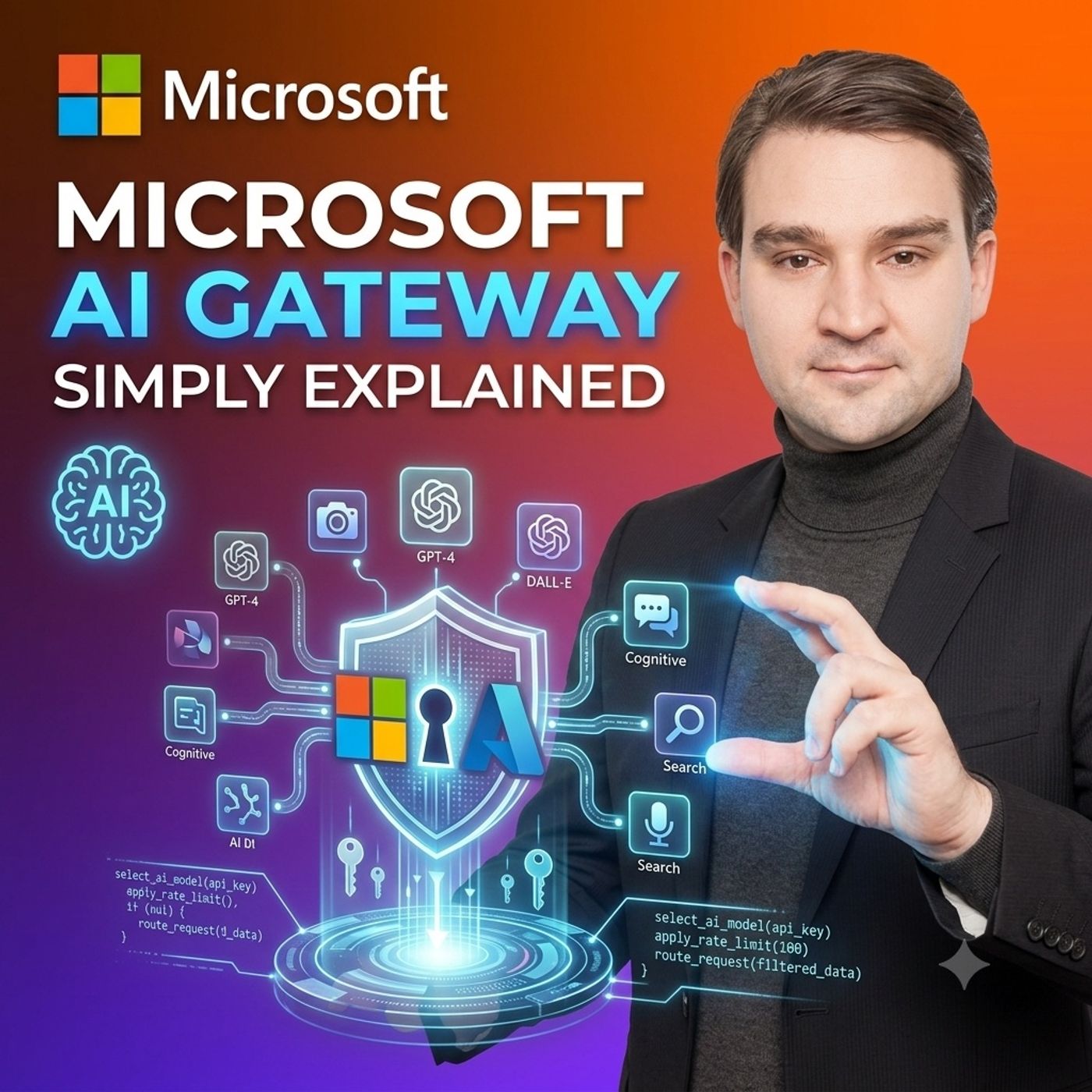
If you want to dive deeper into how modern enterprises are managing this shift, make sure to check out our related podcast episode, Microsoft AI Gateway - Simply Explained. In that episode, we break down how tools like the Microsoft AI Gateway and Azure API Management provide a secure front door for all enterprise AI traffic. In this comprehensive blog post, we will expand significantly on those core concepts, examining how Zero Trust principles, Microsoft Entra ID, managed identities, and the Model Context Protocol (MCP) come together to secure intelligent agents at scale.
Introduction to the Enterprise AI Security Challenge
The enterprise AI security challenge is unlike anything IT and cybersecurity departments have faced before. In traditional software architecture, applications communicate with back-end databases and APIs through deterministic code paths. Access controls, user authentication, and API tokens are tightly governed by established identity management systems. Every transaction is predictable, and every data flow is rigidly mapped out during the software development lifecycle.
Generative AI shatters this predictability. Large Language Models (LLMs) and autonomous agents operate using probabilistic reasoning. They accept natural language inputs, interpret intent, and dynamically decide which tools to call, which databases to query, and what actions to execute. When an AI agent is granted access to internal enterprise tools, it becomes an active participant in your IT ecosystem. Without rigorous architectural guardrails, an AI agent could inadvertently execute unauthorized database queries, exfiltrate sensitive employee personal identifiable information (PII) from HR systems, or run up unsustainable token consumption bills through runaway automated loops.
Furthermore, many organizations initially deploy AI models in a decentralized manner. Individual development teams connect their custom applications directly to various external and internal AI providers. This creates an architectural nightmare known in the industry as shadow AI. Security teams lose visibility into which applications are calling which models, what data is being transmitted across the network, and how access tokens are being managed. Addressing this challenge requires moving away from ad-hoc integrations and toward a centralized, secure, and policy-driven architecture.
Understanding Intelligent Agents and MCP Tools in the Workplace
To secure modern AI systems, we must first understand the components that make them so powerful. The modern enterprise AI stack is no longer just a model endpoint; it consists of orchestration layers, autonomous agents, and specialized integration tools. At the forefront of this evolution is the Model Context Protocol (MCP) and advanced Agent-to-Agent (A2A) communication frameworks.
Intelligent agents are software entities designed to achieve specific goals by perceiving their environment and taking autonomous actions. In a workplace setting, an agent might be tasked with onboarding a new employee. To accomplish this, the agent needs to read company policies, interact with the HR system to generate an employment contract, provision a new user account in Microsoft Entra ID, and submit a hardware request to the IT procurement database.
This is where Model Context Protocol (MCP) tools become essential. MCP provides a standardized way for AI models and agents to connect securely to external data sources and developer tools. Instead of custom-coding bespoke integrations for every single model and data source, developers build standardized MCP servers. These servers expose specific capabilities and data schemas to the AI agent. However, because these MCP tools bridge the gap between abstract AI reasoning and concrete enterprise actions, they represent a critical attack surface. If an unauthorized user manipulates the AI prompt through a prompt injection attack, a poorly secured MCP tool could allow the agent to execute unauthorized commands or access restricted databases. Securing these pathways is the foundational requirement of enterprise AI deployment.
Why Zero Trust Matters for Autonomous AI Systems
For years, the cybersecurity industry has championed the Zero Trust security model. Built on the core philosophy of "never trust, always verify," Zero Trust requires continuous explicit verification of every user, device, and application request before granting access to enterprise resources. While Zero Trust was originally designed for human users and traditional devices, its principles are now absolutely vital for autonomous AI systems and intelligent agents.
In a Zero Trust AI architecture, no AI model, client application, intelligent agent, or MCP tool is implicitly trusted simply because it operates inside the corporate network boundary. Every request made by an AI agent must be authenticated, authorized, and cryptographically verified. If an agent requests access to a financial database, the security layer must verify not only the identity of the calling application but also the specific context of the request, the user initiating the prompt, and whether that exact agent is authorized to perform that specific action on that specific dataset.
Traditional perimeter security fails in the age of generative AI because the perimeter is no longer a physical firewall; it is the boundary of the AI model's context window and the API endpoints it touches. Autonomous agents blur the lines between user intent and automated execution. By applying Zero Trust principles to AI gateways, organizations ensure that least-privilege access is strictly enforced. If an agent is compromised or tricked via a prompt injection attack, the Zero Trust boundary limits its blast radius, preventing unauthorized lateral movement across internal enterprise systems.
How Microsoft AI Gateway Enforces Strict Permission Boundaries
Implementing Zero Trust across a sprawling enterprise AI landscape requires a dedicated architectural component—a secure gateway that sits between client applications and AI model providers. This is the exact problem solved by the Microsoft AI Gateway, built on top of Azure API Management.
The Microsoft AI Gateway acts as a secure, centralized front door for all enterprise AI traffic. Rather than allowing hundreds of different applications, copilots, and intelligent agents to communicate directly with various AI model endpoints across Azure OpenAI, Microsoft Foundry, Anthropic, Google Gemini, or Amazon Bedrock, all traffic is funneled through the gateway. This centralized interception point allows platform and security teams to enforce consistent permission boundaries, rate limits, and security policies across the entire organization.
Inside the gateway, administrators can configure comprehensive policies that inspect incoming prompts, validate user identity, enforce content safety filters, and regulate access to specific MCP tools. If an application attempts to invoke an AI model or tool without proper authorization, the gateway instantly blocks the request before it ever reaches the backend system. Furthermore, the gateway enables seamless load balancing, semantic caching, and model failover strategies, ensuring high availability and resilience without sacrificing security compliance.
Leveraging Microsoft Entra ID and Managed Identities for Access Control
Centralized policy enforcement is only as strong as the underlying identity provider. To secure AI agents and MCP tools effectively, enterprises must eliminate hardcoded API keys, shared secrets, and static passwords. Hardcoded credentials are a notorious security vulnerability; if an application source code repository is exposed, embedded API keys can grant malicious actors unrestricted access to expensive AI models and sensitive backend systems.
This is where Microsoft Entra ID and Azure managed identities play a transformative role. By integrating the Microsoft AI Gateway with Microsoft Entra ID, organizations can authenticate every AI request using enterprise-grade identity tokens. Applications and intelligent agents authenticate to the gateway using secure, cryptographically verifiable tokens issued by Entra ID.
Even more powerfully, services running within Azure can utilize managed identities. A managed identity eliminates the need for developers to manage credentials in code. Azure automatically manages the identity of the AI service or agent, allowing it to securely authenticate to the AI Gateway and downstream MCP tools without storing secrets anywhere. Combined with Role-Based Access Control (RBAC), security administrators can assign precise permissions to each agent. For instance, a customer support agent can be granted an Entra ID identity that only permits access to public knowledge-base MCP tools, while being cryptographically blocked from ever querying financial or HR systems.
Centralizing Governance Across AI Workflows and Business Systems
As AI adoption scales within an enterprise, decentralized management quickly leads to operational chaos. Different business units begin deploying disparate AI solutions, utilizing different models, and establishing inconsistent security standards. Centralizing governance across all AI workflows and integrated business systems is the only way to maintain compliance, control costs, and protect corporate data.
The Microsoft AI Gateway provides a unified control plane where IT administrators, security officers, and compliance teams can monitor and manage the entire AI footprint. Through integration with Azure API Center and comprehensive monitoring dashboards, organizations gain end-to-end visibility into every AI transaction. Administrators can track token consumption metrics, monitor latency, analyze prompt patterns, and detect anomalous behavior in real time.
Centralized governance also ensures that data loss prevention (DLP) and content safety policies are applied uniformly. Whether an employee interacts with an AI agent via a custom internal web application, Microsoft Copilot Studio, or an automated backend workflow, every prompt and response passes through the same security filters. This prevents the accidental leakage of intellectual property, trade secrets, or regulated customer data into public model training sets, ensuring full alignment with enterprise compliance frameworks such as GDPR, HIPAA, and SOC 2.
Best Practices for Securing Scalable Enterprise AI Initiatives
Securing intelligent agents and MCP tools is an ongoing operational journey rather than a one-time configuration task. To help organizations build a resilient, scalable, and secure AI foundation, platform engineering and security teams should adhere to a proven set of best practices:
- Start Small with Managed Workloads: Begin your enterprise AI journey by routing a single pilot application or managed workload through the Microsoft AI Gateway. Validate your authentication flows, test your Entra ID policies, and refine your monitoring before expanding to mission-critical systems.
- Enforce Least Privilege for All Agents: Treat every intelligent agent as a distinct enterprise identity. Assign granular permissions using Microsoft Entra ID and ensure that MCP tools only expose the exact data schemas and functions necessary for the agent to complete its specific task.
- Eliminate Hardcoded Secrets: Completely ban the use of static API keys and shared credentials in application code. Transition entirely to Azure managed identities and token-based authentication for all AI service-to-service communication.
- Implement Robust Cost Controls and Throttling: Generative AI token consumption can quickly spiral out of control. Configure rate limits, token budgets, request quotas, and semantic caching within your AI gateway to protect your organization from unexpected financial spikes and denial-of-service vulnerabilities.
- Maintain Full Observability and Audit Logging: Ensure that every AI request, model response, and tool execution is logged with detailed metadata. Regularly review your AI observability dashboards to detect anomalous usage patterns, inefficient prompts, and potential security breaches.
By following these best practices and leveraging modern cloud infrastructure like the Microsoft AI Gateway, Microsoft Entra ID, and Azure API Management, enterprises can confidently embrace the transformative power of autonomous AI without compromising security, compliance, or financial control. To hear a concise, plain-English breakdown of these concepts and discover how to implement them in your own environment, be sure to listen to our podcast episode, Microsoft AI Gateway - Simply Explained.

Microsoft MVP | Host of M365.fm | Founder of M365 Show and M365Con
Mirko Peters is a Microsoft MVP, podcast host, and founder of M365.fm, M365 Show, and M365Con. His work connects Microsoft practitioners through podcast interviews, livestreams, and community events.
At M365.fm, Mirko hosts conversations with Microsoft MVPs, product experts, architects, and community contributors. Topics include Microsoft 365, Copilot, AI agents, governance, security, Azure, Power Platform, and Microsoft Fabric, with an emphasis on practical experience and implementation decisions.
M365.fm is the podcast and learning platform. M365 Show brings experts together for livestreams, while M365Con provides an online conference setting for community learning.
Official website: Mirko Peters (https://www.mirkopeters.com/). Recognition: Mirko Peters — Microsoft MVP profile (https://mvp.microsoft.com/de-DE/mvp/profile/9b0ca797-db5a-493a-a845-8b9158046cf5). Connect on LinkedIn (https://www.linkedin.com/in/m365showpodcast/).